



Ruddy Shelduck
Tadorna ferruginea
By the Birdfact teamChecked by Nathan Cope
Warm orange-brown from crown to tail, the Ruddy Shelduck is one of the most distinctive wildfowl in the Palearctic — a large, goose-like duck whose rich rusty plumage makes it unmistakable on any wetland. Breeding across a vast arc from southeastern Europe through Central Asia to Mongolia and western China, it winters primarily on the Indian subcontinent, where it is a familiar and culturally cherished bird known as the Brahminy Duck. Eastern populations undertake one of the most extraordinary migrations of any waterfowl, crossing the Himalayas at altitudes exceeding 6,000 m — higher than the summit of Mont Blanc. Outside its core range, the species has established thriving feral populations in Moscow's city parks and across Switzerland and Germany, while small numbers reach Britain as rare vagrants or dispersing feral birds. Revered in Tibetan and Mongolian Buddhism and woven into Slavic mythology, the Ruddy Shelduck carries more cultural weight than almost any other duck.
On this page15 sections
How to recognise it
The Ruddy Shelduck's body plumage is a warm, saturated orange-brown — the rusty tone that gives the species its English name. The head and neck are a shade paler, ranging from creamy buff to light orange-brown, creating a subtle but visible contrast with the richer body colour. In breeding plumage, the male adds a narrow black collar at the base of the neck, a crisp ring that disappears after the post-breeding moult and is restored by a partial moult between December and April. The rump, tail-coverts, tail feathers, and primary flight feathers are black, providing a sharp counterpoint to the warm body tones.
Both the upper and lower wing-coverts are white, forming a bold white forewing patch that dominates the wing in flight and contrasts sharply with the black flight feathers and rusty body — the single most reliable identification feature when a bird is overhead. At rest this patch is largely hidden. Iridescent green speculum feathers sit on the inner wing surfaces, adding a subtle metallic glint at close range. The bill is black and the legs are dark grey.
The female is very similar to the male in overall pattern but differs in two reliable ways: her face and head are distinctly paler — often appearing almost whitish — and she entirely lacks the black neck collar. She is also slightly smaller and lighter, typically weighing 900–1,500 g compared to the male's 1,200–1,630 g. Juveniles resemble females but are a darker, drabber shade of brown overall. Plumage colour in both sexes fades as feathers age, so fresh-moulted birds appear richest in tone. The species holds an upright, goose-like posture and has a strong, direct flight style with powerful, steady wingbeats.
Not sure it’s a Ruddy Shelduck? Check your photo: Birdfact names the bird and shows the look-alike side by side.
Its size
Adults- Length
- 58–70 cm
- Wingspan
- 110–135 cm
- Weight
- 900–1630 g
Its song and calls
The Ruddy Shelduck is among the most vocal of the shelducks, producing a series of loud, carrying, nasal honking calls that are audible from a considerable distance and described as goose-like but distinctly more nasal and penetrating. Calls are made both on the ground and in flight, and vary in character depending on context — alarm, courtship, territorial defence, and contact calls all differ in pace and intensity. Before taking off, the species typically produces a rapid series of trumpeting notes that serve as both a warning and a departure signal.
Male and female vocalisations are distinctly different and can be reliably told apart with experience. The male produces higher-pitched, more trumpet-like honking notes. The female's call is lower-pitched, deeper, and more resonant — a fuller, more nasal honk that carries a different quality. When pairs call together, the two voices interweave in a duet that is characteristic of the species and very different from the calls of either bird alone.
The species is particularly vocal during the breeding season, when pairs defend territories aggressively and call frequently in response to intruders. Recordings from Xeno-canto document calls from perched birds and in flight, including duetting pairs on high-altitude ponds above the treeline in Central Asia. Outside the breeding season, contact calls between flock members are softer and more conversational, but the species never becomes truly quiet — even wintering birds call regularly, particularly at dawn and dusk when movement between roost and feeding sites is greatest.
- Call0:00 / 0:26
Recorded in Vaud, Switzerland · September 2018
Heard one and not sure? Let the bird song identifier listen.
When and where to see it
OctoberLeaving
Most recorded in October
- 1. Wiltshireunder 0.1%
- 2. Stockton-on-Teesunder 0.1%
- 3. Cheshireunder 0.1%
- 4. Flintshireunder 0.1%
- 5. Renfrewshireunder 0.1%
Each dot is a county, state or province: the bigger and darker, the larger the bird’s share of that place’s bird records that month. Grey dots: no regular records. The ringed point is the centre of the bird’s records this month; the arrow shows how it moved since last month, and the dashed loop its path through the year. “Arrivals” colours places where it becomes regular this month (orange) or is in its last regular month (grey). GBIF eBird Observation Dataset, 2019–2024. Map data: Natural Earth, US Census Bureau; place centres © OpenStreetMap contributors.
In your area
See when the Ruddy Shelduck is recorded in your county, state or province.
How often the Ruddy Shelduck turns up in the UK through the year, from birdwatchers' records.
United Kingdom
Summer visitor · all year · most records in August
Show as a table
| Month | United Kingdom |
|---|---|
| January | 0.005% (regular) |
| February | 0.005% (regular) |
| March | 0.003% (regular) |
| April | 0.004% (regular) |
| May | 0.004% (regular) |
| June | 0.010% (regular) |
| July | 0.019% (regular) |
| August | 0.021% (regular) |
| September | 0.011% (regular) |
| October | 0.005% (regular) |
| November | 0.005% (regular) |
| December | 0.003% (regular) |
Recorded regularly in
Worldwide: recorded regularly in 56 countries
Countries where it was recorded in at least 3 of the 6 years 2019–2024. Linked countries have their own bird list.
Europe (25)
Asia (26)
- Armenia
- Azerbaijan
- Bangladesh
- Bhutan
- China
- Cyprus
- Georgia
- India
- Iran
- Israel
- Japan
- Kazakhstan
- Kyrgyzstan
- Laos
- Mongolia
- Myanmar (Burma)
- Nepal
- Pakistan
- Saudi Arabia
- South Korea
- Taiwan
- Tajikistan
- Thailand
- Turkey
- United Arab Emirates
- Uzbekistan
Data: EOD – eBird Observation Dataset (Cornell Lab of Ornithology), accessed via GBIF.org, CC BY 4.0. Records from 2019–2024, aggregated and filtered by Birdfact. How these lists are made
Tips for seeing it
The Ruddy Shelduck's warm orange-brown plumage and bold white wing patches make it one of the easier large waterfowl to identify — there is really nothing else quite like it in the Western Palearctic. In flight, the combination of rusty body, black tail, and flashing white forewing is unmistakable. At rest, look for the upright, goose-like posture and the pale, almost whitish face of the female, or the narrow black neck collar of the breeding male.
In the UK, the species is a rare vagrant and any sighting should be carefully documented. Late summer and early autumn — particularly August and September — are the most likely times for genuine records, when birds dispersing from the Netherlands moulting grounds may appear along the east coast. Small flocks of two to twelve birds are more credible as wild birds than lone individuals, which are more likely to be escapes from wildfowl collections. Check for leg rings or other signs of captivity. The BOURC was reviewing the species' status as a candidate for Category C5 (vagrant naturalised species) as of 2021, so the situation may change.
On the wintering grounds in India and Nepal, the Brahminy Duck is a common and confiding winter visitor to large rivers, lakes, and reservoirs from October to April. The Koshi Barrage in Nepal and the major rivers of northern India are reliable sites. In Central Asia during the breeding season, high-altitude lakes above the treeline — particularly in Kazakhstan, Kyrgyzstan, and Mongolia — can hold good numbers. The species is vocal and conspicuous, so listen for the loud, nasal honking calls as a first alert to its presence.
What it eats
Ruddy Shelducks are omnivorous, drawing on a wide range of plant and animal foods depending on season and locality. Plant material likely makes up the majority of the diet for most of the year. Grasses, the young shoots and leaves of aquatic and terrestrial plants, grain, seeds, and the stems of water plants are all taken regularly. On land the species grazes actively, moving across open fields and meadows in a manner more reminiscent of a goose than a typical duck.
Animal prey supplements the plant diet, particularly during the breeding season when protein demands are higher. Aquatic and terrestrial invertebrates — insects, insect larvae, worms, molluscs, and crustaceans — are taken opportunistically, along with small fish and amphibians. The species also grubs in wet soil for invertebrates, probing with its black bill in a manner similar to waders.
In water, the Ruddy Shelduck dabbles in the shallows and up-ends to reach submerged vegetation at greater depths, but it does not dive. Its foraging is notably more terrestrial than most Anatinae: birds will feed in agricultural fields and on open grassland far from the nearest water body, and will exploit grain stubble and flooded pasture during the winter months. Feeding activity peaks at night, though daytime foraging is regularly observed, particularly in areas where the birds are undisturbed.
Nesting and breeding
Ruddy Shelducks are cavity nesters, choosing sites that are often far from water — sometimes several kilometres away. Natural cavities in trees (up to 10 m above ground), crevices in cliffs or rocky hillsides, animal burrows, ruined buildings, farm sheds, and sand dunes all serve as nest sites. This terrestrial nesting habit, unusual among waterfowl, means that breeding pairs may be encountered well inland with no obvious wetland nearby. The female constructs a shallow depression lined with down and occasionally a little grass.
The breeding season varies with latitude. Southern populations may begin laying as early as January, while northern populations typically start in mid-April, with eggs laid from late April to early June. Pairs arrive at Central Asian breeding locations in March and April, having formed strong, lifelong bonds. The clutch typically consists of 8–9 eggs, with a range of 6–12. Eggs are creamy-white with a dull gloss, averaging approximately 68 × 47 mm. Incubation is performed solely by the female over 28–29 days, while the male stands guard nearby — a division of labour that is consistent and well-defined.
Chicks are precocial and mobile shortly after hatching, beginning to feed independently within hours. Both parents care for the young after hatching. Fledging occurs at approximately 55 days — a relatively long fledging period that reflects the size of the species. Only one brood is raised per year. Courtship involves synchronised neck stretching, head dipping, and tail raising, with mating taking place on the water. During the breeding season, pairs are highly territorial and aggressive toward conspecifics and other species, with the female taking the lead in confronting intruders.
Behaviour
In flight, the Ruddy Shelduck is immediately distinctive. The bold white forewing patch — formed by the upper and lower wing-coverts — dominates the wing and contrasts sharply with the black flight feathers and rusty body. This white-black-orange combination is visible from a long distance and is the single most reliable identification feature when a bird is overhead. The iridescent green speculum on the inner wing adds a subtle flash of colour at closer range.
The flight style is strong and direct, with powerful, steady wingbeats that have a slightly stiff quality reminiscent of a goose rather than a typical duck. The neck is held outstretched and the body appears elongated in the air. The species does not typically engage in the fast, twisting flight of smaller ducks; instead it moves purposefully, often in a straight line or in shallow arcs. Pairs and small groups fly in loose formation rather than tight flocks.
The Ruddy Shelduck's flight capabilities are extraordinary at altitude. Satellite-tracked birds crossing the Himalayas maintained vigorous flapping flight at mean maximum altitudes of 5,590 m, with mean maximum climb rates of 0.45 m/s — sustained in air with roughly half the oxygen density of sea level. Northward migration distances averaged 1,481 km and southward distances averaged 1,238 km per journey, with some individuals covering up to 2,689 km in a single migratory movement. These figures place the Ruddy Shelduck among the most physiologically capable high-altitude migrants of any bird species.
Lifespan and predators
A wild Ruddy Shelduck that reaches adulthood can expect to complete ten or more round-trip Himalayan crossings over its lifetime — the species typically lives for 10–15 years, with the maximum recorded lifespan reaching around 20 years. These figures are broadly comparable to other large shelducks and geese of similar body mass. Survival rates are highest in populations that face limited hunting pressure and have access to stable, undisturbed wetland habitats.
The main causes of mortality in wild populations include illegal hunting and poaching — particularly on the wintering grounds in Central Asia and the Middle East — predation of eggs and chicks by foxes and corvids, and habitat loss reducing food availability during critical periods. Chicks face the highest mortality risk in the first weeks of life before they can fly; the 55-day fledging period is a prolonged window of vulnerability. Once fledged, annual survival rates improve substantially.
Feral populations in urban environments, such as the Moscow city park population, may achieve higher average survival rates due to reduced hunting pressure and reliable food sources, though they face different risks including road traffic, pollution, and disease. The lifelong pair bond characteristic of the species means that the loss of a partner can have significant consequences for an individual's subsequent breeding success, as re-pairing takes time and the new pair must re-establish territorial familiarity.
Conservation
The Ruddy Shelduck is assessed as Least Concern on the IUCN Red List, supported by a global population estimated at 170,000–225,000 individuals. The European population is estimated at 17,000–26,500 pairs (33,900–53,100 mature individuals). However, the picture is not uniform: while populations in Central and Eastern Asia are stable or increasing, the European population underwent a large decline between 1970 and 1990, and continued to decline in Turkey and other key European sites through the 1990s and 2000s, representing a probable decline of more than 30% over three generations in Europe.
The principal threats are wetland drainage and habitat loss driven by agriculture and urbanisation, illegal hunting and poaching (particularly in parts of Central Asia and the Middle East), and water pollution including heavy metal contamination of wintering lagoons. Climate change poses an emerging threat by altering migration routes and affecting breeding success at high-altitude sites. The species is protected under the Agreement on the Conservation of African-Eurasian Migratory Waterbirds (AEWA) and is legally protected across Europe and Italy.
The rapidly growing feral populations in Switzerland and Germany present a conservation paradox: while they boost overall numbers, Swiss authorities consider the population invasive and are concerned about competition with native waterbirds. In contrast, the Moscow feral population — now around 3,300 birds — is largely tolerated and has become a celebrated feature of the city's urban wildlife. Conservation efforts focus on protecting key wetland habitats, managing hunting pressure, and monitoring the status of declining European breeding populations.
Courtship & Display
Courtship in the Ruddy Shelduck is an elaborate, synchronised affair that takes place primarily on the water. The display involves both birds performing coordinated movements: neck stretching upward, head dipping toward the water surface, and tail raising, with the sequence repeated in close synchrony between the pair. This mutual display reinforces the pair bond and is most frequently observed in late winter and early spring as birds return to breeding areas. Mating itself takes place on the water following the display.
The pair bond, once formed, is maintained year-round and typically lasts for life — a level of fidelity that is unusual among ducks, which more commonly form new partnerships each season. Pairs remain closely associated even on the wintering grounds, and the two birds call to each other frequently, their contrasting voices — the male's higher trumpet and the female's deeper honk — creating a characteristic duet that serves as a contact call and a bond-reinforcement signal.
During the breeding season, territorial defence is vigorous and female-led. When an intruder approaches, the female moves toward it with head lowered and neck outstretched in a threat posture, uttering sharp calls. She then returns to the male and performs an incitement display — a behaviour that prompts him to pursue and attack the intruder. This female-led aggression, combined with the lifelong pair bond, gives the Ruddy Shelduck a social structure that is more reminiscent of geese than of typical ducks.
Cultural Significance
Few ducks carry as much cultural weight as the Ruddy Shelduck. In Tibetan and Mongolian Buddhism, the species is considered sacred: its warm orange-brown plumage is said to resemble the robes of Buddhist monks, and the bird features in religious iconography and Himalayan folklore as a symbol of fidelity, purity, and divine connection. This cultural reverence has provided the species with a degree of informal, community-based protection across much of its Asian range — in areas where hunting other waterfowl is common, the Ruddy Shelduck is often left unmolested out of respect.
In India, the species is known as the Brahminy Duck — a name that reflects its association with Brahmin priests and Hindu religious tradition. It appears in ancient Sanskrit texts, classical poetry, and Himalayan folklore, often as a symbol of devoted partnership, a reference to its lifelong pair bond. The Chakravaka, as it is known in Sanskrit literature, is one of the most frequently mentioned birds in classical Indian poetry, where pairs separated at nightfall and reunited at dawn became a metaphor for longing and reunion.
In Slavic mythology, the Ruddy Shelduck also holds a place: it appears in folk traditions across Eastern Europe as a bird associated with fire and the sun, its rusty colour linking it symbolically to flame. Across these diverse cultural traditions — Buddhist, Hindu, and Slavic — the species has accumulated a symbolic richness that is unusual for a waterfowl, and which continues to shape attitudes toward its conservation across its range today.
Uk Status And Records
The Ruddy Shelduck occupies an unusual position on the British List, holding Categories B, D, and E simultaneously — reflecting its complex status as a historical vagrant, a probable escape from captivity, and a potential disperser from naturalised European populations. The most significant genuine vagrancy event in British history was a major irruption from Central Asia in 1892, which brought around 59 birds to Britain and Ireland — a figure that has never been approached since and is now considered a once-in-a-century event linked to exceptional conditions on the breeding grounds.
Through most of the 20th century, British records were treated with scepticism, as the species was widely kept in wildfowl collections and escapes were frequent. A notable influx in 1994 included a flock of 12 birds in Cheshire, which attracted considerable attention. In recent decades, however, the picture has shifted. The rapid growth of naturalised feral populations in Switzerland and Germany — estimated at over 3,600 birds by 2018 — has produced large moulting gatherings in the Netherlands between June and August, with up to 1,935 birds recorded at four key sites in summer 2018. Birds dispersing from these Dutch moulting grounds are now considered the most likely source of late-summer records along the English east coast.
The British Ornithologists' Union Records Committee (BOURC) was actively reviewing the species' status as a candidate for Category C5 — vagrant naturalised species — as of 2021. If accepted, this would formally recognise that at least some British records involve birds from self-sustaining naturalised populations rather than escapes or genuine wild vagrants from Central Asia. For British birders, small flocks of two to twelve birds appearing on the east coast in August or September now represent the most credible candidates for wild or naturalised-origin birds.
More photos
1 photos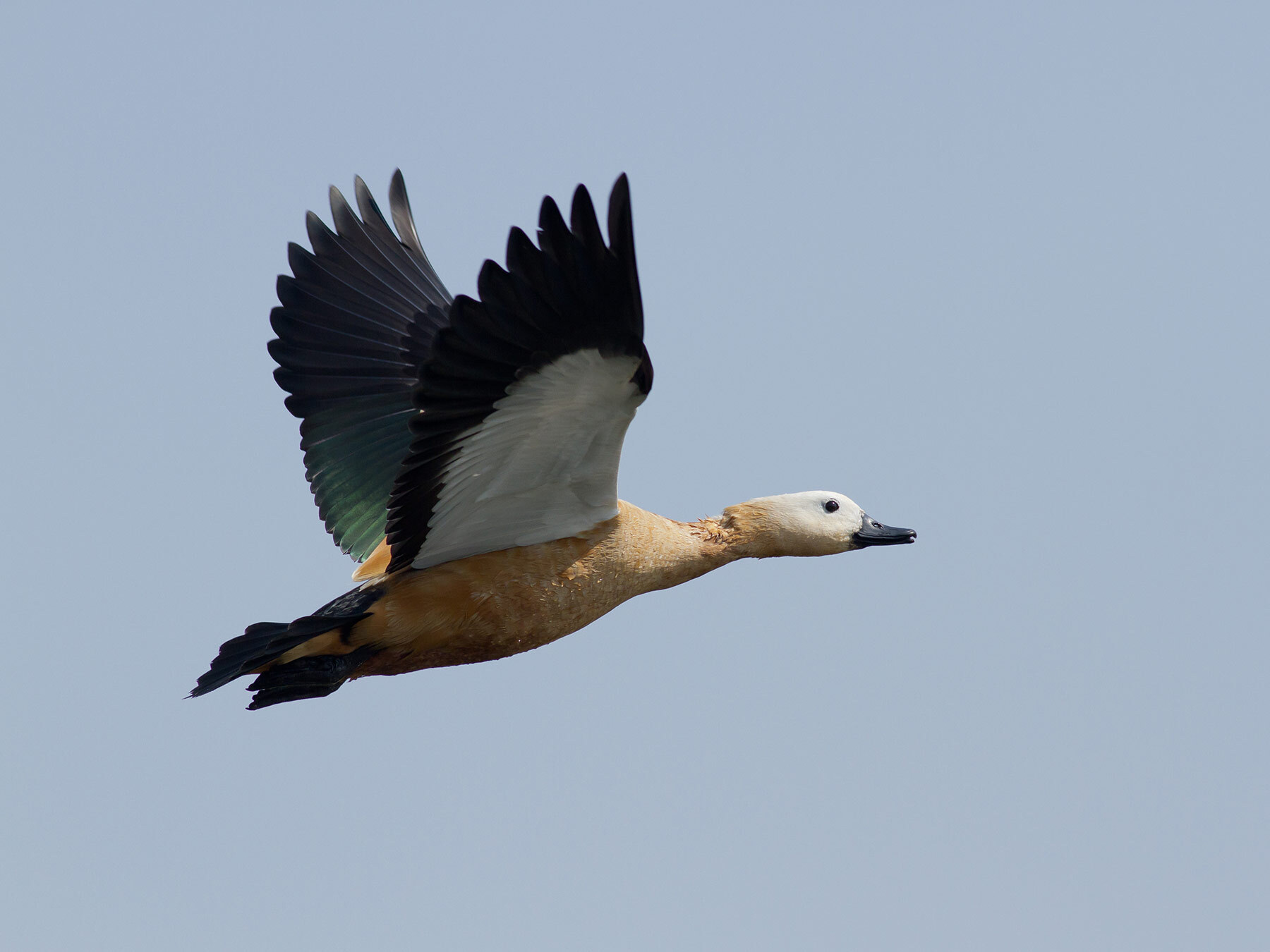
Quick facts
- Length
- 58–70 cm
- Wingspan
- 110–135 cm
- Weight
- 900–1630 g
- Lifespan
- 10–15 years · oldest recorded 20 years
- Family
- Ducks, Geese & Swans
- Migration
- Partial migrant
- Global status (IUCN)
- Least Concern
- World population
- 170,000–225,000 individuals globally; European population 33,900–53,100 mature individuals
- Population trend
- Mixed: stable or increasing in Central and Eastern Asia; declining in Europe, with a probable decline of more than 30% over three generations in key European populations. Feral populations in Switzerland, Germany, and Moscow are growing rapidly.
- Scientific name
- Tadorna ferruginea
Sources
17- 1Ruddy shelduck - Wikipedia Source (opens in a new tab)
- 2Ruddy Shelduck Tadorna ferruginea Species Factsheet | BirdLife DataZone Source (opens in a new tab)
- 3Ruddy Shelduck - eBird Source (opens in a new tab)
- 4Ruddy Shelduck | BTO - British Trust for Ornithology Source (opens in a new tab)
- 5Ruddy Shelduck | BTO BirdFacts Source (opens in a new tab)
- 6High altitude flights by ruddy shelduck Tadorna ferruginea during trans-Himalayan migrations (Parr et al., 2017, Journal of Avian Biology) (2017) Source (opens in a new tab)
- 7An incoming armchair tick? - BirdGuides Source (opens in a new tab)
- 8Ruddy Shelduck – a request for records | British Ornithologists' Union Source (opens in a new tab)
- 9Ruddy Shelduck (Tadorna ferruginea) :: xeno-canto Source (opens in a new tab)
- 10Ruddy Shelduck - Duck Species Source (opens in a new tab)
- 11Ruddy shelduck (Tadorna ferruginea) | Thai National Parks Source (opens in a new tab)
- 12Ruddy Shelduck | Identification Guide | Bird Spot Source (opens in a new tab)
- 13Ruddy shelduck facts, distribution & population | BioDB Source (opens in a new tab)
- 14Ruddy Shelduck / Tadorna ferruginea photo call and song | DiBird Source (opens in a new tab)
- 15Ruddy shelduck | Birds of India | Bird World Source (opens in a new tab)
- 16Ruddy Shelduck (Tadorna ferruginea) | Planet of Birds Source (opens in a new tab)
- 17Ruddy Shelduck (Tadorna ferruginea) Information | Earth Life Source (opens in a new tab)

Checked by
Nathan Cope, founder and editor
Nathan founded Birdfact and leads its writers and contributors in the UK, the US and Canada. He has watched and studied birds for more than ten years, and checks every article and species guide before it’s published.