
Bar-headed Goose
Anser indicus
By the Birdfact teamChecked by Nathan Cope
The Bar-headed Goose flies directly over the Himalayas to reach its wintering grounds, navigating altitudes where oxygen levels are less than half of those at sea level. Easily recognised by the striking black stripes across the back of its white head, this pale grey goose possesses unique physiological adaptations that allow it to survive extreme mountain crossings.
On this page12 sections
How to recognise it
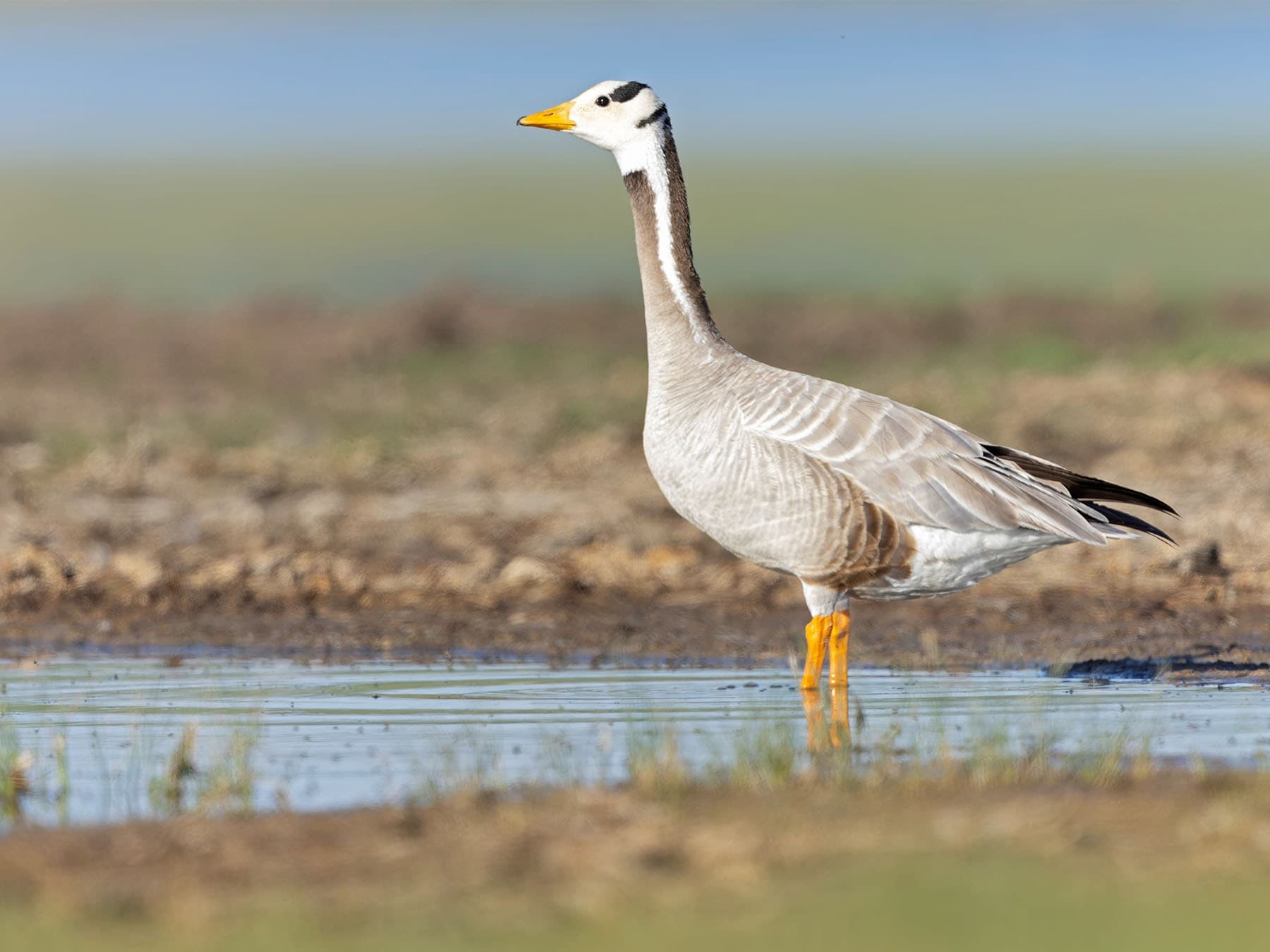
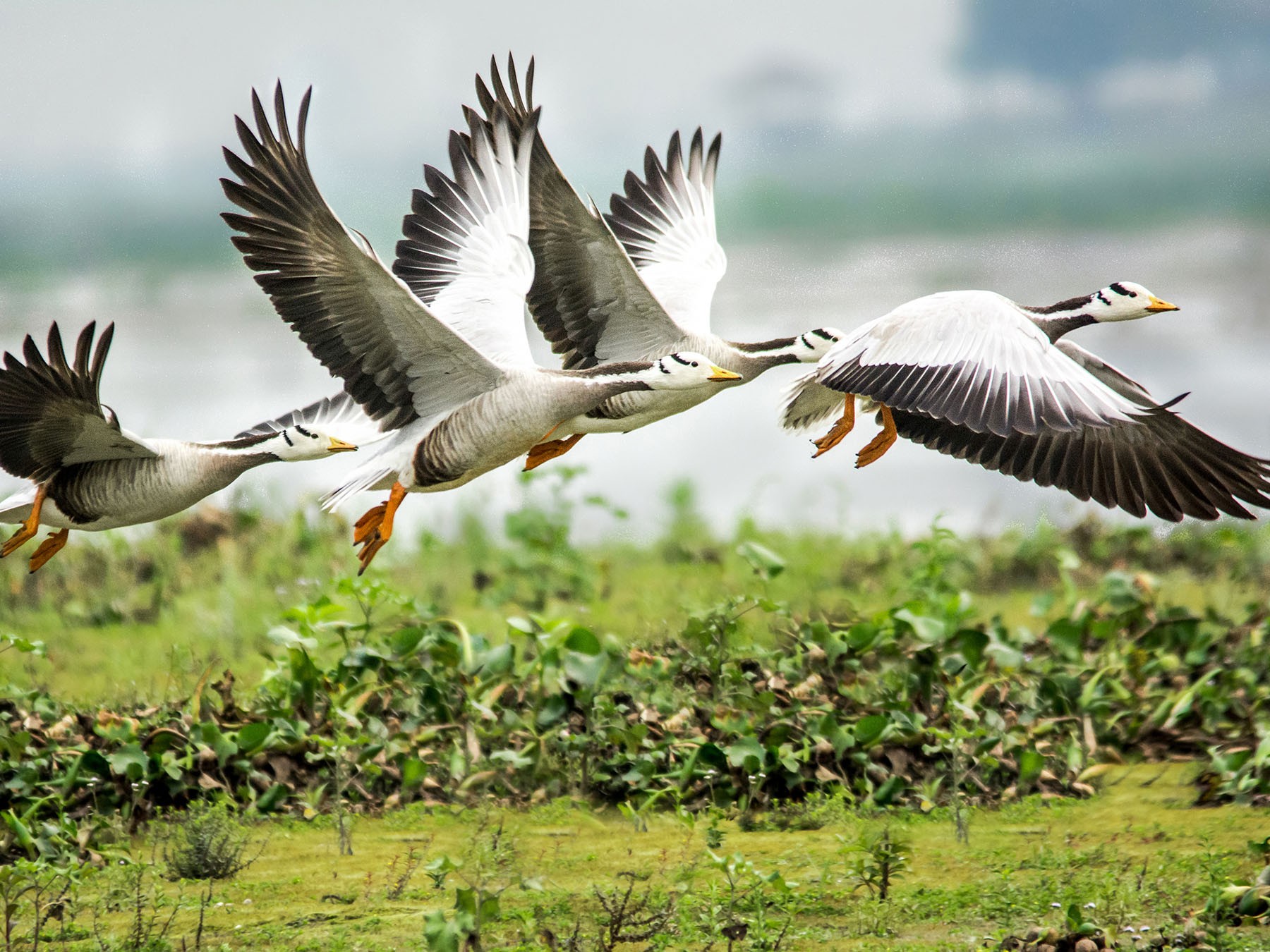
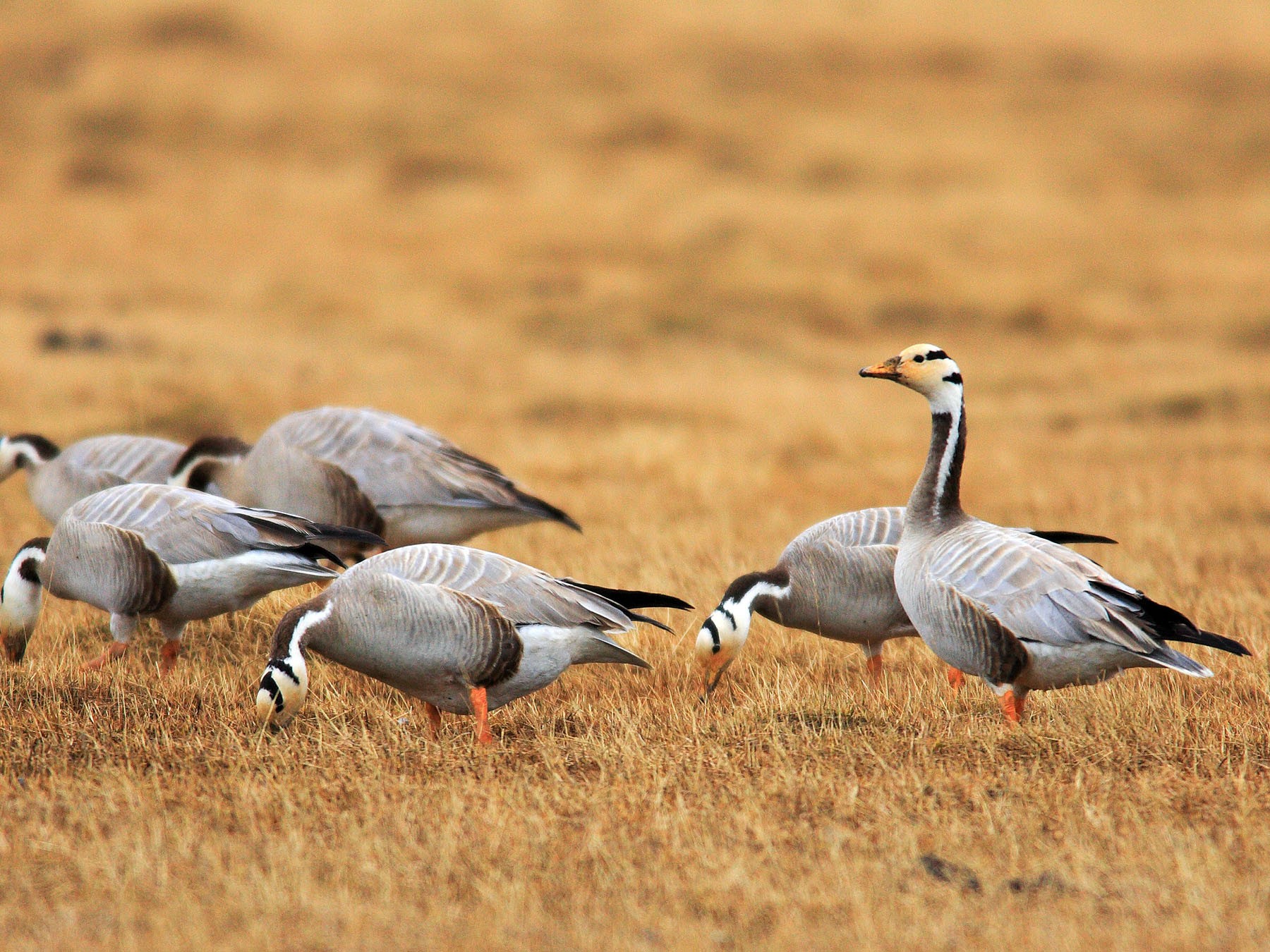
With predominantly pale grey plumage, the Bar-headed Goose is noticeably lighter than other geese in the Anser genus. Its most defining feature is its white head, which bears two distinct black, U-shaped bars wrapping around the back of the head and upper neck.
The bill is a bright orange and the legs are yellow, contrasting sharply with the pale body. In flight, the pale grey wings reveal a broad black trailing edge. Males and females are identical in plumage, though males tend to be slightly larger on average.
Its size
Adults- Length
- 68–78 cm
- Wingspan
- 140–160 cm
- Weight
- 1870–3200 g
Its song and calls
In flight, the Bar-headed Goose produces a resonant, honking call that carries across long distances. These vocalisations are crucial for maintaining spacing while flying in their characteristic V-formations.
The constant calling helps family groups and larger flocks stay connected, especially during their demanding migratory journeys or when navigating through poor visibility.
- Call0:00 / 0:16
Recorded in Bern, Switzerland · May 2022
When and where to see it
OctoberLeaving
Most recorded in October
- 1. Devonunder 0.1%
- 2. Bedfordshireunder 0.1%
- 3. Hampshireunder 0.1%
- 4. Lincolnshireunder 0.1%
- 5. Gloucestershireunder 0.1%
Each dot is a county, state or province: the bigger and darker, the larger the bird’s share of that place’s bird records that month. Grey dots: no regular records. The ringed point is the centre of the bird’s records this month; the arrow shows how it moved since last month, and the dashed loop its path through the year. “Arrivals” colours places where it becomes regular this month (orange) or is in its last regular month (grey). GBIF eBird Observation Dataset, 2019–2024. Map data: Natural Earth, US Census Bureau; place centres © OpenStreetMap contributors.
In your area
See when the Bar-headed Goose is recorded in your county, state or province.
How often the Bar-headed Goose turns up in the UK through the year, from birdwatchers' records.
United Kingdom
Resident · all year · most records in August
Show as a table
| Month | United Kingdom |
|---|---|
| January | 0.003% (regular) |
| February | 0.003% (regular) |
| March | 0.003% (regular) |
| April | 0.003% (regular) |
| May | 0.003% (regular) |
| June | 0.005% (regular) |
| July | 0.005% (regular) |
| August | 0.005% (regular) |
| September | 0.003% (regular) |
| October | 0.002% (regular) |
| November | 0.003% (regular) |
| December | 0.002% (regular) |
Recorded regularly in
Worldwide: recorded regularly in 30 countries
Countries where it was recorded in at least 3 of the 6 years 2019–2024. Linked countries have their own bird list.
Data: EOD – eBird Observation Dataset (Cornell Lab of Ornithology), accessed via GBIF.org, CC BY 4.0. Records from 2019–2024, aggregated and filtered by Birdfact. How these lists are made
Tips for seeing it
During the winter months, large numbers of Bar-headed Geese congregate in lowland wetlands and agricultural fields across India and Nepal. Look for their striking pale grey bodies and the unmistakable black bars on the back of their white heads.
In the UK and Europe, keep an eye out for escapees from waterfowl collections mingling with other wildfowl on lakes and reservoirs. A small naturalised population also breeds in Germany, offering European birdwatchers a chance to see them in the wild.
What it eats
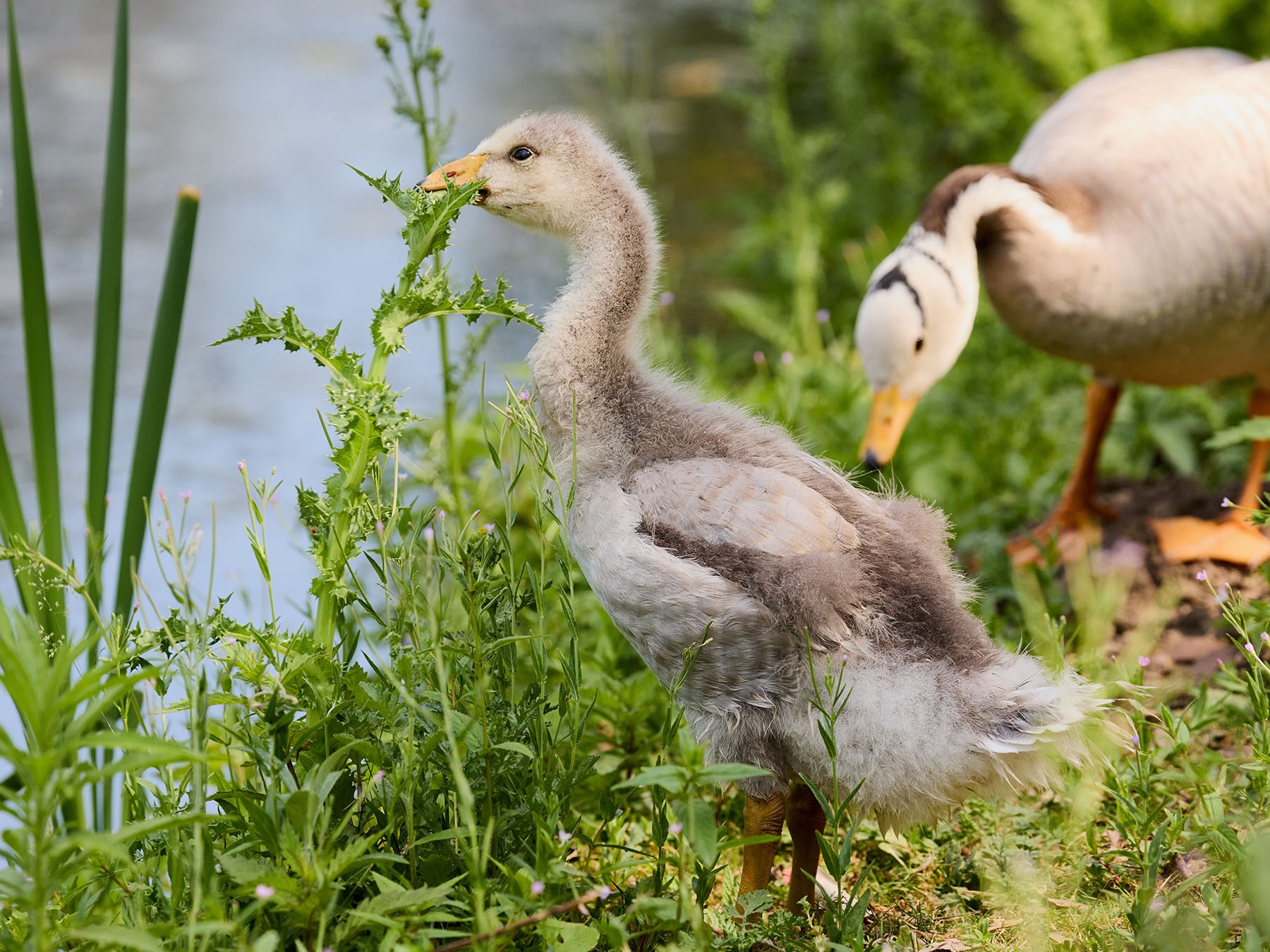
On their summer breeding grounds on the Tibetan-Qinghai Plateau, Bar-headed Geese graze on short highland grasses, roots, tubers, leaves, and seeds found around mountain lakes and streams.
During the winter months in South Asia, they shift their focus to agricultural areas. Here, they feed heavily on cultivated crops such as barley, rice, wheat, and corn. This reliance on agricultural fields can sometimes bring them into conflict with local farmers protecting their harvests.
Nesting and breeding
Nesting in large colonies on the ground near highland marshes and lakes, Bar-headed Geese create shallow depressions lined with vegetation to rear their young. They are seasonal breeders that typically form monogamous pairs, though polygynous arrangements can occur in populations with more females than males.
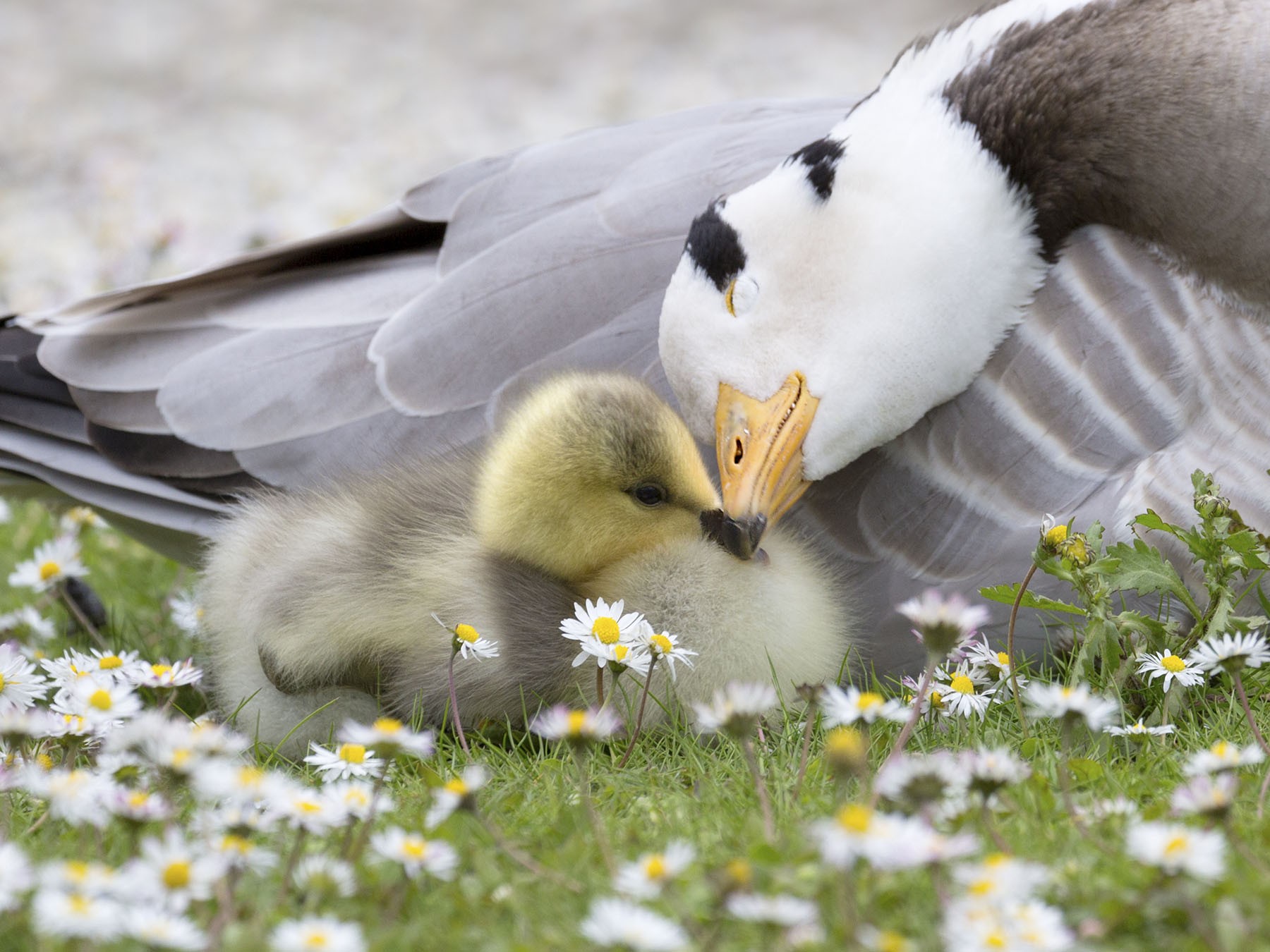
Between late April and June, females lay a clutch of 3 to 8 eggs. The female incubates the eggs for 28 to 30 days while the male stands guard nearby. The precocial goslings leave the nest shortly after hatching and fledge at 55 to 60 days of age, receiving care and protection from both parents.
Behaviour
Twice a year, Bar-headed Geese undertake a demanding journey between their breeding grounds on the Tibetan-Qinghai Plateau and their wintering grounds in South Asia, crossing the formidable Himalayas.
They fly in V-formations, often travelling at night or in the early morning to take advantage of colder, denser air. This strategy provides more lift and oxygen, allowing them to complete the mountain crossing non-stop in as little as seven hours.
Lifespan and predators
Wild Bar-headed Geese typically live between 15 and 20 years, provided they survive their perilous bi-annual migration over the Himalayas and avoid predators like golden eagles and red foxes.
While exact maximum lifespans for wild individuals are difficult to verify, related goose species have been recorded living up to 31 years in captivity.
Conservation
The Bar-headed Goose population is currently increasing across a vast Asian range of over 2,500,000 square kilometres, earning it a Least Concern conservation status. They face natural predation from sea eagles, golden eagles, crows, ravens, and red foxes.
The species is closely monitored by health organisations, as they are known carriers of the highly pathogenic avian influenza (HPAI) H5N1 virus, which can impact both wild bird populations and domestic poultry.
More photos
5 photos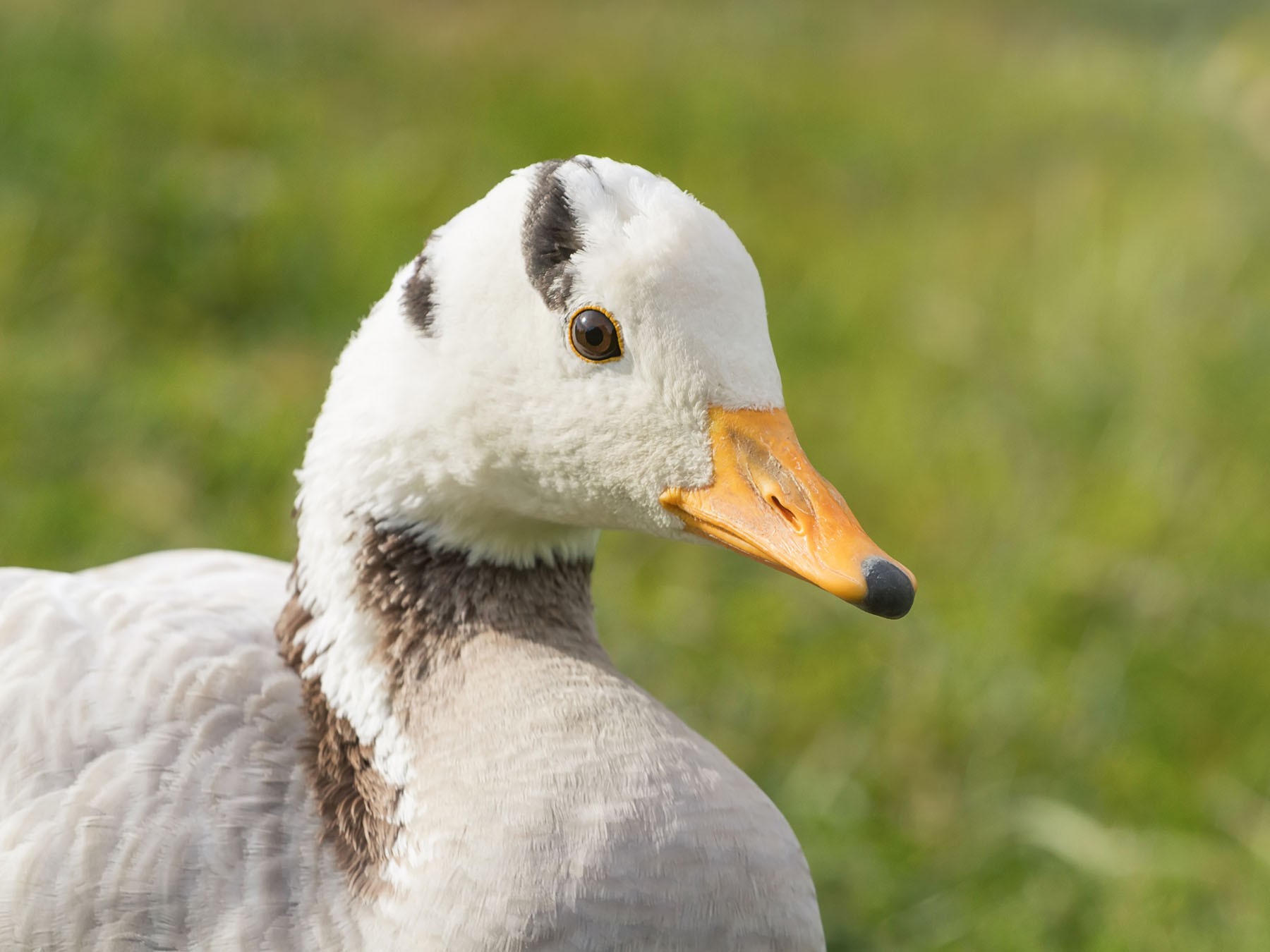
Quick facts
- Length
- 68–78 cm
- Wingspan
- 140–160 cm
- Weight
- 1870–3200 g
- Lifespan
- 15–20 years · oldest recorded 31 years
- Family
- Ducks, Geese & Swans
- Migration
- Full migrant
- Global status (IUCN)
- Least Concern
- World population
- Unknown exact size, but occurs over 2,500,000 km²
- Population trend
- Increasing
- Scientific name
- Anser indicus
Sources
4- 1Bar-headed goose - Wikipedia Source (opens in a new tab)
- 2Anser indicus (bar-headed goose) | Animal Diversity Web Source (opens in a new tab)
- 3Bar-headed Goose - eBird Source (opens in a new tab)
- 4Bar-headed Goose Anser Indicus Species Factsheet | BirdLife DataZone Source (opens in a new tab)

Checked by
Nathan Cope, founder and editor
Nathan founded Birdfact and leads its writers and contributors in the UK, the US and Canada. He has watched and studied birds for more than ten years, and checks every article and species guide before it’s published.