
Rose-ringed Parakeet
Ring-necked Parakeet · Psittacula krameri
By the Birdfact teamChecked by Nathan Cope
On this page14 sections
How to recognise it
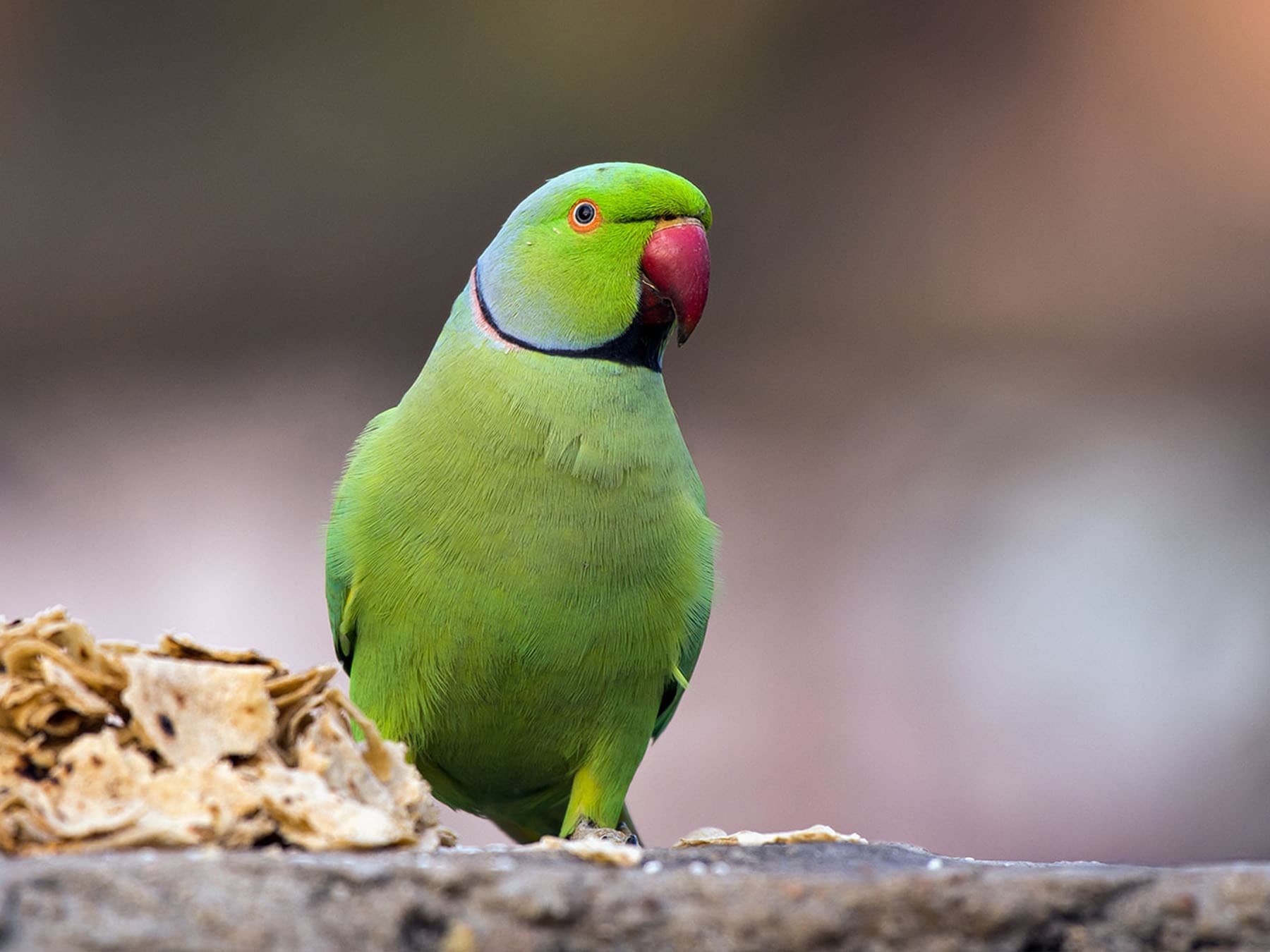
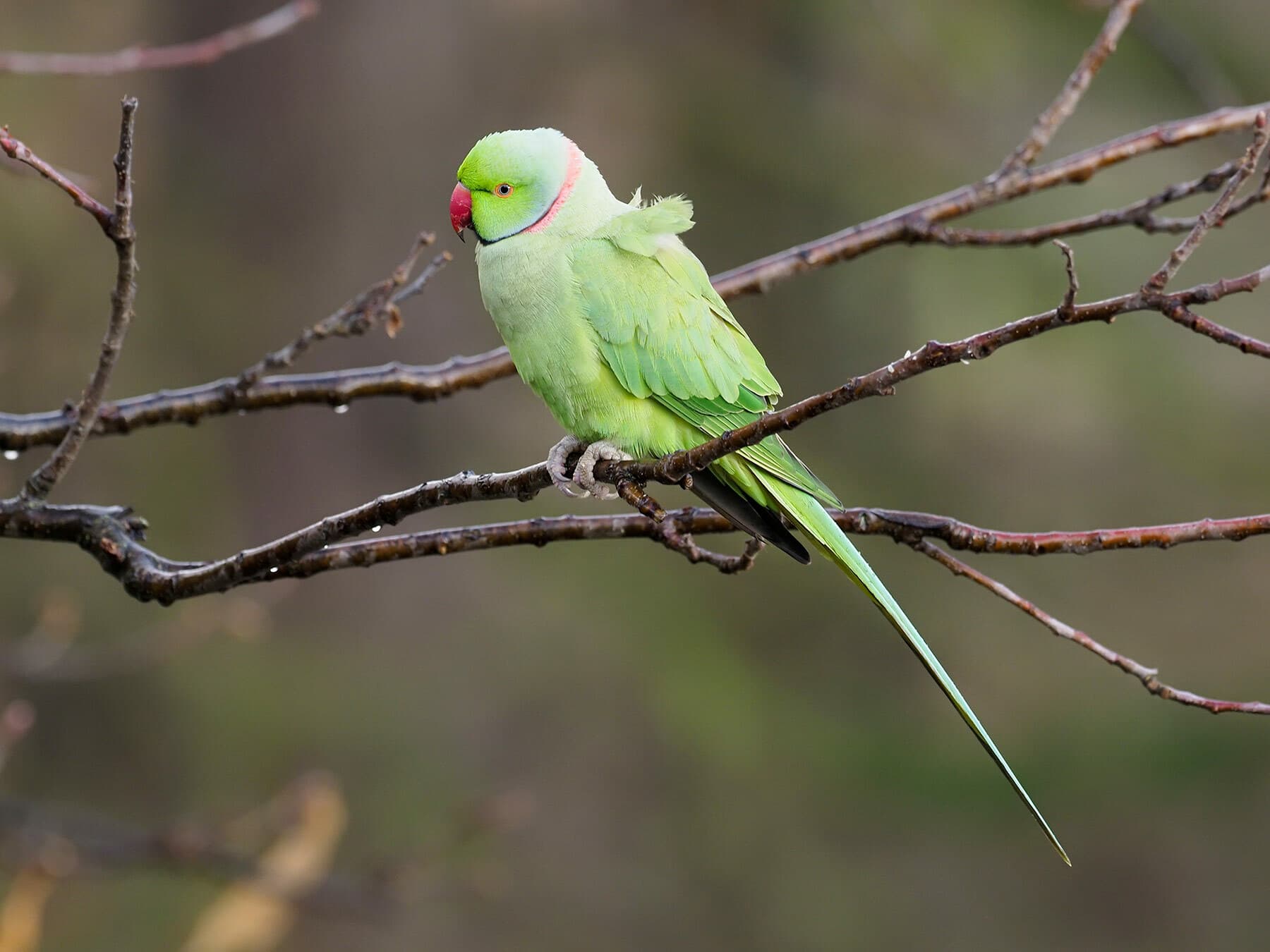
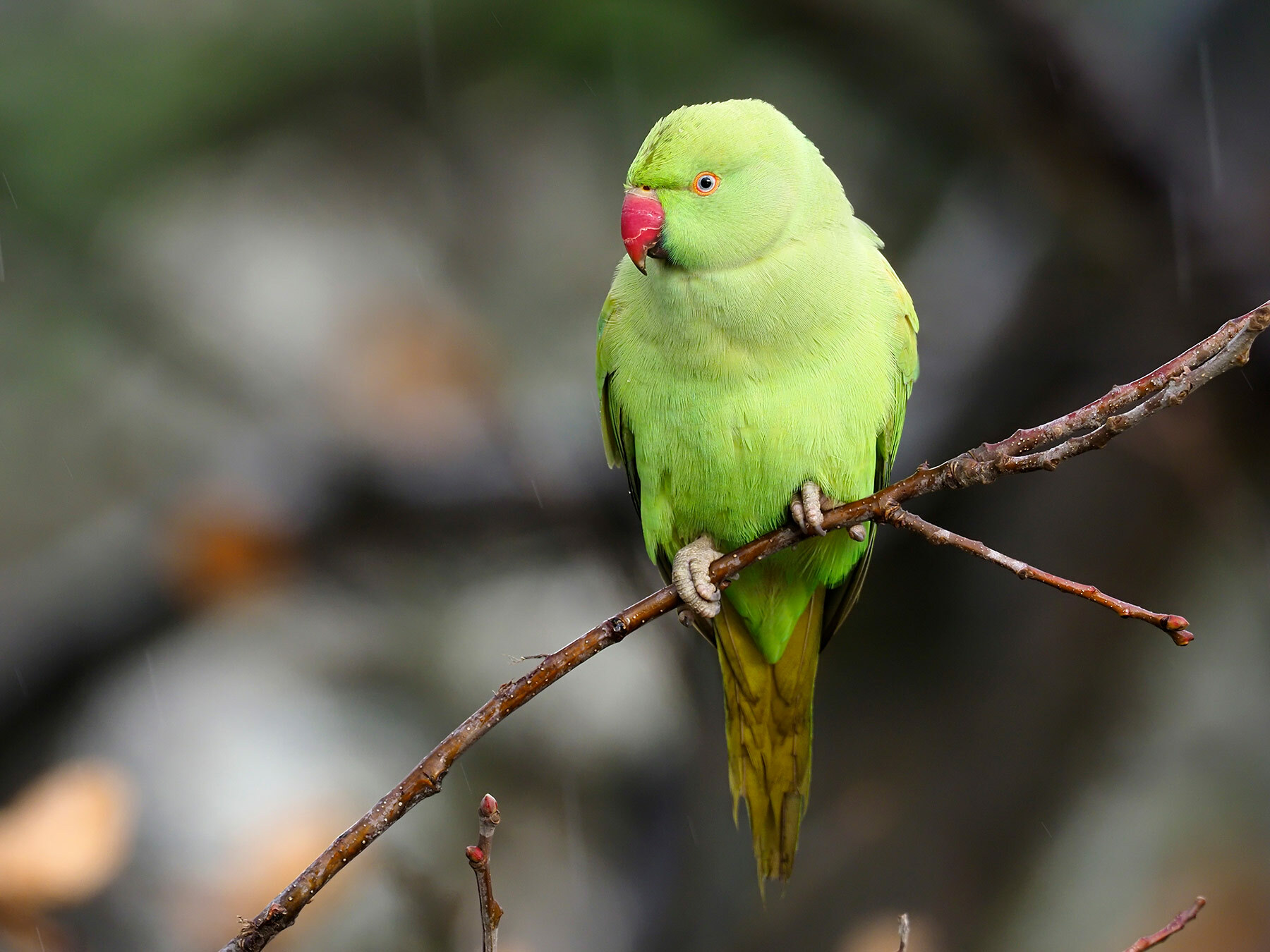
The Rose-ringed Parakeet is a vibrant green parrot with a long tail and a distinctive red beak. It measures 38-42 cm in length, with a slender body and pointed wings.
Adult males feature a black throat stripe and a pink and black collar, while females and immature birds lack these markings. Both sexes have a pale ring around the eye and subtle blue tints on the tail.
Its size
Adults- Length
- 38–42 cm
- Wingspan
- 42–48 cm
- Weight
- 95–143 g
Its song and calls
This parakeet can sound very raucous and is excellent at mimicking sounds, even human voices. In flight and when roosting, they can be very noisy uttering a medium to high pitched screech or squawk and sometimes even a whistle.
- Call0:00 / 0:17
Recorded in Île-de-France, France · May 2019
When and where to see it
OctoberHere all year
Most recorded in October
- 1. London3.0%
- 2. West Midlands1.7%
- 3. Surrey1.6%
- 4. Berkshire1.3%
- 5. Manchester1.2%
Each dot is a county, state or province: the bigger and darker, the larger the bird’s share of that place’s bird records that month. Grey dots: no regular records. The ringed point is the centre of the bird’s records this month; the arrow shows how it moved since last month, and the dashed loop its path through the year. “Arrivals” colours places where it becomes regular this month (orange) or is in its last regular month (grey). GBIF eBird Observation Dataset, 2019–2024. Map data: Natural Earth, US Census Bureau; place centres © OpenStreetMap contributors.
In your area
See when the Rose-ringed Parakeet is recorded in your county, state or province.
How often the Rose-ringed Parakeet turns up in the UK and the United States through the year, from birdwatchers' records.
United Kingdom
Resident · all year · most records in December
United States
Resident · all year · most records in February
Show as a table
| Month | United Kingdom | United States |
|---|---|---|
| January | 0.42% (regular) | 0.004% (regular) |
| February | 0.42% (regular) | 0.005% (regular) |
| March | 0.40% (regular) | 0.004% (regular) |
| April | 0.34% (regular) | 0.002% (regular) |
| May | 0.29% (regular) | 0.001% (regular) |
| June | 0.30% (regular) | 0.002% (regular) |
| July | 0.31% (regular) | 0.002% (regular) |
| August | 0.33% (regular) | 0.002% (regular) |
| September | 0.36% (regular) | 0.002% (regular) |
| October | 0.36% (regular) | 0.003% (regular) |
| November | 0.45% (regular) | 0.003% (regular) |
| December | 0.49% (regular) | 0.003% (regular) |
Recorded regularly in
Worldwide: recorded regularly in 79 countries
Countries where it was recorded in at least 3 of the 6 years 2019–2024. Linked countries have their own bird list.
Europe (15)
Africa (23)
Asia (30)
South America (1)
- Venezuela
Oceania (2)
Data: EOD – eBird Observation Dataset (Cornell Lab of Ornithology), accessed via GBIF.org, CC BY 4.0. Records from 2019–2024, aggregated and filtered by Birdfact. How these lists are made
There have been sightings of individual birds in almost every county of the UK. However, they are concentrated in the Greater London and Home Counties area although more recently, they have also appeared in small populations in the Midlands, East Anglia and Lincolnshire. They are normally seen in suburban parks, orchards and gardens and can frequently be seen roosting in flocks of around thirty birds.
Signs and Spotting tips
After early morning feeding birds will often congregate in large flocks and roost in trees in public parks, particularly around London and will often be heard before being seen. Richmond Park, Wimbledon Common, Hampstead Heath and Battersea Park are just a few popular London locations for sightings of the ring-necked parakeet.
What it eats
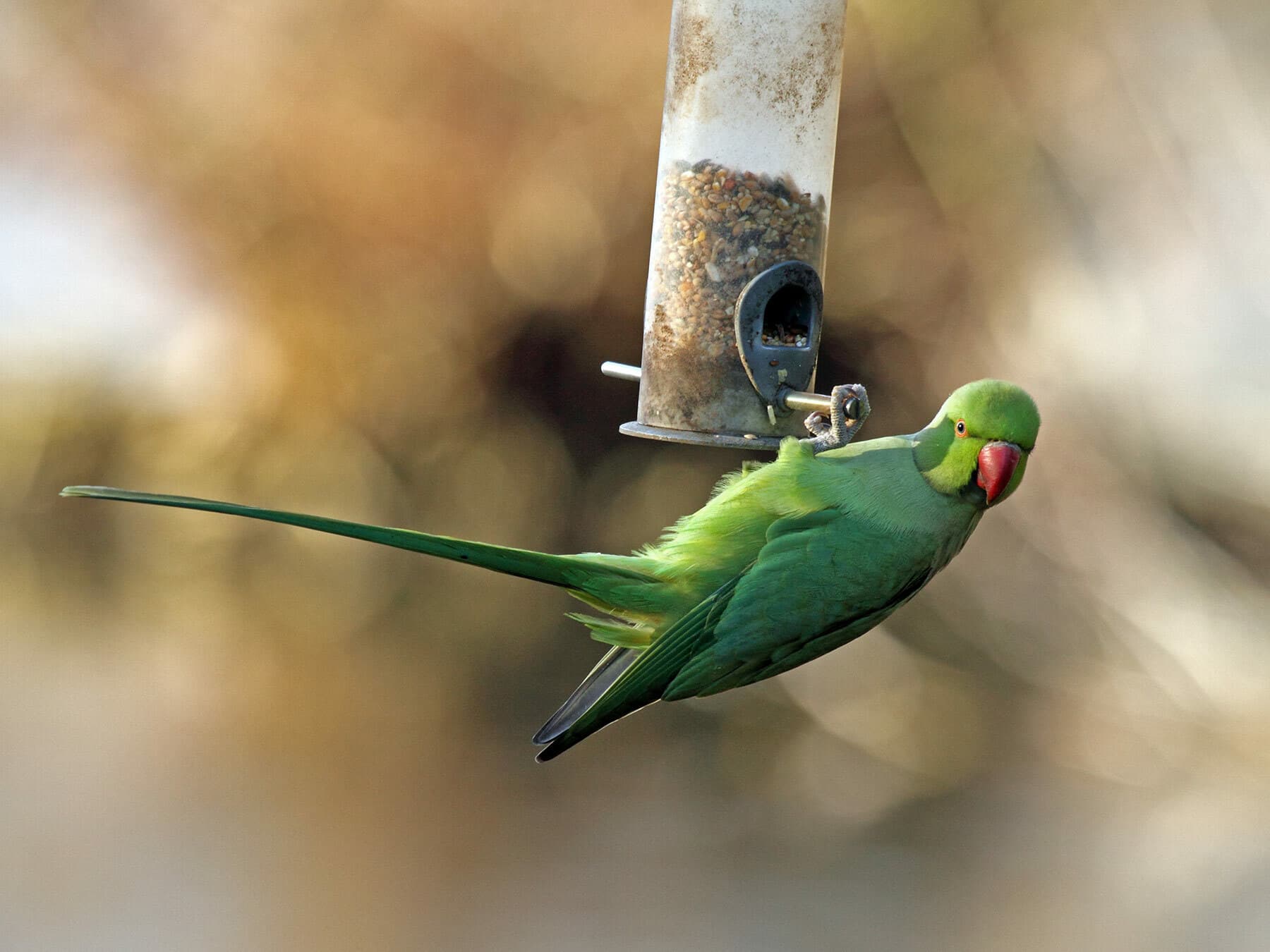
Although predominantly a fruit eater the ring-necked parakeet also feeds on seeds, grain, nuts and berries as well as household scraps and will often take food from gardens and off bird tables. Generally, they are early morning and late afternoon feeders.
Nesting and breeding
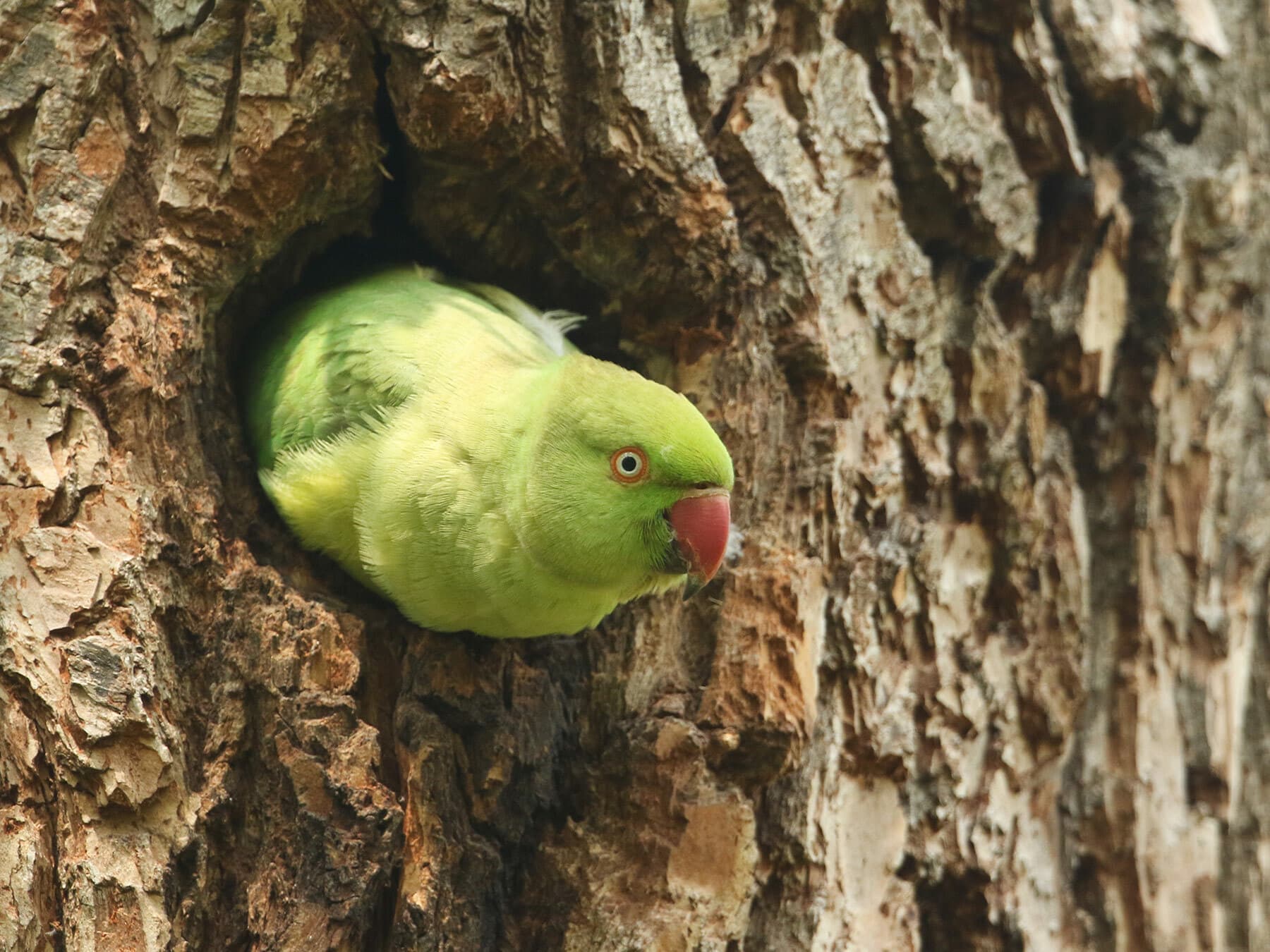
Rather than build their own nests they prefer to occupy old nests from other birds particularly woodpecker nests built in holes in trees as well as utilising medium to large sized nesting boxes. They can start nesting as early as January with the breeding season coming to an end in June. A clutch of 2 – 4 eggs is laid and after hatching the young birds normally fledge at around forty to fifty days with both parents caring for the young in the nest. These birds may produce more than one clutch each season.
Behaviour
Rose-ringed Parakeets are highly social and often seen in noisy flocks. They are agile flyers, capable of swift, direct flight with rapid wing beats.
These birds are known for their intelligence and adaptability, readily adjusting to urban environments and even mimicking human speech in captivity.
Lifespan and predators
The lifespan of birds in the wild is believed to be around nine years although the record for a captive bird is thirty-four years.
Conservation
Despite being non-native in many parts of its range, the Rose-ringed Parakeet is listed as Least Concern.
However, its success as an invasive species in Europe and elsewhere has raised concerns about competition with native birds for nesting sites and food resources.
What does a Ring-Necked Parakeet look like?
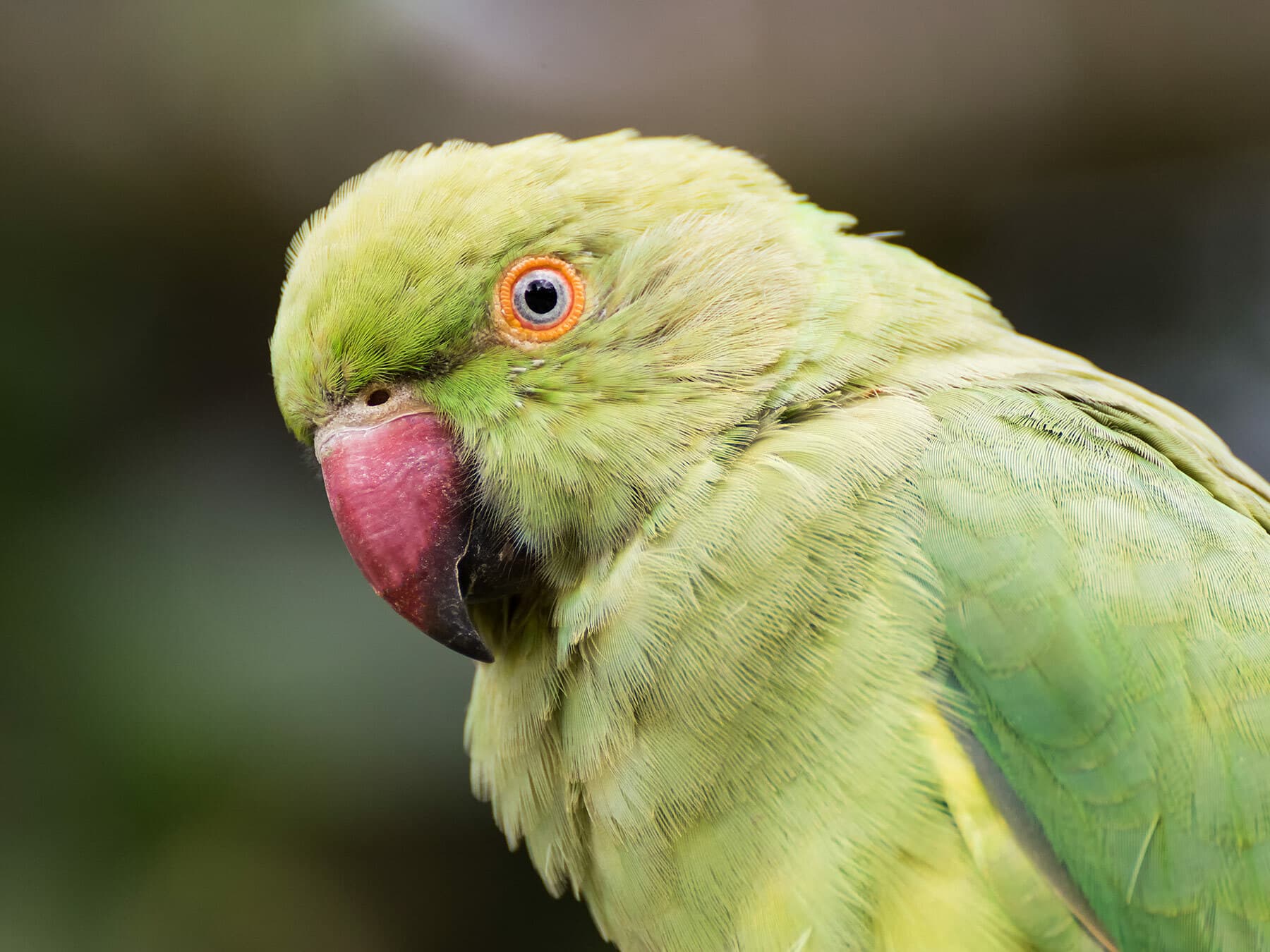
The adult ring-necked parakeet is a large robust parrot with a long narrow tail and pointed wings. It has a red coloured curved and hooked beak and grey green legs. Both males and females have bright green plumage, lighter on the chest and back than the wings and tail, but only the adult males have a black chin and pinky red circle around the neck, from which this bird gets its name.
More photos
2 photos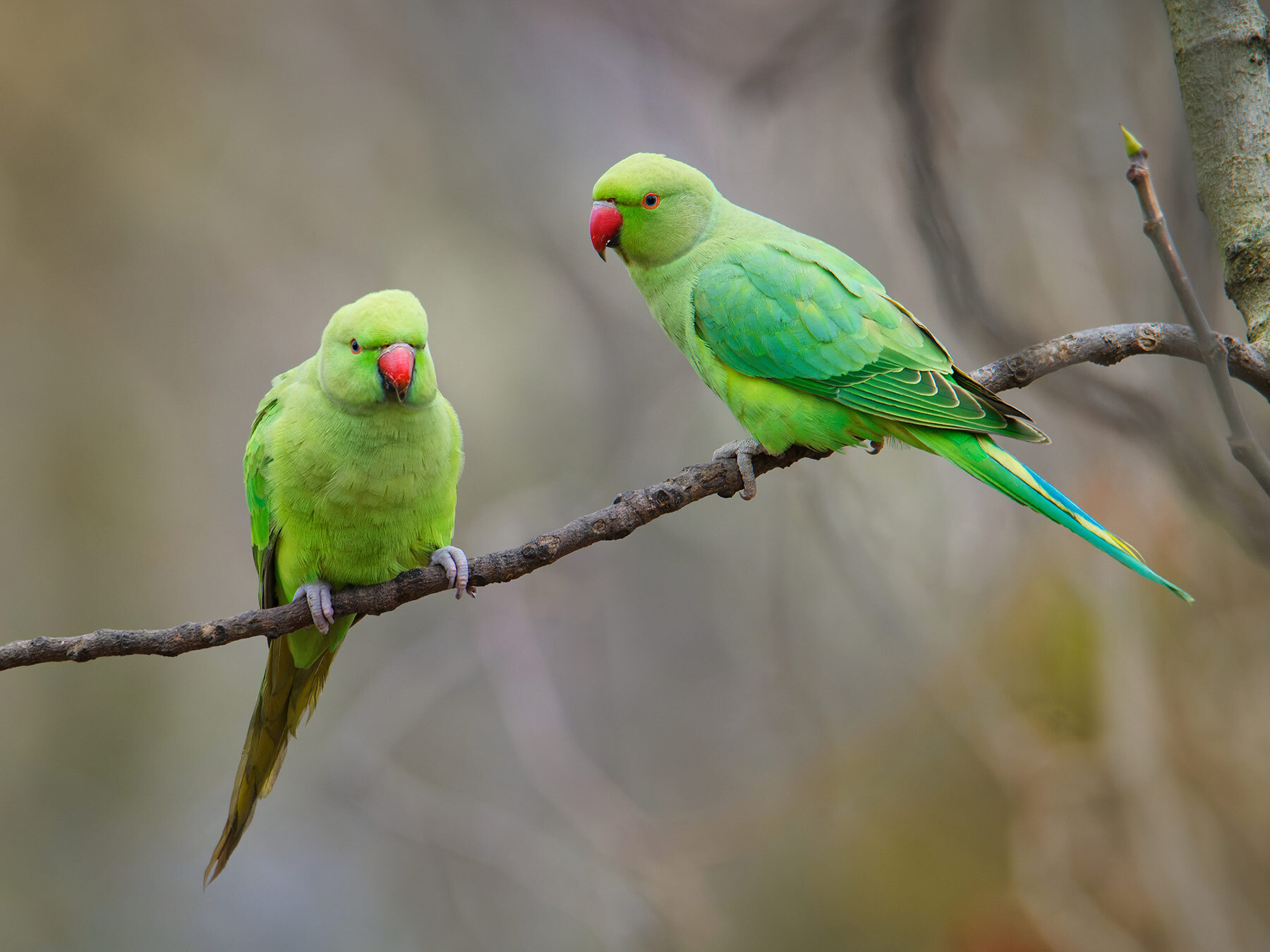
Rose-ringed Parakeet guides
2 guidesQuick facts
- Length
- 38–42 cm
- Wingspan
- 42–48 cm
- Weight
- 95–143 g
- Lifespan
- 20–30 years · oldest recorded 8.9 years
- Family
- Parrots
- Migration
- Resident
- Global status (IUCN)
- Least Concern
- World population
- Not quantified, but abundant throughout its range
- Population trend
- Population increasing, especially in introduced areas
- Also called
- Ring-necked Parakeet
- Scientific name
- Psittacula krameri
Sources
4- 1BirdLife International. 2018. Psittacula krameri. The IUCN Red List of Threatened Species 2018: e.T22685441A132057695. Source (opens in a new tab)
- 2BirdLife International. 2018. Psittacula krameri. The IUCN Red List of Threatened Species 2018: e.T22685441A132057695. Source (opens in a new tab)
- 3del Hoyo et al. (1997)
- 4BTO longevity records: maximum age from a ringed bird, 8 years, 11 months, 8 days (set in 2010), BirdFacts: Ring-necked Parakeet (2010) Source (opens in a new tab)

Checked by
Nathan Cope, founder and editor
Nathan founded Birdfact and leads its writers and contributors in the UK, the US and Canada. He has watched and studied birds for more than ten years, and checks every article and species guide before it’s published.