Species Profile
Red Junglefowl
Gallus gallus
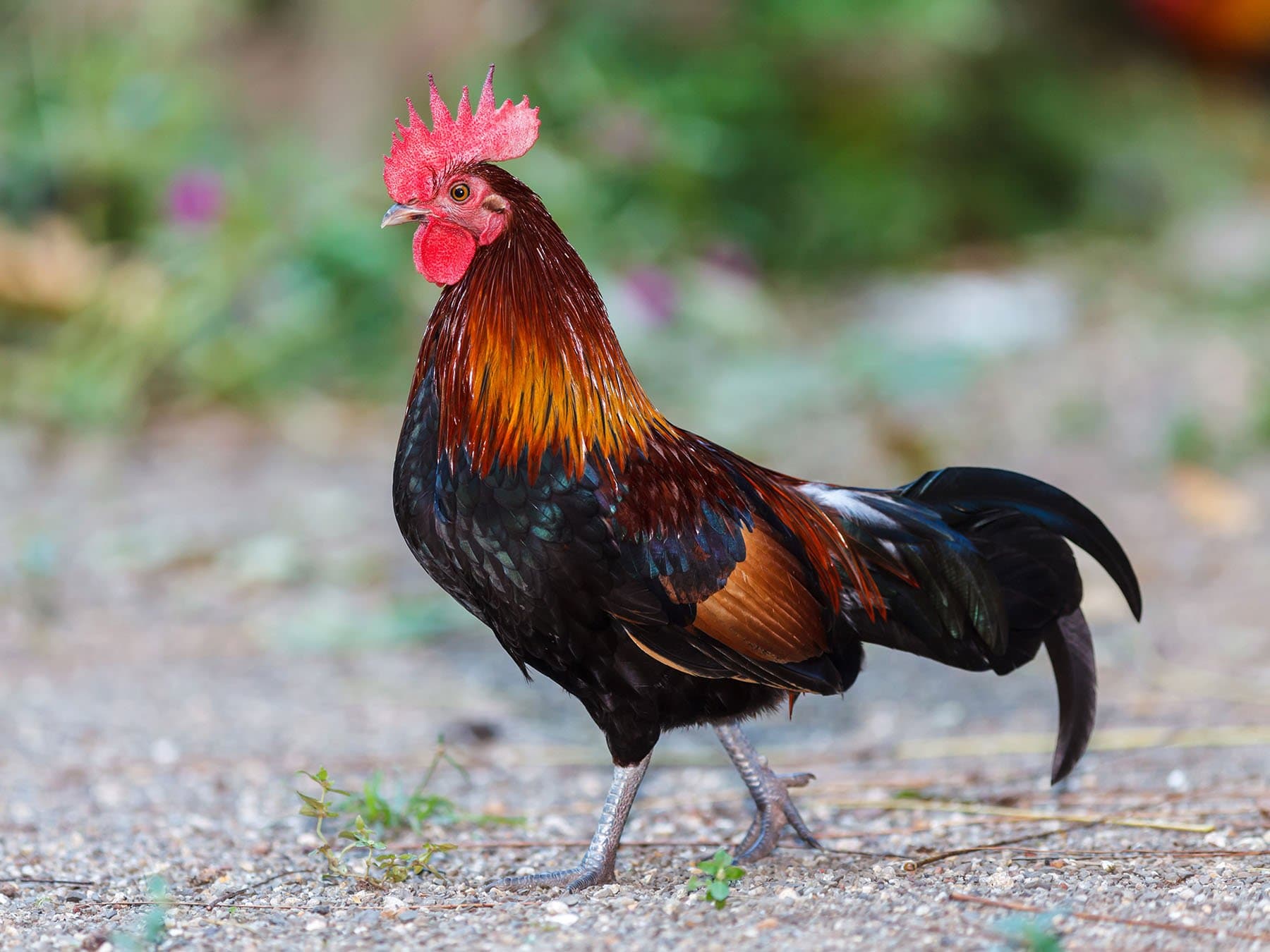
Red Junglefowl standing on a gravel path. Features a red comb, wattle, and iridescent black, brown, and orange-gold plumage.
Quick Facts
Conservation
LCLeast ConcernLifespan
3–11 years
Length
42–75 cm
Weight
500–1500 g
Wingspan
60–100 cm
Migration
Resident
The Red Junglefowl is the wild ancestor of every domestic chicken on Earth — a bird whose crow, cluck, and scratch have shaped human civilisation more than any other. Males are spectacular: a cascade of golden-orange hackles, iridescent black tail feathers arching to 28 cm, and a blazing red comb that has been turning heads — and inspiring selective breeding — for at least 8,000 years.
Think you've spotted a Red Junglefowl?
Upload a photo and we'll confirm it instantly
Confirm with a PhotoAppearance
Few birds pack as much visual drama into a single animal as the male Red Junglefowl. His golden-orange hackle feathers — long, lance-shaped plumes that drape from the head down over the back — flare outward like an umbrella when he displays or fights. The upperparts are a mosaic of chestnut and glossy greenish-black, the secondaries are coppery, and the rump is white. Underparts are mostly black with a greenish gloss in strong light. The tail's 14 iridescent feathers shimmer blue, purple, and green in direct sunlight; two greatly elongated sickle-shaped covert feathers arch over the tail and can reach 28 cm in length, pushing total body length to 70–75 cm.
The facial skin is bare and bright red, with a tall, serrated red comb and prominent wattles on the throat and cheeks. In some subspecies — notably those in Vietnam — the cheek wattles are white rather than red, a useful field mark for separating subspecies. The legs are distinctively grey, which is one of the most reliable features for distinguishing wild birds from domestic chickens, which typically have yellow or orange legs. Roosters also carry sharp bony spurs on the back of each leg, used in combat and defence.
A seasonal eclipse plumage, worn roughly from June to October, replaces the breeding finery with black feathers across the back and small red-orange plumes scattered across the mantle. This eclipse moult is now considered one of the most reliable field indicators of genetic purity in wild birds: domestic and hybrid individuals do not show it. Immature males lack the elongated tail coverts and show only partial development of the comb and wattles.
Females are considerably smaller at 42–46 cm and 500–1,000 g, and cryptically coloured for camouflage. Their plumage is medium-brown overall, with dense orange-and-black streaking on the head and neck, and diffuse whitish streaks on the breast and upperparts. The tail is dark brown to blackish, long, wedge-shaped, and — crucially — held horizontal, unlike domestic hens, which tilt their tails upward. The facial skin is dull pink, the comb tiny, and the wattles much reduced. Females lack hackle feathers, elongated tail coverts, and leg spurs entirely.
Identification & Characteristics
Male Colors
- Primary
- Orange
- Secondary
- Black
- Beak
- Red
- Legs
- Grey
Female Colors
- Primary
- Brown
- Secondary
- Orange
- Beak
- Red
- Legs
- Grey
Male Markings
Golden-orange hackle feathers, iridescent sickle-shaped tail coverts, bright red comb and wattles, grey legs, white rump patch
Tail: 14 iridescent feathers shimmering blue, purple, and green; two greatly elongated sickle-shaped covert feathers arching over the tail, up to 28 cm in length
Female Markings
Cryptic brown plumage with orange-and-black streaked head and neck; dark wedge-shaped tail held horizontal; tiny comb and reduced wattles; no leg spurs
Tail: Long, wedge-shaped dark brown to blackish tail, held horizontal — a key distinction from domestic hens, which tilt their tails upward
Attributes
Understanding Attributes
Rated 0–100 based on research and observation. A score of 50 is average across all bird species. These attributes are relative and don't necessarily indicate superiority.
Habitat & Distribution
Red Junglefowl are birds of tropical and subtropical forest edges rather than dense primary forest. They thrive in secondary growth, regenerating logged areas, bamboo stands — particularly after burning, when bamboo seeds are abundant — scrub forest, and the margins of agricultural land. Disturbed habitats suit them well: the combination of cover and open ground for foraging is more important than forest quality. In Malaysia, palm oil plantations provide both suitable cover and food (palm nuts and associated insects), and the palms offer a range of roost heights. The species occurs from sea level up to moderate elevations in hilly terrain.
The native range stretches across a broad swathe of South and Southeast Asia. In the west, it runs from Pakistan, northern and central India (including Kashmir, Madhya Pradesh, and Andhra Pradesh), Nepal, Bhutan, and Bangladesh. Moving east, the range covers Myanmar, southern China (Yunnan, Guangxi, and Hainan), Thailand, Cambodia, Laos, Vietnam, and south through the Malay Peninsula and Singapore. The Indonesian archipelago — Sumatra, Java, and Bali — is also within the native range, extending as far as Timor-Leste. Five subspecies are recognised: G. g. murghi (north India to Bangladesh), G. g. spadiceus (northeast India to south China and north Sumatra), G. g. jabouillei (south China to north Vietnam), G. g. gallus (south Myanmar through Indochina — the nominate subspecies), and G. g. bankiva (Java and Bali).
The species has been introduced across much of the Pacific and Caribbean, carried by Austronesian peoples starting around 5,000 years ago — one of only three animals (alongside pigs and dogs) routinely transported on prehistoric ocean voyages. Introduced populations exist in Australia, Fiji, Hawaii, Jamaica, the Dominican Republic, the Marshall Islands, Micronesia, Palau, and Puerto Rico. In the United States, the species is an uncommon resident in Hawaii, where it is most visible on Kauai. Polynesian settlers first brought Red Junglefowl (known locally as moa) to Kauai around AD 1200, but the modern feral population was dramatically expanded when Hurricanes Iwa (1982) and Iniki (1992) destroyed domestic coops, releasing thousands of chickens that interbred with the existing junglefowl. In the UK, the species is only recorded as a very rare vagrant — with occasional records from Devon, Dorset, Hertfordshire, Lancashire, Norfolk, South Yorkshire, and Scotland — almost certainly relating to escaped or released birds rather than genuine wild vagrants.
Where to See This Bird
Explore regional guides for locations where this bird has been recorded.
Diet
Red Junglefowl are opportunistic omnivores, and their diet shifts considerably with season, habitat, and age. Plant material makes up the greater part of the adult diet: fallen fruits, seeds (including bamboo seeds, grains, and corn), leaves, roots, and tubers are all consumed. Crop contents from studied birds have revealed seeds and fruits from scores of plant species. Although they forage almost exclusively on the ground, they will occasionally perch on branches to reach hanging fruit in trees.
Animal prey is a consistent supplement. Adult and larval insects — ants, termites, beetles, and grasshoppers — are taken regularly, along with earthworms and other invertebrates. Small vertebrates such as lizards and amphibians are eaten opportunistically when encountered. Chicks have a markedly different diet from adults: in their first weeks, they rely heavily on insects and earthworms, with only occasional plant material. This protein-rich diet supports the rapid early growth that allows chicks to be fully feathered within four to five weeks.
Food is processed in the muscular gizzard, where small stones swallowed deliberately help grind hard seeds and other tough material. Red Junglefowl cannot detect sweet tastes — a trait shared with domestic chickens — and generally dislike salt.
Males perform a distinctive food-related courtship display called "tidbitting" when they find food in the presence of a female. The male produces soft, coaxing cluck-like calls while repeatedly picking up and dropping the food item, bobbing and twitching his head and neck. The display typically ends when the hen takes the food from the ground or directly from the male's beak, and mating sometimes follows immediately. Tidbitting is one of the most studied courtship behaviours in any bird, partly because it is so easily observed in domestic chickens — a direct behavioural inheritance from the wild ancestor.
Behaviour
Red Junglefowl live in small, structured social groups with a clear dominance hierarchy — the familiar pecking order that domestic chickens inherited directly from their wild ancestor. Within a flock, the dominant male controls access to food, mates, and prime roost sites, and his status is reinforced every single morning. Research published in Scientific Reports (2015) confirmed that crowing at dawn follows a strict rank order governed by the circadian clock: the top-ranking rooster always crows first, and subordinates follow in exact descending order of rank, waiting patiently for the bird above them to vocalise before doing so themselves. Only dominant males crow within a flock.
The species is almost entirely ground-dwelling during the day, foraging by scratching through leaf litter and soil with powerful feet. At dusk, the whole group flies up into trees to roost — typically at heights of 4–12 m — where they are safe from most ground predators. In Malaysian palm oil plantations, females with chicks favour lower perches around 4 m, while other adults roost higher, up to 12 m.
Males are highly vigilant and produce distinct alarm calls for different threat types. An aerial predator such as a hawk triggers a specific alarm call that causes flock members to crouch and freeze; a ground predator triggers a different call that prompts the group to scatter into cover. This referential signalling system — once thought to be unique to primates — demonstrates a level of communicative sophistication that has attracted considerable scientific interest.
Outside the breeding season, males and females often forage in separate groups. Daily movements are limited; adjacent roost sites can be as close as 100 metres apart. Flight is used almost exclusively for reaching roost trees and for short-distance escape from predators, not for sustained travel.
Calls & Sounds
The male's crow is one of the most recognisable sounds in the natural world — but the wild bird's version sounds nothing like a farmyard rooster. The Red Junglefowl's crow consists of four quick syllables, is higher-pitched and scratchier in quality, and cuts off abruptly at the end rather than trailing into the long, vibrant note familiar from domestic chickens. This abrupt ending is one of the most reliable acoustic features for distinguishing wild birds from domestic or hybrid individuals in the field.
Crowing is governed by the circadian clock and enforced by social hierarchy. Research published in Scientific Reports (2015) confirmed that in any flock, the top-ranking rooster always crows first at dawn, and subordinates follow in exact descending order of rank. Subordinate males are physiologically inhibited from crowing before the dominant bird has done so. Only dominant males crow regularly within a flock — subordinates are largely silent in the presence of a higher-ranking bird.
Beyond the crow, the species has a rich repertoire of clucking calls structurally identical to those of domestic chickens — contact calls, feeding calls, and the soft coaxing notes of the tidbitting display. Most striking, however, is the alarm call system. Red Junglefowl produce distinct alarm calls for aerial predators (such as hawks) and separate alarm calls for ground predators, and flock members respond appropriately to each — crouching and freezing in response to the aerial alarm, scattering into cover in response to the ground alarm. Males are more vigilant than females and produce male-specific aerial alarm calls. Dominant males make more alarm calls overall, and individuals adjust the duration of alarm calling based on context and the composition of the audience.
Females are generally quieter than males but produce clucking and contact calls, particularly when accompanied by chicks. The female's alarm calls are softer and less frequent than the male's.
Flight
Red Junglefowl are not built for sustained flight. Like most members of the Phasianidae family — including the Red Grouse and common pheasant — they have short, broad, rounded wings that generate rapid acceleration over short distances but are poorly suited to prolonged aerial travel. When flushed from cover, a Red Junglefowl explodes upward with a loud, whirring wingbeat, climbs steeply, then glides on bowed wings before dropping back into vegetation — a flight pattern that covers 50–100 metres at most.
The primary function of flight in this species is vertical: getting up into roost trees at dusk and descending again at dawn. The whole flock flies up to perches at heights of 4–12 m, with females carrying chicks favouring lower branches around 4 m and other adults roosting higher. This nightly ascent is the most sustained flying most individuals do in a day.
In escape flight, the wingbeat is rapid and audible, producing a distinctive clatter as the bird launches. Once airborne, the bird typically glides rather than continuing to flap, conserving energy for the landing. The grey legs and white rump patch of the male are visible in flight and can help confirm identification at a distance. Females in flight show a uniformly brown-and-buff profile with a dark tail, and can be confused with other ground-dwelling birds in similar habitats.
Nesting & Breeding
Breeding season varies across the range. In India, Nepal, Thailand, Vietnam, and Laos, breeding typically coincides with the dry season — broadly March to July, with April the peak month in studied populations in Vietnam. Year-round breeding has been documented in palm oil plantations in Malaysia, and may occur elsewhere in equatorial regions where seasonality is less pronounced.
Males are polygynous, maintaining harems and attempting to monopolise reproductive access to females. Females, however, exercise genuine mate choice: studies show they mate with subordinate males approximately 40% of the time, suggesting female preference plays a significant role alongside male dominance. Courtship involves tidbitting displays (see Diet), wing flapping, crowing, and strutting. Males use their leg spurs in combat with rivals to establish and maintain dominance.
Females build nests on the ground, typically hidden in dense vegetation, under fallen logs, or in thick undergrowth. The nest is a simple scrape lined with leaves, grass, small sticks, or feathers. Clutch size typically ranges from 4 to 7 eggs, with a mean of approximately 5.15 eggs recorded in a peer-reviewed field study of G. g. jabouillei in Vietnam (Frontiers in Ecology and Evolution, 2023). Eggs are creamy white or pale buff, sometimes with subtle speckling. Females lay one egg per day during the laying period.
Incubation lasts approximately 21 days and is performed solely by the female, who relies on her cryptic brown plumage to remain concealed on the nest. Chicks are precocial — they can run, feed, and follow their mother almost immediately after hatching, though breaking out of the shell can take 10–20 hours. By 4–5 weeks, chicks are fully feathered; first adult wing feathers take a further four weeks to grow. At 12 weeks, the mother chases the young from the group, at which point they join or form a new flock. Sexual maturity is reached at around five months. Nesting success in the Vietnam study was 31.2%, with rodents, reptiles, and coucals identified as the primary nest predators.
Lifespan
In the wild, Red Junglefowl typically live between 3 and 11 years, with most individuals in natural populations surviving considerably less than the upper end of that range due to predation, disease, and the pressures of breeding. Nest predation alone limits recruitment significantly — a field study in Vietnam recorded nesting success of just 31.2%, meaning roughly two in three nesting attempts fail before the chicks even hatch.
In captivity, where predation and food stress are removed, the species is considerably longer-lived. The maximum recorded longevity for Gallus gallus in captivity is 30 years, according to the AnAge database of animal ageing — an extraordinary figure for a bird of this size, and a reflection of the species' underlying physiological resilience. For comparison, domestic chickens rarely exceed 10–15 years even in well-managed conditions, suggesting that the selective pressures of domestication have not extended lifespan.
Sexual maturity is reached at around five months of age, with females maturing slightly later than males. This early maturation is typical of ground-nesting Phasianidae, where high predation pressure favours rapid reproduction over longevity. The main causes of mortality in wild populations include predation by raptors, foxes, and snakes; nest failure due to rodents, reptiles, and coucals; disease transmission from domestic and feral chickens; and hunting by humans across much of the range.
Conservation
The Red Junglefowl is listed as Least Concern on the IUCN Red List, reflecting its wide range and generally common status across much of South and Southeast Asia. No precise global population figure is available — BirdLife International does not provide a total estimate — but the species is described as widespread and locally abundant within its native range. The wild population trend is, however, decreasing, and the picture is considerably more complicated than the headline status suggests.
The most serious long-term threat is genetic introgression from domestic and feral chickens. Free-ranging domestic birds interbreed readily with wild Red Junglefowl at forest edges and near human settlements, progressively diluting the wild gene pool. A genomic study of 745 museum specimens found that most wild populations already show evidence of hybridisation with domestic birds. Some ornithologists consider the original pure genetic strain to be effectively extinct or critically endangered across much of the range. The species is classified as Near Threatened in Singapore, reflecting the severity of this problem at the local level. Pure wild-type individuals — identifiable by their eclipse plumage, which hybrid and domestic birds do not show — are now mainly found in western and central parts of the range.
Habitat loss and degradation compound the problem: deforestation and agricultural expansion fragment suitable habitat and increase contact between wild birds and domestic chickens. Hunting for food and capture for the pet trade add further pressure in areas where the species is not legally protected. Disease transmission from feral and domestic chickens — including Newcastle Disease, Mycoplasma gallisepticum, and potentially avian influenza — poses an additional risk to wild populations. Conservation efforts increasingly focus on identifying and protecting genetically pure populations, with eclipse plumage serving as the most practical field indicator of wild-type status.
Population
Estimated: No global estimate available; described as generally common and widespread within native range, though genetically pure wild populations are increasingly fragmented
Trend: Decreasing
Decreasing. Wild population declining due to habitat loss, hunting, and — most critically — genetic introgression from domestic and feral chickens, which is progressively diluting the wild gene pool across most of the range.
Elevation
Sea level to approximately 1,500 m
Additional Details
- Family:
- Phasianidae (Pheasants & Grouse)
- Predators:
- Raptors, foxes, snakes, and monitor lizards (adults); rodents, reptiles, and coucals (nest predators)
- Subspecies:
- Five subspecies recognised: G. g. murghi (north India to Bangladesh), G. g. spadiceus (northeast India to south China and north Sumatra), G. g. jabouillei (south China to north Vietnam), G. g. gallus (south Myanmar through Indochina — nominate), G. g. bankiva (Java and Bali)
Social Behaviour
Red Junglefowl society is built around a linear dominance hierarchy — the pecking order — that governs access to food, mates, and roost sites. Within a flock, each individual knows its rank relative to every other, and disputes are typically resolved through brief displays rather than prolonged fighting. The dominant male sits at the top of this hierarchy and enjoys priority access to all resources; subordinate males and females occupy lower ranks in a descending order that is maintained through daily reinforcement.
Flock composition varies seasonally. During the breeding season, dominant males maintain harems of several females, actively excluding rival males from the group. Outside the breeding season, males and females often forage in separate groups, with young males forming bachelor flocks after being expelled from their natal group at around 12 weeks of age. Group sizes are generally small — typically 2–8 individuals — though larger aggregations can form where food is concentrated.
The species shows a sophisticated capacity for social learning. Chicks learn foraging techniques, food preferences, and predator recognition from their mother and from other flock members. This cultural transmission of information — the ability to learn from others rather than relying solely on instinct — is one of the traits that made Red Junglefowl so amenable to domestication. A bird that learns from its social group is far easier to manage in a human-controlled environment than one that relies entirely on fixed behavioural programmes.
Roosting is a communal activity, with the whole flock ascending to the same trees each evening. The choice of roost site is not random: dominant individuals occupy the highest, safest perches, while subordinates roost lower. This nightly ritual reinforces the social hierarchy and provides collective vigilance against nocturnal predators.
Courtship & Display
The Red Junglefowl's courtship repertoire is more varied and better studied than that of almost any other wild bird, largely because its domestic descendants have been observed in controlled conditions for decades. The centrepiece is the tidbitting display: when a male finds food in the presence of a female, he produces a series of soft, rapid cluck-like calls while repeatedly picking up and dropping the food item, bobbing and twitching his head and neck in an exaggerated manner. The display is a form of honest signalling — the male is demonstrating both his ability to find food and his willingness to share it. The display typically ends when the hen takes the food from the ground or directly from the male's beak, and mating often follows.
Beyond tidbitting, males perform elaborate visual displays that make full use of their ornate plumage. The golden hackle feathers are erected and fanned outward, the iridescent tail is raised and spread, and the bird circles the female with a stiff, exaggerated gait. Wing flapping and crowing punctuate these visual displays, reinforcing the male's dominance status to both the female and any rival males within earshot.
Males use their sharp leg spurs in direct combat with rivals. Spur fights can be intense and occasionally injurious, and the outcome strongly influences subsequent mating success. Despite this, females exercise genuine mate choice: studies show they mate with subordinate males approximately 40% of the time, suggesting that female preference for genetic quality or novelty plays a significant role alongside male dominance. This balance between male competition and female choice has made the Red Junglefowl a key model species in the study of sexual selection.
Domestication And Cultural Significance
No bird has shaped human history more profoundly than the Red Junglefowl. Whole-genome sequencing has confirmed that domestication occurred approximately 8,000 years ago, with the subspecies G. g. spadiceus of northern Thailand, Myanmar, and southwestern China now identified as the closest wild relative to the domestic chicken. Multiple independent maternal lineages contributed to the domestic gene pool, suggesting that domestication was not a single event but a gradual process involving repeated taming of wild birds across a broad geographic area.
The domestic chicken (Gallus gallus domesticus) is today the most numerous bird on Earth by a vast margin, with an estimated 33 billion individuals alive at any one time — roughly four chickens for every human being. The global poultry industry processes around 70 billion birds per year. This extraordinary abundance traces directly back to the wild Red Junglefowl of the Asian forest edge.
The species was spread across the Pacific by Austronesian voyagers starting around 5,000 years ago, carried alongside pigs and dogs as one of only three animals routinely transported on prehistoric ocean voyages. Chickens reached the Pacific islands, the Philippines, and eventually Hawaii (around AD 1200) through this network of deliberate human dispersal — one of the most remarkable examples of human-mediated species distribution in history. There is also contested archaeological evidence suggesting that Polynesian voyagers may have introduced chickens to the coast of South America before European contact, though this remains debated.
Beyond food, Red Junglefowl and their domestic descendants have featured in cockfighting — one of the oldest recorded human sports, with evidence dating back at least 3,000 years in South and Southeast Asia — and in religious and ceremonial contexts across dozens of cultures. The rooster's crow at dawn has been a symbol of vigilance, renewal, and the passage of time in cultures from ancient Rome to modern China.
Birdwatching Tips
In its native range, Red Junglefowl are most reliably found at forest edges and in secondary growth — look for them foraging along the margins of trails, logging roads, and agricultural clearings in the early morning and late afternoon. Dense primary forest is less productive; disturbed habitats with a mix of cover and open ground are far more likely to hold birds. In Thailand, national parks such as Khao Yai and Doi Inthanon offer good opportunities, and the species is regularly seen along forest tracks in Malaysia and Vietnam.
The most reliable identification feature separating wild birds from domestic or hybrid individuals is leg colour: wild Red Junglefowl have grey legs, while domestic chickens typically have yellow or orange legs. The male's eclipse plumage (June–October), in which the golden hackles are replaced by black feathers with scattered red-orange plumes, is another strong indicator of genetic purity — no domestic or hybrid bird shows this moult. Listen for the male's crow: the wild bird's version is higher-pitched and scratchier than a farmyard rooster's, consisting of four quick syllables that cut off abruptly rather than trailing into a long, resonant note.
In Hawaii, the island of Kauai offers the most accessible viewing in the United States — feral birds (a mix of Red Junglefowl and domestic chicken) are genuinely common and approachable, often seen in car parks, roadsides, and gardens. Identifying genetically pure birds on Kauai is now considered extremely difficult given the extent of hybridisation. On other Hawaiian islands, the species is present but less abundant. In the UK, any sighting almost certainly involves an escaped or released bird rather than a genuine wild vagrant, and should be treated with caution.
Dawn is the best time to detect males by their crowing. In mixed-sex groups, watch for the tidbitting display — a male repeatedly picking up and dropping food while clucking softly to a nearby female — which is one of the most distinctive and easily observed courtship behaviours of any bird.
Did You Know?
- The wild male's crow cuts off abruptly after four quick syllables — a strikingly different sound from a domestic rooster's long, resonant call. This abrupt ending is one of the most reliable acoustic features for identifying a genetically pure wild bird in the field.
- Crowing at dawn follows a strict rank order: the top-ranking rooster always crows first, and subordinates wait in exact descending order of rank before vocalising. This behaviour, confirmed by peer-reviewed research in Scientific Reports (2015), is governed by the circadian clock and enforced by social hierarchy.
- Red Junglefowl have two entirely separate alarm calls — one for aerial predators and one for ground predators — and flock members respond differently to each. This referential signalling system was once thought to be unique to primates.
- Eclipse plumage — a seasonal moult from June to October in which the male's golden hackles are replaced by black feathers — is now considered one of the most reliable field indicators of genetic purity. Domestic and hybrid birds do not show this moult, making it a key tool for conservation surveys.
- On Kauai, Hawaii, Polynesian voyagers first introduced Red Junglefowl around AD 1200, but the modern feral population exploded after Hurricanes Iwa (1982) and Iniki (1992) destroyed domestic coops, releasing thousands of chickens that interbred with the existing junglefowl. The resulting hybrid population is now so widespread that ornithologists consider identifying a genetically pure bird on the island effectively impossible.
Records & Accolades
Ancestor of the Domestic Chicken
~8,000 years of domestication
Whole-genome sequencing confirms the Red Junglefowl as the wild ancestor of all domestic chickens — the most numerous bird on Earth, with an estimated 33 billion individuals alive at any one time.
Clockwork Crow
Strict rank-order dawn chorus
The dominant rooster always crows first at dawn, with subordinates following in exact descending order of rank — a behaviour governed by the circadian clock and confirmed by peer-reviewed research in Scientific Reports (2015).
Dual Alarm System
Two distinct predator alarm calls
Red Junglefowl produce separate alarm calls for aerial and ground predators, with flock members responding differently to each — a referential signalling system once thought unique to primates.
Community Photos
Be the first to share a photo of the Red Junglefowl
Upload a PhotoIdentify Any Bird Instantly
- Upload a photo from your phone or camera
- Get an instant AI identification
- Ask follow-up questions about the bird
Monthly Birds in Your Area
- Personalised for your location
- Seasonal tips and garden advice
- Updated every month with new species