


Red-cockaded Woodpecker
RCW · Leuconotopicus borealis
By the Birdfact teamChecked by Nathan Cope
On this page13 sections
How to recognise it
What do Red-cockaded Woodpeckers look like?
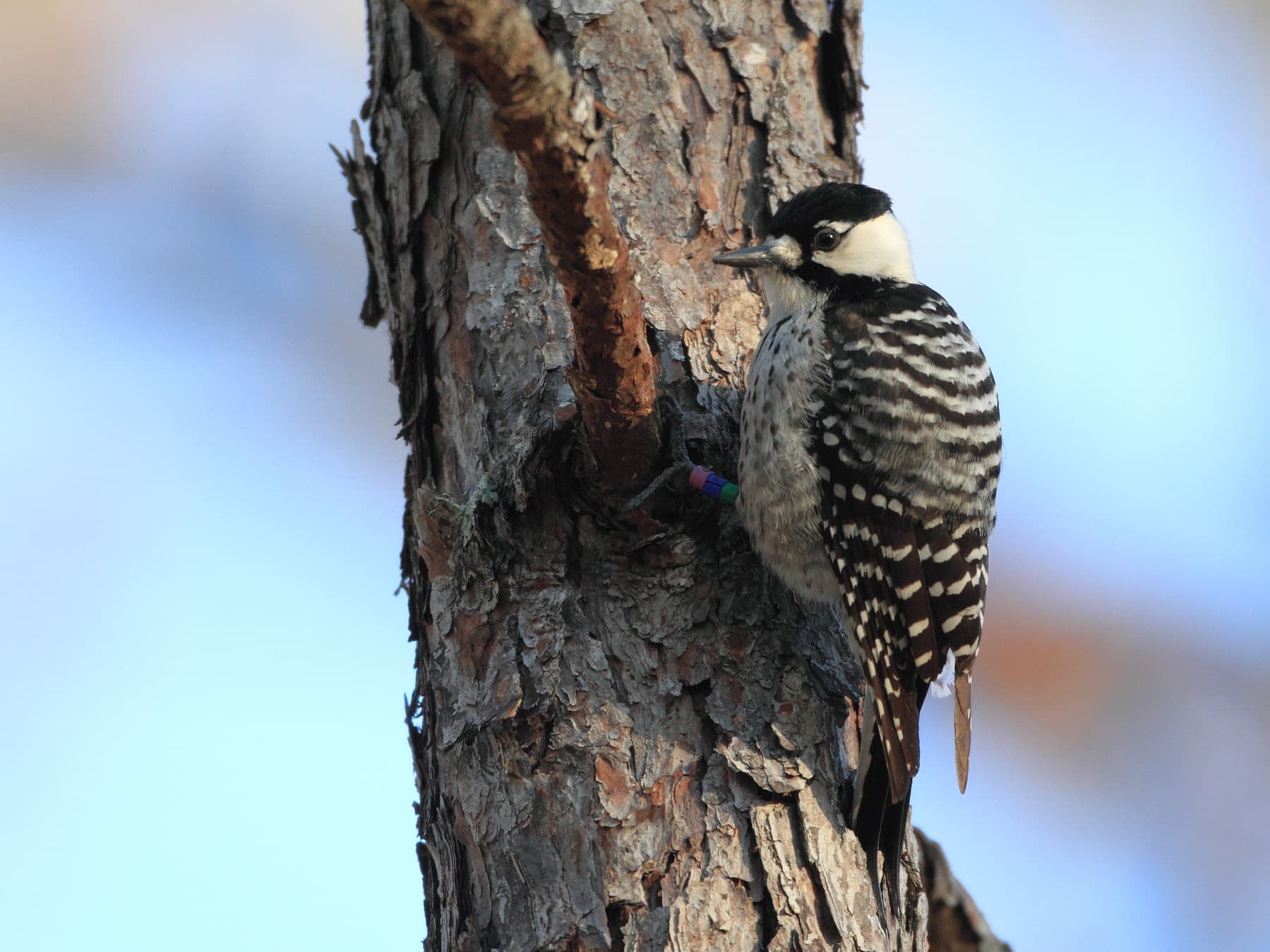
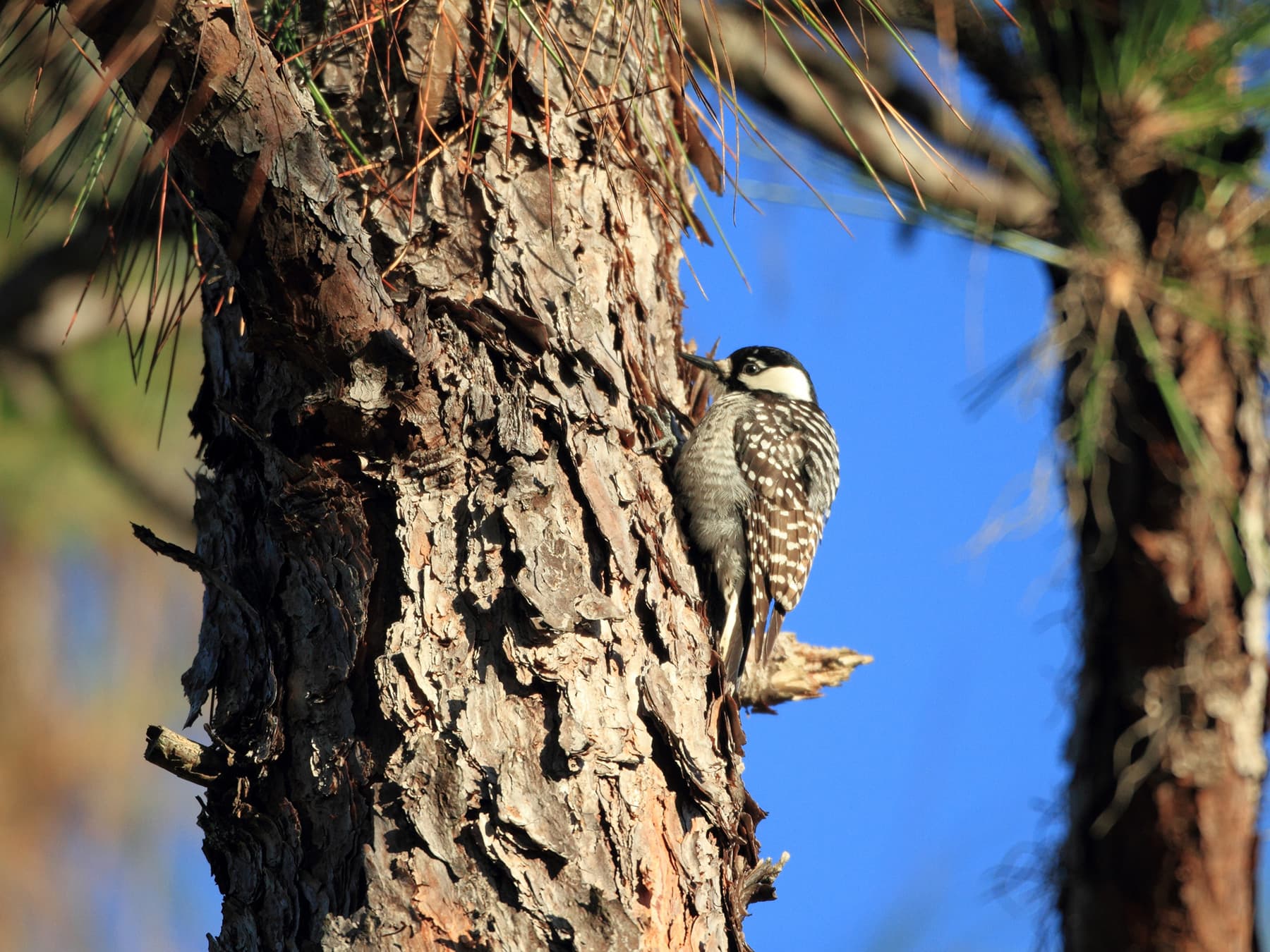
Male red-cockaded woodpeckers may have a tiny red splash of color on the side of their head, but this is difficult to spot in the field and is not always present. Apart from this, their plumage is entirely black and white, with a black crown and nape, a heavily barred black and white back and tail, and a black bar beneath a bold white cheek. The breast and belly are also white, and black spots mark the sides of the breast and the flanks.
In female red-cockaded woodpeckers, the small red facial patch is absent, and the sexes are otherwise alike and reliably cannot be told apart. Both have a short black bill, chestnut brown eyes, and gray legs and feet.
Juveniles have the same patterning as adults but are less glossy and their plumage has a sepia wash. Young males have a crimson patch on their crown, which is no longer evident when they reach maturity.
How big are Red-cockaded Woodpeckers?
Red-cockaded woodpeckers slot in between the larger hairy woodpeckers and the smaller downy woodpeckers in size order. No significant difference between the sizes of males and females is observed.
- Length: 18–23 cm (7.1–9.1 in)
- Wingspan: 34 cm to 41 cm (13 in to 16 in)
- Weight: 40 g to 56 g (1.4 oz to 2 oz)
Its size
Adults- Length
- 20–23 cm
- Wingspan
- 35–38 cm
- Weight
- 40–55 g
Its song and calls
What sound does a Red-cockaded Woodpecker make?
Noisy, chattering groups of red-cockaded woodpeckers are often the first sign that a cluster of nest cavities is nearby. A long ‘sklit’ note is heard as a warning alert, and a loud, buzzy ‘churt’ is used as a contact call between family members.
- Recording0:00 / 3:17
When and where to see it
OctoberArriving
Most recorded in October
- 1. Louisianaunder 0.1%
- 2. South Carolinaunder 0.1%
- 3. North Carolinaunder 0.1%
- 4. Arkansasunder 0.1%
- 5. Floridaunder 0.1%
Each dot is a county, state or province: the bigger and darker, the larger the bird’s share of that place’s bird records that month. Grey dots: no regular records. The ringed point is the centre of the bird’s records this month; the arrow shows how it moved since last month, and the dashed loop its path through the year. “Arrivals” colours places where it becomes regular this month (orange) or is in its last regular month (grey). GBIF eBird Observation Dataset, 2019–2024. Map data: Natural Earth, US Census Bureau; place centres © OpenStreetMap contributors.
In your area
See when the Red-cockaded Woodpecker is recorded in your county, state or province.
How often the Red-cockaded Woodpecker turns up in the United States through the year, from birdwatchers' records.
United States
Resident · all year · most records in January
Show as a table
| Month | United States |
|---|---|
| January | 0.007% (regular) |
| February | 0.007% (regular) |
| March | 0.006% (regular) |
| April | 0.006% (regular) |
| May | 0.004% (regular) |
| June | 0.004% (regular) |
| July | 0.003% (regular) |
| August | 0.002% (regular) |
| September | 0.002% (regular) |
| October | 0.003% (regular) |
| November | 0.004% (regular) |
| December | 0.005% (regular) |
Worldwide: recorded regularly in 1 country
Countries where it was recorded in at least 3 of the 6 years 2019–2024. Linked countries have their own bird list.
North America (1)
Data: EOD – eBird Observation Dataset (Cornell Lab of Ornithology), accessed via GBIF.org, CC BY 4.0. Records from 2019–2024, aggregated and filtered by Birdfact. How these lists are made
What is the habitat of a Red-cockaded Woodpecker?
Pine savannas, with longleaf and other southern pine species, are vital to the survival of red-cockaded woodpeckers. Mature forests at elevations ranging from sea level to 850 m are perfect habitats. In particular, they target trees that are infected by red heart fungus. The presence of this fungus weakens the inner wood of the tree, making it easier to excavate.
What is the range of a Red-cockaded Woodpecker?
Red-cockaded woodpeckers have a fragmented distribution range and are currently found in scattered woodlands from Virginia in the north, Florida in the south, and Arkansas, Oklahoma, and Texas in the west.
Today’s range is greatly contracted compared to the historical range of the species when it extended as far north as New Jersey and Maryland and as far inland as Missouri, Tennessee, and Kentucky.
Where do Red-cockaded Woodpeckers live?
Florida and South Carolina have the highest numbers of red-cockaded woodpeckers on state lands, while private lands in Georgia, South Carolina, and Florida also support further notable populations.
How rare are Red-cockaded Woodpeckers?
Red-cockaded woodpeckers are rarely spotted, and with a population of only around 15,000 remaining across a very scattered geographical area, sightings are scarce. Today’s population represents only around 1 percent of the previous population when the species was widespread across Kentucky, Maryland, Missouri, New Jersey, and Tennessee.
Where can you see Red-cockaded Woodpeckers in the US?
Florida’s Apalachicola National Forest is known for its sizable population of red-cockaded woodpeckers, and sightings are most regularly reported from the western part of the forest.
Blackwater River State Forest has introduced a program to promote the recovery of the local population of red-cockaded woodpeckers. They are particularly visible from April to July when nesting activity is at its peak.
Where can you see Red-cockaded Woodpeckers in Canada?
Red-cockaded woodpeckers are not resident in Canada, with the US states of Virginia and Kentucky forming the northernmost limits of their normal range. Even before the recent large-scale population declines of the 20th century, the species was not found as far north as Canada.
Migration
Do Red-cockaded Woodpeckers migrate?
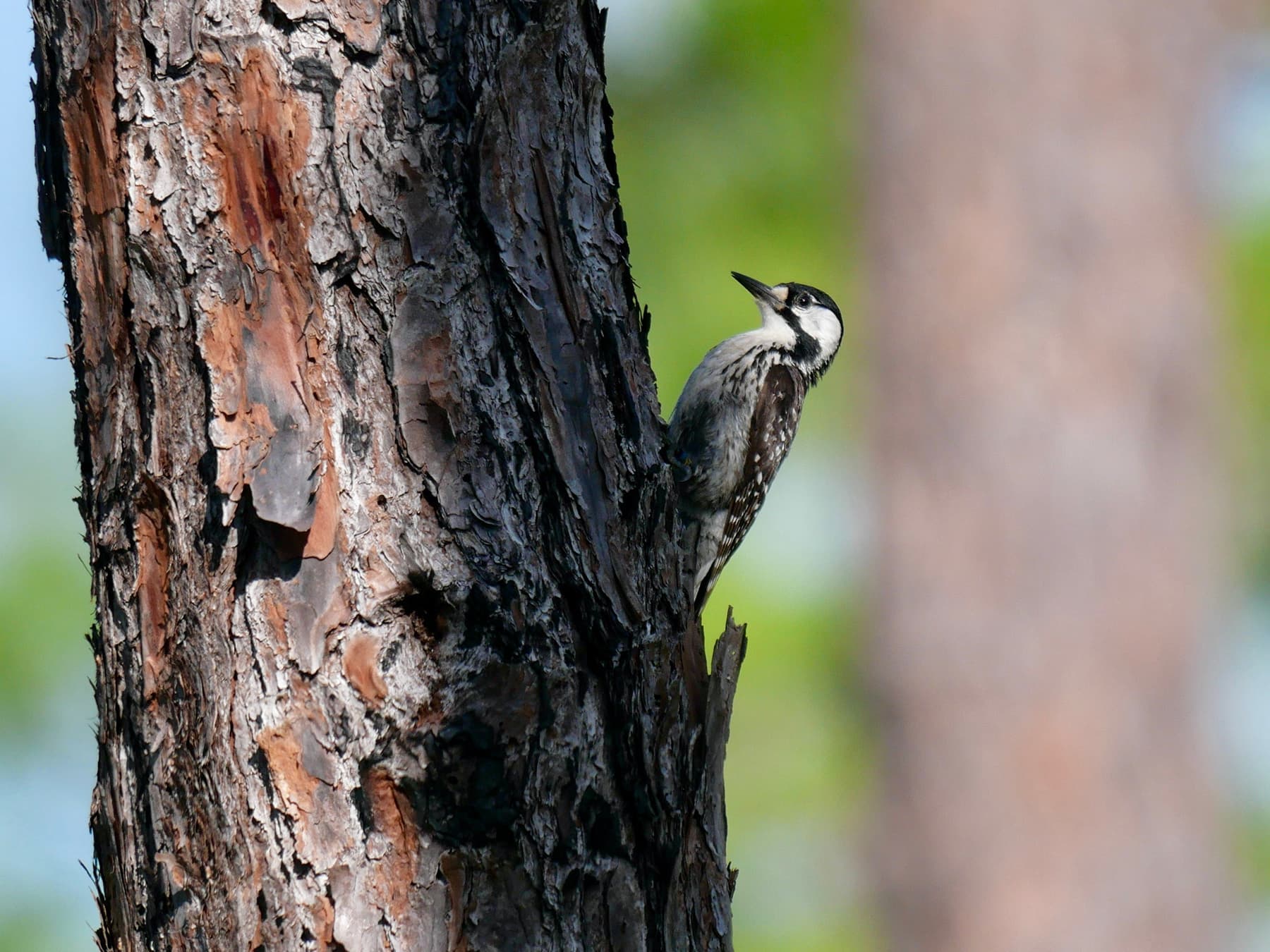
Red-cockaded woodpeckers are a nonmigratory species and remain in their cluster groups all year round, with little movement from their breeding grounds.
Are Red-cockaded Woodpeckers native to the US?
Today, red-cockaded woodpeckers are only found in eastern and southern regions of the United States, where their population is fragmented across scattered mature pine forests.
Tips for seeing it
- Look for them in mature pine forests, especially longleaf pine ecosystems
- Listen for their distinctive call, a sharp 'sklit'
- Search for their unique cavity nests surrounded by resin wells
- Observe early in the morning when they're most active
- Join guided tours in protected areas like national forests
What it eats
What do Red-cockaded Woodpeckers eat?
Insects, other invertebrates, and their larvae are the most important food source for red-cockaded woodpeckers, with ants forming up to 70 percent of their diet. Southern pine beetles and bark beetles are also frequently eaten. Prey is found by foraging on branches, with males tending to forage at higher altitudes than females. Red-cockaded woodpeckers use their bills to pick off sections of bark to access insect life below.
Some seeds and fruit may also be eaten, including pine seeds, wild cherry, pokeberry, magnolia, poison ivy, blueberry, and black gum.
What do Red-cockaded Woodpecker chicks eat?
Larvae, centipedes, and wood roaches are fed to young red-cockaded woodpeckers by both parents, as well as by male helper birds at their nest cluster.
Nesting and breeding
Where do Red-cockaded Woodpeckers nest?
Cavity excavation takes between 1 and 3 years, and due to this protracted carving process, the existing roost cavity of the male is chosen as the nest site. Small holes, or sap wells, are drilled around the nest opening, out of which pine resin oozes down the trunk and acts as a deterrent for predators.
Red-cockaded woodpeckers are cooperative breeders and live in family groups, with several cavity trees located in close proximity. These ‘clusters’ offer nesting spots for breeding pairs and roosting sites for nonbreeders and helpers within the group.
Conservation efforts include the creation of artificial nest chambers within existing clusters, as well as action to restrict existing nest cavities of red-cockaded woodpeckers’ from being enlarged or altered and then taken over by other species.
When do Red-cockaded Woodpeckers nest?
Eggs are usually laid in April, and one of the shortest avian incubation periods follows, with young hatching within 10 or 11 days. Both parents share incubation, with males taking a larger portion and always the overnight shift. Helper birds within the cluster will also frequently assist with incubation. Fledging takes place between 24 and 27 days, and the young remain associated with their parents for several months.
What do Red-cockaded Woodpecker eggs look like?
A typical red-cockaded woodpecker’s clutch consists of between 1 and 5 shiny white eggs, which measure 24 mm by 18 mm (0.9 in by 0.8 in).
Do Red-cockaded Woodpeckers mate for life?
Bonds between red-cockaded woodpeckers are monogamous and usually last for several breeding seasons. However, sometimes individuals may change mates from year to year.
Behaviour
Are Red-cockaded Woodpeckers aggressive?
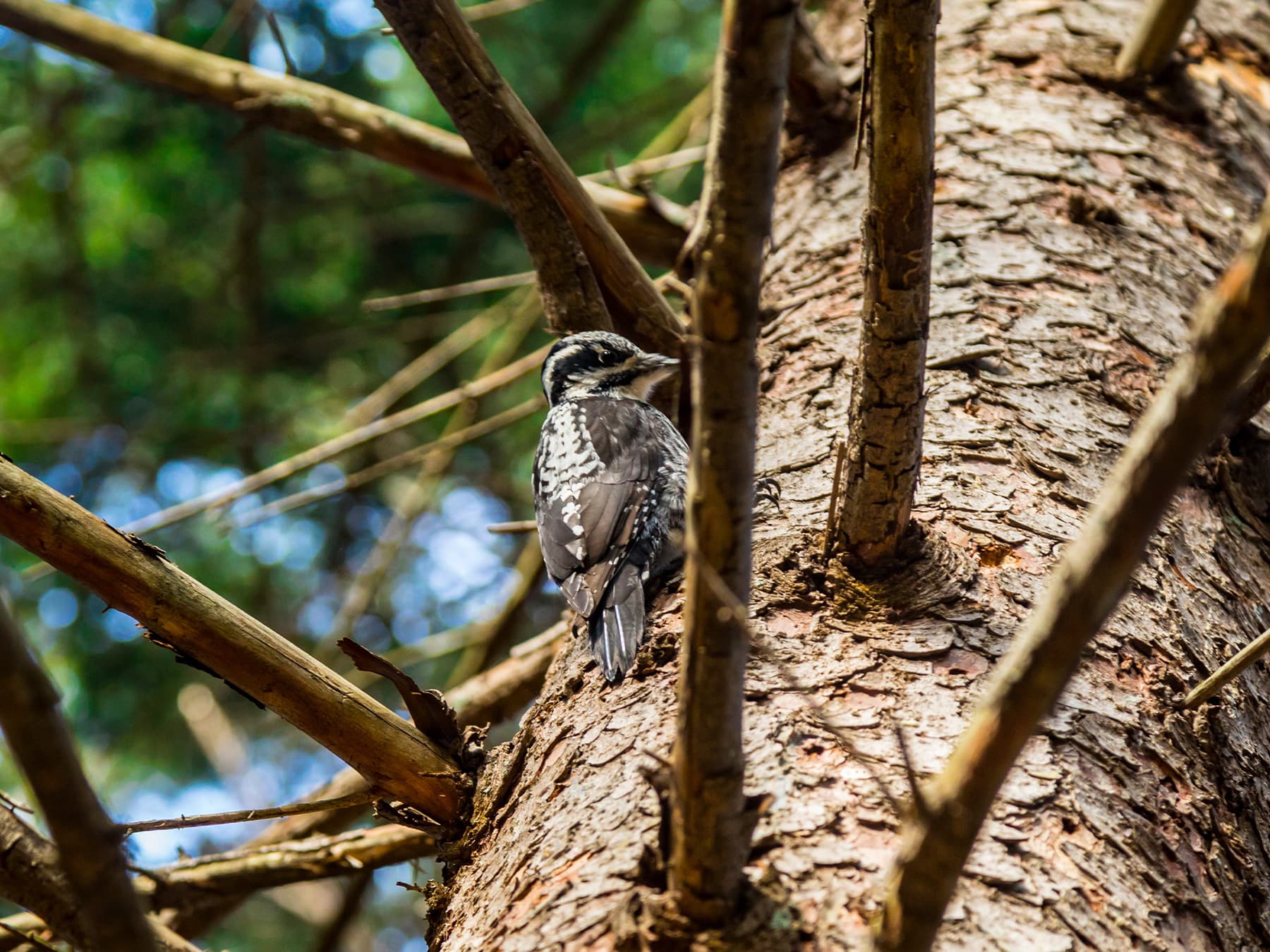
Although they are a territorial species, red-cockaded woodpeckers are also cooperative breeders, living in small groups with nonbreeding individuals helping to raise young. Group members are tolerated, and unite to chase off any intruders, using jabbing and posturing to reinforce their territory.
Where do Red-cockaded Woodpeckers sleep at night?
Red-cockaded woodpeckers roost in individual cavities hollowed out in the trunks of pines, but may also use chambers carved out by other species or natural hollows in trees. If no suitable roosting cavity is available, a sheltered spot under a tree limb may be chosen.
Lifespan and predators
How long do Red-cockaded Woodpeckers live?
The oldest recorded red-cockaded woodpecker, identified through banding programs, was 18 years old, although average life expectancy is thought to be significantly lower. Birds are able to breed for the first time in their first year, and one brood per year is raised.
What are the predators of Red-cockaded Woodpeckers?
Corn snakes and rat snakes are predators of nest cavities, although the defense tactic of letting fresh pine resin spill around nest openings does help to prevent unwanted visitors from gaining access. Eastern screech owls, American kestrels, and southern flying squirrels are other known predators.
Are Red-cockaded Woodpeckers protected?
As well as being protected by the Migratory Bird Treaty Act of 1918, red-cockaded woodpeckers are identified under the federal Endangered Species Act of 1973. This additional level of protection is justified because of the serious threat to the future survival of the species because of extensive habitat loss.
Are Red-cockaded Woodpeckers endangered?
Red-cockaded woodpeckers have already become locally extinct in a number of states, including Missouri, Maryland, Tennessee, New Jersey, and Kentucky.
Their official conservation status is Near Threatened, and some intensive species recovery plans have been introduced to safeguard their future. Since 1992, some reversal to the decline has begun to show as a result of forest management schemes.
Conservation
The Red-cockaded Woodpecker is listed as Near Threatened due to habitat loss and fragmentation.
Conservation efforts focus on preserving and managing mature pine forests, particularly longleaf pine ecosystems. Artificial cavity construction and controlled burns are key management techniques for supporting populations.
Similar birds
Often mistaken for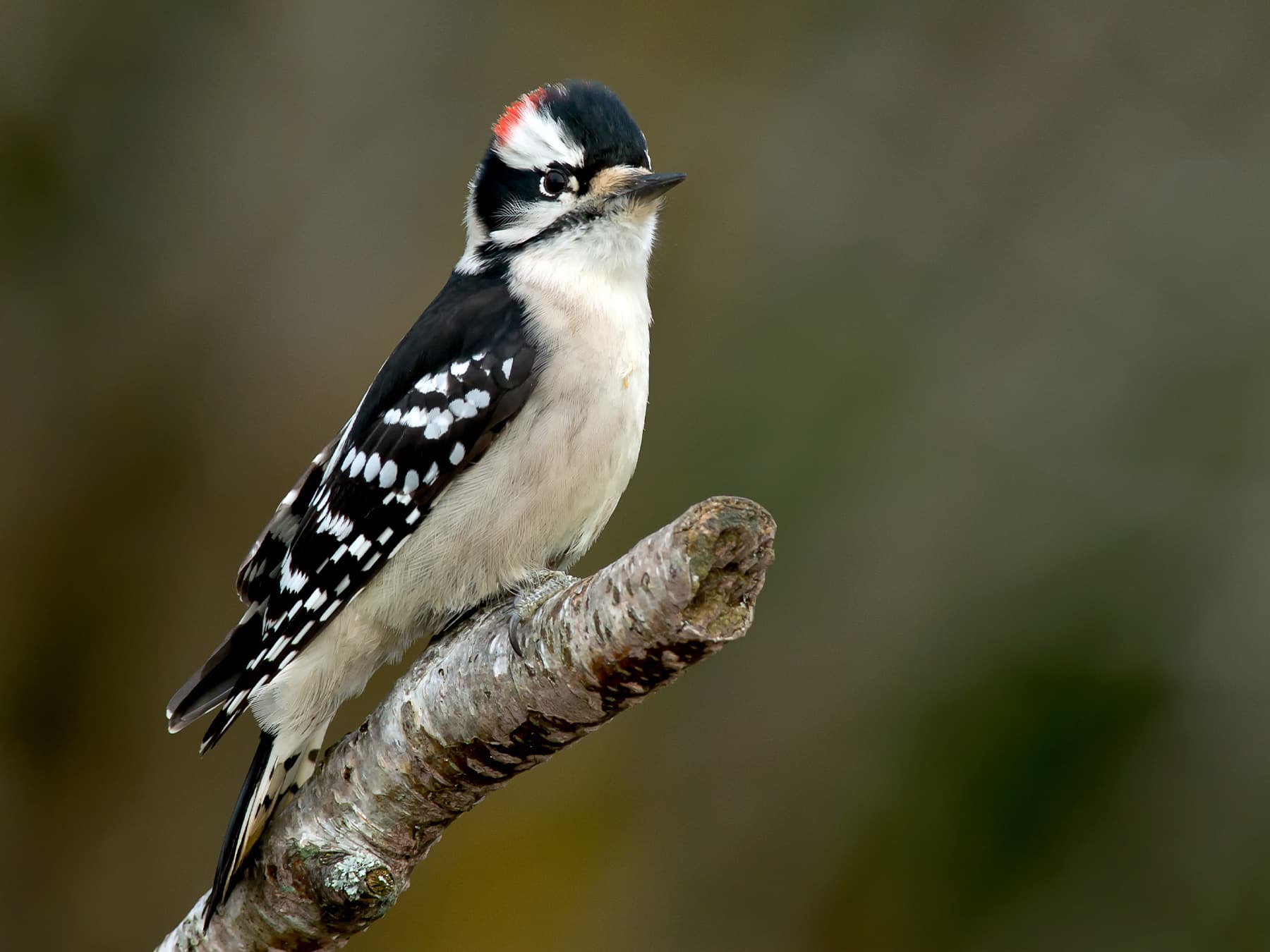
Quick facts
- Length
- 20–23 cm
- Wingspan
- 35–38 cm
- Weight
- 40–55 g
- Lifespan
- 10–12 years · oldest recorded 16.1 years
- Family
- Woodpeckers
- Migration
- Resident
- Global status (IUCN)
- Near Threatened
- World population
- 19,0000 mature individuals
- Population trend
- Decreasing
- Also called
- RCW
- Scientific name
- Leuconotopicus borealis
Questions
6What attracts Red-cockaded Woodpeckers?
Red-cockaded woodpeckers are attracted to large mature pines, in open, park-like woodlands and savannas. Fruit and berry trees also provide a welcome additional foraging ground, so yards planted with grapes, hackberries, elderberries, and bayberries may also bring these rare visitors to your garden.
What trees do Red-cockaded Woodpeckers prefer?
Mature longleaf pine forests are vital to the survival of red-cockaded woodpeckers. Other important species include loblolly, slash, shortleaf, Virginia, pitch, and pond pines.
Do Red-cockaded Woodpeckers harm trees?
Red-cockaded woodpeckers are unique among woodpeckers in that they excavate cavities in living trees rather than dead or dying ones. However, they frequently choose trees that are infected with a red heart fungus, making the heartwood softer to drill into, so it can be argued that the trees they use are already at risk.
The presence of woodpeckers can both cause damage and bring multiple benefits to a forest – Holes drilled into trees can weaken the trunk and cause disease and infestations to spread, but woodpeckers balance this by keeping insect populations under control and increasing biodiversity.
Do Red-cockaded Woodpeckers go to bird feeders?
Red-cockaded woodpeckers are occasional visitors to backyard feeders near their home territory, where they feed on suet.
What is the difference between a downy woodpecker and a red-cockaded woodpecker?
Downy woodpeckers are noticeably smaller than red-cockaded woodpeckers, and have a much wider range, covering almost the entire United States and much of Canada.
Visually they are reasonably similar looking, although the red patch on the rear of a downy woodpecker’s head is more prominent than the small red spot on the side of a red-cockaded woodpecker’s head. Red-cockaded woodpeckers have speckled flanks and a pure white cheek, while in downy woodpeckers, the cheek features a bold black patch and their flanks are plain white.
What do red-cockaded woodpeckers do for the environment?
Known as a keystone species, red-cockaded woodpeckers are vital to their local ecosystems. Their nest cavities offer valuable habitats for other species, including eastern bluebirds, flying squirrels, corn snakes, and barking tree frogs.
Their disused cavities can also be modified into larger spaces by northern flickers and pileated woodpeckers, which are then useful for even more species, including eastern screech owls, bats, and honeybees.
Sources
4- 1Longevity Records Of North American Birds. Version 2023.1 Source (opens in a new tab)
- 2BirdLife International. 2020. Leuconotopicus borealis. The IUCN Red List of Threatened Species 2020: e.T22681158A179376787. Source (opens in a new tab)
- 3Rosenberg et al. (2016)
- 4Partners in Flight (2019) Source (opens in a new tab)

Checked by
Nathan Cope, founder and editor
Nathan founded Birdfact and leads its writers and contributors in the UK, the US and Canada. He has watched and studied birds for more than ten years, and checks every article and species guide before it’s published.