


Purple Sandpiper
Calidris maritima
By the Birdfact teamChecked by Nathan Cope
On this page14 sections
How to recognise it
What do Purple Sandpipers look like?
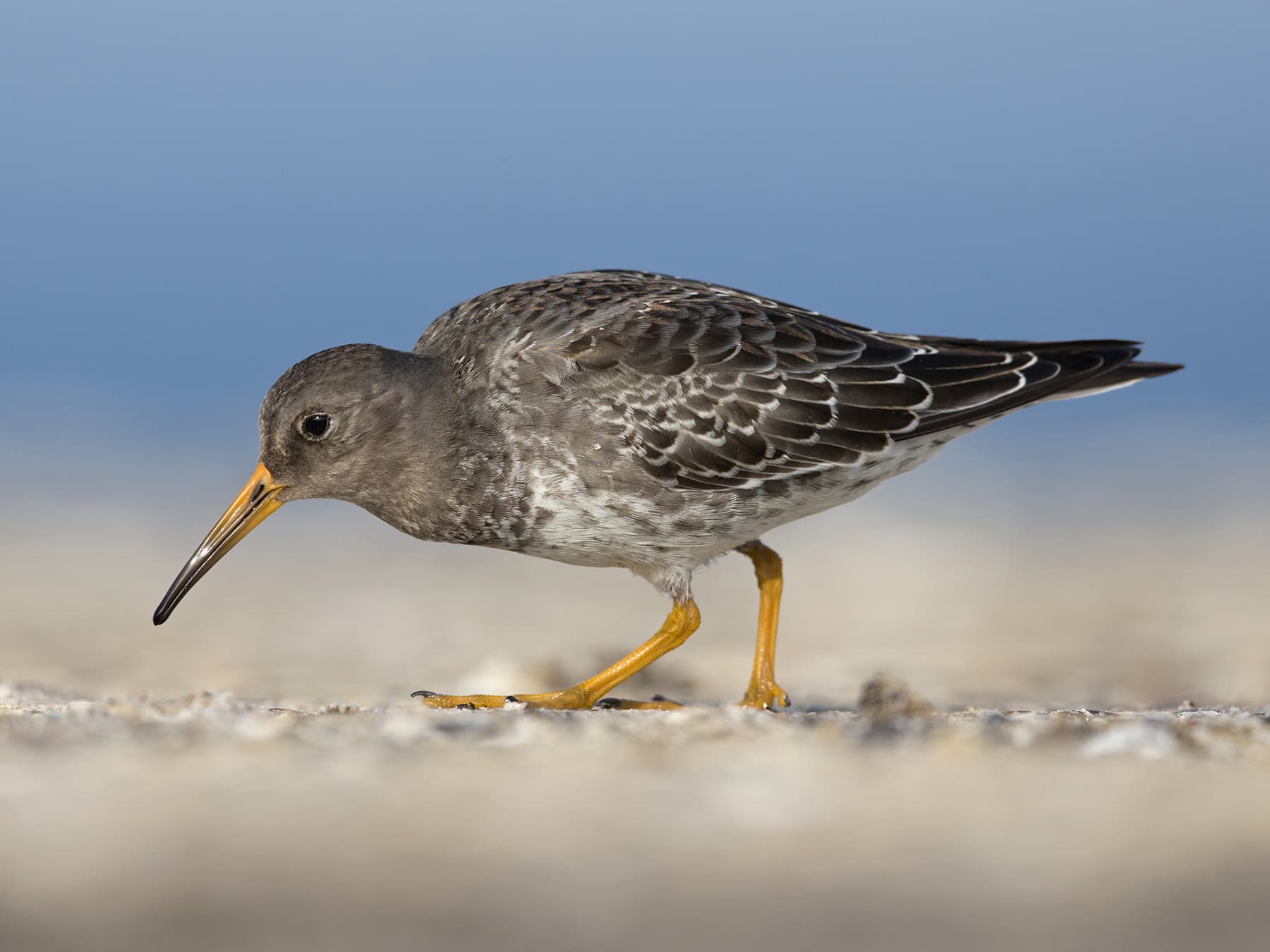
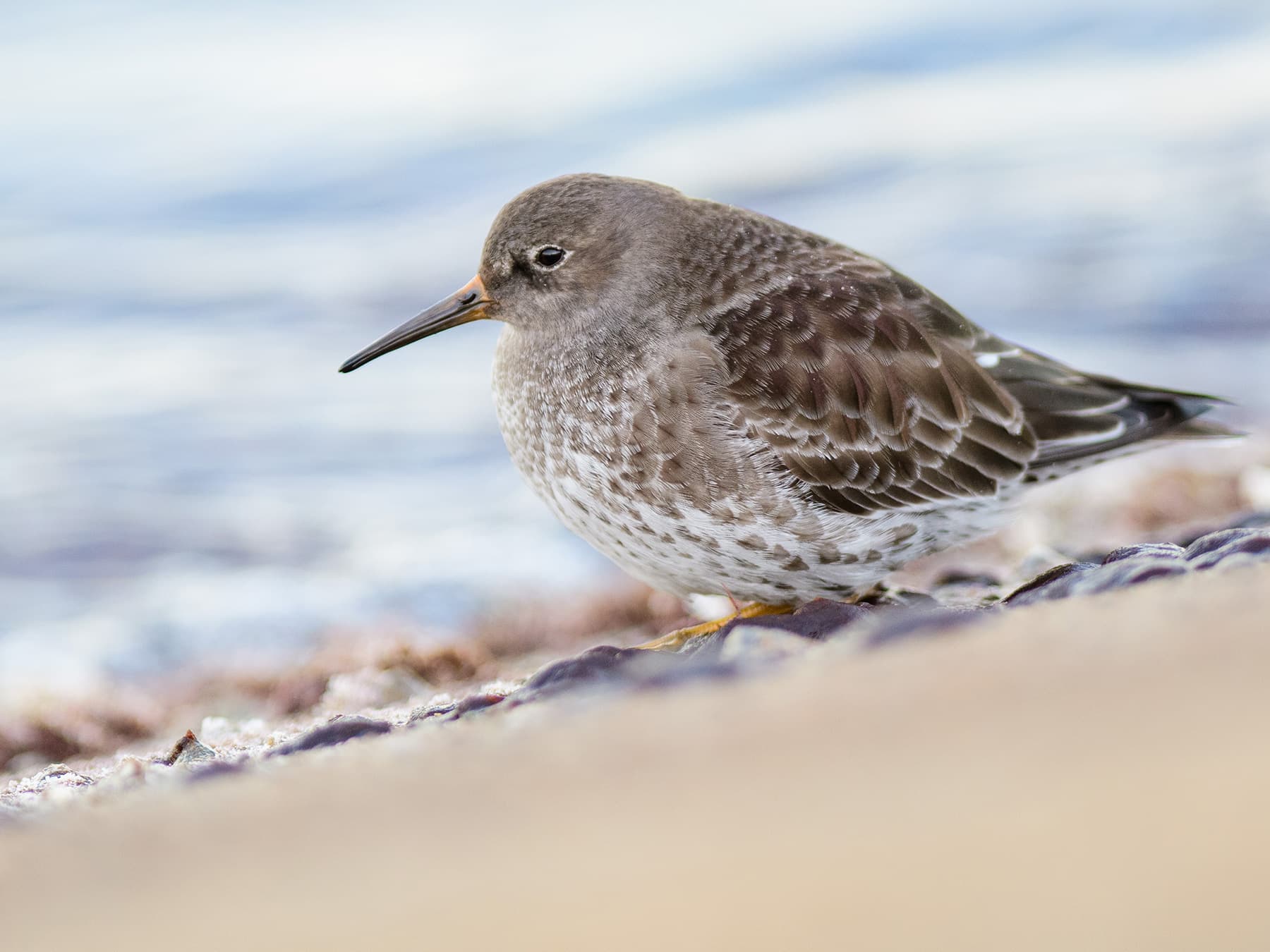
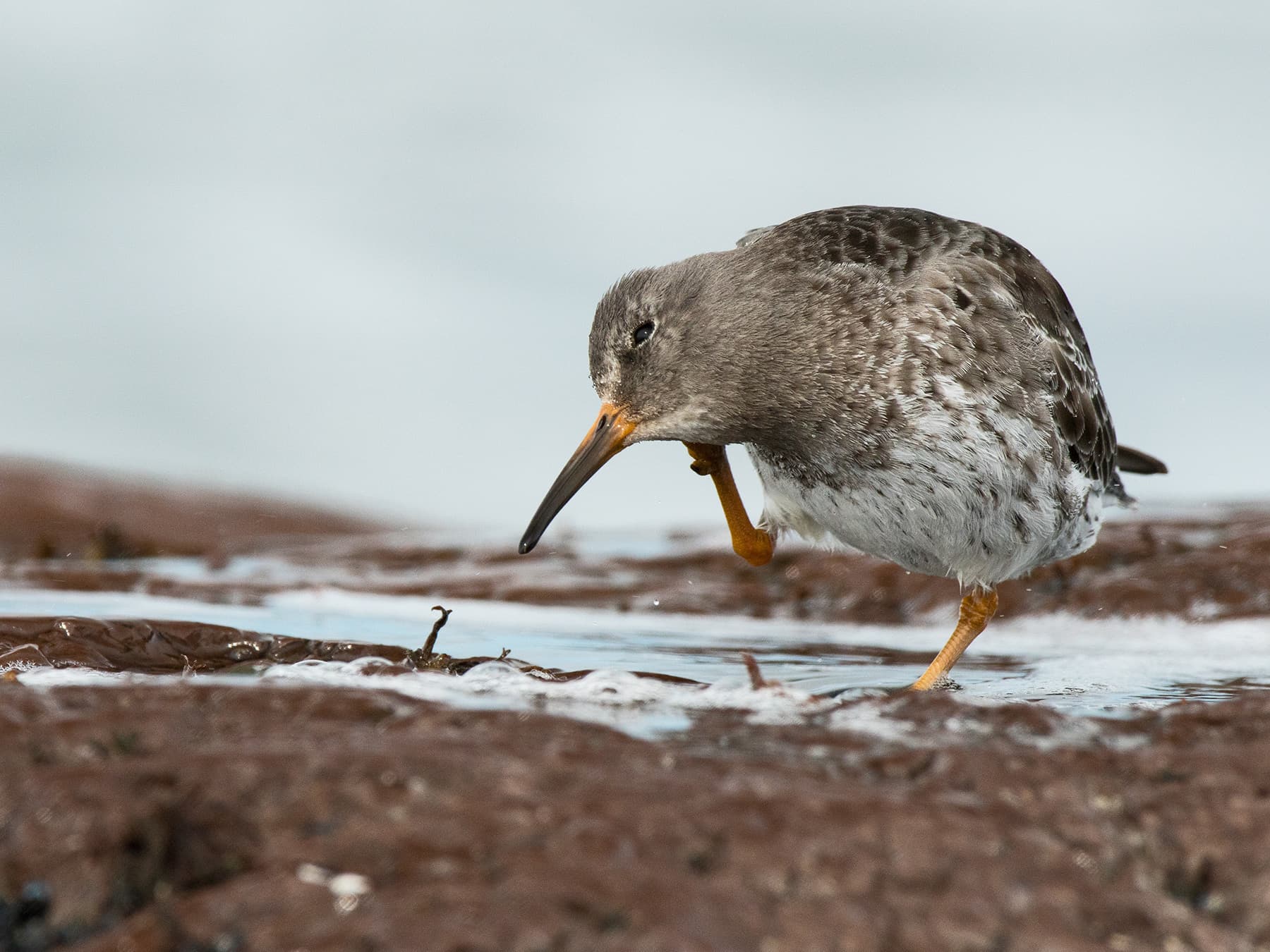
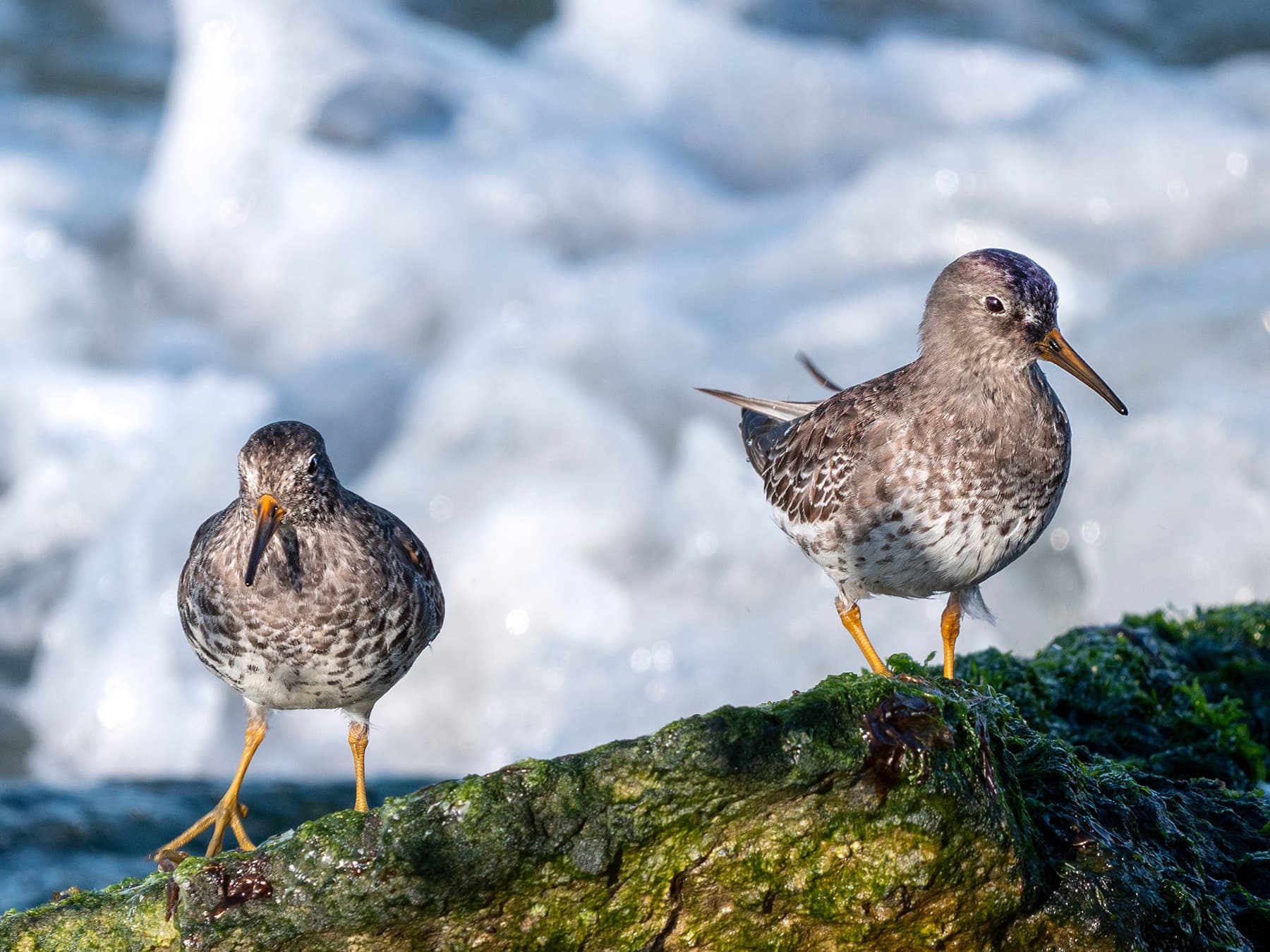
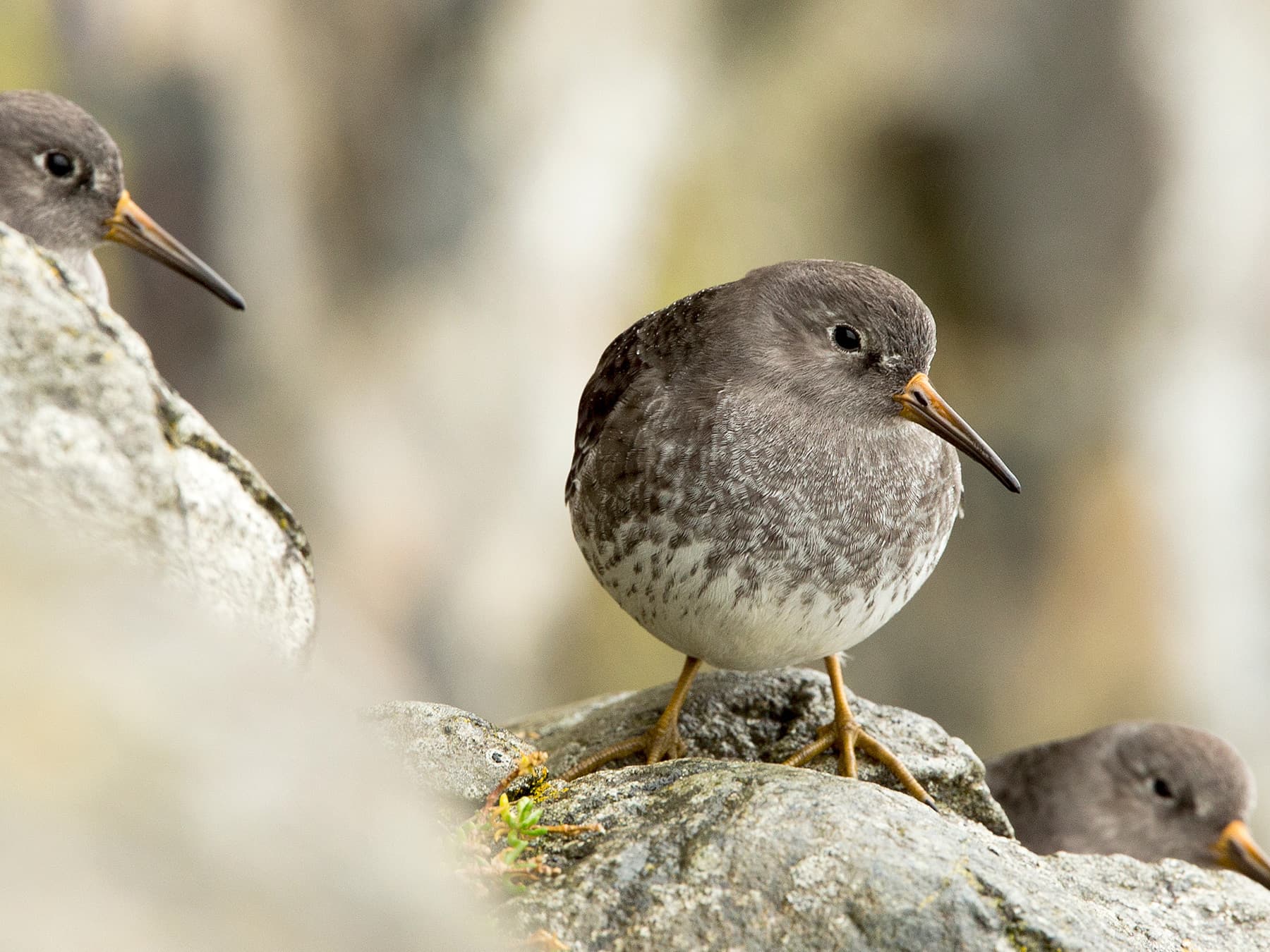
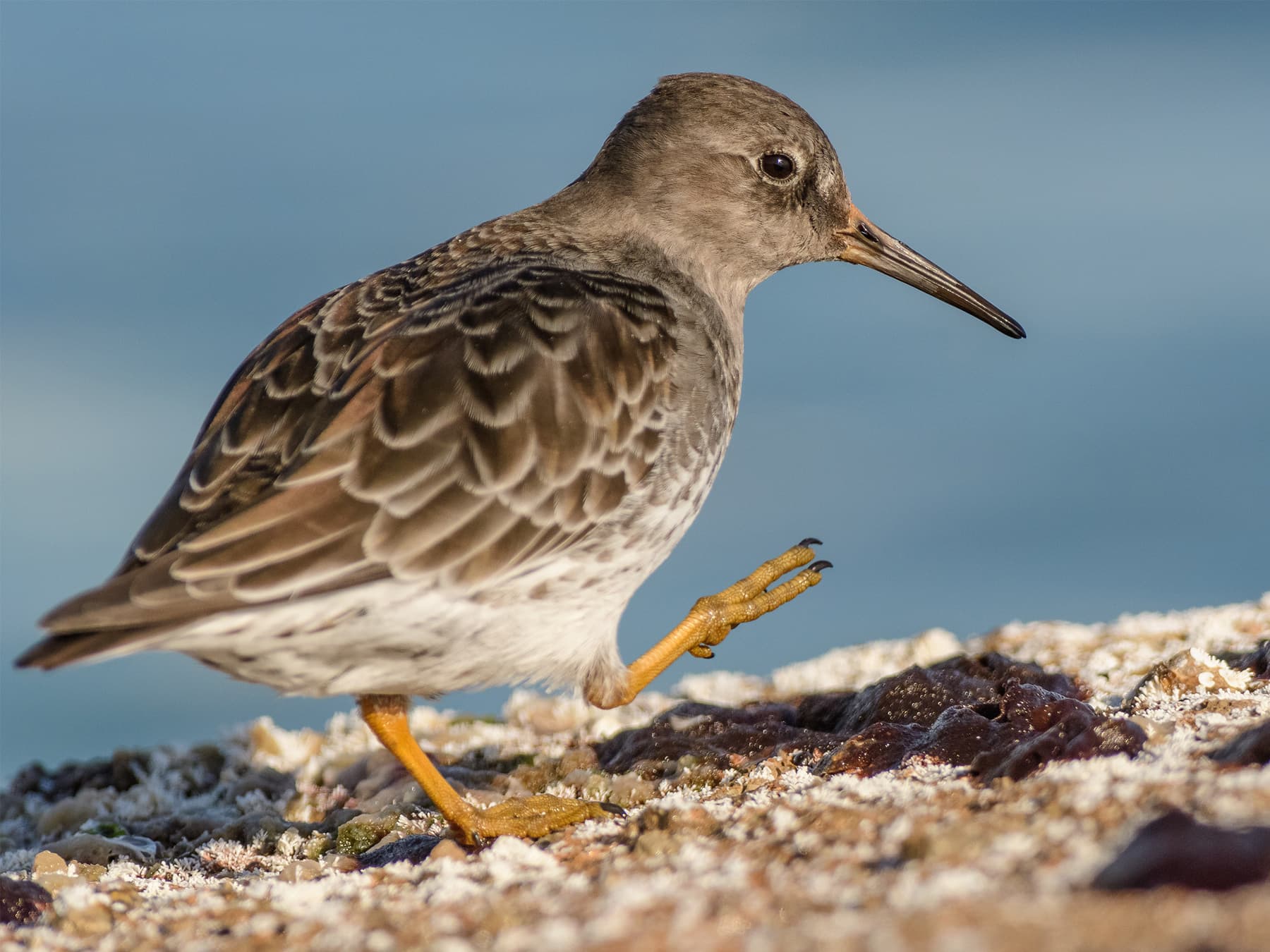
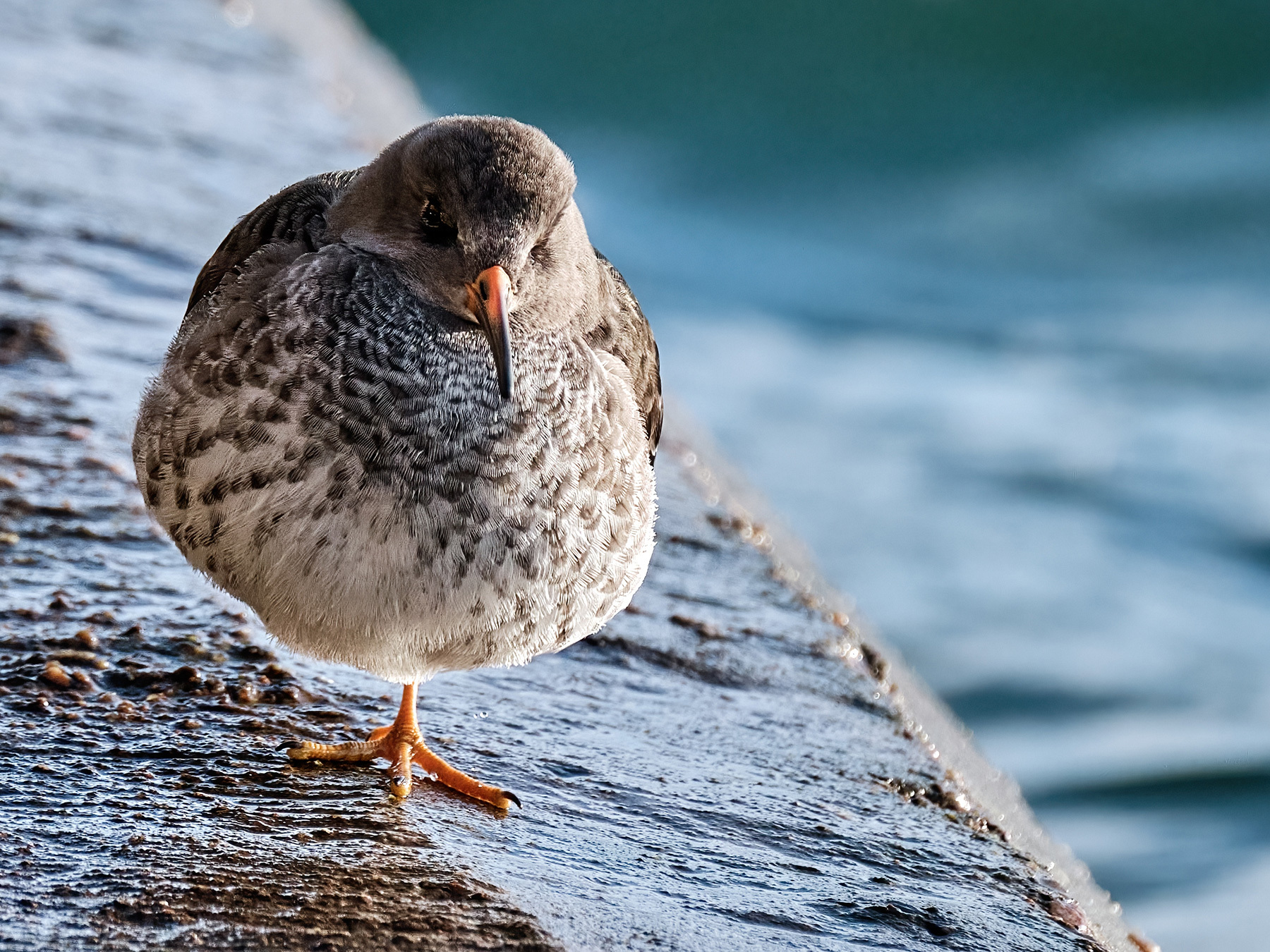
Despite their colorful name, a vibrant purple plumage is not a distinguishing feature of this chunky shorebird. Instead, their appearance is rather drab: mostly pale gray in winter, with mottled gray and white underparts, yellow legs and a yellow, slightly downcurved bill that darkens to gray towards the tip.
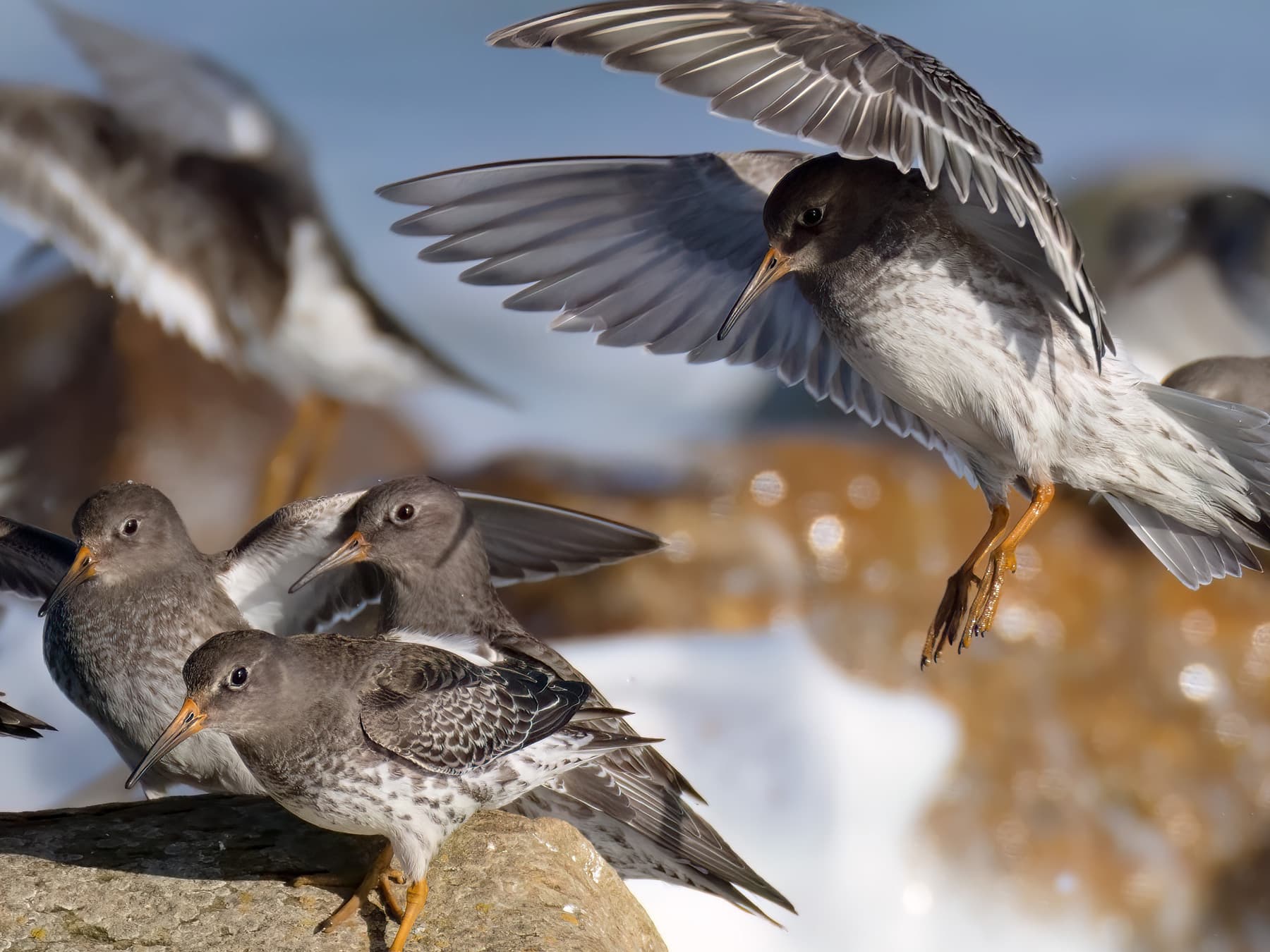
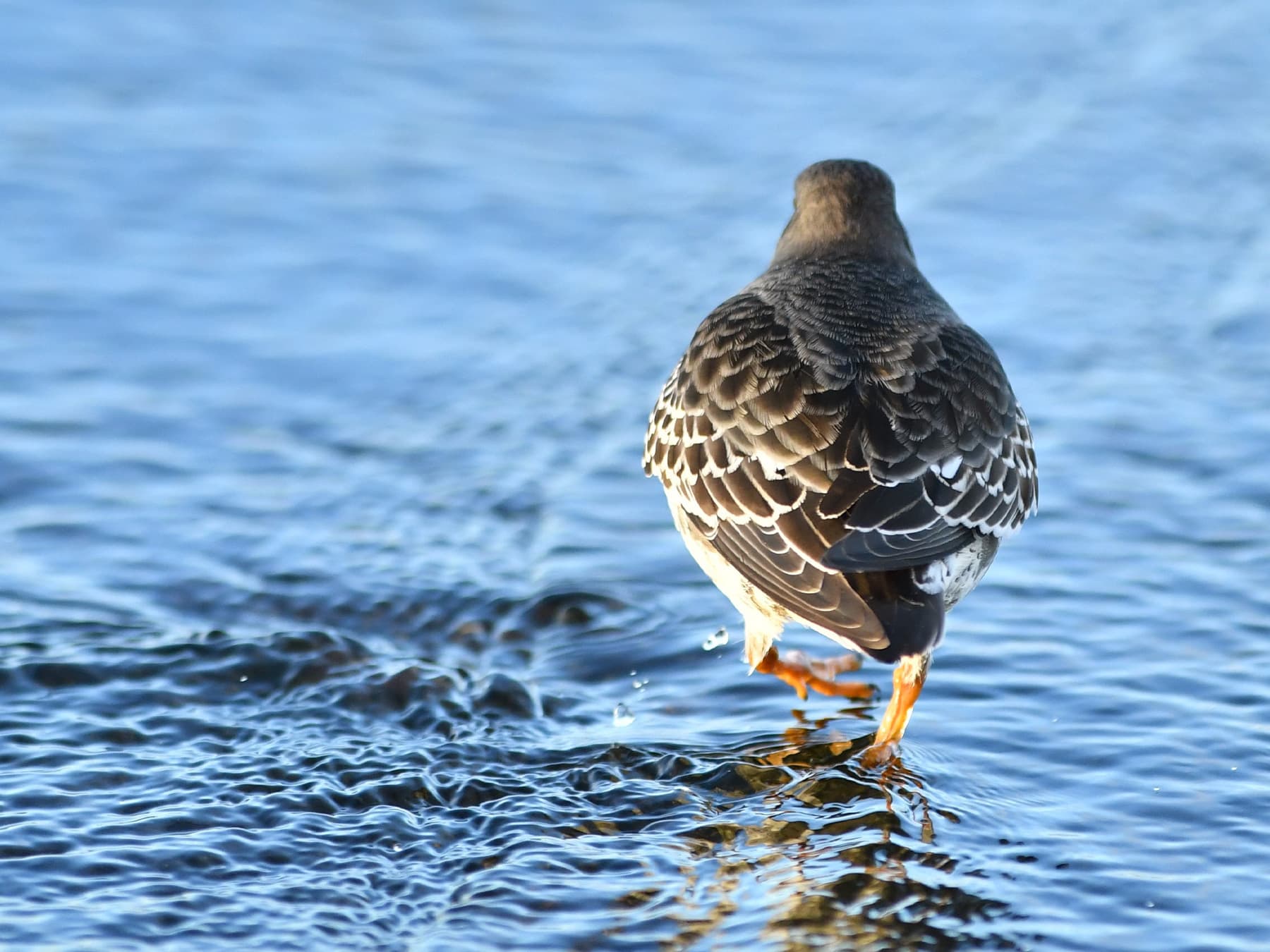
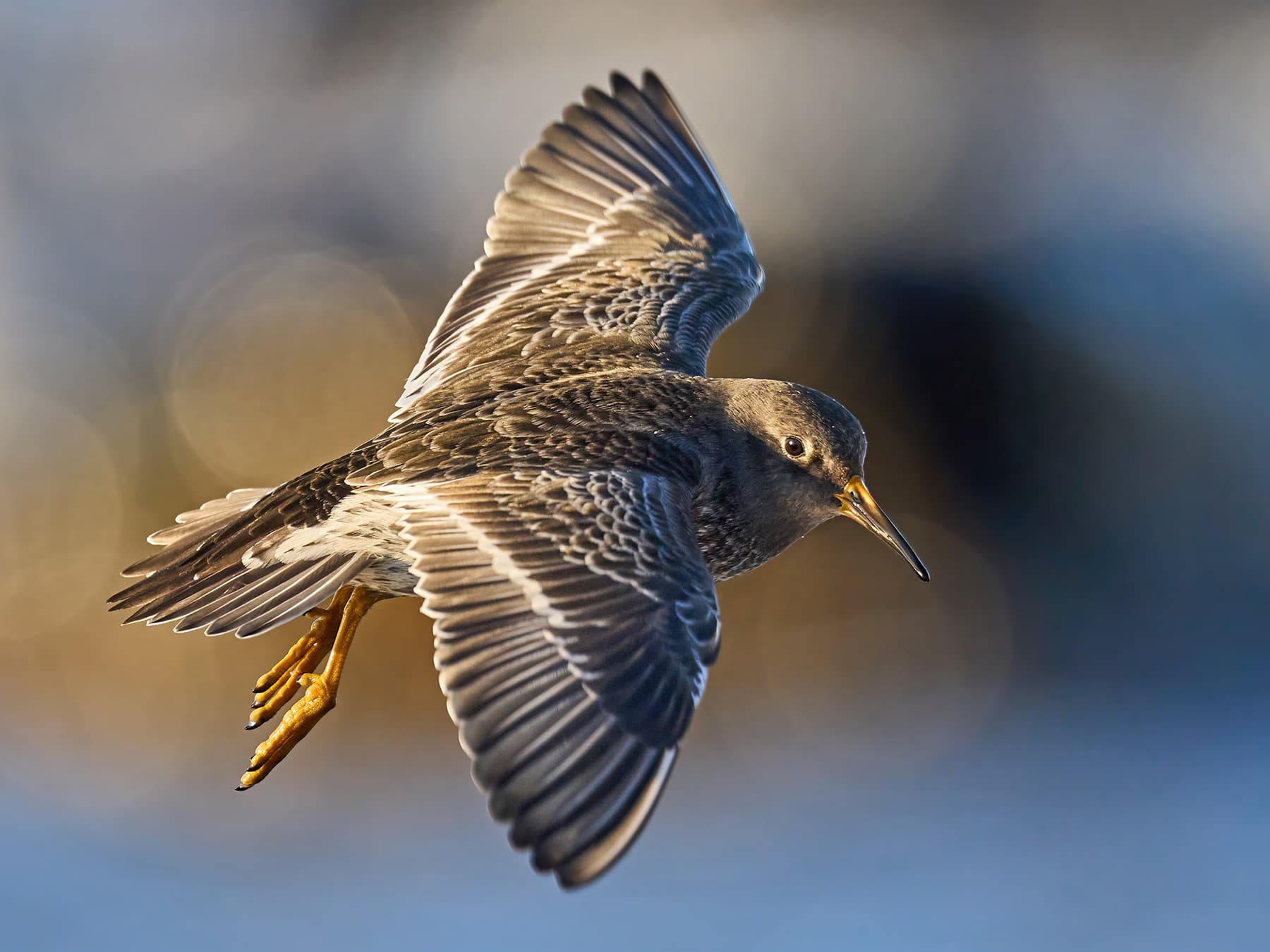
Wings have a scaly appearance, with lighter edging creating overlapping patterning, and in some lights, a faint purple wash may be visible. A white wing stripe is visible in flight.
In summer, purple sandpipers develop a brighter set of feathers, with rufous and chestnut markings becoming visible on the upper wings, and browner speckling being a distinctive feature of their pale breast.
Male and female purple sandpipers are alike in coloring, although females tend to be slightly larger, with longer bills.
Juvenile purple sandpipers resemble breeding adults, with more chestnut fringing visible on their backs and upper wings, and a darker gray breast, more heavily mottled with gray-brown spotting.
How big are Purple Sandpipers?
Purple sandpipers are medium-sized waders, with rounded stocky bodies. Their relatively short legs give them a squat, thick-set appearance. Females are larger than males, with longer bills, but the differences are not always immediately clear in the field.
- Length: 20 cm to 22 cm (7.9 in to 8.7 in)
- Wingspan: 40 cm to 44 cm (15.7 in to 17.3 in)
- Weight: 60 g to 75 g (2.1 oz to 2.6 oz)
Its size
Adults- Length
- 20–22 cm
- Wingspan
- 42–46 cm
- Weight
- 50–110 g
Its song and calls
What sound does a Purple Sandpiper make?
One particularly common call of a purple sandpiper is a chuckling, rolling song, which is repeated as a series of grating notes. Contact calls are a squeaky, rasping call that sounds like a harsh ‘keer’. Flight calls are also distinct and low in pitch, making a ‘kip’ sound.
- Call0:00 / 0:12
Recorded in Kalmar län, Sweden · May 2024
When and where to see it
OctoberIn season
Most recorded in October
- 1. Orkney Islands0.73%
- 2. Aberdeen0.48%
- 3. Derry0.40%
- 4. Moray0.32%
- 5. Northumberland0.27%
Each dot is a county, state or province: the bigger and darker, the larger the bird’s share of that place’s bird records that month. Grey dots: no regular records. The ringed point is the centre of the bird’s records this month; the arrow shows how it moved since last month, and the dashed loop its path through the year. “Arrivals” colours places where it becomes regular this month (orange) or is in its last regular month (grey). GBIF eBird Observation Dataset, 2019–2024. Map data: Natural Earth, US Census Bureau; place centres © OpenStreetMap contributors.
In your area
See when the Purple Sandpiper is recorded in your county, state or province.
How often the Purple Sandpiper turns up in the UK, Ireland, the United States and Canada through the year, from birdwatchers' records.
United Kingdom
Winter visitor · regularly Aug–May · most records in November
Ireland
Winter visitor · regularly Sep–May · most records in January
United States
Winter visitor · regularly Nov–May · most records in January
Canada
Winter visitor · regularly Oct–May · most records in November
Show as a table
| Month | United Kingdom | Ireland | United States | Canada |
|---|---|---|---|---|
| January | 0.070% (regular) | 0.19% (regular) | 0.026% (regular) | 0.021% (regular) |
| February | 0.057% (regular) | 0.15% (regular) | 0.017% (regular) | 0.015% (regular) |
| March | 0.037% (regular) | 0.11% (regular) | 0.008% (regular) | 0.012% (regular) |
| April | 0.025% (regular) | 0.060% (regular) | 0.002% (regular) | 0.006% (regular) |
| May | 0.008% (regular) | 0.019% (regular) | 0.004% (regular) | 0.004% (regular) |
| June | <0.001% | <0.001% | <0.001% | 0.001% |
| July | 0.002% | – | <0.001% | <0.001% |
| August | 0.011% (regular) | 0.006% | <0.001% | <0.001% |
| September | 0.024% (regular) | 0.018% (regular) | <0.001% | <0.001% |
| October | 0.044% (regular) | 0.043% (regular) | 0.001% | 0.009% (regular) |
| November | 0.073% (regular) | 0.13% (regular) | 0.013% (regular) | 0.040% (regular) |
| December | 0.060% (regular) | 0.19% (regular) | 0.022% (regular) | 0.031% (regular) |
Recorded regularly in
Worldwide: recorded regularly in 27 countries
Countries where it was recorded in at least 3 of the 6 years 2019–2024. Linked countries have their own bird list.
Europe (23)
North America (4)
Data: EOD – eBird Observation Dataset (Cornell Lab of Ornithology), accessed via GBIF.org, CC BY 4.0. Records from 2019–2024, aggregated and filtered by Birdfact. How these lists are made
What is the habitat of a Purple Sandpiper?
During the breeding season, purple sandpipers’ preferred habitats are frozen tundra landscapes, moss-covered moorlands, lichen-rich plateaus and expanses of pebble or coarse sand shorelines.
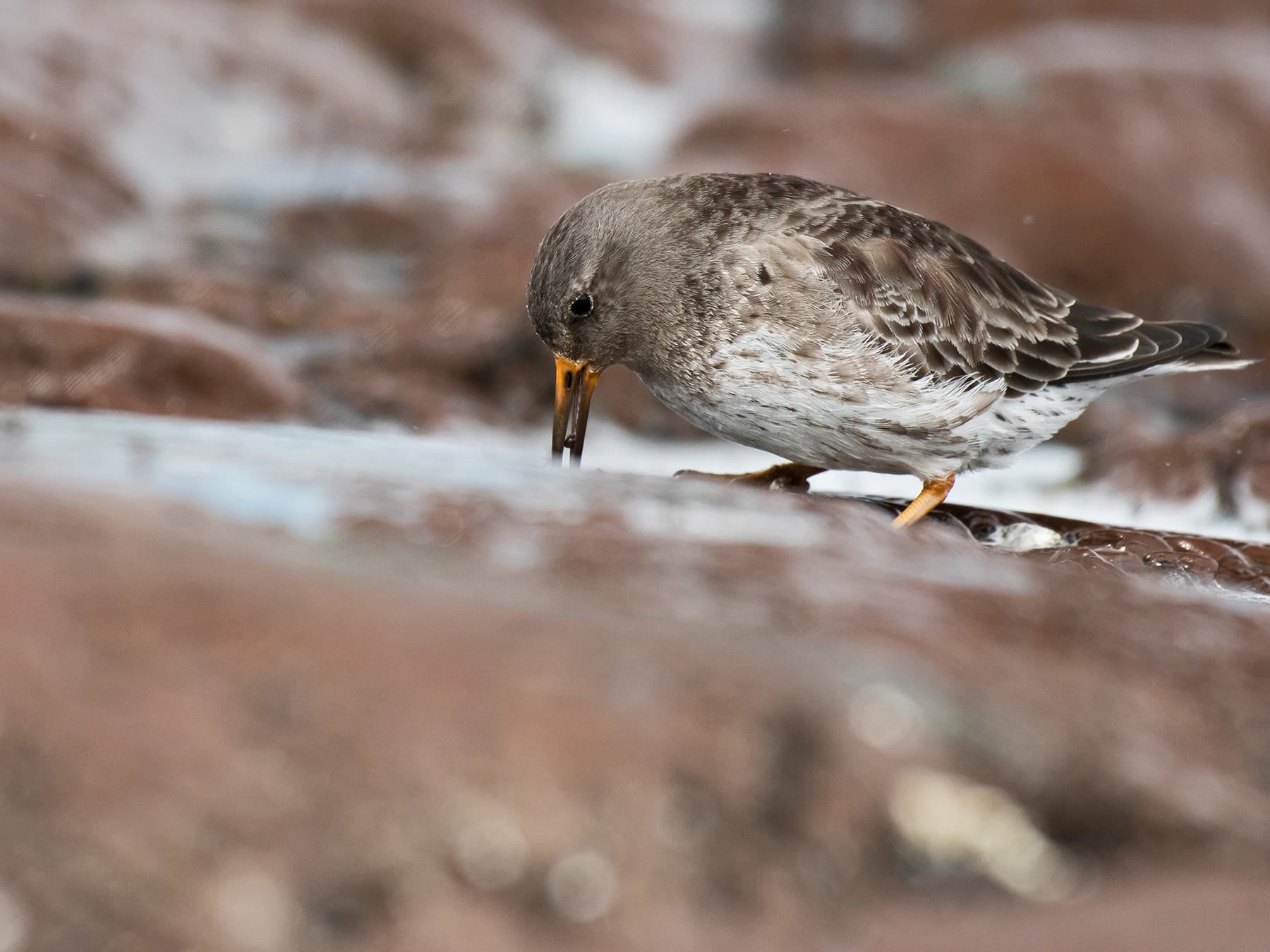
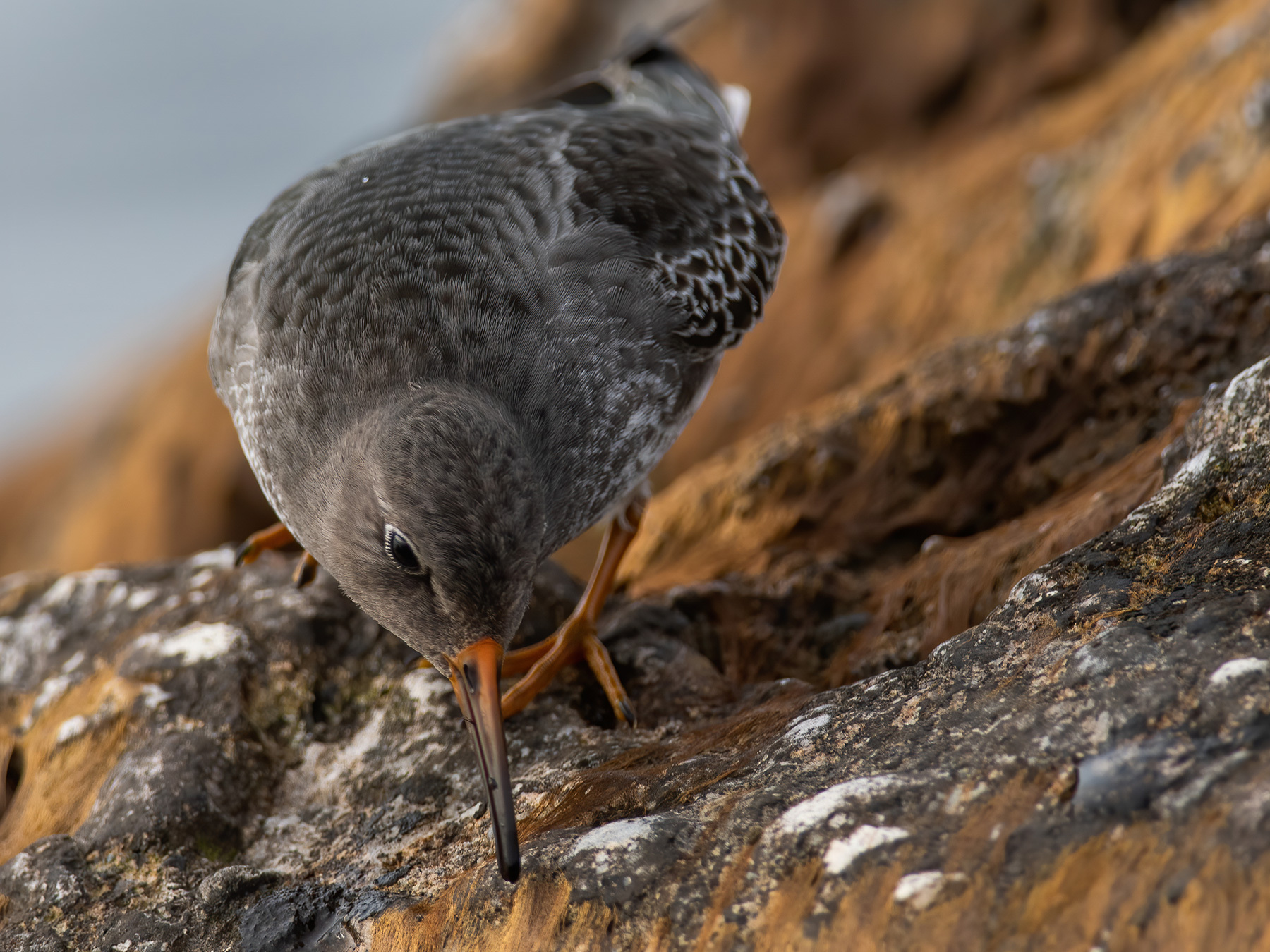
During migration, stopovers are common along rocky coasts and occasionally at mudflats and sandy beaches. Winter months are spent foraging on rocky shores next to the sea, where they feed on seaweed-rich landscapes, sheltered by breakwaters and groynes.
What is the range of a Purple Sandpiper?
Breeding is limited to stretches of coastline in the extreme northeastern Arctic regions of Canada, including Melville, Bathurst, Devon, Bylot, and Baffin islands and from the coast of Quebec to the coast of Newfoundland.
The breeding range extends across the coast of Greenland, to Iceland, the British Isles, Norway, Sweden, Finland and into Russia and Siberia, including offshore islands within the Arctic Circle.
During winter, the range of purple sandpipers expands southwards, reaching as far south as midway along the Atlantic coast of the United States, and in Europe, the species becomes more widespread across the UK, and takes up temporary residence in Germany, Denmark and the Netherlands and the Baltic states.
Where do Purple Sandpipers live?
Iceland is home to the largest share of global breeding purple sandpipers with up to 66,000 pairs nesting there annually and winter population estimates of up to 100,000.10,500 pairs breed in Norway, and up to 10,000 pairs in Russia. A further 15,000 pairs are estimated to breed in the extreme north of Canada.
How rare are Purple Sandpipers?
There are up to 220,000 purple sandpipers around the world, distributed throughout the Arctic coastlines of northern Canada,Greenland, Scandinavia, Finland, Russia and offshore islands in Arctic waters.
Due to their ability to survive in the most inhospitable tundra landscapes, they are not particularly common in more southerly latitudes, and are considered rare breeding birds outside of these Arctic conditions.
During winter, sightings become slightly more common, with arrivals from breeding grounds reported from August onwards along the northeastern coast of the United States and in coastal wetlands of Scotland and northern England.
Where can you see Purple Sandpipers in North America?
The majority of purple sandpipers that arrive to spend winters in the United States congregate along the coast of Maine, but they have a reputation as a hardy species and can be seen further north on the Atlantic coast than any other species, and are regularly spotted along the coast of Canada into the northeastern United States, as far south as the Carolinas.
Where can you see Purple Sandpipers in the UK?
Purple sandpipers are more common as winter visitors than as a breeding bird, although limited breeding does occur in Scotland. Most temporary winter residents are found along the eastern coast of Scotland and England, north of Yorkshire. Scotland’s Orkney and Shetland islands welcome large flocks of purple sandpipers each autumn.
Migration
Do Purple Sandpipers migrate?
Purple sandpipers living in higher Arctic latitudes that freeze in winter move southwards after the breeding season if their habitat becomes impossible to survive in. Frost-free landscapes are necessary for foraging for molluscs, crustaceans and invertebrates, and during the nonbreeding season, temporary relocation is common, until conditions ease the following spring.
Are Purple Sandpipers native to North America?
Breeding purple sandpipers are found in the Arctic regions of northeastern Canada, with migration to more southerly latitudes once breeding is complete. Wintering grounds for North American purple sandpipers are located along the northeastern Atlantic coast of the United States, and reach as far south as South Carolina.
Are Purple Sandpipers native to the UK?
A couple of pairs of purple sandpipers breed annually in Scotland, but they are not widespread and are far more common as a winter visitor than as an established breeding bird in the UK.
Tips for seeing it
- Look for them on rocky coastlines, especially during the winter months
- Observe their unique ability to feed among crashing waves
- Listen for their distinctive, low-pitched 'weet' call
- In the UK, check popular sites like the Farne Islands or Scottish coasts
What it eats
What do Purple Sandpipers eat?
Adult purple sandpipers follow a mixed diet, eating crustaceans, insects, plants and spiders. In winter, more molluscs, periwinkles, crabs, whelks and mussels are of importance, while on spring breeding grounds, more larvae, caterpillars, beetles, worms and algae are eaten.
What do Purple Sandpiper chicks eat?
Within 24 to 36 hours of hatching, purple sandpiper chicks are led to feeding grounds by their parents, and begin to feed themselves. Parents never feed their young, so they become independent relatively quickly, learning to forage for insects and their larvae on the tundra landscapes on which they live.
Nesting and breeding
Where do Purple Sandpipers nest?
Simple scrapes on tundra landscapes are as sophisticated as a purple sandpiper’s nest gets. The male usually roughly works on several sites simultaneously, consisting of a rough depression directly on the ground. The female then selects her favorite option to lay her eggs in. A bottom lining of leaves is added before the clutch is completed.
When do Purple Sandpipers nest?
The earliest clutches are laid from mid-May onwards (in Iceland) but the peak-laying period is around a month later at higher latitudes.
Only one brood is raised each year. Young purple sandpipers are able to walk and feed themselves within the first 24 to 36 hours of hatching, and are usually cared for by one parent for the first 4 to 5 weeks.
What do Purple Sandpiper eggs look like?
Purple sandpipers’ eggs measure around 38 mm by 26 mm (1.5 in by 1 in), and are pale brown in color, heavily patterned with dark brown scrawls and blotches.
Incubation is shared, although the lion’s share falls to the male. A typical clutch consists of 3 or 4 eggs, which hatch after 21 to 22 days.
Do Purple Sandpipers mate for life?
Long-term monogamous pair bonds are commonly observed in purple sandpipers. Many birds return to their former breeding sites already paired, and raise young with the same mate for several consecutive seasons.
Behaviour
Are Purple Sandpipers aggressive?
Confrontational posturing is used to drive intruders away from nesting territories, with birds displaying their white underwings in an intimidating stance. Territorial clashes may also occur, with chases between males not uncommon.
Lifespan and predators
How long do Purple Sandpipers live?
On average, purple sandpipers live for around 6 years, but much longer-lived individuals have been recorded, e.g. a ringed bird aged 15 years and 2 months was found in 1997.
Breeding is thought to occur for the first time at one or two years.
What are the predators of Purple Sandpipers?
During the breeding season, Arctic foxes and jaegers (skuas) are common predators of purple sandpipers’ eggs. In winter, birds of prey, especially goshawks, sparrowhawks and gyrfalcons, will prey on adult purple sandpipers feeding in large flocks.
Are Purple Sandpipers protected?
The Migratory Bird Treaty Act, introduced in 1918, made it illegal to capture a purple sandpiper, to seize their eggs or to intentionally kill or injure an adult bird or disturb their nest site or young.
In the UK, the breeding sites of purple sandpipers are kept secret to avoid encouraging egg thefts and nest disturbances. They are listed under Schedule I of the Wildlife and Countryside Act, 1981, which states it is illegal to interfere with nest sites. The Act also offers protection against individual birds being killed, injured or taken into captivity.
Are Purple Sandpipers endangered?
The worldwide population estimate for purple sandpipers is between 170,000 and 220,000 birds, with the species rated of least concern globally.
Indications show that in Canada, their status may be upgraded to a species of moderate concern due to habitat loss and population declines.
In the UK, purple sandpipers have Red status in the British Birds of Conservation Concern list, due to the extremely low numbers of breeding birds each year.
Conservation
While currently listed as Least Concern, Purple Sandpipers face threats from climate change and coastal development. Their specialized habitat requirements make them vulnerable to sea-level rise and changes in coastal ecosystems.
Conservation efforts focus on protecting key wintering and breeding sites.
More photos
3 photos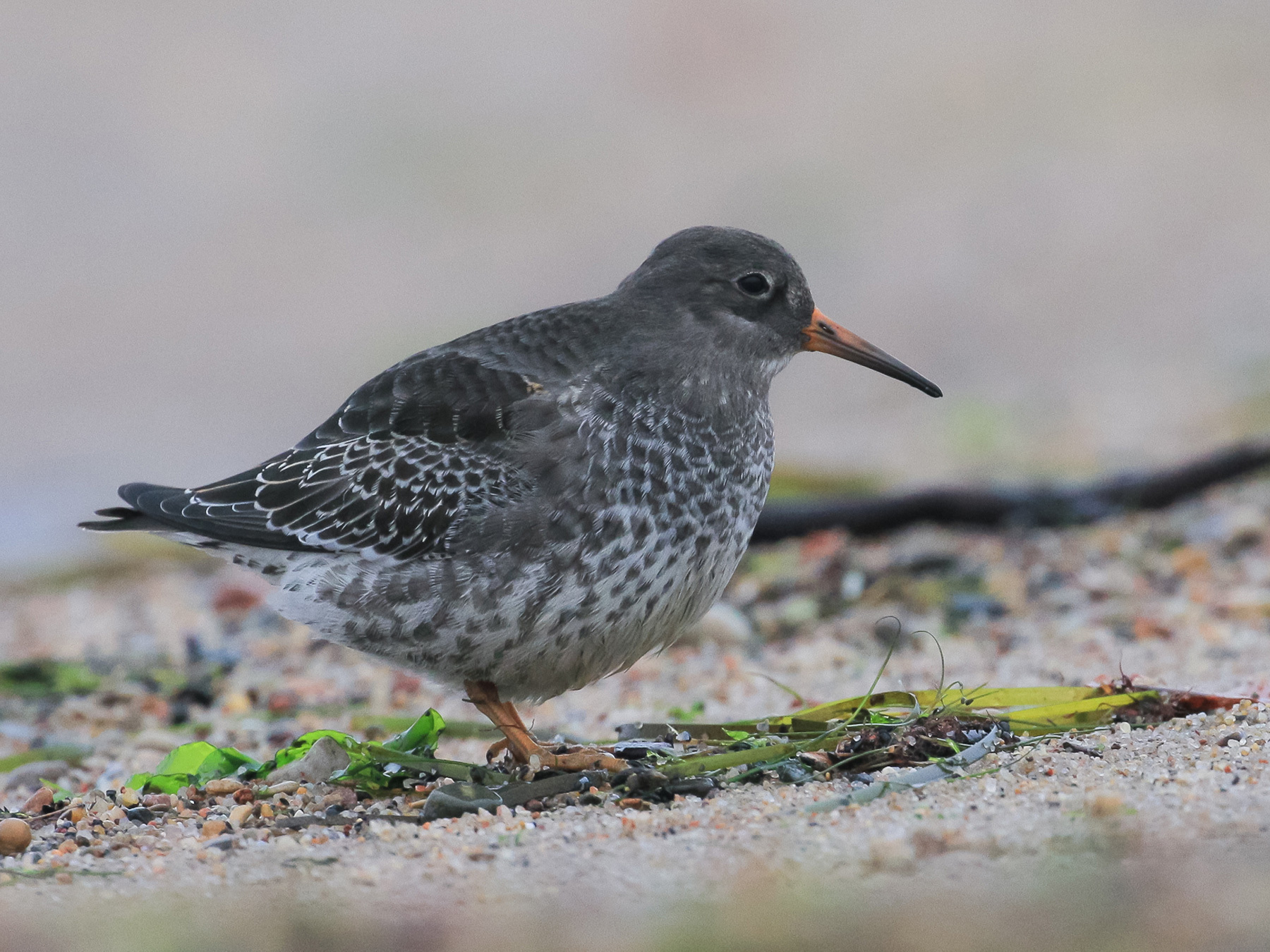
Purple Sandpiper guides
1 guidesQuick facts
- Length
- 20–22 cm
- Wingspan
- 42–46 cm
- Weight
- 50–110 g
- Lifespan
- 6–9 years · oldest recorded 20 years
- Family
- Sandpipers & Snipes
- Migration
- Short-distance migrant
- Global status (IUCN)
- Least Concern
- World population
- 205,000 - 295,000 individuals
- Population trend
- Decreasing
- Scientific name
- Calidris maritima
Questions
1Why is the Purple Sandpiper called purple?
Although it does not have vibrant mauve or lilac feathers by any stretch of the imagination, in some lights, a purple sandpiper’s plumage does have a faint purplish shimmer, which gives the species its colorful name.
Sources
4- 1BirdLife International. 2018. Calidris maritima. The IUCN Red List of Threatened Species 2018: e.T22693420A131929424. Source (opens in a new tab)
- 2Breeding Bird Survey and/or Christmas Bird Count: Butcher and Niven (2007)
- 3Wetlands International (2015)
- 4Fransson et al., EURING list of longevity records for European birds (2010) Source (opens in a new tab)

Checked by
Nathan Cope, founder and editor
Nathan founded Birdfact and leads its writers and contributors in the UK, the US and Canada. He has watched and studied birds for more than ten years, and checks every article and species guide before it’s published.