Species Profile
Philadelphia Vireo
Vireo philadelphicus
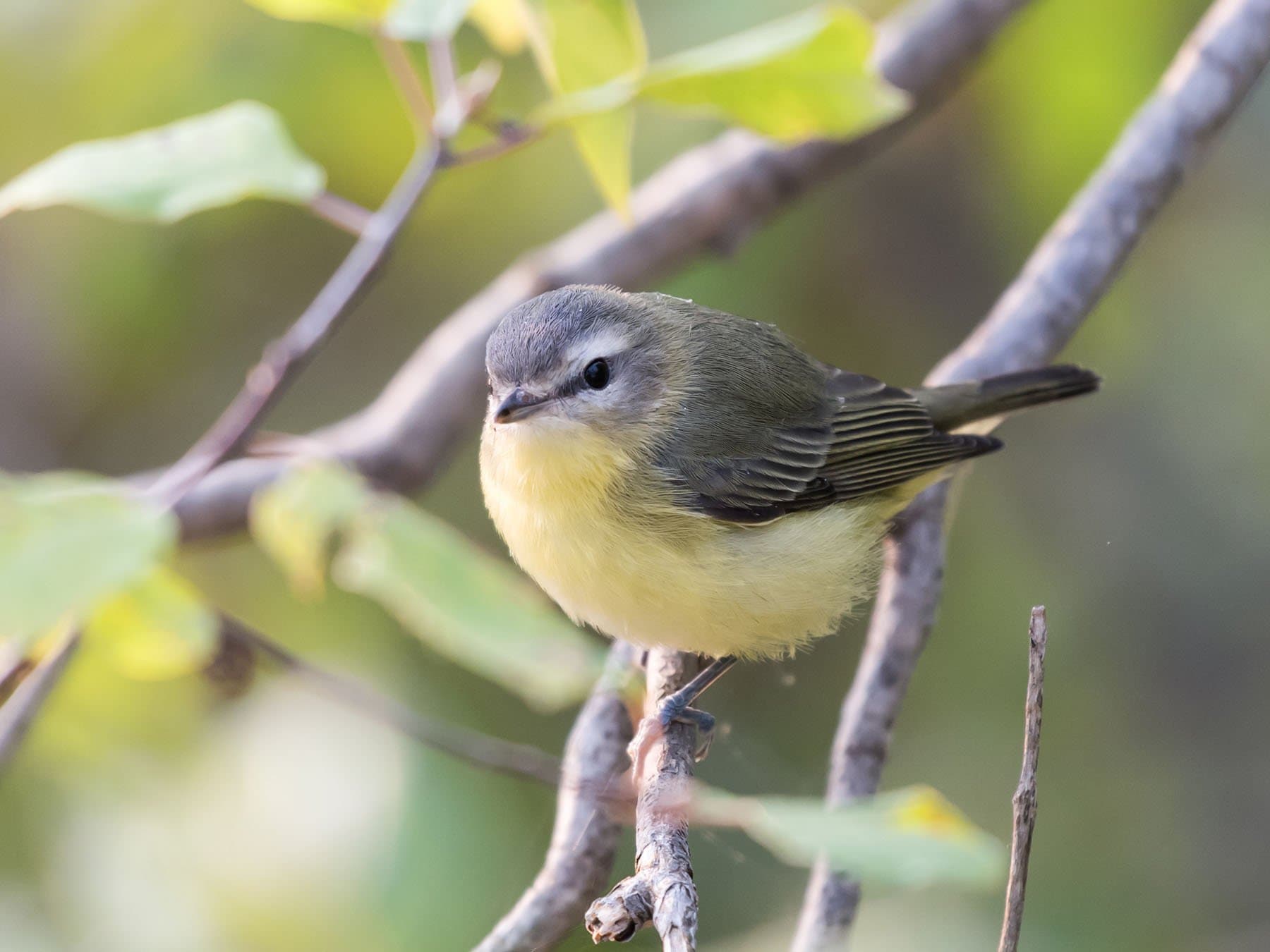
Philadelphia Vireo perched on a branch, showing gray head, dark eye, yellow underparts, and olive-green back in natural habitat.
Quick Facts
Conservation
LCLeast ConcernLifespan
1–3 years
Length
10.7–13.3 cm
Weight
10.3–16.1 g
Wingspan
19–21 cm
Migration
Long-distance Migrant
Despite a global population of around 4 million birds, the Philadelphia Vireo remains one of North America's most overlooked songbirds — its song so similar to the abundant Red-eyed Vireo that even experienced birders routinely walk past it. Small, compact, and washed in pale yellow below, this boreal forest specialist breeds deep in Canada's north, yet carries the name of a city where it has never been known to nest.
Think you've spotted a Philadelphia Vireo?
Upload a photo and we'll confirm it instantly
Confirm with a PhotoAppearance
A yellow throat, dark lores, and no wing bars — three field marks that separate the Philadelphia Vireo from its two most confusing lookalikes before you even reach for a field guide. Adults are olive-brown to olive-grey on the upperparts, covering the back, wings, and tail uniformly. The underparts are washed in pale to bright yellow, with the colour most intense on the throat and central upper chest. That yellow throat is the single most reliable field mark: in the Warbling Vireo, the throat is white.
The crown is dark grey, contrasting sharply with a broad white supercilium that runs from the base of the bill to behind the eye. Dark grey lores — the area between the bill and the eye — give the face a masked, slightly stern expression. The eyes themselves are dark brown, not the vivid red of the Red-eyed Vireo. The bill and legs are slate grey to black. The wings are plain and unmarked: no wing bars, no eye ring, no contrasting panel.
The species shows no sexual dimorphism. Males and females are identical in plumage throughout the year, and juvenile birds closely resemble adults. In fresh autumn plumage, birds can appear noticeably brighter yellow below than worn summer individuals. The tail is relatively short and olive-grey, contributing to the species' compact, rounded silhouette — a useful impression to hold when scanning a canopy for this easily-missed bird.
Identification & Characteristics
Colors
- Primary
- Olive
- Secondary
- Yellow
- Beak
- Grey
- Legs
- Black
Markings
Yellow-washed underparts (brightest on throat and upper chest); broad white supercilium; dark grey lores forming a masked facial expression; plain, unbarred wings; dark brown eyes; short, stout, hooked bill.
Tail: Short, olive-grey, contributing to the species' compact, rounded silhouette. Plain and unmarked.
Attributes
Understanding Attributes
Rated 0–100 based on research and observation. A score of 50 is average across all bird species. These attributes are relative and don't necessarily indicate superiority.
Habitat & Distribution
The Philadelphia Vireo breeds across a relatively narrow band of southern Canada. Its range runs from northeastern British Columbia and the extreme southeastern Yukon in the west, east through Alberta, Saskatchewan, Manitoba, Ontario, Quebec, New Brunswick, Nova Scotia, and Newfoundland to the Atlantic coast. An estimated 86% of the global population breeds in Canada's boreal forest — one of the highest proportions of any North American songbird. The species also breeds in small numbers in the northernmost United States, including the upper peninsula of Michigan, northern Wisconsin, northern Minnesota (primarily Cook, Lake, and St. Louis Counties), and occasionally northern New England.
On the breeding grounds, the species favours early- to mid-successional deciduous and mixed woodlands. Trembling aspen, balsam poplar, white birch, yellow birch, alder, cherry, ash, and willow are the characteristic trees. It is strongly associated with woodland edges, overgrown clearings, burned-over areas, and logged sites.
Riparian thickets along streams and lakes are particularly productive habitat. In British Columbia, it breeds almost exclusively in the northeastern plains in deciduous stands of trembling aspen and balsam poplar, at elevations between approximately 285 m and 1,033 m. It prefers dense habitats with 70–100% canopy closure and complex vertical structure.
In winter, the species migrates to Central America, from southern Mexico south through Guatemala, Belize, Honduras, Nicaragua, Costa Rica, and Panama, at elevations up to 1,600 m. Wintering habitat is diverse: lowland gardens, mangrove forests, and shaded coffee and cacao plantations at higher elevations all support the species. During migration, it passes through the eastern half of the United States, primarily through the Mississippi Valley and along the Gulf Coast. Key migration watchpoints include Crane Creek in Ohio, Point Pelee in Ontario, and sites along the western Gulf Coast.
In the UK, the Philadelphia Vireo is an extreme vagrant with only two accepted British records (see the dedicated section below). In Ireland, the first Western Palearctic record came from Co. Cork in 1985.
Where to See This Bird
Explore regional guides for locations where this bird has been recorded.
Diet
Caterpillars dominate the Philadelphia Vireo's diet during the breeding season, providing the protein-rich food that growing nestlings require. Beyond caterpillars, the species takes a wide range of invertebrates: spiders, weevils, wood-boring beetles, leaf-eating beetles, click beetles, wasps, bees, ants, ichneumon wasps, true bugs, moths, flies, and snails have all been recorded as prey. The hooked bill is well adapted for subduing and manipulating larger, more robust insects.
Berries and fruit become increasingly important from late summer onwards. Bayberry and dogwood berries are particularly favoured during the pre-migration fattening period, when birds need to accumulate fat reserves for the long flight south. On the wintering grounds in Central America, fruit can constitute up to 20% of the diet — a meaningful shift from the almost exclusively insectivorous diet of the breeding season.
The species shows a preference for foraging on white ash and yellow birch on the breeding grounds. It forages predominantly in the upper canopy — typically higher than the co-occurring Red-eyed Vireo — which helps reduce direct dietary competition where the two species overlap. The combination of slow, deliberate gleaning, upside-down twig-tip inspection, and occasional aerial sallying gives the Philadelphia Vireo access to prey items that more passive foragers would miss.
Behaviour
Philadelphia Vireos are methodical, deliberate foragers. They move slowly through the upper canopy, pausing to scan leaves and twigs before picking prey with a precise, hooked-bill strike. They regularly hang upside down at twig tips to inspect the undersides of leaves — a posture more reminiscent of a tit than a typical warbler. Short aerial sallies to snatch insects in flight are also part of the repertoire, though gleaning remains the dominant technique.
Where Philadelphia and Red-eyed Vireos share breeding territories, the two species defend those territories against each other as well as against their own kind — a phenomenon known as interspecific territoriality. The Philadelphia Vireo consistently occupies the highest canopy layer, while the Red-eyed Vireo tends to forage in the middle storey, reducing direct competition. During aggressive interactions, the smaller Philadelphia Vireo has been observed using apparent distraction displays when Red-eyed Vireos approach its young.
During migration, Philadelphia Vireos join mixed-species flocks alongside warblers and other vireos, often foraging lower in the vegetation than they do on the breeding grounds. Males are strongly territorial on the breeding grounds, driving away rival males with threat postures, chases, and occasional physical contact. Outside the breeding season, the species is generally solitary. Pairs are socially monogamous for the duration of the breeding season, though whether bonds persist across years has not been well studied.
Calls & Sounds
The Philadelphia Vireo's song is a series of short, whistled phrases of 3–5 notes, delivered with pauses of 1–2 seconds between each phrase. It is often rendered as "See-me? Here-I-am! Up-here. See-me?" — an upward-inflected, questioning quality that carries well through dense canopy. The song is strikingly similar to that of the Red-eyed Vireo but is generally higher-pitched, slower, and with slightly longer pauses between phrases. Even experienced observers frequently overlook singing Philadelphia Vireos, mistaking them for the far more abundant Red-eyed Vireo — making it one of the more challenging routine identification problems in North American birding.
Where the two species share breeding territories, the Philadelphia Vireo has been documented singing near-perfect imitations of Red-eyed Vireo song. Scientists hypothesise this is a defensive strategy: by sounding like a Red-eyed Vireo, the smaller, subordinate Philadelphia Vireo may deter the larger, more aggressive species from entering its territory — treating the sound as that of a conspecific rather than a competitor. It is a well-documented example of adaptive interspecific vocal mimicry in North American passerines.
The call is a harsh "ehh", used as an alarm call when intruders approach and as a contact call between mates. Males are most vocal on the breeding grounds from early June onwards, singing to establish and defend territories. They sing considerably less during spring migration, which contributes significantly to the species being overlooked at that time of year. Both sexes produce the harsh contact and alarm call. Subtle variations in song on the nesting grounds are thought to convey information about territory status, nesting stage, and the presence of rivals.
Flight
In flight, the Philadelphia Vireo appears compact and slightly heavy-bodied for its size — the short tail and rounded wings give it a blunter silhouette than many warblers of similar length. The wingbeats are fairly rapid and slightly undulating, typical of small vireos, without the bounding, deeply undulating flight of finches or the fluttery style of many warblers. The bird moves with purpose rather than elegance, covering ground efficiently between foraging bouts.
Migration occurs primarily at night, as with most North American songbird migrants. During the day, birds drop into suitable scrub and woodland to rest and refuel, often foraging lower in the vegetation than they do on the breeding grounds. The species crosses the Gulf of Mexico in spring — a non-stop overwater flight of up to approximately 1,000 km — and returns south on a broader front in autumn. Vagrant birds reaching western Europe have almost certainly been caught up in strong westerly airflows during autumn migration, carried across the Atlantic from the eastern seaboard of North America.
In the canopy, the Philadelphia Vireo moves with deliberate, unhurried hops along branches, punctuated by brief hovering sallies to take insects from foliage. It occasionally hangs upside down at twig tips — a manoeuvre that requires precise wing control and good balance. The overall flight impression, combined with the compact shape and yellow underparts, can be a useful supplementary clue when trying to separate this species from the Warbling Vireo in a mixed migrant flock.
Nesting & Breeding
Philadelphia Vireos are among the later-returning spring migrants, typically not arriving on Canadian breeding grounds until the last week of May. Males begin singing in early June, and pair formation follows approximately two weeks after arrival. Courtship involves an elaborate physical display by the male — described in full in the courtship and display section — after which males guard females closely through nest-building and egg-laying, driving away rivals with threat postures and chases.
The female selects the nest site, typically near the top of a small deciduous tree — aspen, birch, maple, willow, or alder — usually 2.4–20 m above the ground, with an average of around 15 m. Some nests have been recorded as high as 27 m.
The nest is a compact, basket-like pensile cup, suspended from a horizontal forked twig, usually fairly close to the trunk. The female builds it (occasionally assisted by the male) using bark strips, grasses, seed tufts, feathers, beard-moss lichen, and spider webs. The interior is lined with pine needles and grass blades. Nests average about 7 cm across, with an interior cup approximately 5 cm wide and deep.
Clutch size is typically 3–4 eggs, occasionally 5. Eggs are white, spotted with rusty, dark brown, or black markings, and measure approximately 19 mm in length. Incubation is shared by both parents; males develop a small brood patch during this period — the only known physical difference between the sexes during the breeding season. Incubation lasts 11–13 days.
Nestlings hatch helpless and blind, with orange-yellow skin and sparse pale-grey down. The young are fed and brooded by both adults, and fledging occurs 12–15 days after hatching. After leaving the nest, the young remain dependent on their parents for at least a further 10 days. One brood is raised per year. The species is an occasional host to Brown-headed Cowbird brood parasitism, though this is not considered a significant population-level threat.
Lifespan
Detailed lifespan data for the Philadelphia Vireo are limited, reflecting how little-studied the species remains despite its relatively large population. The oldest confirmed individual was at least 8 years and 10 months old: a bird banded in Ontario in 1962 was recovered in Guatemala in 1970, having completed at least 16 trans-Gulf migrations. BioKIDS (University of Michigan) records a maximum lifespan of 10.6 years in the wild, though the source data for this figure are not fully documented.
Typical annual survival rates have not been precisely calculated for this species, but are likely similar to those of comparable small Neotropical migrants — perhaps 50–60% annual adult survival, implying a median lifespan of one to two years for birds that survive their first migration. The hazards are substantial: nocturnal collision with lit structures during migration, predation by hawks and other raptors, and the energetic demands of twice-yearly long-distance migration all take a toll.
Occasional Brown-headed Cowbird parasitism reduces productivity in some nests, though the population-level impact appears minor. Basic aspects of the species' life history — including age at first breeding, mate fidelity between years, and natal site fidelity — remain poorly studied. Given that the species breeds in remote boreal forest and is easily overlooked even when singing, long-term individual monitoring has been difficult to sustain. The longevity record of nearly nine years suggests that, for birds that navigate the gauntlet of migration successfully, a reasonably long life is achievable.
Conservation
The Philadelphia Vireo is listed as Least Concern on the IUCN Red List (assessed 2016), with a global population estimated at approximately 4 million mature individuals by BirdLife International and Partners in Flight. North American Breeding Bird Survey data show a population increase of approximately 2.3% per year from 1966 to 2015 — a genuinely positive trend driven partly by forest management practices, particularly selective harvesting and natural succession, which have increased the availability of early-successional nesting habitat across the boreal zone.
Partners in Flight rates the species 9 out of 20 on the Continental Concern Score, indicating low conservation concern at the continental level.
The picture is not uniformly positive, however. The primary long-term threat is habitat loss on the wintering grounds in Central America, where widespread conversion of forest to pasture has reduced available habitat. Collision mortality during nocturnal migration is a significant concern: like most nocturnally migrating songbirds, Philadelphia Vireos are vulnerable to strikes with illuminated buildings, communication towers, and other lit structures.
Climate change poses a more diffuse but potentially serious risk, as shifts in the timing and availability of successional forest habitat could affect breeding success across the boreal range. At the state level, the Minnesota Department of Natural Resources designates the Philadelphia Vireo a Species in Greatest Conservation Need, reflecting its rarity as a breeding bird at the southern edge of its range. In British Columbia, potential future large-scale harvesting of mature trembling aspen in the northeast of the province has been identified as a concern, though no population decline has yet been detected there. The species' strong dependence on Canada's boreal forest — a globally significant but increasingly pressured biome — means that the long-term health of that ecosystem is central to its future.
Population
Estimated: ~4,000,000 mature individuals
Trend: Increasing
Increasing at approximately 2.3% per year (North American Breeding Bird Survey, 1966–2015). Partners in Flight Continental Concern Score: 9/20 (low concern).
Elevation
285–1,033 m on breeding grounds (British Columbia); up to 1,600 m on wintering grounds in Central America.
Additional Details
- Genus:
- Vireo
- Order:
- Passeriformes
- Family:
- Vireonidae (Vireos)
- Nest type:
- Pensile cup suspended from forked twig
- Uk status:
- Extreme vagrant; 2 accepted British records (BBRC)
- Clutch size:
- 3–4 eggs (occasionally 5)
- Fledging age:
- 12–15 days
- Breeding range:
- Southern Canada (BC to Newfoundland); locally in northern USA
- Broods per year:
- 1
- Migration route:
- Mississippi Valley and Gulf Coast (spring); broader eastern front (autumn)
- Wintering range:
- Southern Mexico to Panama
- Incubation period:
- 11–13 days
In The Uk
The Philadelphia Vireo is one of the rarest transatlantic vagrants to reach Britain and Ireland. The first Western Palearctic record was a bird found in Co. Cork, Ireland, in 1985 — a landmark record that established the species as a genuine, if exceptional, vagrant to the region. The first accepted British record followed two years later: a bird present on Tresco, Isles of Scilly, from 10–13 October 1987, found during the peak autumn vagrant season at one of Britain's most productive vagrant traps.
The second British record did not come until 36 years later: a bird at Castlebay, Barra, in the Outer Hebrides, on 23 September 2023. Both British records fall in the classic window for North American passerine vagrants — late September to mid-October — and at locations well positioned to receive birds displaced eastward by Atlantic weather systems. There are only two accepted British records to date, making this one of the rarest American passerines on the British list.
Any British or Irish birder encountering a small, compact vireo with yellow underparts, dark lores, a white supercilium, and no wing bars in autumn should treat it as a potential Philadelphia Vireo and document it carefully. The species is most likely to turn up at coastal headlands and island bird observatories in the southwest and northwest of Britain during late September and October, particularly following periods of strong westerly winds. Records should be submitted to the British Birds Rarities Committee (BBRC) with full supporting documentation.
Similar Species
Two species make the Philadelphia Vireo one of the trickier birds to pin down in North America — and one of them sounds almost identical. The Red-eyed Vireo and the Warbling Vireo share its range and habitat, and getting to grips with the differences between all three is one of the more satisfying challenges in North American birding.
Against the Red-eyed Vireo, the key differences are: smaller and more compact body; shorter, stouter bill; yellow underparts (including the throat) versus white underparts in Red-eyed; dark brown eyes versus the vivid red of an adult Red-eyed Vireo (though immature Red-eyed Vireos also have dark eyes, making this mark unreliable in autumn); and a less contrasting head pattern — the Red-eyed Vireo has a bold black border to its white supercilium, which the Philadelphia Vireo lacks. The song is the most treacherous similarity: Philadelphia Vireo sings higher, slower, and with longer pauses, but the difference is subtle enough that even experienced birders are regularly fooled.
Against the Warbling Vireo, the distinctions are more straightforward once you know what to look for. Yellow throat is immediately diagnostic — Warbling Vireo has a white throat. Look also at the lores: Philadelphia shows darker, more defined lores, giving a more masked facial expression. Its head shape is rounder, and the bill proportionately shorter. The Warbling Vireo tends to appear longer and slimmer overall. In song, the two species are quite different: Warbling Vireo delivers a long, rambling warble rather than the short, separated phrases of the Philadelphia Vireo.
Courtship & Display
Courtship in the Philadelphia Vireo is a full-body performance. The male faces the female directly and begins swaying from side to side, simultaneously fluffing his plumage and spreading the tail. He then erects the crown feathers, quivers his wings, and snaps his bill audibly. The female's response — dropping and vibrating her wings — signals receptivity. The display has a ritualistic quality, with each element apparently serving to both attract the female and suppress her escape response.
Males guard females with unusual intensity through the entire pre-laying period. Rival males are driven away with escalating threat postures, aerial chases, and, when necessary, physical contact. This mate-guarding behaviour is consistent with the need to ensure paternity in a species where both parents invest heavily in incubation and chick-rearing. Males develop a small brood patch during the incubation period — the only external physical difference between the sexes — confirming that male incubation is a genuine and regular contribution rather than an occasional behaviour.
Pair formation occurs approximately two weeks after males arrive on the breeding grounds in late May or early June, giving males time to establish and advertise territories through song before females arrive. The female takes the lead in nest-site selection, inspecting potential locations before committing. Once a site is chosen, she builds the majority of the nest, though males have occasionally been observed contributing material.
Birdwatching Tips
Finding a Philadelphia Vireo requires patience and a good ear — and then the willingness to question what your ear is telling you. The song is strikingly similar to that of the Red-eyed Vireo, and most Philadelphia Vireos on migration are overlooked because observers assume they are hearing the commoner species. Listen for a song that is slightly higher-pitched, slightly slower, and delivered with marginally longer pauses between phrases than a typical Red-eyed Vireo. If a singing vireo makes you think "that Red-eyed sounds a bit odd", look harder.
In North America, the best opportunities come during autumn migration, from late August through October, when birds move south on a broader front across the eastern United States. Spring migration is narrower and more westerly, concentrated through the Mississippi Valley; the species is genuinely scarce along the Atlantic Coast in spring. Key watchpoints include Crane Creek (Magee Marsh) in Ohio, Point Pelee in Ontario, and sites along the western Gulf Coast. In Minnesota, the species breeds in the northeastern counties — Cook, Lake, and St. Louis — and can be found in early-successional aspen and birch woodland from early June.
When you have a bird in view, focus on the throat. A yellow throat rules out the Warbling Vireo immediately. Check the lores: Philadelphia Vireo shows dark, well-defined lores, giving a masked impression; Warbling Vireo has paler, less distinct lores. The bill is proportionately shorter and stouter than either Red-eyed or Warbling Vireo. The eyes are dark, not red. No wing bars, no eye ring. The overall impression is of a compact, round-headed, yellow-bellied bird — smaller and chunkier than it looks in field guides.
In the UK, the species is an extreme vagrant. Both accepted British records have fallen in autumn at classic vagrant traps: Tresco on the Isles of Scilly (October 1987) and Castlebay on Barra in the Outer Hebrides (September 2023). Any British or Irish birder encountering a small, yellow-bellied vireo in October should treat it as a potential Philadelphia Vireo and document it thoroughly for submission to the BBRC.
Did You Know?
- The Philadelphia Vireo was named after Philadelphia, Pennsylvania — a city where it has never been known to breed and where it is only an uncommon migrant. The type specimen was collected there during migration by ornithologist John Cassin in 1851. A nineteenth-century local name for the species was the Brotherly-love Vireo, a nod to Philadelphia's Quaker heritage.
- With a global population of around 4 million birds, the Philadelphia Vireo is one of North America's most consistently overlooked songbirds — not because it is rare or secretive, but because its song is so similar to the far more abundant Red-eyed Vireo that most observers never realise they are hearing a different species at all.
- Males develop a small brood patch during the incubation period. In most songbirds, brood patches are exclusive to females; regular male incubation in the Philadelphia Vireo is a genuine contribution to the breeding effort, not an occasional behaviour.
- The Philadelphia Vireo has the most northerly breeding range of any vireo species in the world, yet winters as far south as Panama — a round trip that includes a non-stop crossing of the Gulf of Mexico each spring.
- The oldest confirmed Philadelphia Vireo was at least 8 years and 10 months old when recovered in Guatemala in 1970, having been banded in Ontario in 1962. Yet basic aspects of the species' life history, including mate fidelity and age at first breeding, remain poorly studied.
Records & Accolades
Boreal Specialist
86% boreal
An estimated 86% of the global Philadelphia Vireo population breeds in Canada's boreal forest — one of the highest boreal dependencies of any North American songbird.
Master Mimic
Interspecific mimicry
Philadelphia Vireos have been documented singing near-perfect imitations of Red-eyed Vireo song on shared territories — a defensive strategy to deter the larger rival species.
Most Northerly Vireo
Northernmost breeding vireo
The Philadelphia Vireo holds the most northerly breeding range of any vireo species in the world, nesting deep in Canada's boreal forest.
Community Photos
Be the first to share a photo of the Philadelphia Vireo
Upload a PhotoIdentify Any Bird Instantly
- Upload a photo from your phone or camera
- Get an instant AI identification
- Ask follow-up questions about the bird
Monthly Birds in Your Area
- Personalised for your location
- Seasonal tips and garden advice
- Updated every month with new species