


Pallid Swift
Pale Swift · Apus pallidus
By the Birdfact teamChecked by Nathan Cope
On this page13 sections
How to recognise it
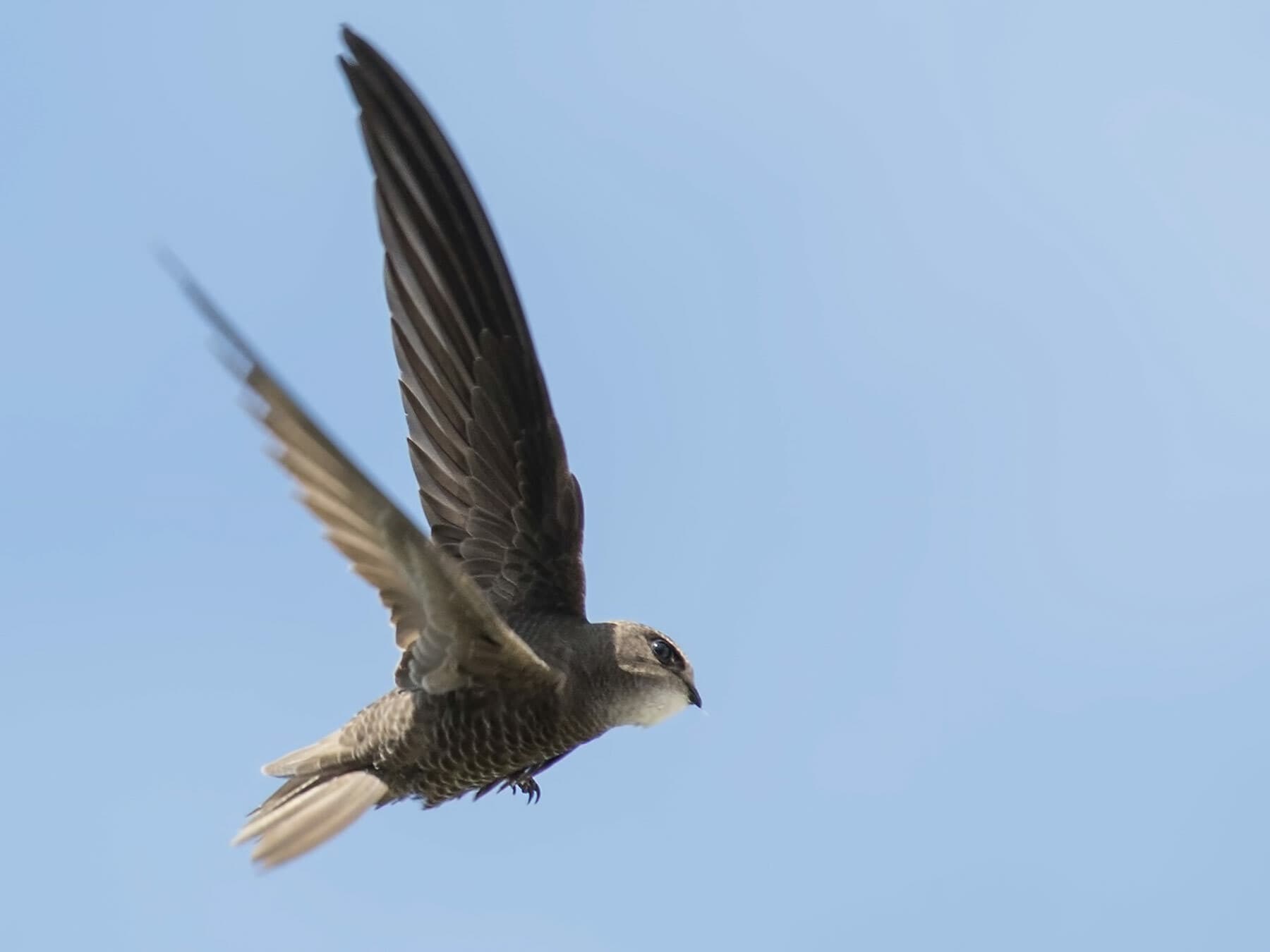
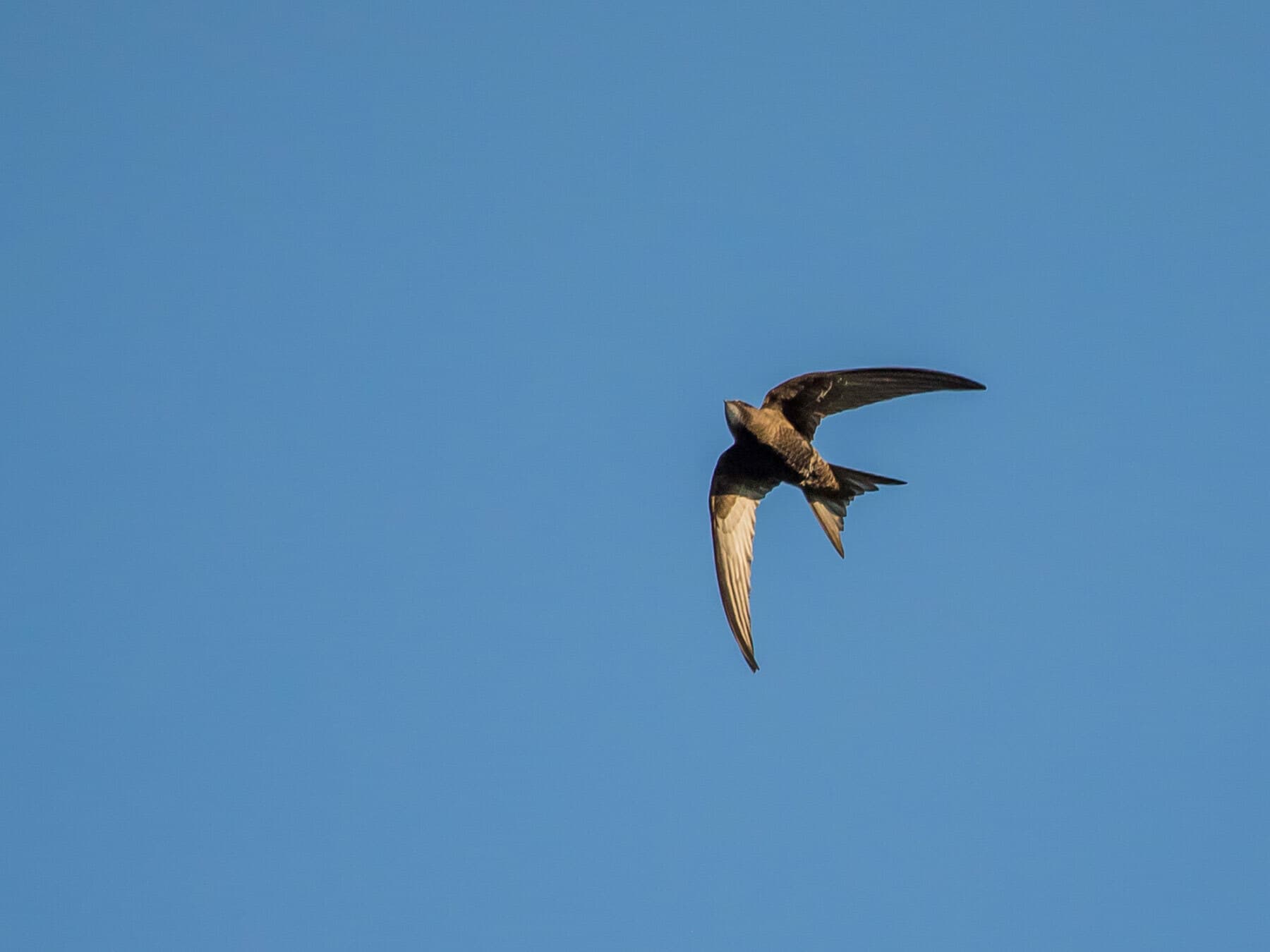
The Pallid Swift is a sleek, streamlined bird with long, curved wings and a forked tail.
Its plumage is predominantly greyish-brown, lighter than its close relative, the Common Swift. The throat is noticeably paler, often appearing white, which contrasts with the darker body.
Both sexes look alike, with juveniles showing faint pale edges to their feathers. The Pallid Swift does not undergo significant seasonal plumage changes, unlike some swifts.
Its size
Adults- Length
- 16–17 cm
- Wingspan
- 39–44 cm
- Weight
- 30–50 g
Its song and calls
Most species of swift vocalise in loud screams and the pallid swift is no different although the pitch of its call is generally lower and similar in sound to ‘ssrrreee - ssrrree’.
- Call0:00 / 0:04
Recorded in Normandie, France · August 2026
When and where to see it
OctoberPeak season
Most recorded in October
- 1. Morayunder 0.1%
- 2. Angusunder 0.1%
- 3. Gloucestershireunder 0.1%
- 4. East Riding of Yorkshireunder 0.1%
- 5. East Lothianunder 0.1%
Each dot is a county, state or province: the bigger and darker, the larger the bird’s share of that place’s bird records that month. Grey dots: no regular records. The ringed point is the centre of the bird’s records this month; the arrow shows how it moved since last month, and the dashed loop its path through the year. “Arrivals” colours places where it becomes regular this month (orange) or is in its last regular month (grey). GBIF eBird Observation Dataset, 2019–2024. Map data: Natural Earth, US Census Bureau; place centres © OpenStreetMap contributors.
In your area
See when the Pallid Swift is recorded in your county, state or province.
How often the Pallid Swift turns up in the UK through the year, from birdwatchers' records.
United Kingdom
Passage migrant · regularly Oct–Nov · most records in October
Show as a table
| Month | United Kingdom |
|---|---|
| January | – |
| February | – |
| March | – |
| April | <0.001% |
| May | – |
| June | <0.001% |
| July | – |
| August | – |
| September | – |
| October | 0.006% (regular) |
| November | 0.004% (regular) |
| December | – |
Recorded regularly in
Worldwide: recorded regularly in 45 countries
Countries where it was recorded in at least 3 of the 6 years 2019–2024. Linked countries have their own bird list.
Europe (23)
- Albania
- Belgium
- Bosnia & Herzegovina
- Bulgaria
- Croatia
- Denmark
- France
- Germany
- Gibraltar
- Greece
- Italy
- Malta
- Monaco
- Montenegro
- Netherlands
- North Macedonia
- Portugal
- Romania
- Serbia
- Spain
- Switzerland
- United Kingdom
- Vatican City
Africa (9)
- Algeria
- Egypt
- Gambia
- Guinea-Bissau
- Mauritania
- Morocco
- Senegal
- Tunisia
- Western Sahara
Data: EOD – eBird Observation Dataset (Cornell Lab of Ornithology), accessed via GBIF.org, CC BY 4.0. Records from 2019–2024, aggregated and filtered by Birdfact. How these lists are made
Whilst breeding on the Atlantic islands of the Canaries and Madeira, they are widespread throughout the European Mediterranean coastal regions and islands, including the Balearics, Sardinia, Corsica, Sicily, Crete, the Dodecanese and Cyprus. Additionally, they have breeding grounds in Gibraltar, north Africa, Israel, the Arabian Peninsula and Iran.
Signs and Spotting tips
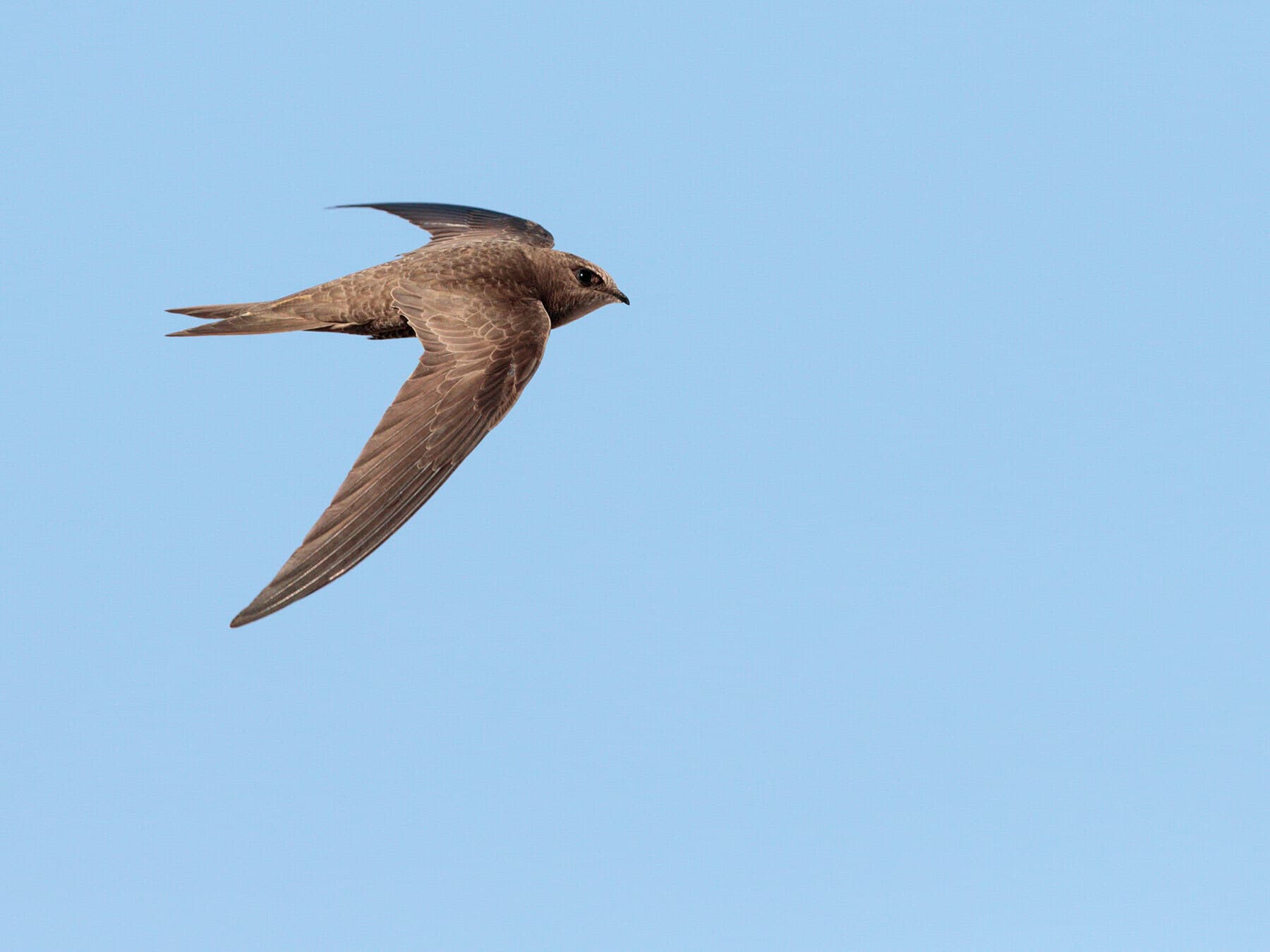
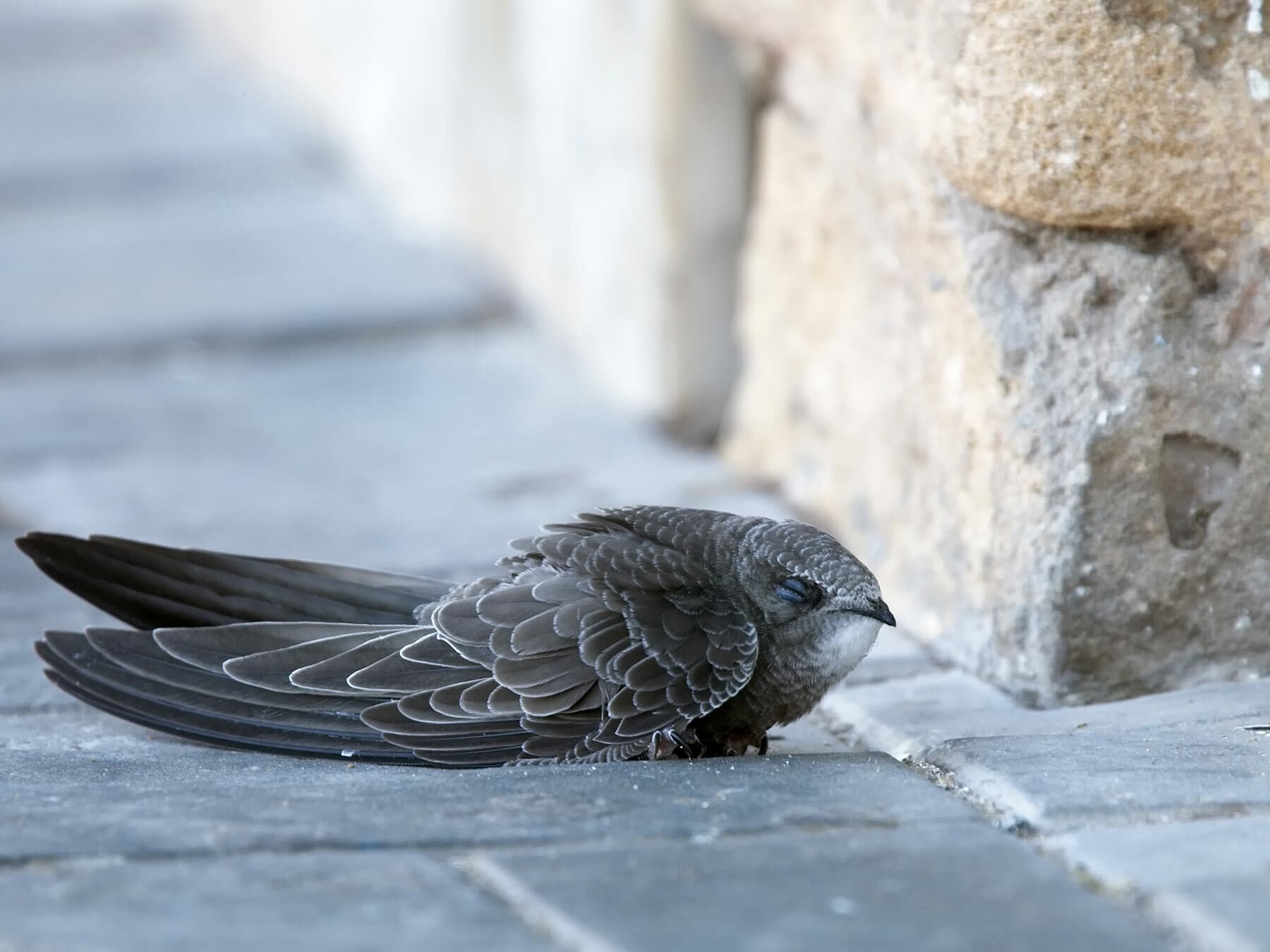
Pallid swifts are seldom seen north of their European habitats and apart from resident colonies in Egypt, and dependent upon the location of their breeding grounds, they migrate to sub-Saharan Africa or south east Asia during winter months. Migration patterns vary but most birds return north from Africa between February to May and fly south again between August and November. They are often mistaken for common swifts, particularly from a distance. It is unlikely to find a pallid swift on the ground as with all swifts the legs are unable to support the bird’s body weight sufficiently to walk and life is spent predominantly in the air. The bird’s tiny feet are simply used to cling on to rough surfaces as they negotiate passage to their nests but they are unable to perch on branches or overhead cables.
What it eats
Pallid swifts feed on the wing catching prey in their beaks. Their diet consists of a range of flying insects including beetles, mosquitoes, small flies and flying ants and even drifting spiders. They also drink on the wing and the sight of them swooping down to the surface of a lake or reservoir and dipping their bills to scoop up water is commonplace.
Nesting and breeding
Nests are often in unlined cavities in roof spaces, caves or cliff faces but are also constructed of grasses or straw and feathers in an oval shape glued together to form a strong shell and stuck to the surrounding area, such as eaves, with spittle. Throughout the range of the breeding grounds one or two broods are produced annually between March to July when 2 – 3 eggs are laid and incubated for up to three weeks before hatching. Fledging occurs at around forty five days.
Behaviour
Pallid Swifts are highly aerial birds, spending most of their lives on the wing. They feed, drink, and even sleep while flying, only landing to nest.
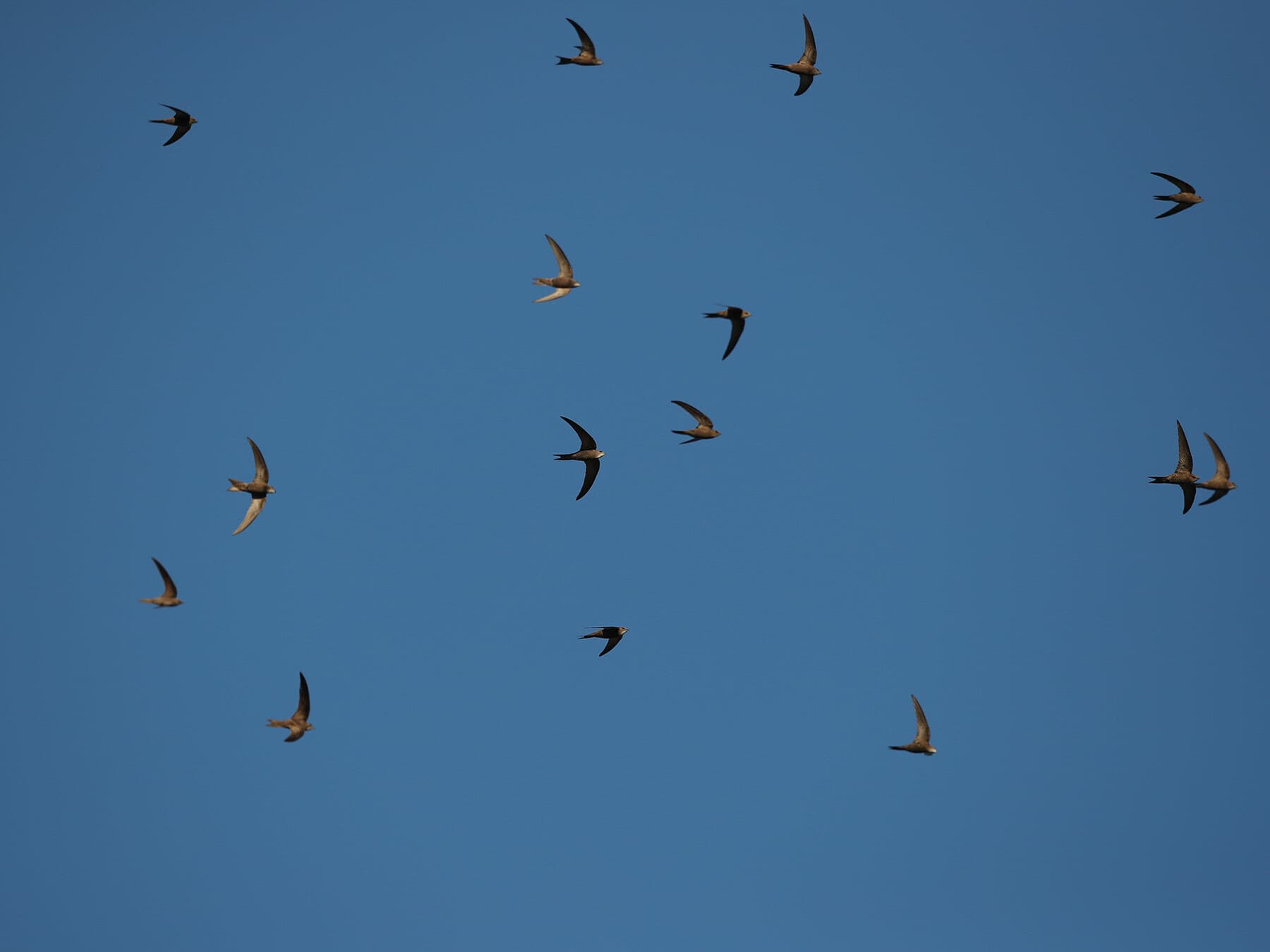
These birds are social, often seen in large, screaming flocks, especially during migration and in the evening when they gather to roost.
Lifespan and predators
The lifespan of the pallid swift is between ten to fifteen years.
Conservation
While the Pallid Swift is listed as Least Concern by the IUCN, it faces challenges from habitat loss and climate change. Urban development can reduce nesting sites, but some populations have adapted to use buildings.
Conservation efforts focus on protecting breeding sites and monitoring population trends.
What does a Pallid Swift look like?
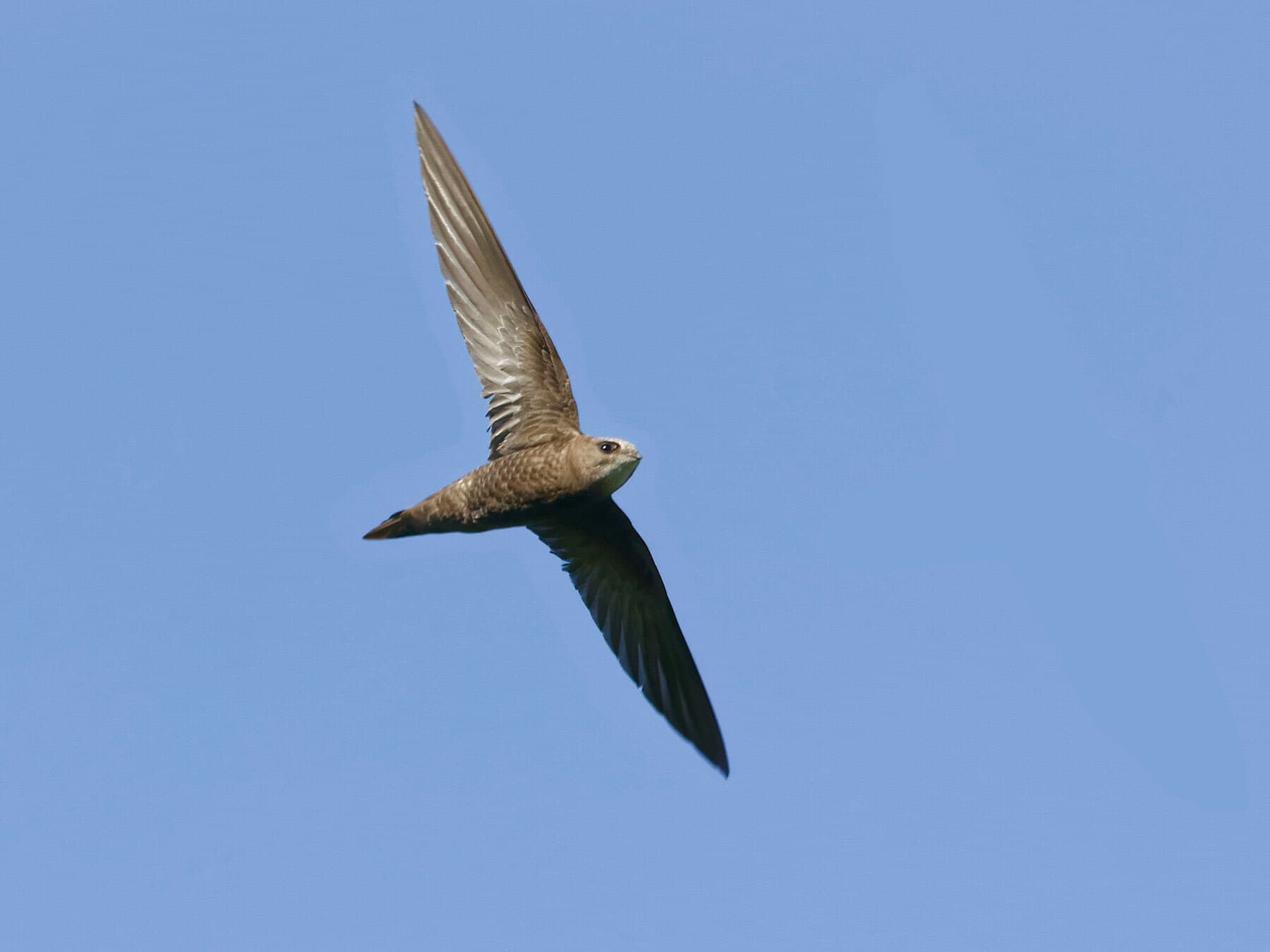
Adult pallid swifts have broad swept back wings with dark brown rounded wingtips (when compared to the pointed wing tips of the Alpine or Common Swift) and a short, forked tail. The upperparts are predominantly mid brown with a paler brown band extending diagonally from the primary wing coverts towards the lesser coverts. The tail is very dark, almost black. The underwing areas are a buff or light brown with pale edges to the feathers and the underside of the body is dark brown with a pale brown scalloped effect, giving the impression of scales. The head is brown with a grey brown cap and face and white throat and chin. The dark grey bill is very small hiding a large wide mouth and the legs and feet are tiny with all four toes pointing forwards. Adult males and females are similar in size and plumage. Juveniles have a mottled patter on the upper parts with light brown/cream feather edges.
Similar birds
Often mistaken for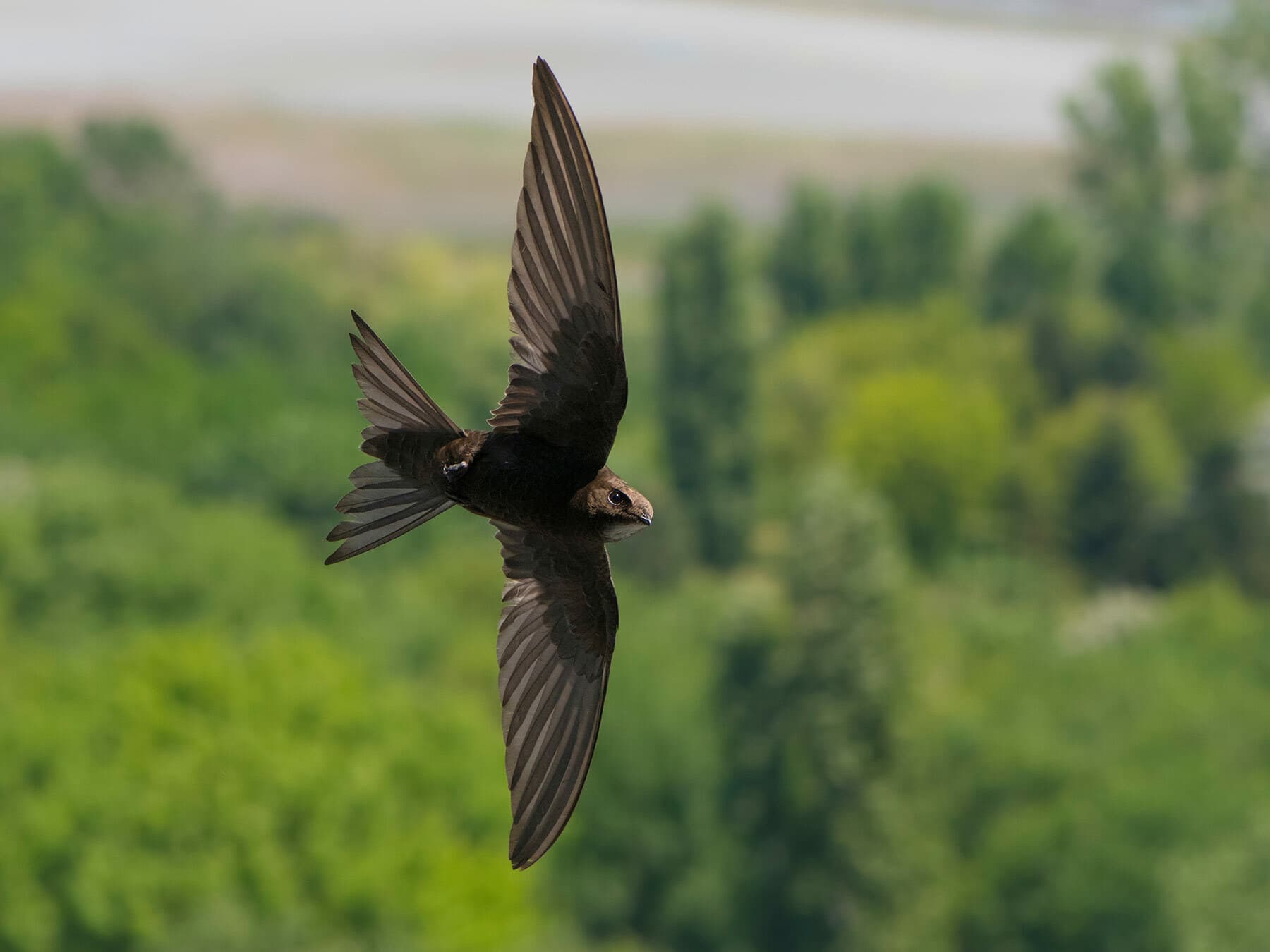
Quick facts
- Length
- 16–17 cm
- Wingspan
- 39–44 cm
- Weight
- 30–50 g
- Lifespan
- 5–10 years
- Family
- Swifts
- Migration
- Long-distance Migrant
- Global status (IUCN)
- Least Concern
- World population
- 800,000 - 1,499,999 mature individuals
- Population trend
- Stable
- Also called
- Pale Swift
- Scientific name
- Apus pallidus
Sources
3- 1BirdLife International. 2019. Apus pallidus (amended version of 2018 assessment). The IUCN Red List of Threatened Species 2019: e.T22686815A155463151. Source (opens in a new tab)
- 2BirdLife International. 2019. Apus pallidus (amended version of 2018 assessment). The IUCN Red List of Threatened Species 2019: e.T22686815A155463151. Source (opens in a new tab)
- 3BirdLife International. 2019. Apus pallidus (amended version of 2018 assessment). The IUCN Red List of Threatened Species 2019: e.T22686815A155463151. Source (opens in a new tab)

Checked by
Nathan Cope, founder and editor
Nathan founded Birdfact and leads its writers and contributors in the UK, the US and Canada. He has watched and studied birds for more than ten years, and checks every article and species guide before it’s published.