Species Profile
Mourning Warbler
Geothlypis philadelphia
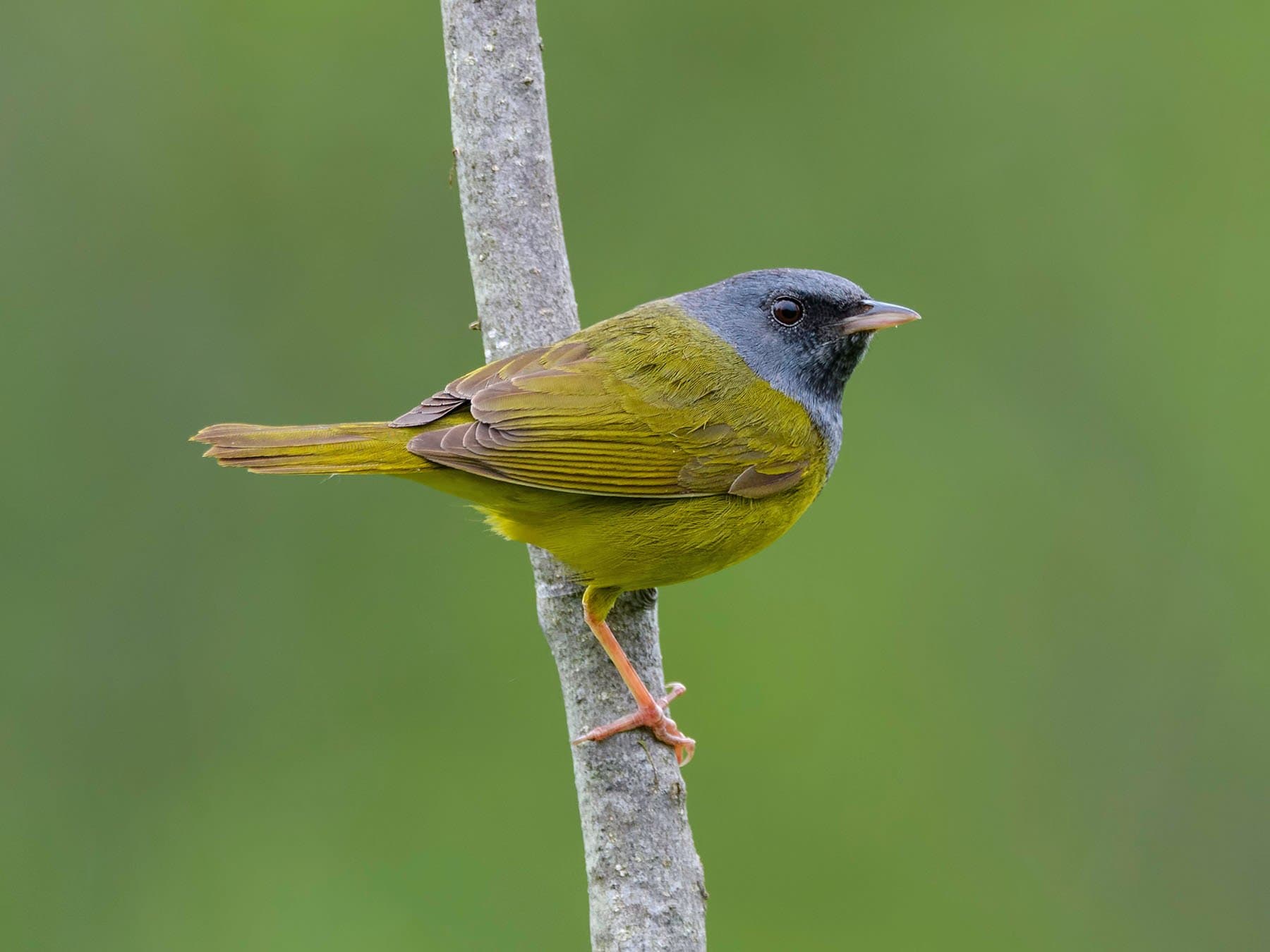
Mourning Warbler perched on a bare branch, showing its dark gray head, black mask, and olive-green plumage against a green background.
Quick Facts
Conservation
LCLeast ConcernLifespan
3–5 years
Length
10–15 cm
Weight
11–13 g
Wingspan
18–20 cm
Migration
Long-distance Migrant
Named in 1810 by Alexander Wilson, who saw the male's dark hood and black breast patch as a mourning veil, the Mourning Warbler is a compact, secretive bird of dense brushy clearings across boreal and mixed forest. It is one of the latest spring migrants to arrive in North America, one of the earliest to leave in autumn, and — unusually among warblers — sings in four distinct regional dialects that have held stable for at least 36 years.
Think you've spotted a Mourning Warbler?
Upload a photo and we'll confirm it instantly
Confirm with a PhotoAppearance
The Mourning Warbler is a chunky, short-tailed warbler measuring approximately 13–14 cm in length with a wingspan of 18–20 cm and a weight of 11–13 g. The upperparts are uniformly olive-green in both sexes. The underparts are bright, unstreaked yellow — vivid on the belly, slightly olive-tinged on the flanks. The bill is thin and pointed, with a brownish-black upper mandible and a pale brown lower mandible with a pinkish base. The legs and feet are pinkish-flesh. The iris is brown. The tail is relatively short and rounded.
Adult males in spring and summer are the most striking. A bold, solid blue-grey hood covers the head, neck, and throat, darkening to near-black on the crown, hindneck, chin, and throat. A conspicuous black patch marks the upper breast, contrasting sharply with the yellow below. Most adult males lack an eye ring entirely — a useful distinction from the similar Connecticut Warbler, which always shows a complete white eye ring. A small percentage of Mourning Warbler males show a very thin, broken white eye ring.
In autumn and winter, adult males retain the same basic pattern but grey feather tips partially obscure the black chest patch, giving it a mottled or broken appearance. A faint broken eye ring may appear in this plumage, which can cause confusion with MacGillivray's Warbler — a closely related western species.
Adult females are noticeably paler and duller. The hood is a soft grey-brown rather than the bold blue-grey of males, and there is no black on the chin, throat, or chest. The chin and throat are light grey, sometimes tinged brownish-white. The yellow underparts are duller than in males. Females may show a thin, faint eye ring. In autumn and winter, adult females become more olive or brownish on the head and upperparts, with a yellowish or whitish throat. Immature birds in their first autumn resemble adult females but show more olive-grey on the hood and an incomplete olive-grey bib across the breast, typically with a faint broken eye ring. First-autumn young females lack any grey on the head or chest; the crown and hindneck are olive-brownish, the throat and chest are dull yellowish tinged with olive or grey, and the eyelids are dull yellow. The species is sexually dimorphic, with males considerably bolder in pattern.
Nestlings hatch with dark olive-brown upperparts, yellowish-brown sides and breast, a buff-yellow belly, and wing-coverts tipped with cinnamon-brown. They are covered in tufts of dark grey down and have a distinctive red mouth.
Identification & Characteristics
Male Colors
- Primary
- Olive
- Secondary
- Grey
- Beak
- Black
- Legs
- Pale Pink
Female Colors
- Primary
- Olive
- Secondary
- Yellow
- Beak
- Brown
- Legs
- Pale Pink
Male Markings
Bold blue-grey hood darkening to near-black on crown and throat; conspicuous black breast patch contrasting with bright yellow underparts; olive-green upperparts; typically no eye ring in adult males
Tail: Short and rounded; olive-green above, pale below; no white spots or patches
Female Markings
Soft grey-brown hood (not blue-grey); no black on chin, throat, or chest; light grey throat; duller yellow underparts; may show thin faint eye ring
Tail: Short and rounded; olive-green above, pale below; slightly shorter on average than male (average 4.67 cm vs 4.9 cm)
Attributes
Understanding Attributes
Rated 0–100 based on research and observation. A score of 50 is average across all bird species. These attributes are relative and don't necessarily indicate superiority.
Habitat & Distribution
Disturbed, regrowing forest is the Mourning Warbler's defining habitat requirement. On the breeding grounds, the species occupies dense brushy clearings within or adjacent to boreal and mixed forest — thickets of raspberry, blackberry, wild rose, alder, and elderberry growing up through fallen timber and stumps. The surrounding landscape typically includes aspen, birch, and balsam fir in the northern boreal zone, and maple, oak, and beech in the Appalachian highlands. Clearings are typically colonised 1–2 years after disturbance; most birds vacate after 7–10 years as trees begin to dominate the shrub layer. Human-caused disturbances — logging, mining, power line installation, road building — create habitat just as effectively as natural fires, storms, and insect outbreaks.
The breeding range spans eastern and central North America from northeastern British Columbia and the southwestern Northwest Territories east across the Prairie Provinces (Alberta, Saskatchewan, Manitoba), through Ontario and Quebec to Newfoundland and Labrador, and Nova Scotia. In the United States, breeding occurs south through North Dakota, Minnesota, Wisconsin, Michigan, New York, Pennsylvania, West Virginia, and Virginia, with isolated populations in the Appalachian Mountains at higher elevations. The highest breeding densities in North America are found in northeastern Minnesota and parts of Ontario.
In Canada, the species is widespread and accessible during the breeding season — particularly in Ontario, Manitoba, and the Maritime Provinces, where suitable logged or burned clearings are common. In the US, birders in Minnesota, Wisconsin, Michigan, and the Appalachians have the best chance of finding breeding birds from late May through July.
The wintering range centres on southern Nicaragua, Costa Rica, Panama, and northwestern South America — primarily Colombia, western Venezuela, and northern Ecuador — in humid lowland thickets and second-growth forest from sea level up to about 1,400 m in the Andean foothills. During migration, the species passes through the central United States as a rare but regular passage migrant, following the Mississippi and Ohio River valleys in spring. It is a vagrant across much of the western and southern United States.
Where to See This Bird
Explore regional guides for locations where this bird has been recorded.
Diet
Caterpillars, beetles and their larvae, spiders, and other insect larvae make up the bulk of the Mourning Warbler's diet during the breeding season. The species also takes mayflies opportunistically. One of its more distinctive foraging habits is the removal of legs and wings from larger insects before swallowing them — the bird catches the prey, picks off the appendages, discards them, and swallows the body whole.
Foraging takes place almost entirely within 3 m of the ground, and most often at 1.5–1.8 m (5–6 ft). The bird gleans prey from branches and leaves, hops along the ground to search leaf litter, and makes short aerial sallies to catch flying insects. It forages alone rather than joining mixed-species flocks, and is most active at dawn and dusk.
On the wintering grounds in tropical lowlands, the diet broadens considerably. Mourning Warblers consume the protein bodies (Müllerian bodies) produced at the leaf-bases of young Cecropia trees — a plant-derived food source unusual for a warbler. Fruit consumption also increases during migration and on the wintering grounds, with birds pecking at fruit while it still hangs from the branch. Wintering birds occasionally follow army ant swarms to capture flushed insects, a behaviour that supplements their usual gleaning.
Behaviour
The Mourning Warbler is a skulking bird that spends most of its time low in dense shrubs and thickets, rarely venturing above 3 m (10 ft) from the ground. It hops rather than walks — a key behavioural distinction from the Connecticut Warbler, which walks deliberately across the ground. When disturbed near the nest, both sexes perform a broken-wing distraction display, fluttering weakly away as though injured, then scurrying mouse-like along the ground for 6–8 m before flying to safety.
Males are highly territorial during the breeding season. Territory establishment involves frequent singing from low perches, with males working their way gradually higher into shrubs and small trees. Close-range encounters between rival males are intense: birds bob vigorously, flip their wings and fan their tails, and exchange rapid short 'tschrip' notes before resorting to chasing. Territories average approximately 0.7 ha (1.75 acres) in extent. Near dusk, males perform a distinctive flight song — rising steeply, then dropping rapidly back to earth while singing.
Outside the breeding season, Mourning Warblers are largely solitary and do not join mixed-species flocks, unlike many other warblers. Foraging activity peaks at dawn and dusk. On the wintering grounds in Central and South America, birds occasionally follow army ant swarms, capturing insects flushed by the ants — an opportunistic behaviour shared with several other Neotropical migrants.
The species is a 'fugitive' in ecological terms: because its preferred early-successional scrub becomes unsuitable after just 7–10 years as trees overtop the shrubs, individuals must periodically abandon established territories and locate new disturbed habitat elsewhere in the landscape. This constant movement makes local populations highly dynamic.
Calls & Sounds
The primary song is a loud, bright, rolling warble of repeated two-syllable phrases, typically rendered as 'chirry-chirry-chirry-chorry-chorry' or 'churry-churry-churry-chur-or.' The second set of phrases drops slightly in pitch and volume compared to the first, giving the song a characteristic descending quality. The overall effect is rich and burry — carrying well through dense scrub.
Only males sing the primary song, using it to advertise territory and attract mates. Singing begins approximately half an hour before sunrise, declines after mid-morning, resumes in early evening, and ends shortly after dusk. Frequency decreases as the nesting cycle progresses but typically continues until after the young have left the nest.
Near dusk, males also perform a flight song — similar to the primary song but incorporating chip notes — delivered as the bird flies steeply upward and then drops rapidly back to earth. This display is most common early in the breeding season.
The main call is a sharp, buzzy 'chit' or 'chip.' A second, higher-pitched call is also given. The flight call — useful for identifying nocturnal migrants — is a thin, sharp 'svit.' During close-range territorial encounters, males give rapid 'tschrip' notes while bobbing and flipping wings and tail.
The Mourning Warbler is one of very few warbler species known to have distinct regional song dialects, called regiolects. Research by Jay Pitocchelli of Saint Anselm College identified four stable regiolects across the breeding range: a Western regiolect (northeastern British Columbia across the Prairie Provinces into the Great Lakes region), an Eastern regiolect (central Ontario to the Maritimes and south through the Appalachians), a Nova Scotia regiolect, and a Newfoundland regiolect. A 36-year study (1983–2019) found these boundaries have remained geographically consistent across 12–13 generations — an unusual degree of stability driven by strong content bias in song learning rather than random copying.
Flight
The Mourning Warbler's flight is typical of small, compact warblers: rapid and slightly undulating, with bursts of wingbeats interspersed with brief glides. The short, rounded wings and relatively short tail give the bird a chunky silhouette in the air, quite different from the longer-winged, more attenuated look of some other Parulidae. In direct flight between patches of cover, birds move low and fast, rarely rising more than a few metres above the vegetation.
During migration, Mourning Warblers travel at night, which is when they are most vulnerable to building and window collisions. The flight call — a thin, sharp 'svit' — is the primary way to detect nocturnal migrants overhead. The species is a circumgulf migrant, meaning it travels overland through Mexico and Texas rather than crossing the Gulf of Mexico directly, a route that adds distance but avoids the high-risk open-water crossing taken by many other warblers.
The male's dusk flight song display is one of the more distinctive aerial behaviours among North American warblers: the bird rises steeply from a low perch, sings while ascending, then drops rapidly back to earth. This display is most frequent early in the breeding season and appears to function in both territory advertisement and mate attraction. Outside of this display, the species spends very little time in open flight, preferring to move through dense cover on foot or in short low hops between shrubs.
Nesting & Breeding
Nests are placed on or very near the ground — rarely more than 90 cm (3 ft) high — in dense shrubs, ferns, sedges, goldenrod, or grass tussocks, typically near habitat edges such as bogs or trails. Males arrive on the breeding grounds in May or early June and immediately begin singing to establish territories, which average approximately 0.7 ha in extent. Eggs are laid as early as late May and as late as mid-July.
The nest is a bulky open cup constructed from grasses, sedges, weeds, leaves, and bark, then lined with finer grasses, hair, and rootlets. Average dimensions are approximately 16 cm across and 8.6 cm tall, with an interior cup roughly 5.3 cm wide and 4.8 cm deep. Nest construction is performed primarily or entirely by the female.
Clutch size is 2–5 eggs, typically 3–4, averaging around 4. Eggs are creamy white or white, speckled with reddish-brown and black spots or blotches. Incubation lasts approximately 12 days. The male feeds the female during incubation, visiting her on or near the nest. Both parents feed the nestlings; the female broods the young, especially in early morning and at night. Nestlings hatch helpless (altricial), covered in tufts of dark grey down, with a distinctive red mouth.
Young leave the nest after just 7–9 days — a short fledging period that reduces the risk of nest predation. The family group remains together for approximately three weeks after fledging, with parental care potentially continuing for four weeks or more. Mourning Warblers are occasionally parasitised by Brown-headed Cowbirds (Molothrus ater), with parasitism rates reaching up to 10% in some areas, potentially exacerbated by habitat fragmentation at forest edges.
Lifespan
The typical lifespan of a Mourning Warbler in the wild is estimated at 3–5 years, though survival data for this secretive species are limited. The oldest recorded individual was a banded male caught in Alberta at a minimum age of 7 years and 1 month — a longevity record that underscores how much variation exists in wild bird survival. Annual survival rates for small Neotropical migrants are generally in the range of 50–65%, meaning many individuals do not survive beyond their second or third year.
Mortality causes include predation at the nest (squirrels, chipmunks, and raccoons are documented nest predators), collision with buildings and communication towers during nocturnal migration, and severe weather events during the long migratory journey between North America and Central or South America. The species' disproportionate vulnerability to low-rise building collisions — more than 19 times the average migrant risk — likely contributes meaningfully to annual mortality, particularly during spring and autumn passage.
Compared to related species, the Mourning Warbler's lifespan is broadly similar to other small Parulidae. The Common Yellowthroat, its closest relative within Geothlypis, has a comparable maximum recorded age of around 11 years in exceptional cases, though typical survival is similarly short. The pressures of long-distance migration, combined with the need to locate new breeding habitat every 7–10 years as scrub matures, make the Mourning Warbler's life a demanding one by any measure.
Conservation
The Mourning Warbler is listed as Least Concern on the IUCN Red List, with a global breeding population estimated at 14–16 million mature individuals. Despite this, the population trend is clearly downward. North American Breeding Bird Survey data show an annual decline of approximately 1.2% between 1966 and 2015, amounting to a cumulative loss of around 43–45% over 50 years. Partners in Flight projects that if present rates continue, the species will lose another half of its remaining population by 2065. It scores 12/20 on the Continental Concern Score and is listed as 'On Alert' by the North American Bird Conservation Initiative's State of the Birds 2022 report.
The species is designated a Species of Greatest Conservation Need in Massachusetts, Maryland, and Pennsylvania. In northern New England, trends have been more variable — populations increased through the 1980s, then declined irregularly, with a slight uptick since 2015 possibly linked to increased timber harvesting in Maine and adjacent Canada.
The primary long-term threat is habitat maturation: as early-successional scrub grows into closed-canopy forest, suitable breeding habitat disappears. Reducing disturbance events such as logging and prescribed fire can shrink the available habitat pool. Building and structure collisions during nocturnal migration pose a disproportionate risk — one study found Mourning Warblers are more than 19 times more likely than the average migrant to collide with low-rise buildings. They also strike windows and communication towers. Additional threats include severe weather during migration, nest predation by squirrels, chipmunks, and raccoons, and sensitivity to some forestry herbicides.
Active conservation measures include prescribed burning and managed logging to maintain early-successional habitat. Trail management in Ontario has been cited as a local conservation precedent. The species' dependence on disturbance means that some forms of human land management — often considered harmful to wildlife — can directly benefit Mourning Warbler populations when applied thoughtfully.
Population
Estimated: 14,000,000–16,000,000 mature individuals
Trend: Decreasing
Decreasing. BBS data show an annual decline of approximately 1.2% between 1966 and 2015, a cumulative loss of around 43–45% over 50 years. Partners in Flight projects a further halving of the remaining population by 2065 if current trends continue.
Elevation
Breeding: sea level to montane elevations in the Appalachians; higher elevations preferred in the southernmost breeding areas. Wintering: sea level to approximately 1,400 m in Andean foothills.
Additional Details
- Predators:
- Documented nest predators include squirrels, chipmunks, and raccoons. Brown-headed Cowbirds (Molothrus ater) parasitise nests at rates up to 10% in some areas. During migration, the species is highly vulnerable to collisions with low-rise buildings, windows, and communication towers — more than 19 times more likely to strike low-rise buildings than the average migrant.
Birdwatching Tips
The Mourning Warbler's preference for dense, low thickets makes it one of the more challenging warblers to observe well. The song is the most reliable way to locate a bird: listen for a loud, rolling 'chirry-chirry-chirry-chorry-chorry' from within brushy clearings, with the second set of phrases dropping slightly in pitch. Singing is most frequent in the hour before sunrise and again in early evening, so early morning visits to suitable habitat pay dividends.
In the United States and Canada, the best time to look is late May through June on the breeding grounds. Target recently logged or burned clearings within boreal or mixed forest — look for areas with dense raspberry, blackberry, or alder thickets, ideally 1–6 years post-disturbance. In Minnesota, Wisconsin, Michigan, and Ontario, these habitats are relatively accessible. The Adirondacks and higher Appalachian ridges in New York, Pennsylvania, and West Virginia hold breeding birds at elevation.
During spring migration (mid-May), Mourning Warblers pass through the central and eastern United States as a scarce but regular migrant. The Mississippi and Ohio River valleys are the most productive corridors. In the east, birds filter through in small numbers along the Appalachian ridges and coast. Fall migration begins surprisingly early — some birds depart breeding grounds in late July — with peak passage through August and September.
Separating Mourning Warbler from the similar Connecticut Warbler is one of the trickier identification challenges in North American birding. The Connecticut Warbler always shows a complete, bold white eye ring; the Mourning Warbler typically lacks an eye ring entirely (adult males) or shows only a thin, broken one (females and immatures). The Connecticut Warbler also walks rather than hops. MacGillivray's Warbler, the western counterpart, shows a broken white eye ring in all plumages and has white crescents above and below the eye rather than a full ring.
Did You Know?
- The Mourning Warbler's name dates to 1810, when Alexander Wilson shot a specimen near Philadelphia and was struck by the male's dark hood and black breast patch, which he felt resembled the mourning dress of 19th-century mourners. The species name philadelphia also commemorates that location — making the bird doubly linked to the city where it was first described.
- Mourning Warblers are more than 19 times more likely than the average migrant to collide with low-rise buildings during nocturnal migration — making them one of the most collision-prone migratory birds relative to their abundance, according to research cited by Cornell Lab of Ornithology.
- Until 2011, the Mourning Warbler was placed in the genus Oporornis alongside the Connecticut, MacGillivray's, and Kentucky Warblers. DNA analysis then revealed that Mourning, MacGillivray's, and Kentucky Warblers are far more closely related to yellowthroats (genus Geothlypis) — so all three were moved, leaving the Connecticut Warbler as the world's sole remaining Oporornis species.
- The oldest recorded Mourning Warbler was a banded male aged at least 7 years and 1 month, caught in Alberta — a remarkable lifespan for a bird weighing barely 12 g that makes a round trip of thousands of kilometres each year.
- Researcher Jay Pitocchelli has used the species' four regional song dialects as a migration tracking tool, crowdsourcing recordings from birders across the Americas to identify the breeding origin of individual migrants — effectively reading a bird's 'accent' to determine where it came from.
Records & Accolades
Regional Dialect Champion
4 stable regiolects over 36 years
One of very few warbler species with distinct, geographically stable song dialects — four regiolects identified across the breeding range, unchanged across 12–13 generations (1983–2019).
Most Collision-Prone Migrant
19× average collision risk
Mourning Warblers are more than 19 times more likely than the average migrant to collide with low-rise buildings during nocturnal migration, according to research cited by Cornell Lab of Ornithology.
Latest Spring Warbler
Arrives late May–early June
One of the last North American warblers to arrive on breeding grounds each spring, and among the earliest to depart in autumn — with some birds leaving as early as late July.
Community Photos
Be the first to share a photo of the Mourning Warbler
Upload a PhotoIdentify Any Bird Instantly
- Upload a photo from your phone or camera
- Get an instant AI identification
- Ask follow-up questions about the bird
Monthly Birds in Your Area
- Personalised for your location
- Seasonal tips and garden advice
- Updated every month with new species