


Montagu's Harrier
Ash-colored Harrier · Circus pygargus
By the Birdfact teamChecked by Nathan Cope
On this page20 sections
- How to recognise it
- Its size
- Its song and calls
- When and where to see it
- What it eats
- Nesting and breeding
- Behaviour
- Lifespan and predators
- Conservation
- What does a Montagu’s Harrier look like?
- How big is a Montagu’s Harrier?
- How much does a Montagu’s Harrier weigh?
- What is the scientific name of the Montagu’s Harrier?
- Are Montagu’s Harriers aggressive or friendly?
- Are Montagu’s harriers endangered?
- Do Montagu’s Harriers mate for life?
- Similar birds
- Montagu's Harrier guides
- Quick facts
- Sources
How to recognise it
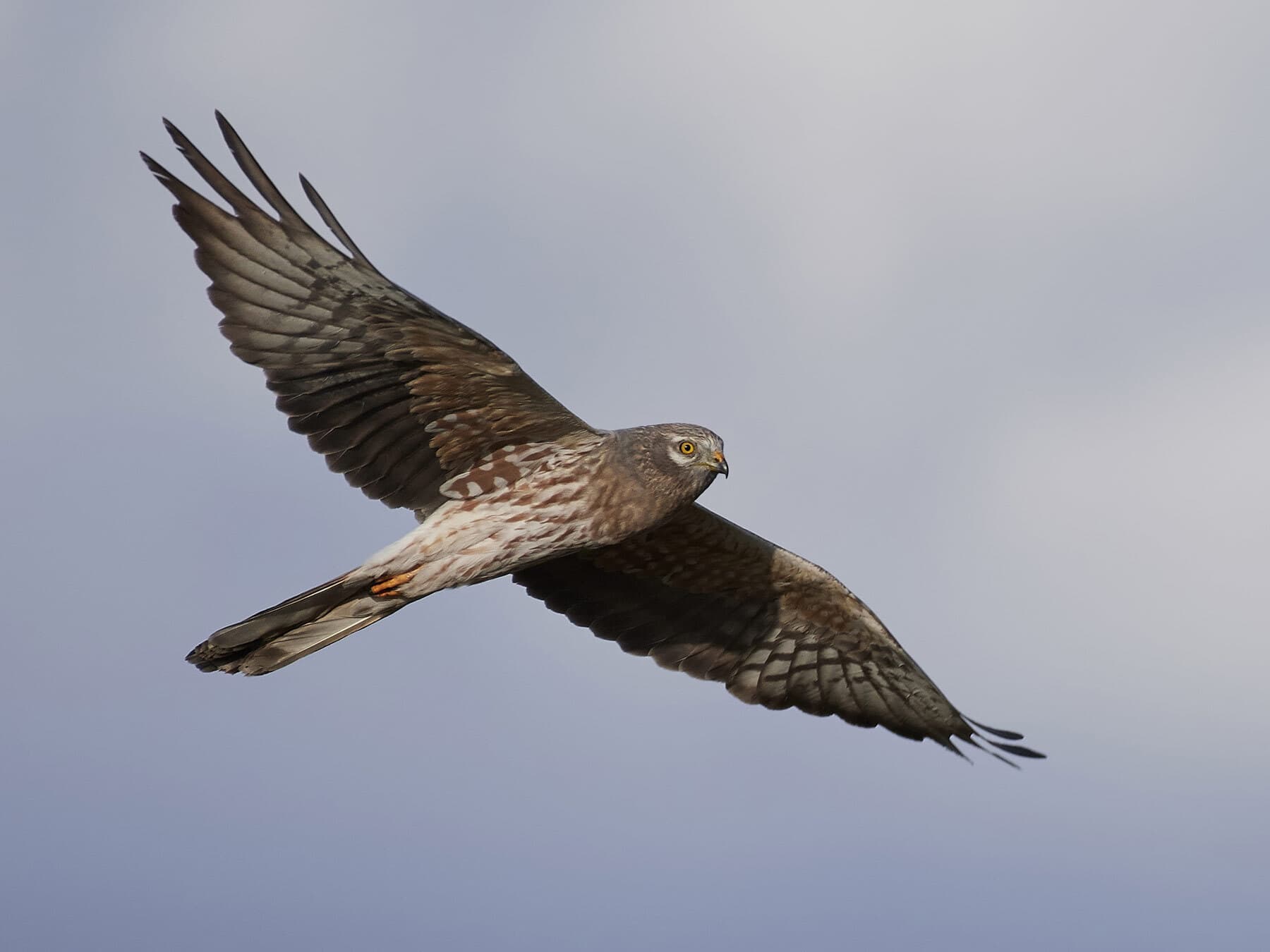
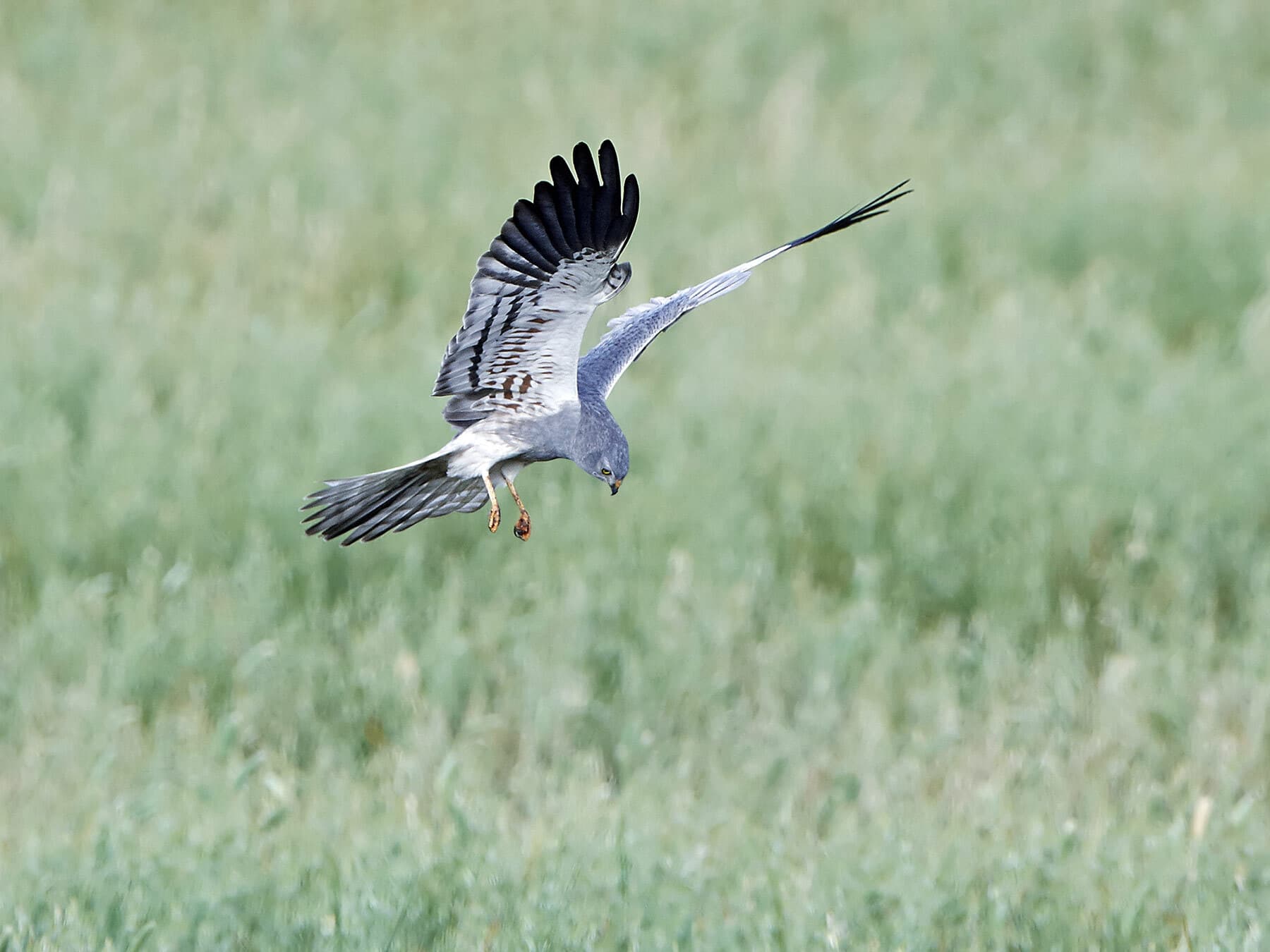
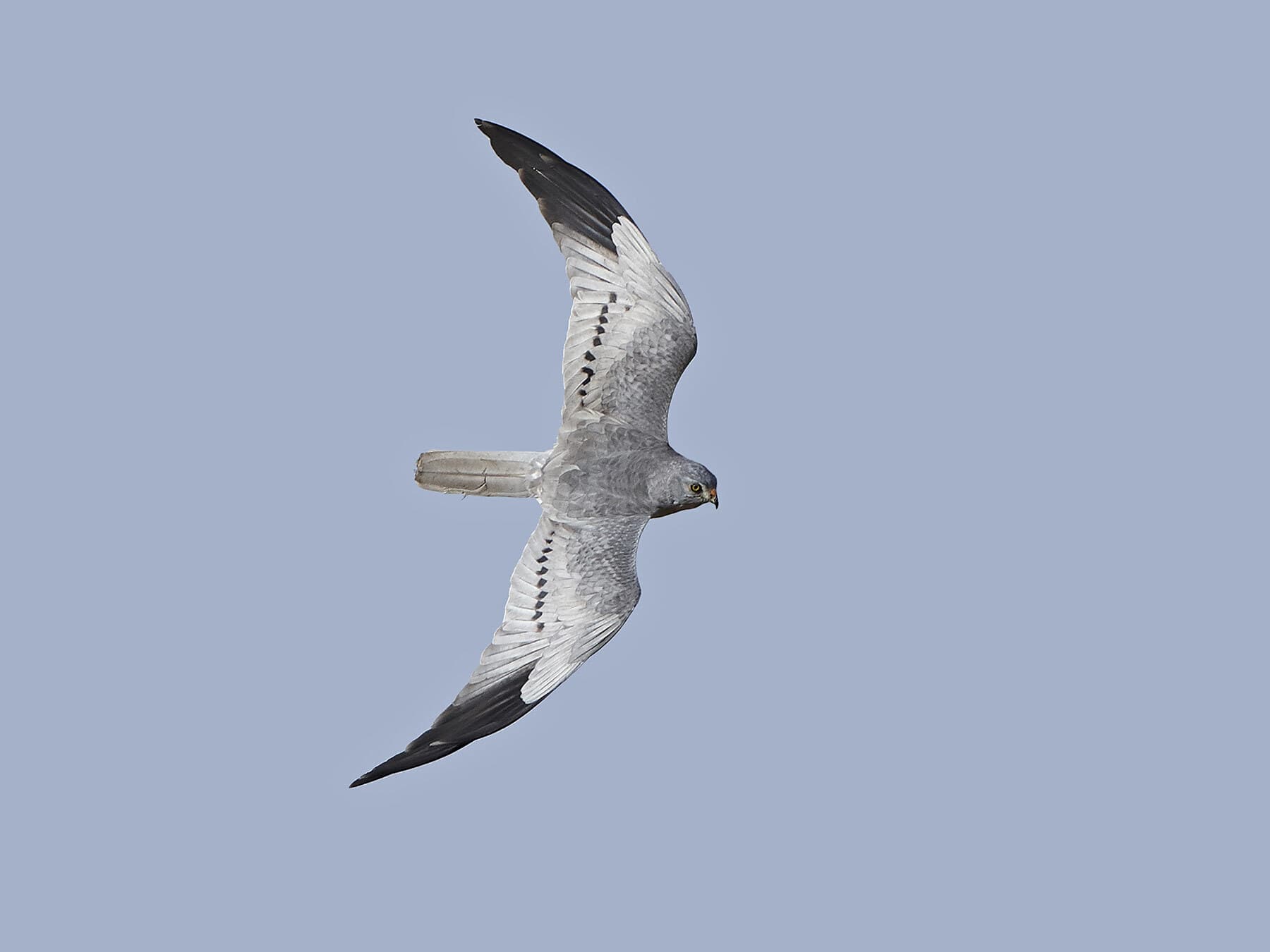
Montagu's Harriers are slender, long-winged raptors with a distinctive owl-like facial disc. Males are predominantly pale grey with black wingtips and a black bar across the secondary feathers. Their underparts are white with fine rufous streaks.
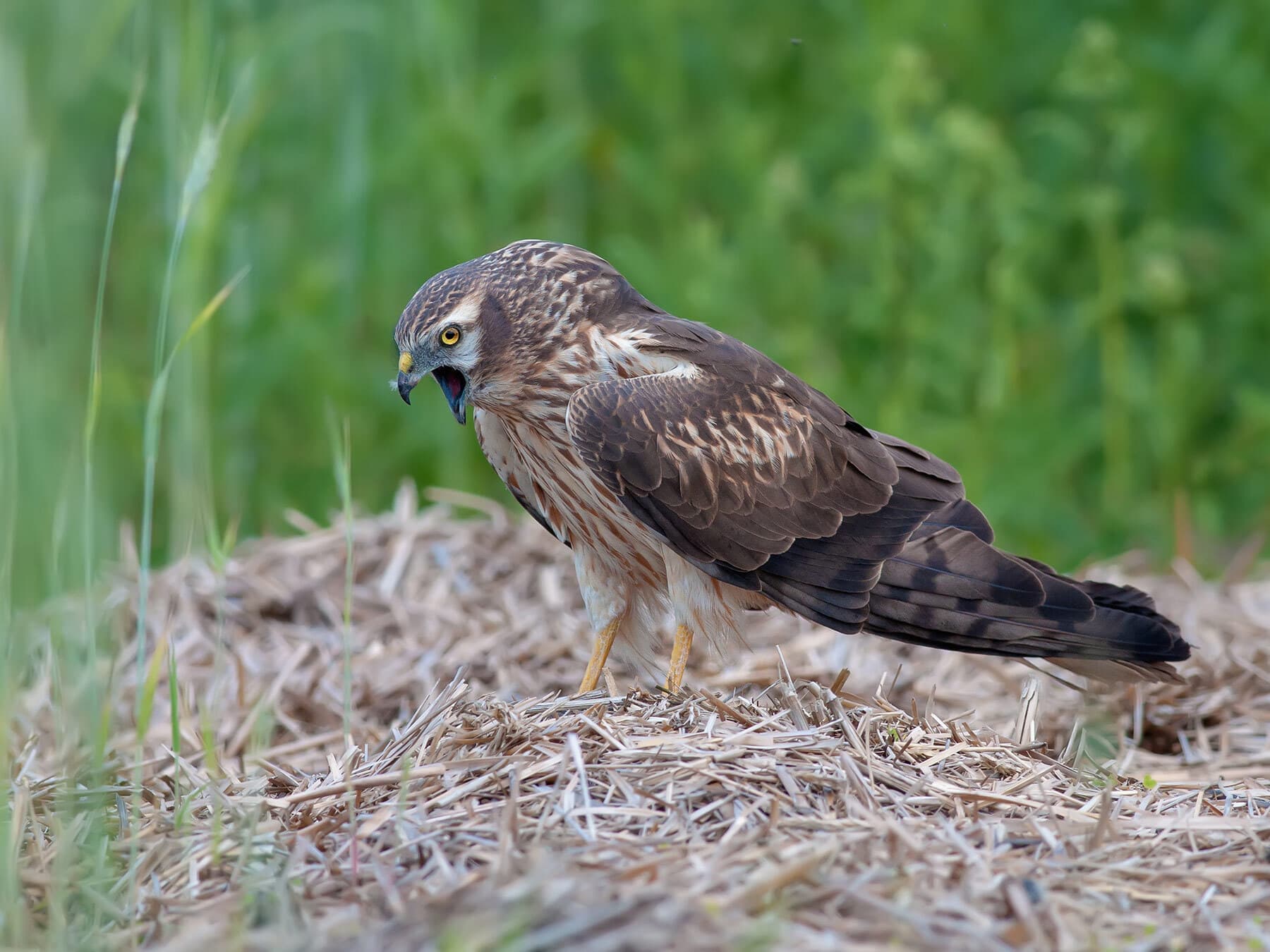
Females are larger and brown, with a white rump and barred tail. Juveniles resemble females but have darker upperparts and a rich orange-buff underside. In flight, all show long, narrow wings and a long tail.
Its size
Adults- Length
- 43–47 cm
- Wingspan
- 108–120 cm
- Weight
- 230–445 g
Its song and calls
Normally only vocal during the breeding season or in close proximity to the nest the Montagu’s harrier has a relatively limited repertoire of calls. The adult male has a loud, harsh, resounding cackle of, ‘kek – kek – kek - kek’ which will often result in a softer and more rapid female response of, ‘kekekekek’. The male’s ‘kek – kek’ call can also be used as an alarm or alert.
‘Keeeeee’, which is a high-pitched squealing sound, can be heard as a begging call for food.
Why is it called a Montague’s Harrier?
The Montagu’s harrier is so named after a famous British naturalist who was the first to identify the bird within the United Kingdom. Born in the County of Wiltshire, England, in 1753, George Montagu joined the British army at 17 years of age, rising to the rank of Colonel. Upon his retirement from the army, he concentrated on his passion as a naturalist and ornithologist. He died in 1815.
The common names of several species of animal are directly attributed to him and bear his name including, blenny, ray, sucker, sea snail and of course, the Montagu’s harrier.
When and where to see it
How often the Montagu's Harrier turns up in the UK and Ireland through the year, from birdwatchers' records.
Ireland
Scarce · regularly May · most records in May
Show as a table
| Month | Ireland |
|---|---|
| January | – |
| February | – |
| March | – |
| April | 0.002% |
| May | 0.005% (regular) |
| June | 0.002% |
| July | – |
| August | – |
| September | – |
| October | – |
| November | – |
| December | – |
Recorded in United Kingdom, but eBird withholds many records of this sensitive species to protect it, so no months are shown.
Worldwide: recorded regularly in 78 countries
Countries where it was recorded in at least 3 of the 6 years 2019–2024. Linked countries have their own bird list.
Europe (36)
Africa (20)
Asia (22)
- Armenia
- Azerbaijan
- China
- Cyprus
- Georgia
- India
- Iran
- Israel
- Jordan
- Kazakhstan
- Kuwait
- Kyrgyzstan
- Lebanon
- Oman
- Pakistan
- Palestinian Territories
- Qatar
- Saudi Arabia
- Sri Lanka
- Turkey
- United Arab Emirates
- Uzbekistan
Data: EOD – eBird Observation Dataset (Cornell Lab of Ornithology), accessed via GBIF.org, CC BY 4.0. Records from 2019–2024, aggregated and filtered by Birdfact. How these lists are made
In the main the Montagu’s harrier is a lowland bird and during the breeding season nests are built on the ground, predominantly by the female, in open areas with tall vegetation. The nests are often constructed within small to medium colonies for protection and consist of a small platform made from thin twigs and grasses. Often pairs will perch on a rock or fence post overlooking the nest site but general roosting, in common with nesting, takes place on the ground.
What is the habitat of the Montagu’s Harrier?
The Montagu’s harrier prefers flat or gently undulating open areas such as pastures, cultivated fields, grass plains, scrubland, moors, marshes, meadows, steppes and heathland. Such wide-open areas may possibly offer a number of advantages to the harrier affording better notice of impending attack by a predator and conversely allowing the low and slow flying bird to easily spot prey of its own.
The Montagu’s harrier breeds throughout southern and central Europe into western Russia, Kazakhstan and China’s northwest. Small numbers of breeding pairs are also found along the coast on North West Africa. It overwinters in the Indian sub-continent as far south as Sri Lanka and in sub-Saharan and South Africa.
Where can I see Montagu’s Harriers?
Probably the best time to spot Montagu’s harriers is from afar during the breeding season, particularly when they are nesting in colonies. The Iberian Peninsula and Spanish steppes were favoured spotting locations in the past but there has been a gradual movement away from western Europe possibly due to enhanced pressure from mechanised farming and chemical sprays.
Remember that these birds prefer open plains so don’t expect to be able to get too close for that elusive photo opportunity before being spotted. Unfortunately, the easiest place to view a Montagu’s harrier is likely to be in captivity.
Do Montagu’s Harriers migrate?
Whilst some Montagu’s harriers that are resident within southern Europe remain year round, most birds migrate during the winter months preferring the warmer climes of Africa and India. Within Europe, birds arrive for courtship and breeding from around mid-April to mid-May, always returning to the nesting area of previous years. Juvenile Montagu’s harriers will often remain in their wintering grounds during the first and even second years of life.
The Autumn migration south is typically in August and September. The passage time during winter migration tends to be in the region of 16 – 18 days whilst the passage north to the breeding grounds takes double that time.
Tips for seeing it
- Look for their distinctive low, gliding flight over open fields and marshes
- Listen for their 'kek-kek-kek' call during breeding season
- Observe early morning or late afternoon when they're most active
- In the UK, focus on areas like East Anglia and the southwest during the summer months
What it eats
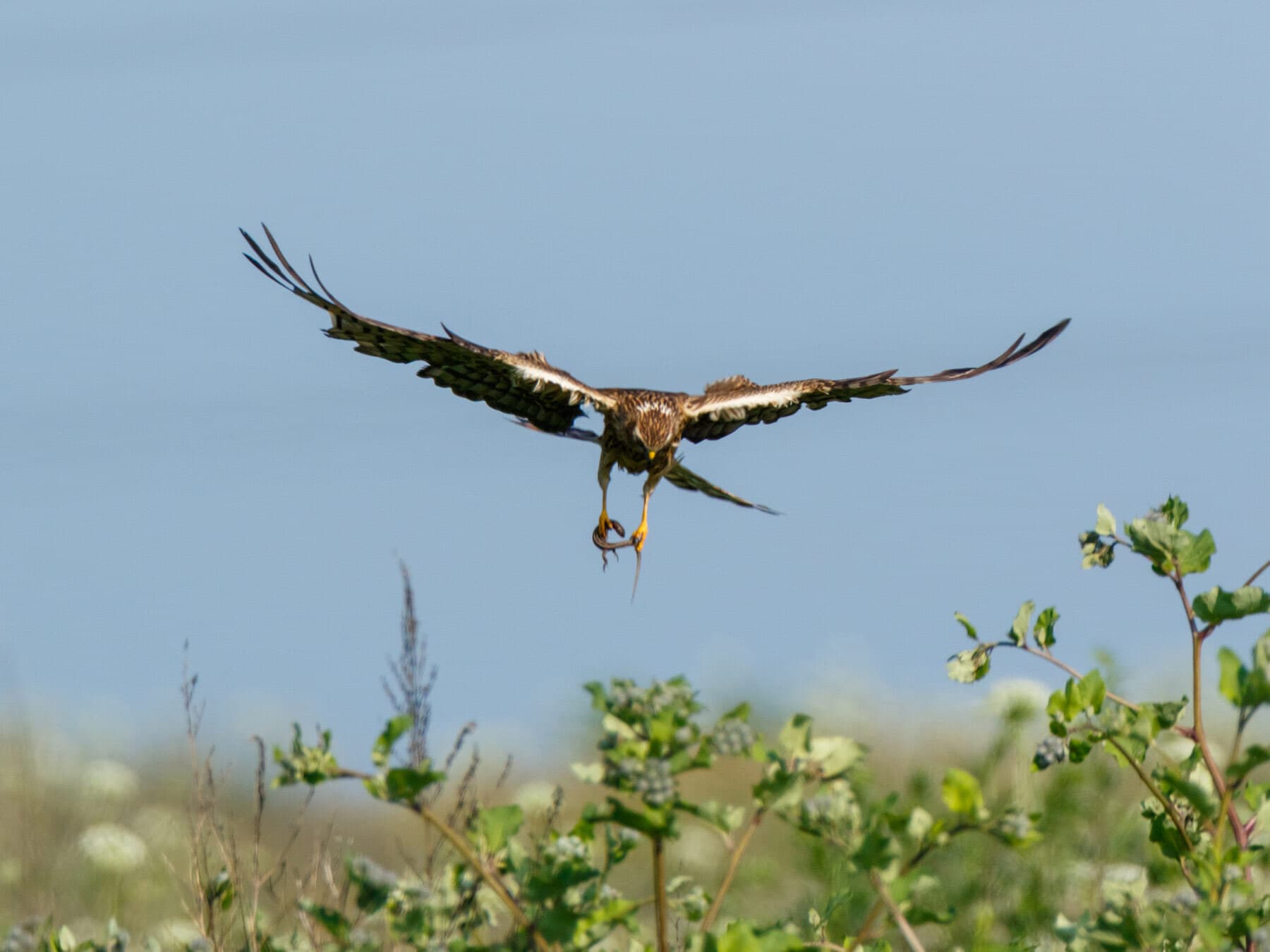
Montagu’s harriers are carnivorous taking much of their food directly from the ground which they spot by flying low over open areas on well established flightpaths. Dependent upon their geographical location they feed on a variety of small mammals such as rabbits and voles, lizards and other reptiles, insects and small birds.
Nesting and breeding
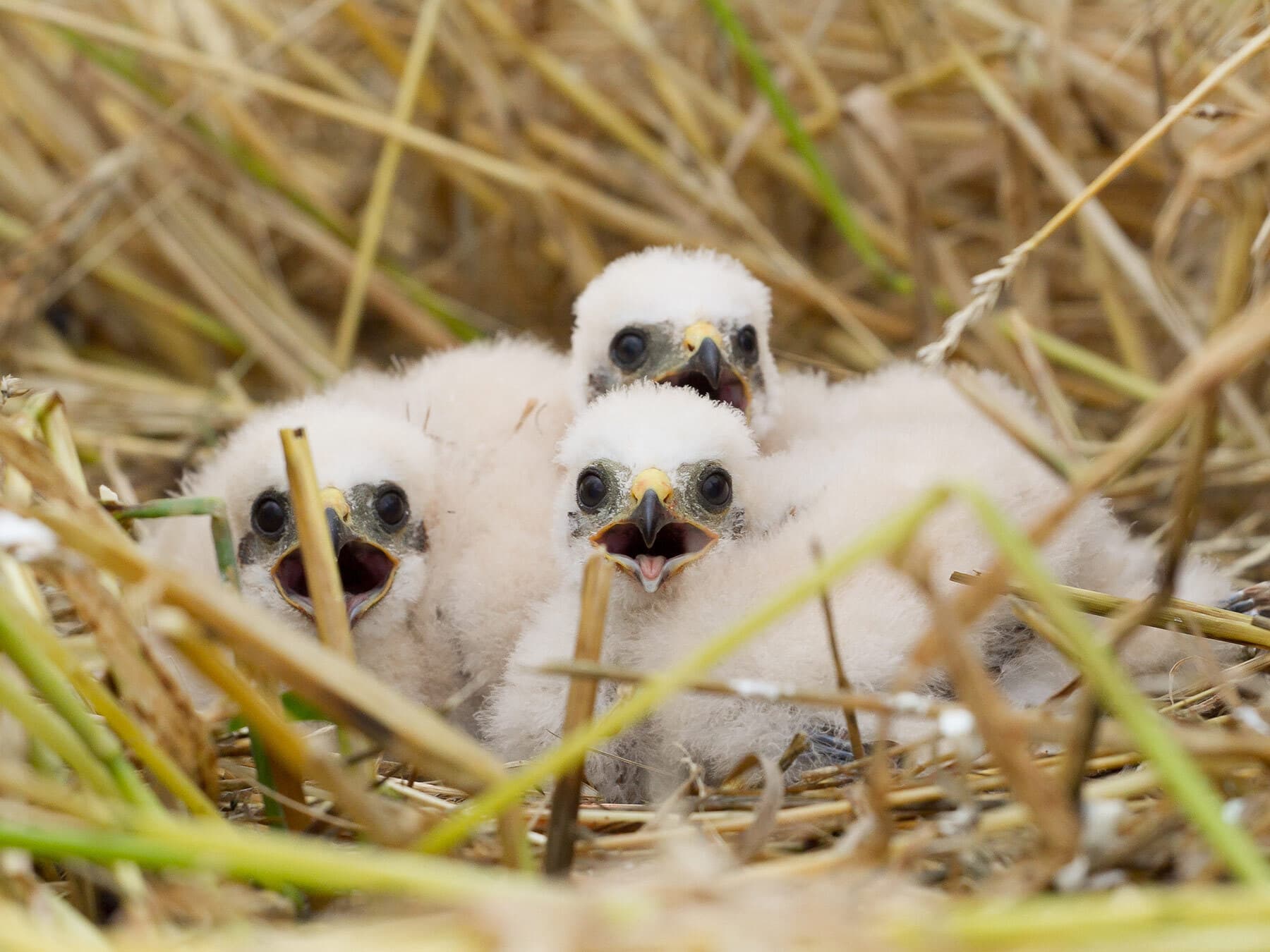
The female lays one brood of, on average, between 3 – 5 eggs annually. The eggs are laid at intervals of up to 3 days apart. The breeding season runs from April to June dependent upon region. The female alone incubates the eggs for a period of 28 – 29 days. Fledging occurs between 35 – 40 days from hatching during which time the male parent catches all the food which is passed on to the female who in turn feeds her chicks. During this time the male will search for food in excess of 10 kilometres (over 6 miles) away from the nest area.
What do Montagu’s Harrier eggs look like?
Montagu’s harrier eggs are a matt white finish averaging 4.2 x 3.3 cm in size and weighing around 24 g.
Behaviour
Montagu's Harriers are known for their graceful, low flight over open country. They often hunt by quartering fields with slow, buoyant wingbeats, suddenly dropping onto prey.
During the breeding season, males perform spectacular 'sky-dancing' displays involving steep climbs and tumbling dives to attract mates.
Lifespan and predators
The average lifespan of a Montagu’s harrier is often stated as being up to 15 years although this appears to be over ambitious and it is generally agreed that the expected longevity of an adult is more likely to be closer to 7 years, with 10 years probably being the upper norm.
Conservation
Despite being listed as Least Concern globally, Montagu's Harriers face threats from agricultural intensification and habitat loss.
Conservation efforts focus on protecting cropland nesting sites and maintaining suitable hunting habitats. In some areas, nest protection schemes involve cooperation with farmers.
What does a Montagu’s Harrier look like?
The adult male is predominantly grey overall with black primary flight feathers forming tapered wing tips and additional black barring across the inner wing area, across the top of the secondary flight feathers. The rump and tail are grey and the underwing area is pale grey with rufous bars. The belly area is almost white streaked with bold rufous markings.
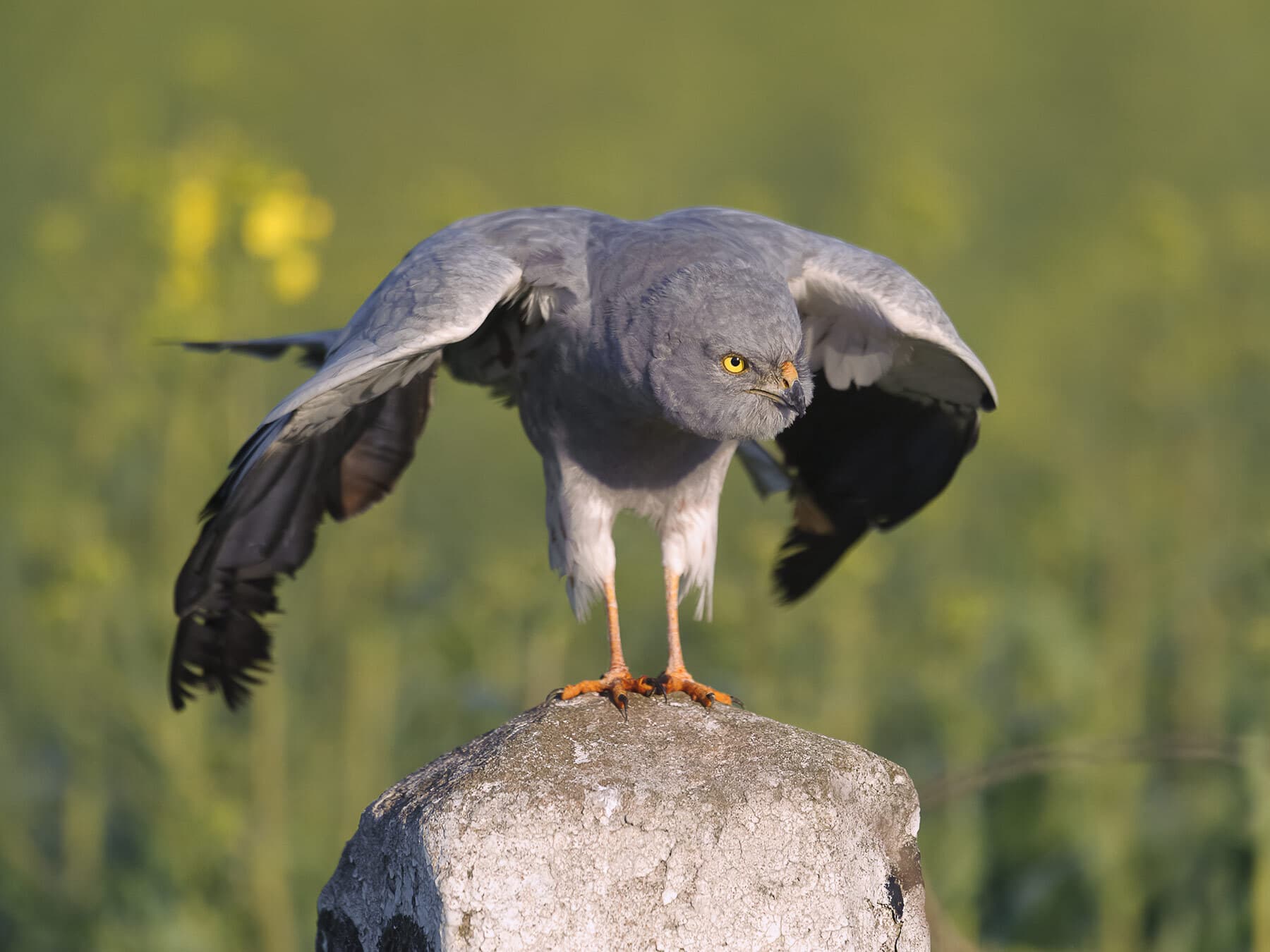
The short but chunky hooked bill is a dark grey or black with a yellow cere (the area at the base of the upper mandible) and the legs and feet are bright yellow. The iris is also bright yellow in the adult.
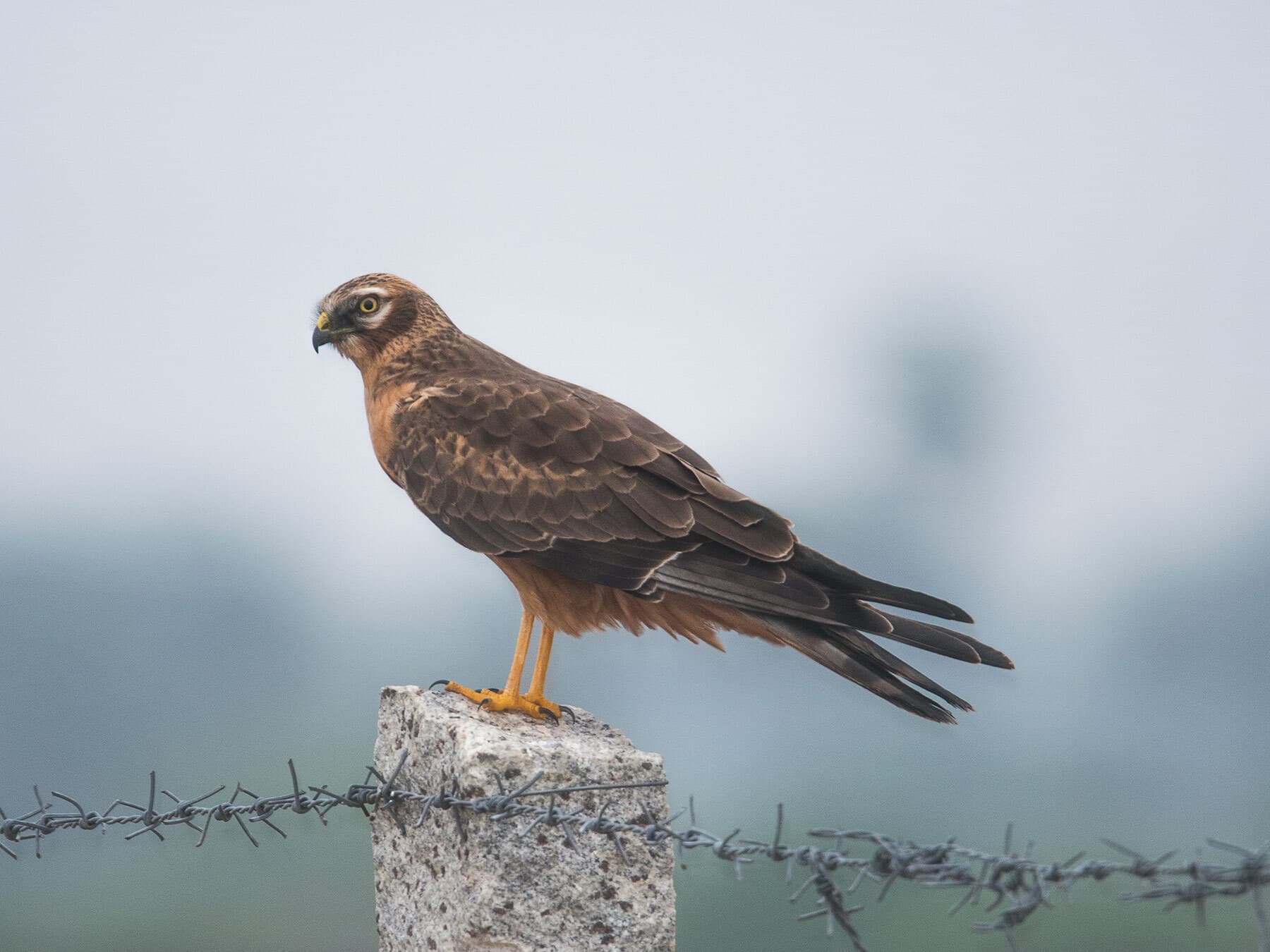
The fully grown female is generally larger than her male partner and is dark brown above with pale buff, almost yellow underparts, streaked rufous. The rump is white and the upper tail a mid brown banded with black bars. Primary and secondary flight feathers are tipped black and the upper central wing area is a paler brown that the rest of the upper wing. The head is a mid brown and there are white crescent shaped areas below and above the eye. The eye colour and bare parts are similar to the male.
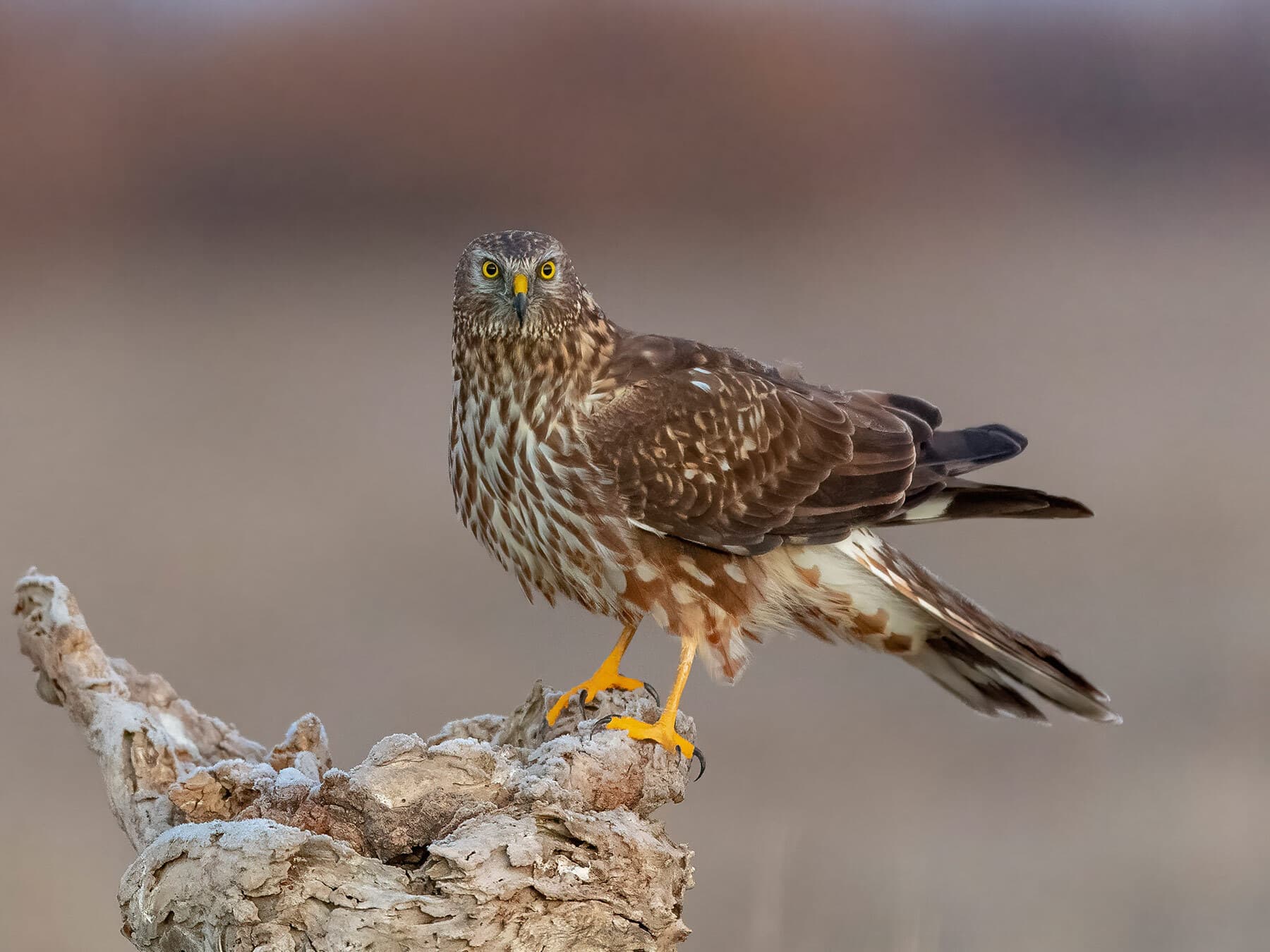
The juvenile bird is similar to the adult female being predominantly brown as opposed to grey like the male, although the underwing and underparts are a rufous brown and are unstreaked. Legs, feet and bill are as adult birds but they eyes of juveniles lack the yellow iris of the adults being either dark grey or brown.
Nestlings are born altricial, that is to say, underdeveloped and totally reliant on their parents until fledging. They are born with a think white down, tinged buff.
It is not uncommon for Montagu’s Harriers to show signs of Melanism. A simple explanation of the word melanism is to portray it as the opposite of albinism where in melanism there is an over production of a dark pigment which can affect the plumage of individual birds. In males it produces brownish black upper parts, a black head and grey underparts, whereas in females it manifests as a uniformly dark brown colouration overall apart from grey flight feathers.
How big is a Montagu’s Harrier?
The Montagu’s harrier is one of the smaller birds of prey although its size can be deceptive as it has a small slender body but a large wing area in comparison. The adult bird’s length varies from 40 – 45 cm (16 – 18 in) and its wingspan is an impressive 100 – 120 cm (39 – 47 in).
How much does a Montagu’s Harrier weigh?
The adult female Montagu’s harrier is heavier than the male, weighing in at between 254 – 450 g (9 – 16 oz) although this is not always apparent to the naked eye. Being larger than the male is caused by the female’s requirement to produce eggs. The weight of the adult male varies from 227 – 305 g (8 – 10.75 oz).
What is the scientific name of the Montagu’s Harrier?
The Montagu’s harrier is a monotypic species meaning there are no subspecies. The species name, Circus pygargus, derives from the Greek words Kirkos, meaning ‘circle’ due to the circling flight movements of the bird and pugargos meaning ‘white rump’. The 16 separate species of harrier are all prefixed scientifically with the word Circus.
Montagu’s harrier is a member of the scientific family classed as Accipitridae, from the order Accipitriformes which includes Hawks, Kites and Eagles. Members of this family are found worldwide bar the continent of Antarctica. There are in total 250 individual species included within the family Accipitridae.
Accipitriformes are predominantly carnivorous birds of prey with strong talons and robust hooked bills.
Are Montagu’s Harriers aggressive or friendly?
Montagu’s harriers are both solitary and gregarious with breeding pairs often forming small to medium sized colonies as a defence against predation of the young by other birds or mammals such as foxes.
Are Montagu’s harriers endangered?
Whilst the population trend of the Montagu’s harrier is decreasing it is not doing so at a rate currently considered to be within numbers likely to render the species vulnerable. For this reason, it is classed globally, within conservation circles, as being of Least Concern.
However, within the United Kingdom its conservation status is defined as Amber being one class above Red due to its continued historical decline, particularly with regards to ‘in country’ breeding success.
Do Montagu’s Harriers mate for life?
Many male Montagu’s harriers are understood to be polygamous having two partners per season, although it is believed that because birds return to the same breeding grounds every year the female mates with the same partner each year and could therefore be described as monogamous by having just the one life mate.
Similar birds
Often mistaken for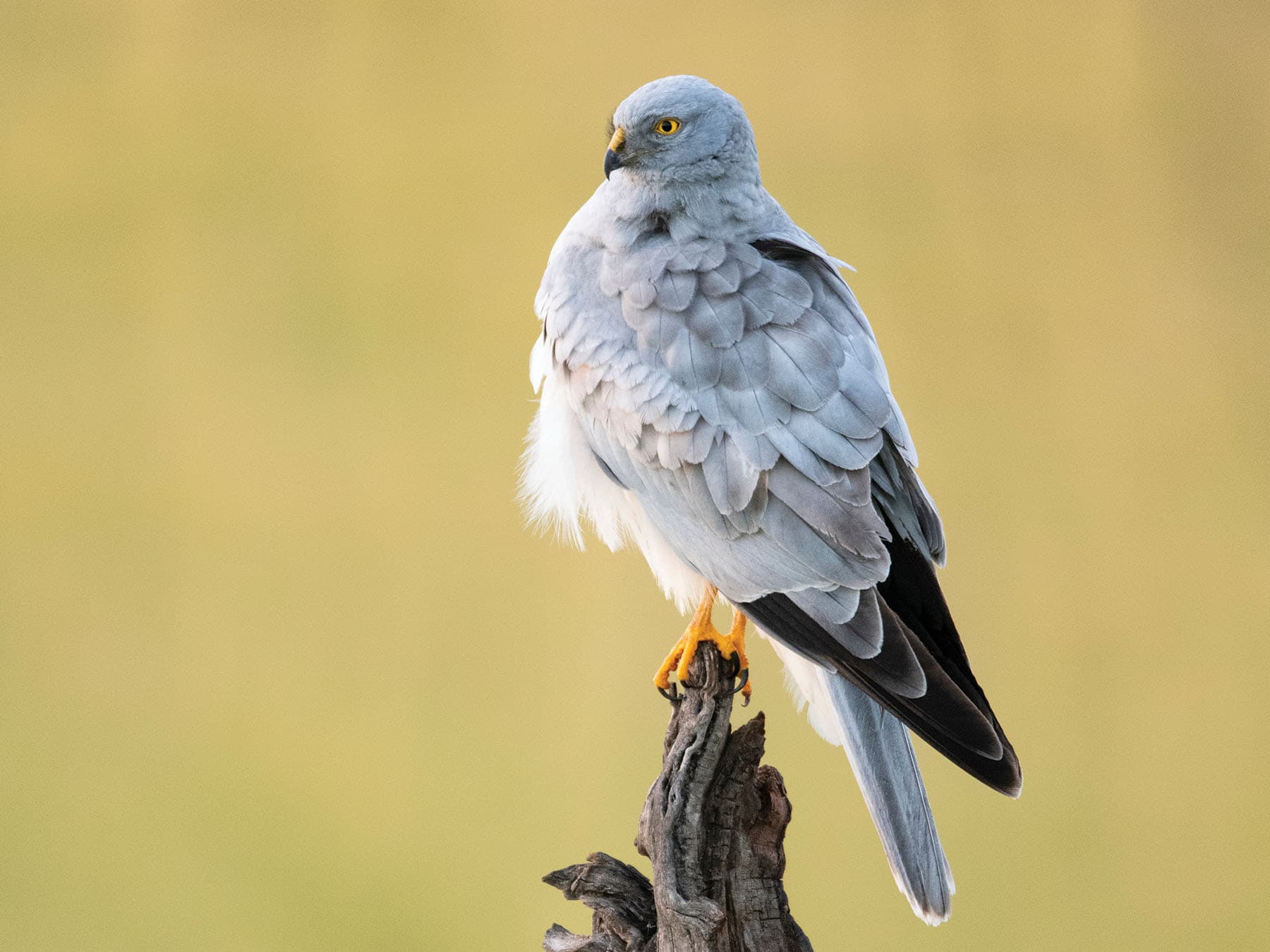
Montagu's Harrier guides
1 guidesQuick facts
- Length
- 43–47 cm
- Wingspan
- 108–120 cm
- Weight
- 230–445 g
- Lifespan
- 6–16 years
- Family
- Hawks & Eagles
- Migration
- Long-distance Migrant
- Global status (IUCN)
- Least Concern
- World population
- 300,000 to 550,000 mature individuals
- Population trend
- Decreasing
- Also called
- Ash-colored Harrier
- Scientific name
- Circus pygargus
Sources
3- 1BirdLife International. 2021. Circus pygargus. The IUCN Red List of Threatened Species 2021: e.T22695405A201058261. Source (opens in a new tab)
- 2Ferguson-Lees and Christie (2001)
- 3BirdLife International. 2021. Circus pygargus. The IUCN Red List of Threatened Species 2021: e.T22695405A201058261. Source (opens in a new tab)

Checked by
Nathan Cope, founder and editor
Nathan founded Birdfact and leads its writers and contributors in the UK, the US and Canada. He has watched and studied birds for more than ten years, and checks every article and species guide before it’s published.