


Jack Snipe
Jacksnipe · Lymnocryptes minimus
By the Birdfact teamChecked by Nathan Cope
On this page14 sections
How to recognise it
What do Jack Snipes look like?
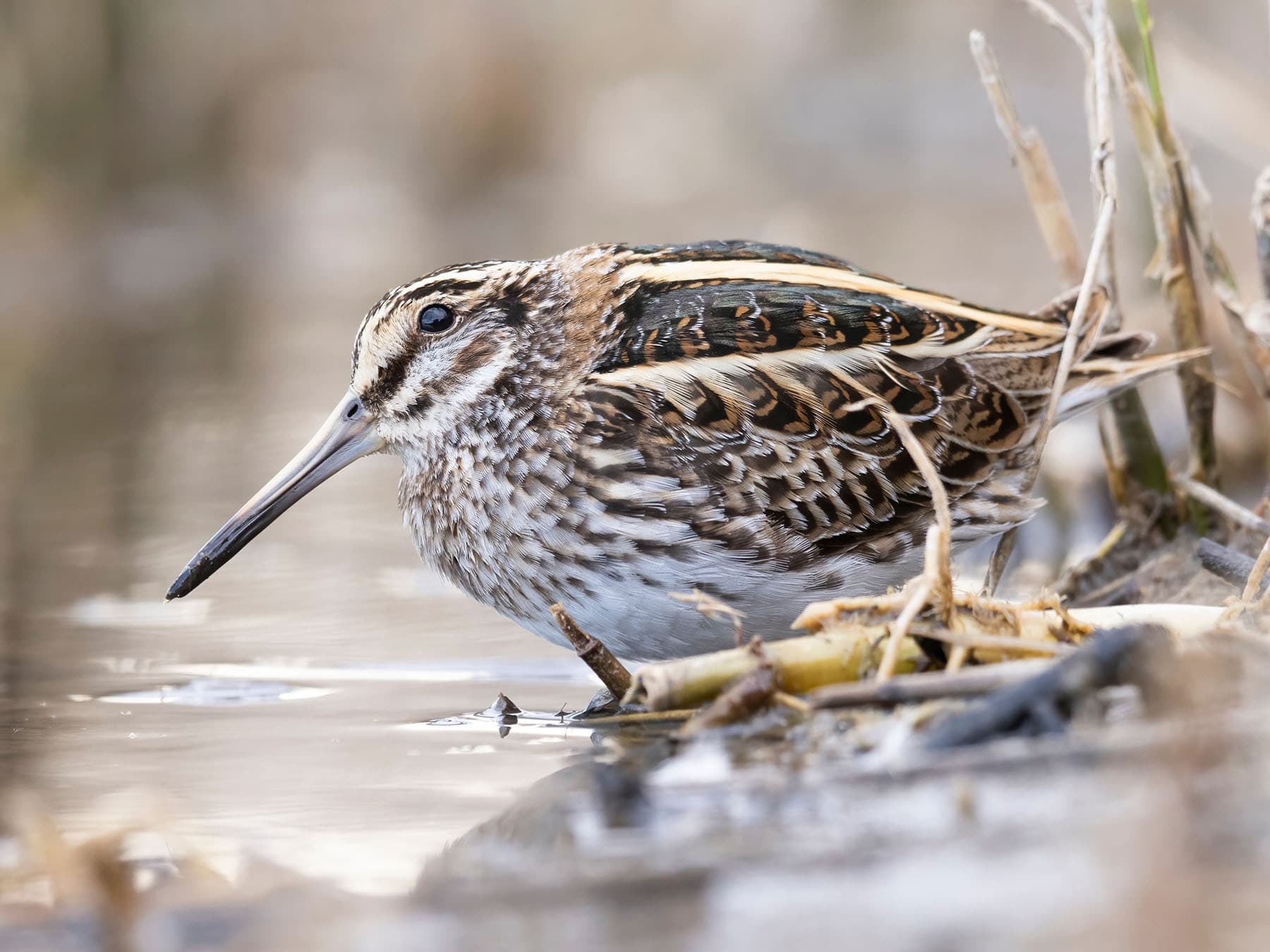
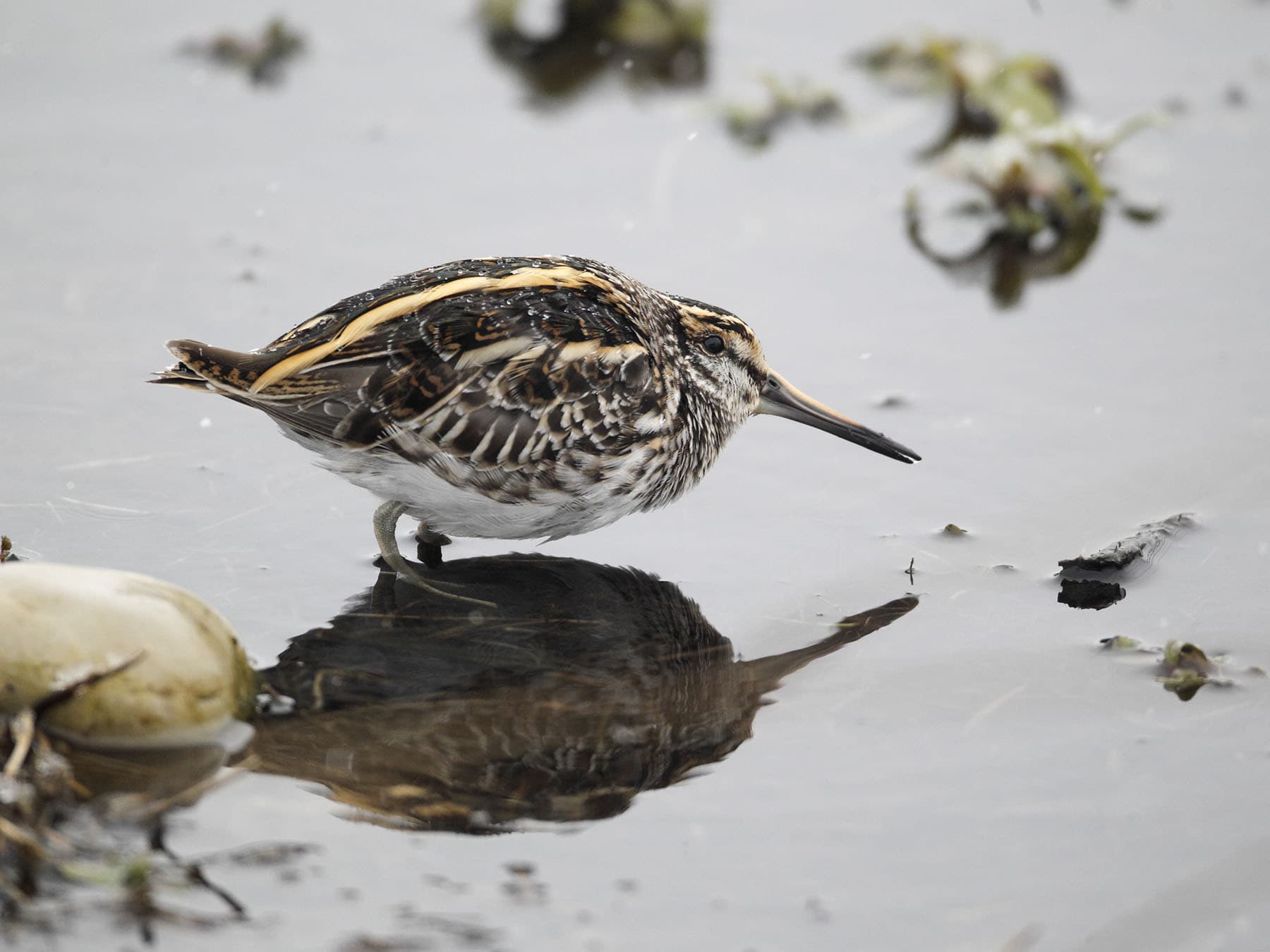
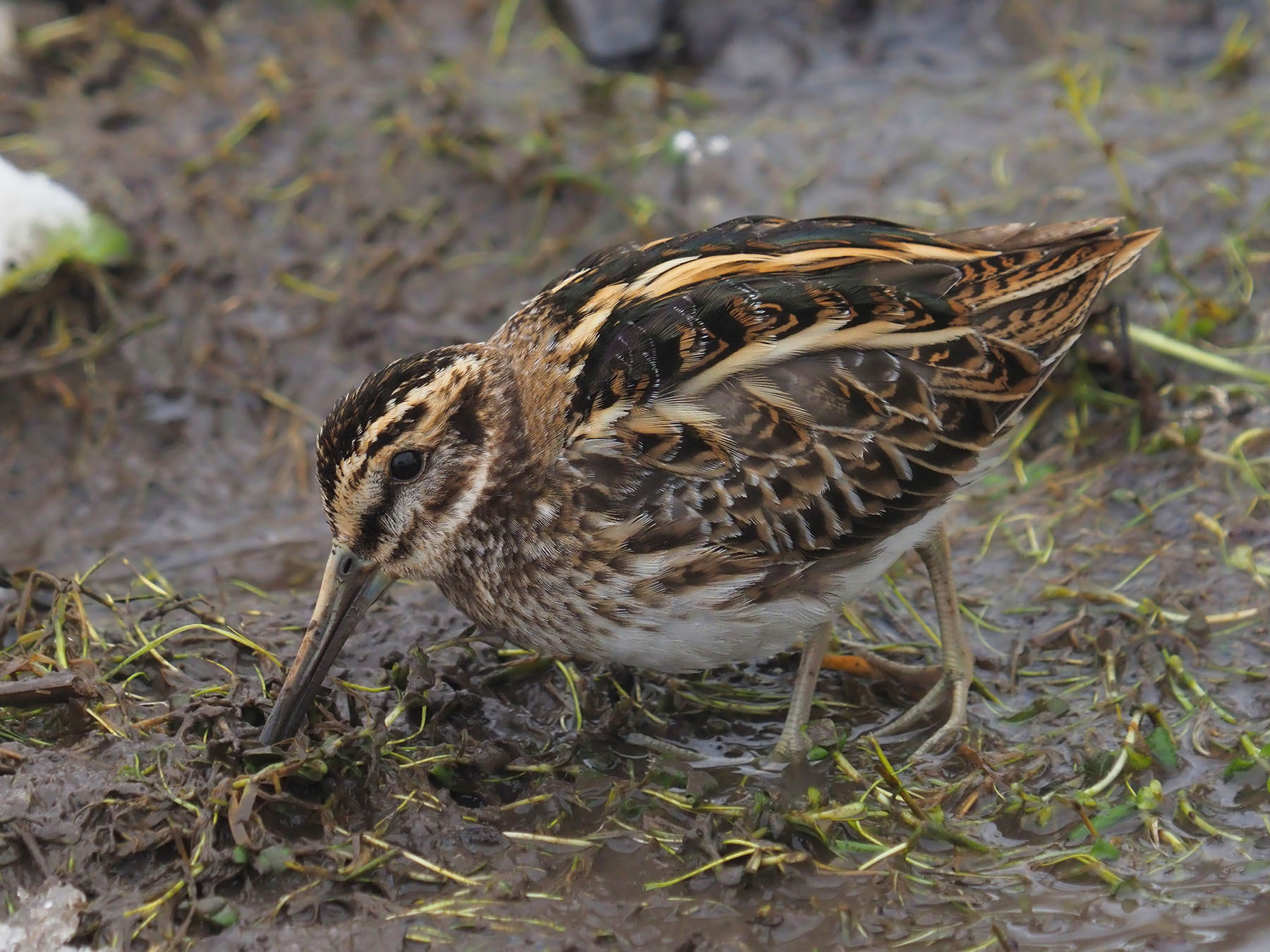
Smaller than a common snipe, and with a shorter bill, the jack snipe is a stocky wading bird, with a large head, narrow wings and a wedge-shaped tail.
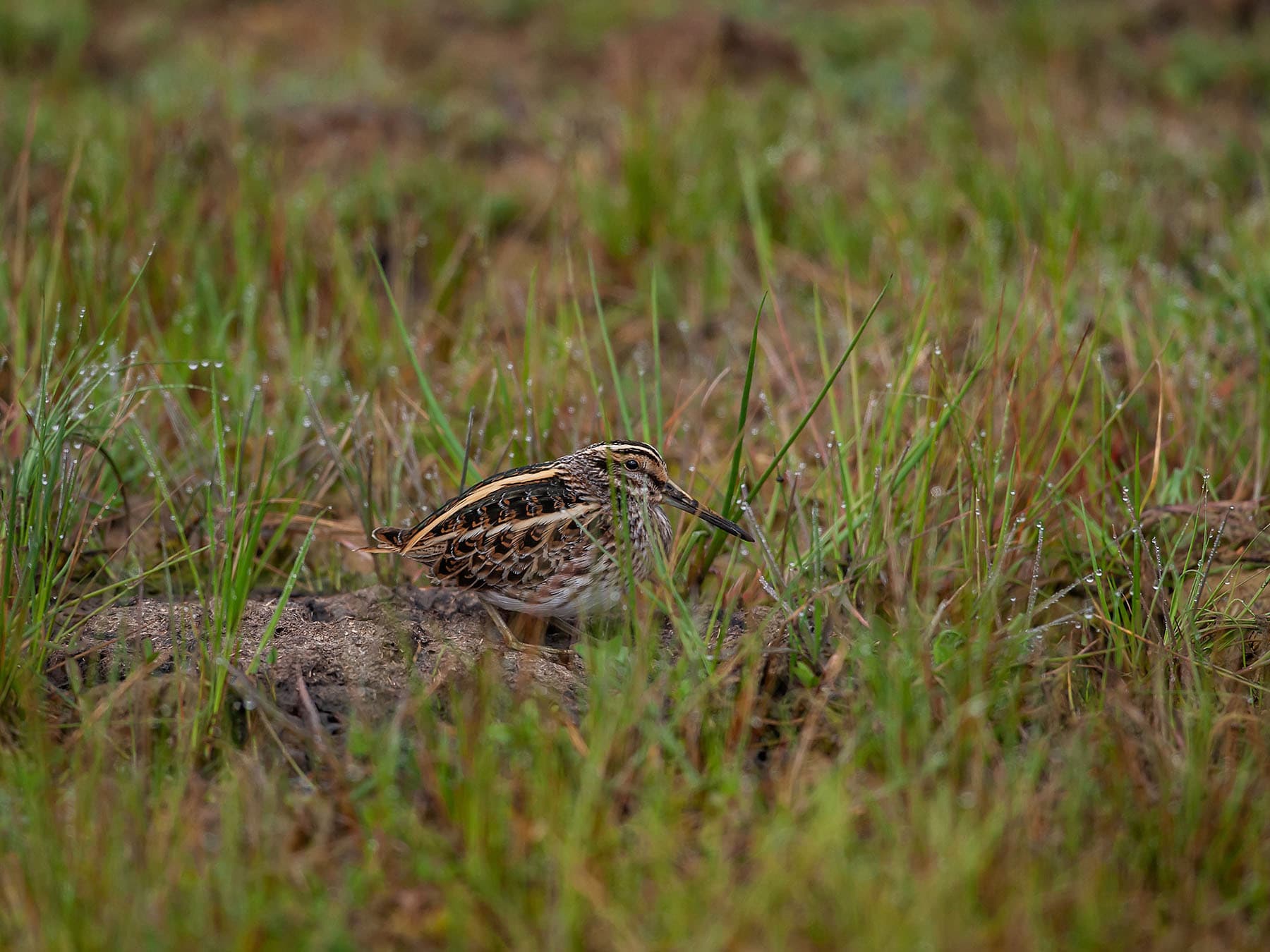
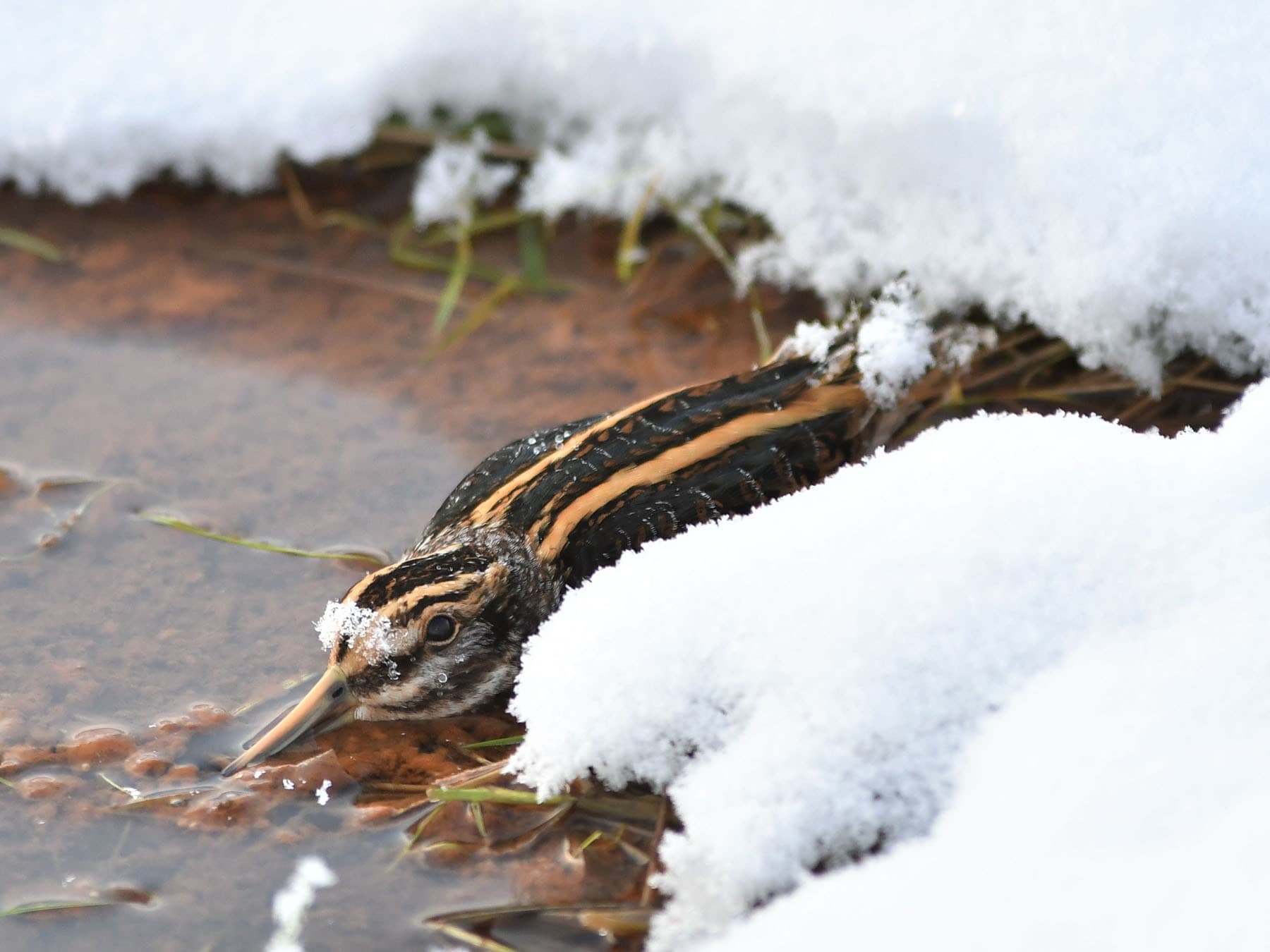
Males and females are alike in appearance: their mottled dark brown bodies are marked with golden stripes, allowing them to blend in well among wetland vegetation. The lower belly is white, while the upper breast is buff and streaked with thin dark markings.
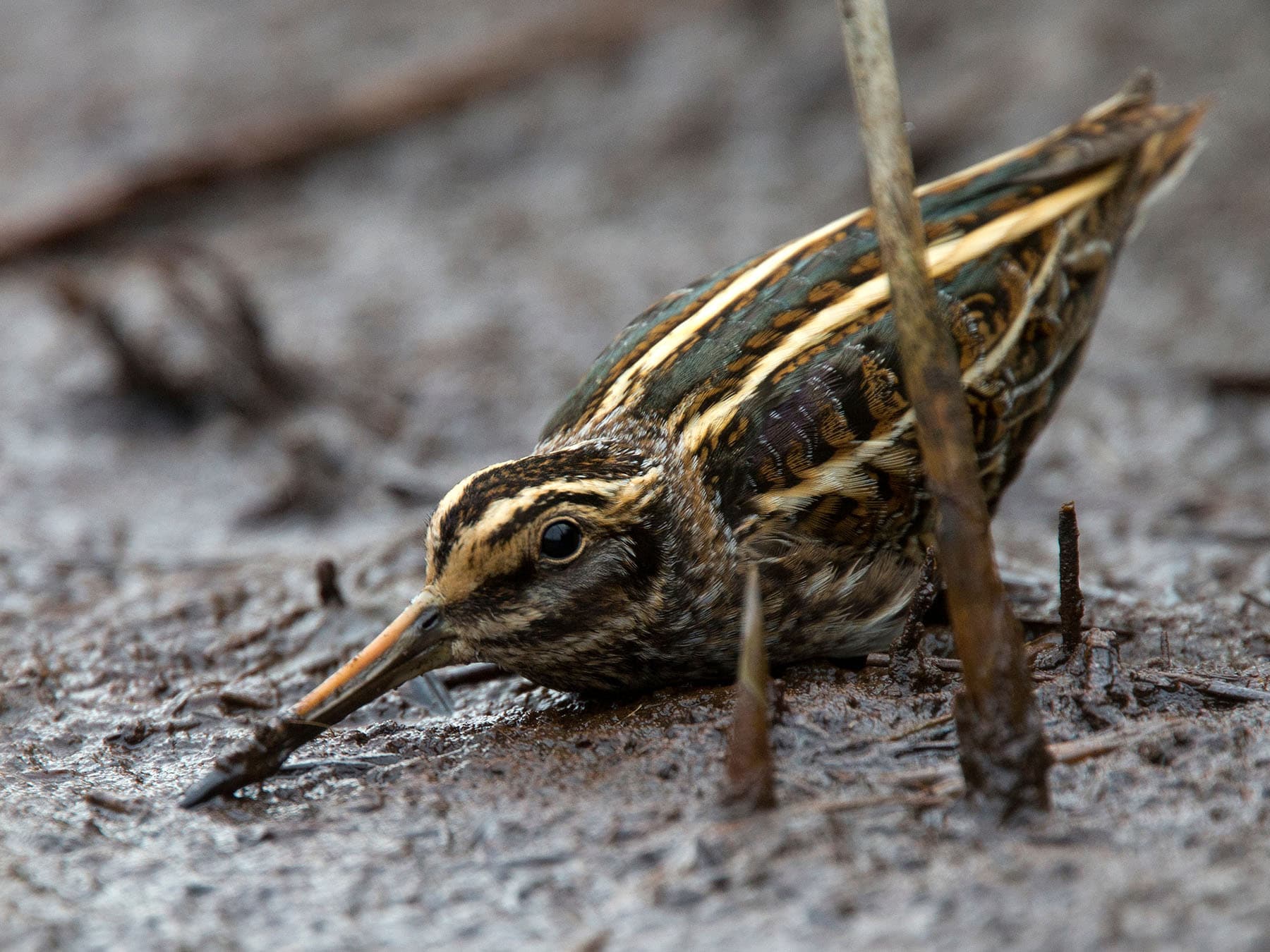
The jack snipe’s back features a glossy green-purple shine to the dark brown-black patches. It has a dark brown head, with pale lines above the eyes, punctuated by a thin dark brown ‘eyebrow’.
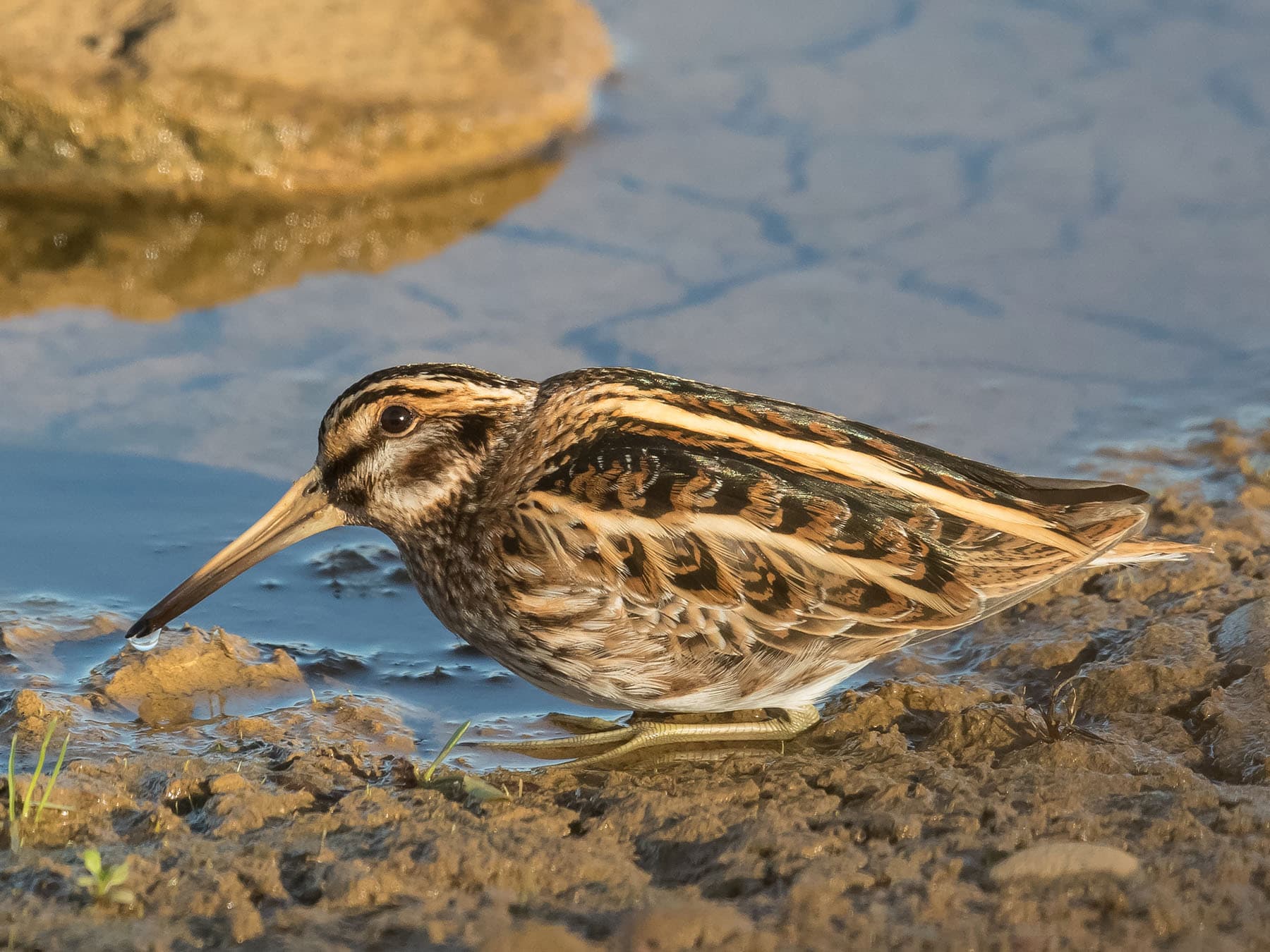
Female jack snipes are hard to tell apart from males when a lone bird is observed, but when studying a pair, you may be able to see that the bill of the female is slightly longer, while the male’s is broader.
Juvenile jack snipes are similar in appearance and colouring to adults, but are marginally smaller and lighter in weight. The underside of a young jack snipe’s tail is paler than that of adult birds, and its bill and legs are darker.
How big are Jack Snipes?
In body size, male and female jack snipes are roughly the same size, but wingspan is where the key difference between the sexes lies. Males have significantly longer wings and tails than females.
- Length: 18 cm to 25 cm (7.1 in to 9.8 in)
- Wingspan: 30 cm to 41 cm (12 in to 16 in)
- Weight: 33 g to 73 g (1.2 oz to 2.6 oz)
Its size
Adults- Length
- 17–19 cm
- Wingspan
- 30–36 cm
- Weight
- 33–73 g
Its song and calls
What sound does a Jack Snipe make?
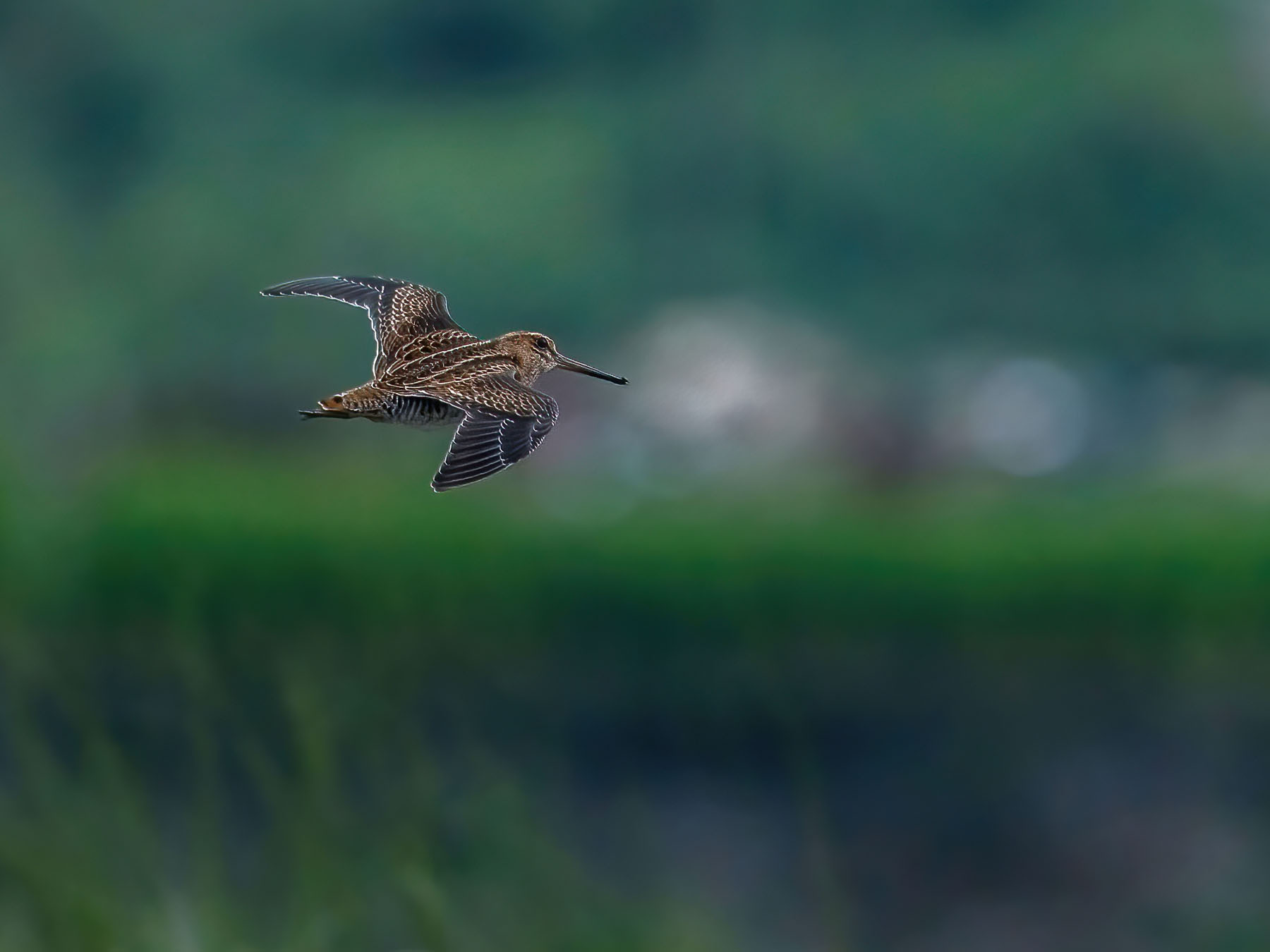
Jack snipes are generally only heard during the breeding season, when they are known for making a highly distinctive call that sounds like the clip-clopping noise made by a galloping horse as part of their courtship flight display.
Other sounds made by male jack snipes in their noisy bid to attract a mate include loud drumming and a series of high-pitched whistled notes.
- Song0:00 / 0:22
Recorded in Finnmark, Norway · July 2026
- Flight call0:00 / 0:03
Recorded in Bretagne, France · December 2025
When and where to see it
OctoberIn season
Most recorded in October
- 1. Shetland Islands0.51%
- 2. Orkney Islands0.45%
- 3. Tipperary0.31%
- 4. Cornwall0.17%
- 5. East Riding of Yorkshire0.15%
Each dot is a county, state or province: the bigger and darker, the larger the bird’s share of that place’s bird records that month. Grey dots: no regular records. The ringed point is the centre of the bird’s records this month; the arrow shows how it moved since last month, and the dashed loop its path through the year. “Arrivals” colours places where it becomes regular this month (orange) or is in its last regular month (grey). GBIF eBird Observation Dataset, 2019–2024. Map data: Natural Earth, US Census Bureau; place centres © OpenStreetMap contributors.
In your area
See when the Jack Snipe is recorded in your county, state or province.
How often the Jack Snipe turns up in the UK and Ireland through the year, from birdwatchers' records.
United Kingdom
Winter visitor · regularly Sep–Apr · most records in October
Ireland
Winter visitor · regularly Sep–Apr · most records in February
Show as a table
| Month | United Kingdom | Ireland |
|---|---|---|
| January | 0.042% (regular) | 0.018% (regular) |
| February | 0.031% (regular) | 0.025% (regular) |
| March | 0.026% (regular) | 0.017% (regular) |
| April | 0.012% (regular) | 0.013% (regular) |
| May | 0.002% | – |
| June | <0.001% | – |
| July | <0.001% | – |
| August | <0.001% | – |
| September | 0.008% (regular) | 0.004% (regular) |
| October | 0.065% (regular) | 0.017% (regular) |
| November | 0.037% (regular) | 0.016% (regular) |
| December | 0.038% (regular) | 0.020% (regular) |
Recorded regularly in
Worldwide: recorded regularly in 54 countries
Countries where it was recorded in at least 3 of the 6 years 2019–2024. Linked countries have their own bird list.
Europe (34)
Asia (18)
- Azerbaijan
- Cyprus
- Georgia
- India
- Iran
- Israel
- Kazakhstan
- Kuwait
- Lebanon
- Nepal
- Oman
- Pakistan
- Palestinian Territories
- Qatar
- Saudi Arabia
- Taiwan
- Turkey
- United Arab Emirates
Data: EOD – eBird Observation Dataset (Cornell Lab of Ornithology), accessed via GBIF.org, CC BY 4.0. Records from 2019–2024, aggregated and filtered by Birdfact. How these lists are made
What is the habitat of a Jack Snipe?
Habitats and landscapes favoured by jack snipes for breeding include marshland, bogs, tundra and wet meadows with short vegetation. In winter, mudflats and freshwater wetlands with dense vegetation provide ideal foraging spots for visiting jack snipes.
What is the range of a Jack Snipe?
Jack snipes breed across northern Europe and northern Russia. Outside of the breeding season, they can be found throughout Britain, in Atlantic and Mediterranean coastal regions of Europe, and as far afield as Africa, and India.
Where do Jack Snipes live?
Overwintering jack snipes can be seen across the UK between late September and February to March, with the exception of upland areas.
Wetlands, including river edges, lagoons, reedbeds and mudflats record the most sightings, with parts of Scotland and northern England attracting large numbers of visiting birds due to their geographical location on their migration route from Scandinavia.
How rare are Jack Snipes?
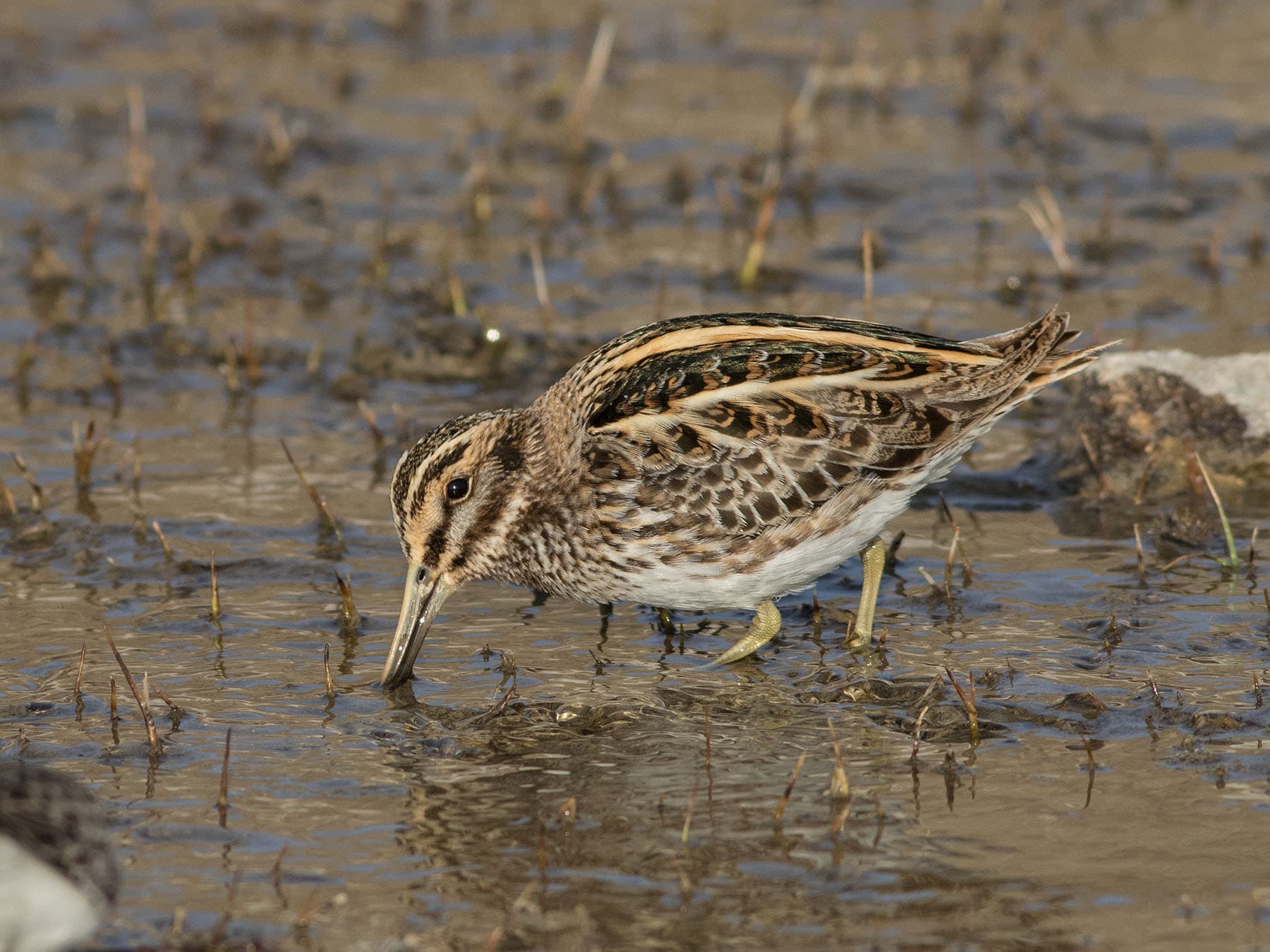
In the UK, the common snipe (Gallinago gallinago) is far more common than the jack snipe, and is present all year round. To see a jack snipe is relatively rare, due to its cleverly camouflaged plumage and preference to forage out of sight in boggy wetland vegetation.
Around 50,000 to 100,000 jack snipes spend winter on British shores, but despite these numbers, a sighting would still be considered quite a coup due to their secretive nature.
Where can you see Jack Snipes in the UK?
Many birdwatchers head to Glasgow in the hope of spotting a jack snipe, where several sightings of the species are regularly recorded in the city’s wetlands, particularly during the autumn.
Local ringing efforts are recording visiting numbers and researching fidelity to wintering grounds, and report up to 50 birds each winter across the local region.
MIgration
Do Jack Snipes migrate?
Jack snipes are a migratory species and are present in Britain during winter months, but do not breed here. Breeding takes place across northern Europe and northern Russia between March and September.
Jack snipes then head south-west across Europe to reach their wintering grounds, and can be seen in the UK from late September to early March each year.
Tips for seeing it
- Look for Jack Snipes on muddy edges of marshes, bogs, and wet meadows
- Watch for their distinctive bobbing motion while feeding
- Be patient, as they often remain motionless when approached
- In the UK, search for them during winter months in suitable wetland habitats
What it eats
What do Jack Snipes eat?
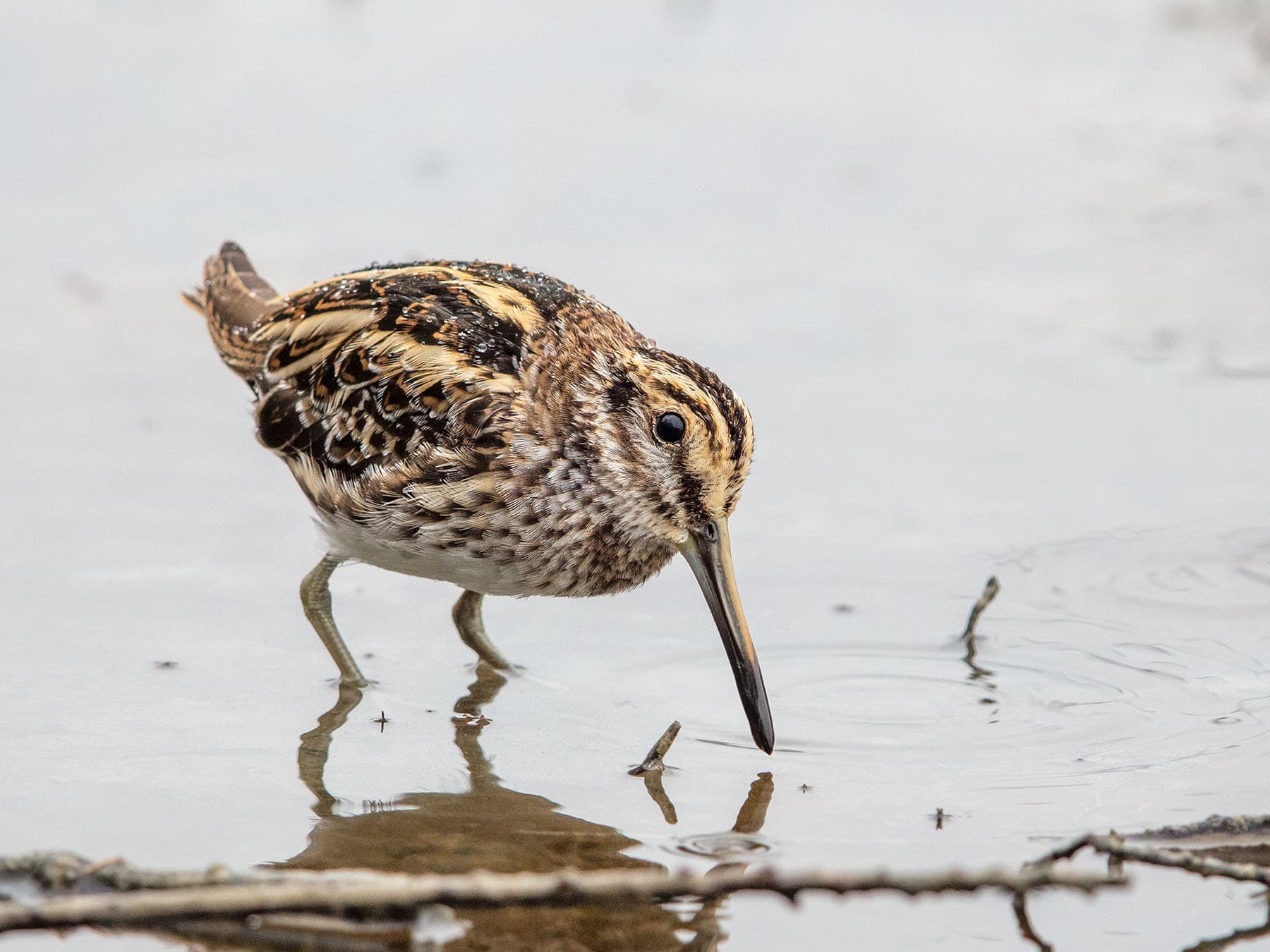
Commonly seen foraging around the edges of reedbeds and lagoons, jack snipes probe the soft mud for insects and worms beneath the surface, as well as picking up food they have spotted.
As well as insects and other invertebrates, plant material forms an important share of a jack snipe’s food intake.
Jack snipes are crepuscular, feeding at dusk after resting during daylight. Night-time hunting is not uncommon and they are thought to rely on bright moonlight to aid their nocturnal foraging.
What do Jack Snipe chicks eat?
Young jack snipes are fed by both parents until they reach independence a short while after fledging at around 20 days. Their diet matches that of adult jack snipes, invertebrates, larvae and crustaceans, as well as plant matter, including grasses and seeds.
Nesting and breeding
Where do Jack Snipes nest?
Typical nest sites for jack snipes include ground-level reeds, floating vegetation and sometimes on dry land, in waterside vegetation. Nests are formed from roughly scraped ground and are lined with grasses and feathers.
What do Jack Snipe eggs look like?
Jack snipe eggs are olive-buff to dark brown in colour and are dotted with dark chestnut and pale tan spots. Most clutches contain four eggs, although sometimes only three are laid, and while one brood a season is most common, sometimes a second brood is successfully raised.
Eggs measure 38 mm by 27 mm (1.5 in by 1.1 in) and weigh 14 g (0.5 oz). Incubation lasts from 21 to 24 days, with young jack snipe ready to fledge after 19 to 20 days.
Do Jack Snipes mate for life?
Believed to be monogamous for the duration of a breeding season, jack snipes form pairs after the male advertises his availability in a series of plunging aerial courtship displays above his chosen territory.
Behaviour
Are Jack Snipes aggressive?
Territorial displays are common at the start of the breeding season, with impressive bursts of aerial swirling flight, but outside of this period, Jack Snipes are not considered aggressive and are not at all vocal.
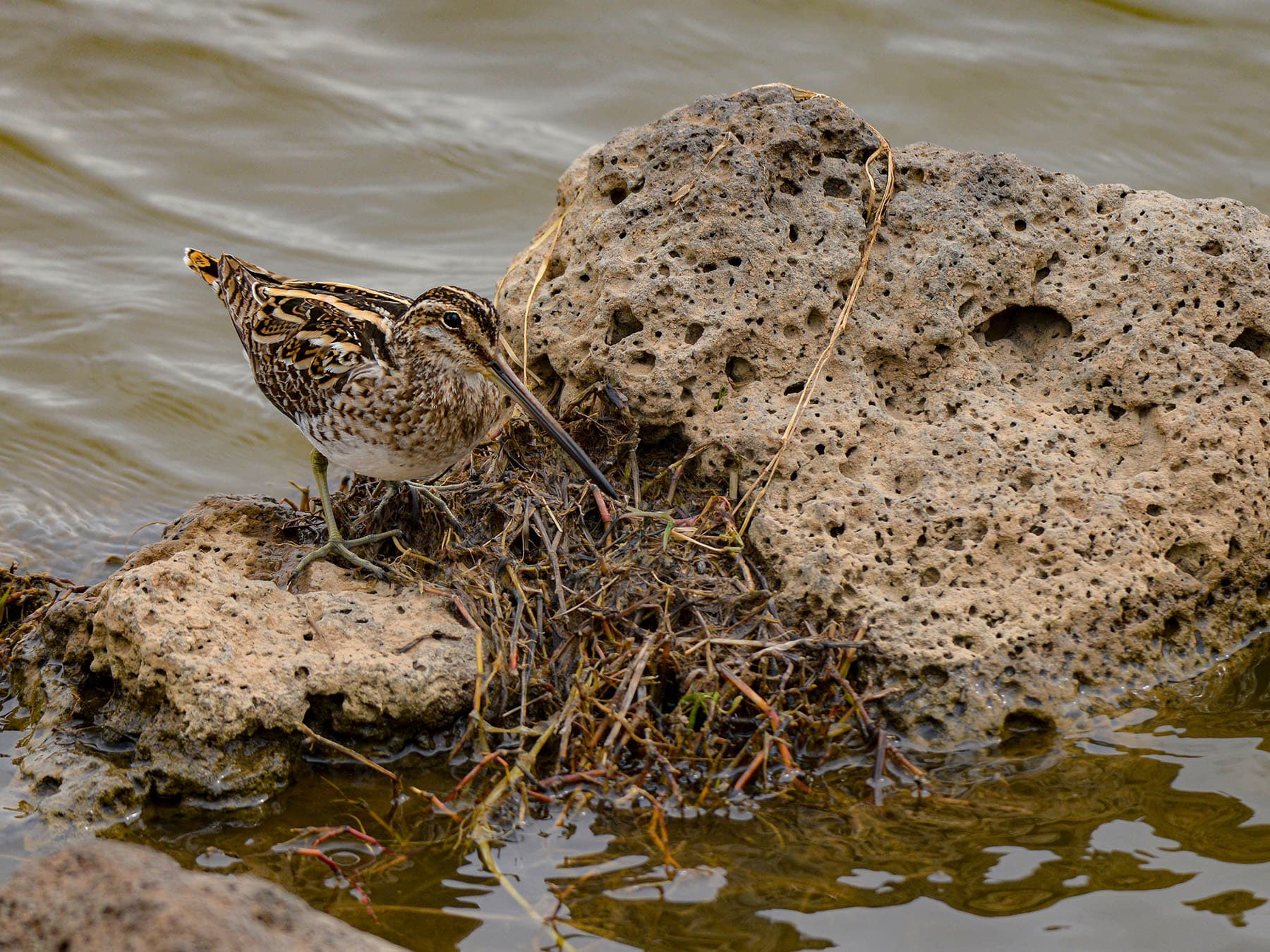
Jack snipes are furtive, solitary birds that crouch down when disturbed and attempt to blend into their surroundings, rather than noisily drawing attention to themselves and putting themselves in danger.
Loose groups of up to five birds are not uncommon, but most sightings record lone birds.
Lifespan and predators
How long do Jack Snipes live?
Typical lifespan of a jack snipe is thought to be from between 5 and 10 years. Ringing records include an individual jack snipe that reached 12 years and 3 months. Juvenile birds breed for the first time at one year.
What are the predators of Jack Snipes?
Humans pose one of the greatest risks to the survival of jack snipe populations, with hunting during autumn migration common across parts of Europe. Poisoning from lead shot is also a major concern.
Are Jack Snipes protected?
Jack snipes are protected under the Wildlife and Countryside Act, 1981, against being hunted, killed, injured or captured. Knowingly damaging or destroying their eggs or nest sites is also illegal under this legislation.
While the jack snipe is protected in England, Scotland and Wales, in Northern Ireland it is on the list of quarry birds that can be hunted during the annual open shooting season.
Are Jack Snipes endangered?
Jack snipes are classified as a green species on the UK Red List for bird species of conservation concern, and their wintering population numbers are steady and stable. During the 1980s, hunting for sport was a major issue, but is now outlawed in England, Scotland and Wales.
Conservation
While the Jack Snipe is currently listed as Least Concern, it faces threats from habitat loss due to drainage of wetlands and changes in land use. Climate change may also impact its breeding and wintering grounds. Conservation efforts focus on protecting and managing suitable wetland habitats.
Similar birds
Often mistaken for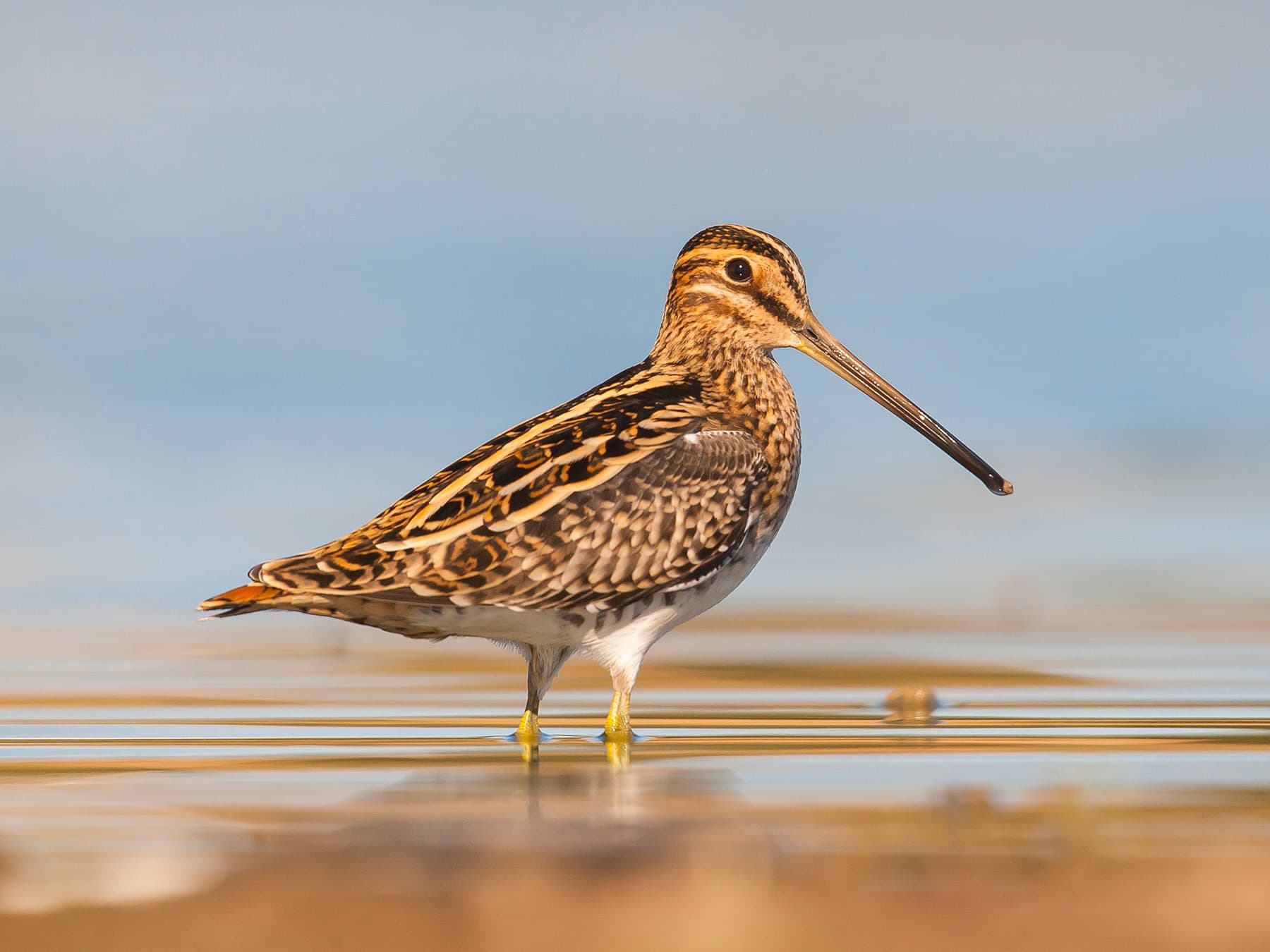
More photos
3 photos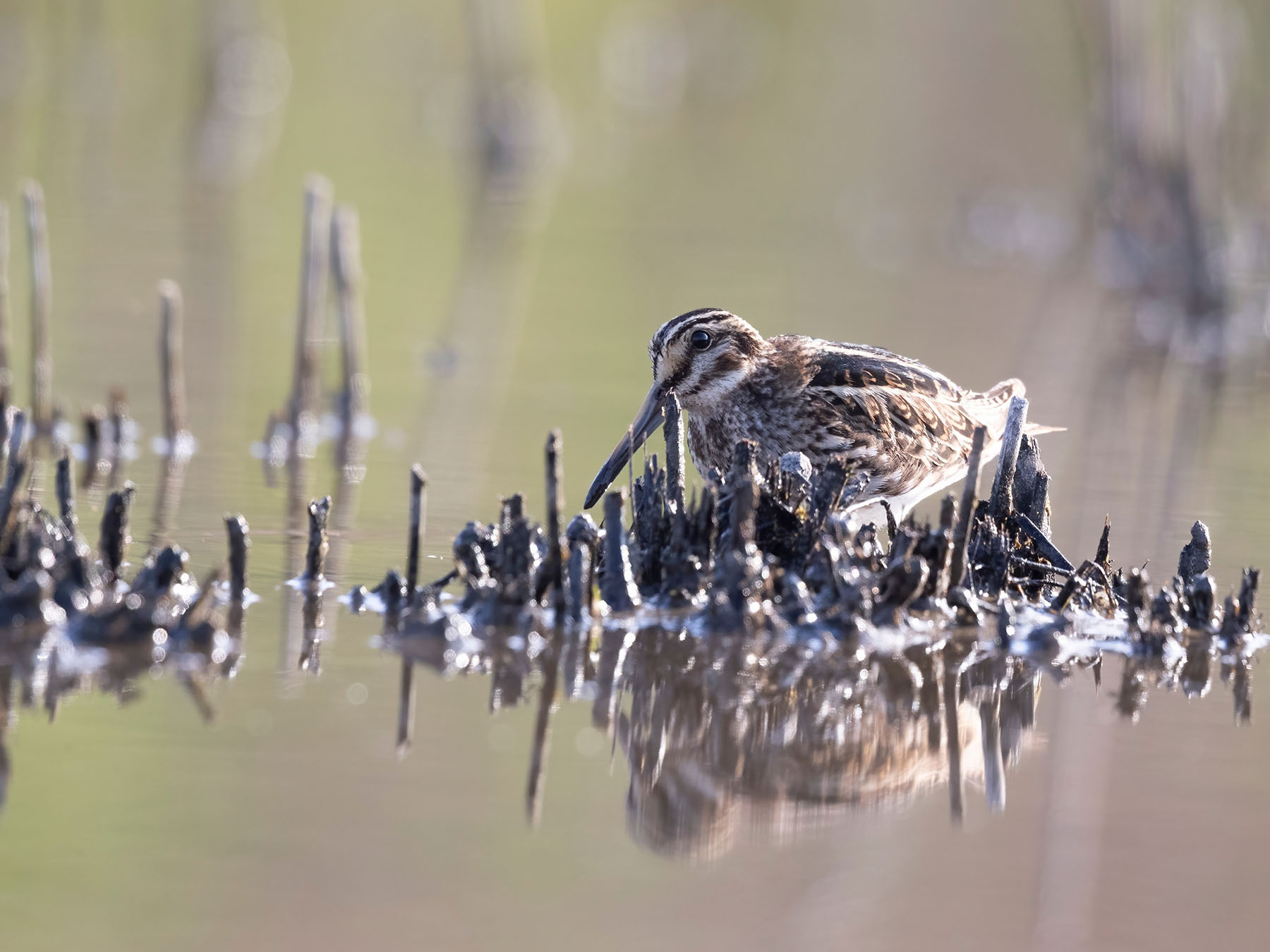
Quick facts
- Length
- 17–19 cm
- Wingspan
- 30–36 cm
- Weight
- 33–73 g
- Lifespan
- 3–5 years · oldest recorded 9.3 years
- Family
- Sandpipers & Snipes
- Migration
- Long-distance Migrant
- Global status (IUCN)
- Least Concern
- World population
- 1,000,000 individuals
- Population trend
- Stable
- Also called
- Jacksnipe
- Scientific name
- Lymnocryptes minimus
Questions
1Why do Jack Snipe bob?
Bobbing is a fascinating behaviour trait seen in jack snipes, and their springy, bouncing movements are thought to disturb invertebrates living beneath the ground, causing them to rise to the surface, making them easier to catch and eat.
Sources
4- 1BirdLife International. 2016. Lymnocryptes minimus. The IUCN Red List of Threatened Species 2016: e.T22693133A86640472. Source (opens in a new tab)
- 2Wetlands International (2015)
- 3Wetlands International (2015)
- 4BTO longevity records: maximum age from a ringed bird, 9 years, 4 months, 17 days (set in 1981), BirdFacts: Jack Snipe (1981) Source (opens in a new tab)

Checked by
Nathan Cope, founder and editor
Nathan founded Birdfact and leads its writers and contributors in the UK, the US and Canada. He has watched and studied birds for more than ten years, and checks every article and species guide before it’s published.