


Indian Peafowl
Pavo cristatus
By the Birdfact teamChecked by Nathan Cope
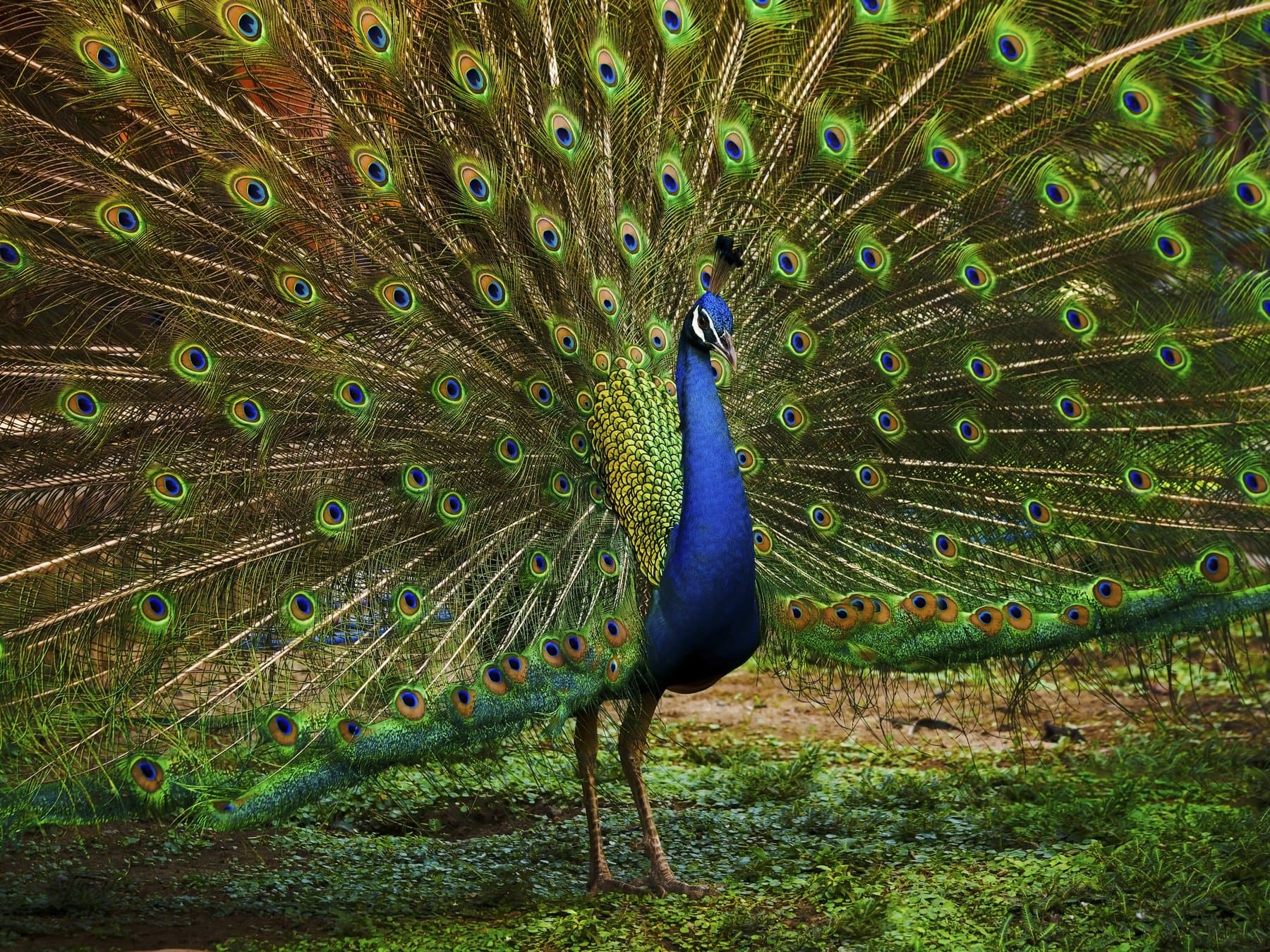
The male Indian Peafowl carries a train of up to 150 elongated feathers — each tipped with an iridescent eyespot — that can stretch 150 cm beyond his body and fan into a shimmering arc nearly 2 metres wide. Those dazzling blues and greens contain no pigment whatsoever; every colour is pure physics, produced by a microscopic lattice of melanin rods that bends light like a living diffraction grating.
On this page14 sections
How to recognise it
Few birds on earth display sexual dimorphism as extreme as the Indian Peafowl. The male (peacock) has a bill-to-tail body length of 100–120 cm, but with his fully grown train he can measure up to 230 cm from bill tip to train tip — making him one of the longest birds in the world. He is also among the heaviest members of the family Phasianidae, weighing 4.1–6 kg.
His head, neck, and upper breast are a brilliant metallic cobalt-blue, iridescent in direct light. A fan-shaped crest of bare black shafts, each tipped with blue-green webbing, rises from the crown. Bare white skin forms a stripe above the eye and a crescent-shaped patch below it. The back is scaly bronze-green; the scapulars and wing coverts are finely vermiculated black and white; the primary flight feathers are chestnut, the secondaries black. The abdomen is blackish-brown and the thighs buff. Each leg carries a single tarsal spur.
The train — the peacock's defining feature — is not made of tail feathers at all. It is composed of elongated upper-tail covert feathers that grow from the rump and back. The true tail feathers underneath are short and brown, acting as a support strut to hold the train erect during display. Each train feather ends in an elaborate ocellus or eyespot: a purplish-black heart-shaped nucleus enclosed by blue, then a copper rim, surrounded by alternating green and bronze. Around 30–40 of the outermost eyespots are v-shaped rather than circular. A fully grown male carries 100–150 train feathers, each up to 150 cm long. Crucially, none of those colours come from pigment. They are produced entirely by structural colouration — a two-dimensionally ordered rectangular lattice of melanin rods and air channels in the feather barbules that interferes with light at specific wavelengths, the same physical principle as a soap bubble or an oil film. The train is not fully developed until the male's fourth year.
The female (peahen) is considerably smaller at 90–100 cm and 2.7–4.1 kg. She is predominantly brown and cryptically patterned — essential camouflage during incubation. Her crest tips are chestnut edged with green. The upper body is brownish with pale mottling; the lower neck is metallic green, her most iridescent feature. The breast is dark brown glossed with green, transitioning to whitish underparts. Both sexes have dark brown eyes, a grey-brown bill, and pinkish-grey legs. Females also possess small spurs (approximately 2.5 cm), though far less prominent than the male's. Juvenile males resemble females, with chestnut primaries; the spur and train begin developing only in the second year.
Not sure it’s a Indian Peafowl? Check your photo: Birdfact names the bird and shows the look-alike side by side.
Its size
Adults- Length
- 86–230 cm
- Wingspan
- 130–160 cm
- Weight
- 2700–6000 g
Its song and calls
The Indian Peafowl has a repertoire of at least eight distinct call types used in different social and seasonal contexts. The most familiar is the loud, far-carrying contact and advertising call — a piercing, screaming "may-yow" or "ka-aan" that is heard most frequently during the breeding season and at dawn and dusk. This call is given repeatedly and can be heard from several hundred metres away. During the rainy season it is given almost incessantly, and eBird describes it as one of the most recognisable sounds of the Indian countryside.
Both sexes produce alarm calls — sharp, loud calls given in response to predators — which alert other animals in the vicinity. Peafowl will also call at night if disturbed or threatened, and neighbouring birds often respond in a chain reaction. This nocturnal alarm behaviour is well known to wildlife guides in Indian tiger reserves, where a sudden chorus of peafowl calls at 2 a.m. can signal a tiger moving through the area. The male produces softer clucking notes during close-range courtship display.
Beyond audible calls, research published in peer-reviewed journals has confirmed that Indian Peafowl produce and perceive infrasound — sounds far below the threshold of human hearing. During courtship displays, the male's vibrating train feathers generate low-frequency signals as low as 4 Hz. A 2020 study published in PLOS ONE confirmed that peafowl can hear frequencies as low as 4 Hz, with a hearing range at 60 dB SPL extending from 29 Hz to 7.065 kHz — roughly spanning the lowest note on a pipe organ up to the upper register of a piccolo. The crest feathers have also been shown to resonate at infrasound frequencies. This infrasonic channel may allow males to signal to females across distances or through dense vegetation without alerting predators — a communication system entirely invisible to human observers.
- Song0:00 / 0:08
Recorded in Baden-Württemberg, Germany · May 2024
- Call0:00 / 0:12
Recorded in Kerala, India · September 2021
Heard one and not sure? Let the bird song identifier listen.
When and where to see it
OctoberIn season
Most recorded in October
- 1. Oxfordshireunder 0.1%
- 2. Hertfordshireunder 0.1%
- 3. Isle of Wightunder 0.1%
- 4. Essexunder 0.1%
- 5. Warwickshireunder 0.1%
Each dot is a county, state or province: the bigger and darker, the larger the bird’s share of that place’s bird records that month. Grey dots: no regular records. The ringed point is the centre of the bird’s records this month; the arrow shows how it moved since last month, and the dashed loop its path through the year. “Arrivals” colours places where it becomes regular this month (orange) or is in its last regular month (grey). GBIF eBird Observation Dataset, 2019–2024. Map data: Natural Earth, US Census Bureau; place centres © OpenStreetMap contributors.
In your area
See when the Indian Peafowl is recorded in your county, state or province.
How often the Indian Peafowl turns up in the UK, Ireland, the United States and Canada through the year, from birdwatchers' records.
United Kingdom
Resident · all year · most records in May
Ireland
Passage migrant · regularly Aug · most records in August
United States
Resident · all year · most records in March
Canada
Resident · all year · most records in December
Show as a table
| Month | United Kingdom | Ireland | United States | Canada |
|---|---|---|---|---|
| January | <0.001% (regular) | – | 0.008% (regular) | 0.001% (regular) |
| February | <0.001% (regular) | – | 0.008% (regular) | 0.001% (regular) |
| March | 0.001% (regular) | – | 0.008% (regular) | 0.001% (regular) |
| April | 0.002% (regular) | – | 0.008% (regular) | <0.001% (regular) |
| May | 0.003% (regular) | – | 0.005% (regular) | <0.001% (regular) |
| June | 0.003% (regular) | <0.001% | 0.006% (regular) | <0.001% (regular) |
| July | 0.002% (regular) | 0.002% | 0.005% (regular) | 0.001% (regular) |
| August | 0.001% (regular) | 0.003% (regular) | 0.004% (regular) | <0.001% (regular) |
| September | 0.001% (regular) | <0.001% | 0.004% (regular) | 0.001% (regular) |
| October | 0.001% (regular) | <0.001% | 0.004% (regular) | <0.001% (regular) |
| November | <0.001% (regular) | – | 0.005% (regular) | 0.001% (regular) |
| December | 0.001% (regular) | – | 0.007% (regular) | 0.002% (regular) |
Recorded regularly in
Worldwide: recorded regularly in 46 countries
Countries where it was recorded in at least 3 of the 6 years 2019–2024. Linked countries have their own bird list.
Europe (15)
Africa (3)
Asia (14)
North America (10)
- Bahamas
- Canada
- Cayman Islands
- Cuba
- Curaçao
- Dominican Republic
- Mexico
- Puerto Rico
- United States
- US Virgin Islands
South America (1)
Oceania (3)
- Australia
- New Caledonia
- New Zealand
Data: EOD – eBird Observation Dataset (Cornell Lab of Ornithology), accessed via GBIF.org, CC BY 4.0. Records from 2019–2024, aggregated and filtered by Birdfact. How these lists are made
Tips for seeing it
In the Indian subcontinent, Indian Peafowl are genuinely easy to find — they are common around villages, temple grounds, national parks, and agricultural land across India and Nepal. Ranthambore, Keoladeo (Bharatpur), and Bandhavgarh national parks all hold large populations, and birds are often seen foraging along roadsides in the early morning. The best time to observe courtship displays is March to June, when males fan their trains at dawn and dusk.
Listen for the loud, piercing "may-yow" call — once heard, it is unmistakeable and carries for several hundred metres through forest. During the breeding season this call is given incessantly, particularly at dawn. If you hear it, scan the treetops as well as the ground: birds often call from high perches before descending to forage.
For birdwatchers in the United States, feral populations in the Los Angeles area of California (particularly Arcadia, Monrovia, and Palos Verdes) and in parts of Florida offer reliable sightings. Birds in these suburban populations are often very tame and allow close approach. In Australia, feral birds can be found in parts of Queensland and Western Australia.
Distinguishing the Indian Peafowl from the Green Peafowl (Pavo muticus) is straightforward: the Indian Peafowl male has a blue neck and a fan crest, while the Green Peafowl has a green neck and an upright, pointed crest. The female Indian Peafowl's white face and rufous-brown crest distinguish her from the female Green Peafowl, which is more uniformly green. In captivity and introduced populations, hybrids between the two species (known as Spaldings) do occur, so check the crest shape carefully.
What it eats
Plant matter forms the bulk of the Indian Peafowl's diet: seeds, grains, berries, wild figs, flowers, and green crops. But the species is a committed omnivore and takes a wide range of animal prey — insects (particularly grasshoppers and beetles), small reptiles, frogs, small rodents, and occasionally other small vertebrates. Peafowl are well known in Indian villages for killing and eating venomous snakes, including cobras, and this behaviour has long made them welcome around human settlements.
Foraging takes place almost exclusively on the ground. Birds emerge cautiously into forest clearings, ploughed fields, and fallow land primarily in the early morning and late afternoon, scratching through leaf litter and soil with their powerful feet. In agricultural landscapes they readily exploit newly sown crops and ploughed fields, which can bring them into conflict with farmers despite their protected status.
Outside the breeding season, foraging groups are typically single-sex. During the breeding season, a cock may forage with a small harem of hens. In the vicinity of human habitation, peafowl exploit cultivated areas, orchards, and outlying scrubland with equal opportunism. Their broad diet — spanning everything from grain to venomous snakes — is one of the key reasons the species has thrived across such a wide range of habitats and has adapted so successfully to life alongside humans.
Nesting and breeding
The breeding season is broadly tied to the onset of the monsoon rains. In India, the main season runs from approximately April to September, with peak display activity in the pre-monsoon months of March to June. Males become sexually mature at 2–3 years, though the train is not fully developed until age four. Females can breed from age two.
The mating system is polygynous and lek-based. Males establish and defend small display territories clustered together to form a lek, where they perform elaborate courtship displays. A single male may mate with up to six females in a season. Females visit multiple males at the lek before selecting a mate, with preference generally given to males with the greatest number of eyespots on their train — see the Courtship and Display section for a full account of how and why this works. After mating, the female raises the young entirely alone.
The nest is a shallow scrape on the ground, lined with dry sticks and leaves, typically hidden under shrubs or in dense scrub vegetation such as Lantana or Zizyphus. In flood-prone areas, nests may be slightly elevated. The female lays 3–8 pale buff-brown eggs (occasionally up to 12), one every other day, typically in the afternoon. Incubation lasts 28–30 days and is performed solely by the female. Males take no part in incubation or chick-rearing.
Chicks are precocial — fully feathered and mobile at hatching. They can fly short distances within about one week and flap up into trees for safety after two weeks.
By four weeks they develop crests; by two months they resemble their mother but are only half her size. Males do not attain adult coloration until their second year. Peachick mortality is high — see the Lifespan section for survival rates. If eggs are removed, a peahen may lay additional clutches; up to three clutches have been recorded in captivity.
Behaviour
Despite their extraordinary size and the encumbrance of a 150 cm train, Indian Peafowl are capable and powerful fliers. They take off with a loud, rapid series of wingbeats that produce an audible whooshing sound, launching themselves almost vertically from the ground before levelling out. The wings are broad and rounded — typical of the Phasianidae — generating high lift at the cost of sustained speed. Flight is generally low and direct, covering short to medium distances before the bird glides down and lands running.
Peafowl do not fly long distances voluntarily, but they use flight daily to reach their roost trees at dusk and descend again at dawn. Roost trees are typically tall, with the birds perching 6–10 m above the ground — high enough to be out of reach of most terrestrial predators. When flushed by a predator, a peafowl will fly explosively to the nearest tree and then continue moving through the canopy.
In flight, the male's train streams behind him, and the chestnut primary flight feathers are conspicuous against the darker wing. The white facial skin and blue neck are visible at close range. The female in flight shows a similar wing pattern — chestnut primaries, dark secondaries — but lacks the streaming train, making her appear far more compact. The wingbeat is powerful but not sustained; like most gamebirds, the Indian Peafowl relies on burst flight rather than prolonged aerial travel. Wingspan ranges from 130 to 160 cm.
Lifespan and predators
In the wild, Indian Peafowl typically live 10–25 years, though reaching the upper end of that range requires avoiding predation, disease, and human persecution. The maximum recorded longevity in captivity is 23.2 years, according to the AnAge longevity database. In managed collections with veterinary care, birds regularly reach their late teens and early twenties.
Peachick mortality is the primary bottleneck: typically only around two of every six chicks survive to adulthood, with predation by mongooses, jungle cats, and raptors accounting for most losses. Once a bird reaches adulthood, survival rates improve considerably. Adults have few natural predators capable of taking them — leopards, tigers, and large pythons are the main threats in the native range — and their alertness and powerful alarm calls provide significant protection.
Compared to other members of the Phasianidae, the Indian Peafowl is a long-lived species. The Red Grouse (Lagopus lagopus scotica), for example, has a typical lifespan of just 2–3 years with a maximum of around 7 years. The peafowl's greater longevity reflects its larger body size — a well-established pattern in birds — as well as its relatively low predation pressure as an adult. Males do not attain their full train until age four, meaning a bird must survive several years of vulnerability before reaching peak reproductive condition.
Conservation
The Indian Peafowl is listed as Least Concern on the IUCN Red List, with a global population estimated at over 100,000 individuals (a conservative 2002 figure; the true total is likely considerably higher) and a population trend assessed as stable. The species benefits enormously from its sacred status in India, where it is protected under the Wildlife Protection Act of 1972 and has been the national bird since 1 February 1963. In many Indian villages, peafowl are actively fed and protected, and birds around temples and rural settlements can become very tame.
Despite this broadly positive picture, the species faces a range of localised threats. Habitat loss and degradation — particularly the felling of tall roosting trees and forest clearance for agriculture — reduces carrying capacity across parts of the range. Illegal hunting and poaching for feathers, eggs, and body parts used in traditional medicine continues in some areas. Additional threats include pesticide poisoning, electrocution from power lines, and road collisions. In Bangladesh, the species may now be locally extinct.
The conservation picture is complicated by the species' status as an invasive pest in parts of its introduced range. In Japan's Yaeyama island group (Okinawa Prefecture), introduced peafowl have caused significant damage to native ecosystems and active extermination programmes have been implemented. This serves as a reminder that a species' benign status in its native range does not preclude ecological harm elsewhere.
In the UK, the species has no conservation concern — all records are of escaped or feral birds from private collections. In the US, feral populations in California and Florida are self-sustaining but not considered a significant ecological threat in most areas, though they can cause localised nuisance in suburban settings.
Courtship & Display
A displaying male raises his train into a shimmering semicircle up to 2.1 m wide — a fan of up to 150 feathers, each bearing an iridescent eyespot — and fans it forward so that it frames his body. He then vibrates the feathers rapidly, a behaviour called "train-rattling", producing both a distinctive rustling sound and a visual shimmer as thousands of eyespots catch the light simultaneously. He may also turn slowly to present different angles to watching females, and perform short rushes toward the peahen.
The mating system is lek-based: males establish small display territories clustered together, and females visit multiple males before selecting a mate. Research has consistently shown that females prefer males with the greatest number of eyespots on their train. A male with a full train of 150 feathers, each bearing a perfect ocellus, signals genetic quality and developmental health. He has survived long enough to grow the train, and has the resources to maintain it — a textbook example of Zahavi's handicap principle: the train is costly to grow and carry, so only genuinely fit males can afford to produce the best ones.
The debate about exactly what females are assessing has occupied evolutionary biologists for decades. Darwin used the peacock as his central example of sexual selection in The Descent of Man (1871), arguing that female preference drives the elaboration of male ornaments. More recent research has examined whether eyespot number, symmetry, or iridescence is the key signal — and whether the train honestly predicts offspring quality or parasite resistance. The question remains active in the scientific literature, making the Indian Peafowl one of the most studied birds in evolutionary biology.
Beyond the visual display, the male's vibrating train generates infrasonic signals below 20 Hz that females can detect. This adds a hidden acoustic dimension to the display — one that humans standing a few metres away cannot perceive at all.
Cultural Significance
The Indian Peafowl is one of very few birds to appear in the iconography of three major world religions simultaneously. In Hinduism, Lord Krishna is traditionally depicted with a peacock feather in his crown; the god Kartikeya (god of war) rides a peacock as his vehicle; and the goddess Saraswati (goddess of knowledge and arts) is associated with the bird. The peacock throne of the Mughal emperors — encrusted with jewels and surmounted by two peacocks — became one of the most famous symbols of imperial power in history.
The species was declared India's national bird on 1 February 1963, and is protected under the Wildlife Protection Act of 1972. Killing a peafowl in India carries a prison sentence of up to seven years. This legal and cultural protection has been a significant factor in the species' continued abundance across the subcontinent.
The bird's cultural reach extends far beyond South Asia. In ancient Greece, the peacock was sacred to Hera, queen of the gods. According to myth, Hera placed the hundred eyes of her slain servant Argus onto the peacock's tail feathers — the origin story of the eyespots. In medieval Europe, roast peacock was the ultimate prestige dish at royal banquets, served with the skin and feathers reattached and the beak gilded. Phoenician traders introduced the bird to Egypt and the Levant; Alexander the Great encountered peafowl during his Indian campaign and was reportedly so struck by them that he imposed the death penalty on anyone who harmed one. By Roman times, peafowl were kept in ornamental aviaries across the empire and their eggs were considered a delicacy.
Indian Peafowl guides
2 guidesQuick facts
- Length
- 86–230 cm
- Wingspan
- 130–160 cm
- Weight
- 2700–6000 g
- Lifespan
- 10–25 years · oldest recorded 23.2 years
- Family
- Pheasants & Grouse
- Migration
- Non-migratory
- Global status (IUCN)
- Least Concern
- World population
- Over 100,000 individuals (conservative 2002 estimate); global total considered large and stable
- Population trend
- Stable across the native range; locally extinct in parts of Bangladesh. Introduced populations expanding in the US, Australia, and elsewhere.
- Scientific name
- Pavo cristatus
Sources
12- 1Indian peafowl - Wikipedia Source (opens in a new tab)
- 2Indian Peafowl Pavo cristatus Species Factsheet - BirdLife DataZone Source (opens in a new tab)
- 3Indian Peafowl - eBird (Cornell Lab of Ornithology) Source (opens in a new tab)
- 4Pavo cristatus (Indian peafowl) - Animal Diversity Web Source (opens in a new tab)
- 5Indian Peafowl - Oiseaux-Birds Source (opens in a new tab)
- 6Peacock Fact Sheet - PBS Nature Source (opens in a new tab)
- 7Hearing in Indian peafowl (Pavo cristatus): sensitivity to infrasound - PubMed (2020) Source (opens in a new tab)
- 8Infrasound in mating displays: a peacock's tale - ScienceDirect Source (opens in a new tab)
- 9Reflections on iridescent neck and breast feathers of the peacock - Interface Focus (Royal Society) Source (opens in a new tab)
- 10Pavo cristatus longevity, ageing, and life history - AnAge Database Source (opens in a new tab)
- 11Indian Peafowl - BTO BirdFacts Source (opens in a new tab)
- 12Indian Peafowl Facts and Information - SeaWorld Source (opens in a new tab)

Checked by
Nathan Cope, founder and editor
Nathan founded Birdfact and leads its writers and contributors in the UK, the US and Canada. He has watched and studied birds for more than ten years, and checks every article and species guide before it’s published.