Species Profile
Helmeted Guineafowl
Numida meleagris
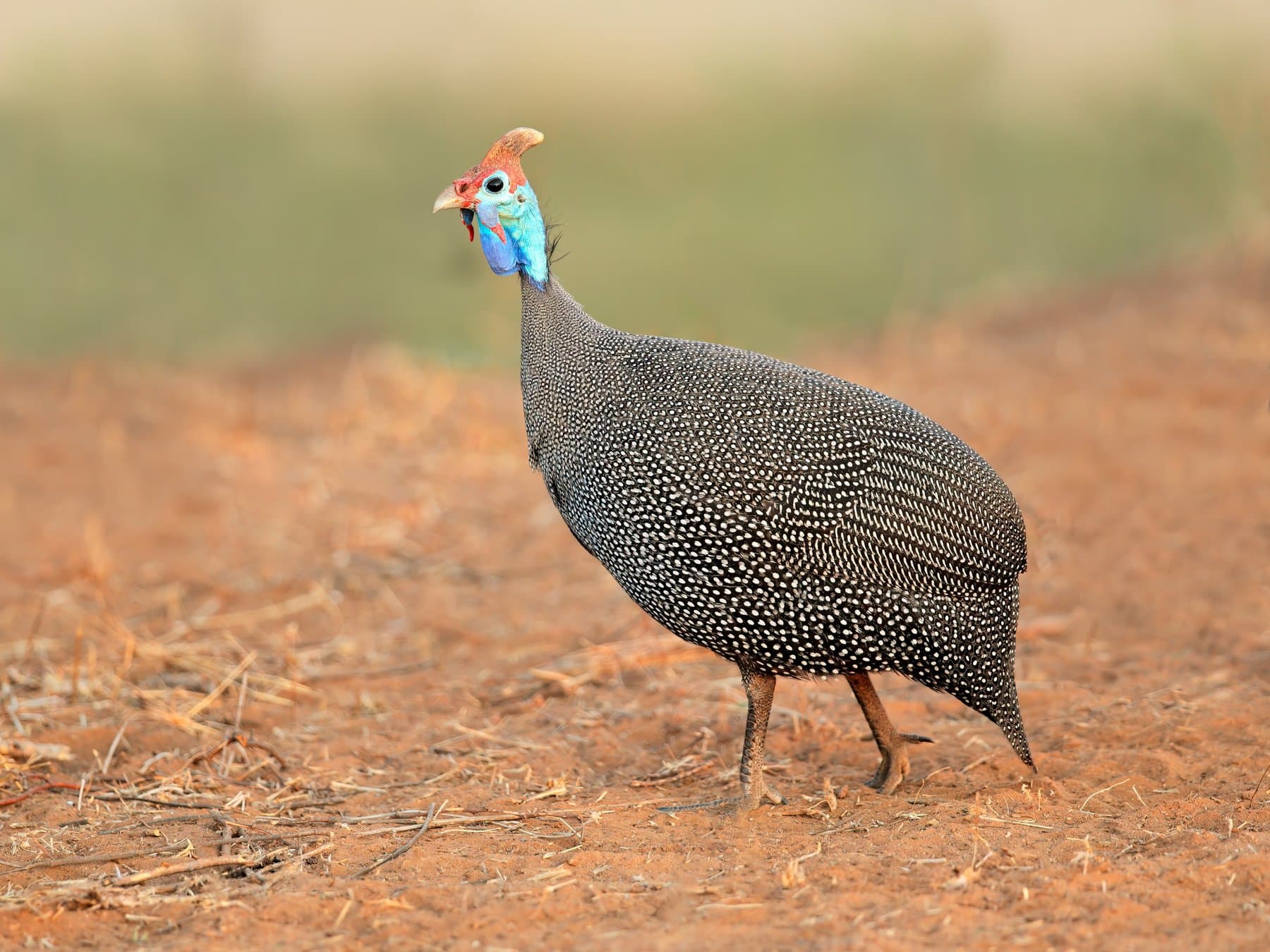
Helmeted Guineafowl standing on dry, reddish-brown ground, looking left. Features black plumage with white spots and a bare blue and red head.
Quick Facts
Conservation
LCLeast ConcernLifespan
10–15 years
Length
53–63 cm
Weight
1000–1800 g
Wingspan
95–100 cm
Migration
Non-migratory
Covered in a dense constellation of white spots on near-black plumage, the Helmeted Guineafowl is one of Africa's most instantly recognisable birds — and one of its noisiest. The bare blue-and-red face, topped by a dull orange bony casque, gives it an almost prehistoric look. Its raucous, accelerating alarm call is as much a part of the African savanna soundscape as the lion's roar.
Think you've spotted a Helmeted Guineafowl?
Upload a photo and we'll confirm it instantly
Confirm with a PhotoAppearance
Few birds are as instantly identifiable as the Helmeted Guineafowl — a large, round-bodied gamebird whose dark plumage is peppered from neck to tail in crisp white spots. The wings are short and rounded, the tail short and drooping. The overall silhouette is that of a hunched, heavy-bodied bird with a surprisingly small, naked head.
That head is the species' most striking feature. The bare facial skin is coloured blue and red, with fleshy red wattles hanging from either side of a short, stout, curved bill. On the crown sits a dull yellow to reddish-orange bony casque — the "helmet" that gives the species its name. The lower neck carries short, brownish-grey downy feathers. The eyes appear black but are actually dark brown. Legs and feet are dark grey; unlike many gamebirds, this species has no leg spurs.
The Helmeted Guineafowl is largely monomorphic — males and females are so similar in size, colour, and plumage that field sexing by appearance alone is unreliable. The male's casque and wattles are typically larger, and males adopt a characteristically stiff, upright posture when walking. Females have proportionally larger pectoral muscles.
Across the species' wide range, nine subspecies are recognised, varying considerably in casque shape, size, and wattle colour. The subspecies N. m. mitrata (tufted guineafowl) carries a distinctive feather tuft on the head, while N. m. galeatus of West Africa has a more pronounced casque. The likely-extinct N. m. sabyi of northwestern Morocco was the northernmost subspecies of all.
Identification & Characteristics
Colors
- Primary
- Dark Grey
- Secondary
- White
- Beak
- Red
- Legs
- Dark Grey
Markings
Dense white spotting on dark grey-black plumage; bare blue-and-red facial skin; dull orange bony casque (helmet) on crown; red wattles flanking the bill
Tail: Short, drooping tail; dark grey-black with white spotting continuous with body plumage
Attributes
Understanding Attributes
Rated 0–100 based on research and observation. A score of 50 is average across all bird species. These attributes are relative and don't necessarily indicate superiority.
Habitat & Distribution
The Helmeted Guineafowl has the widest range of any guineafowl species, covering most of sub-Saharan Africa. Its native range spans the continent from west to east and south: from Senegal and Gambia in the west to Eritrea, Ethiopia, and Somalia in the east, and southward through the whole of East and southern Africa to the Cape. It occurs across Burkina Faso, Ghana, Nigeria, Chad, Cameroon, the Democratic Republic of the Congo, Angola, Uganda, Kenya, Tanzania, Zambia, Zimbabwe, Botswana, Namibia, Mozambique, and South Africa. One subspecies, N. m. sabyi, was historically found in northwestern Morocco — the only guineafowl population north of the Sahara — but is now likely extinct.
The species favours warm, fairly dry, open habitats: savanna, grassland, thorn scrubland (bushveld), open woodland, and farmland. It avoids true desert, dense rainforest, and extensive marshland. It occurs from sea level up to above 3,000 m elevation.
In Kenya, it is most common in the woodlands and savannas of the west and south. In South Africa, it is widely distributed and has become a familiar sight in suburban parks and gardens — urban birds in Cape Town have adapted to city life, moving more slowly, sticking to footpaths, feeding in gardens, and roosting on rooftops.
The species has been introduced widely beyond Africa. Established feral populations exist in the West Indies (including Antigua, Cuba, Puerto Rico, and the US Virgin Islands), parts of North America, Brazil, Colombia, Australia, and parts of Europe — notably southern France and Portugal.
It has also been introduced to Madagascar, Cape Verde, São Tomé & Príncipe, Mauritius, and New Zealand, where breeding populations are recorded. In Australia, feral birds are present in parts of Queensland and Western Australia. In the UK, escaped or released birds are occasionally recorded, but no self-sustaining wild population is established.
Diet
The Helmeted Guineafowl is omnivorous and its diet shifts dramatically with the seasons. During the dry, non-breeding months, plant material dominates: grass seeds, grain, seedlings, leaves, bulbs, roots, tubers, fruit, and flower heads, supplemented by agricultural spillage wherever farmland is nearby. Come the breeding season, the balance tips sharply toward animal protein — more than 80% of the diet may consist of invertebrates, timed to coincide with peak insect abundance during the rains.
Year-round protein sources include beetles, grasshoppers, termites, snails, insect larvae, spiders, worms, and frogs. Small lizards and occasionally mice are also taken. One of the most ecologically useful items on the menu is ticks. Guineafowl consume large quantities of ticks, including deer ticks (Ixodes scapularis), the primary vector of Lyme disease. Research in New York State confirmed that guineafowl provide effective tick control on lawns and field borders — a finding that has driven their adoption on farms and smallholdings across the United States. In Africa, they have been observed gleaning ticks directly from warthogs.
Foraging technique is vigorous but precise. Birds scratch and dig with strong feet — similar to chickens, but rarely uprooting growing plants — and peck, flick, and jab with the bill. They jump to reach elevated food and have been observed dissecting elephant dung in search of invertebrates. Small pebbles are swallowed as gizzard grit to help grind hard seeds and insect casings. Flocks forage communally, which increases food-finding efficiency while keeping multiple pairs of eyes scanning for predators.
Behaviour
Helmeted Guineafowl are intensely social birds. Outside the breeding season, they gather in flocks of 25 to over 100 individuals — large aggregations that serve two clear purposes: collective foraging efficiency and shared vigilance against predators. When one bird spots danger, the whole flock knows about it within seconds.
Daily activity follows a predictable rhythm. Foraging peaks in the early morning and late afternoon, with the midday heat spent resting in shade. At dusk, the entire flock moves to roost in trees — a critical behaviour, since roosting off the ground is their primary defence against nocturnal predators such as leopards, caracals, and pythons. They are strong walkers and can cover 10 km or more in a single day.
During the breeding season, the large winter flocks dissolve into pairs and small family groups. Males compete aggressively for females, and once paired, male and female remain inseparable for around five weeks, roosting together, preening each other, and calling in near-constant communication.
A 2024–2025 study at Madikwe Game Reserve, South Africa, used a live-streaming waterhole webcam to track a wild population for an entire year. The research challenged a long-held assumption: rather than huddling together for warmth, guineafowl rely entirely on individual posture to thermoregulate.
Flock size was driven entirely by food availability and predator pressure. On cold mornings below 17°C, birds puffed out their collar feathers and tucked their bare necks into their bodies. On hot days above 30°C, they panted, spread their wings, and exposed bare skin to cool down.
Calls & Sounds
The Helmeted Guineafowl is one of Africa's most vocal birds, and its calls are among the most recognisable sounds on the continent. Crucially, the species is sexually dimorphic in vocalisation — one of the very few reliable ways to tell the sexes apart in the field.
Males produce a single-note "chek" or "kek" contact call, used to maintain flock cohesion during foraging. Females give a distinctive two-note call rendered as "buck-wheat" or "ka-bak" — repetitive, far-carrying, and plaintive. This call is unique to females and is frequently heard at night, drifting across the bush long after dark. If you hear a two-note call, you are listening to a female.
The alarm call is shared by both sexes and is one of the most arresting sounds in African wildlife: a loud, harsh, accelerating rattle rendered as "kek-kek-kek-kek-krrrrrrrrr" or "kek-kek-kek-kraaaaaaah". It increases in volume and tempo as excitement builds, and a flock of alarmed guineafowl erupting simultaneously creates a cacophonous chorus that carries vast distances.
Recordings from Kafue National Park, Zambia, capture harsh alarm calls at dusk and the female "ka-bak" series heard through the night. A quieter "kerr" or "chuk" contact call is used within the flock during calm foraging. A softer "pi-pi'oo" has also been described. During the breeding season, paired birds call to each other in what observers describe as a duet — a near-continuous exchange that keeps the pair in contact as they move through dense vegetation. With 89 foreground recordings on Xeno-canto alone, the species is well-documented acoustically, and its calls are a reliable identification tool even when the birds themselves are hidden in scrub.
Flight
The Helmeted Guineafowl is not built for sustained flight. Like most gamebirds, it is primarily a ground-dweller and relies on its legs for daily movement. When pressed, it prefers to run rather than fly — and it runs fast, reaching speeds of up to 35 km/h over rough terrain with remarkable stability. Biomechanics research has shown that this running prowess is underpinned by a proximo-distal gradient of joint control, with hips providing stability and ankles making fine-tuned adjustments — a strategy that has since informed bipedal robot design.
When flight is unavoidable, the bird launches itself with a burst of rapid, noisy wingbeats, producing a loud whirring sound as it clears the ground. The wings are short and rounded, generating the explosive lift typical of gallinaceous birds but limiting sustained aerial travel. Flight is low and direct, with rapid wingbeats interspersed with short glides. Birds rarely fly more than a few hundred metres at a stretch.
The most important flight behaviour is the nightly roost ascent. Each evening, the flock moves to trees and flies up to roost — sometimes several metres above the ground — to avoid nocturnal predators. This requires enough wing power to reach branches quickly, and keets develop flight capability remarkably fast: within a week of hatching, they can flutter onto low branches. In the air, the spotted body, short rounded wings, and small bare head make the Helmeted Guineafowl unmistakable even at a distance.
Nesting & Breeding
Breeding is tightly tied to rainfall. In southern Africa, the season runs from October to April — the austral spring and summer — when insect abundance peaks. In West Africa, pairing begins with the onset of the rains between March and June. During winter, testosterone in males drops to near zero; at the height of the breeding season, testes can weigh up to 1.6 g and serum testosterone reaches 5.37 ng/ml.
Pair formation is competitive and sometimes brutal. Males fight for females, rushing rivals with wings raised and beaks gaping, and fights can leave birds bloodied. Successful males also perform courtship displays and offer food to prospective mates — courtship feeding that signals both fitness and commitment. Once paired, male and female remain inseparable for approximately five weeks, communicating continuously and preening each other.
The nest is a well-concealed scrape in the ground, typically hidden in dense vegetation and lined with grass, leaves, feathers, and dry weeds. The female lays 6–20 eggs, though clutches of up to 30 have been recorded in good rainy seasons. Eggs are cream-brown, pear-shaped, approximately 53 mm long and 40 mm wide, with a notably hard, thick shell. Incubation is carried out solely by the female and lasts 25–29 days. It begins only when the last egg is laid — a strategy that synchronises hatching across the entire clutch. This reduces the window during which predators can detect the nest by sound.
A notable behaviour is egg-dumping: females sometimes lay eggs in another hen's nest, producing communal nests that can contain 50 or more eggs. The male guards the nest during incubation and feeds the female, but departs once incubation begins to seek other females, returning after hatching.
Chicks (called keets) are precocial and cryptically coloured with longitudinal black stripes on a brown head. They leave the nest within hours of hatching and begin foraging almost immediately. Rapid wing growth enables keets to flutter onto low branches within a week. Both parents defend the keets; the female broods them at night while the male broods during the day for the first two weeks.
Keets become independent after 50–75 days. Sexual maturity is reached at approximately one to two years of age.
Lifespan
For a bird that nests on the ground in leopard country, the Helmeted Guineafowl lives a surprisingly long life — typically 10 to 15 years in the wild, with a maximum recorded lifespan of around 20 years. This is a relatively long life for a ground-nesting gamebird of this size — the Wild Turkey, a larger bird in the same order, averages only 3 to 5 years in the wild, reflecting the much heavier hunting pressure it faces.
Survival in the wild is shaped by several competing pressures. Ground-nesting makes eggs and keets highly vulnerable: nest predation by mongooses, genets, snakes, and monitor lizards is a significant source of mortality in the first weeks of life. Adults face predation from leopards, caracals, servals, African wild dogs, pythons, and martial eagles. Domestic dogs and cats are an increasing threat in peri-urban areas.
The species' longevity is supported by several behavioural adaptations. Communal roosting in trees removes the flock from ground predators each night. Large flock sizes during the dry season provide collective vigilance — many eyes scanning for danger simultaneously. The hard-shelled eggs and synchronised hatching reduce the predation window at the nest. In captivity, where predation and hunting pressure are absent, birds regularly reach 10–15 years and occasionally beyond.
Sexual maturity is reached at approximately one to two years of age, meaning birds that survive their vulnerable first year have a reasonable prospect of contributing to multiple breeding seasons across a long adult life.
Conservation
The Helmeted Guineafowl is listed as Least Concern on the IUCN Red List, with a global population estimated at over one million mature individuals. The population is considered stable, with no evidence of significant declines at the global level. It is not listed on CITES. In the United States — where it is actively kept for tick control — it receives no protection under the US Fish and Wildlife Service. In the UK and EU, the species has no established wild population and falls outside the scope of domestic wildlife legislation.
Globally secure, the species nonetheless faces localised threats. Habitat loss and degradation — particularly the conversion of savanna and grassland to intensive agriculture — reduces available foraging and nesting habitat. Hunting pressure is significant: the Helmeted Guineafowl is southern Africa's most popular land gamebird, and in some areas hunting has driven local population crashes. Persecution by farmers who view the birds as crop pests adds further pressure, as does predation by domestic dogs and cats in peri-urban areas.
The consequences of localised pressure can be severe. The species has undergone dramatic local extinctions in Lesotho and parts of the Eastern Cape of South Africa due to a combination of heavy hunting and severe habitat degradation. The subspecies N. m. sabyi of northwestern Morocco is likely already extinct — a reminder that even a globally abundant species can lose populations permanently at its range margins.
On the positive side, the species' adaptability has allowed it to colonise agricultural land, suburban parks, and urban environments, partially offsetting habitat losses elsewhere. Its value as a tick predator has also generated active interest in its conservation and management on farms and smallholdings, particularly in the United States, where it is kept specifically for biological pest control.
Population
Estimated: Over 1,000,000 mature individuals
Trend: Stable
Stable. The population is suspected to be stable in the absence of evidence for any declines or substantial threats at the global level. Localised extinctions have occurred in Lesotho and parts of the Eastern Cape of South Africa due to hunting pressure and habitat degradation.
Elevation
Sea level to above 3,000 m
Additional Details
- Family:
- Numididae (Guineafowl)
- Predators:
- Leopard, caracal, serval, African wild dog, python, martial eagle, mongoose, genet, monitor lizard (eggs and keets); domestic dogs and cats in peri-urban areas
- Subspecies:
- Nine recognised subspecies including N. m. meleagris (nominate), N. m. mitrata (tufted), N. m. galeatus (West African), N. m. ptilorhyncha (East African), N. m. sabyi (Morocco, likely extinct)
- Local names:
- Tarentaal (Afrikaans), impangele (Zulu)
Cultural Significance
Few birds carry as much cultural and historical baggage as the Helmeted Guineafowl. The Greek myth of Meleager — in which the gods transform his grieving sisters into guineafowl, their tears becoming the white spots on the plumage — is one of the oldest bird-related myths in Western literature. The species name meleagris preserves that story in the scientific record, and the same word was applied to the wild turkey by early European colonists who confused the two birds on first encounter.
In sub-Saharan Africa, the bird carries multiple common names reflecting its deep familiarity. In South Africa it is known as tarentaal in Afrikaans and impangele in Zulu — names that appear in folk sayings, hunting traditions, and rural culture across the region.
The species has also served as an unlikely security system. The Romans valued guineafowl not only as food but as living alarm systems: their explosive alarm call when disturbed served the same function as guard dogs, alerting households to intruders. This use persists today on farms and smallholdings across Africa and beyond, where a flock of guineafowl provides both pest control and an early-warning system that no technology can quite replicate.
Domestication History
The Helmeted Guineafowl has one of the longest domestication histories of any bird. Archaeological evidence suggests ancient Egyptians kept them for food at least 4,000 years ago. The Romans domesticated them extensively, importing the subspecies N. m. ptilorhyncha from North Africa and distributing them across the Empire. Roman writers praised their meat and their utility as alarm animals.
After the fall of Rome, guineafowl disappeared from European tables for nearly a thousand years. The Portuguese reintroduced them in the 1500s, this time importing the West African subspecies N. m. galeatus from their colonies along the Guinea coast — which is why the bird is called a "guineafowl" in English. They spread rapidly through Europe: by the Elizabethan era they were commonplace in England, appearing in household accounts and recipe books. Today, guineafowl are sold in Western supermarkets and raised commercially for their lean, flavourful meat.
The domestication timeline spans four millennia and two separate introductions to Europe, making the Helmeted Guineafowl one of the most historically travelled birds on the planet. Its feral descendants now breed wild on multiple continents — a living record of human trade routes stretching from ancient Egypt to the modern Caribbean.
Birdwatching Tips
Across sub-Saharan Africa, the Helmeted Guineafowl is hard to miss. Flocks of 25 or more birds are a common sight in savanna, bushveld, and open woodland, particularly in the early morning when they move noisily through the undergrowth. Listen for the loud, accelerating alarm rattle — once heard, it is never forgotten — or the female's distinctive two-note "buck-wheat" call, which carries far across open ground and is often heard at night.
East Africa offers some of the most reliable sightings: Kenya's Maasai Mara, Amboseli, and Tsavo regions are all excellent, as are most national parks and game reserves across southern Africa. South Africa's urban centres are surprisingly productive too — flocks regularly turn up in suburban gardens in Cape Town and Johannesburg, moving along roadsides or feeding on lawns in the early morning.
Sexing birds in the field is tricky since plumage is nearly identical between males and females. The most reliable method is vocalisation: only females produce the two-note "buck-wheat" call, while males give a single-note "chek". Males also tend to adopt a stiffer, more upright posture when walking and have a noticeably larger casque and wattles.
Beyond Africa, feral populations in parts of Queensland, Australia, can be found in open farmland and scrub, and breeding populations are established in some rural areas of New Zealand. The US Virgin Islands and Puerto Rico hold feral birds year-round. Occasional escaped birds turn up in rural parts of the UK, but these are not wild birds and no self-sustaining population exists there. The best time to observe breeding behaviour anywhere in the range is during the local rainy season, when pairs separate from winter flocks and males begin their energetic courtship displays.
Did You Know?
- The species name meleagris comes from Greek mythology: the sisters of Prince Meleager of Calydon were transformed into guineafowl by the gods, their tears becoming the white spots on the plumage. The same word was later applied to the wild turkey, after early European colonists confused the two birds — a mix-up preserved in the turkey's genus name Meleagris. The full story is told in the Cultural Significance section.
- Helmeted Guineafowl are a model organism in locomotion biomechanics research. High-speed video studies show they maintain stability running at up to 35 km/h over rough terrain — a feat that has directly informed the design of bipedal robots.
- Egg-dumping produces communal nests containing 50 or more eggs. The eggs have an exceptionally hard shell that shatters into fragments as the keet hatches, rather than breaking cleanly in two — an unusual trait among birds.
- A 2024–2025 study at Madikwe Game Reserve, South Africa, found that only about 2% of observed visits to a waterhole by guineafowl involved actual drinking. The birds obtain the vast majority of their moisture from the food they eat.
Records & Accolades
Africa's Alarm System
Loudest flock alarm call
The Helmeted Guineafowl's accelerating alarm rattle — kek-kek-kek-kraaaaaaah — erupts from an entire flock simultaneously and carries vast distances across the savanna, alerting every animal in earshot to danger.
Biomechanics Pioneer
Model organism for bipedal robot design
High-speed video studies show guineafowl maintain stability running at up to 35 km/h over rough terrain. Their joint control strategy has directly informed the design of bipedal robots.
Synchronised Hatcher
Communal nests of 50+ eggs
Egg-dumping females produce communal nests containing 50 or more eggs. Incubation only begins when the last egg is laid, synchronising hatching across the entire clutch to minimise the predation window.
Ancient Domestic Bird
4,000+ years of domestication
Kept by ancient Egyptians, farmed across the Roman Empire, reintroduced to Europe by the Portuguese in the 1500s, and now sold in Western supermarkets — the Helmeted Guineafowl has one of the longest domestication histories of any bird.
Community Photos
Be the first to share a photo of the Helmeted Guineafowl
Upload a PhotoIdentify Any Bird Instantly
- Upload a photo from your phone or camera
- Get an instant AI identification
- Ask follow-up questions about the bird
Monthly Birds in Your Area
- Personalised for your location
- Seasonal tips and garden advice
- Updated every month with new species