


Golden Oriole
Eurasian Golden Oriole, European Golden Oriole · Oriolus oriolus
By the Birdfact teamChecked by Nathan Cope
On this page15 sections
How to recognise it
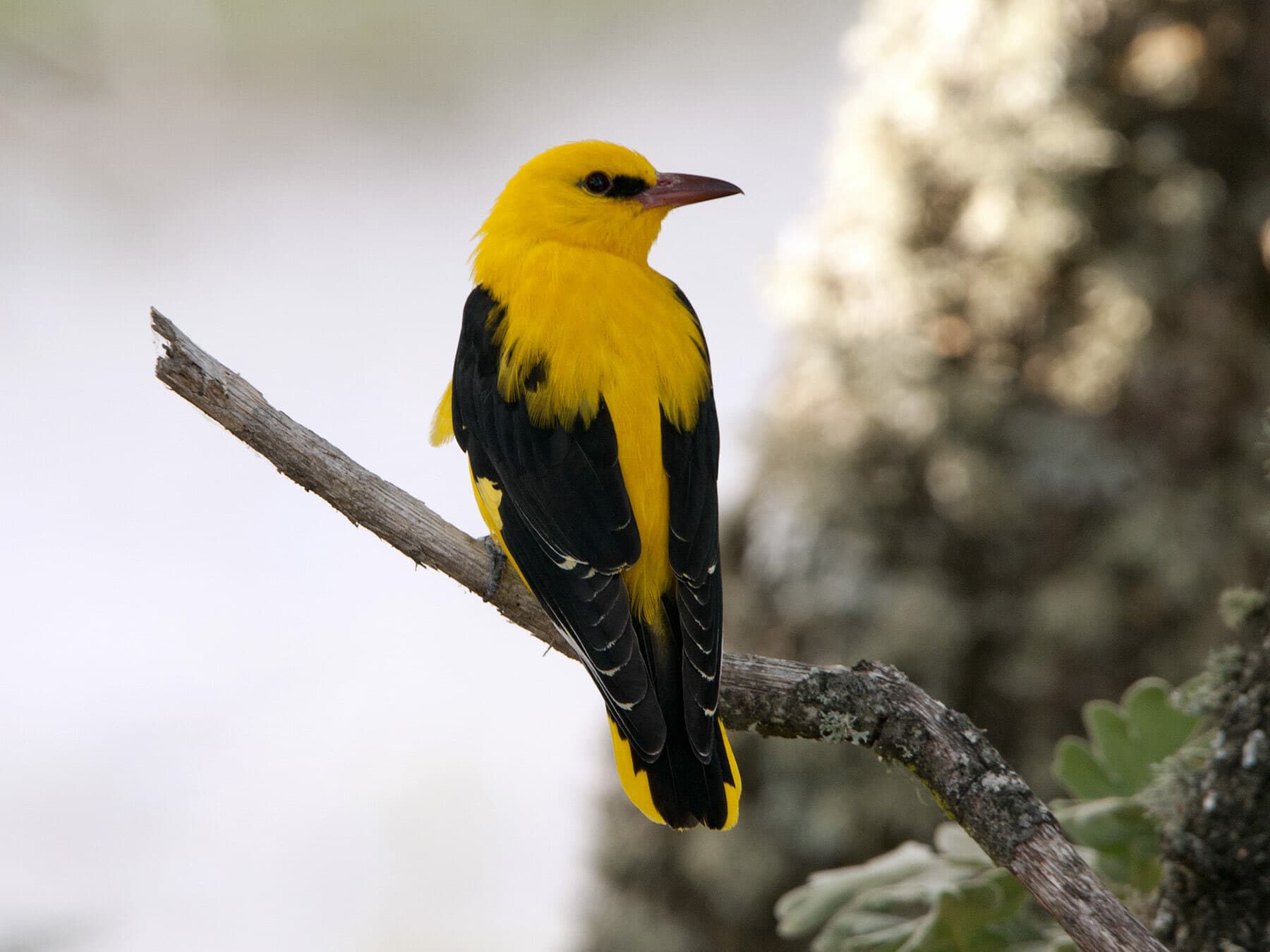
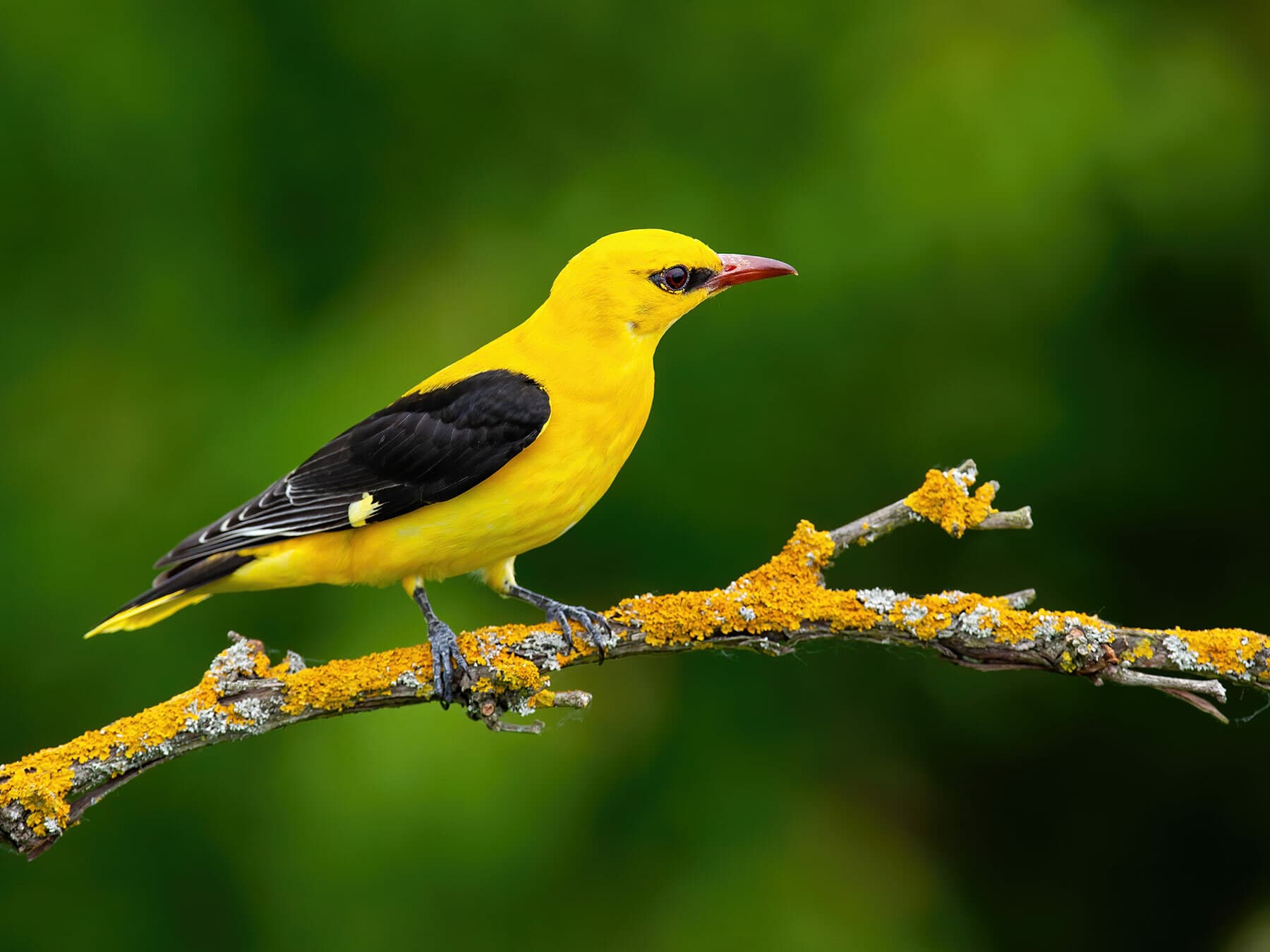
The Golden Oriole is a striking bird with vibrant plumage. Males display brilliant golden yellow bodies contrasted by jet-black wings and a distinctive black stripe through the eye. Their tails are yellow with black tips.
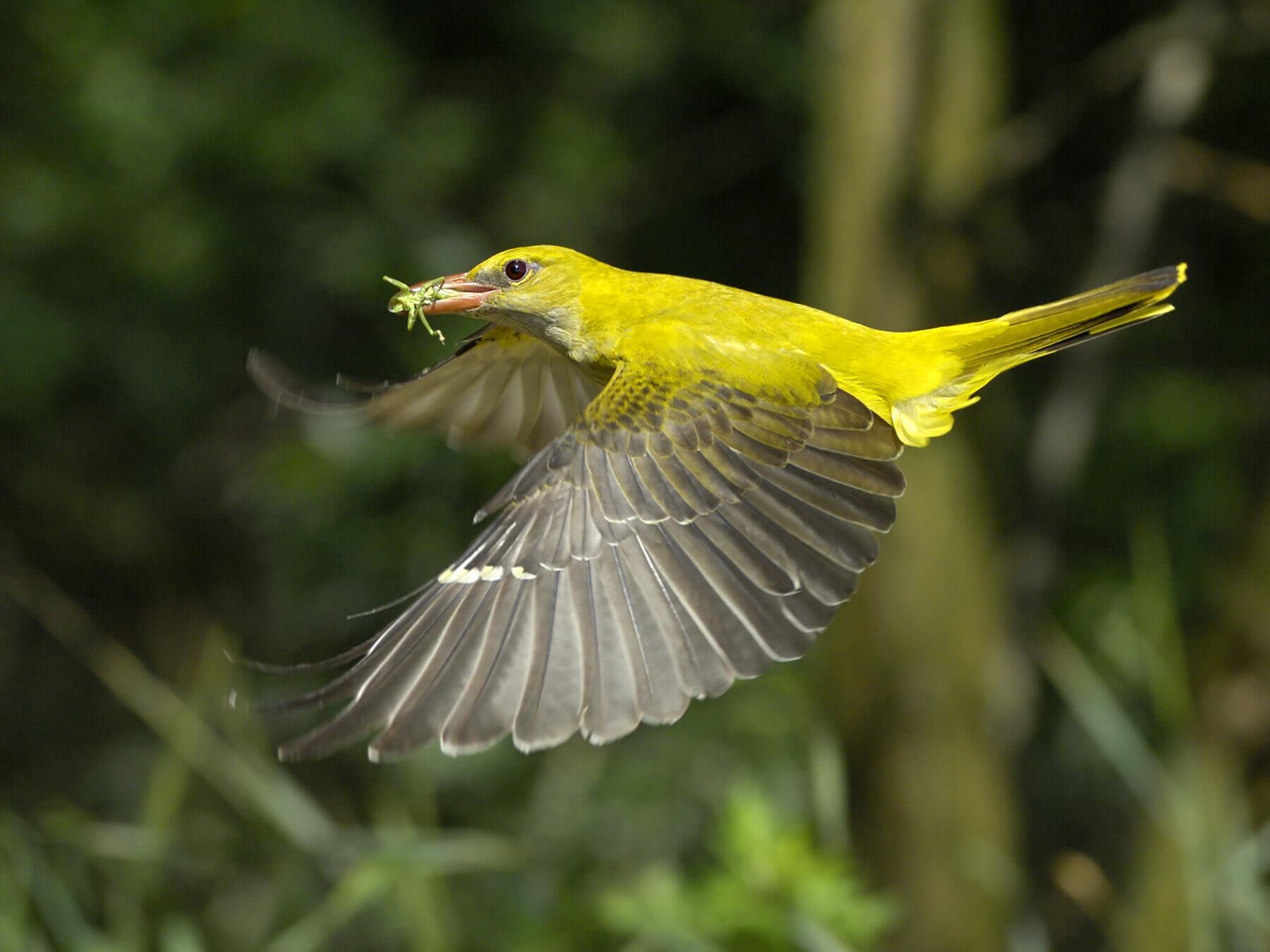
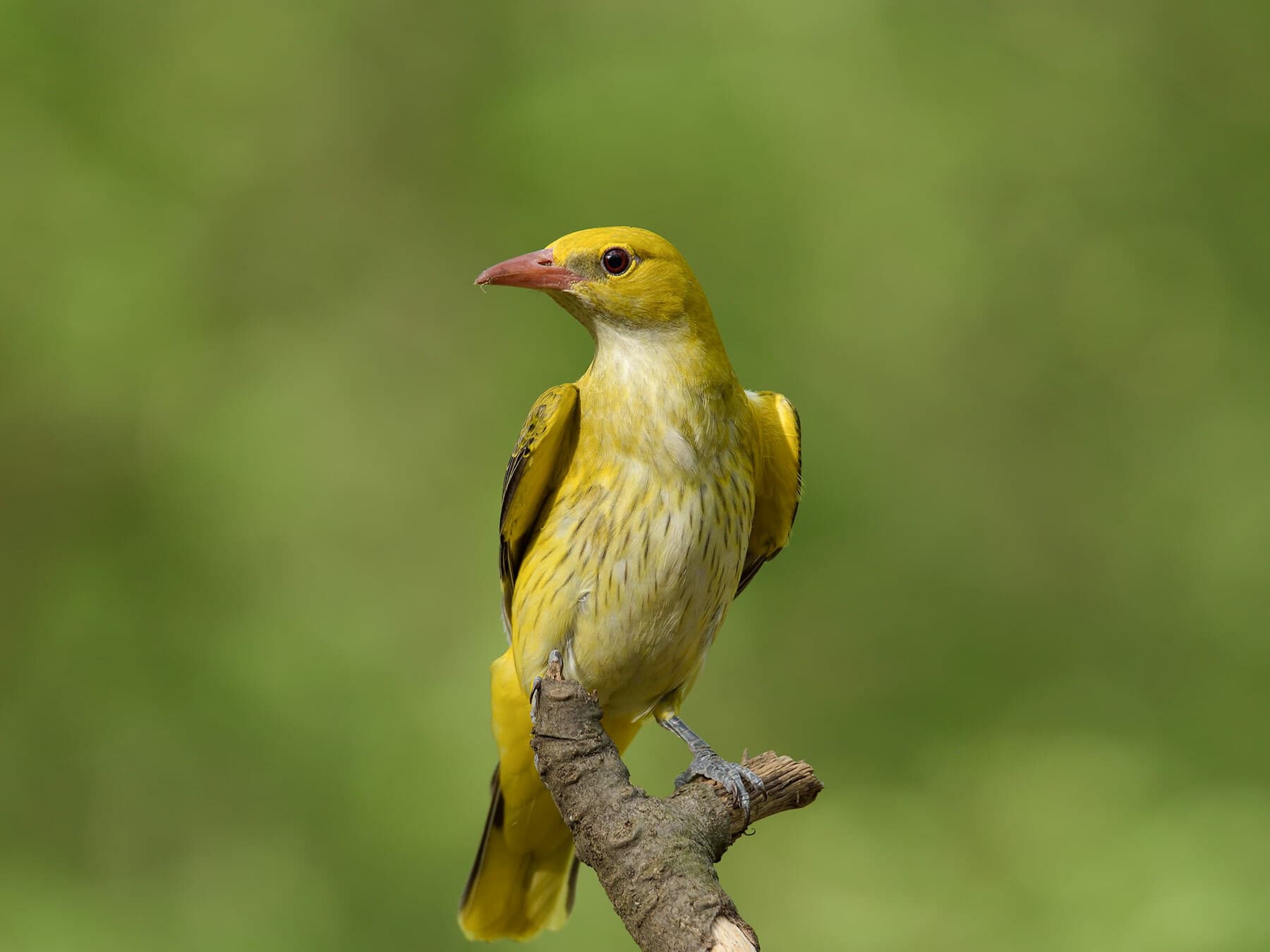
Females and juveniles are more subdued, with olive-green upperparts and greyish-white underparts streaked with dark lines. The female is also without the black mask worn proudly by the male. Both sexes have reddish-pink bills and bluish-grey legs.
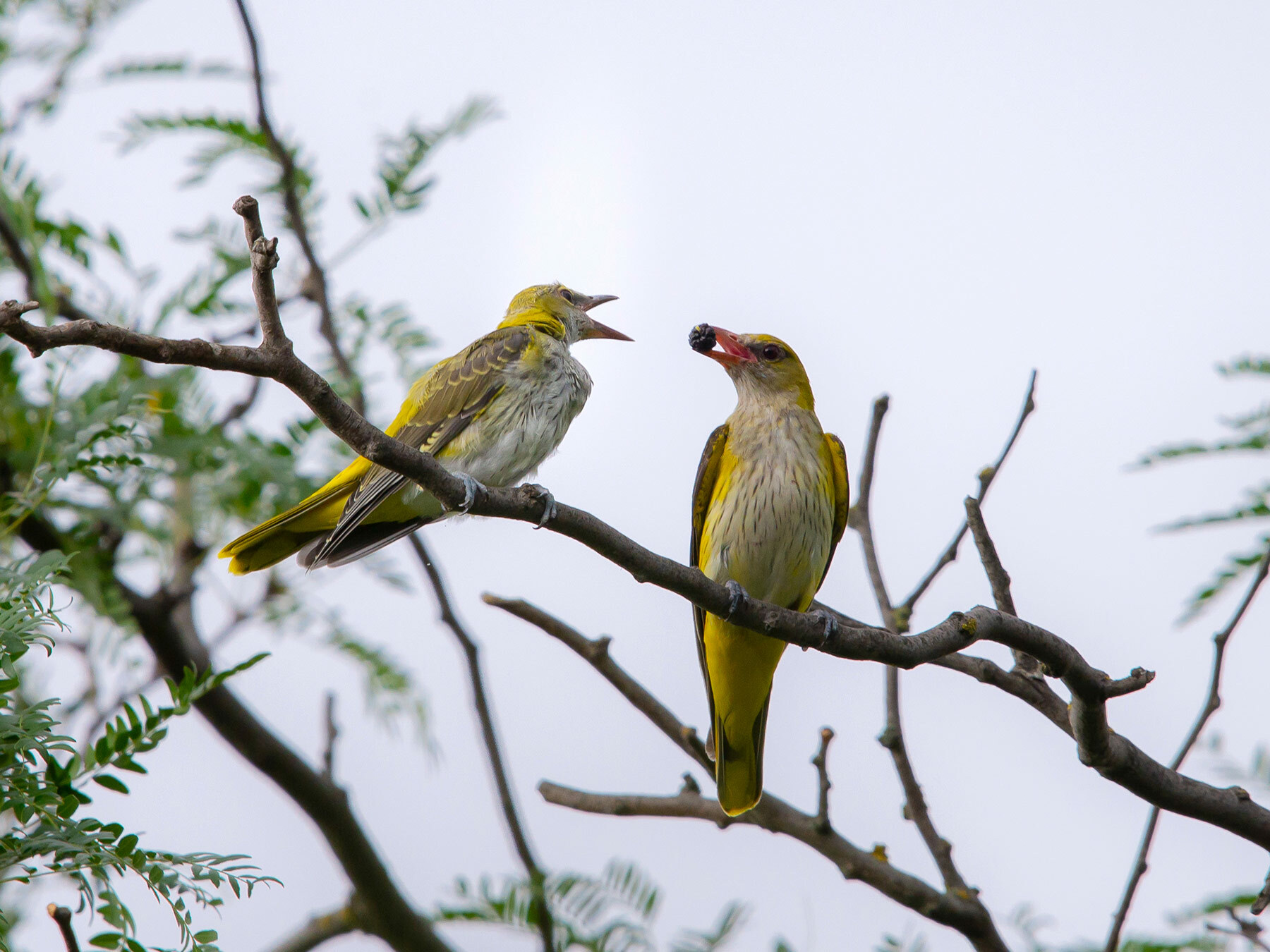
Juveniles are similar to adult females, although generally duller and with heavier underpart streaking.
Its size
Adults- Length
- 22–24 cm
- Wingspan
- 44–47 cm
- Weight
- 56–79 g
Its song and calls
Golden orioles are often heard singing to each other in melodious duets with the female answering the male’s soft whistling sounds with a ‘skweeeeer‘ response. The sound of the male singing can often be heard emanating from thick foliage although sighting the bird can prove extremely difficult in these circumstances.
- Song and calls0:00 / 0:52
Recorded in Provence-Alpes-Côte d'Azur, France · June 2022
- Call0:00 / 0:53
Recorded in podlaskie, Poland · July 2019
When and where to see it
OctoberMostly absent
Most recorded in October
- 1. Shetland Islandsunder 0.1%
Each dot is a county, state or province: the bigger and darker, the larger the bird’s share of that place’s bird records that month. Grey dots: no regular records. The ringed point is the centre of the bird’s records this month; the arrow shows how it moved since last month, and the dashed loop its path through the year. “Arrivals” colours places where it becomes regular this month (orange) or is in its last regular month (grey). GBIF eBird Observation Dataset, 2019–2024. Map data: Natural Earth, US Census Bureau; place centres © OpenStreetMap contributors.
In your area
See when the Golden Oriole is recorded in your county, state or province.
How often the Golden Oriole turns up in the UK through the year, from birdwatchers' records.
United Kingdom
Passage migrant · regularly Apr–Jun · most records in May
Show as a table
| Month | United Kingdom |
|---|---|
| January | <0.001% |
| February | – |
| March | – |
| April | <0.001% (regular) |
| May | 0.005% (regular) |
| June | 0.002% (regular) |
| July | <0.001% |
| August | <0.001% |
| September | <0.001% |
| October | <0.001% |
| November | – |
| December | – |
Recorded regularly in
Worldwide: recorded regularly in 81 countries
Countries where it was recorded in at least 3 of the 6 years 2019–2024. Linked countries have their own bird list.
Europe (39)
- Albania
- Austria
- Belarus
- Belgium
- Bosnia & Herzegovina
- Bulgaria
- Croatia
- Czechia
- Denmark
- Estonia
- Finland
- France
- Germany
- Greece
- Hungary
- Italy
- Kosovo
- Latvia
- Liechtenstein
- Lithuania
- Luxembourg
- Malta
- Moldova
- Montenegro
- Netherlands
- North Macedonia
- Norway
- Poland
- Portugal
- Romania
- Russia
- Serbia
- Slovakia
- Slovenia
- Spain
- Sweden
- Switzerland
- Ukraine
- United Kingdom
Africa (20)
Asia (22)
- Armenia
- Azerbaijan
- Bahrain
- China
- Cyprus
- Georgia
- Iran
- Iraq
- Israel
- Jordan
- Kazakhstan
- Kuwait
- Kyrgyzstan
- Lebanon
- Mongolia
- Oman
- Palestinian Territories
- Qatar
- Saudi Arabia
- Turkey
- United Arab Emirates
- Uzbekistan
Data: EOD – eBird Observation Dataset (Cornell Lab of Ornithology), accessed via GBIF.org, CC BY 4.0. Records from 2019–2024, aggregated and filtered by Birdfact. How these lists are made
The European golden oriole is a migratory bird preferring to overwinter in sub Saharan Africa but spending summer and the breeding season in the more temperate climates of western Europe and eastwards into Mongolia and northwest China.
Signs and Spotting tips
Golden orioles like trees! They live in forests, feed in forests and breed in forests. Only occasionally will they venture in to open spaces to forage for food or nesting material. Broadleaf woodlands, mixed and coniferous forests, plantations, orchards and even urban and suburban gardens are used as habitats by these birds. The adult male, once spotted is easy to identify with the female being less so and often confused with a green woodpecker, particularly during flight. Nesting high in the forest canopy they are difficult to spot from the ground and often their singing is the only indication of their presence.
What it eats
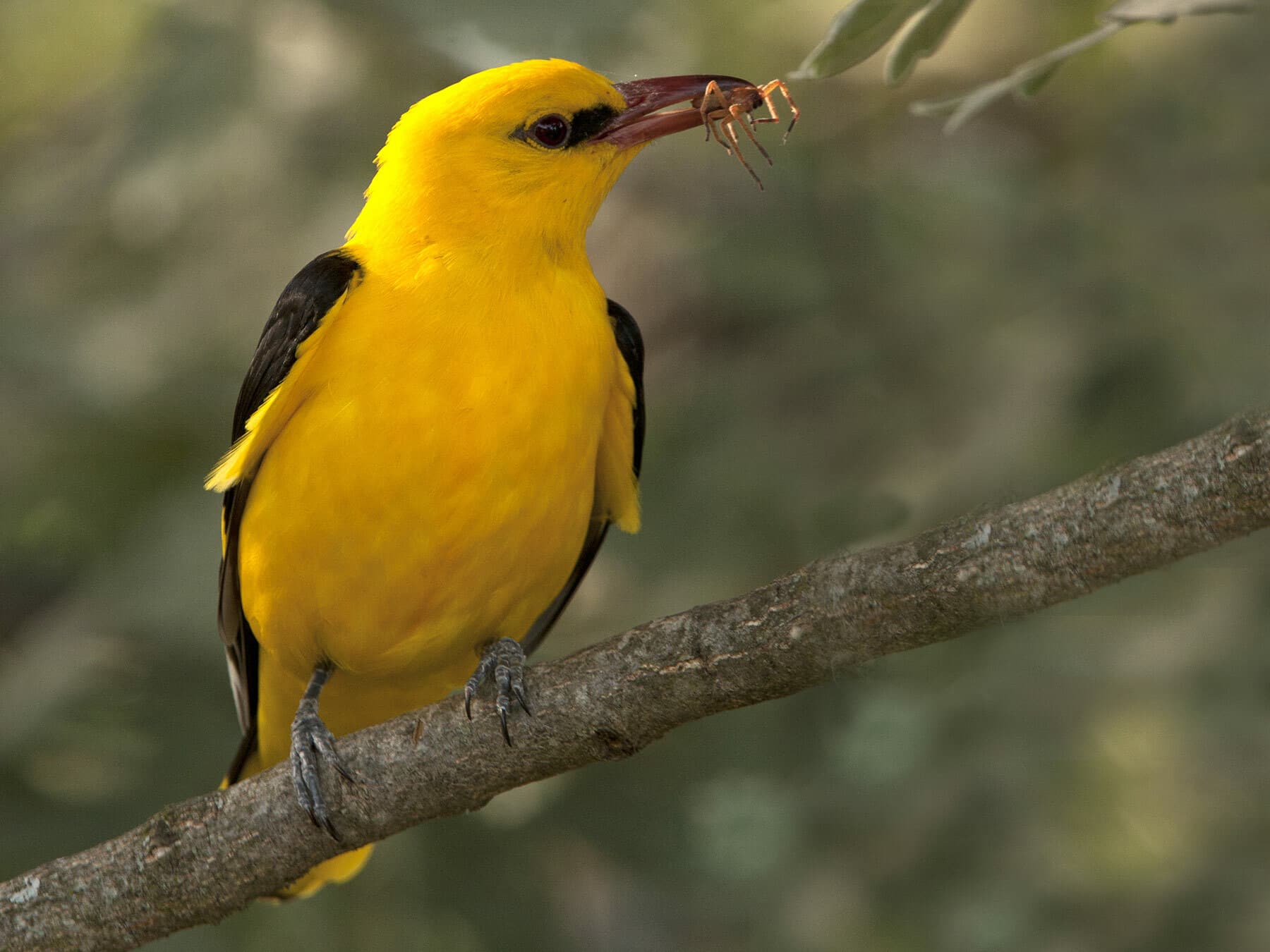
At home feeding from the foliage high up in the trees or foraging on the ground, the golden oriole takes small invertebrates such as caterpillars and also fruits and seeds.
Nesting and breeding
The male golden oriole arrives at the nesting site a few days prior to the arrival of his mate in order to chase away intruders and lay claim to his territory. Once the female arrives she starts to build the nest which is a woven structure made of almost anything to hand from bark, reeds, grasses and other vegetable matter to animal fur and hair and man made fibres or synthetic waste. The nest, a shallow cup shape, is located high in the forest or wood where it is suspended beneath a fork in the branches high up in the tree canopy. Annually, between May to June, and in some areas July, one brood of 3 – 5 pale cream eggs, with black splodges, are laid and incubated by both parents for a period of up to seventeen days. Nestlings are fed by the male and female and fledging has normally occurred by three weeks.
Behaviour
Golden Orioles are shy and elusive, often concealing themselves in dense foliage. They move gracefully through trees, hopping along branches while foraging.
These birds are typically solitary or found in pairs, but they become more social during migration when they may form small flocks.
Lifespan and predators
Average life expectancy for the European golden oriole is between five to ten years.
Conservation
While the Golden Oriole is listed as Least Concern globally, it faces localised threats. Habitat loss due to deforestation and agricultural intensification poses challenges.
It is a rare breeding bird in the UK, with conservation efforts focused on protecting and expanding suitable woodland habitats.
What does a Golden Oriole look like?
The adult male is a striking looking bird with a golden yellow head, upper body and underparts. The wings and tail are a shiny black with yellow tips to the primary coverts. The underwing coverts are yellow whilst the flight feathers (remiges) have narrow, yellowish white tips. The male’s lores, which is the area immediately in front of the eye and behind the base of the bill, is black, giving the impression of the bird wearing a small mask. The eyes are a deep dark red and the medium to large bill is a bright pinkish red. Legs are grey blue in colour. The female lacks the male’s distinctive golden yellow colour and instead has predominantly pale yellowish green upper body parts and upper wing coverts with dark grey to black wings and a yellow rump. The area of the chin morphing to the upper breast is a pale grey. The lower breast, belly and flanks are a pale yellow with black streaks and the bill is more pink than red. The female is also without the black mask worn proudly by the male. Juveniles are similar to the adult female although generally duller and with heavier underpart streaking.
Similar birds
Often mistaken for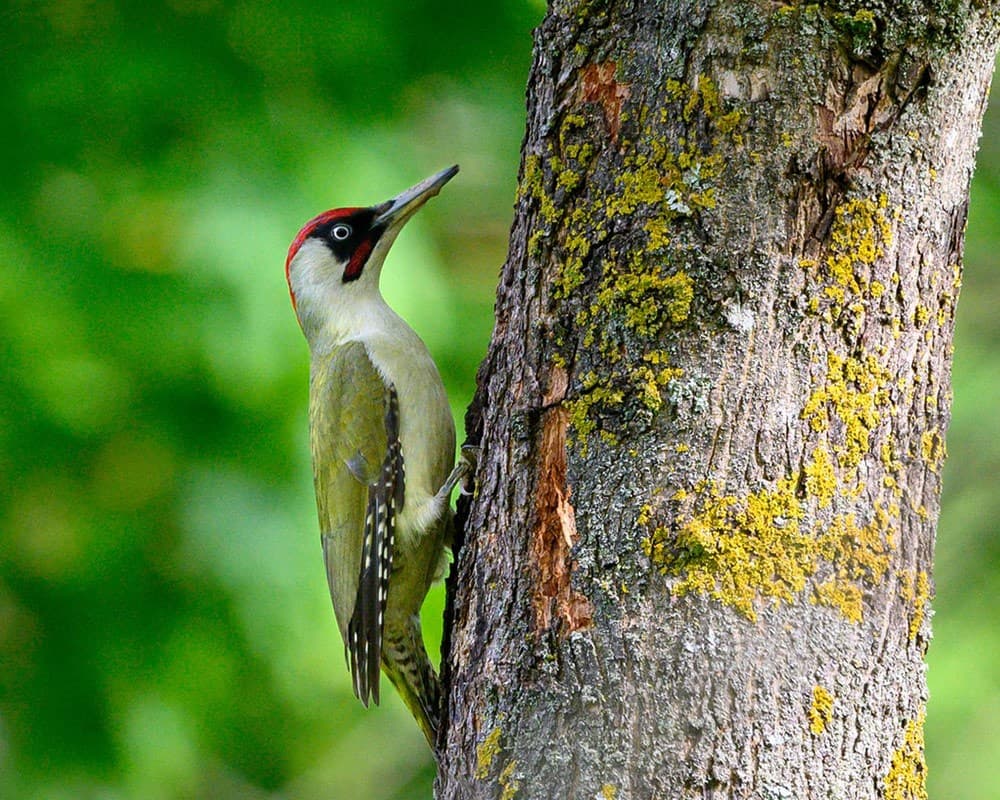
More photos
2 photos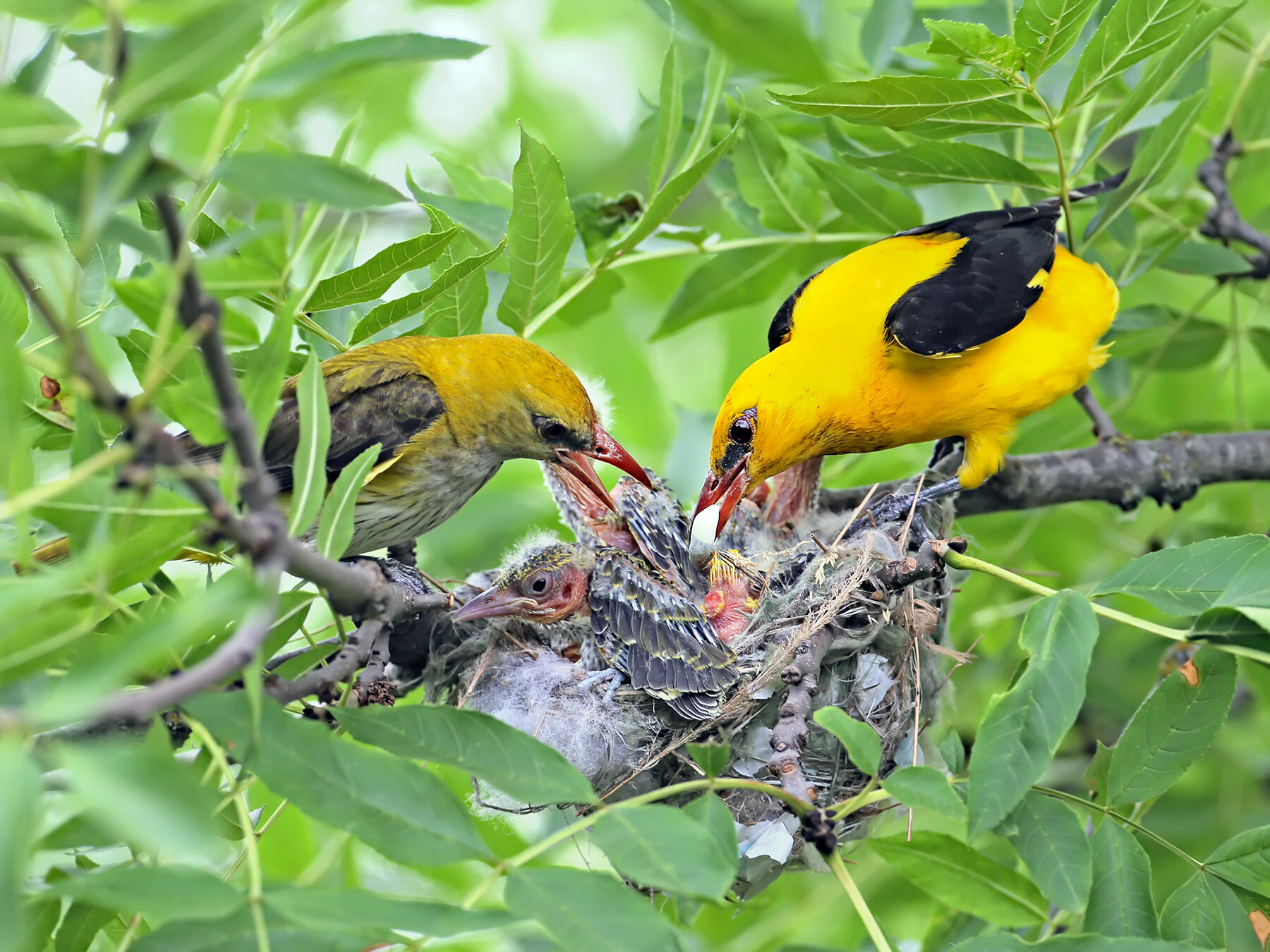
Golden Oriole guides
1 guidesQuick facts
- Length
- 22–24 cm
- Wingspan
- 44–47 cm
- Weight
- 56–79 g
- Lifespan
- 5–10 years · oldest recorded 10 years
- Family
- Old World Orioles
- Migration
- Long-distance Migrant
- Global status (IUCN)
- Least Concern
- World population
- 17,480,000 - 32,000,000 mature individuals
- Population trend
- Stable
- Also called
- Eurasian Golden Oriole, European Golden Oriole
- Scientific name
- Oriolus oriolus
Sources
4- 1BirdLife International. 2017. Oriolus oriolus (amended version of 2016 assessment). The IUCN Red List of Threatened Species 2017: e.T103692938A111783061. Source (opens in a new tab)
- 2EBCC (2015)
- 3BirdLife International. 2017. Oriolus oriolus (amended version of 2016 assessment). The IUCN Red List of Threatened Species 2017: e.T103692938A111783061. Source (opens in a new tab)
- 4BTO longevity records: maximum age from a ringed bird, 10 years, 1 month, 1 day (set in 1996), BirdFacts: Golden Oriole (1996) Source (opens in a new tab)

Checked by
Nathan Cope, founder and editor
Nathan founded Birdfact and leads its writers and contributors in the UK, the US and Canada. He has watched and studied birds for more than ten years, and checks every article and species guide before it’s published.