Species Profile
Black-billed Cuckoo
Coccyzus erythropthalmus
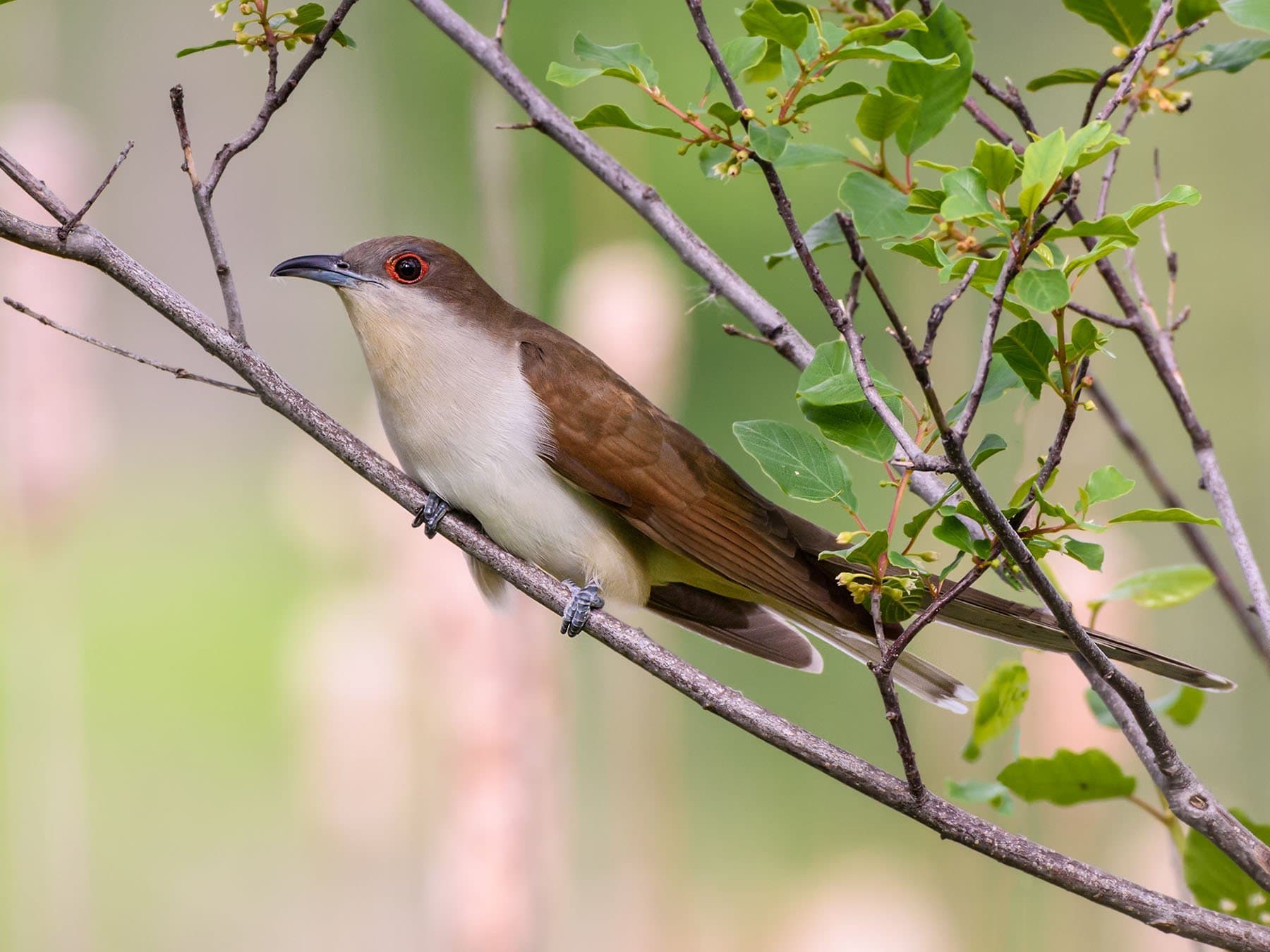
Black-billed Cuckoo perched on a branch, displaying brown upperparts, white underparts, a red eye-ring, and a black bill in a natural setting.
Quick Facts
Conservation
LCLeast ConcernLifespan
2–4 years
Length
28–32 cm
Weight
40–65 g
Wingspan
34–40 cm
Migration
Long-distance Migrant
Slender, secretive, and built for speed, the Black-billed Cuckoo is a long-distance migrant that travels from the forests of eastern North America to the rainforests of South America each year — and back again. It is one of the few birds in the world capable of eating hairy caterpillars with impunity, and it can go from freshly laid egg to fully fledged chick in just 17 days, one of the fastest developmental timelines of any bird species.
Think you've spotted a Black-billed Cuckoo?
Upload a photo and we'll confirm it instantly
Confirm with a PhotoAppearance
The Black-billed Cuckoo is a slender, long-tailed bird with a distinctly hunchbacked posture when perched. Adults measure 28–32 cm in length with a wingspan of 34–40 cm — roughly comparable in size to a large thrush or small dove, bigger than a Baltimore Oriole but noticeably smaller than an American Crow. The upperparts — head, back, and wings — are a uniform grayish-brown, with no trace of the rufous or cinnamon tones visible in the wings of the closely related Yellow-billed Cuckoo. The underparts are entirely white.
The bill is all black and slightly downcurved, with a hooked tip on the upper mandible. This is the single most reliable field mark for separating this species from the Yellow-billed Cuckoo, which shows a bold yellow lower mandible. The most striking facial feature of adults is a narrow, bright red orbital ring encircling the dark brown eye — sometimes described as crimson or orange-red, it is vivid at close range and visible in good light.
The long, graduated tail is grayish-brown above and darker below. The outer tail feathers carry small but distinct white crescent-shaped tips — notably smaller and less bold than the large white spots on the tail of the Yellow-billed Cuckoo. The feet are zygodactylous, with two toes pointing forward and two pointing backward, an arrangement shared with woodpeckers and parrots that aids in clambering through dense vegetation.
The sexes are very similar in plumage and are not reliably distinguished in the field. Females average slightly larger than males — a mild reverse sexual dimorphism in size. Juveniles differ from adults in having a yellowish or buff-coloured eye ring rather than red, a creamier rather than pure white underside, and some rusty-brown coloration on the outer wing feathers. Newly hatched chicks have shiny black skin with sparse, sheath-like white down and unusual creamy structures on the mouth and tongue — entirely normal for the species.
Identification & Characteristics
Colors
- Primary
- Brown
- Secondary
- White
- Beak
- Black
- Legs
- Grey
Markings
All-black bill; narrow bright red orbital ring around the dark eye; small white crescent-shaped tips on outer tail feathers; uniform grayish-brown upperparts with no rufous in the wings
Tail: Long, graduated tail, grayish-brown above and darker below, with small but distinct white crescent-shaped tips on the outer tail feathers
Attributes
Understanding Attributes
Rated 0–100 based on research and observation. A score of 50 is average across all bird species. These attributes are relative and don't necessarily indicate superiority.
Habitat & Distribution
Black-billed Cuckoos favour edges over interiors — the margins of mature deciduous or mixed deciduous-coniferous forests, dense shrubby thickets, and second-growth woodland. They are consistently drawn to habitats near water: rivers, streams, lakes, marshes, and ponds all attract the species, particularly where alder and willow scrub line the banks. Favoured tree species include aspen, poplar, birch, sugar maple, hickory, hawthorn, and willow. In Montana, the species is found primarily in riparian cottonwood and green ash stands with a shrubby willow understory. They also occur in orchards, abandoned farmland, golf courses, and residential parks with sufficient tree cover.
The breeding range covers eastern North America east of the Rocky Mountains, from the eastern seaboard west to Montana and south to Oklahoma, northern Arkansas, Tennessee, and North Carolina. The species is absent from the Deep South during the breeding season. In Canada, it breeds across a broad southern band from central Alberta, Saskatchewan, and Manitoba through Ontario and Quebec into the Maritime Provinces — including Prince Edward Island, eastern New Brunswick, and western Nova Scotia. It is the more northerly-breeding of the two North American Coccyzus cuckoos, being more common as a nesting bird in the northern parts of the range than the Yellow-billed Cuckoo.
The wintering grounds lie in northwestern South America — primarily Colombia, Venezuela, Ecuador, Peru, and Bolivia — where the species inhabits tropical rainforests, deciduous woodlands, and scrub. During migration it will use almost any dense cover, including thickets, hedgerows, and gardens.
In the British Isles, the Black-billed Cuckoo is an extremely rare vagrant (Category A on the British list), with approximately 15–16 accepted records as of 2016–17. The majority of European records come from the UK in autumn, with October the peak month; most birds arrive dead or moribund after being blown off course over the Atlantic. A notable exception was a spring bird found on North Uist in the Outer Hebrides in May 2016, which remained healthy and visible for at least 10 days — an extraordinary occurrence for a species that almost never lingers. Records have also come from Cornwall and Merseyside. Vagrant records from the Pacific coast of North America include British Columbia, Washington, and California.
Diet
Hairy caterpillars are the cornerstone of the Black-billed Cuckoo's diet — and the species has evolved specific adaptations to handle prey that most other birds refuse to touch. Tent caterpillars, fall webworms, spongy moth (formerly gypsy moth) larvae, and forest tent caterpillars are all taken regularly. The stiff hairs of these caterpillars penetrate and irritate the stomach linings of most predators, but cuckoos deal with this in two ways: they beat caterpillars against a branch to remove some hairs before swallowing, and they periodically shed the entire stomach lining — regurgitating it as a compact pellet, much like an owl casts up bones and fur. This is not a curiosity but a genuine physiological adaptation, allowing the bird to continue feeding on prey that would otherwise cause internal damage.
The scale of caterpillar consumption can be extraordinary. Studies have found more than 100 caterpillars in a single cuckoo's stomach at once; one individual was recorded with 250 young tent caterpillars in its gut, and another was observed consuming 36 caterpillars in just five minutes. During outbreak years, this appetite makes the species a significant natural control on pest populations.
Beyond caterpillars, the diet includes katydids, cicadas, grasshoppers, beetles, and butterflies — including the toxic Monarch Butterfly, which most birds avoid. Snails, small fish, and the eggs of other birds are also taken opportunistically. On the wintering grounds in South America, fruit and small seeds become more important dietary components. Foraging is done by moving slowly through shrubs and trees, gleaning prey from foliage; the species tends to forage lower in the canopy than the Yellow-billed Cuckoo and will occasionally descend to the ground.
Behaviour
Black-billed Cuckoos are solitary and secretive birds, far more often heard than seen. They move slowly and deliberately through dense foliage, clambering and hopping among branches with a deliberate, almost reptilian quality. Despite their size, they can be extraordinarily difficult to spot — they tend to sit motionless in the interior of a shrub or tree, and their brown-and-white plumage blends well against dappled leaf cover.
One of the most ecologically distinctive behaviours of this species is its nomadic response to insect outbreaks. Rather than returning to a fixed territory each year, Black-billed Cuckoos actively search large areas of forest after arriving on the breeding grounds, homing in on zones where caterpillar populations have exploded. During spongy moth or tent caterpillar outbreaks, local cuckoo numbers can surge dramatically as birds converge from surrounding areas. This makes the species genuinely unpredictable in terms of local abundance — common one year, absent the next.
When threatened, young birds adopt a cryptic "bittern pose" — stretching the neck upward and pointing the bill skyward while remaining completely motionless. Adults are similarly reluctant to flush, preferring to freeze or slip quietly through cover rather than take flight. Outside the breeding season the species is largely solitary, though during migration it may occasionally be found alongside other species in mixed-species flocks using dense cover.
The species is primarily active during the day on the breeding grounds, but becomes increasingly nocturnal in midsummer — calling through the night and migrating after dark. This nocturnal activity is a useful identification cue for observers listening for flight calls overhead during autumn migration.
Calls & Sounds
The primary song is a series of 2–5 rapid, rhythmic groups of "cu-cu-cu-cu" notes, all delivered on the same pitch with a brief pause between each group — often transcribed as "coo-coo-coo-coo, coo-coo-coo-coo." The overall quality is soft, clear, and slightly hollow, lacking the harder, more knocking character of the similar Yellow-billed Cuckoo's call. This tonal difference is one of the most reliable ways to separate the two species by ear.
Adults call mainly during the day during the breeding season but begin calling at night in midsummer — a useful identification cue for nocturnal observers. The species also gives a "croak" call of five short, lower-pitched notes ("krak-ki-ka-kruk-kruk"), a low, mournful "coo-oo-oo" call thought to be used when a predator is nearby, and a soft "mew" call used by females during courtship and when feeding nestlings. In total, the species produces around six distinct vocalisations, each associated with different social contexts.
The nocturnal flight call — given both during migration and on the breeding grounds — is described as a low gurgling trill that typically decelerates and rises slightly in pitch. A repeated low "coo-coo-coo" at approximately three calls per second is also given in flight. These calls can be heard overhead on still autumn nights as birds move south.
Chicks produce a buzzing, insect-like sound from 1–3 days old, followed by a low barking call from about 6–7 days old. The species is colloquially known as the "rain crow" across much of its North American range, based on the folk belief that it calls more frequently before rain — a correlation that has never been scientifically confirmed but has persisted in rural tradition for centuries.
Flight
In flight, the Black-billed Cuckoo appears long and slender, with pointed wings and a notably long tail that streams behind it. The overall silhouette is distinctive — more elongated than a thrush or dove of similar body weight, with a slightly front-heavy look created by the long bill and relatively small head. The wingbeats are rapid and shallow, producing a direct, purposeful flight style with little of the undulating quality seen in woodpeckers or finches.
The underwings show a buff wash that can be visible in good light — a useful feature when a bird is crossing open ground between patches of cover. The tail, seen from below, shows the small white crescent tips on the outer feathers; these are less bold than the large white spots of the Yellow-billed Cuckoo and can be difficult to assess in brief flight views.
The species tends to fly low and direct, hugging the edge of woodland or scrub rather than crossing open areas. It rarely soars or glides, preferring to move in short bursts between dense cover. During migration, birds fly at night, navigating by stellar cues (star patterns), and are rarely seen in active flight during the day unless disturbed. The nocturnal flight call — a low, gurgling trill — is often the only indication that birds are passing overhead during autumn migration in August and September.
When flushed from cover, the bird typically drops low and accelerates away with rapid wingbeats before diving back into vegetation. It does not linger in the open.
Nesting & Breeding
The breeding season runs from May through September, with peak activity in June and July. Pairs form in mid to late May, sometimes not until June. Courtship involves the male landing near a female with a food item in his bill and calling; if receptive, the female moves closer and performs a distinctive tail-flicking display — flicking her tail up and down repeatedly for up to 15 minutes while giving a soft "mew" call. The male remains motionless throughout, then mounts the female (still holding the food item), after which he either eats it or feeds it to her. The pair is monogamous for the breeding season.
Both adults build the nest — a loose, flimsy platform or shallow cup of twigs, grasses, and plant stems, lined with dead or green leaves, pine needles, catkins, plant fibres, rootlets, mosses, and spiderwebs. The finished structure is approximately 15 cm across and less than 2.5 cm deep. Nests are typically placed in a shrub or low tree, 0.3–6 m above the ground, usually below 3 m, concealed among dense foliage or tangles of vines. Unusually, nest construction continues even after incubation has begun.
Clutch size is typically 2–3 eggs, sometimes 4–5; in years of caterpillar abundance, clutches may be larger and laying begins earlier. Eggs are elliptical, greenish-blue, and unmarked, measuring approximately 22.6–32.3 mm long and 18.3–23.5 mm wide; they may take on a marbled appearance after a few days of incubation. Both parents share incubation continuously; the incubation period is just 10–13 days — one of the shortest of any North American bird.
Chick development is equally rapid. Nestlings leave the nest at just 6–7 days old, still flightless, and clamber through branches using their feet and bill. Full flight is achieved at approximately three weeks. The total time from egg-laying to fledging is around 17 days — among the shortest of any bird species in the world. Both parents feed the young, crushing food before thrusting it into the chicks' mouths. In years of caterpillar abundance, the species occasionally engages in brood parasitism, laying eggs in the nests of other Black-billed Cuckoos, Yellow-billed Cuckoos, Chipping Sparrows, American Robins, Gray Catbirds, Wood Thrushes, and at least six other species.
Lifespan
The Black-billed Cuckoo is a relatively short-lived bird. The typical lifespan in the wild is 2–4 years, and the maximum recorded longevity for a wild individual is 5 years, based on banding data. Sexual maturity is reached at approximately one year of age, meaning most birds attempt to breed in their first full summer.
Survival rates are influenced by the hazards of long-distance migration — the species must complete a round trip of several thousand kilometres between eastern North America and northwestern South America each year, crossing the Gulf of Mexico and traversing Central America. Collisions with communication towers and buildings during nocturnal migration are a significant source of mortality, and the species appears disproportionately vulnerable to these strikes compared to many other migrants.
On the breeding grounds, adults face predation from birds of prey, and nests are vulnerable to mammalian predators including raccoons and squirrels. The rapid developmental timeline — from egg to fledgling in just 17 days — may be an adaptation to minimise the period of nest vulnerability in a species that builds a notoriously flimsy, exposed nest.
Compared to the Common Cuckoo, which can live up to 6–8 years in the wild, the Black-billed Cuckoo has a shorter recorded maximum lifespan, though both species face similar pressures as long-distance migrants. The oldest known Black-billed Cuckoo was recovered through banding records at 5 years of age.
Conservation
The Black-billed Cuckoo is listed as Least Concern on the IUCN Red List, with a global population estimated at approximately 880,000 mature individuals. However, the population trend is firmly downward. The North American Breeding Bird Survey recorded a cumulative decline of approximately 67–68% between 1970 and 2019, at a rate of over 2% per year. Partners in Flight rates the species 13 out of 20 on the Continental Concern Score and has placed it on the Yellow Watch List-D for species with population declines and moderate-to-high threats. If current rates of decline continue, the species could lose half its remaining population by 2037.
In Canada, the Breeding Bird Survey suggests an overall moderate decrease since 1970, and the species is a candidate for assessment by COSEWIC (the Committee on the Status of Endangered Wildlife in Canada). At the state level, it is listed as Threatened in Illinois and as a Species of Special Concern in New Jersey.
The primary threats are interconnected. Pesticide use — particularly insecticides applied in orchards and agricultural areas — reduces caterpillar prey populations and may directly poison cuckoos. Habitat loss and fragmentation on both breeding and wintering grounds, including loss of shrubland through forest maturation and over-browsing by deer, removes suitable nesting habitat. The species also appears disproportionately susceptible to collisions with communication towers and buildings, particularly during nocturnal migration. Climate change is projected to alter the species' range and the timing of caterpillar outbreaks on which it depends.
The species is protected under the US Migratory Bird Treaty Act. Conservation priorities include reducing pesticide use in key foraging habitats, maintaining shrubby woodland edges, and addressing tower collision mortality through lighting and structural modifications.
Population
Estimated: Approximately 880,000 mature individuals
Trend: Decreasing
Decreasing. The North American Breeding Bird Survey recorded a cumulative decline of approximately 67–68% between 1970 and 2019, at a rate of over 2% per year. Partners in Flight places the species on the Yellow Watch List-D. If current rates continue, the species could lose half its remaining population by 2037.
Elevation
Lowlands to moderate elevations; primarily below 1,000 m on breeding grounds
Additional Details
- Predators:
- Adults face predation from birds of prey including Sharp-shinned Hawks and Cooper's Hawks. Nests are vulnerable to mammalian predators such as raccoons, squirrels, and corvids. Young birds adopt a cryptic "bittern pose" — stretching the neck upward and pointing the bill skyward — when threatened.
Courtship & Display
Courtship in the Black-billed Cuckoo is understated but precise. The male initiates by landing near a female with a food item — typically a caterpillar or other large insect — held in his bill, and calling softly. The female's response, if she is receptive, is one of the more unusual displays in North American birds: she moves closer to the male and begins flicking her tail up and down in a slow, rhythmic motion, continuing this display for up to 15 minutes while giving a soft "mew" call. The male remains completely motionless throughout.
After mounting the female — still holding the food item in his bill — the male either eats it himself or passes it to her as a courtship gift. This food-offering behaviour is thought to signal male quality and provisioning ability, giving the female information about how well he is likely to feed their chicks. The pair is monogamous for the duration of the breeding season.
Nest building is a shared activity, with both adults contributing to the loose twig platform. Unusually, construction continues even after incubation has begun — the nest is never truly "finished" in the way that many songbird nests are. Both adults also share incubation duties continuously, with no clear division of labour between day and night shifts. This shared investment from the outset of the breeding cycle is consistent with the species' monogamous pair bond and contrasts sharply with the entirely parasitic strategy of the Common Cuckoo, which forms no pair bond and invests nothing in parental care.
Cultural Significance
Across much of its North American range, the Black-billed Cuckoo is known as the "rain crow" — a name rooted in the folk belief that it calls more frequently in the hours before rain. The name appears in rural American tradition from at least the 19th century and is shared informally with the Yellow-billed Cuckoo, which occupies much of the same range. Despite the persistence of the belief, no scientific study has confirmed a reliable correlation between cuckoo calling behaviour and incoming precipitation. The name likely reflects the species' habit of calling loudly and persistently in warm, humid weather — conditions that often precede summer storms — rather than any genuine meteorological sensitivity.
The "rain crow" name is part of a broader tradition of associating cuckoo calls with weather prediction that spans multiple continents. In Europe, the call of the Common Cuckoo has long been treated as a harbinger of spring, and various folk traditions hold that the number of calls heard on first encounter predicts the number of years until marriage, death, or good fortune. The Black-billed Cuckoo carries none of these European associations in North America, but the rain crow name gives it a distinct cultural identity in the rural communities of the eastern United States and Canada where it breeds.
The species' secretive habits and ventriloquial call — which seems to come from everywhere and nowhere at once — have contributed to its reputation as a mysterious, elusive bird. It is rarely depicted in popular culture but holds a quiet place in the natural history of the eastern woodlands, where its hollow, rhythmic call drifting from a thicket on a July evening is one of the characteristic sounds of the season.
Birdwatching Tips
Patience and ears are the primary tools for finding a Black-billed Cuckoo. The species is secretive and tends to sit motionless deep within shrubs and trees, making visual detection genuinely difficult. Start by learning the song — a series of 2–5 rhythmic "cu-cu-cu-cu" groups, all on the same pitch, with a soft, hollow quality quite different from the knocking rattle of the Yellow-billed Cuckoo. In midsummer, listen at night: the species begins calling after dark from late July onwards, and nocturnal flight calls — a low, gurgling trill that decelerates and rises slightly in pitch — can be heard overhead during autumn migration in August and September.
The best habitats to search are shrubby woodland edges near water: alder and willow scrub along streams, overgrown orchards, and the margins of second-growth forest. In years of tent caterpillar or spongy moth outbreaks, check affected trees carefully — cuckoos will be drawn in and may be unusually approachable as they feed. Peak breeding season activity runs from late May through July across the eastern US and southern Canada.
When you do get a view, focus on the bill (all black, no yellow), the tail spots (small white crescents, not bold white patches), and the orbital ring (red in adults, buff-yellow in juveniles). The absence of rufous in the wings immediately rules out the Yellow-billed Cuckoo. In flight, look for the long, pointed wings and the buff wash on the underwing. The species tends to fly low and direct between patches of cover, rarely crossing open ground.
In the UK and Ireland, any cuckoo-shaped bird in October — particularly on western headlands, islands, or coastal scrub — is worth scrutinising carefully. The Black-billed Cuckoo is an extremely rare vagrant but has been recorded from Cornwall to the Outer Hebrides.
Did You Know?
- The Black-billed Cuckoo can shed its entire stomach lining to rid itself of accumulated caterpillar spines and hairs, regurgitating it as a compact pellet — much like an owl casting up bones and fur. One individual was recorded with 250 young tent caterpillars in its stomach; another was observed eating 36 caterpillars in just five minutes.
- The time from egg-laying to fledging is approximately 17 days — among the shortest of any bird species in the world. Nestlings leave the nest at just 6–7 days old, still unable to fly, and spend nearly two more weeks clambering through branches before achieving full flight at around three weeks.
- Rather than holding a fixed territory, the Black-billed Cuckoo actively searches vast areas of forest each spring, tracking caterpillar outbreak zones. During spongy moth or tent caterpillar plagues, local cuckoo numbers can surge dramatically as birds converge from surrounding areas — making the species genuinely nomadic in its breeding habits.
- In the British Isles, the Black-billed Cuckoo has only around 15–16 accepted records, the majority found dead or dying on arrival after crossing the Atlantic. A spring bird on North Uist in the Outer Hebrides in May 2016 was a remarkable exception — it remained healthy and visible for at least 10 days, an extraordinary occurrence for a species that almost never lingers in Europe.
- Unlike the Common Cuckoo, which is an obligate brood parasite that never raises its own young, the Black-billed Cuckoo normally builds its own nest and raises its own chicks. It only occasionally parasitises other species' nests — and even then, it most commonly targets other Black-billed Cuckoos.
Records & Accolades
Speed Record
~17 days egg to fledgling
The Black-billed Cuckoo completes one of the fastest egg-to-fledgling developmental cycles of any bird species in the world, going from freshly laid egg to a chick leaving the nest in as little as 17 days.
Caterpillar Champion
250 caterpillars in one stomach
One individual was recorded with 250 young tent caterpillars in its stomach. Another was observed consuming 36 caterpillars in just five minutes — a consumption rate matched by very few insectivorous birds.
Community Photos
Be the first to share a photo of the Black-billed Cuckoo
Upload a PhotoIdentify Any Bird Instantly
- Upload a photo from your phone or camera
- Get an instant AI identification
- Ask follow-up questions about the bird
Monthly Birds in Your Area
- Personalised for your location
- Seasonal tips and garden advice
- Updated every month with new species