


Eurasian Bittern
Bittern, Great Bittern · Botaurus stellaris
By the Birdfact teamChecked by Nathan Cope
On this page14 sections
How to recognise it
What do Bitterns look like?
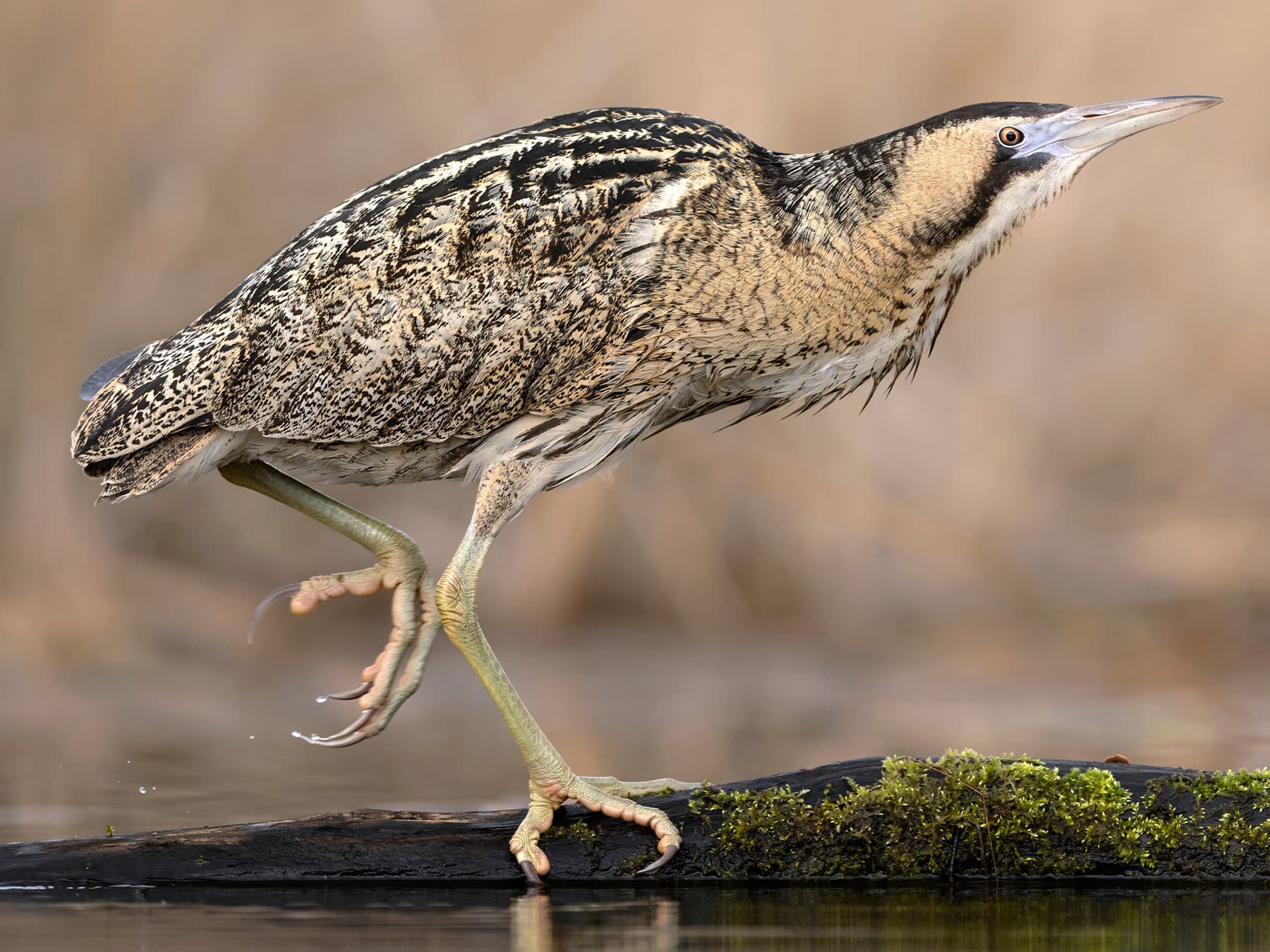
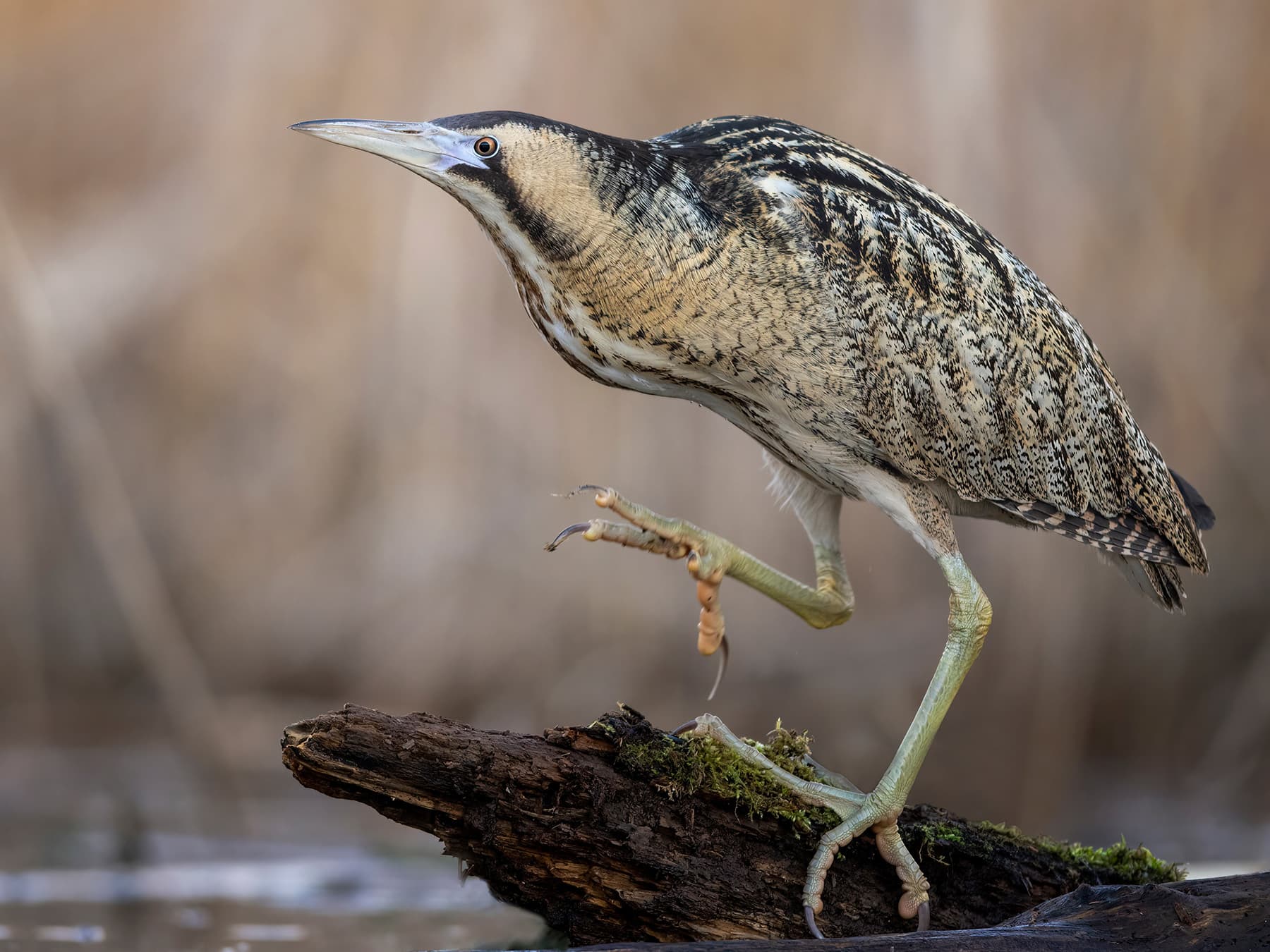
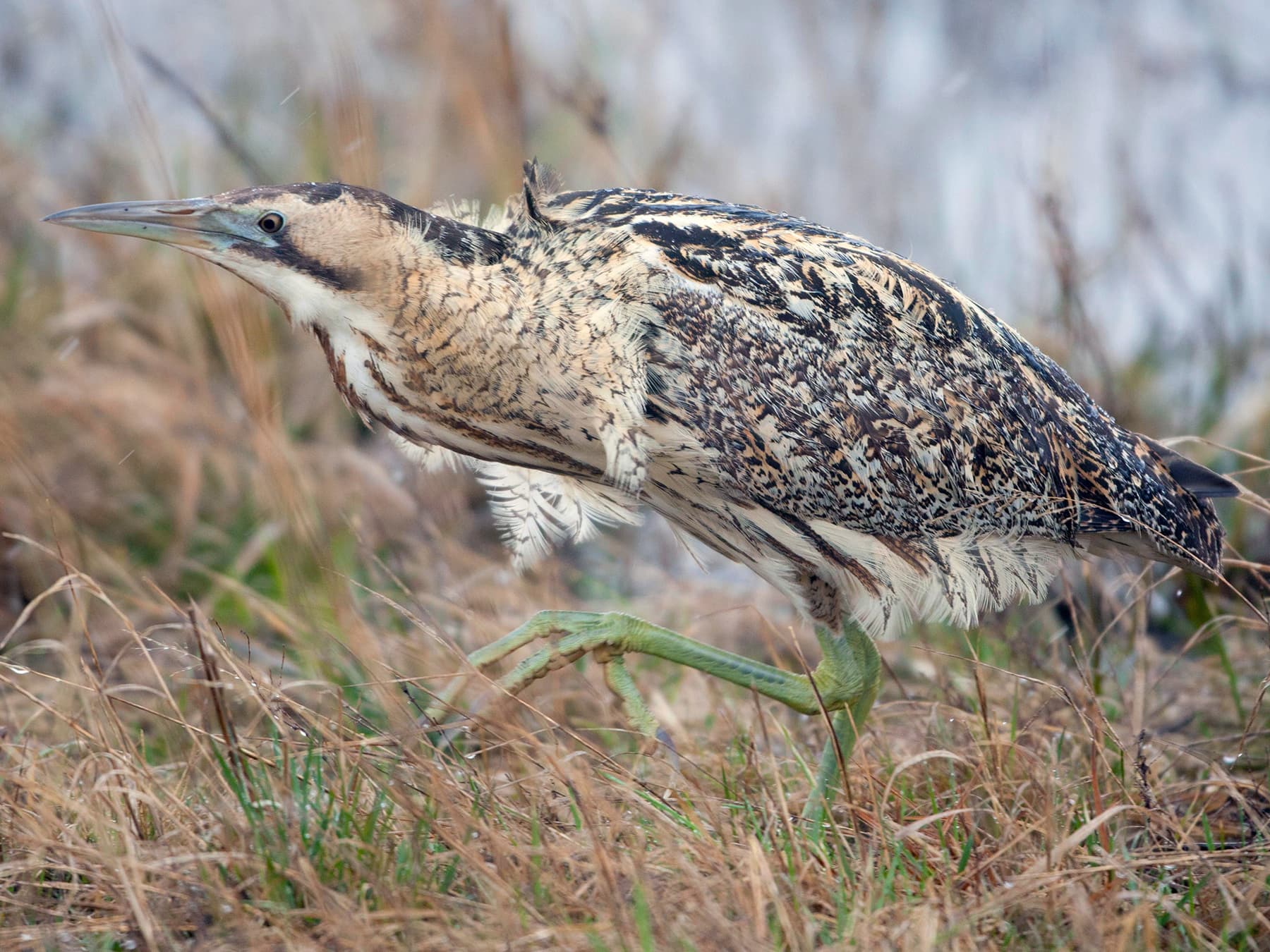
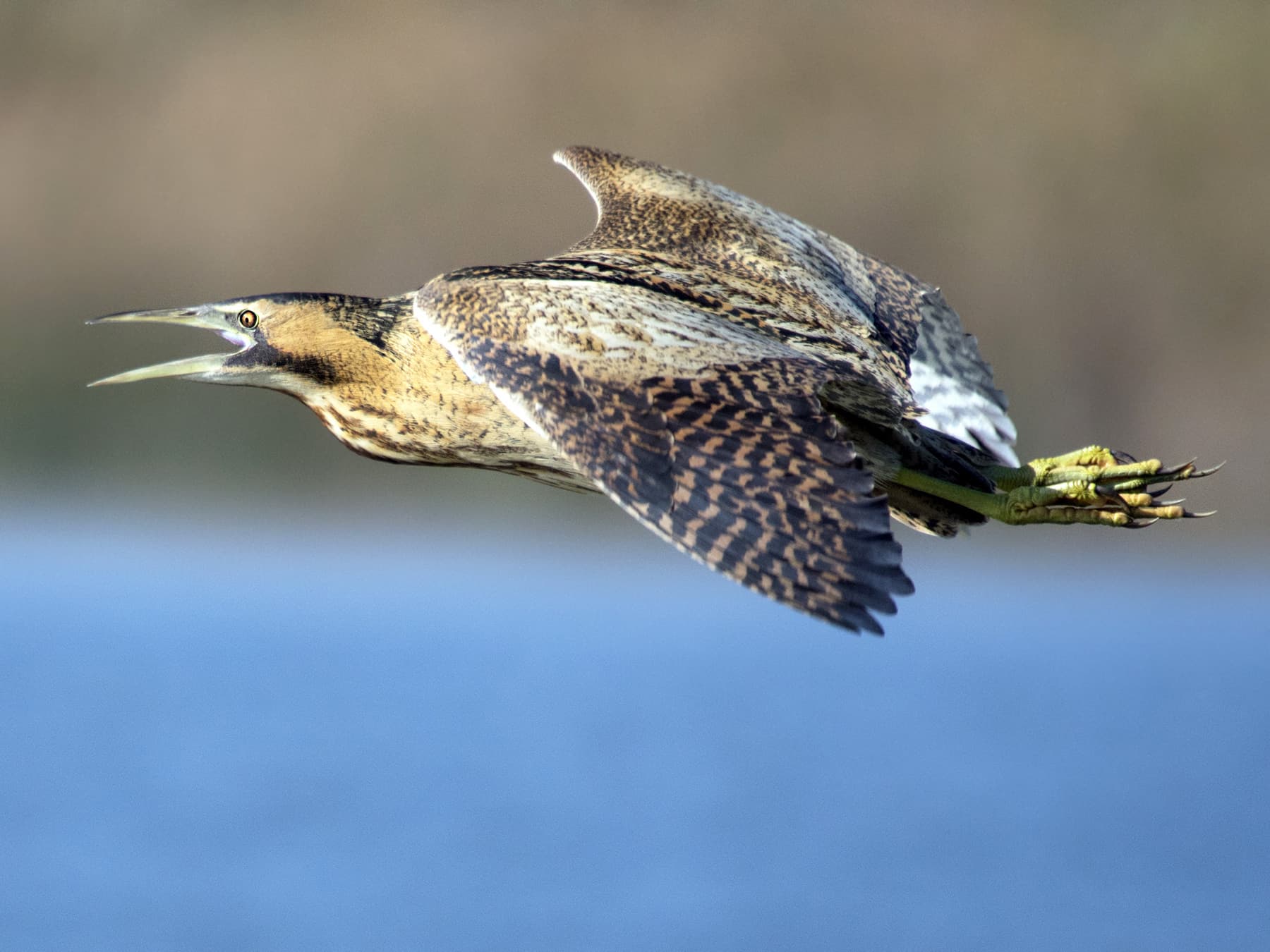
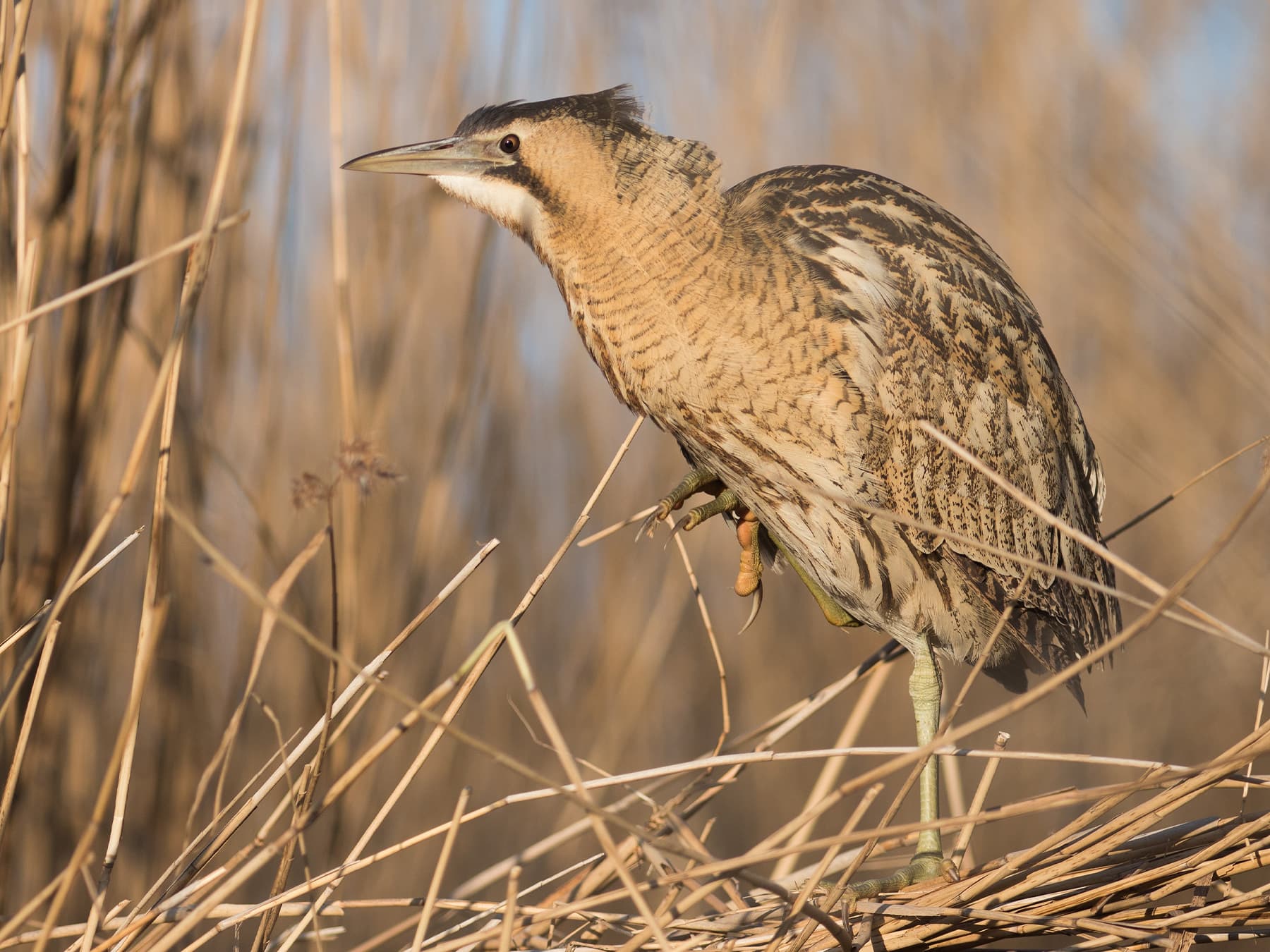
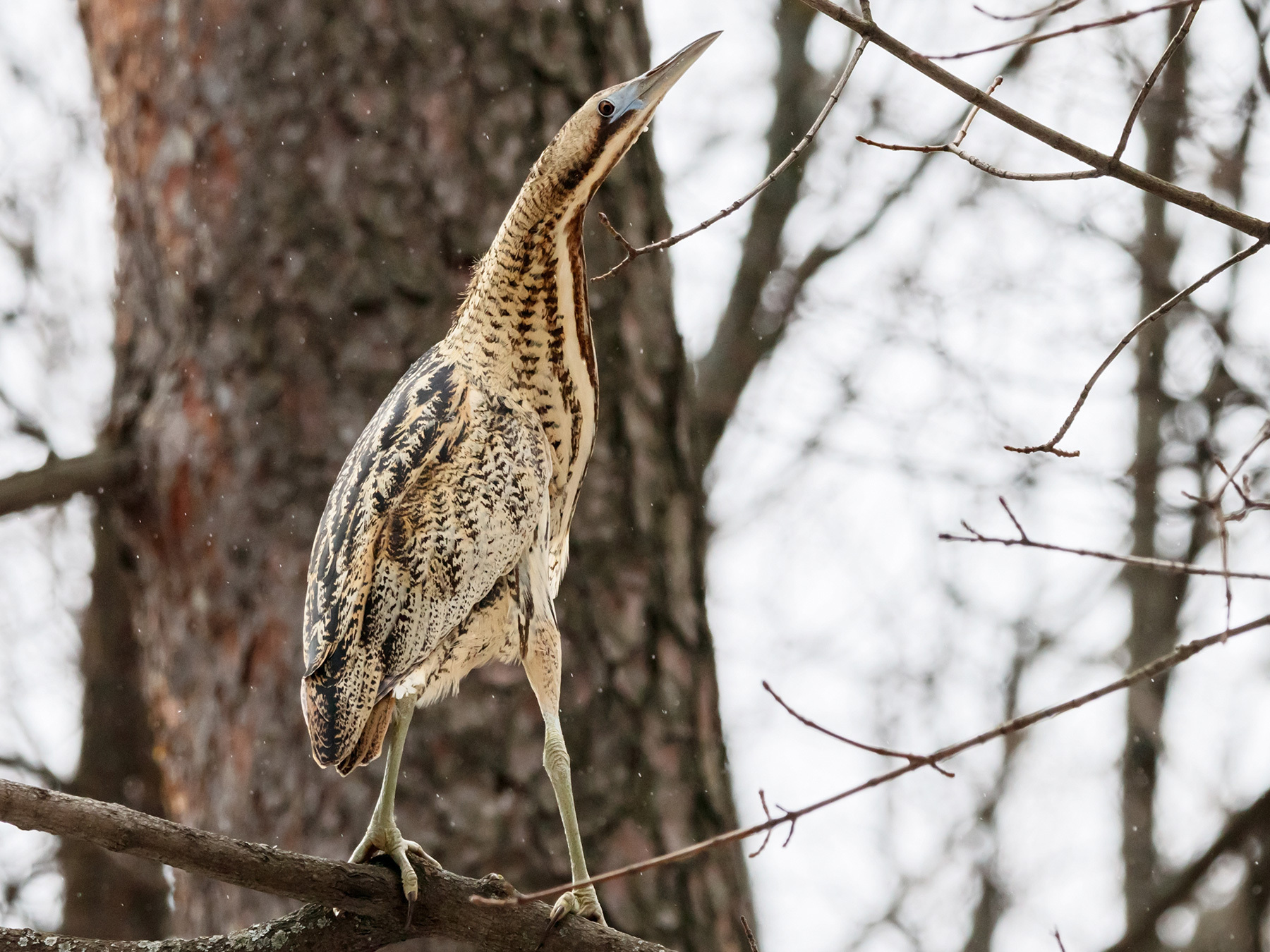
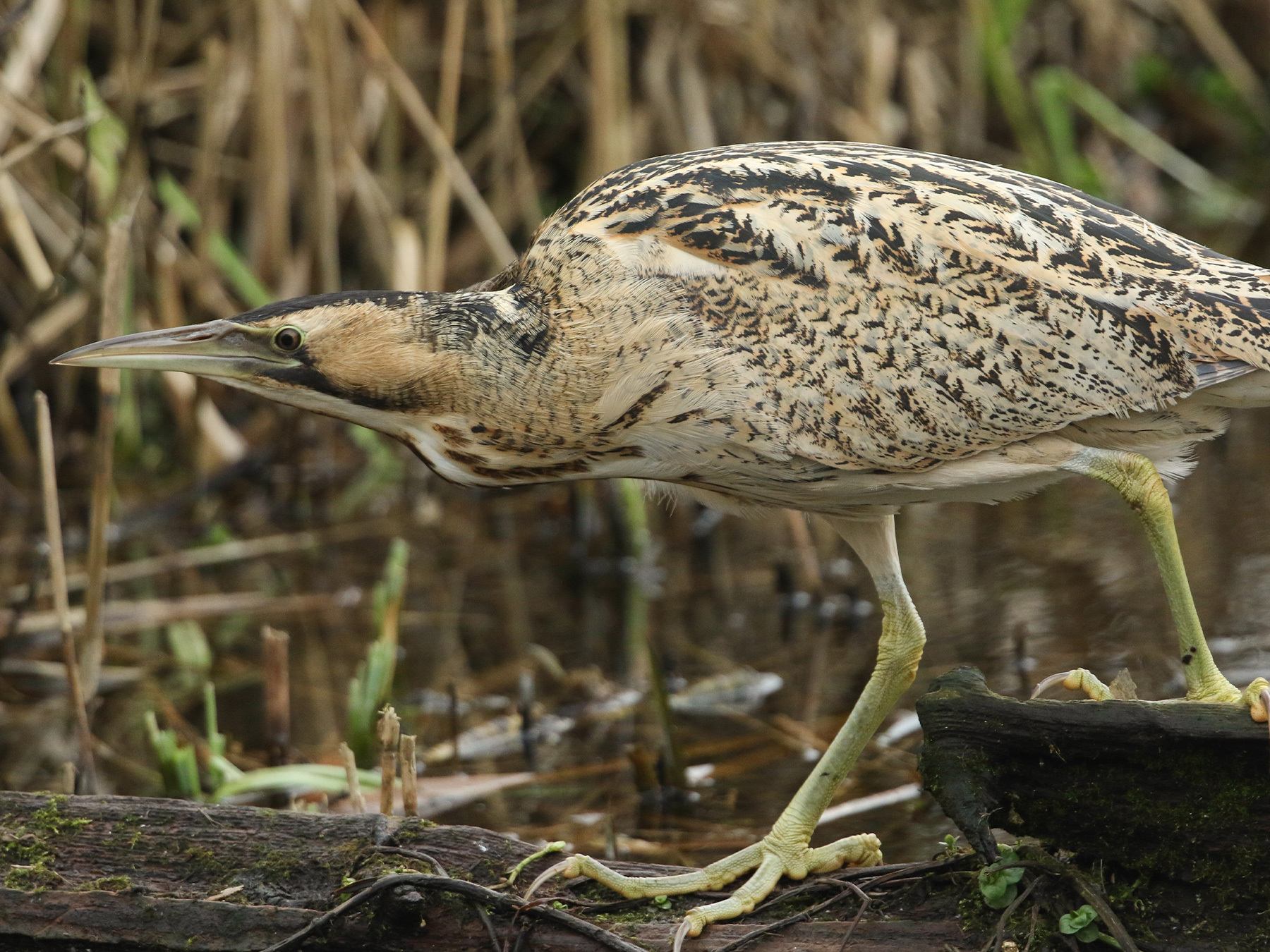
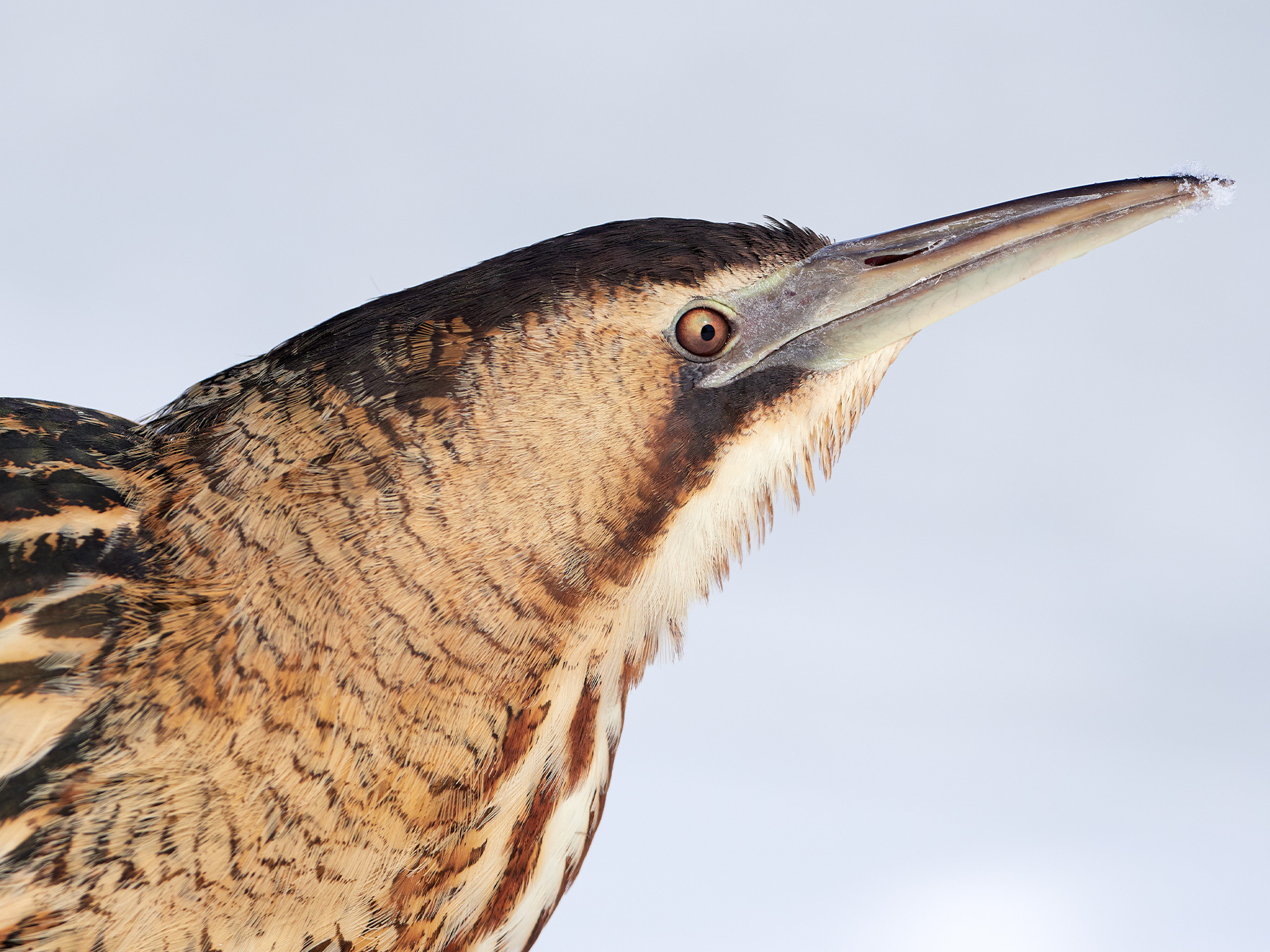
Bitterns are large, stocky herons with buff-coloured plumage broken by dark, bold streaks and faint barring. Their most distinctive features are a dark cap and stripe from the bill to their throat. They have short but seemingly oversized yellow legs and feet, straight, pale beaks and small eyes.
Female Bitterns are difficult to distinguish from males, although they are generally smaller. During the breeding season, males develop light blue lores (the area between the bill and eye), while females have grey lores. Juvenile Bitterns are similar to adults but have paler caps and less heavily streaked backs.
Bitterns are unlikely to be confused with any other UK heron species if seen well.
How big are Bitterns?
The Bittern is a large but compact member of the heron family. They usually appear relatively short-necked but can extend their neck to a surprising length when striking at prey.
Length
Bitterns measure 64 to 80 centimetres in length. Their legs are heavily built and much shorter than other species like the Grey Heron and Little Egret.
Weight
Bitterns weigh anything from 650 grams to just over two kilograms. Males are the heavier sex, and females grow a little over one kilogram (1150 grams).
Wingspan
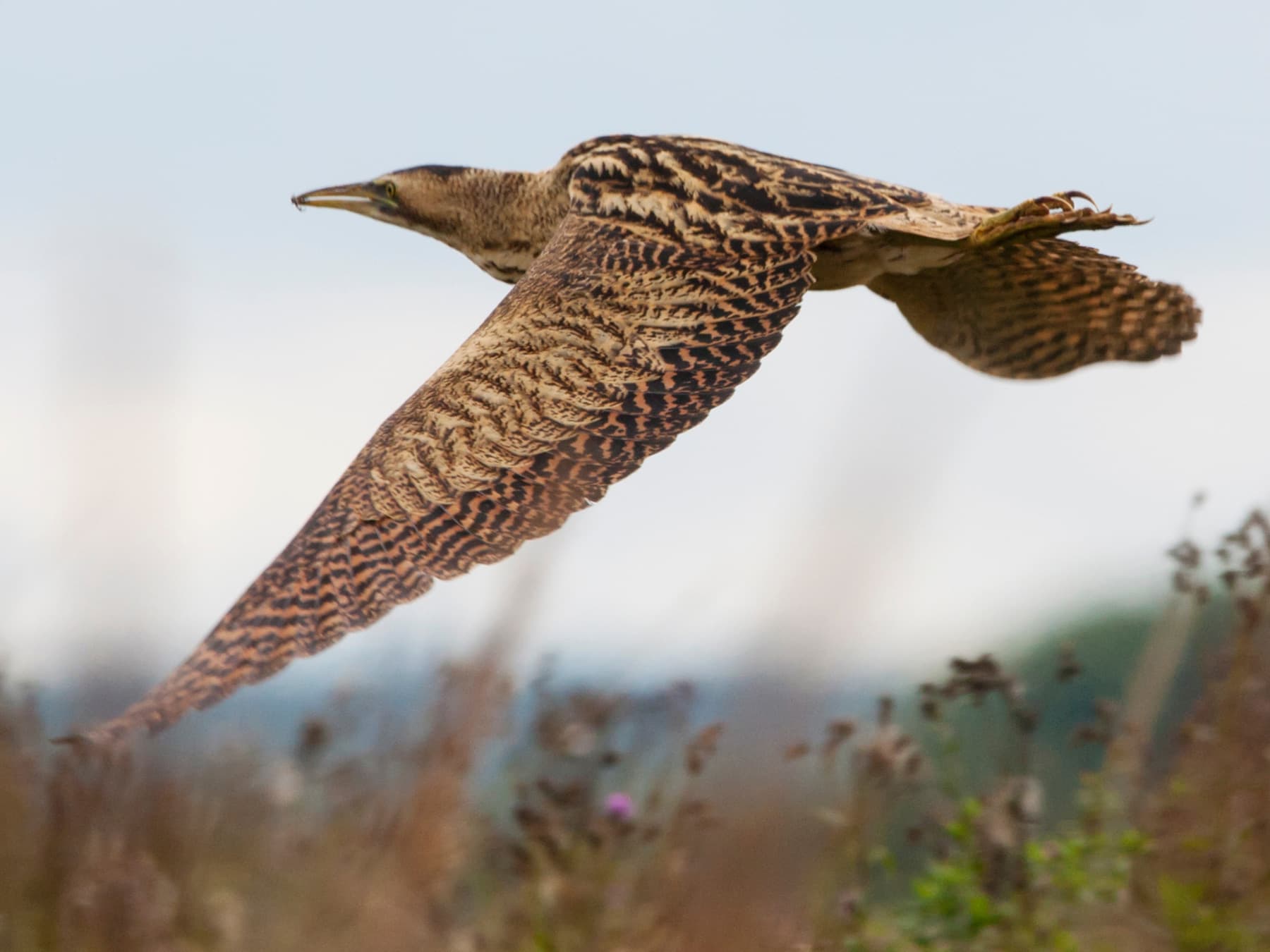
The Bittern has a wingspan of 1.25 to 1.35 meters.
Its size
Adults- Length
- 69–81 cm
- Wingspan
- 100–130 cm
- Weight
- 900–1900 g
Its song and calls
What sound does a Bittern make?
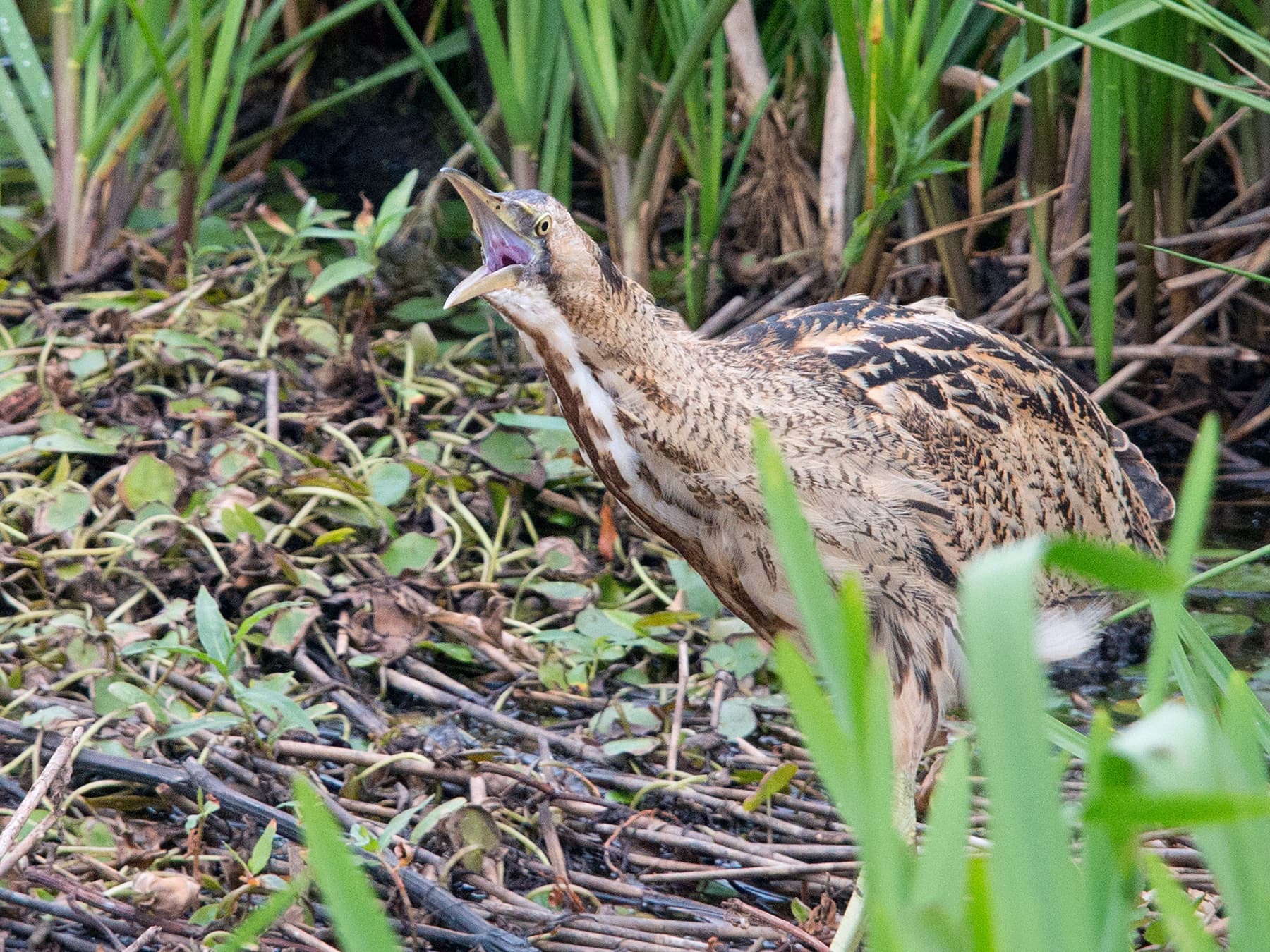
The Bittern produces a unique booming call unlike any other you are likely to hear in the United Kingdom. The call usually consists of two to four low-pitched notes repeated at intervals of a second or two. They also make softer contact calls and a single noted ‘Kaa’ flight call.
Do Bitterns boom all year round?
Bitterns boom most frequently in the spring breeding season, although some males begin as early as late January. They are most vocal between April and June.
How far can you hear Bitterns?
The Bittern’s booming call can be heard from three to five kilometres (up to three miles) away in settled conditions. The best time to listen for this impressive call is often in the quiet hour of dawn.
How loud is a Bittern?
Bitterns are one of the world’s loudest birds and are considered the loudest species in the United Kingdom. Their far-carrying call serves to advertise their territory to potential partners and defend it against other males.
- Song0:00 / 0:12
Recorded in Hauts-de-France, France · May 2022
- Flight call0:00 / 0:15
Recorded in Gelderland, Netherlands · August 2018
When and where to see it
OctoberArriving
Most recorded in October
- 1. Newport0.24%
- 2. South Yorkshire0.24%
- 3. West Yorkshire0.17%
- 4. Suffolk0.10%
- 5. Lancashireunder 0.1%
Each dot is a county, state or province: the bigger and darker, the larger the bird’s share of that place’s bird records that month. Grey dots: no regular records. The ringed point is the centre of the bird’s records this month; the arrow shows how it moved since last month, and the dashed loop its path through the year. “Arrivals” colours places where it becomes regular this month (orange) or is in its last regular month (grey). GBIF eBird Observation Dataset, 2019–2024. Map data: Natural Earth, US Census Bureau; place centres © OpenStreetMap contributors.
In your area
See when the Eurasian Bittern is recorded in your county, state or province.
How often the Eurasian Bittern turns up in the UK through the year, from birdwatchers' records.
United Kingdom
Resident · all year · most records in May
Show as a table
| Month | United Kingdom |
|---|---|
| January | 0.030% (regular) |
| February | 0.033% (regular) |
| March | 0.052% (regular) |
| April | 0.087% (regular) |
| May | 0.11% (regular) |
| June | 0.080% (regular) |
| July | 0.043% (regular) |
| August | 0.028% (regular) |
| September | 0.020% (regular) |
| October | 0.024% (regular) |
| November | 0.024% (regular) |
| December | 0.024% (regular) |
Recorded regularly in
Worldwide: recorded regularly in 60 countries
Countries where it was recorded in at least 3 of the 6 years 2019–2024. Linked countries have their own bird list.
Europe (35)
Africa (3)
Data: EOD – eBird Observation Dataset (Cornell Lab of Ornithology), accessed via GBIF.org, CC BY 4.0. Records from 2019–2024, aggregated and filtered by Birdfact. How these lists are made
What is the habitat of a Bittern?
Bitterns are restricted to fresh and brackish water wetlands. They require dense flooded Phragmites (Common Reed) reedbeds for nesting with small open areas where they can hunt for fish. They occupy various lowland wetlands in the non-breeding season.
What is the range of a Bittern?
The Bittern breeds in scattered wetlands across England, particularly in Kent, East Anglia, Somerset, Lancashire, and Yorkshire. They are more widespread in winter when non-breeding birds may be seen in suitable habits in much of England, parts of Wales and eastern Scotland.
Where do Bitterns live?
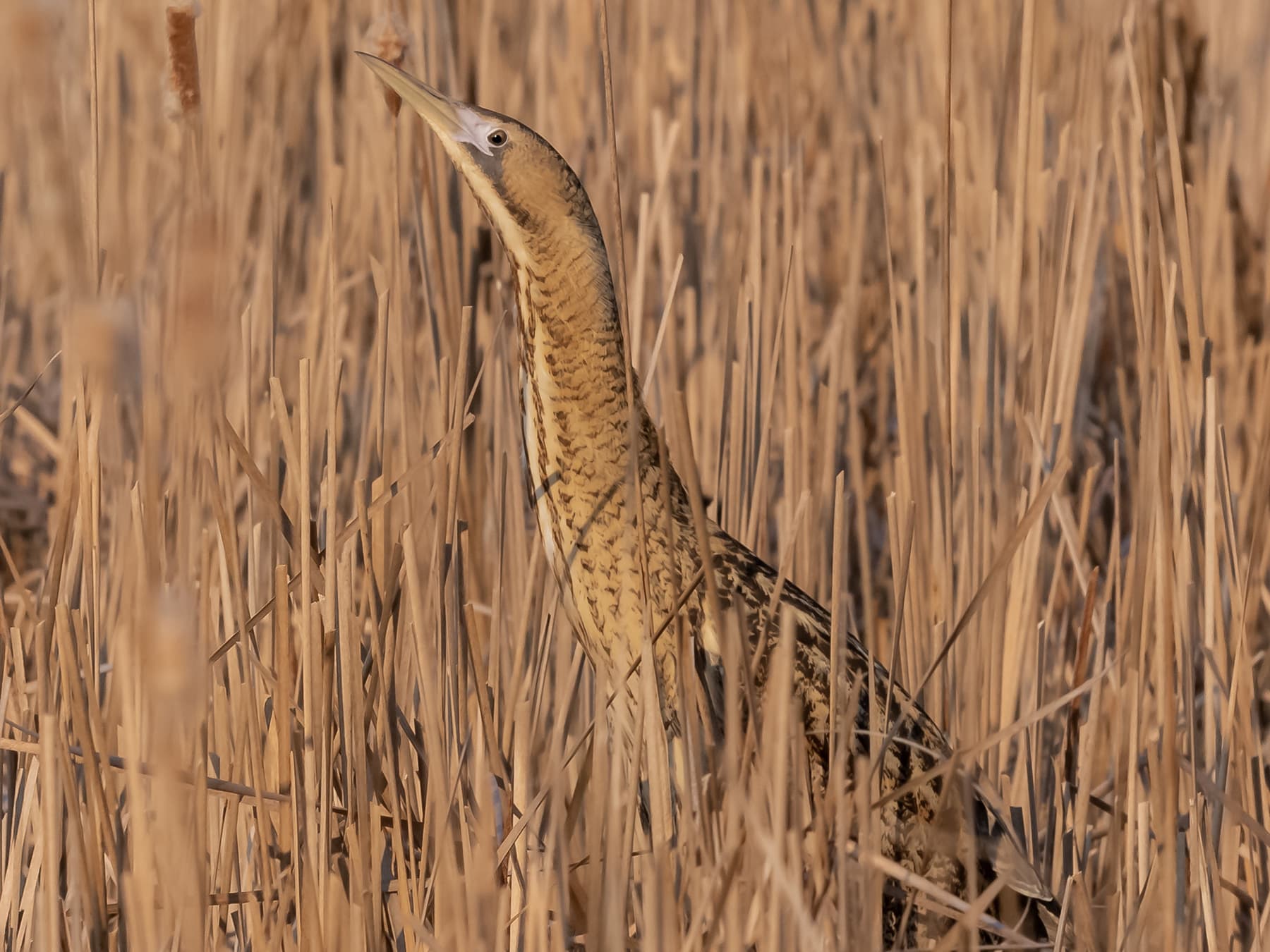
Bitterns spend most of their lives stalking through reedbeds. They are shy birds that rarely fly for long distances or perch in conspicuous places. Bitterns can swim well, although they prefer to walk on matted reeds or through shallow water.
How rare are Bitterns?
Bitterns are rare in the United Kingdom, with an estimated breeding population of about 227 pairs in 2019. However, these low numbers represent a conservation success story since their recovery from local extinction in the 1800s.
Bitterns returned to breed in the UK in the early 1900s but struggled to establish themselves and dropped to just 11 calling males in the 1990s. They have rebounded in the last decade or so, and their numbers continue to rise.
Where can you see Bitterns in the UK?
Despite their growing population, Bitterns remain a very challenging target for UK birdwatchers. They are shy and blend in perfectly among the dry brown reeds where they live. Visit wetlands at the following sites for your best chance of a sighting:
- RSPB Minsmere in Suffolk
- The Great Fen in Cambridgeshire
- Leighton Moss in Lancashire
- RSPB Ham Wall in Somerset
- Newport Wetlands, Wales
- RSPB St. Aidan’s, West Yorkshire
Migration
Do Bitterns migrate?
Bitterns are sedentary in the United Kingdom. However, populations in continental Europe and Asia are migratory, and some birds from countries like Sweden, the Netherlands, Belgium, and Germany overwinter in the UK.
Are Bitterns native to the UK?
Bitterns are native to the United Kingdom. They were extinct as a breeding species for a few decades around the late 1800s but have since recolonised, and their population continues to grow.
Tips for seeing it
- Listen for the male's distinctive booming call in spring, especially at dawn and dusk
- Scan reedbeds carefully, looking for slight movements or the distinctive shape of a bittern's head and bill
- Visit wetland reserves with viewing platforms for better chances of spotting this elusive bird
- In the UK, try sites like RSPB Minsmere or Leighton Moss for Bittern sightings
What it eats
What do Bitterns eat?
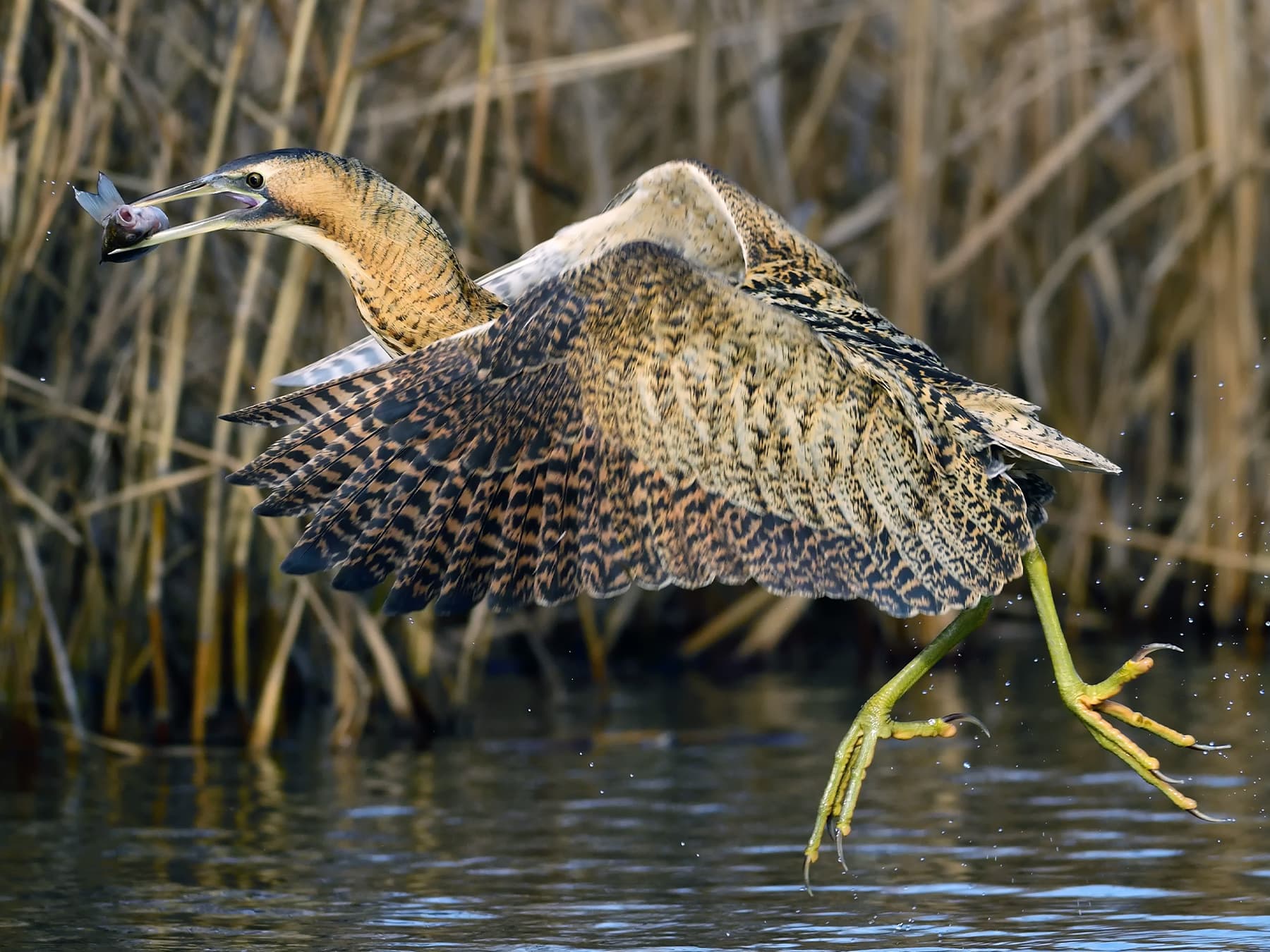
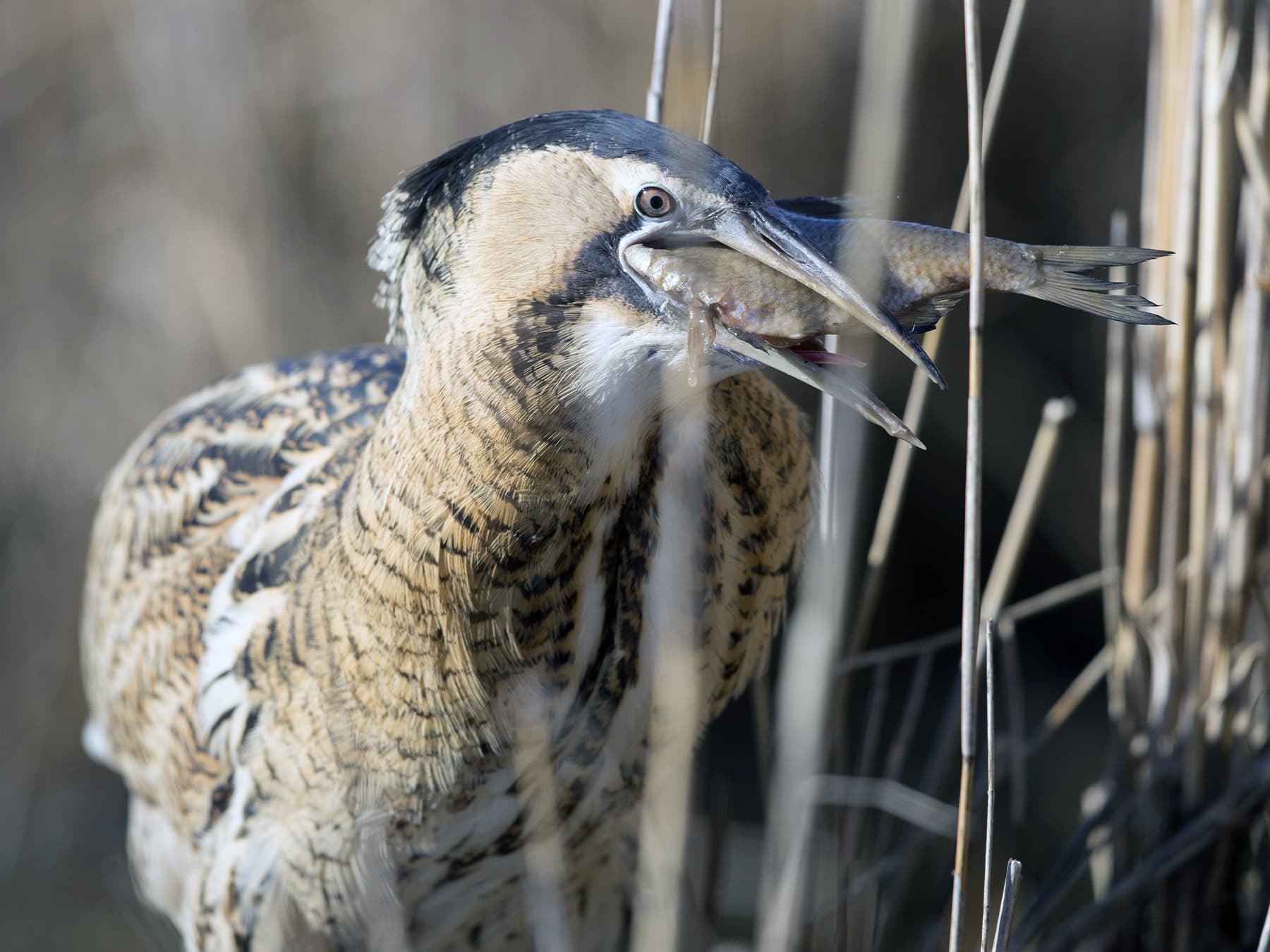
Bitterns are carnivorous birds. Eels and other fish are their principal prey, although they also hunt for frogs, insects, rodents, reptiles and small birds in and around the water. They use their excellent camouflage and a quick strike to catch their target and then swallow it whole.
What do Bittern chicks eat?
Fish is the most important component of the Bittern chick diet, although they also eat other small animals like frogs, birds, and rodents. The female feeds the chicks by regurgitation without the help of the male.
Nesting and breeding
Where do Bitterns nest?
Female Bitterns build their nests among standing reeds in flooded wetlands. The nest is a round platform of reed stems arranged just above the water line.
When do Bitterns nest?
Bitterns nest in the spring and early summer in the United Kingdom, from April to June. These birds are ready to breed at a year old and produce a single brood each nesting season.
What do Bittern eggs look like?
Bitterns usually produce four or five olive-brown eggs, each measuring approximately 53 millimetres long and 38 millimetres wide.
Do Bitterns mate for life?
Bitterns do not mate for life. Some pairs are monogamous, but often a single male with a prime territory will mate with several females in a single season.
Behaviour
Are Bitterns aggressive?
Bitterns are generally solitary creatures. The males are highly territorial and will engage in vicious fights to defend areas from two to fifty hectares. These powerful birds have sharp bills, and these disputes may be fatal.
Where do Bitterns sleep at night?
Bitterns may be active at any time of day or night. They sleep among reeds and other wetland vegetation.
Lifespan and predators
How long do Bitterns live?
Bitterns can live for over eleven years, although their typical lifespan is probably closer to four. These are rare and elusive birds, so accurate measures of their longevity are difficult.
What are the predators of Bitterns?
Adult Bitterns have few predators, although their eggs and chicks could fall prey to a variety of predators, including mink, fox, and Marsh Harrier.
Are Bitterns protected?
Bitterns in the United Kingdom are protected by the Wildlife and Countryside Act 1981.
Are Bitterns endangered?
Bitterns are rare and localised in the United Kingdom, but they are not endangered. These elusive waterbirds have a wide distribution range on three continents and are assessed as a ‘Least Concern’ species on the IUCN Red List.
Conservation
While listed as Least Concern globally, Bitterns have faced significant declines in parts of their range due to wetland drainage and habitat loss.
Conservation efforts, particularly in the UK and Europe, focus on restoring and managing reedbed habitats. These initiatives have led to local population recoveries, highlighting the importance of wetland preservation for this species.
More photos
4 photos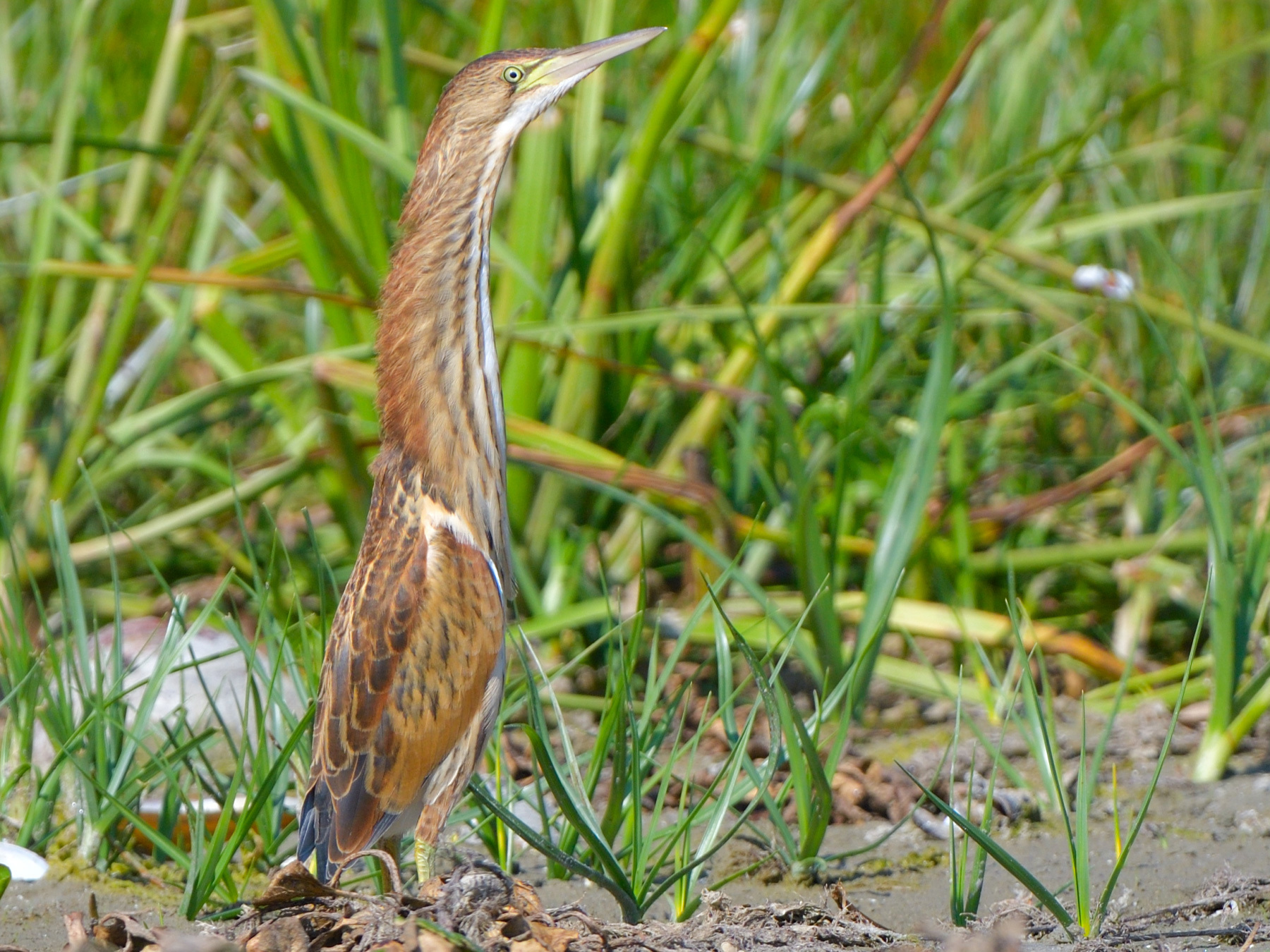
Eurasian Bittern guides
1 guidesQuick facts
- Length
- 69–81 cm
- Wingspan
- 100–130 cm
- Weight
- 900–1900 g
- Lifespan
- 4 years · oldest recorded 11.3 years
- Family
- Herons & Egrets
- Migration
- Partial migrant
- Global status (IUCN)
- Least Concern
- World population
- 115,000 - 340,000 mature individuals
- Population trend
- Decreasing
- Also called
- Bittern, Great Bittern
- Scientific name
- Botaurus stellaris
Questions
3Are there Bitterns in Scotland?
Bitterns are rare visitors to Scotland. They do not nest there, but it is hoped that their breeding range may expand northwards in time.
What is the best time of day to see Bitterns?
The low light of dawn and dusk provide the best chance of spotting the Bittern. These shy birds rarely break cover and generally fly for short distances, dropping quickly out of sight.
Do Bitterns call at night?
The Bittern’s booming call can be heard by day or night, although their ‘Kaa’ flight call is more likely to be heard after dark.
Sources
4- 1BirdLife International. 2016. Botaurus stellaris. The IUCN Red List of Threatened Species 2016: e.T22697346A86438000. Source (opens in a new tab)
- 2BirdLife International. 2016. Botaurus stellaris. The IUCN Red List of Threatened Species 2016: e.T22697346A86438000. Source (opens in a new tab)
- 3Wetlands International (2015)
- 4Fransson et al., EURING list of longevity records for European birds (2010) Source (opens in a new tab)

Checked by
Nathan Cope, founder and editor
Nathan founded Birdfact and leads its writers and contributors in the UK, the US and Canada. He has watched and studied birds for more than ten years, and checks every article and species guide before it’s published.