


Alpine Chough
Yellow-billed Chough · Pyrrhocorax graculus
By the Birdfact teamChecked by Nathan Cope
On this page20 sections
- How to recognise it
- Its size
- Its song and calls
- When and where to see it
- What it eats
- Nesting and breeding
- Behaviour
- Lifespan and predators
- Conservation
- What does an Alpine Chough look like?
- How big is an Alpine Chough?
- How much does an Alpine Chough weigh?
- What is the scientific name for an Alpine Chough?
- How do you pronounce Alpine Chough?
- Are Alpine Choughs endangered?
- Do Alpine Choughs mate for life?
- Similar birds
- More photos
- Quick facts
- Sources
How to recognise it
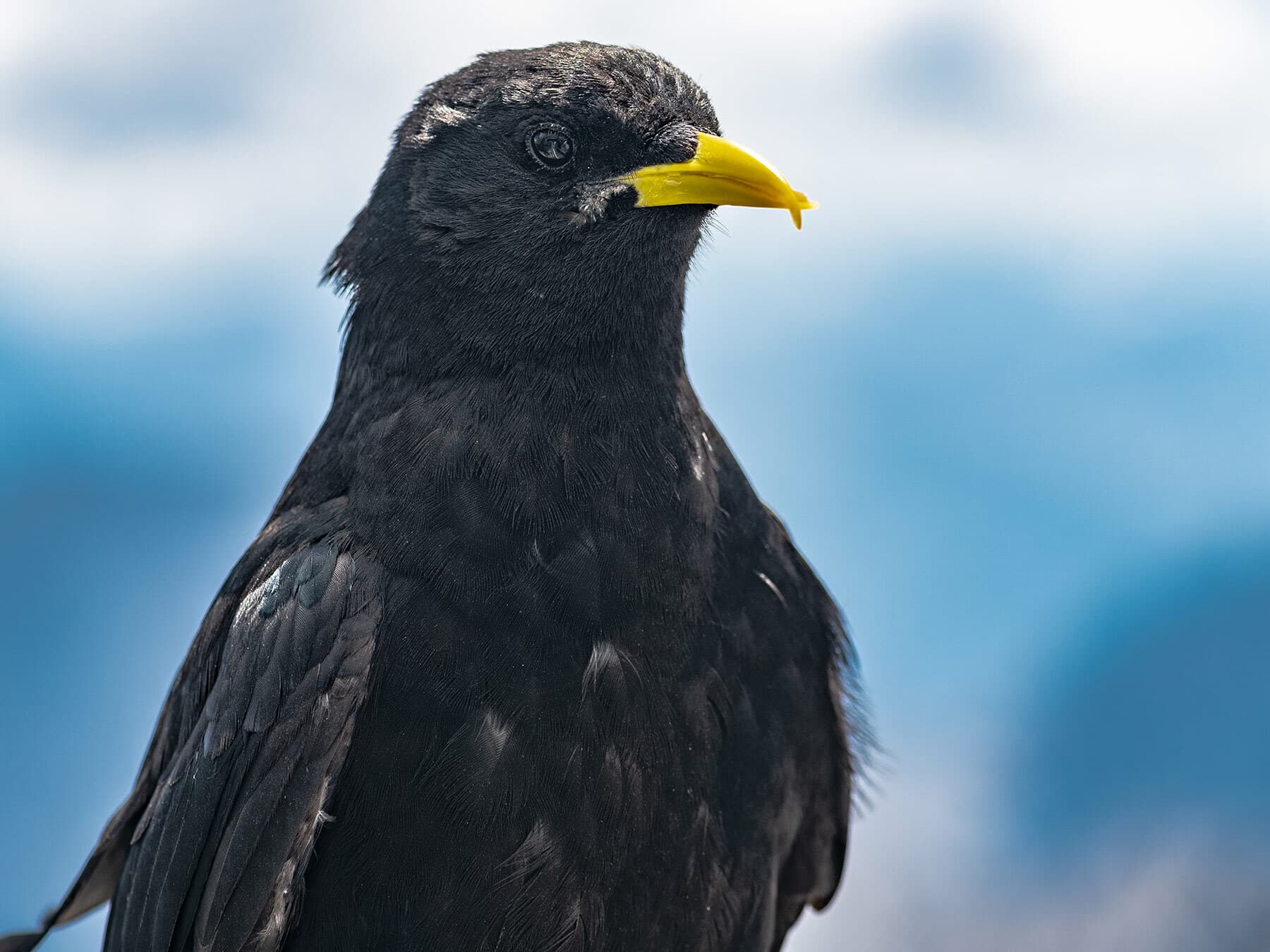
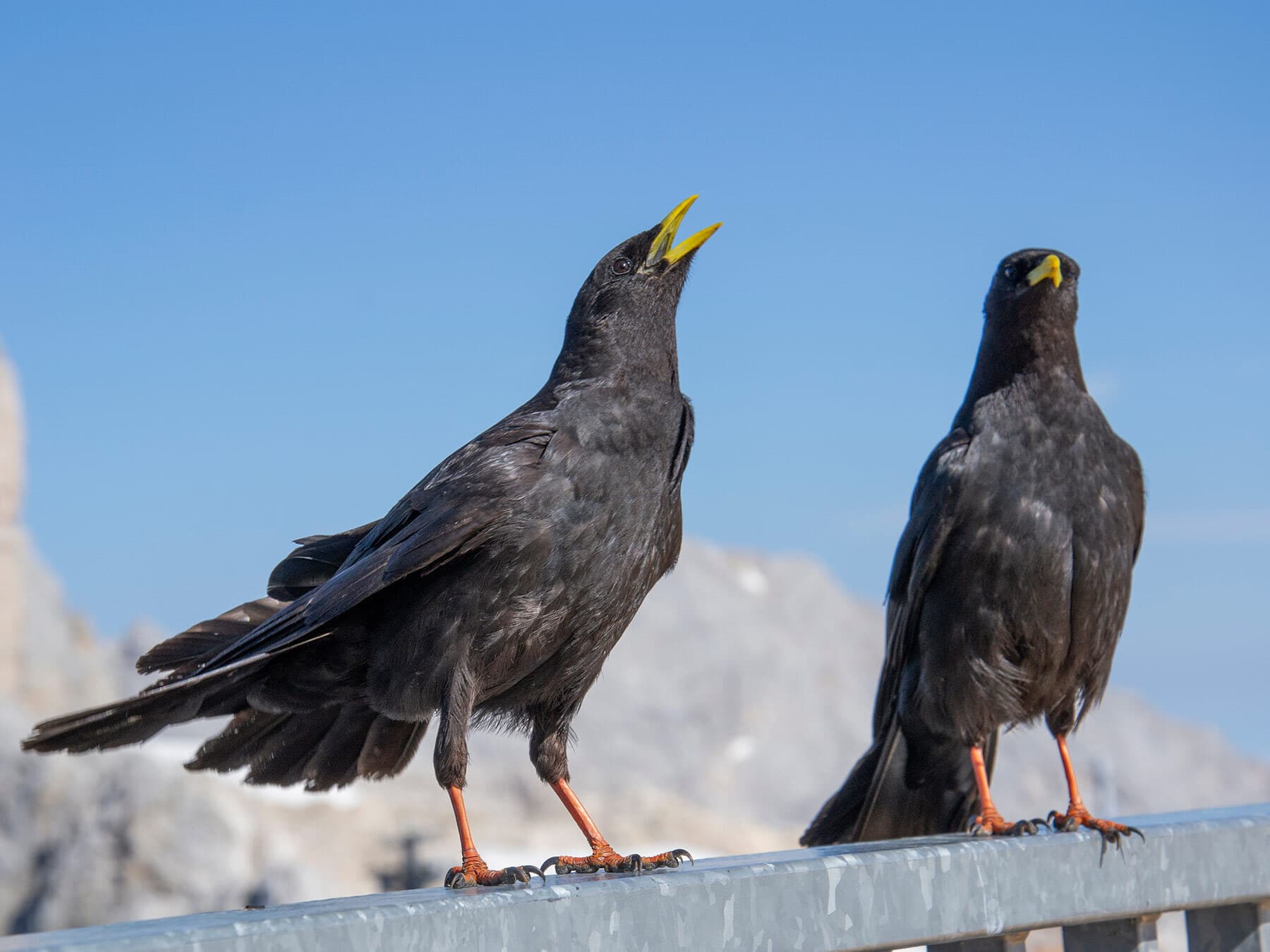
The Alpine Chough is a medium-sized corvid with glossy black plumage that shimmers with a blue-green iridescence in sunlight. Its most striking features are its curved, bright yellow bill and vivid red legs, which contrast sharply with its dark body.
Both males and females share identical plumage, although males are slightly larger. There is no seasonal variation in plumage. Juveniles resemble adults but have duller plumage and paler yellow bills, gradually developing adult colouration over their first year.
Its size
Adults- Length
- 36–39 cm
- Wingspan
- 75–85 cm
- Weight
- 190–250 g
Its song and calls
The call is not like other corvids at all and that makes it distinctive. The main call is a 'preeep' with a descending whistling 'sweeeooo' sound. A harsh 'churr' sound is also often given.
The song is a subdued warbling, which is mainly when birds are resting or feeding together.
- Flight call0:00 / 0:19
Recorded in Valle d'Aosta, Italy · September 2019
When and where to see it
The Alpine Chough is not recorded regularly in the UK, Ireland, the United States or Canada.
Worldwide: recorded regularly in 34 countries
Countries where it was recorded in at least 3 of the 6 years 2019–2024. Linked countries have their own bird list.
Europe (18)
- Albania
- Andorra
- Austria
- Bosnia & Herzegovina
- Bulgaria
- Croatia
- France
- Germany
- Greece
- Italy
- Liechtenstein
- Montenegro
- North Macedonia
- Russia
- Serbia
- Slovenia
- Spain
- Switzerland
Africa (1)
Asia (15)
- Armenia
- Azerbaijan
- Bhutan
- China
- Georgia
- India
- Iran
- Kazakhstan
- Kyrgyzstan
- Lebanon
- Mongolia
- Nepal
- Pakistan
- Tajikistan
- Turkey
Data: EOD – eBird Observation Dataset (Cornell Lab of Ornithology), accessed via GBIF.org, CC BY 4.0. Records from 2019–2024, aggregated and filtered by Birdfact. How these lists are made
Alpine Choughs build nests in quite a few different habitats. These include shelves or ledges at the top of caves, cliff faces, roof spaces of abandoned buildings and occasionally mine-shafts.
Both the male and female build the nests. Males will generally gather the materials and bring them back to the female, who then constructs the nest. Sometimes, youngsters from a previous brood will assist with nest building.
The nests are made from a mixture of sticks and roots, with linings of moss, feathers and grass. Mostly a solitary nester, but in areas with high population density, loose flocks are formed.
What is the habitat of an Alpine Chough?
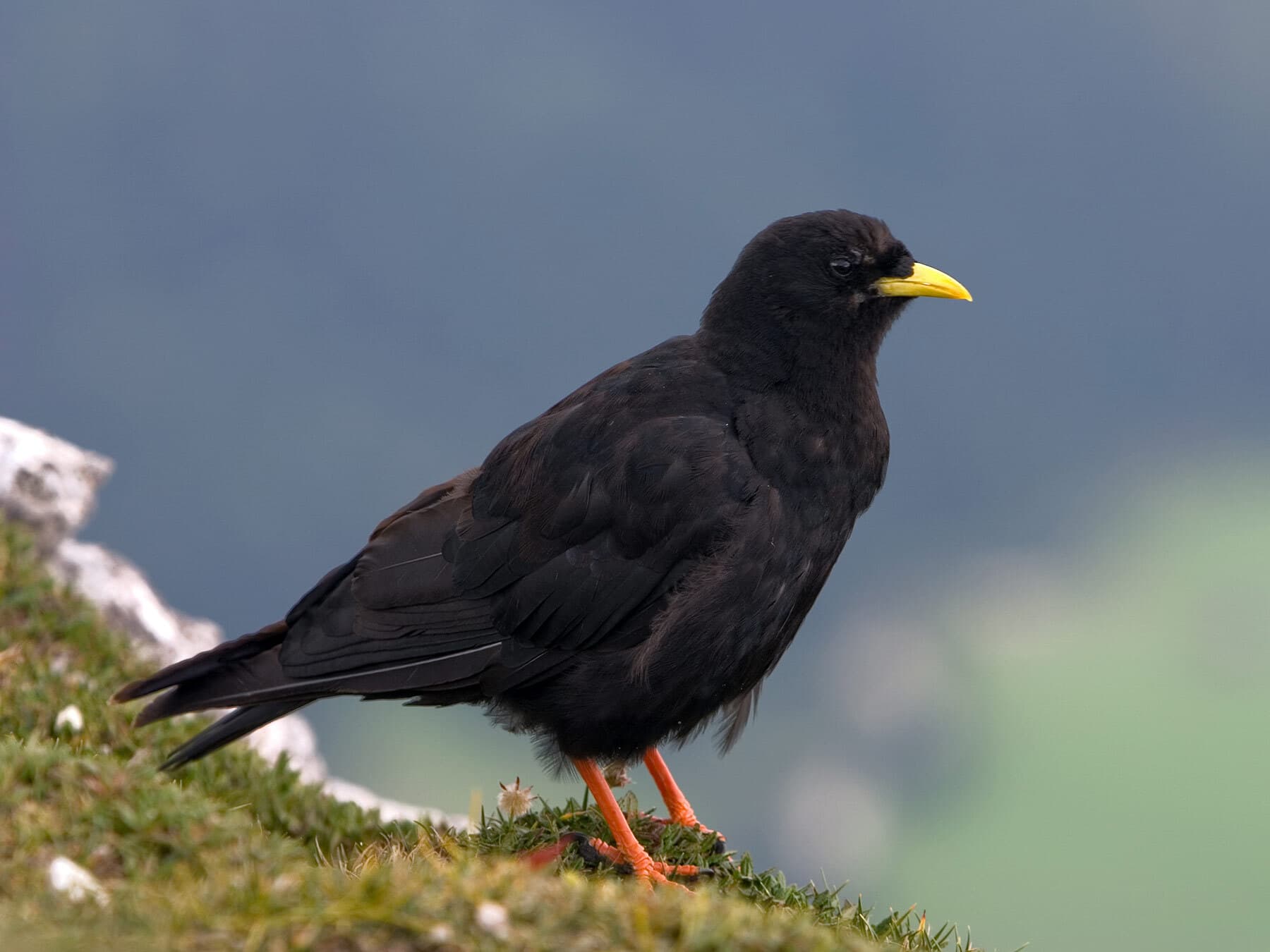
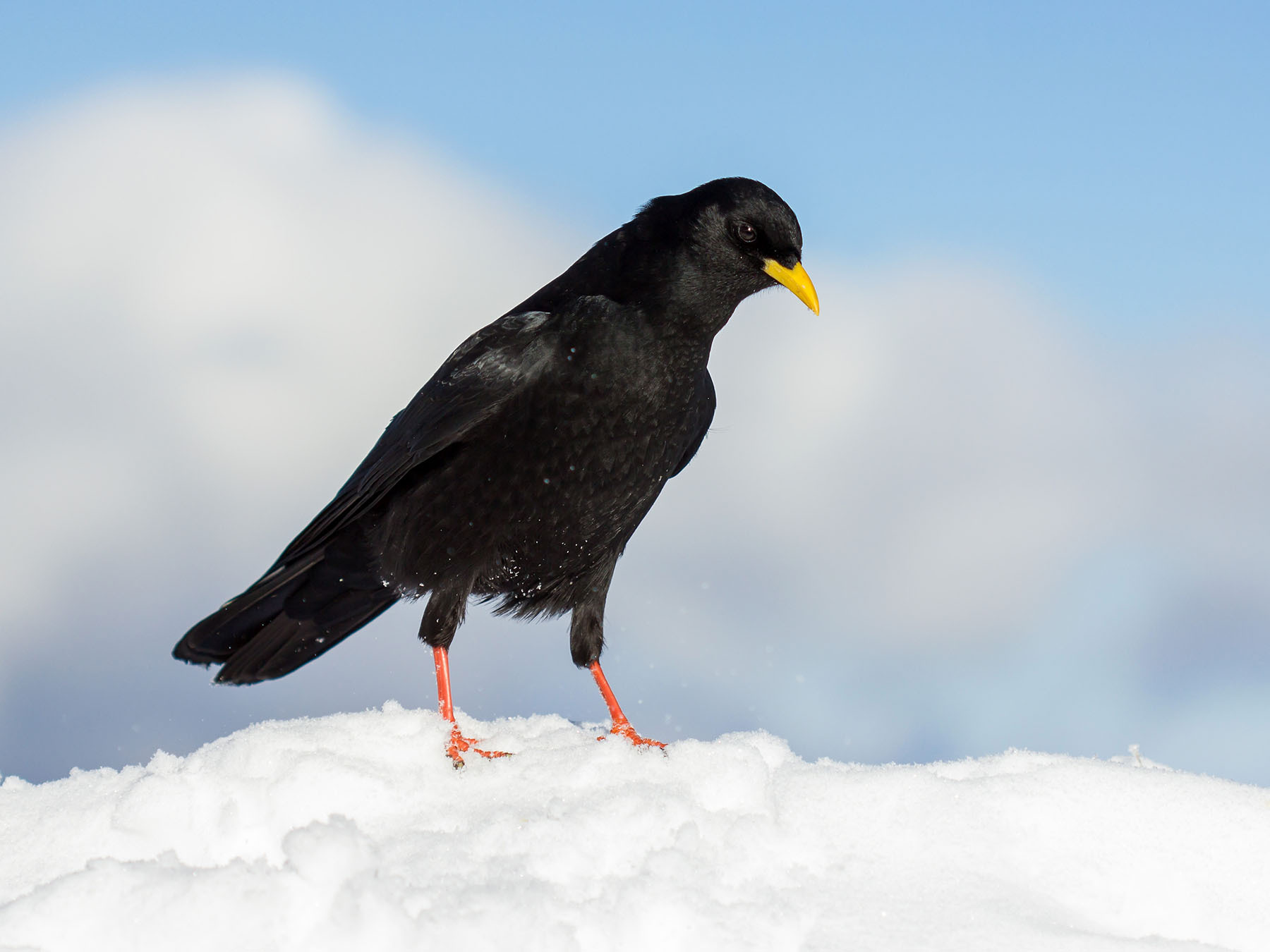
Pastures on high mountains are preferred habitats for these birds, and in winter, they will descend into upper valleys. Ski resorts throughout Europe are suitable habitats, as these birds scavenge the human habitat.
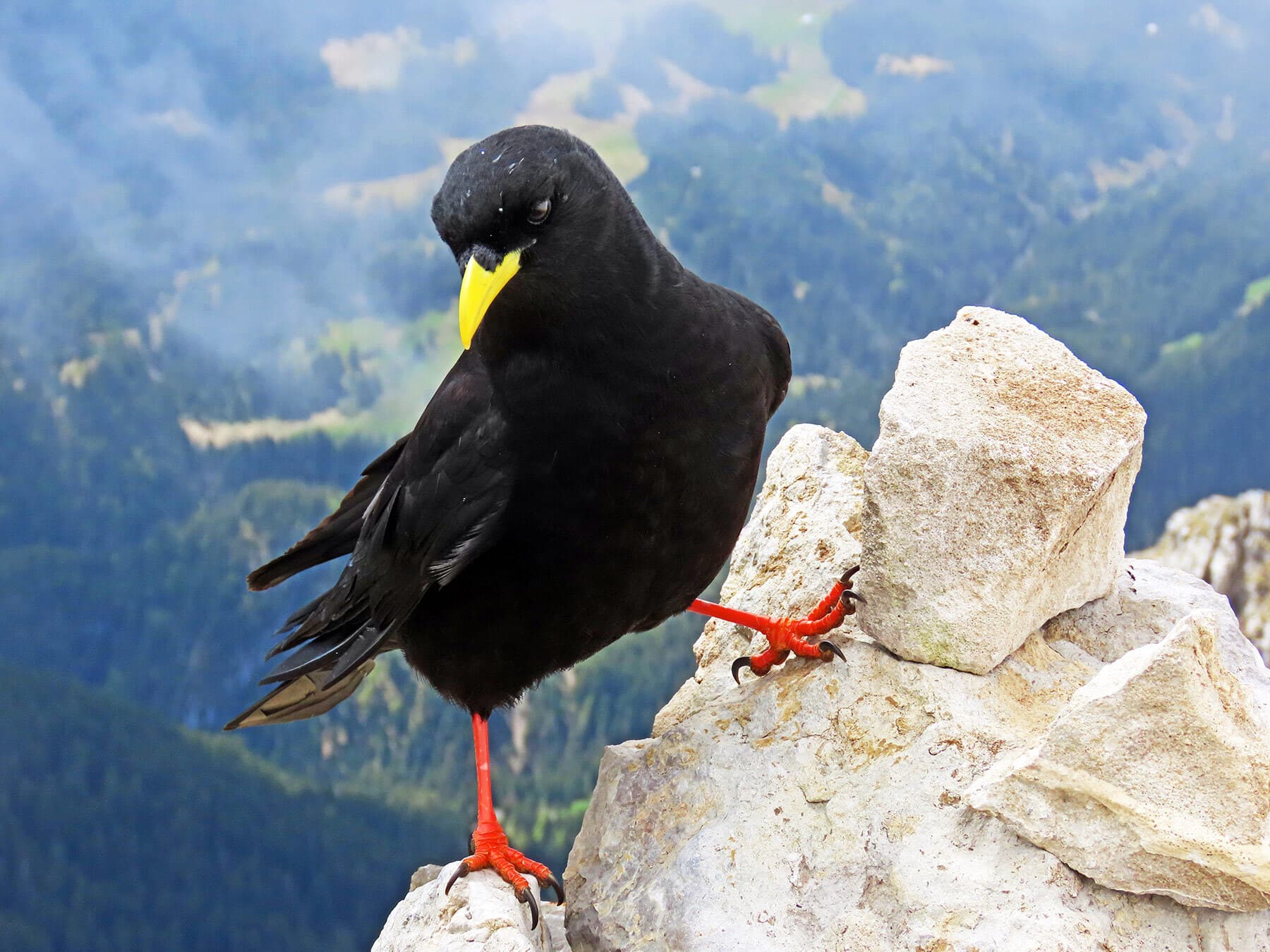
This is mainly at altitudes of over 1200m and up to 2880m in Europe. In the Himalayas, this can be between 3500m and 5000m, and in Nepal, they have been recorded of heights of up to 8300m following climbers.
In ski resorts and towns, alpine choughs can often be seen waiting outside of hotel windows for food. This is an amusing and welcoming sight for guests, but not so much for the hotel owners!
These birds have also been reported to nest at heights of 6500m (21,300 ft), which makes them the highest nesting birds in the world.
Where do Alpine Choughs live?
These birds breed in the mountains of Spain, the Alps and Southern Europe. They also breed in Central Asia and the Himalayas to western parts of China. They can also be found throughout Morocco, Crete and Corsica.
Where can I see Alpine Choughs?
Ski resorts, mountain towns and areas lower down in the valleys are the best places to see these birds during the winter. This is because the birds will move to lower levels once the first snowfall begins to forage during the day before returning up the mountain to roost at night. They do have a habit of following climbers and walkers in the mountains scavenging for food.
During March and April, alpine choughs will frequent villages at the top of valleys before returning to the meadows.
Do Alpine Choughs migrate?
Alpine Choughs are considered mainly sedentary, with their daily movements of up to 20km and 1600m in altitude to lower down feeding areas. After feeding, they return up the mountain to roost.
Ringing studies in Europe have shown that birds generally don't move more than 50km from their natal area.
Tips for seeing it
- Look for them soaring near mountain peaks and along cliff faces
- Listen for their distinctive high-pitched 'preeu' call echoing in alpine valleys
- Observe ski resorts and mountain huts where they may gather for food scraps
- Watch for their acrobatic flight displays, especially during the breeding season
What it eats
In summer, the diet of an Alpine Chough mainly comprises of invertebrates. This includes beetles, snails, grasshoppers, ants, dragonflies and caterpillars. They will also take small amphibians, reptiles, small birds, small rodents and eggs.
The diet becomes more varied during autumn and winter with extensive types of seeds, fruits, and berries. They will travel in flocks to nearby ski resorts and villages in the mountains to scavenge and forage for food before heading back up into the mountains at night to roost. During this, they will often follow walkers in the mountains for scraps. These birds have a particular fondness for sultanas!
Most of the foraging and feeding is done on the ground, and usually in small flocks.
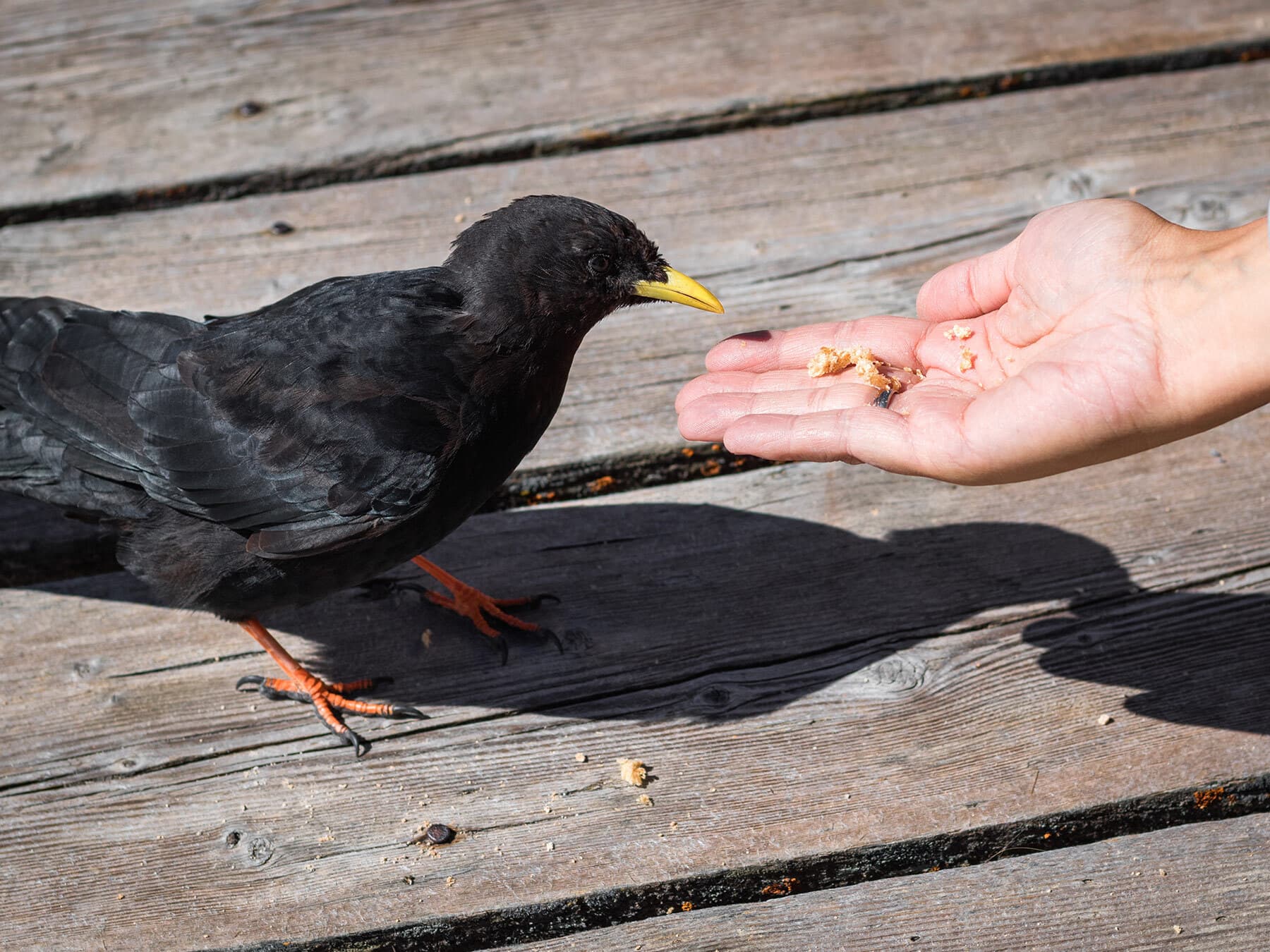
They can even be quite tame and will even take food from the hands of humans occasionally.
Nesting and breeding
Alpine Chough clutches usually contain 4 eggs, but can sometimes be up to 6 eggs in total.
The eggs are incubated by only the female for between 18 and 21 days. During this time, the male will feed the female and occasionally by the helper.
Chicks stay in the nest for around 30 days of age and are fed by both parents.
Egg-laying varies depending on the range, but will usually start in May and finish in mid-June in Europe and Morocco.
What do Alpine Chough eggs look like?
The eggs are mostly a glossy whitish colour and have either buff or light-green speckling. The average size for the eggs is 33.9 x 24.9mm (1.33 x 0.98 in).
Alpine Chough eggs have fewer pores than those of lowland species and therefore lose less water by evaporation at low atmospheric pressure. This makes it possible for these choughs to lay their eggs at higher altitudes than other birds.
Behaviour
Alpine Choughs are highly social birds, often seen in large flocks performing acrobatic aerial displays.
They are known for their playful nature, frequently engaging in aerial games and sliding down snow slopes on their backs. These intelligent birds have also been observed using tools, such as twigs, to probe for insects in tree bark.
Lifespan and predators
The average lifespan for an alpine chough is between 8 and 10 years. However, the maximum recorded age for one of these birds was 19 years.
Conservation
While currently listed as Least Concern, Alpine Choughs face potential threats from climate change. As temperatures rise, their specialised alpine habitat may shrink, potentially impacting food availability and breeding sites.
Conservation efforts focus on monitoring population trends and protecting high-altitude ecosystems.
What does an Alpine Chough look like?
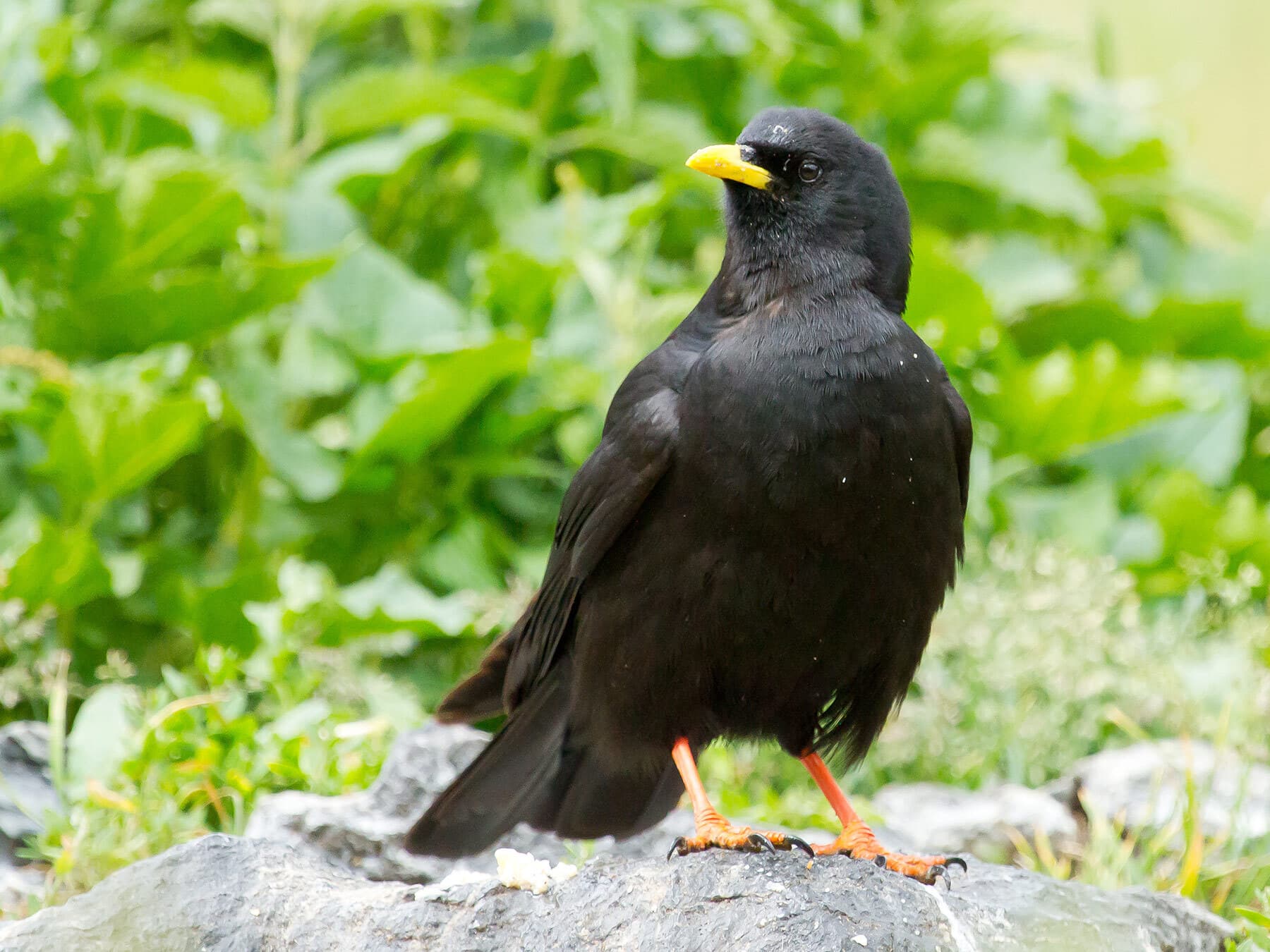
The Alpine Chough, at first glance, has entirely black plumage. Upon closer inspection, you'll notice that the black - mainly the wings and long tails - are more of a glossy bluish-green colour.
The legs are a vibrant red, and the beak is short and bright yellow with a slight downward curve - which is where the name 'Yellow-billed Chough' is derived from. The eyes are dark brown. Both male and females have the same plumage, but males generally are larger.
Recently fledged juveniles have dark black plumages, dark brown or black legs, the bill is dull yellow. Juveniles legs become red during the first winter.
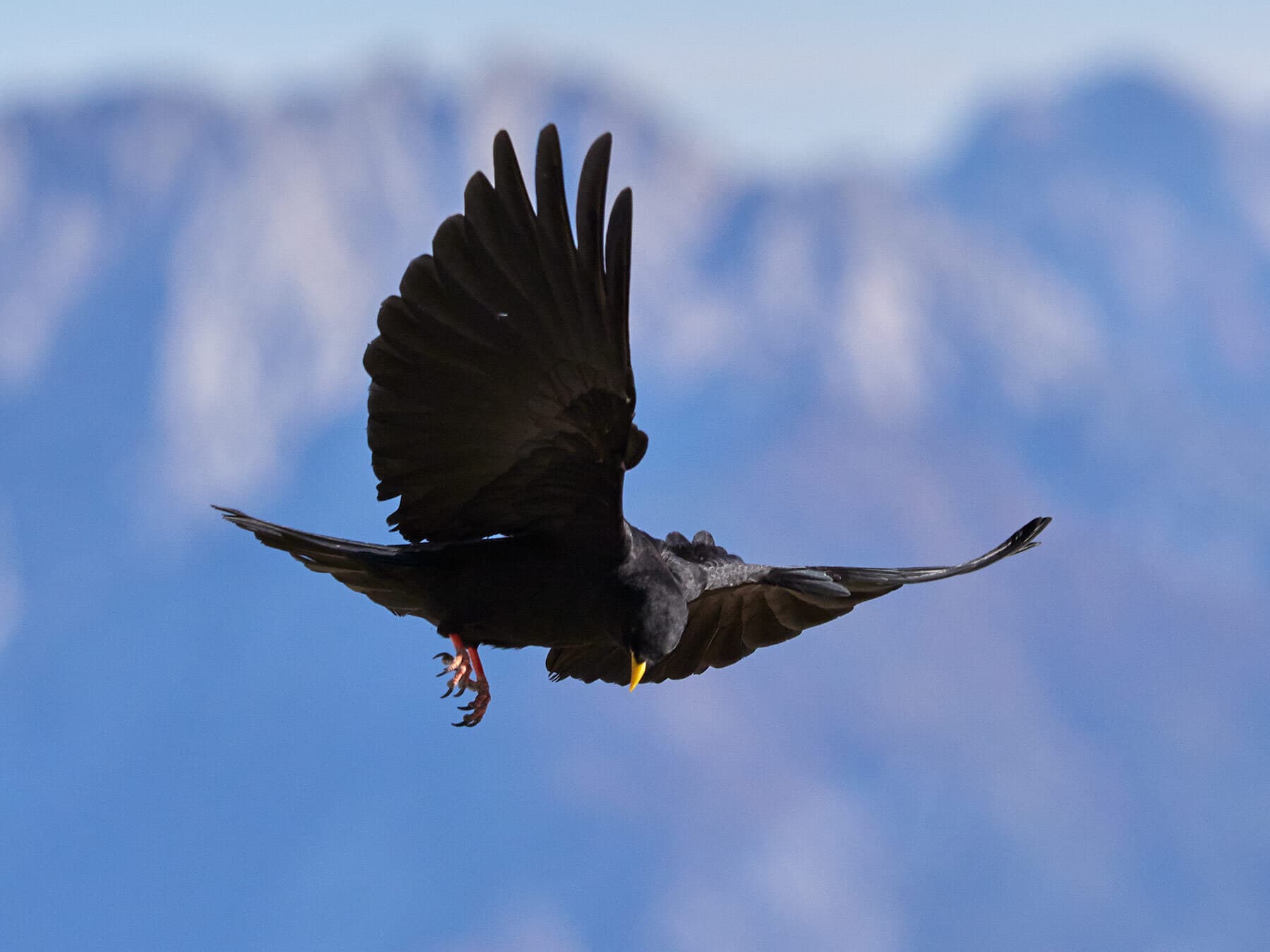
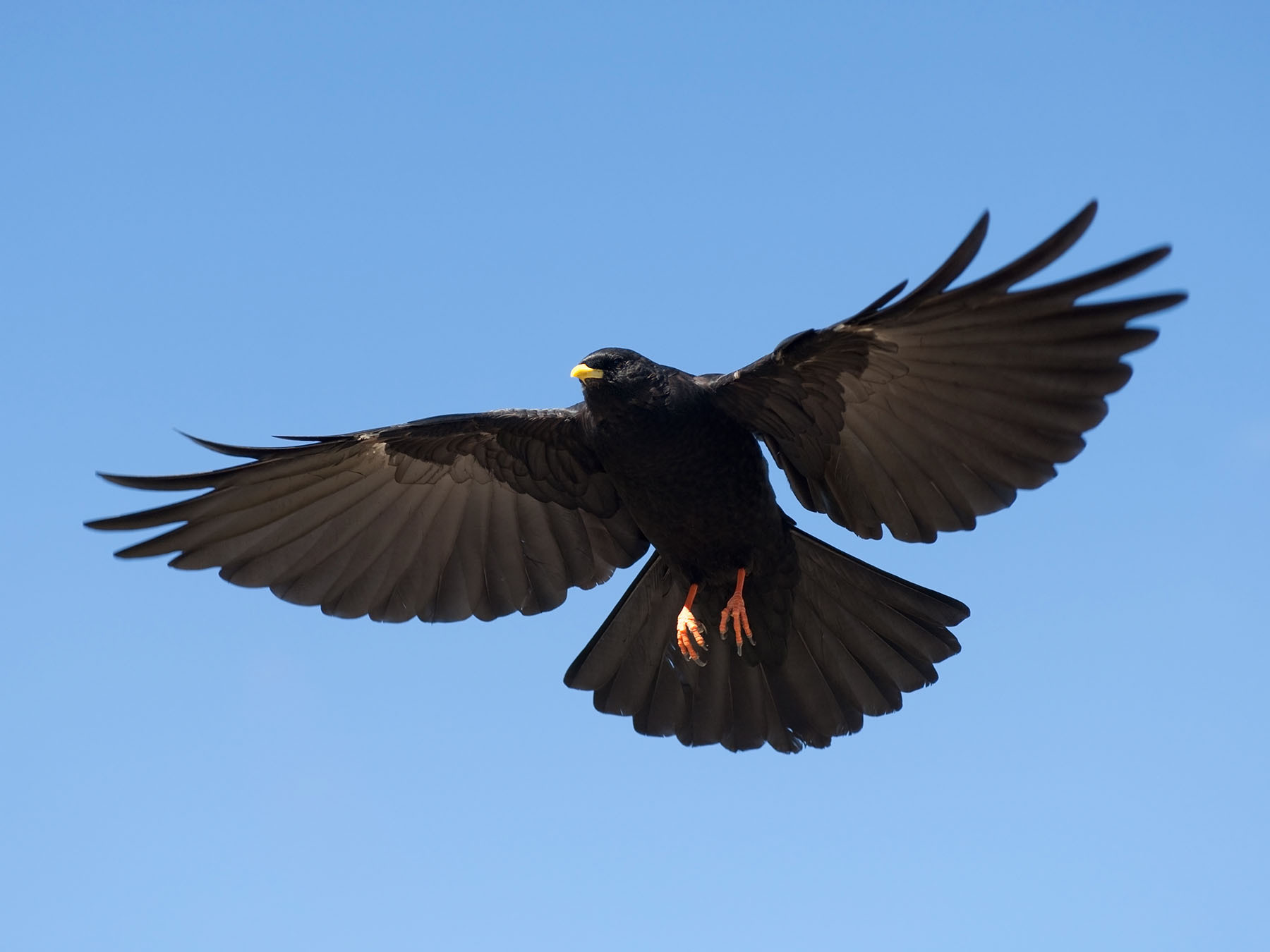
They are acrobatic in flight and can be seen soaring in the updrafts at cliff faces. The high manoeuvrability is accomplished from the fanning of their tails and folding the wings.
They are quite distinguishable from the closely related red-billed chough in flight, as they have less rectangular wings and longer tails - which are also less square.
How big is an Alpine Chough?
The alpine chough is a medium-sized member of the crow family. The total length is usually between 34 and 38cm (13.4 - 15 inches). Their tails are fairly long relative to the size of their bodies between 12 and 14cm (4.7 - 5.5 inches). The wingspan ranges between 75 and 85cm (30 - 33 inches).
How much does an Alpine Chough weigh?
The average weight for a male is between 194 and 277g (6.8 - 9.8 ounces) and females usually slightly smaller at between 160 and 254g (5.6 - 9 ounces).
What is the scientific name for an Alpine Chough?
The scientific name is Pyrrhocorax graculus.
The specific name (second part), graculus, is Latin for 'Jackdaw'.
The genus, Pyrrhocorax, is derived from Greek and translates to 'flame-coloured raven'. This current binomial name was formerly applied to the red-billed chough.
How do you pronounce Alpine Chough?
Most people wonder how to pronounce the second part of the name, Chough. The most common way it is pronounced is as Alpine 'chuff'.
Are Alpine Choughs endangered?
Alpine Choughs are currently not threatened, and therefore they are listed as a species of Least Concern on the Global IUCN List.
The population in Europe is stable, with an estimated population of 48,000 to 96,000 pairs. A staggering 50% of this population can be found across the Alps.
Estimated population by country:
- 17,000 in France
- 10,000 in Spain
- 9,000 in Austria
- 8,000 in Switzerland
- 8,000 in Greece
- 7,000 in Italy
- 6,000 in Croatia
- 2,000 - 4,000 in Germany
- 2,000 in Bulgaria
- 1,000 in Slovenia
- 300 in Albania
Global warming is one of the biggest threats to the Alpine Chough, as, over time, it could cause the preferred Alpine climate to move higher or entirely disappear. Other threats to these birds include heavy metals and pesticides in the mountain soil, heavy rain and shooting.
Natural predators include peregrine falcons, golden eagles and Eurasian eagle-owls. From time to time, common ravens will take the nestlings.
Do Alpine Choughs mate for life?
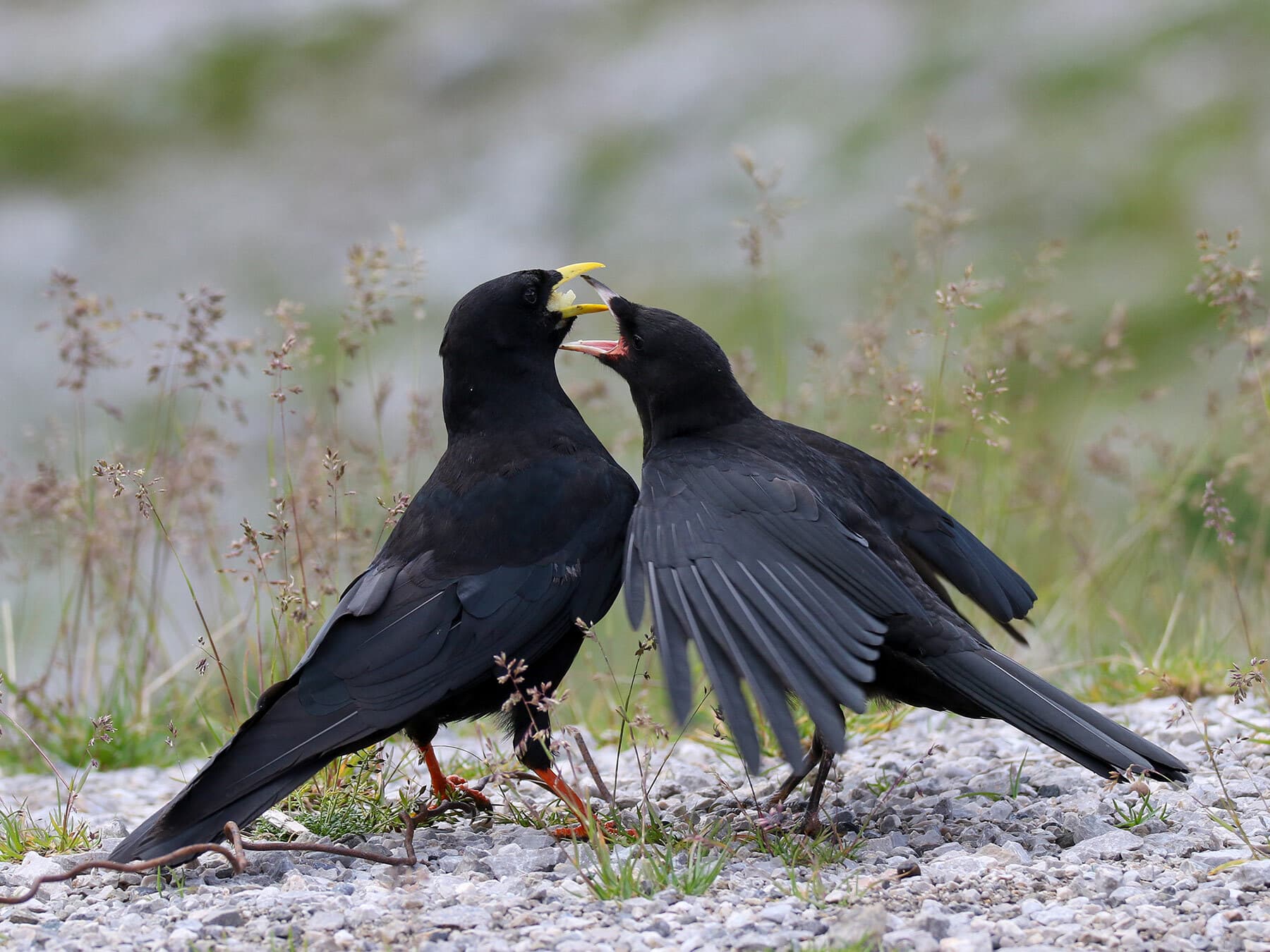
Yes, they are generally lifelong monogamous and will form a pair for life. Pairs usually will stay together throughout the year too.
Similar birds
Often mistaken for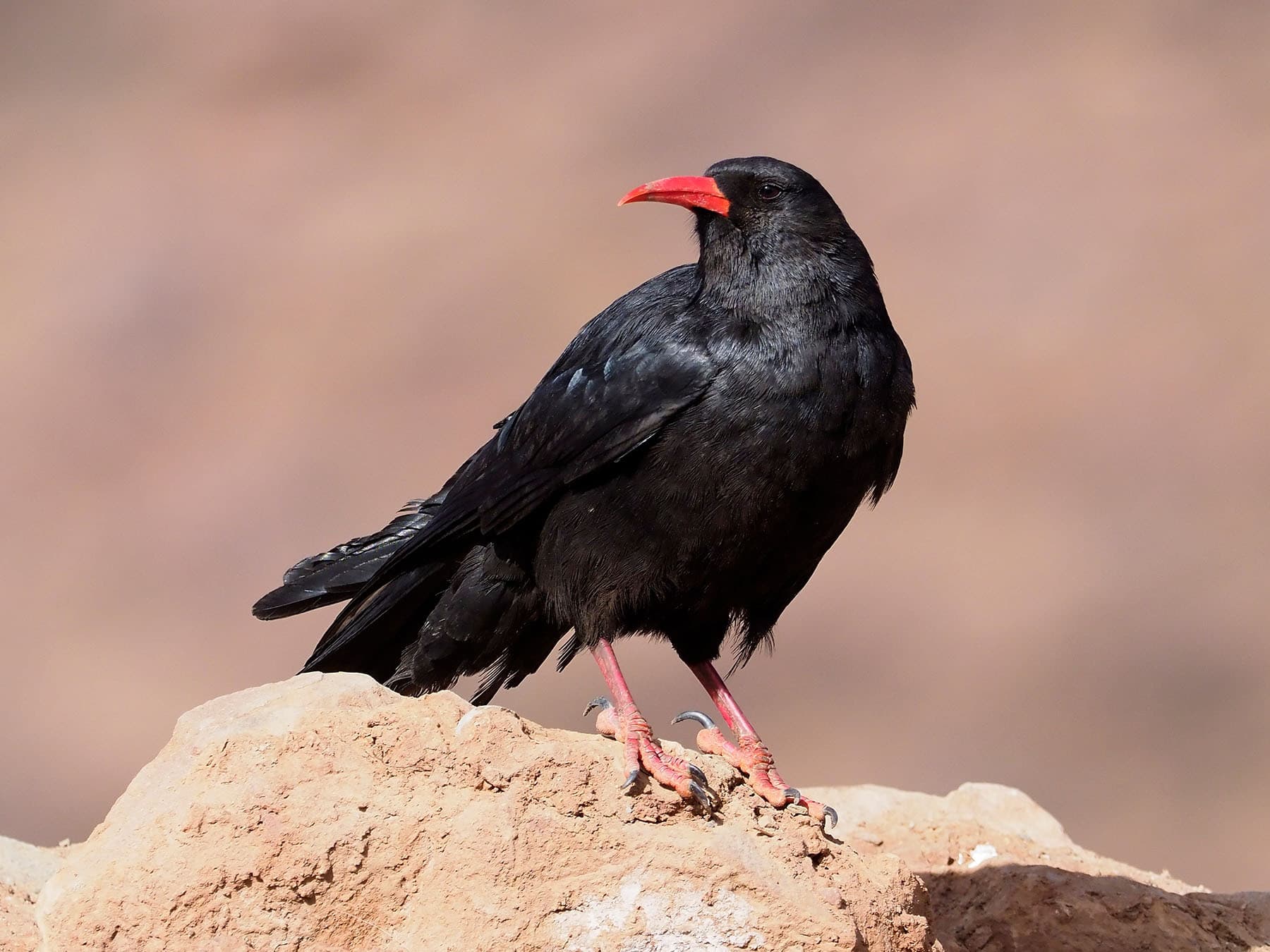
More photos
3 photos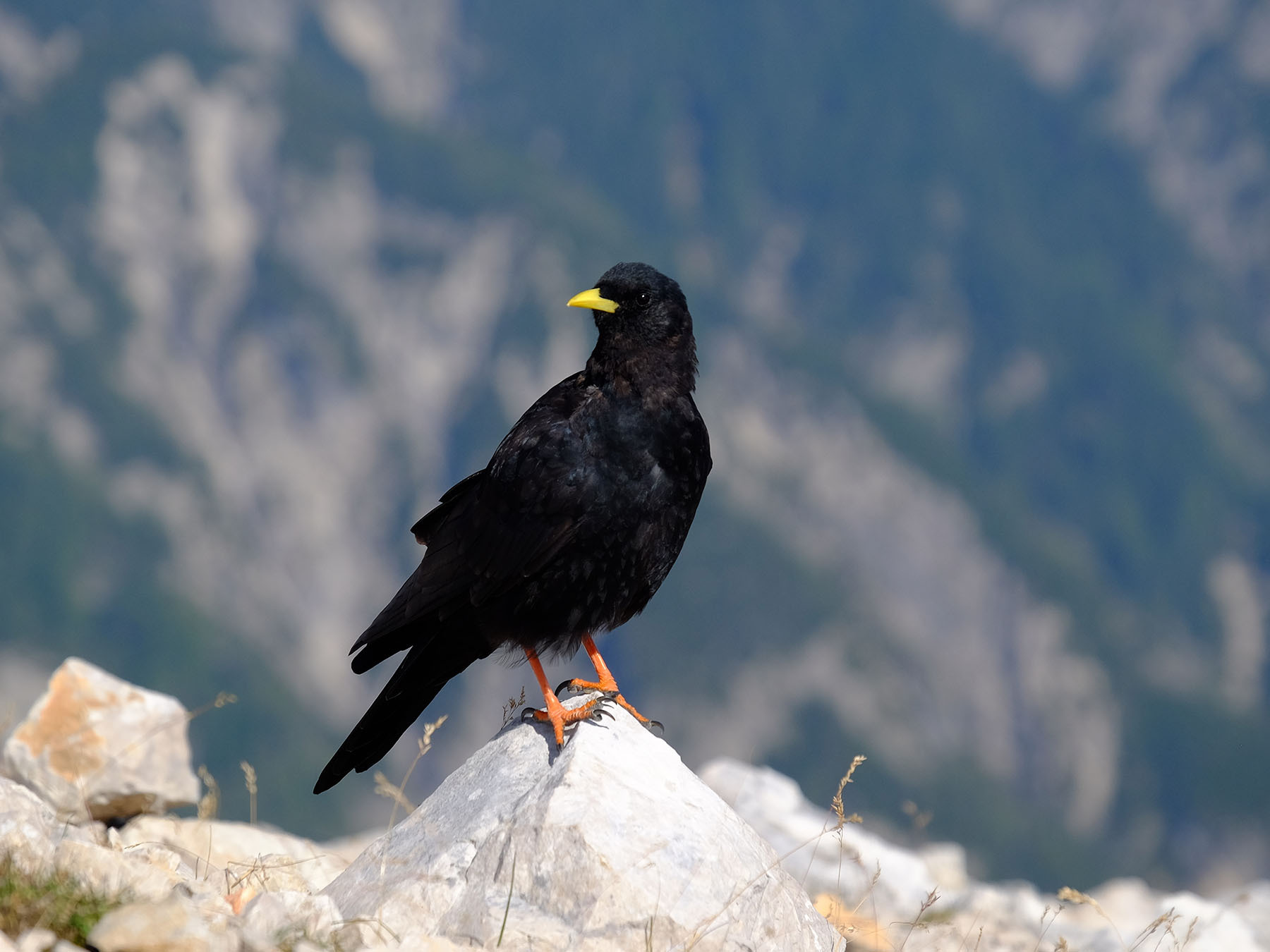
Quick facts
- Length
- 36–39 cm
- Wingspan
- 75–85 cm
- Weight
- 190–250 g
- Lifespan
- 8–10 years · oldest recorded 24.4 years
- Family
- Crows & Jays
- Migration
- Altitudinal migrant
- Global status (IUCN)
- Least Concern
- World population
- 1,075,000 - 2,535,000 mature individuals
- Population trend
- Stable
- Also called
- Yellow-billed Chough
- Scientific name
- Pyrrhocorax graculus
Sources
4- 1BirdLife International. 2016. Pyrrhocorax graculus. The IUCN Red List of Threatened Species 2016: e.T22705921A87386602. Source (opens in a new tab)
- 2BirdLife International. 2016. Pyrrhocorax graculus. The IUCN Red List of Threatened Species 2016: e.T22705921A87386602. Source (opens in a new tab)
- 3BirdLife International. 2016. Pyrrhocorax graculus. The IUCN Red List of Threatened Species 2016: e.T22705921A87386602. Source (opens in a new tab)
- 4Fransson et al., EURING list of longevity records for European birds (2010) Source (opens in a new tab)

Checked by
Nathan Cope, founder and editor
Nathan founded Birdfact and leads its writers and contributors in the UK, the US and Canada. He has watched and studied birds for more than ten years, and checks every article and species guide before it’s published.