


Wryneck
Eurasian Wryneck, Northern Wryneck · Jynx torquilla
By the Birdfact teamChecked by Nathan Cope
On this page14 sections
How to recognise it
The Wryneck is a distinctive bird, unlikely to be mistaken for any other in the United Kingdom.
What do Wrynecks look like?
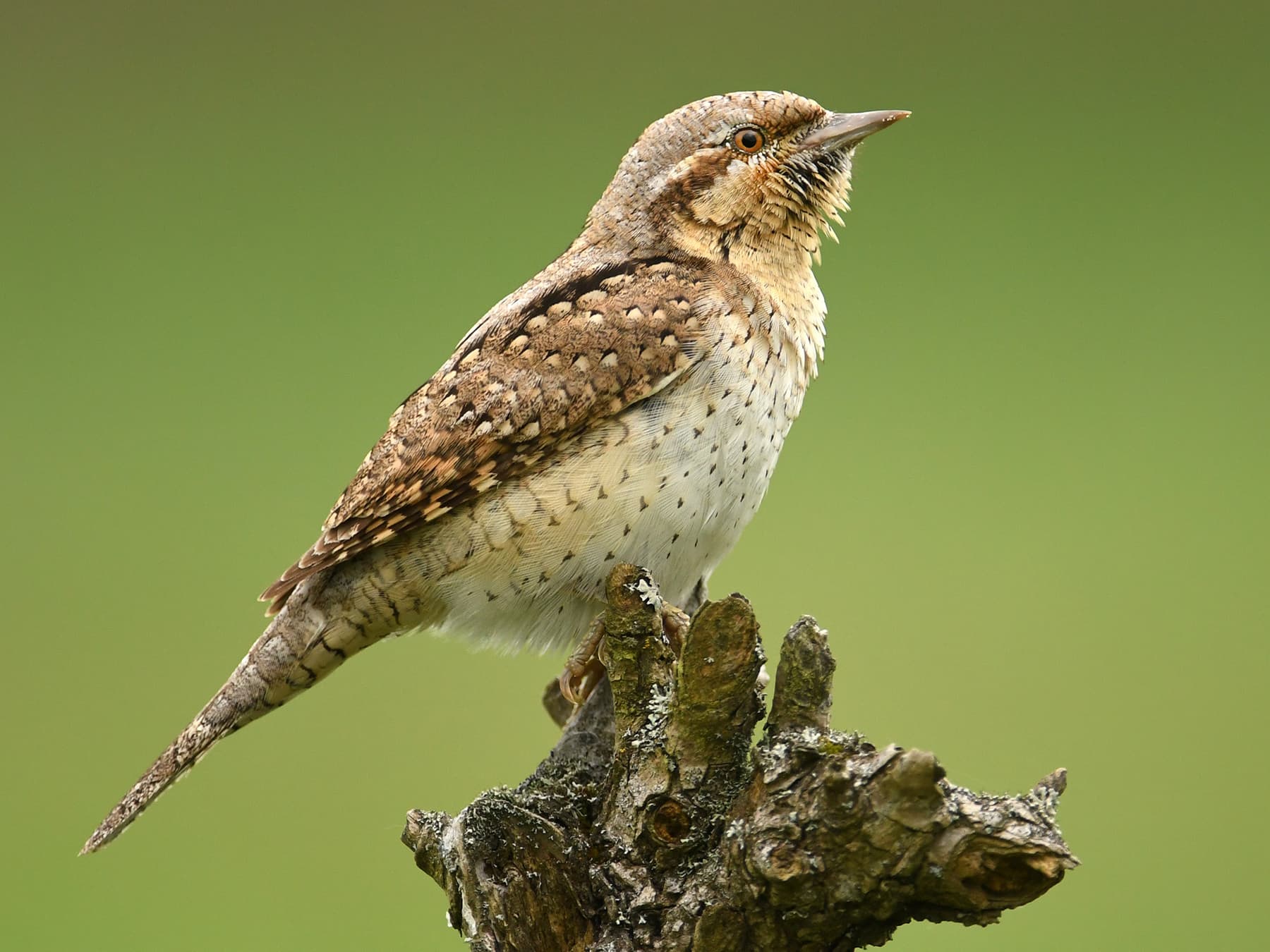
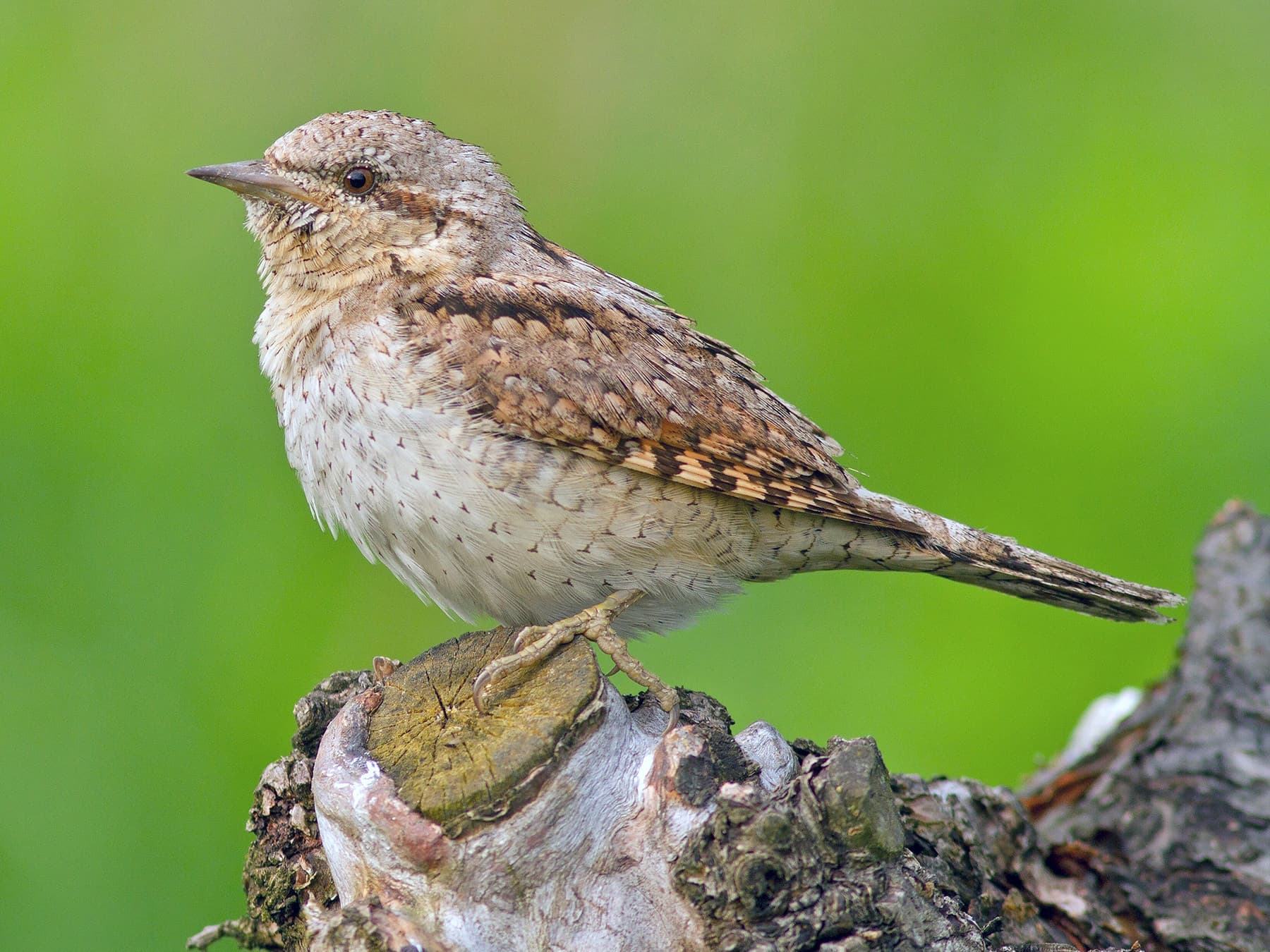
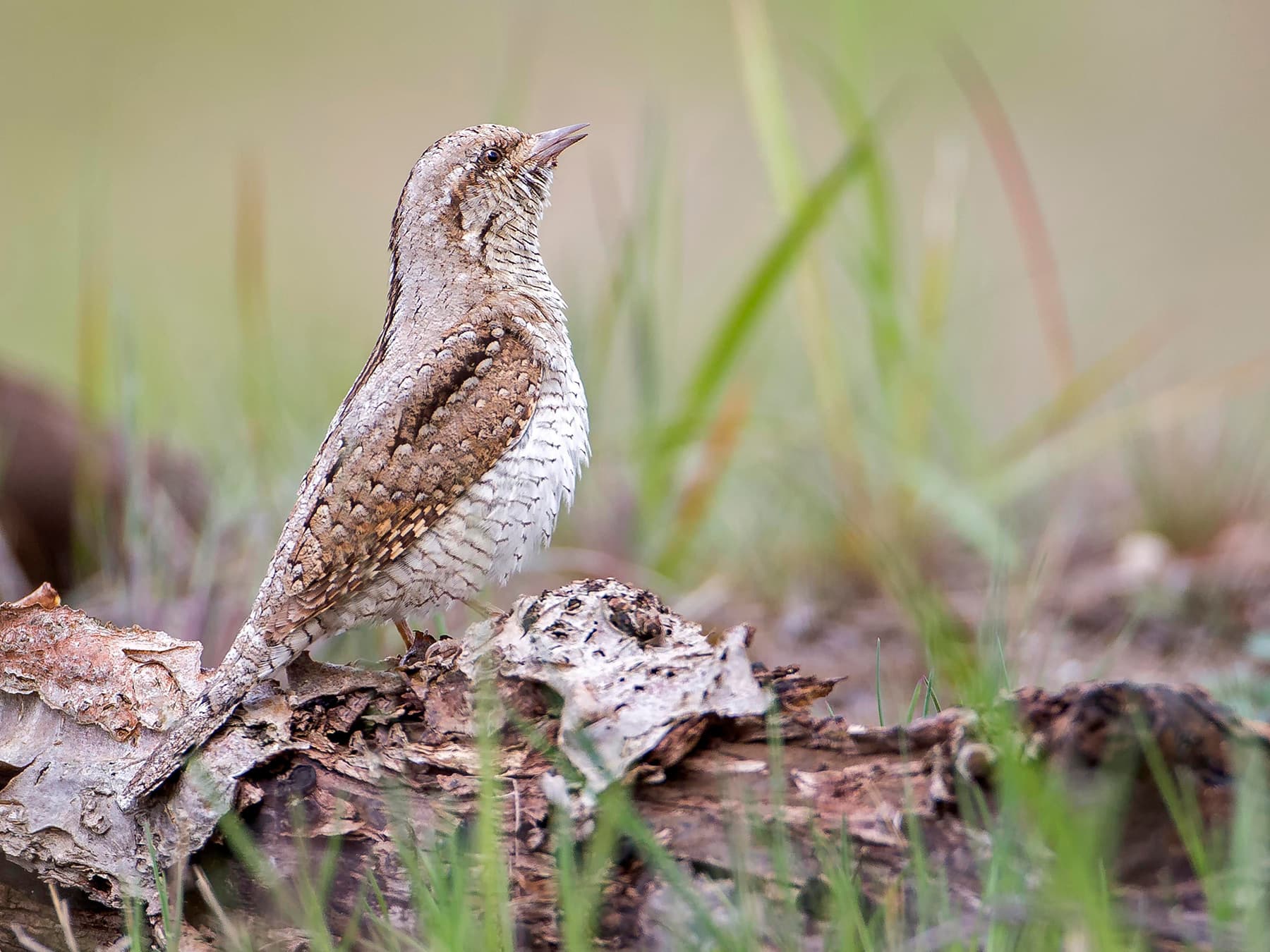
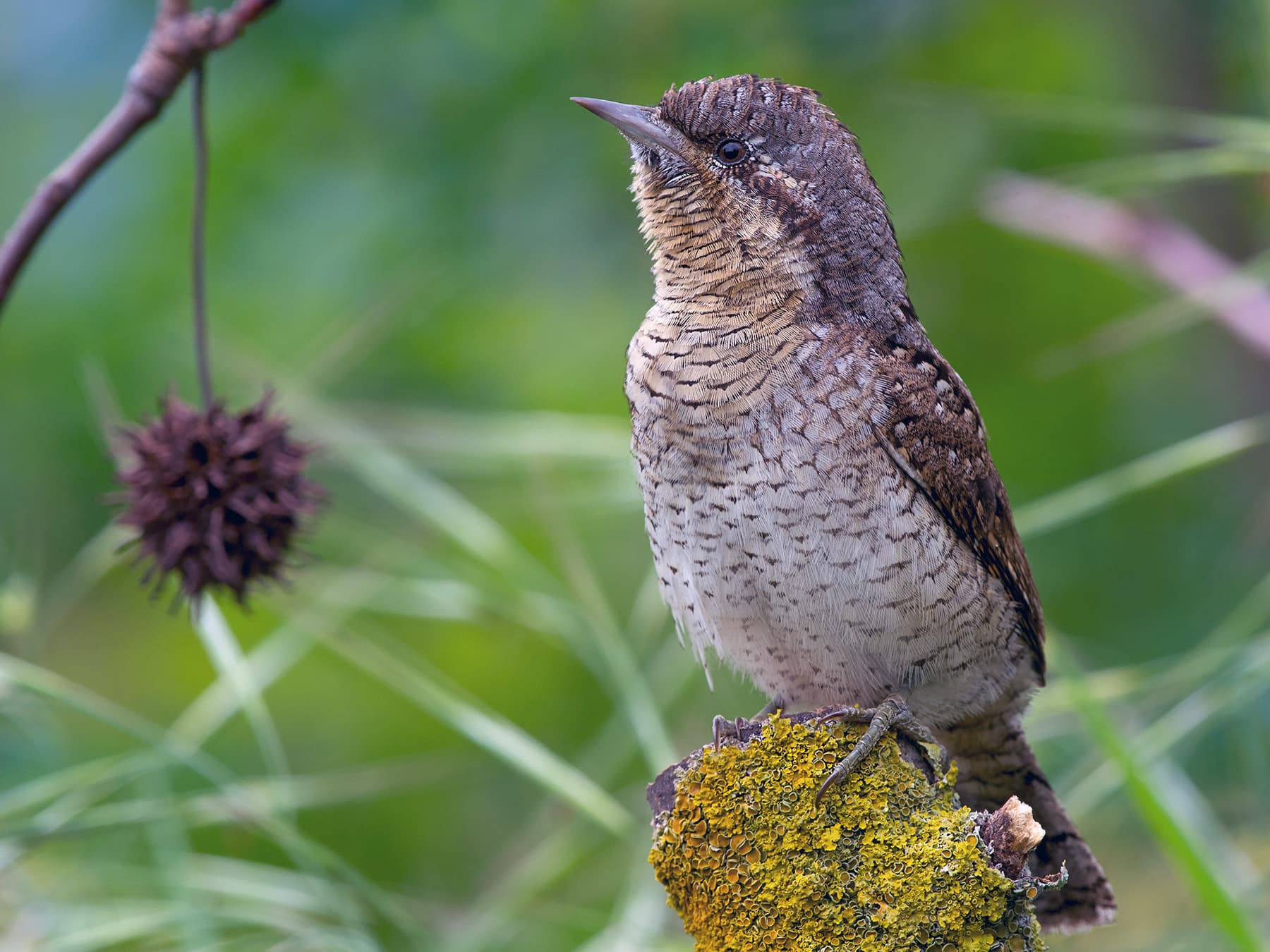
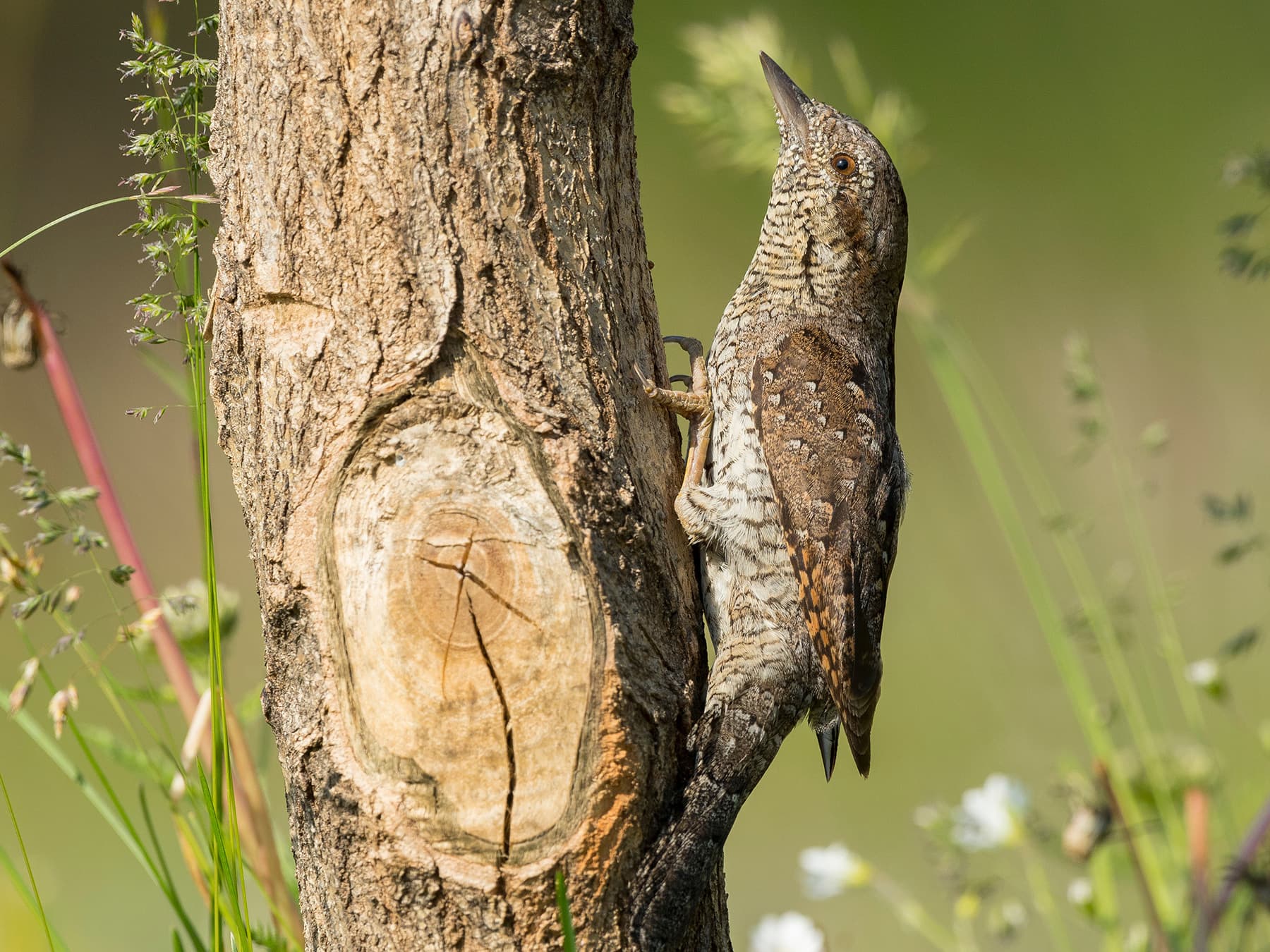
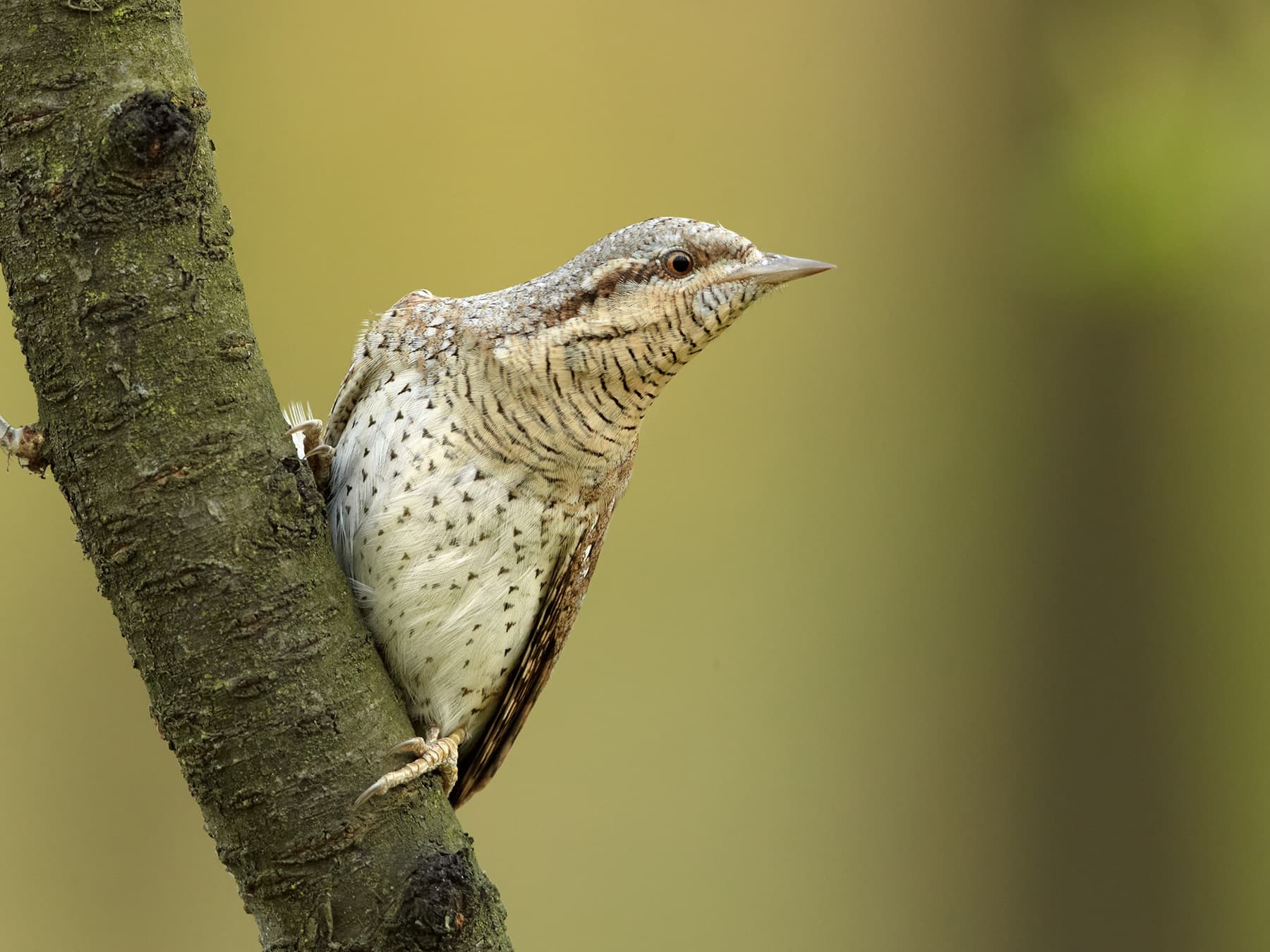
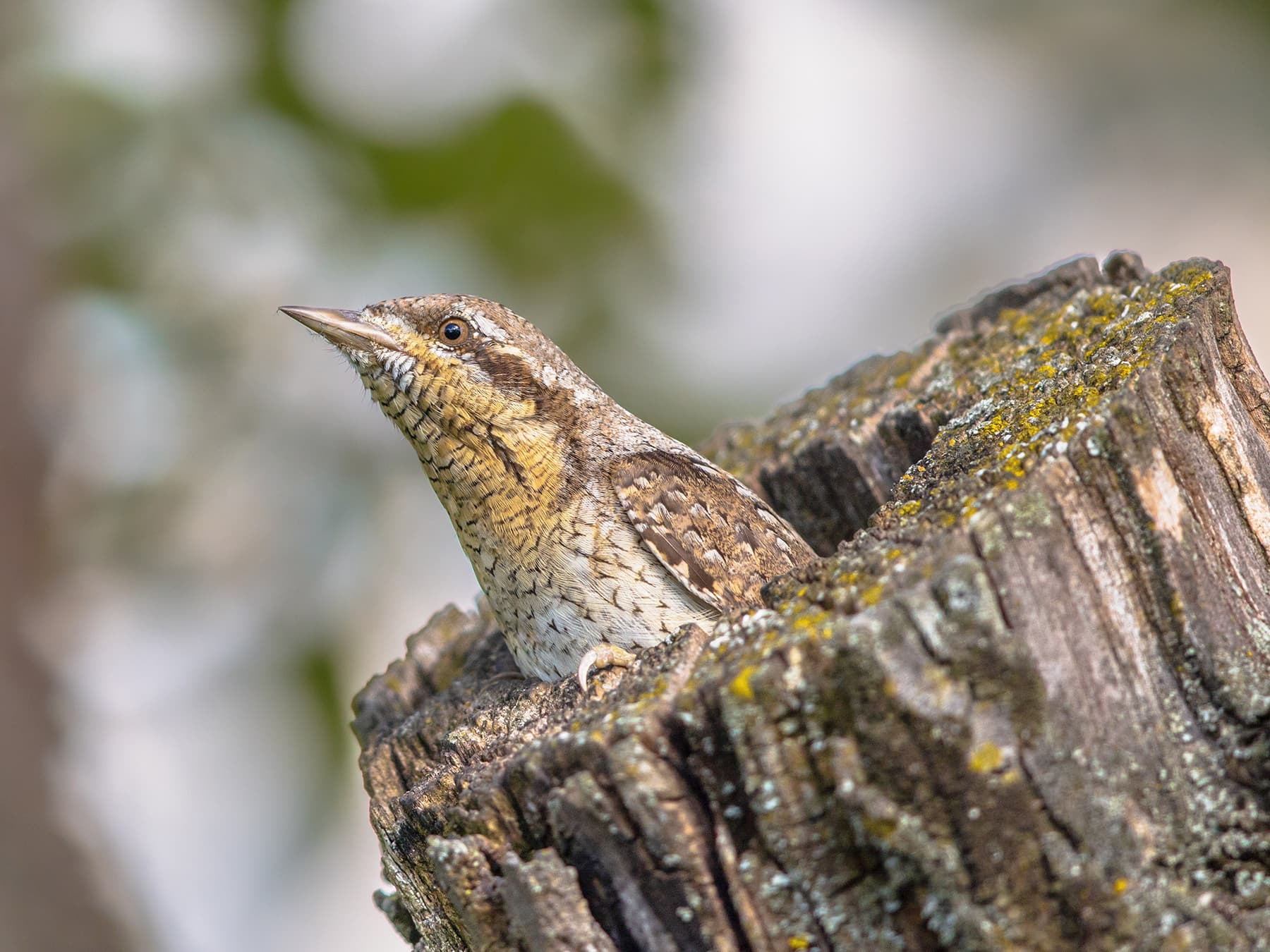
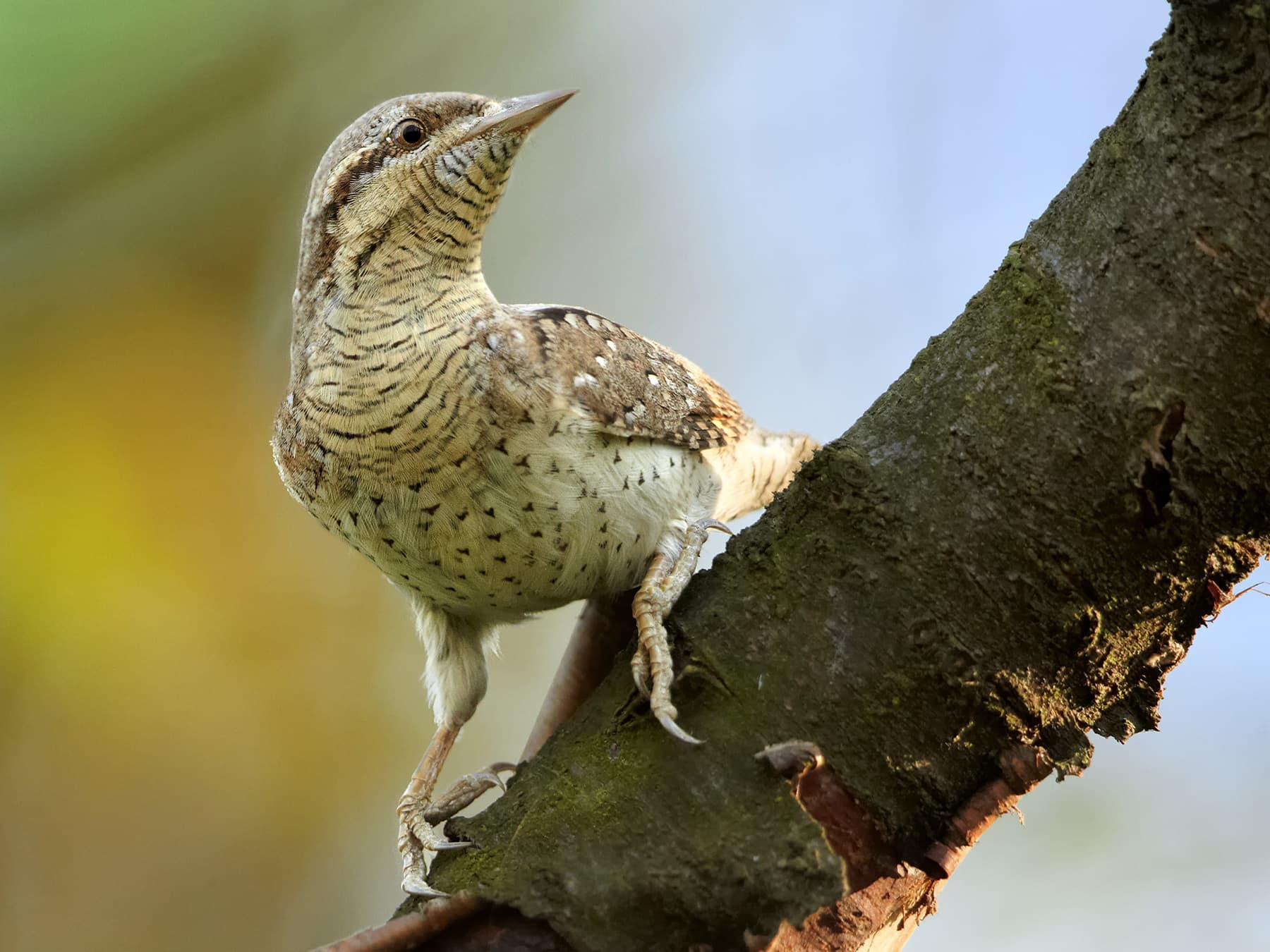
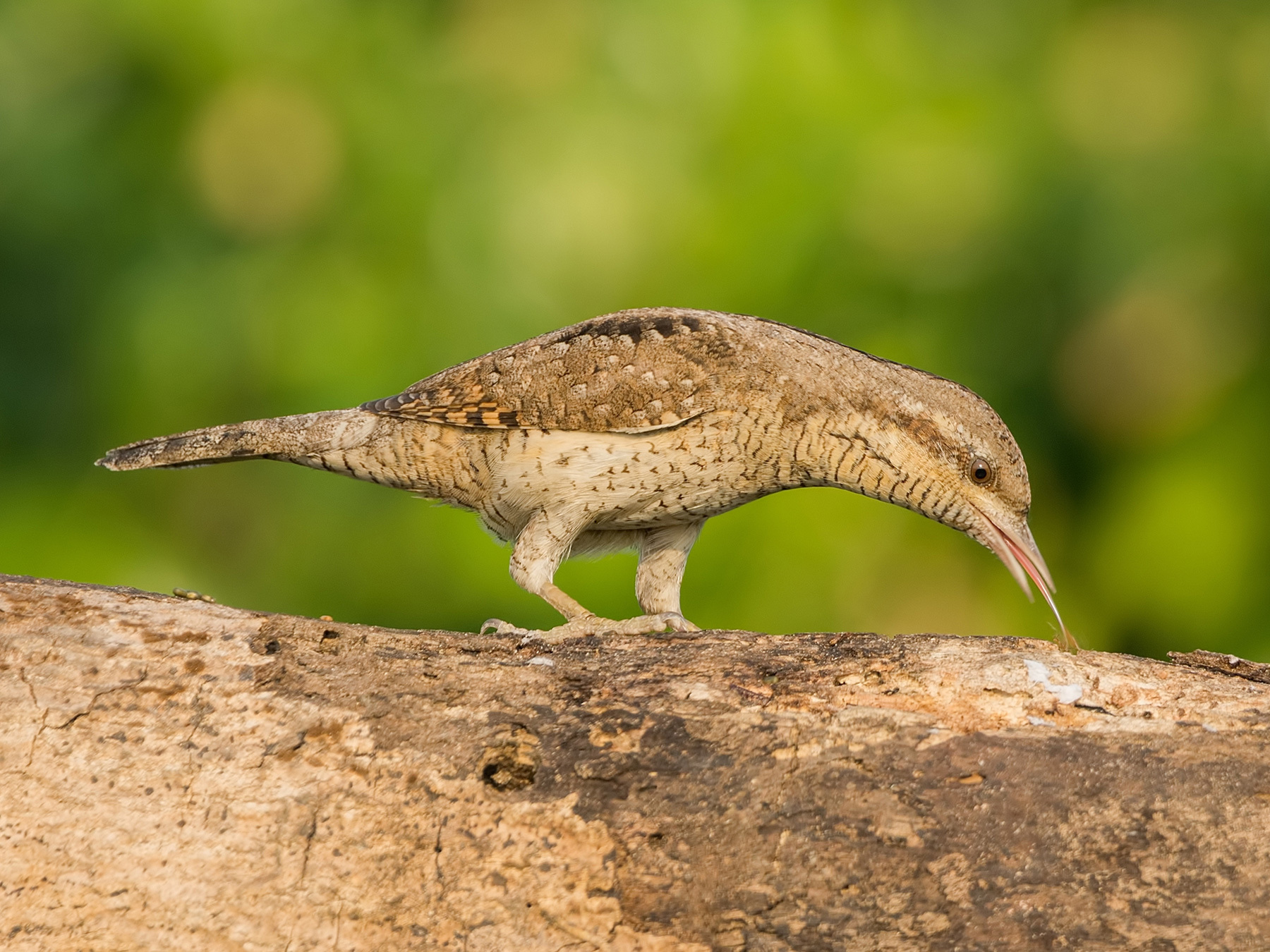
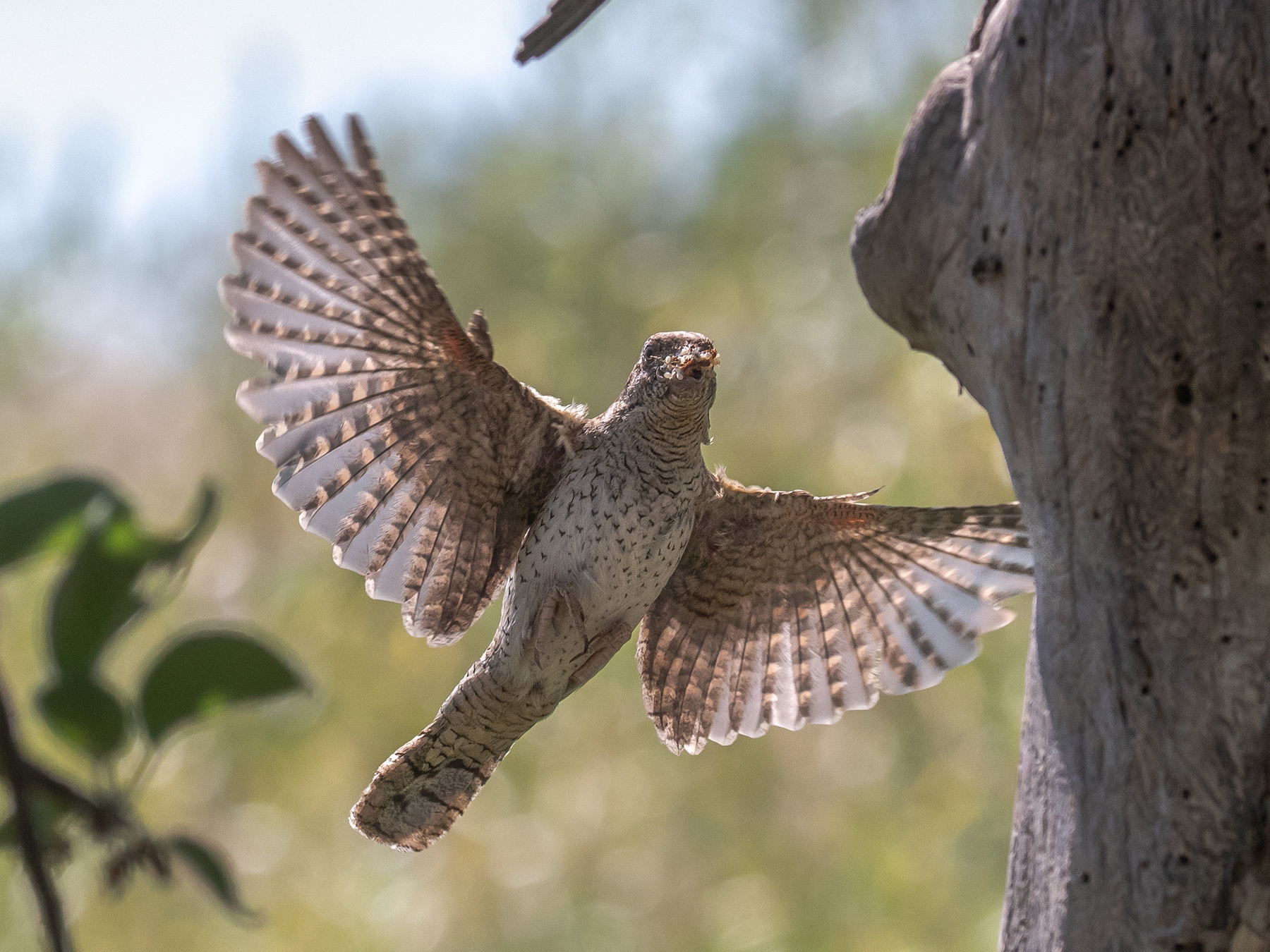
The Wryneck is a small woodpecker-like bird with cryptic grey and brown camouflage. Their most prominent features are a dark stripe along the back and crown, a brown streak through each eye, and another across each shoulder.
The crown, back and upper tail are grey, while the wings are mottled brown. Their underparts are whitish and finely marked, becoming buff at the throat and cheeks. Wrynecks have brownish bills, eyes, and legs. Like other birds of their family, these birds have zygodactyl feet.
Male and female Wrynecks have very similar plumage. Juveniles appear similar to adult birds but have darker plumage, with heavier barring on the upper parts, underparts, and tail.
How big are Wrynecks?
The Wryneck is a small bird, intermediate between a Robin and a Starling.
Length
The Wryneck has a total body length of 16 to 18 centimetres.
Weight
Their weight varies from 30 to 50 grams.
Wingspan
They have a wingspan of 25 to 27 centimetres.
Its size
Adults- Length
- 16–18 cm
- Wingspan
- 25–27 cm
- Weight
- 30–45 g
Its song and calls
The Wryneck is rarely heard in the United Kingdom, although its song may be confused for a small bird of prey.
What sound does a Wryneck make?
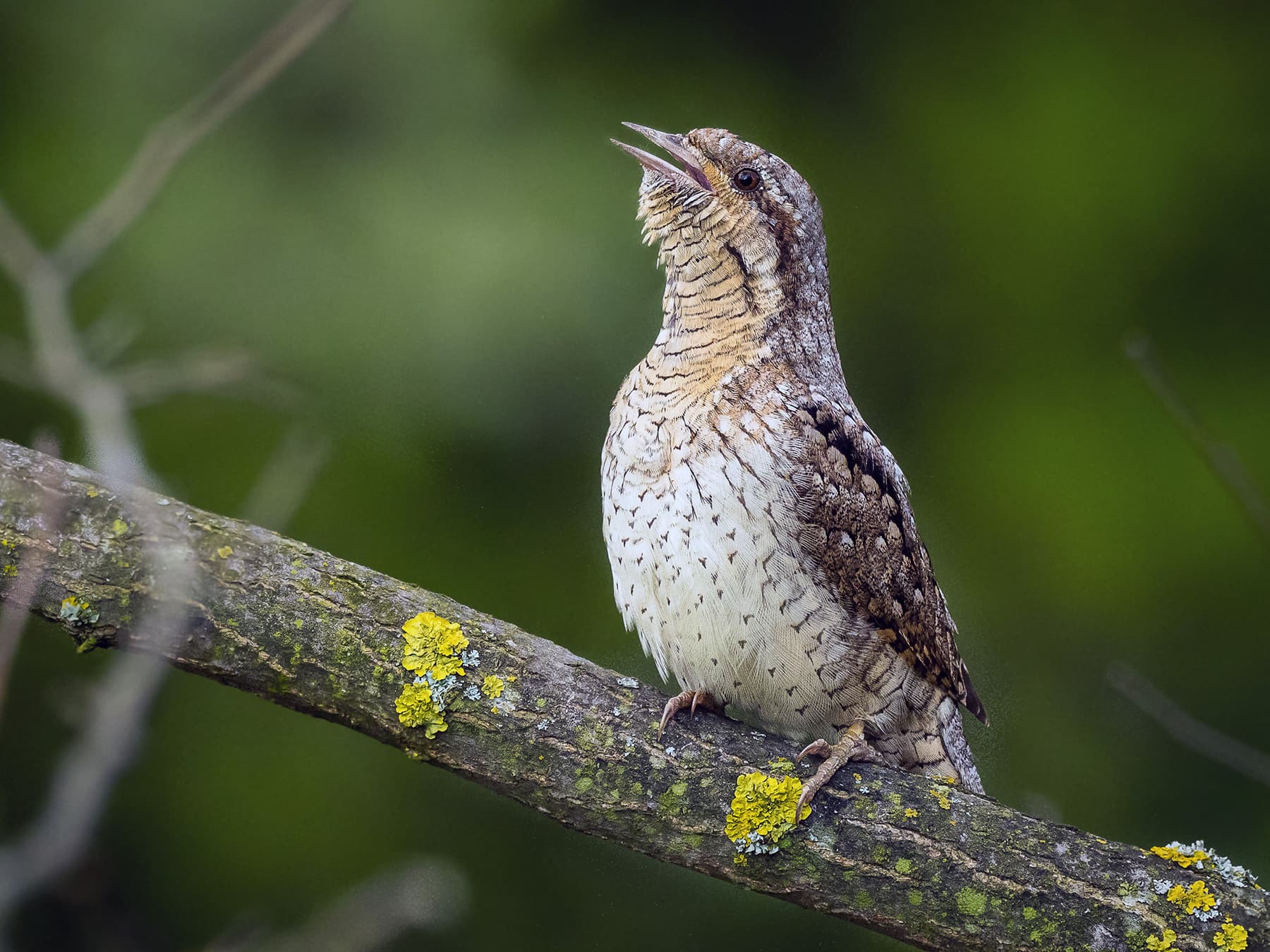
The Wryneck’s song is a simple series of ‘Kwee-kwee-kwee’ notes repeated about a dozen times. The effect is similar to the call of the Kestrel. They also produce various other vocalisations, including greetings and alarm calls.
- Song0:00 / 0:10
Recorded in Kalmar County, Sweden · May 2024
When and where to see it
OctoberLeaving
Most recorded in October
- 1. Pembrokeshire0.12%
- 2. Cornwall0.12%
- 3. Galwayunder 0.1%
- 4. Corkunder 0.1%
- 5. Dorsetunder 0.1%
Each dot is a county, state or province: the bigger and darker, the larger the bird’s share of that place’s bird records that month. Grey dots: no regular records. The ringed point is the centre of the bird’s records this month; the arrow shows how it moved since last month, and the dashed loop its path through the year. “Arrivals” colours places where it becomes regular this month (orange) or is in its last regular month (grey). GBIF eBird Observation Dataset, 2019–2024. Map data: Natural Earth, US Census Bureau; place centres © OpenStreetMap contributors.
In your area
See when the Wryneck is recorded in your county, state or province.
How often the Wryneck turns up in the UK and Ireland through the year, from birdwatchers' records.
United Kingdom
Passage migrant · regularly Apr–Oct · most records in September
Ireland
Passage migrant · regularly Sep–Oct · most records in September
Show as a table
| Month | United Kingdom | Ireland |
|---|---|---|
| January | – | – |
| February | – | – |
| March | <0.001% | – |
| April | 0.002% (regular) | – |
| May | 0.002% (regular) | – |
| June | <0.001% | – |
| July | – | – |
| August | 0.013% (regular) | <0.001% |
| September | 0.039% (regular) | 0.009% (regular) |
| October | 0.009% (regular) | 0.008% (regular) |
| November | <0.001% | – |
| December | – | – |
Recorded regularly in
Worldwide: recorded regularly in 89 countries
Countries where it was recorded in at least 3 of the 6 years 2019–2024. Linked countries have their own bird list.
Europe (40)
- Åland Islands
- Albania
- Austria
- Belarus
- Belgium
- Bosnia & Herzegovina
- Bulgaria
- Croatia
- Czechia
- Denmark
- Estonia
- Finland
- France
- Germany
- Gibraltar
- Greece
- Hungary
- Ireland
- Italy
- Latvia
- Lithuania
- Luxembourg
- Malta
- Moldova
- Montenegro
- Netherlands
- North Macedonia
- Norway
- Poland
- Portugal
- Romania
- Russia
- Serbia
- Slovakia
- Slovenia
- Spain
- Sweden
- Switzerland
- Ukraine
- United Kingdom
Asia (39)
- Armenia
- Azerbaijan
- Bahrain
- Bangladesh
- Bhutan
- Cambodia
- China
- Cyprus
- Georgia
- Hong Kong SAR China
- India
- Iran
- Iraq
- Israel
- Japan
- Jordan
- Kazakhstan
- Kuwait
- Kyrgyzstan
- Laos
- Lebanon
- Macao SAR China
- Mongolia
- Myanmar (Burma)
- Nepal
- Oman
- Pakistan
- Palestinian Territories
- Qatar
- Saudi Arabia
- South Korea
- Sri Lanka
- Taiwan
- Tajikistan
- Thailand
- Turkey
- United Arab Emirates
- Uzbekistan
- Vietnam
Data: EOD – eBird Observation Dataset (Cornell Lab of Ornithology), accessed via GBIF.org, CC BY 4.0. Records from 2019–2024, aggregated and filtered by Birdfact. How these lists are made
The Wryneck has a wide distribution range, although they are difficult to find in the United Kingdom.
What is the habitat of a Wryneck?
Wrynecks occupy various habitats, including short grassland, open woodlands, and old orchards. They choose areas with abundant ant colonies that provide their primary food source.
What is the range of a Wryneck?
Wrynecks used to be widespread in the United Kingdom, although they are now seen only near England’s south and east coasts. They also turn up on Scotland’s Orkney and Shetland islands.
These birds have an extensive global range, encompassing the mid-latitudes of Europe and Asia to the Pacific Coast, large parts of Southeast Asia and the Indian Subcontinent, and a wide band across Central Africa.
Where do Wrynecks live?
Wrynecks spend much of the day and night in trees. Unlike other birds from the woodpecker family, they rarely cling and climb tree trunks. These birds may look for food among the branches, although they generally descend to feed on the ground.
How rare are Wrynecks?
Wrynecks are scarce but regular visitors to the United Kingdom. Less than 300 individuals are believed to pass through the UK each year on migration.
Where can you see Wrynecks in the UK?
Wrynecks are most often seen near the south and east coasts of England. You are most likely to spot these rare ant-eating birds in the Autumn months of August and September, although smaller numbers pass through in April and May.
Migration
Despite their local extinction as a breeding species, these birds can still be seen on passage through the United Kingdom. Continue reading to learn more about Wryneck migration.
Do Wrynecks migrate?
Wrynecks are highly migratory across most of their range. The birds that pass through the United Kingdom do so on their annual spring and autumn migrations.
Wrynecks that nest in Europe and Western Asia fly south to overwinter in Africa, while central and East Asian breeders overwinter in south Asia. Populations in the Mediterranean and North African regions migrate short distances or move between high and low altitudes according to the seasons.
Are Wrynecks native to the UK?
Wrynecks are no longer a breeding species in the United Kingdom. Those that pass through are only temporary visitors as they move between breeding and overwintering grounds in Europe and Africa.
Tips for seeing it
- Look for Wrynecks in open woodlands and orchards during spring and summer.
- Listen for their distinctive 'kee-kee-kee' call, which is often the easiest way to locate them.
- Observe ant nests or sandy areas where Wrynecks often feed.
- In the UK, watch for them during spring and autumn migration periods.
What it eats
Wrynecks may be related to woodpeckers, but these birds do most of their foraging on the ground. Continue reading to learn about their specialised diet.
What do Wrynecks eat?
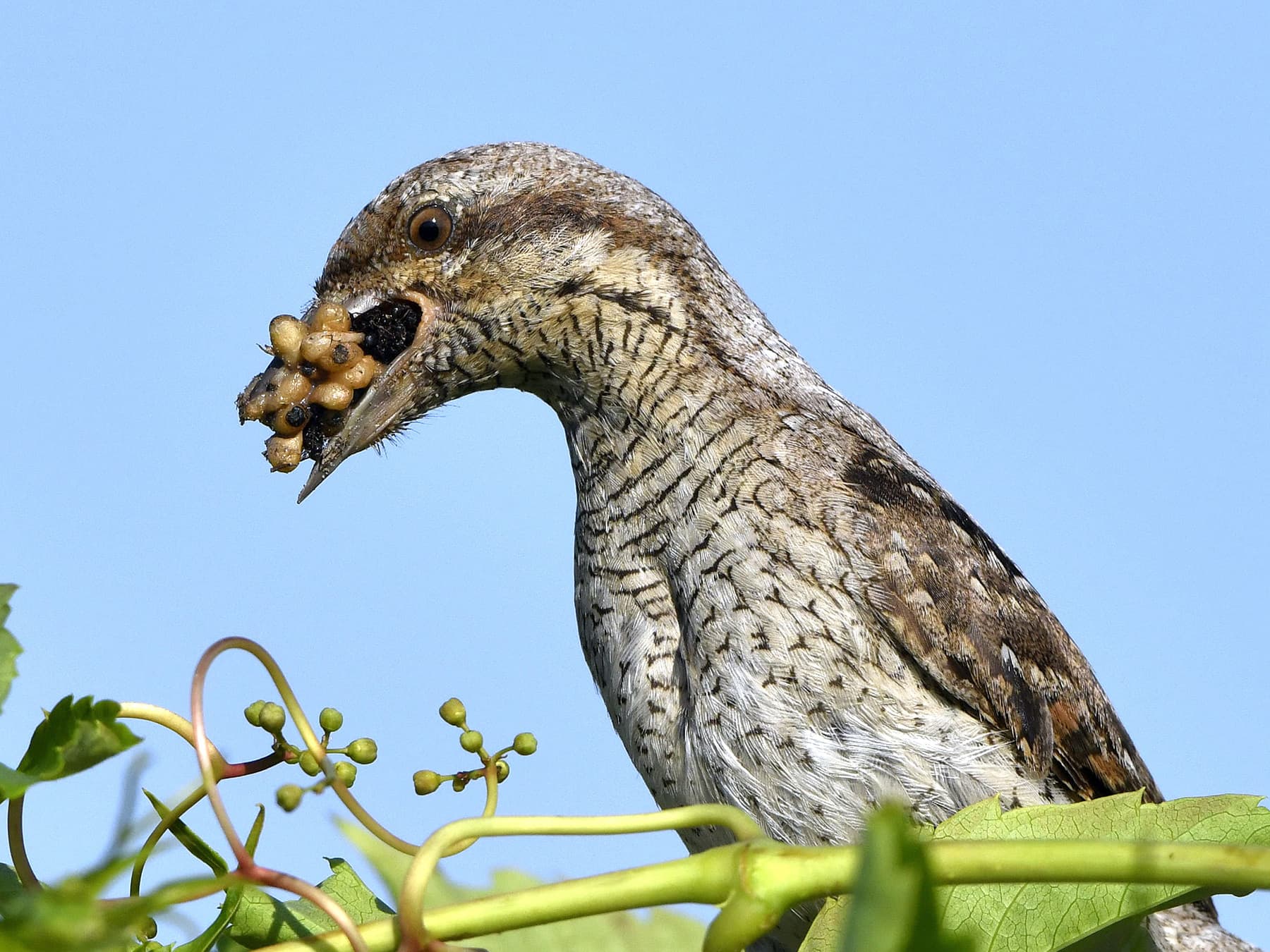
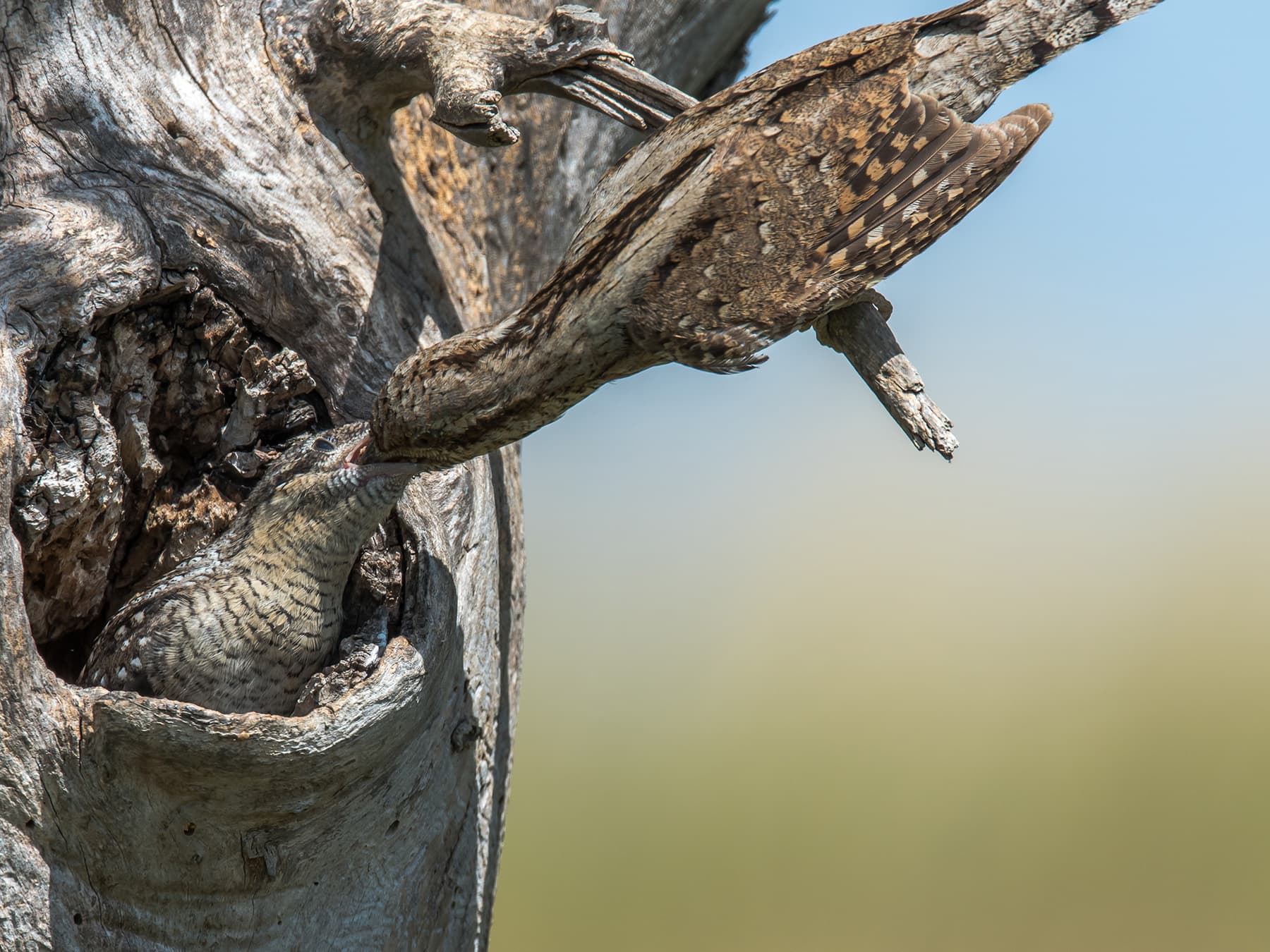
Wrynecks feed predominantly on ants and their larvae which they catch on the ground. They use their bill to open ant nests and their long sticky tongue to extract their prey. These birds also feed on various other insects, invertebrates, tadpoles and birds’ eggs.
What do baby Wrynecks eat?
Wryneck chicks eat ants and their larvae. Both parents feed the chicks for 20 to 22 days until they leave the nest and then another week or two until they become fully independent.
Nesting and breeding
Where do Wrynecks nest?
Wrynecks nest across most of Continental Europe and through Asia to Japan. Active nests have not been confirmed in the UK for over 20 years. However, it is possible that some still breed in northern Scotland. They nest in natural tree cavities, old woodpecker nests, or artificial nest boxes.
What do Wryneck eggs look like?
Wrynecks lay seven to twelve white eggs, each measuring approximately 20 millimetres long and 15 millimetres wide.
Do Wrynecks mate for life?
Wrynecks are generally monogamous in the breeding season, and females are highly faithful to their partners. However, males may begin nesting with a second female before the first season’s offspring have fledged.
Behaviour
Are Wrynecks aggressive?
Wrynecks use deception to defend themselves from predators rather than aggression. Even as nestlings, these birds know how to hiss and move in the manner of a snake to frighten would-be predators.
Where do Wrynecks sleep at night?
Wrynecks usually roost in tree cavities.
Lifespan and predators
How long do Wrynecks live?
Adult Wrynecks have an average lifespan of about two years and a maximum lifespan of about ten years.
What are the predators of Wrynecks?
Wrynecks could fall prey to a variety of birds of prey, carnivorous mammals, and reptiles. Sparrowhawks, stoats, and weasels are all potential predators in the United Kingdom.
Are Wrynecks protected?
Wrynecks are a Schedule 1 species on the Wildlife and Countryside Act 1981.
Are Wrynecks endangered?
Sadly, the Wryneck has declined massively in the United Kingdom and is now extinct here as a breeding bird. The cause of their decline is not fully understood, although changes in rainfall, pesticide use, and habitat destruction could be to blame.
At a species level, the Wryneck is a ‘Least Concern’ species with a vast global range. Although not endangered, their population is believed to be in decline.
Conservation
While listed as Least Concern globally, Wryneck populations have declined in parts of Europe due to habitat loss and changes in agricultural practices.
Conservation efforts focus on maintaining suitable breeding habitats and preserving traditional orchards and wood pastures.
More photos
3 photos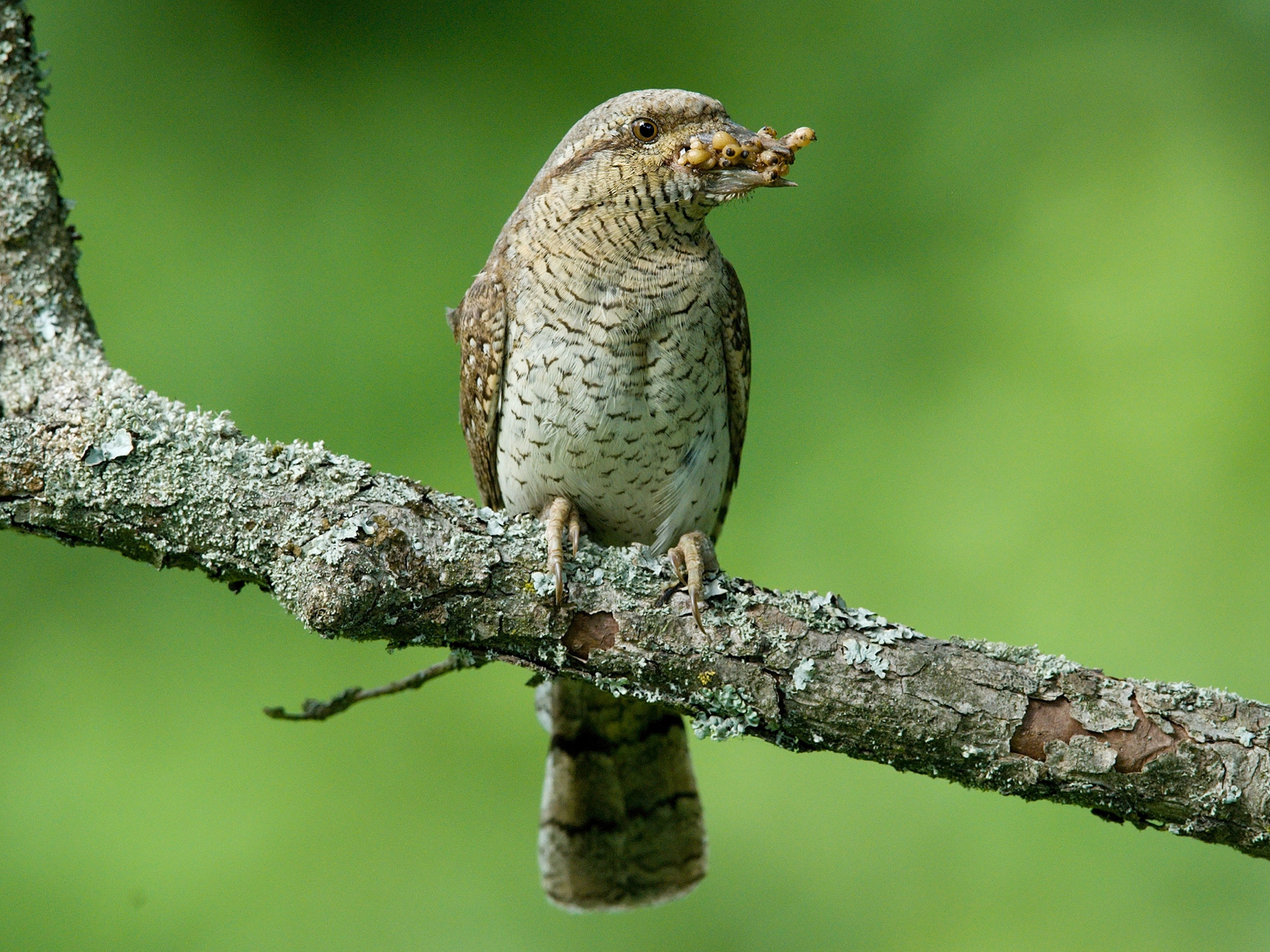
Wryneck guides
1 guidesQuick facts
- Length
- 16–18 cm
- Wingspan
- 25–27 cm
- Weight
- 30–45 g
- Lifespan
- 2–10 years · oldest recorded 10 years
- Family
- Woodpeckers
- Migration
- Long-distance Migrant
- Global status (IUCN)
- Least Concern
- World population
- 3,000,000 - 7,100,000 mature individuals
- Population trend
- Decreasing
- Also called
- Eurasian Wryneck, Northern Wryneck
- Scientific name
- Jynx torquilla
Questions
2Why are they called Wrynecks?
Wrynecks have a strange and unique way of defending themselves against predators. These birds extend and twist their neck in a sinuous, snake-like fashion to fool their enemies into thinking they are more dangerous than they really are. They may even hiss to complete the ruse.
What is the Wryneck myth?
You only have to look at the Wryneck’s generic name (Jynx) to know there’s something mysterious about these birds! Their extraordinary snake-like movements when confronted with a predator led to the old belief that these birds could put a spell on people.
Sources
4- 1BirdLife International. 2017. Jynx torquilla (amended version of 2016 assessment). The IUCN Red List of Threatened Species 2017: e.T22680683A111819000. Source (opens in a new tab)
- 2EBCC (2015)
- 3BirdLife International. 2017. Jynx torquilla (amended version of 2016 assessment). The IUCN Red List of Threatened Species 2017: e.T22680683A111819000. Source (opens in a new tab)
- 4Moller, Sociality, age at first reproduction and senescence: comparative analyses of birds, J Evol Biol, 19:682-689 (2006) Source (opens in a new tab)

Checked by
Nathan Cope, founder and editor
Nathan founded Birdfact and leads its writers and contributors in the UK, the US and Canada. He has watched and studied birds for more than ten years, and checks every article and species guide before it’s published.