


Thekla's Lark
Thekla Lark · Galerida theklae
By the Birdfact teamChecked by Nathan Cope
On this page12 sections
How to recognise it
What do Thekla's Larks look like?
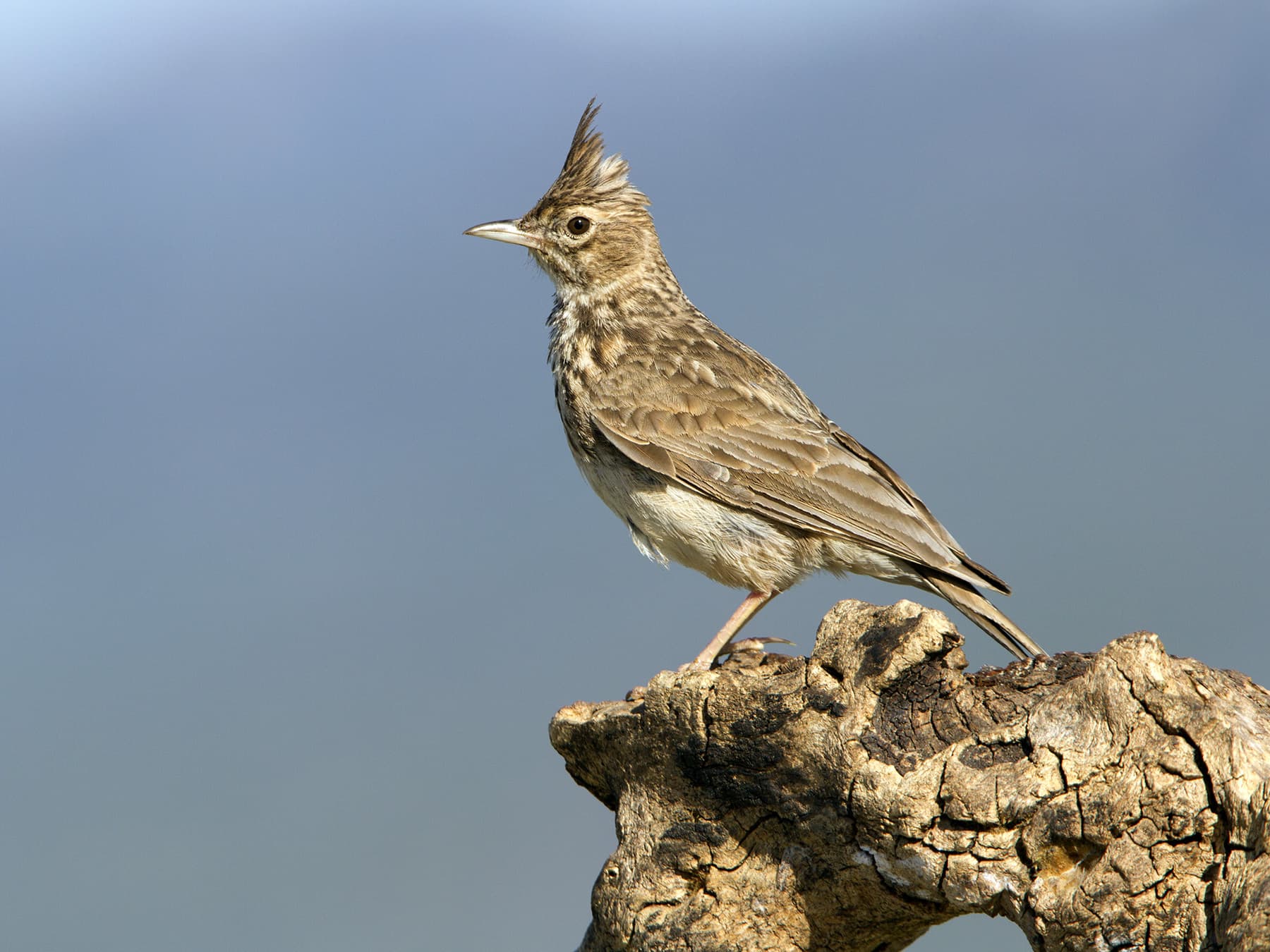
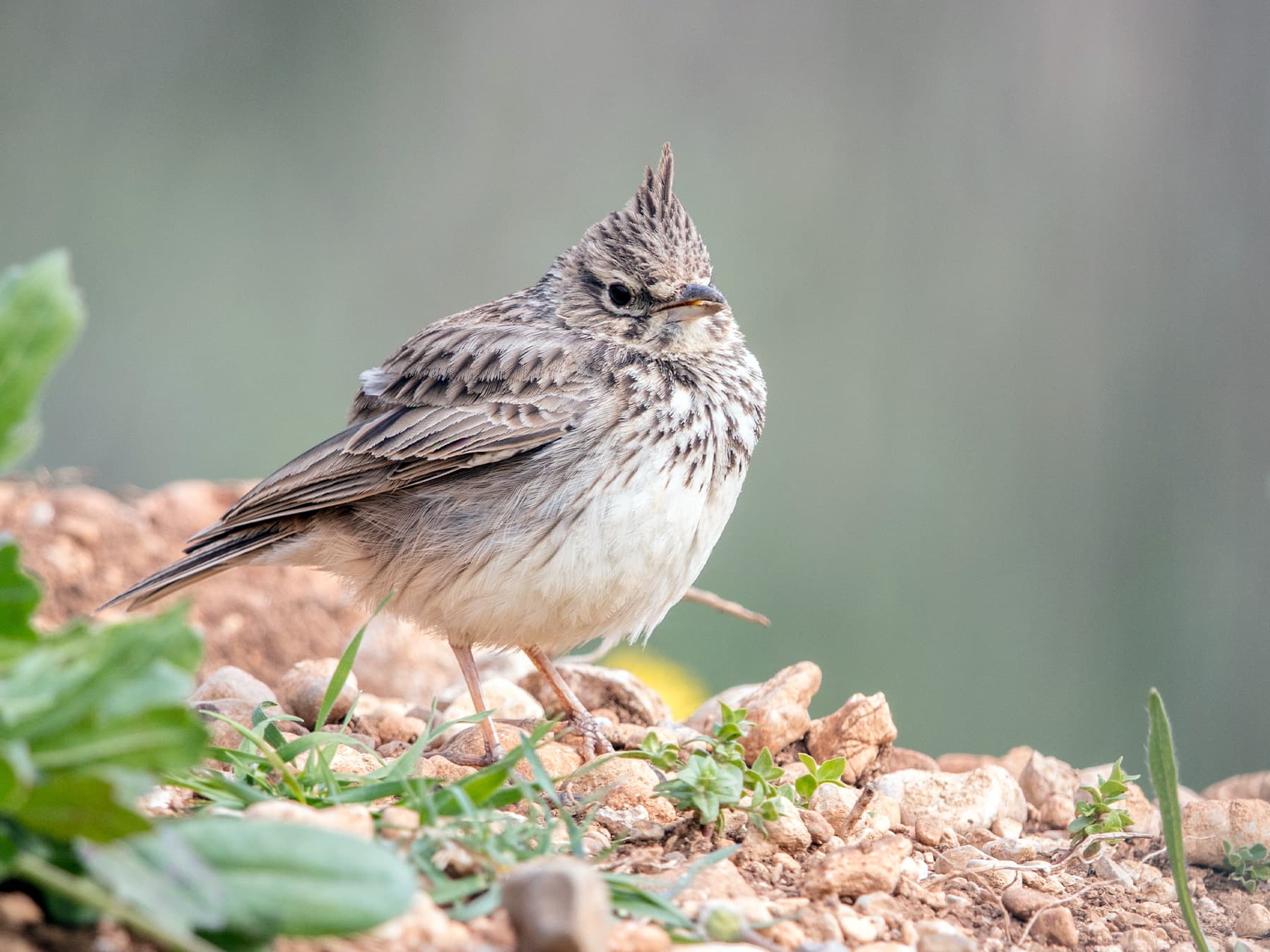
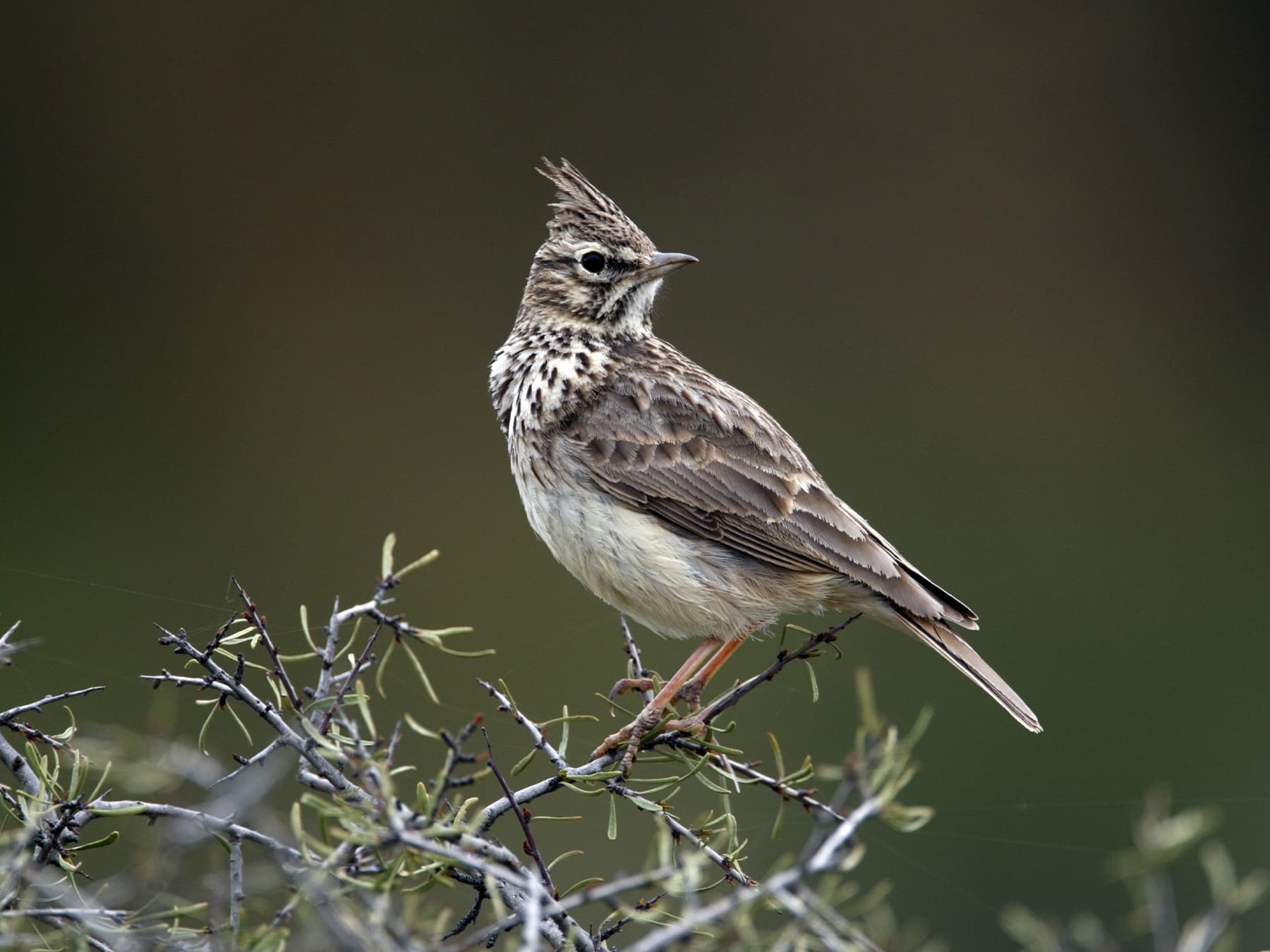
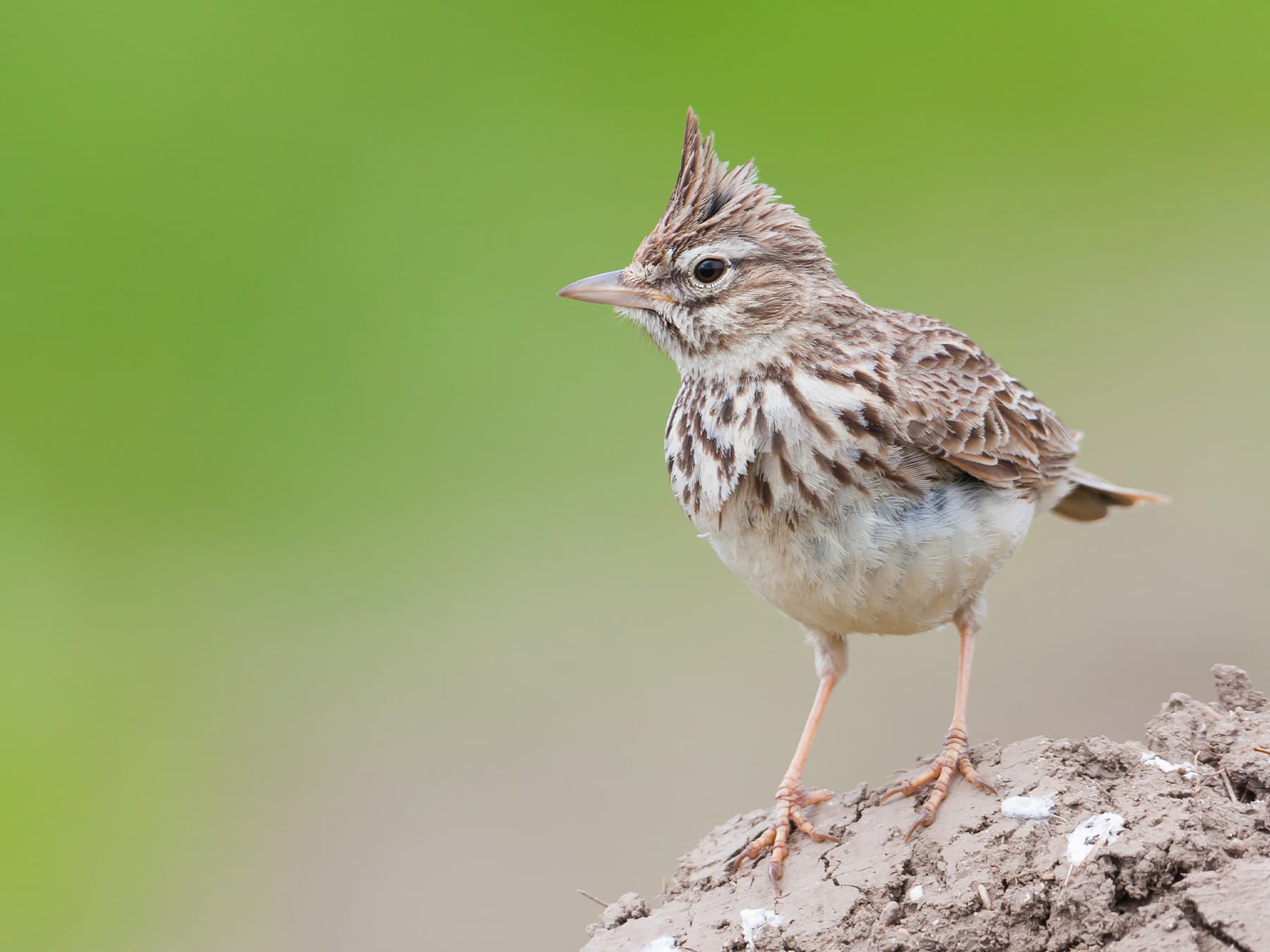
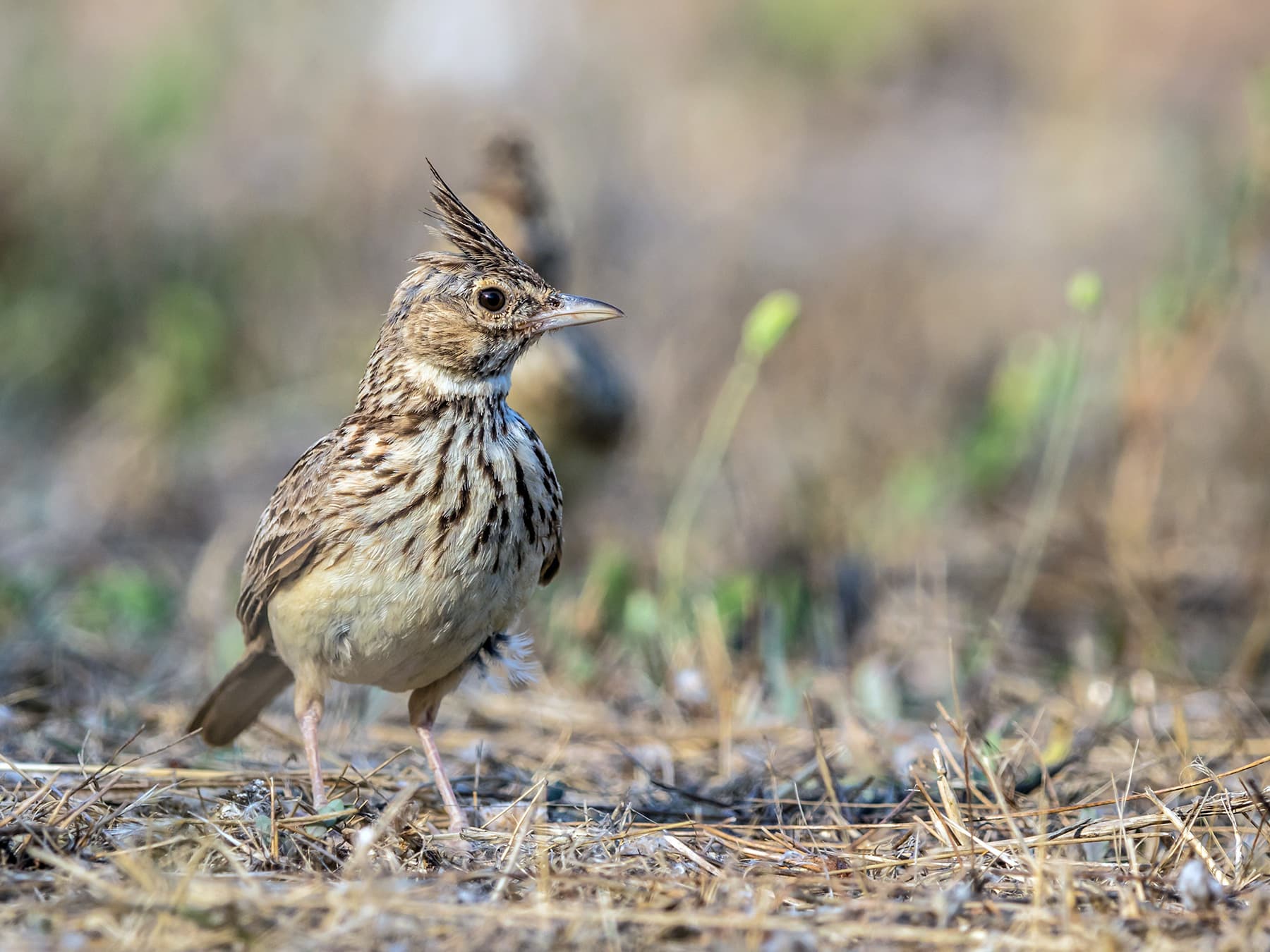
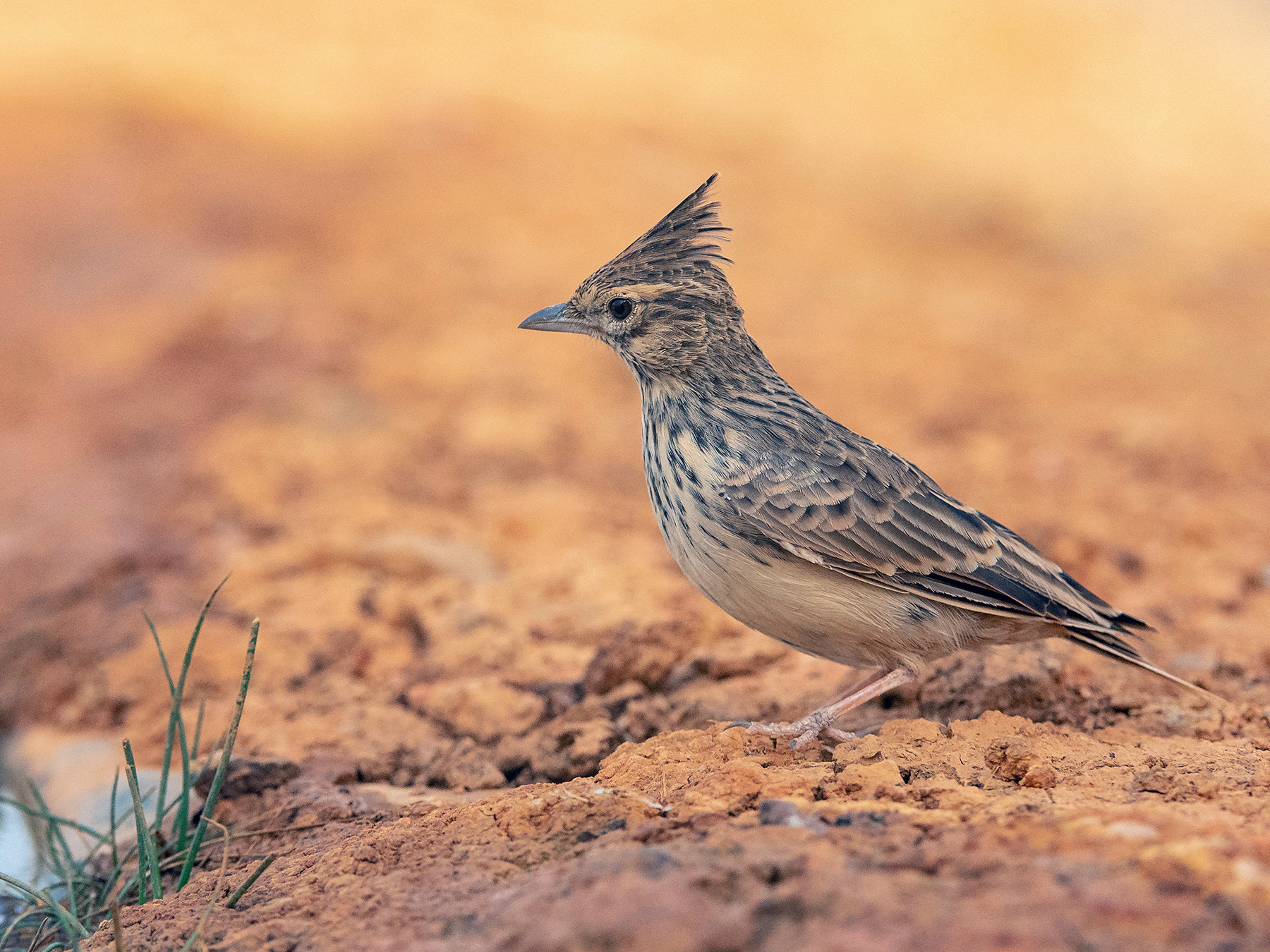
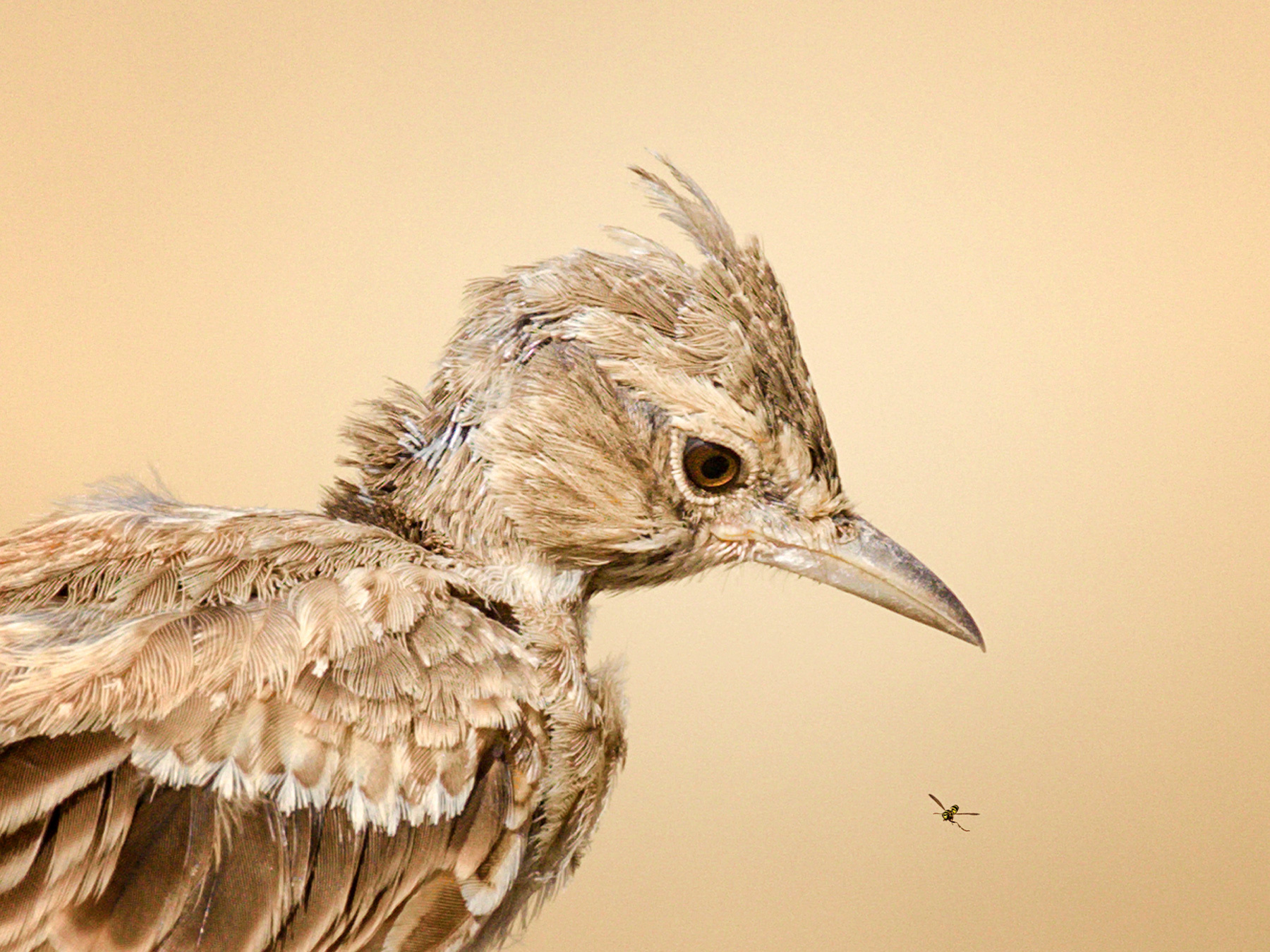
The most distinctive feature of a Thekla’s lark is its spiky crest, which peaks towards the back of the crown. It has greyish-brown upper parts and is heavily streaked with black markings on its wings and back. The breast is whitish, tinged with buff, and marked with black spots. The flanks and underparts are pale and unmarked.
Facial markings include a white eye ring and eyebrow stripe, a black streak next to the eye, and a dark moustache, with grey-brown cheeks and a white chin and throat. The eyes are black, the medium-length bill is greyish and the legs are yellowish-brown.
Female Thekla’s larks are identical in plumage and size to males and cannot be told apart visually.
In juvenile Thekla’s larks, the crest is smaller and not as prominent. Streaky markings are also less defined.
How big are Thekla's Larks?
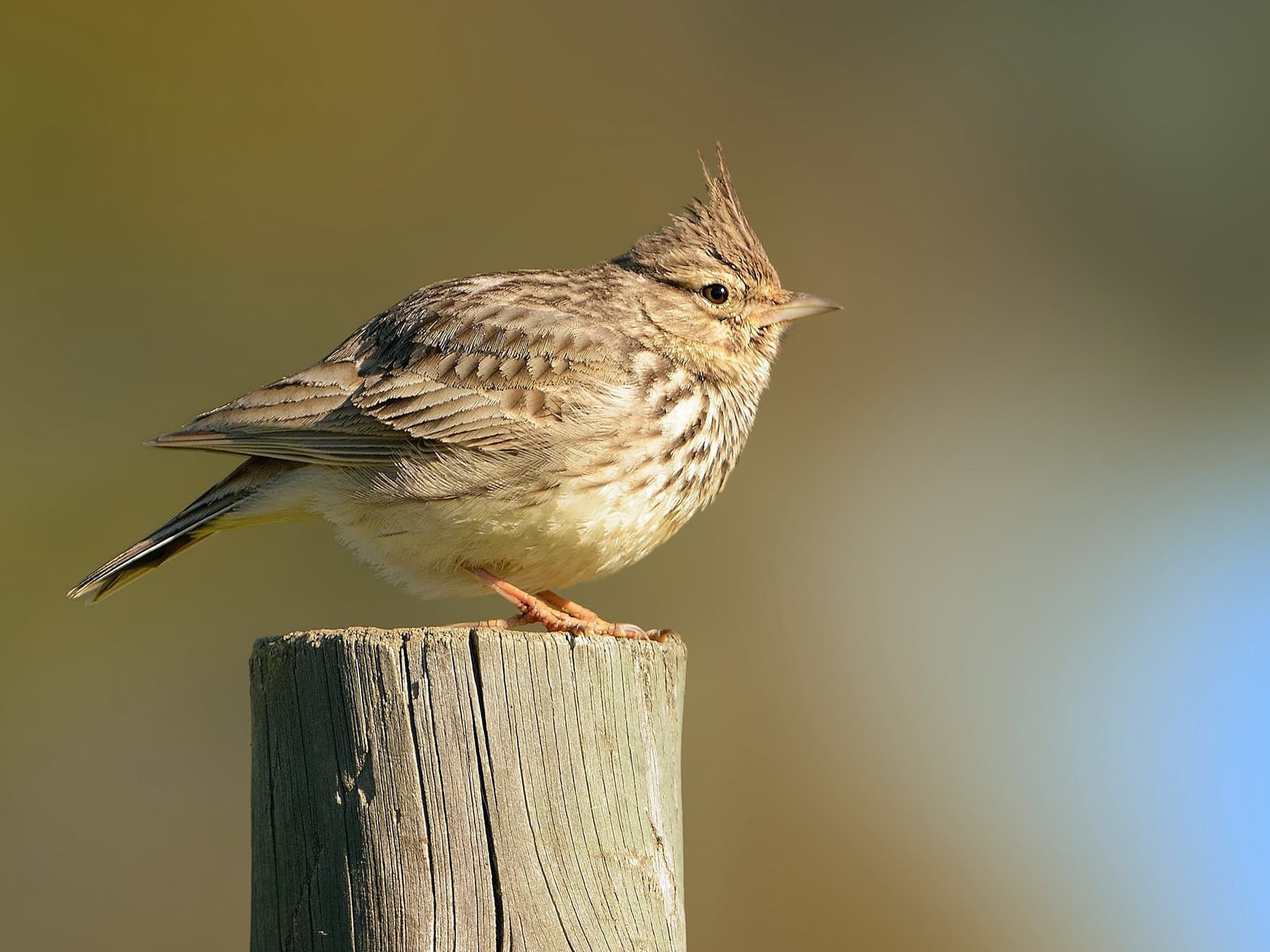
Thekla’s larks are a medium-sized lark, slightly smaller but with a stockier shape than the Eurasian skylark. Males and females are the same size.
- Length: 15 cm to 17 cm (5.9 in to 6.7 in)
- Wingspan: 28 cm to 32 cm (11 in to 12.6 in)
- Weight: 30 g to 40 g (1.1 oz to 1.2 oz)
Its size
Adults- Length
- 15–17 cm
- Wingspan
- 28–32 cm
- Weight
- 28–45 g
Its song and calls
What sound does a Thekla's Lark make?
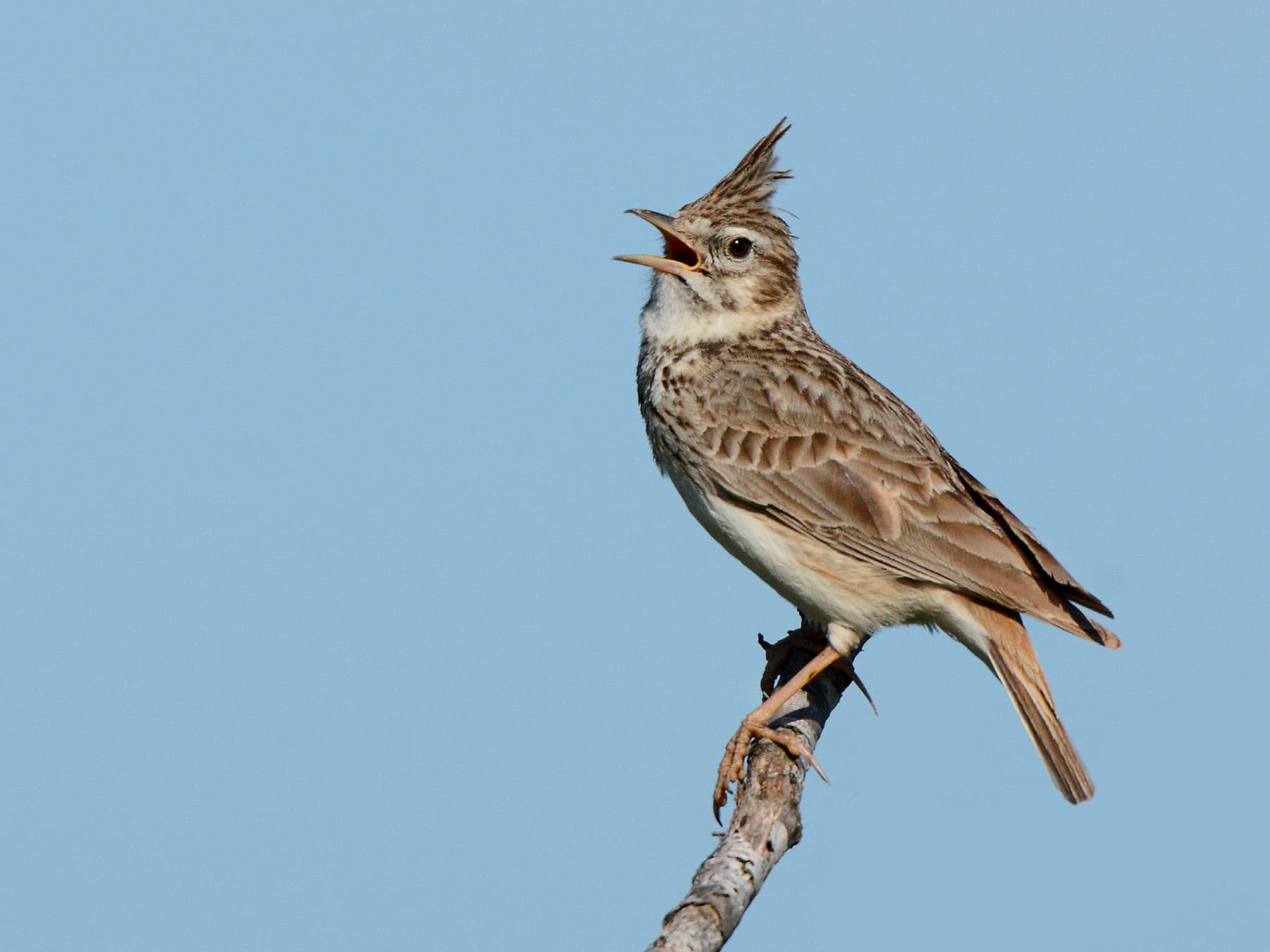
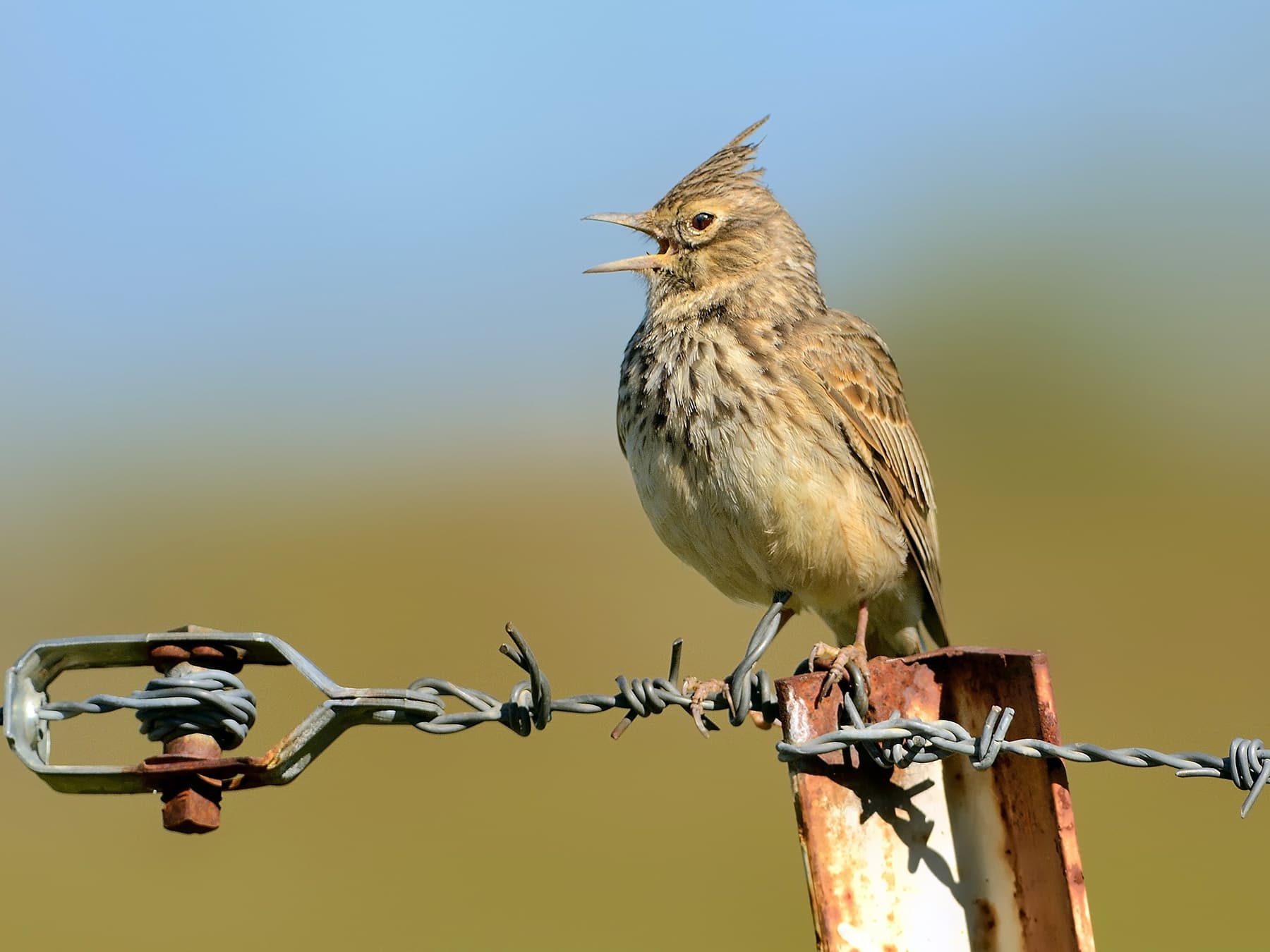
Male Thekla’s larks have a tuneful and melodious song that includes a series of cheery warbling notes. Their vocal repertoire includes some mimicry of other species and lively whistling and can be heard both from treetop perches and in flight.
- Song0:00 / 1:14
Recorded in Andalucía, Spain · August 2018
When and where to see it
The Thekla's Lark is not recorded regularly in the UK, Ireland, the United States or Canada.
Worldwide: recorded regularly in 10 countries
Countries where it was recorded in at least 3 of the 6 years 2019–2024. Linked countries have their own bird list.
Data: EOD – eBird Observation Dataset (Cornell Lab of Ornithology), accessed via GBIF.org, CC BY 4.0. Records from 2019–2024, aggregated and filtered by Birdfact. How these lists are made
What is the habitat of a Thekla's Lark?
Thekla’s larks are found in rugged areas of scrubland, with bare land and sparse vegetation. Semi-arid grasslands offer suitable environments for both nesting and feeding. Vineyards and olive groves are also popular, as well as sloped, rocky landscapes. Pastureland may also attract Thekla’s larks, although they are generally not present in land cultivated for cereal crops.
What is the range of a Thekla's Lark?
Three distinct geographical regions are home to Thekla's larks. In Europe, they are present all year round in southern France, Spain, including the Mediterranean islands of Mallorca and Menorca, and eastern and southern Portugal. Across the Mediterranean, their North African range extends from Western Sahara through Morocco, Algeria, and Tunisia, and there are isolated populations in Libya and Egypt. In East Africa, Thekla’s larks are native to Eritrea, Ethiopia, Somalia and Kenya.
Where do Thekla's Larks live?
Spain is the stronghold of Thekla’s larks in Europe, with up to 94 percent of the continent’s population. In Africa, they are particularly common and widespread in Morocco, where they are thought to be the most abundant species of lark.
How rare are Thekla's Larks?
Within their range, Thekla’s larks are widespread and abundant, and the global population is estimated at between 23.3 million and 37.9 million individuals. In Spain, Morocco, Western Sahara, Tunisia, parts of Libya, Somalia, and parts of northern Kenya they are particularly common.
A much smaller population of only around 350 to 400 pairs is present in France, limited to a particular region in the south-west, and sightings are more of a rarity.
Migration
Do Thekla's Larks migrate?
Some short-distance dispersal may occur following breeding in their European range, but otherwise, Thekla’s larks are largely sedentary and do not undertake annual migrations.
Tips for seeing it
- Look for Thekla's Larks in open, rocky areas with sparse vegetation
- Listen for their melodious song, often delivered in flight
- Observe their ground-foraging behaviour and distinctive crest
- Pay attention to subtle differences from the similar Crested Lark, such as a shorter bill and more streaked appearance
What it eats
What do Thekla's Larks eat?
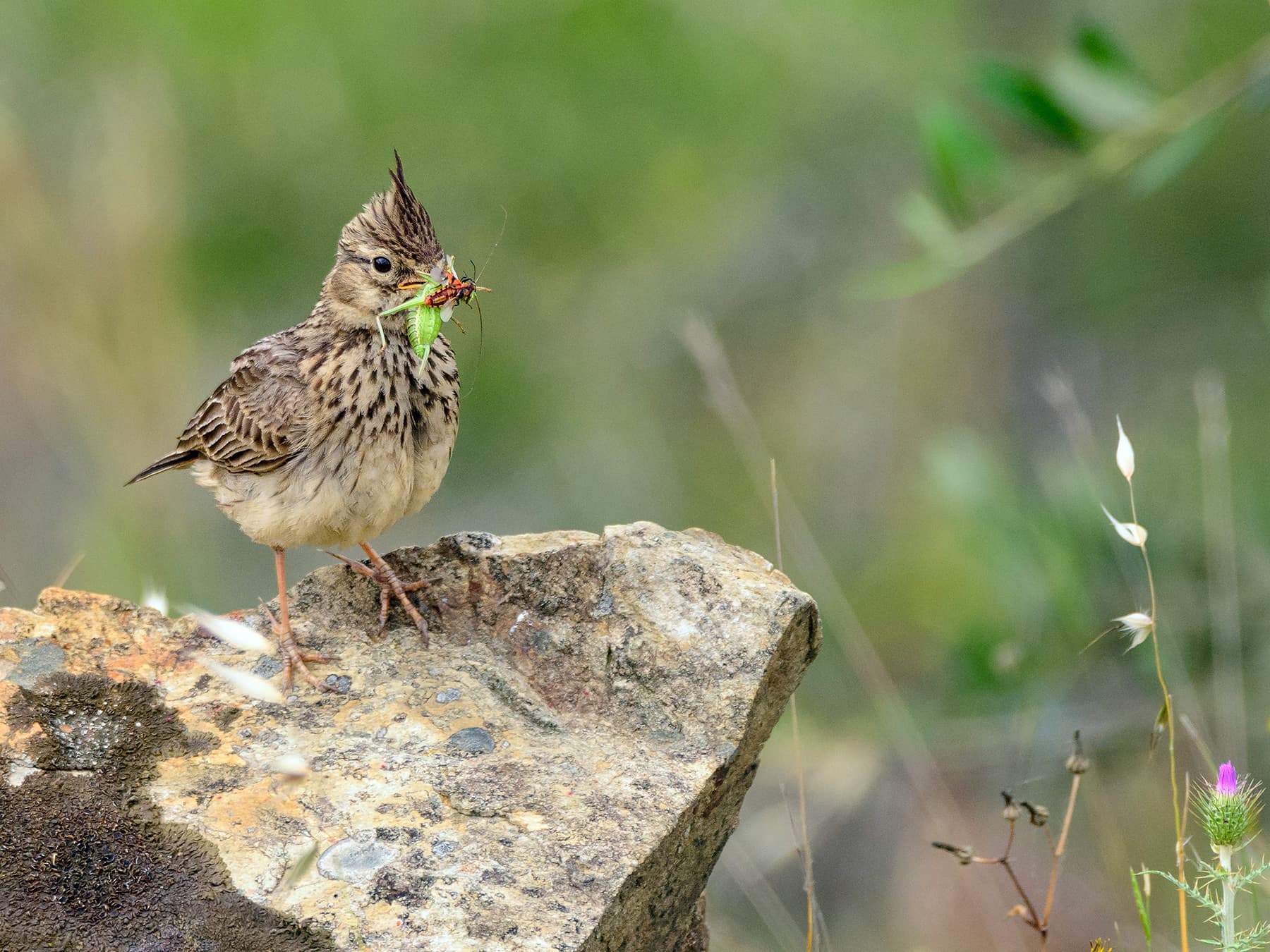
Mainly ground feeders, Thekla’s larks forage for invertebrates, weeds and seeds, with insects being particularly important during the breeding season. They have been observed to smash snails’ shells against the ground and look under stones in search of food.
What do Thekla's Lark chicks eat?
The initial diet of Thekla’s lark hatchlings is animal-based, especially grasshoppers, spiders, caterpillars, and beetles, fed by both parents at the nest. As they grow, larger insects are offered and by late summer as they gain independence, more seeds and green plant shoots are introduced.
Nesting and breeding
Where do Thekla's Larks nest?
Thekla’s larks are ground nesters, which makes them particularly vulnerable to predators and disturbance from humans. Nest success is low, with only between 10 and 20 percent of clutches hatching successfully.
Eggs are laid in a simple depression on the ground, usually concealed by shrubbery or clumps of grass. Grass stems and nearby vegetation is used to form and line a rough nest shape.
When do Thekla's Larks nest?
Nesting begins from February onwards, with most eggs laid between April and June. Up to two broods are raised in a season although three is not unusual in Spain. Incubation lasts for between 11 and 17 days, with the female as the sole incubator. Young Thekla’s larks leave the nest early, after only 9 days but master flight later, from around 15 days.
What do Thekla's Lark eggs look like?
Between two and six white eggs, heavily marked with dark brown speckling are laid. Thekla’s larks’ eggs are relatively small in comparison to those of other lark species, measuring 22 mm by 17 mm (0.9 in by 0.7 in).
Do Thekla's Larks mate for life?
Thekla’s larks form monogamous pairs at the start of the breeding season and are believed to remain with the same mate if more than one brood is raised. Pairs separate once breeding is complete and larger foraging flocks form during the autumn and winter. New mates are found in the following breeding season.
Behaviour
Are Thekla's Larks aggressive?
Any territorial displays shown by Thekla’s larks are limited to vocal claims and defence of a nesting site, rather than physical or aggressive interactions with other birds. When breeding they are typically solitary birds or seen in pairs. In late summer, larger family groups become more common, and flocks of up to 10 to 15 birds may be spotted foraging together in winter.
Lifespan and predators
How long do Thekla's Larks live?
Little is known about the maximum age a Thekla’s lark may be able to live to, but their average lifespan is thought to be around 3.8 years, with first-time breeding at one year.
What are the predators of Thekla's Larks?
Thekla’s larks spend a lot of time on the ground, making them particularly vulnerable to a number of land predators, including rabbits, foxes, mongooses, and wild dogs. Magpies and crows may raid nests and steal eggs or unattended nestlings.
Are Thekla's Larks protected?
The species is included in the EU Birds Directive Annex I and the Bern Convention Appendix II, but no specific conservation activities relating to Thekla’s larks or their habitats are in place in Europe.
Are Thekla's Larks endangered?
Thekla’s larks are considered a species of least concern, and there are no immediate threats to their future survival. In parts of their Spanish range, some slight declines have been reported, linked to increases in the presence of some of the species’ key predators, rabbits, and foxes, after the hunting ban was introduced. Habitat loss from irrigation of pasturelands may also be a factor.
Conservation
While Thekla's Lark is currently listed as Least Concern, it faces localised threats from habitat loss due to agricultural intensification and urbanisation.
Conservation efforts focus on maintaining suitable open habitats and promoting sustainable land-use practices in its range.
More photos
3 photos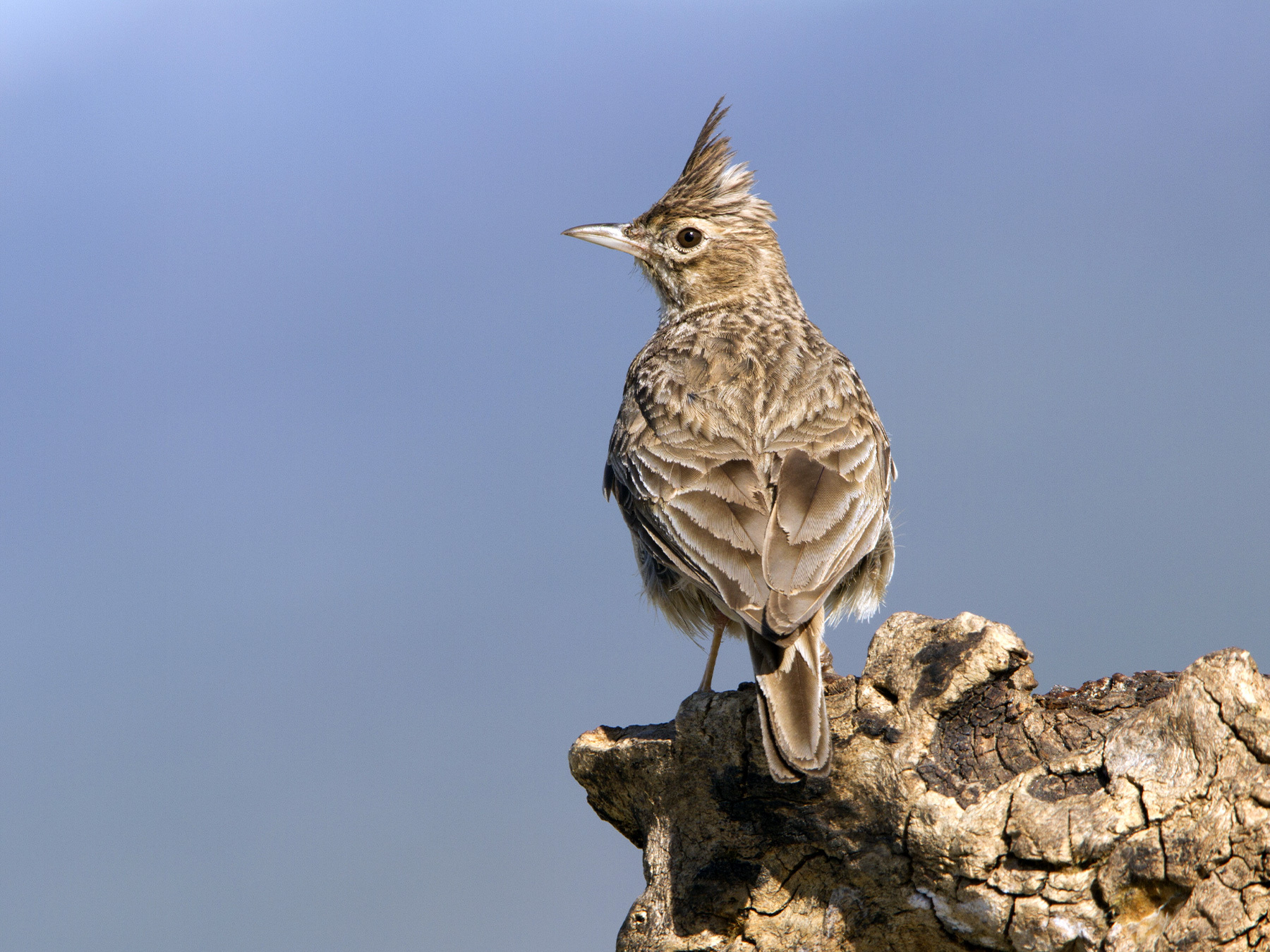
Quick facts
- Length
- 15–17 cm
- Wingspan
- 28–32 cm
- Weight
- 28–45 g
- Lifespan
- 3–5 years
- Family
- Larks
- Migration
- Resident
- Global status (IUCN)
- Least Concern
- World population
- 23,300,000 - 37,900,000 mature individuals
- Population trend
- Decreasing
- Also called
- Thekla Lark
- Scientific name
- Galerida theklae
Sources
3- 1BirdLife International. 2017. Galerida theklae (amended version of 2016 assessment). The IUCN Red List of Threatened Species 2017: e.T22717387A111112049. Source (opens in a new tab)
- 2EBCC (2015)
- 3BirdLife International. 2017. Galerida theklae (amended version of 2016 assessment). The IUCN Red List of Threatened Species 2017: e.T22717387A111112049. Source (opens in a new tab)

Checked by
Nathan Cope, founder and editor
Nathan founded Birdfact and leads its writers and contributors in the UK, the US and Canada. He has watched and studied birds for more than ten years, and checks every article and species guide before it’s published.