


Subalpine Warbler
Eastern Subalpine Warbler · Curruca cantillans
By the Birdfact teamChecked by Nathan Cope
On this page10 sections
How to recognise it
The Sub Alpine Warbler is a relatively rare summer migrant with a seasonal population on the Island estimated to be around one thousand. This bird tends to favour specific locations including The Boquer Valley, the road up to the Cap de Formentor, Cap Blanc and the coastal area at Porto Colom.
Technical description
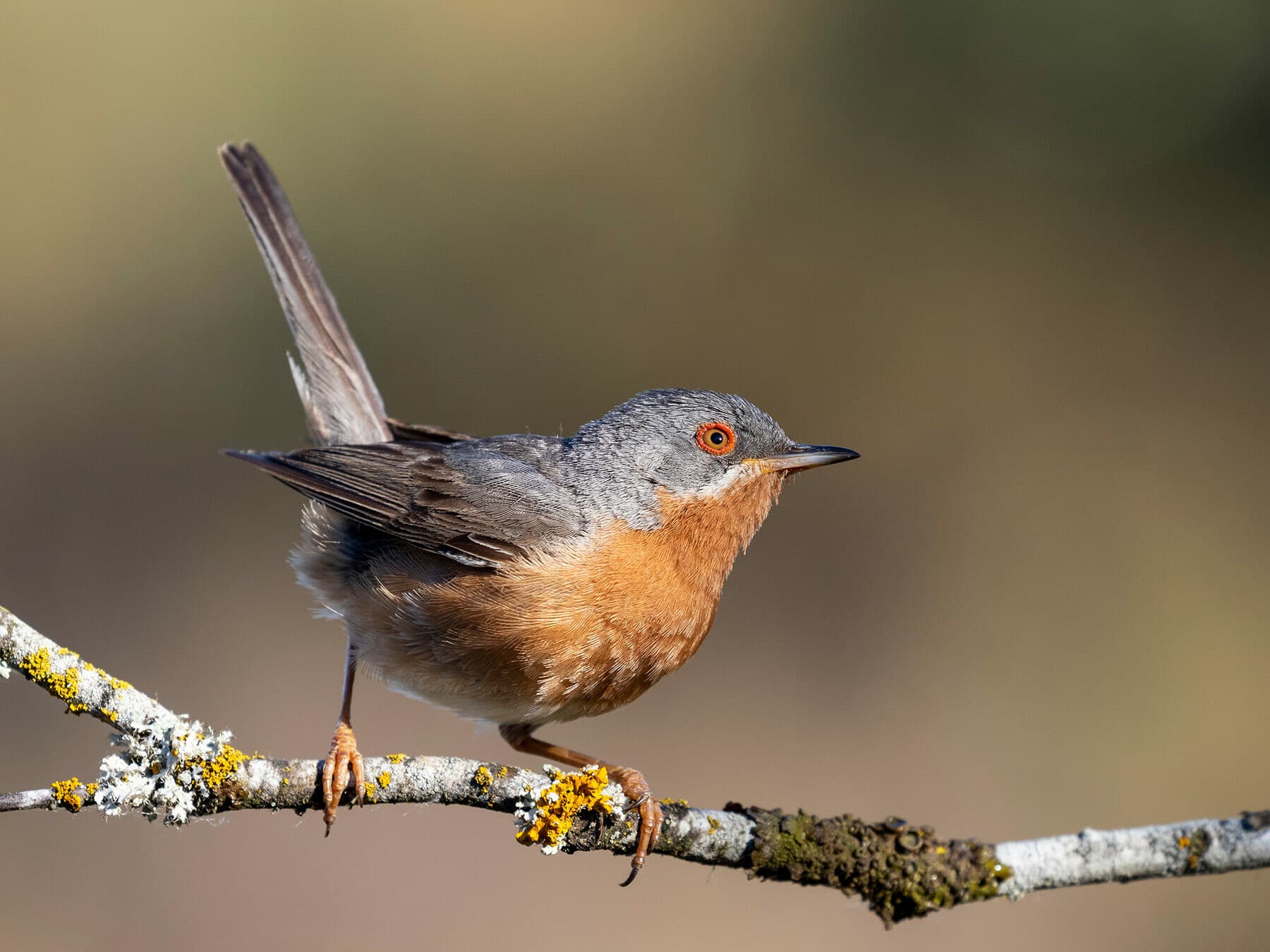
Subalpine Warbler (Sylvia cantillans) is a small typical warbler which breeds in the southernmost areas of Europe and northwest Africa. This small passerine bird is migratory, and winters along the southern edge of the Sahara. Like most Sylvia species, it has distinct male and female plumages. The adult male has a grey back and head, brick-red underparts, and white malar streaks (“moustaches”). The female is mainly brown above, with a greyer head and whitish below with a pink flush. The subalpine warbler’s song is fast and rattling.
Its size
Adults- Length
- 11–12.5 cm
- Wingspan
- 15–19 cm
- Weight
- 9–12 g
Its song and calls
The Subalpine Warbler's song is a rapid, rattling trill, often described as 'trrrrrrt-trrrrrrt'. Their call is a soft 'tac' or 'tchac'.
Males sing persistently during the breeding season, often from exposed perches to defend territory and attract mates.
When and where to see it
OctoberArriving
Most recorded in October
- 1. Shetland Islandsunder 0.1%
Each dot is a county, state or province: the bigger and darker, the larger the bird’s share of that place’s bird records that month. Grey dots: no regular records. The ringed point is the centre of the bird’s records this month; the arrow shows how it moved since last month, and the dashed loop its path through the year. “Arrivals” colours places where it becomes regular this month (orange) or is in its last regular month (grey). GBIF eBird Observation Dataset, 2019–2024. Map data: Natural Earth, US Census Bureau; place centres © OpenStreetMap contributors.
In your area
See when the Subalpine Warbler is recorded in your county, state or province.
How often the Subalpine Warbler turns up in the UK through the year, from birdwatchers' records.
United Kingdom
Passage migrant · regularly Apr–Jun · most records in May
Show as a table
| Month | United Kingdom |
|---|---|
| January | – |
| February | – |
| March | – |
| April | 0.001% (regular) |
| May | 0.002% (regular) |
| June | <0.001% (regular) |
| July | – |
| August | – |
| September | – |
| October | <0.001% |
| November | – |
| December | – |
Recorded regularly in
Worldwide: recorded regularly in 23 countries
Countries where it was recorded in at least 3 of the 6 years 2019–2024. Linked countries have their own bird list.
Europe (15)
- Albania
- Bosnia & Herzegovina
- Bulgaria
- Croatia
- France
- Germany
- Greece
- Italy
- Malta
- Montenegro
- North Macedonia
- Norway
- Slovenia
- Switzerland
- United Kingdom
Data: EOD – eBird Observation Dataset (Cornell Lab of Ornithology), accessed via GBIF.org, CC BY 4.0. Records from 2019–2024, aggregated and filtered by Birdfact. How these lists are made
Tips for seeing it
- Look for quick movements in low shrubs and bushes
- Listen for their distinctive rattling call
- Observe during spring migration in coastal areas
- Pay attention to the male's bright red eye ring for identification
What it eats
The Subalpine Warbler primarily feeds on small insects and spiders, which it gleans from leaves and branches.
During autumn, they supplement their diet with small berries and fruits, especially before migration, to build up fat reserves.
Nesting and breeding
Breeding occurs from April to July, with males establishing territories through song and display flights. Pairs form monogamous bonds for the breeding season.
The female constructs a cup-shaped nest low in dense shrubs, using grasses, spider webs, and plant down. She typically lays 3-5 eggs, which are pale with brown speckles.
Incubation lasts about 12 days, primarily by the female. Both parents feed the chicks, which fledge after 11-12 days but remain dependent on adults for another two weeks.
Behaviour
Subalpine Warblers are active and agile, constantly flitting through dense vegetation in search of insects. They often hover briefly while foraging, a behaviour that distinguishes them from other warblers.
During the breeding season, males become territorial and perform display flights to attract mates.
Conservation
While currently listed as Least Concern, the Subalpine Warbler faces threats from habitat loss due to agricultural intensification and climate change.
Conservation efforts focus on preserving Mediterranean scrubland habitats and monitoring population trends across its range.
Quick facts
- Length
- 11–12.5 cm
- Wingspan
- 15–19 cm
- Weight
- 9–12 g
- Lifespan
- 3–5 years
- Family
- Sylviid Warblers
- Migration
- Long-distance Migrant
- Global status (IUCN)
- Least Concern
- World population
- Not been quantified since the species was split
- Population trend
- Increasing
- Also called
- Eastern Subalpine Warbler
- Scientific name
- Curruca cantillans
Sources
2- 1BirdLife International. 2019. Sylvia cantillans (amended version of 2018 assessment). The IUCN Red List of Threatened Species 2019: e.T103874024A155622649. Source (opens in a new tab)
- 2EBCC (2015)

Checked by
Nathan Cope, founder and editor
Nathan founded Birdfact and leads its writers and contributors in the UK, the US and Canada. He has watched and studied birds for more than ten years, and checks every article and species guide before it’s published.