


Stygian Owl
Tropical Great Horned Owl · Asio stygius
By the Birdfact teamChecked by Nathan Cope
On this page12 sections
How to recognise it
What do Stygian Owls look like?
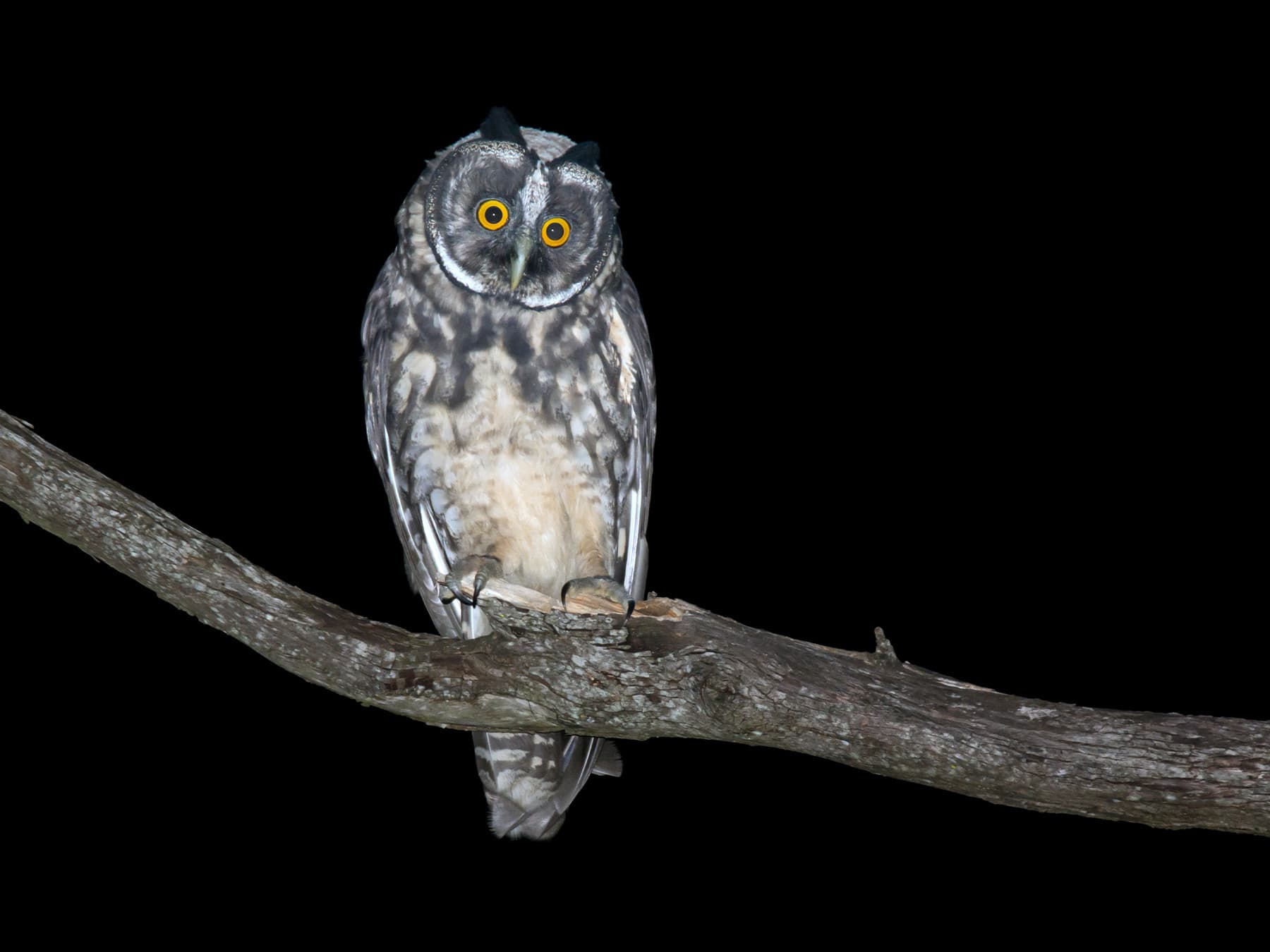
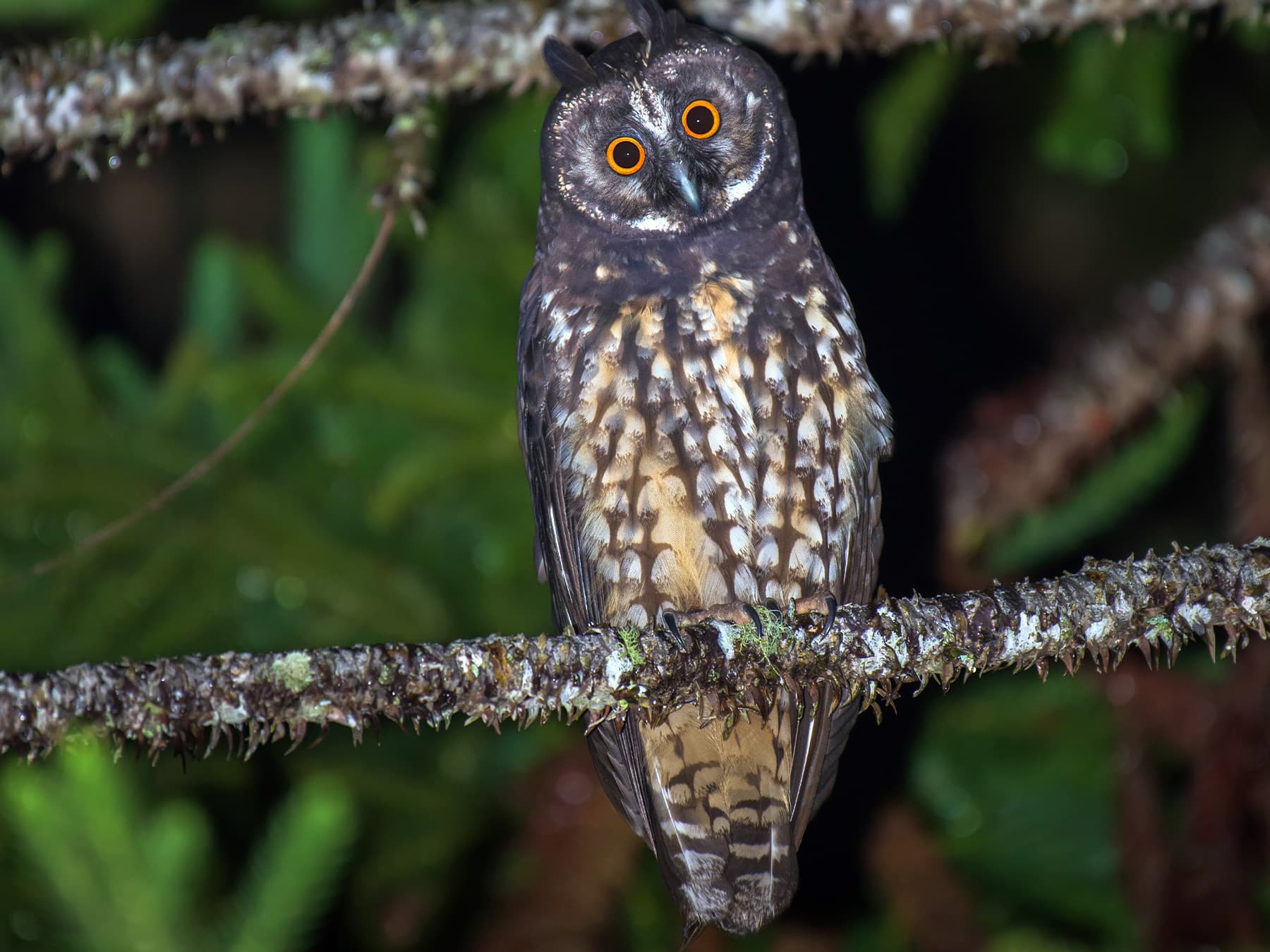
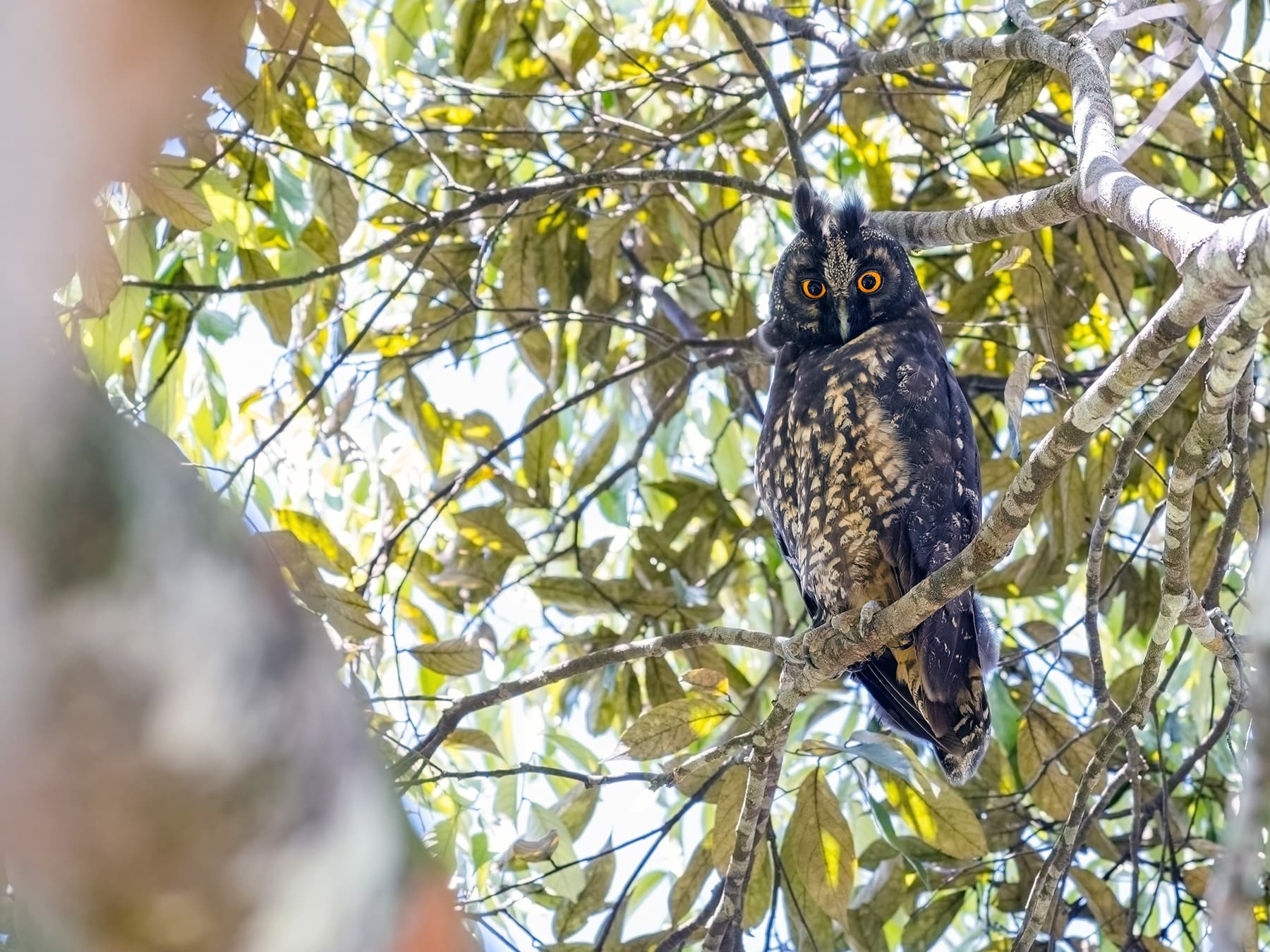
Stygian owls are remarkable for their particularly dark plumage, with a small blackish facial disk bordered by pale feathers. Their prominent dark ear tufts are an identifying feature of this species. Their wings and back are dark with lighter buff streaking. The breast and belly are pale buff, densely marked with deep black-brown barring.
The eyes are a piercing yellow, the bill is blue-black, and the legs and feet are grayish-pink.
Sexes are similar, although females are slightly larger and heavier.
Juvenile stygian owls are initially downy in appearance, and have an overall lighter gray and paler brown appearance than the dark, dusky adults of the species. Their bodies are heavily marked with dark barring, and their facial disk is less defined than in adults. The eyes of juvenile stygian owls are brownish-yellow and gradually become a clearer bright yellow with age and maturity.
How big are Stygian Owls?
A moderately large member of the owl family, the stygian owl is similar in size to a barn owl and a long-eared owl. Females are larger and heavier than males and have slightly longer wings.
- Length: 38 cm to 46 cm (15 in to 18 in)
- Wingspan: 96 cm to 110 cm (38 in to 43 in)
- Weight: 500 g to 700 g (1.1 lb to 1.5 lb)
Its size
Adults- Length
- 41–46 cm
- Wingspan
- 100–120 cm
- Weight
- 450–680 g
Its song and calls
What sound does a Stygian Owl make?
Male stygian owls can be heard making a repetitive deep "whoof" with short intervals between calls. Females use a shrill “miah” scream in "miah", in response to the male. A noisy "wak-wak-wak" signals excitement, and young owlets make a “cheet” cry when hungry.
When and where to see it
The Stygian Owl is not recorded regularly in the UK, Ireland, the United States or Canada.
Worldwide: recorded regularly in 14 countries
Countries where it was recorded in at least 3 of the 6 years 2019–2024. Linked countries have their own bird list.
Data: EOD – eBird Observation Dataset (Cornell Lab of Ornithology), accessed via GBIF.org, CC BY 4.0. Records from 2019–2024, aggregated and filtered by Birdfact. How these lists are made
What is the habitat of a Stygian Owl?
Stygian owls are known primarily as forest-dwelling owls, found in mountainous regions at elevations between 700 m to 3000 m (2300 ft and 10,000ft) above sea level.
Present in both tropical rainforests and both humid and semi-arid forested landscapes, stygian owls are usually absent from low-lying regions, although, in parts of Brazil and Belize, they are observed to hunt in savannah environments.
What is the range of a Stygian Owl?
Eastern and southern Mexico forms the northern limit of the stygian owl’s usual distribution range. Scattered populations occur throughout Central America to Nicaragua. Stygian owls also have a presence in the Caribbean islands of Cuba and Hispaniola.
In South America stygian owls are resident from the extreme northwest of Venezuela through eastern Colombia and central Ecuador. A small population is found in north-central Brazil, with a larger area spreading from eastern Bolivia south through eastern Paraguay, northeastern Argentina, and into southern Brazil.
Where do Stygian Owls live?
Stygian owls have a discontinuous range, and have been recorded as a native species in Mexico, the South American countries of Colombia, Venezuela, Ecuador, Brazil, Bolivia, Peru, Paraguay, and Argentina, and in Belize, Guatemala, Honduras, and Nicaragua in Central America. Stygian owls are also native to the Caribbean islands of Cuba, the Dominican Republic, and Haiti.
How rare are Stygian Owls?
Despite having an expansive geographical distribution area, little is known about the population size or prevalence of stygian owls.
Only a handful of records exist from Venezuela and Nicaragua, while in Brazil it is thought to be more widespread and numerous. The overall population is unknown, but a wide estimate of 50,000 to 499,999 is suggested by Bird Life International.
Where can you see Stygian Owls in the US?
Stygian owls are not normally resident in any part of the United States, with their northern range beginning from the state of Durango in western Mexico. However, occasional reports of vagrant individuals have been recorded in the southern US, including the first recorded sighting in Texas in 1996 at Bentsen-Rio Grande Valley State Park.
Migration
Do Stygian Owls migrate?
From all information available about the species’ habits and behavior, it appears that across their range, stygian owls are permanent residents and no migration occurs.
Are Stygian Owls native to the US?
Stygian owls are not native to the US and the only records of the species in the country are as scarce vagrant individuals, limited to Florida and Texas. Sightings are not regular and no breeding has ever taken place in the United States.
Tips for seeing it
- Look for Stygian Owls in dense forests or along forest edges after sunset
- Listen for their distinctive low-pitched hoots, which can carry for long distances
- Search for pellets or whitewash beneath large trees, which may indicate roosting sites
- Use red-filtered flashlights to minimize disturbance when observing at night
What it eats
What do Stygian Owls eat?
Birds form the chief element of a stygian owl’s diet, including blue-black grassquit, eared doves, and lesser nothura. Bats are also important, and frogs and insects are also eaten.
Stygian owls hunt from perches, targeting birds roosting overnight or catching bats in flight. Compared to other owl species, stygian owls are notable as their diet is not focused primarily on rodents.
What do Stygian Owl chicks eat?
Adult stygian owls bring prey to the nest, including regurgitated grasshoppers, crickets, and small birds that are torn up and fed to their young.
Nesting and breeding
Where do Stygian Owls nest?
Stygian owls do not build their own nests, instead repurposing an abandoned tree nest of another bird. Ground-level nests are occasionally used.
When do Stygian Owls nest?
Stygian owls’ breeding is timed to coincide with the rainy season, and timings differ from location to location. Nests are variously reported in March in central Brazil, in July in Belize, in September in southern Brazil, and in December in Cuba.
Incubation, by the female alone, lasts for around 30 days.
What do Stygian Owl eggs look like?
Eggs laid by stygian owls are plain white and rounded in shape, similar in size to table tennis balls. A typical clutch contains between 1 and three eggs.
Do Stygian Owls mate for life?
From what little we know about the breeding habits of stygian owls, it appears that they are monogamous and will usually reunite to breed each year. Bonds are strengthened during courtship with males performing a wing-clapping display flight and females presenting males with food offerings.
Behaviour
Are Stygian Owls aggressive?
Aggressive hunting behavior is characteristic of stygian owls, who are observed to fearlessly attack prey that is much larger than themselves. Hissing and bill-snapping may be used when they feel their nest site is at risk.
Where do Stygian Owls sleep at night?
Stygian owls are nocturnal, hunting during hours of darkness and roosting in dense vegetation during daylight hours. Empty cavities abandoned by other species may be used for roosting.
Lifespan and predators
How long do Stygian Owls live?
Due to an absence of in-depth research on the behavior and ecology of stygian owls, information about their lifespan and first breeding age is unknown.
What are the predators of Stygian Owls?
Unusually for an owl species, stygian owls are known to prey on their own species, an adaptation known as intraguild predation, which is thought to occur to eliminate competition for food resources.
Are Stygian Owls protected?
Across their range, stygian owls are protected under various local conservation acts. In Mexico, they are protected under the Endangered Species Act, while in Brazil, the Brazilian Wildlife Protection Act prohibits them from being killed, captured, traded, or injured.
Are Stygian Owls endangered?
Little is known about the threats and impacts of habitat change on the population numbers or future survival patterns of stygian owls, other than the global population is believed to be in decline. Worldwide, they are ranked as a species of least concern.
Conservation
While the Stygian Owl is listed as Least Concern by the IUCN, it faces threats from habitat loss due to deforestation in parts of its range.
Conservation efforts focus on protecting large tracts of mature forest, which are crucial for this species' survival.
Quick facts
- Length
- 41–46 cm
- Wingspan
- 100–120 cm
- Weight
- 450–680 g
- Lifespan
- 10–15 years
- Family
- Owls
- Migration
- Resident
- Global status (IUCN)
- Least Concern
- World population
- 50,000 - 499,999 mature individuals
- Population trend
- Decreasing
- Also called
- Tropical Great Horned Owl
- Scientific name
- Asio stygius
Questions
2Do Stygian Owls have red eyes?
Stygian owls have piercing golden-yellow eyes. Their eyes can appear to glow a fiery red when illuminated by artificial light.
What do Stygian Owls symbolize?
Stygian refers to the Styx, the river of the Underworld in Greek mythology. The Styx was the river crossed by souls to reach the Underworld and formed the boundary of Hades. Today it has a wider meaning relating to being dark and gloomy, which reflects their dusky plumage.
Sources
3- 1BirdLife International. 2023. Asio stygius. The IUCN Red List of Threatened Species 2023: e.T22689504A167862135. Source (opens in a new tab)
- 2BirdLife International. 2023. Asio stygius. The IUCN Red List of Threatened Species 2023: e.T22689504A167862135. Source (opens in a new tab)
- 3Partners in Flight (2022)

Checked by
Nathan Cope, founder and editor
Nathan founded Birdfact and leads its writers and contributors in the UK, the US and Canada. He has watched and studied birds for more than ten years, and checks every article and species guide before it’s published.