


Steller's Sea-eagle
Steller's Sea Eagle, Pacific Sea Eagle · Haliaeetus pelagicus
By the Birdfact teamChecked by Nathan Cope
On this page21 sections
- How to recognise it
- Its size
- Its song and calls
- When and where to see it
- What it eats
- Nesting and breeding
- Behaviour
- Lifespan and predators
- Conservation
- What does a Steller’s Sea-Eagle look like?
- How big is a Steller’s Sea-Eagle?
- How much does a Steller’s Sea-Eagle weigh?
- How much weight can a Steller’s Sea-Eagle carry?
- How big are the talons on a Steller’s Sea-Eagle?
- What is the scientific name of a Steller’s Sea-Eagle?
- Are Steller’s Sea-Eagles aggressive or friendly?
- Are Steller’s Sea-Eagles endangered?
- Do Steller’s Sea-Eagles mate for life?
- Steller's Sea-eagle guides
- Quick facts
- Sources
How to recognise it
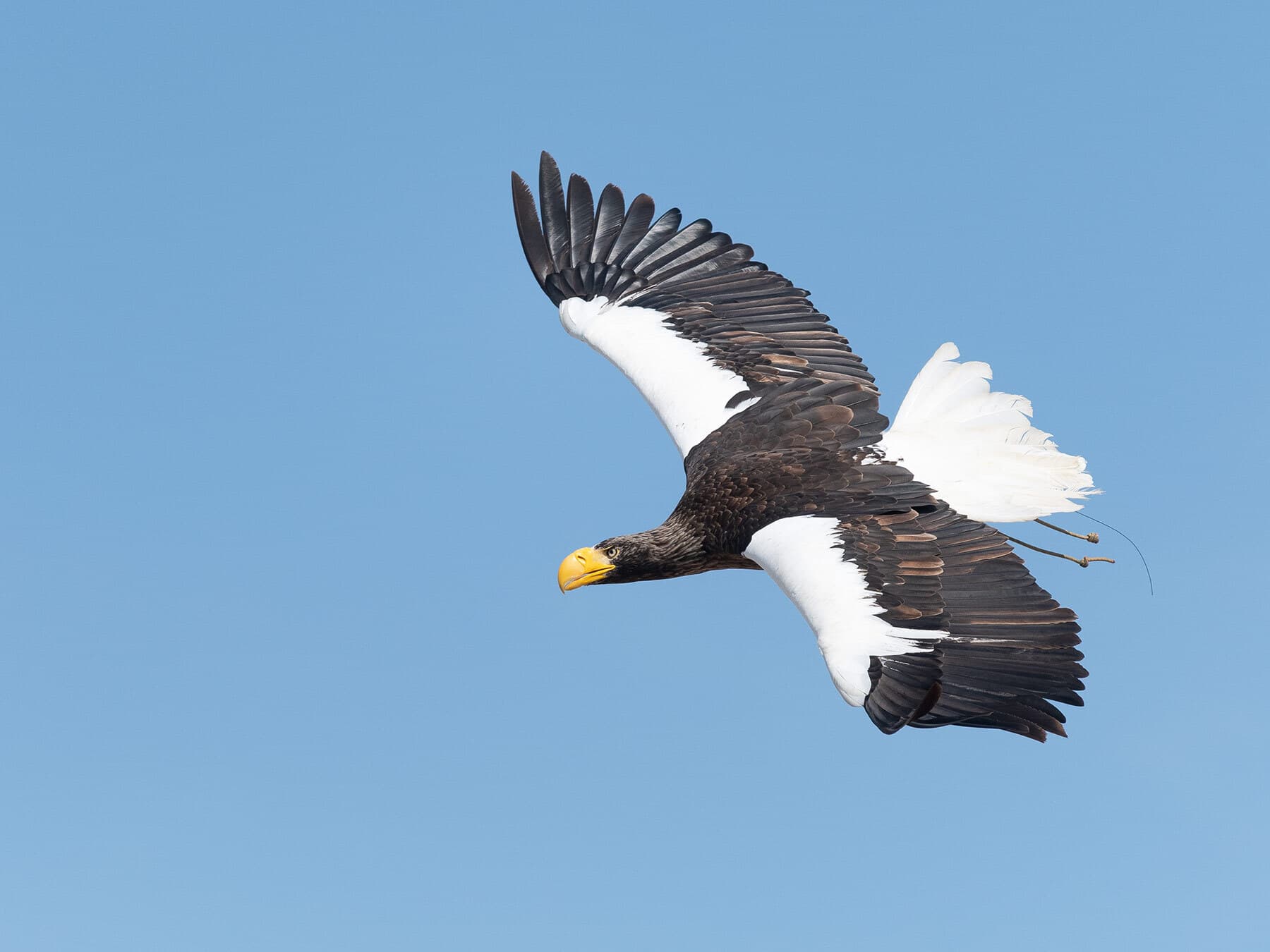
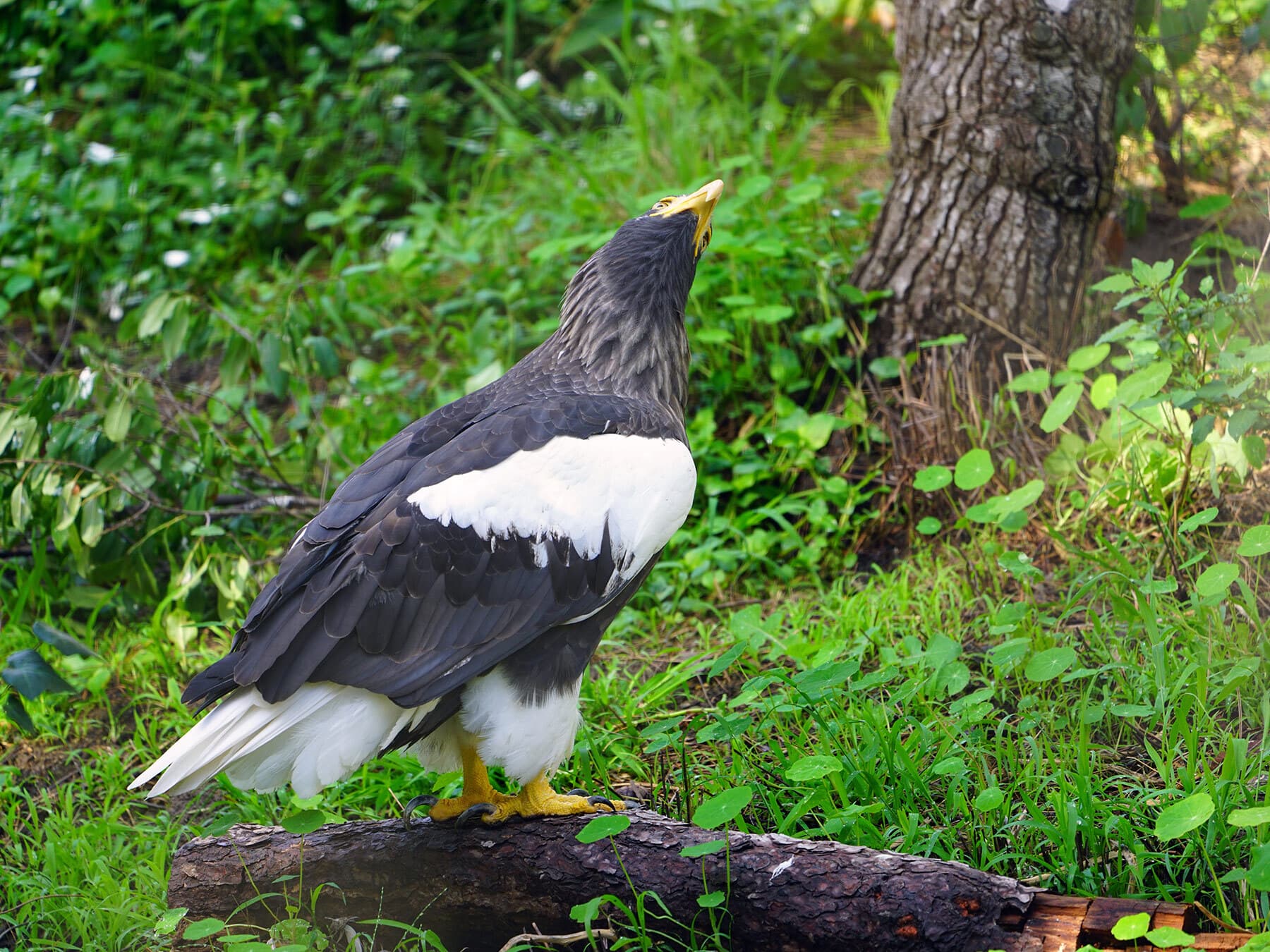
The Steller's Sea Eagle is one of the largest eagles in the world. Its distinctive dark brown body sharply contrasts with white shoulders, tail, and thighs. The eagle's massive yellow beak is a standout feature, complemented by powerful yellow talons. The nostrils are also large and prominent.
Juveniles have a darker overall plumage, with mottled white on the wings and tail. Adults develop their full white markings by about five years of age, with no significant plumage differences between males and females. However, females are much larger.
Its size
Adults- Length
- 85–105 cm
- Wingspan
- 195–250 cm
- Weight
- 4900–9000 g
Its song and calls
Generally regarded as silent birds, their calls are more frequent during the breeding season when their song is similar to a large gull’s ‘kyow – kyow’ sound or alternatively, when feeding or roosting outside the breeding season it consists of a raucous deep barking noise, ‘kra – kra – kra’.
When and where to see it
OctoberMostly absent
Most recorded in October
- 1. Newfoundland and Labradorunder 0.1%
- 2. Alaskaunder 0.1%
Each dot is a county, state or province: the bigger and darker, the larger the bird’s share of that place’s bird records that month. Grey dots: no regular records. The ringed point is the centre of the bird’s records this month; the arrow shows how it moved since last month, and the dashed loop its path through the year. “Arrivals” colours places where it becomes regular this month (orange) or is in its last regular month (grey). GBIF eBird Observation Dataset, 2019–2024. Map data: Natural Earth, US Census Bureau; place centres © OpenStreetMap contributors.
In your area
See when the Steller's Sea-eagle is recorded in your county, state or province.
How often the Steller's Sea-eagle turns up in the United States and Canada through the year, from birdwatchers' records.
United States
Scarce · most records in January
Canada
Passage migrant · regularly Apr–Nov · most records in July
Show as a table
| Month | United States | Canada |
|---|---|---|
| January | 0.002% | <0.001% |
| February | 0.001% | – |
| March | <0.001% | <0.001% |
| April | – | <0.001% (regular) |
| May | <0.001% | <0.001% |
| June | <0.001% | <0.001% (regular) |
| July | <0.001% | 0.003% (regular) |
| August | <0.001% | 0.001% (regular) |
| September | – | <0.001% |
| October | <0.001% | <0.001% |
| November | <0.001% | 0.002% (regular) |
| December | 0.001% | <0.001% |
Worldwide: recorded regularly in 7 countries
Countries where it was recorded in at least 3 of the 6 years 2019–2024. Linked countries have their own bird list.
Data: EOD – eBird Observation Dataset (Cornell Lab of Ornithology), accessed via GBIF.org, CC BY 4.0. Records from 2019–2024, aggregated and filtered by Birdfact. How these lists are made
Breeding pairs will often build a number of large heavy nests close to water on rocky outcrops or high up in the forks of trees, but they will raise their chicks in only one nest. The same adults may visit the same nests year after year during subsequent breeding seasons. Nests are constructed from sticks and twigs and are made or repaired (if using nests from a previous year) during the months of February and March.
Where do Steller’s Sea-Eagles live?
Steller’s sea-eagles live in an area of the Palearctic in the northeast corner of Russia, on its Pacific east coast, predominantly along the Kamchatka Peninsula, the western area of the Bering Sea and the Sea of Okhotsk which lies between the east coast of the Russian mainland and the west coast of the Kamchatka Peninsula.
What is the habitat of the Steller’s Sea-Eagle?
Heavily dependent upon a fish diet influences where the Steller’s sea-eagle lives which is either along sea cliffs or in mature forested valleys overlooking richly stocked salmon and trout rivers.
Where can I see Steller’s Sea-Eagles?
Unless you are particularly adventurous you are most likely to come across a Steller’s sea-eagle at a zoo or wildlife park! As a resident breeder in the Russian north east, predominantly along the Kamchatka Peninsula, their chosen domain may not be easily accessible.
Do Steller’s Sea-Eagles migrate?
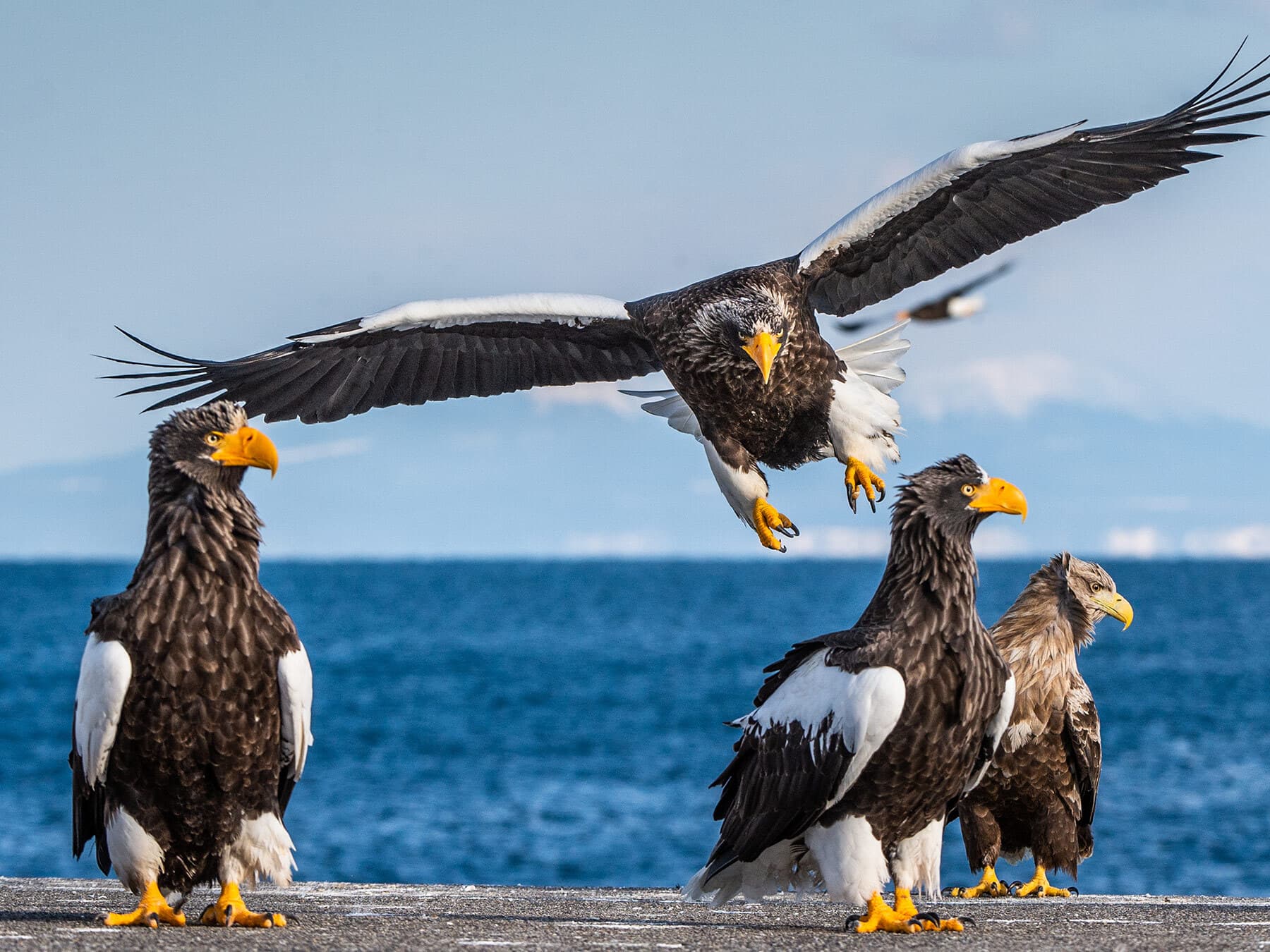
Not all of this species migrates, although the majority do and do so at a time which is dependent upon the availability of food stocks and the conditions of the ice across the breeding grounds. Some simply move away from the coast and settle on the ice sheets close to open water. Those birds that do migrate during the winter months travel south to Russia’s Kuri Islands, Japan’s northernmost land mass Hokkaido, and Korea. Very occasionally vagrant birds find their way across the Bering Straits into Alaska.
Tips for seeing it
- Look for them along coastlines and near large rivers in northeastern Asia
- Scan for their distinctive white tail and shoulders against dark plumage
- Visit known wintering grounds in Hokkaido, Japan, for the best viewing opportunities
- Observe them during early morning or late afternoon when they're most active
What it eats
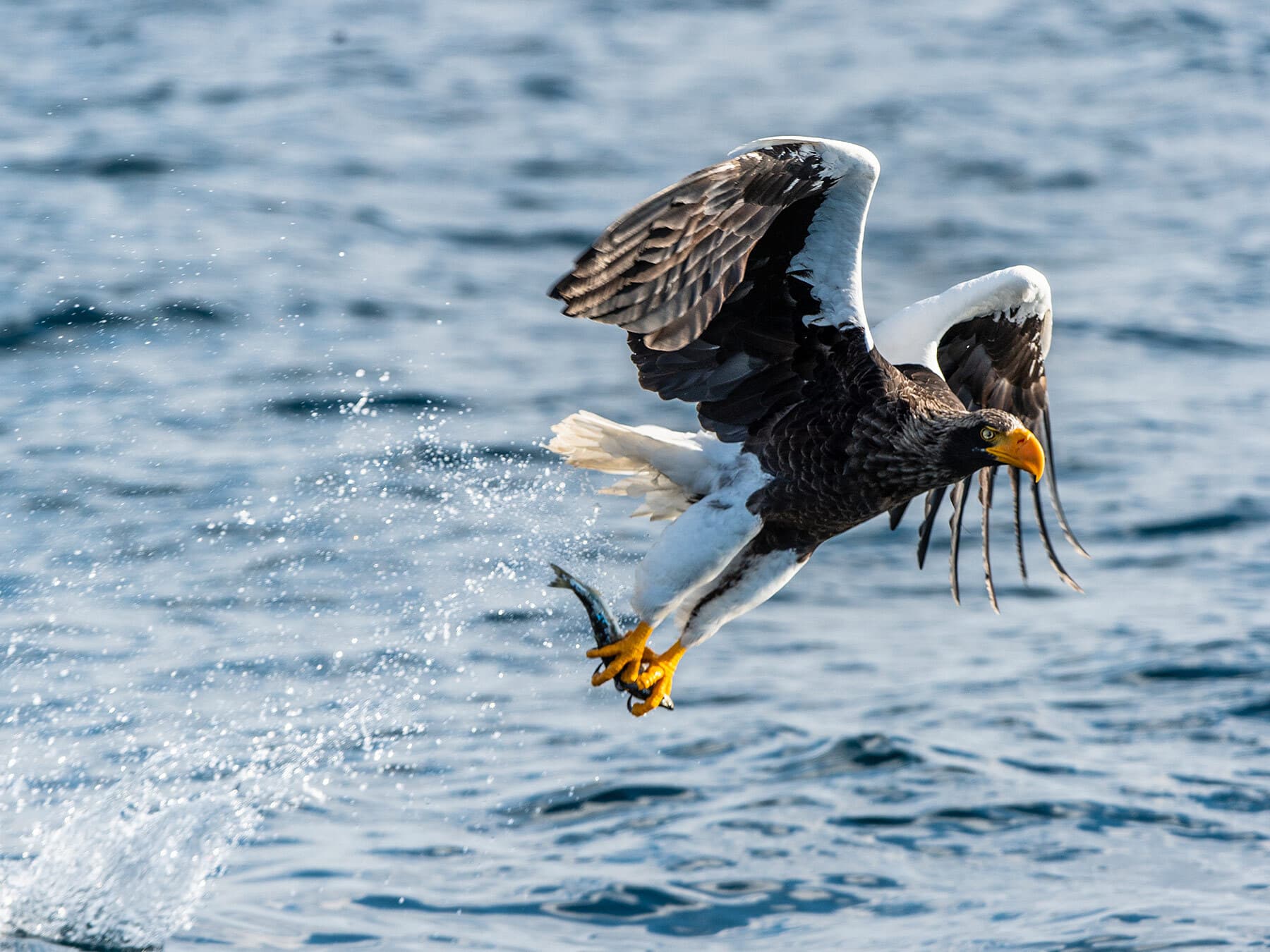
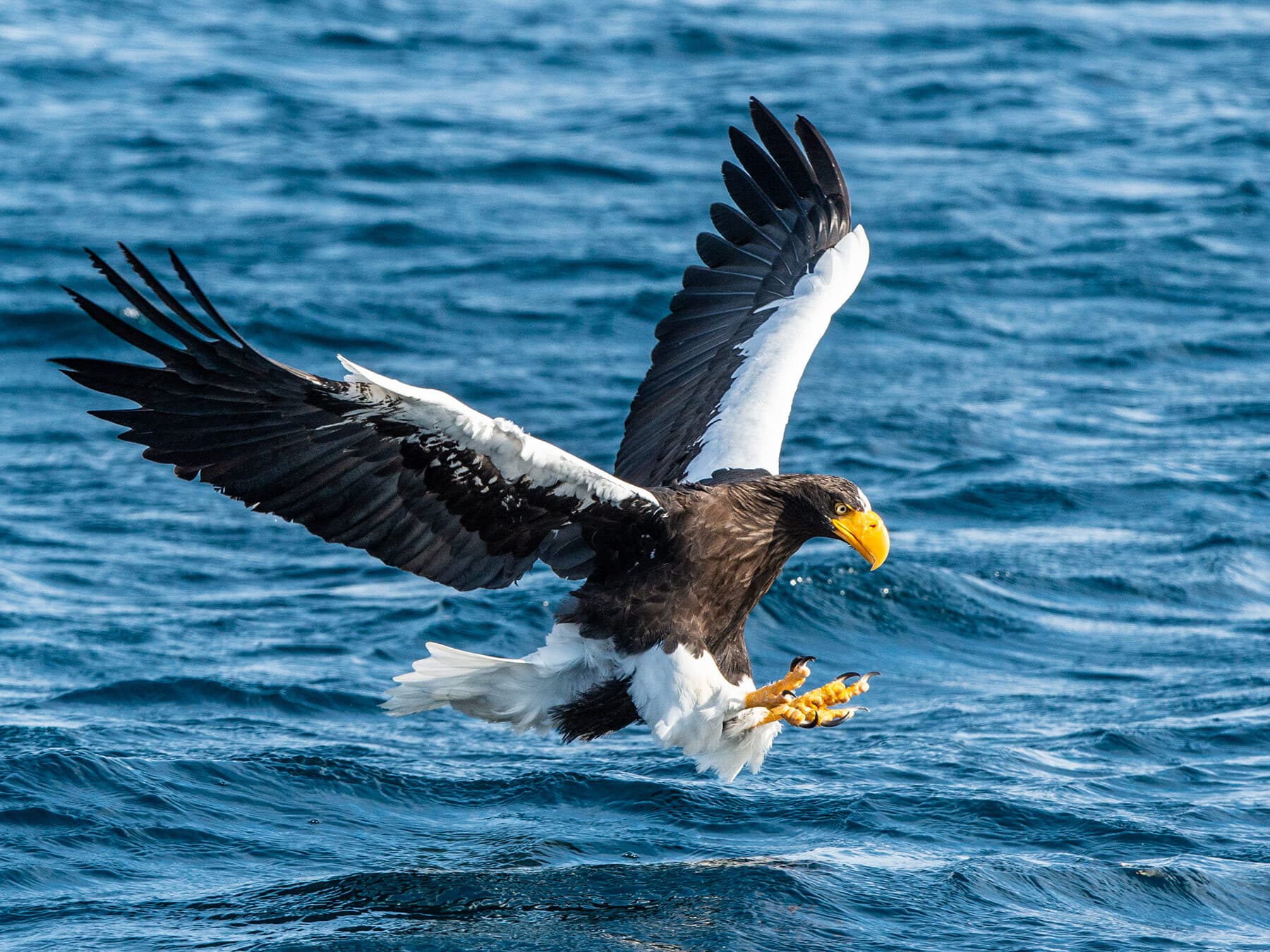
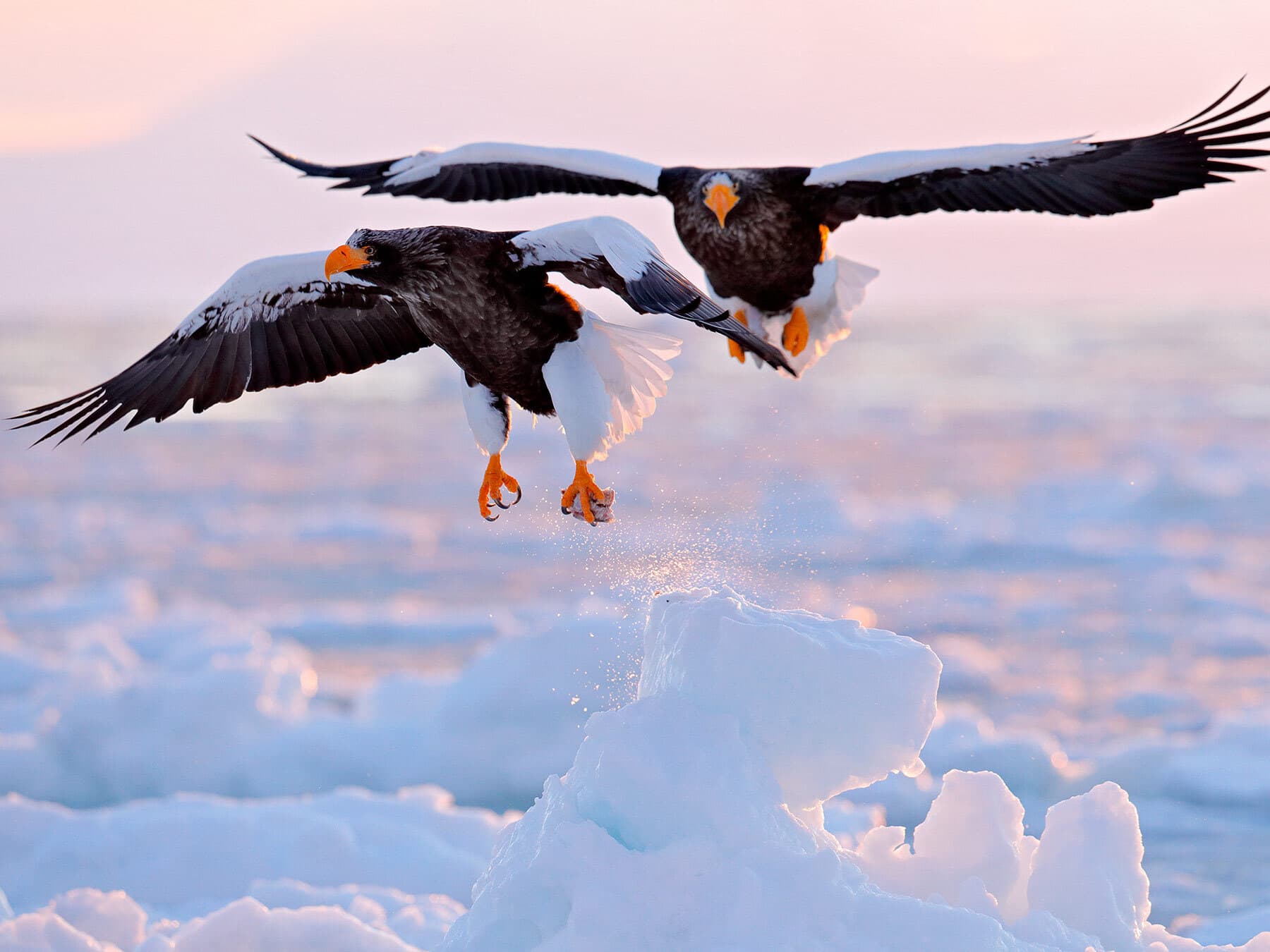
The sea-eagle’s diet comprises predominantly of fish and in particular salmon and trout. They will not necessarily just prey on live fish but will also scavenge for dead fish and even steal from other birds. Where fish are not available, they will prey on small sea birds and mammals. Generally, they feed by catching live fish in their talons, diving down to the water’s surface feet first as their prey swims by.
Nesting and breeding
The adult breeding female produces one clutch of one to three eggs annually, normally just the two, between the months of April and May. The eggs are incubated for between 38 to 45 days. Infant mortality due to falls from the nest or disease often means only one chick per season will survive. Young fledge around ten weeks after hatching.
What do Steller’s Sea-Eagle eggs look like?
Steller’s sea-eagle eggs are a greenish white and are medium to large in size weighing 5.6 ounces (160g) which is slightly larger than a goose egg.
Behaviour
Steller's Sea-eagles are often solitary but may gather in small groups at abundant food sources. They soar effortlessly on thermals and updrafts, using their keen eyesight to spot prey.
During winter, these eagles can be seen perching on sea ice or coastal trees, patiently waiting for fishing opportunities.
Lifespan and predators
It is unusual for a full brood of chicks, normally no more than three, to reach adulthood, with generally only one of the clutch surviving to become a breeding adult. The average lifespan of the Steller’s sea-eagle in the wild is twenty years although this can be extended in captivity.
Conservation
Steller's Sea-eagles face threats from habitat loss, pollution, and climate change. Logging in their breeding areas and coastal development impact nesting sites.
Conservation efforts focus on protecting key habitats and reducing human disturbances in their range.
What does a Steller’s Sea-Eagle look like?
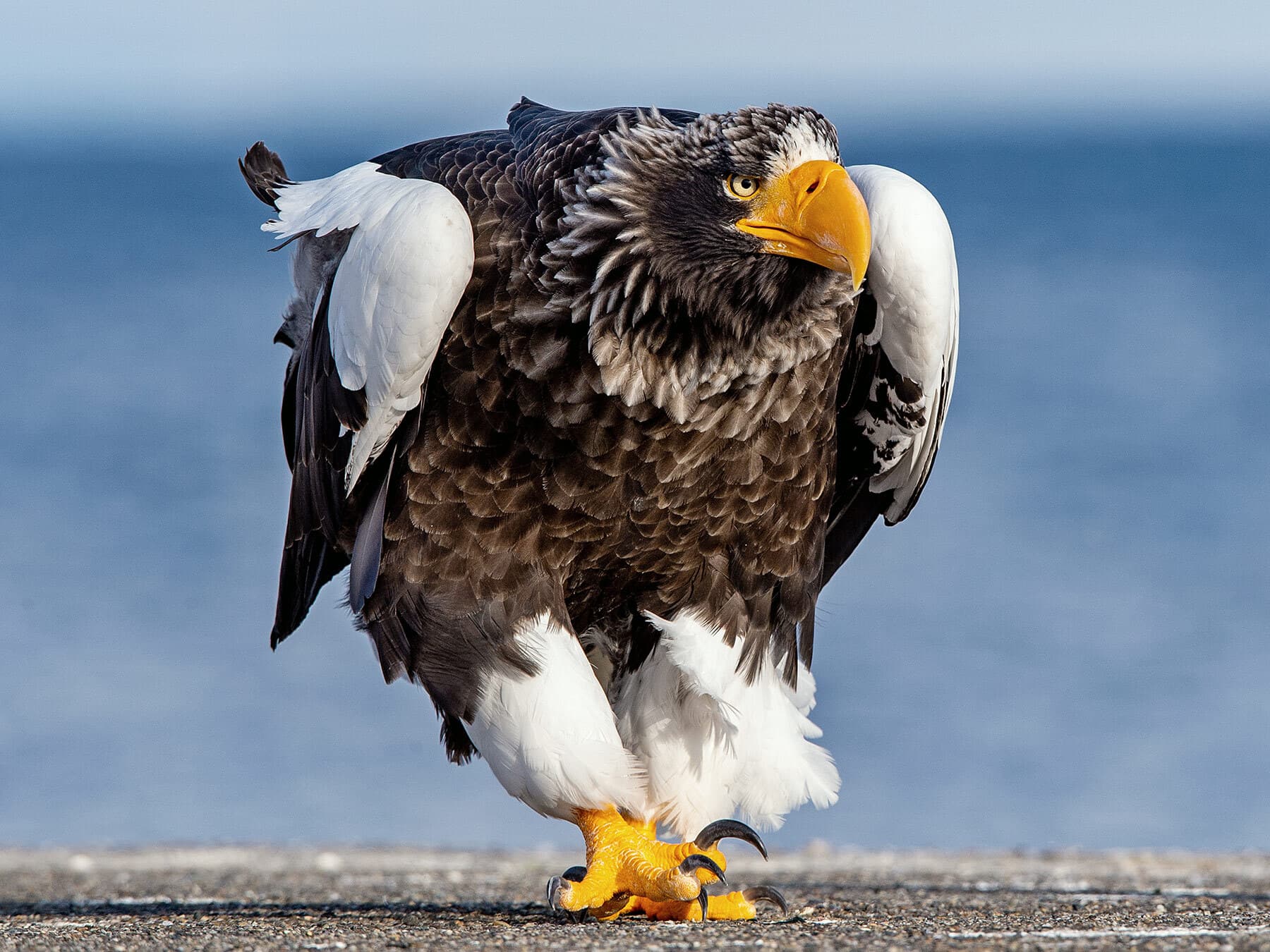
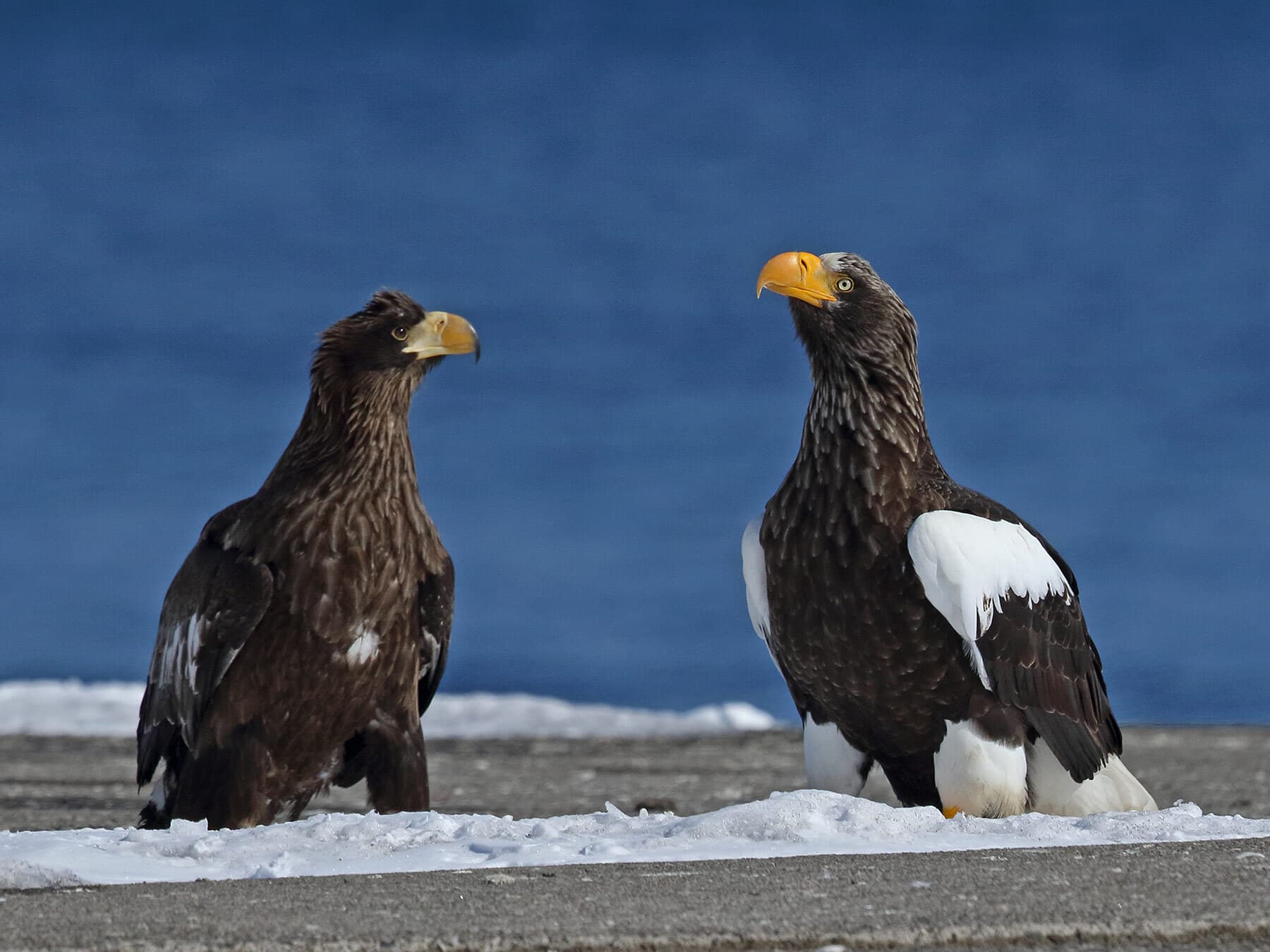
One of the most striking things about the Steller’s sea-eagle is the size of its bright yellow coloured bill which is huge, robust and rounded into a vicious hook shape. The nostrils are also large and prominent. The bird is predominantly black or blackish brown above and below with contrasting bright white tail, rump and leg feathers. The shoulders and leading edge of the wings are white and there is a small white patch on the forehead just above the base of the upper mandible. The eyes are yellow as is the eye ring (the area of skin immediately surrounding the eye). Feet are also yellow with sharp hooked dark grey coloured talons. The adult female resembles the male apart from her size which is much larger.
There is an alternative colour morph to the adult Steller’s sea-eagle where the adult bird is black all over apart from a white tail. Although this colour variant is less common, it was also once thought to belong to a subspecies of the nominate.
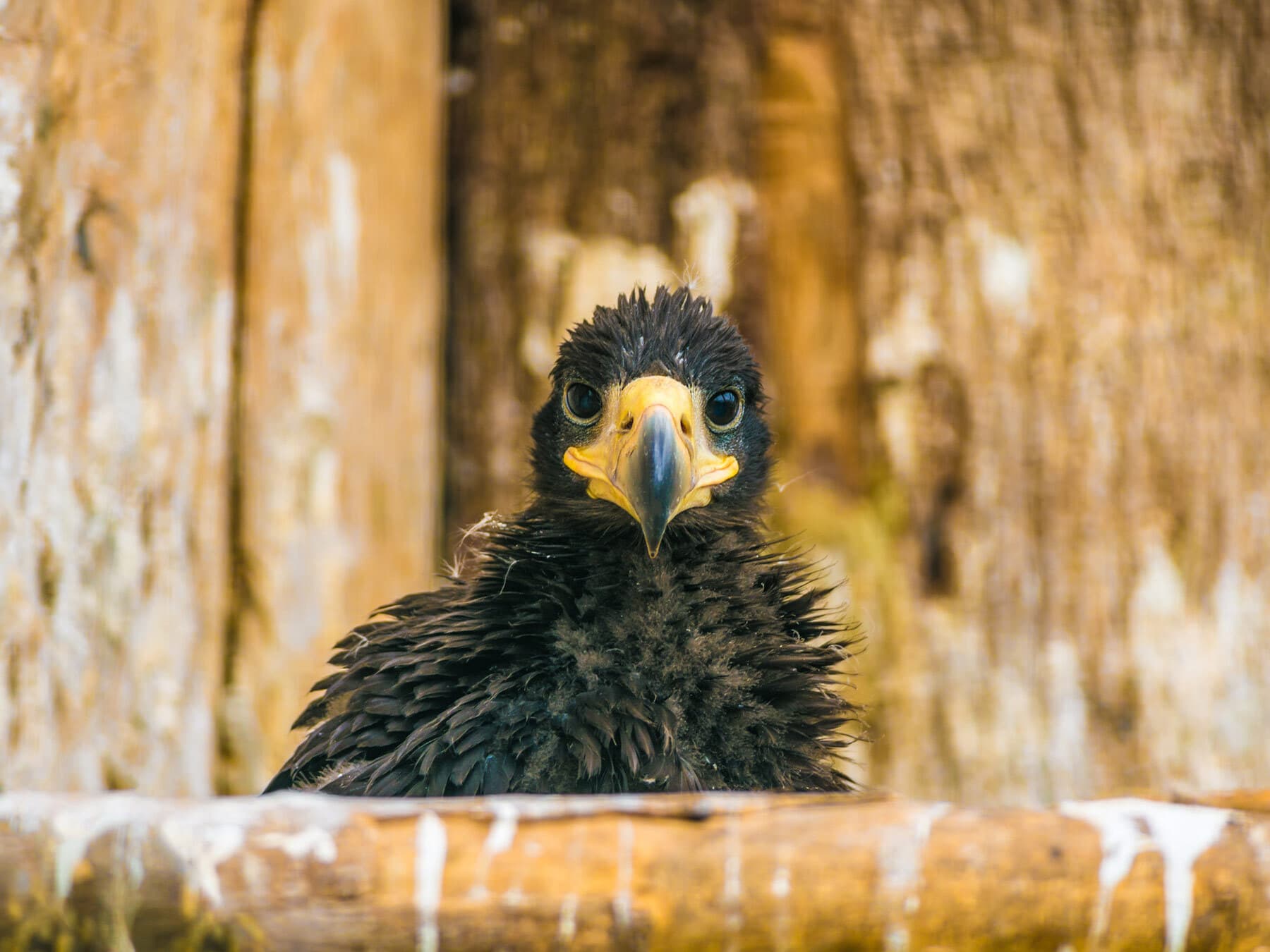
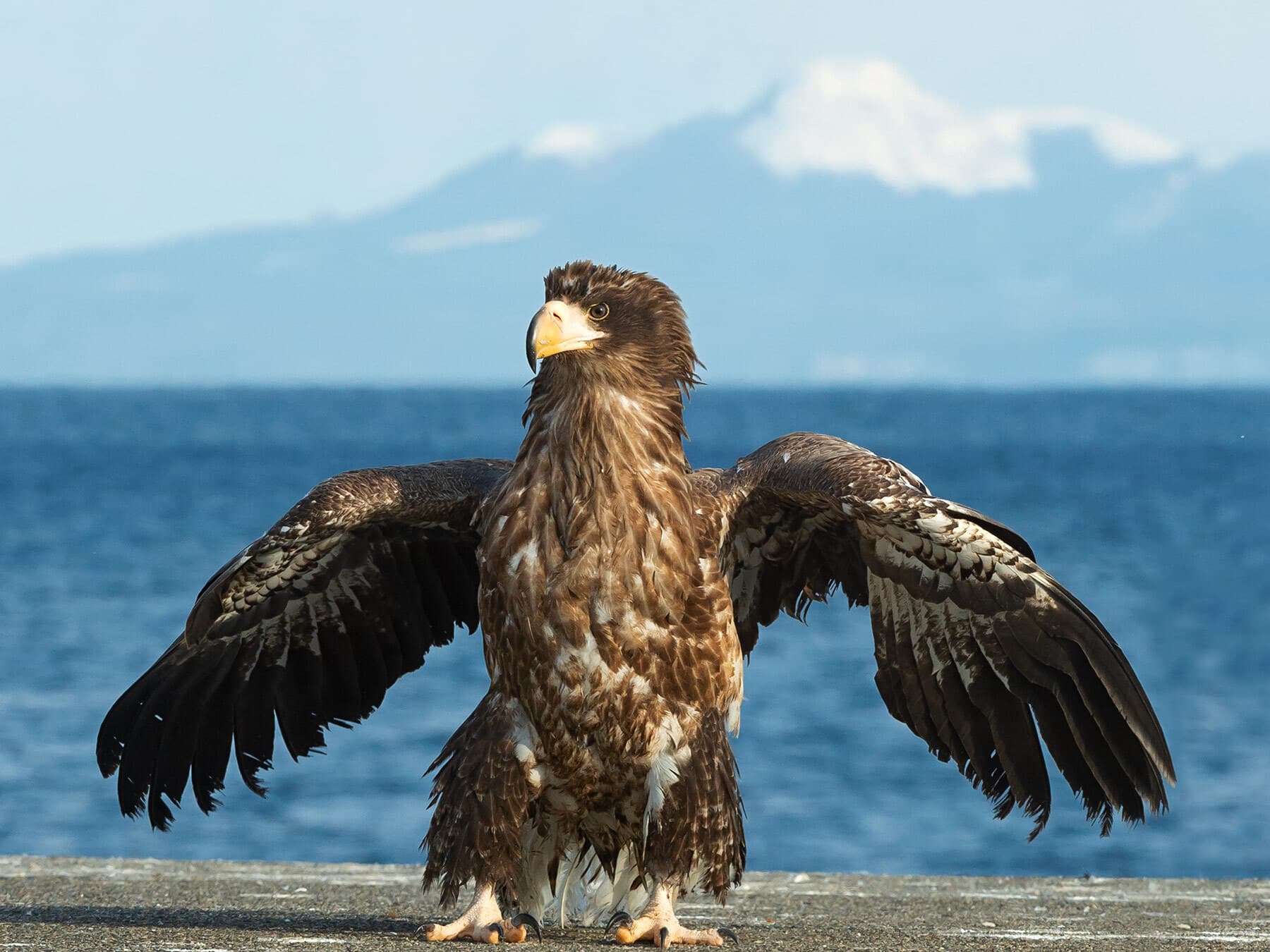
Juvenile birds appear more blackish brown than black, with grey streaks across the head and breast and dark mottling on a white tail. The beak and feet, like the adult, are yellow.
Upon hatching, chicks have white downy feathers which change to a dirty greyish brown within a week or two.
How big is a Steller’s Sea-Eagle?
The Steller’s sea-eagle is one of the largest raptors on the planet with a body length from the head to the tip of the tail at just over a metre or 39 inches. The wingspan of an adult can reach 2.5 metres which equates to over 8 feet in length. The plumage and large bill also helps to emphasise the size of this magnificent predator.
How much does a Steller’s Sea-Eagle weigh?
Adult females are larger than males and can reach a maximum weight of 9.5 kilos which is 21 pounds and it is thus one of the world’s heaviest eagles. The average adult male weighs between 5 and 6 kilos.
How much weight can a Steller’s Sea-Eagle carry?
Its huge wings and strong legs and talons enable the Steller’s sea-eagle to carry prey up to 7 kilos (in excess of 15 pounds). Considering that an adult male sea-eagle weighs a maximum of 6 kilos this indicates the bird’s incredible strength allowing it to grab a live struggling fish from the water and fly off.
How big are the talons on a Steller’s Sea-Eagle?
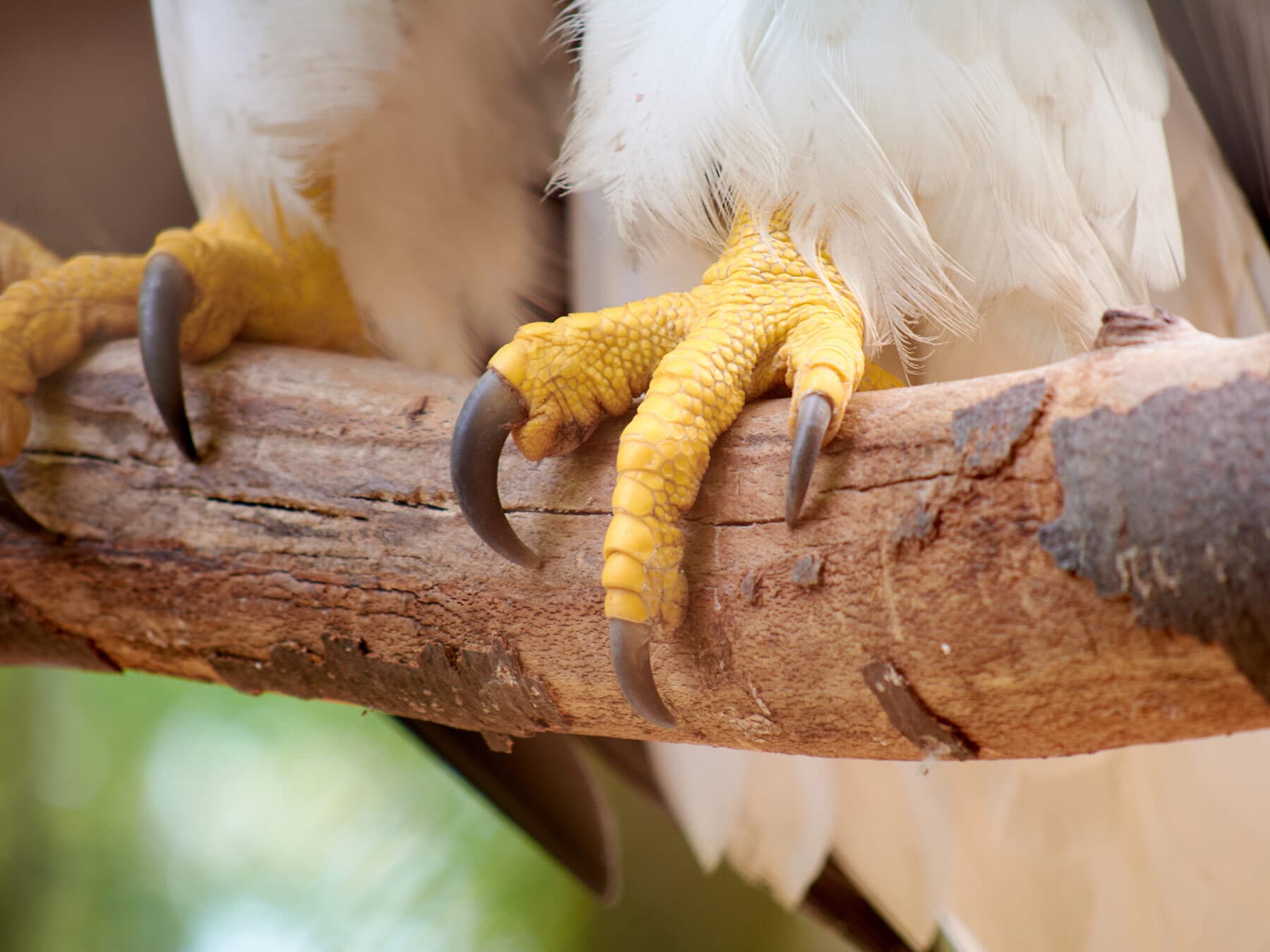
This particular eagle survives mainly on a diet of fish and as such its feet and talons (hooked claws) are smaller than some raptors with a diet of mainly birds and mammals. The toes are shorter than land eagles but very strong and the underside of the feet have ridges which, combined with the overly curved claws, are perfectly designed to hold on to a large, slippery struggling fish.
What is the scientific name of a Steller’s Sea-Eagle?
Belonging to the family Accipitridae, the scientific name for the Steller’s sea-eagle is ‘Haliaeetus pelagicus’ which is derived from ancient Greek. The first word is split in two with ‘Hali’ meaning ‘at sea’ and the remainder of the word meaning ‘eagle’. Pelagicus indicates ‘open sea or ocean’.
Are Steller’s Sea-Eagles aggressive or friendly?
Generally considered solitary birds, they will on occasion come together in flocks particularly during seasonal salmon runs when food is in abundance. They are particularly fierce hunters and tend to stick to their own breeding areas. During migration they will either fly totally alone or if in a small group they will often remain hundreds of metres apart.
Are Steller’s Sea-Eagles endangered?
Not only are these birds considered to be Rare they are also classified by the International Union for Conservation of Nature (IUCN) as being on their Red List and are Globally Threatened and Vulnerable. In the most recent estimates it is believed that worldwide there are approximately 5,000 birds which includes up to 2,000 breeding pairs and with the population overall being in decline.
Do Steller’s Sea-Eagles mate for life?
Steller’s sea-eagles are monogamous meaning they have only one mate at a time and they normally establish a long lasting bond. If one partner loses another it will generally seek a second mate.
Steller's Sea-eagle guides
3 guidesQuick facts
- Length
- 85–105 cm
- Wingspan
- 195–250 cm
- Weight
- 4900–9000 g
- Lifespan
- 20 years
- Family
- Hawks & Eagles
- Migration
- Partial migrant
- Global status (IUCN)
- Vulnerable
- World population
- 4,000 - 5,000 mature individuals
- Population trend
- Decreasing
- Also called
- Steller's Sea Eagle, Pacific Sea Eagle
- Scientific name
- Haliaeetus pelagicus
Sources
3- 1BirdLife International. 2021. Haliaeetus pelagicus. The IUCN Red List of Threatened Species 2021: e.T22695147A204871862. Source (opens in a new tab)
- 2BirdLife International. 2021. Haliaeetus pelagicus. The IUCN Red List of Threatened Species 2021: e.T22695147A204871862. Source (opens in a new tab)
- 3BirdLife International. 2021. Haliaeetus pelagicus. The IUCN Red List of Threatened Species 2021: e.T22695147A204871862. Source (opens in a new tab)

Checked by
Nathan Cope, founder and editor
Nathan founded Birdfact and leads its writers and contributors in the UK, the US and Canada. He has watched and studied birds for more than ten years, and checks every article and species guide before it’s published.