


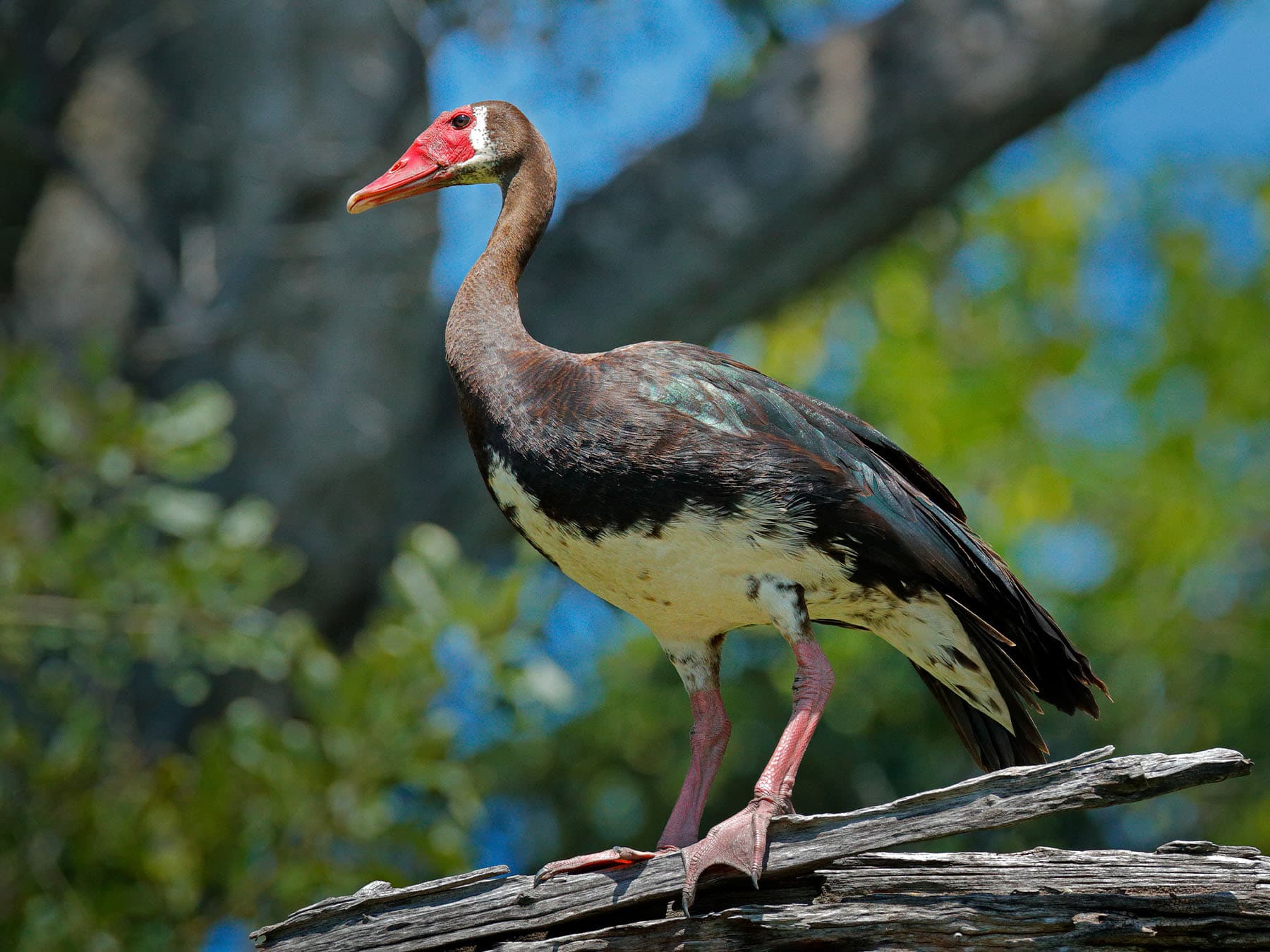
Spur-winged Goose
Gambian Spur-winged Goose · Plectropterus gambensis
By the Birdfact teamChecked by Nathan Cope
On this page11 sections
How to recognise it
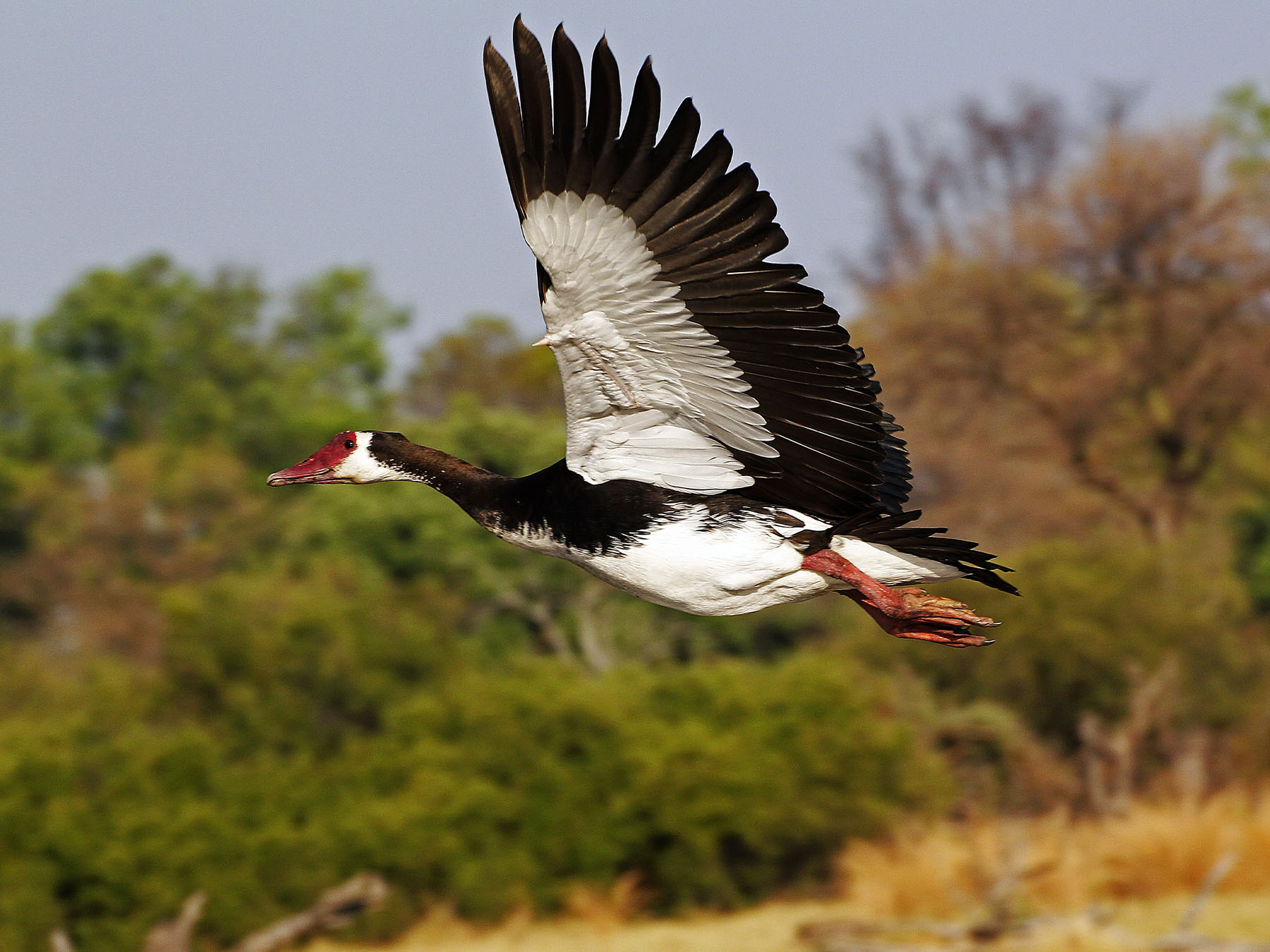
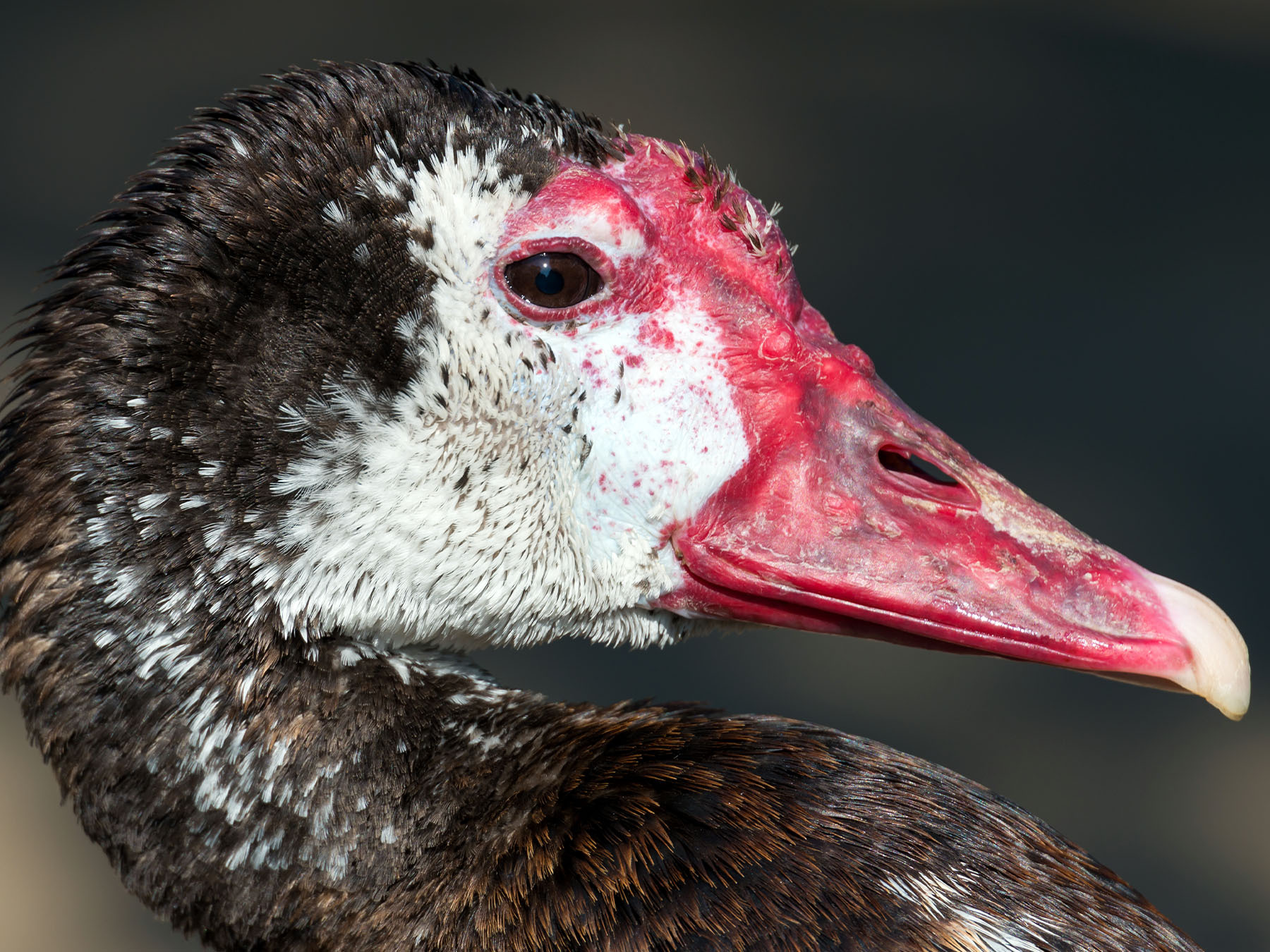
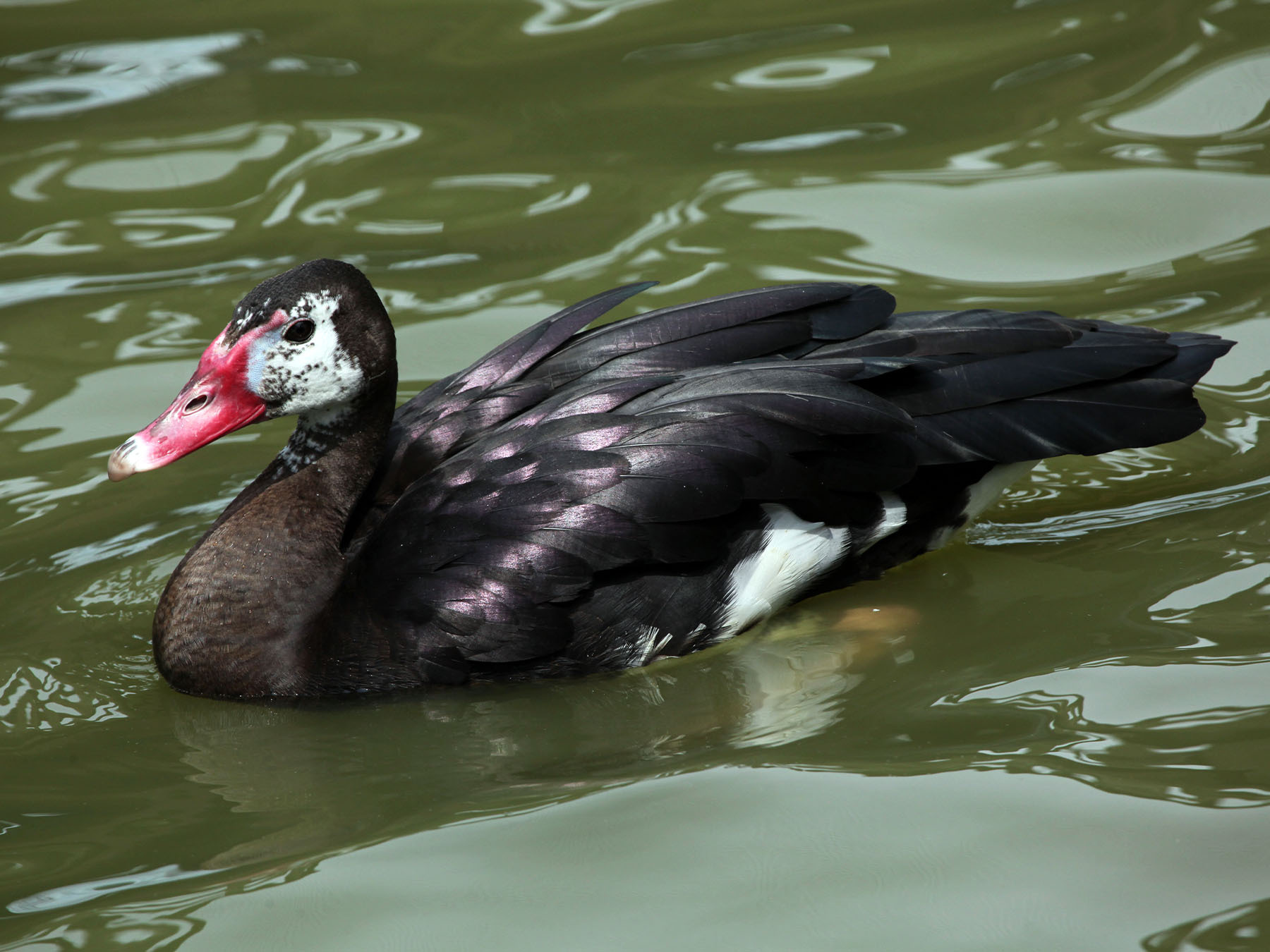
The Spur-winged Goose is a large, striking waterfowl with predominantly black plumage contrasted by white wing patches and belly. Its head and neck display iridescent green and purple hues, while a prominent red facial knob and pinkish legs add to its distinctive appearance.
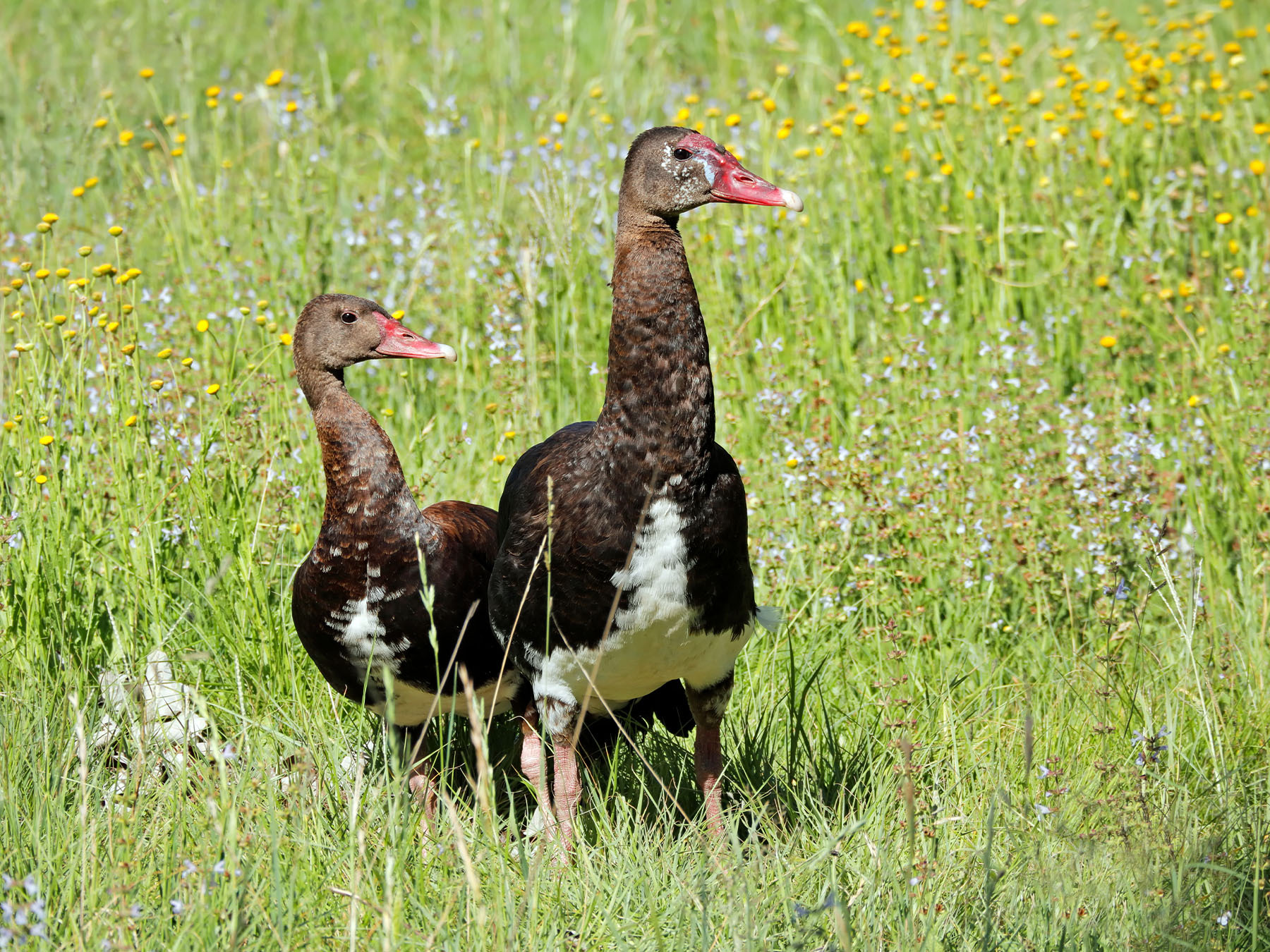
Males are larger than females, with more extensive iridescence, a larger red facial patch and a larger facial knob. Females have a browner overall colouration and a smaller knob. Juveniles resemble females but lack the facial knob.
Its size
Adults- Length
- 75–115 cm
- Wingspan
- 150–200 cm
- Weight
- 4000–6800 g
Its song and calls
Spur-winged Geese are generally quiet but produce a variety of vocalisations. Their most common call is a loud, nasal honking, often described as a 'honk-honk' or 'hank-hank'.
During courtship or when alarmed, they may emit softer whistles or grunts.
When and where to see it
The Spur-winged Goose is not recorded regularly in the UK, Ireland, the United States or Canada.
Worldwide: recorded regularly in 22 countries
Countries where it was recorded in at least 3 of the 6 years 2019–2024. Linked countries have their own bird list.
Data: EOD – eBird Observation Dataset (Cornell Lab of Ornithology), accessed via GBIF.org, CC BY 4.0. Records from 2019–2024, aggregated and filtered by Birdfact. How these lists are made
Tips for seeing it
- Look for large, dark waterfowl with white wing patches in wetlands and grasslands
- Listen for their distinctive honking calls, especially in flight
- Observe their behaviour on land, where they spend much time grazing
- Watch for their reluctance to fly when approached, often preferring to run or swim
What it eats
Spur-winged Geese are primarily herbivorous, feeding on grasses, aquatic plants, and crops. They also consume small invertebrates and occasionally fish.
Their strong bill allows them to dig for roots and tubers, while their long neck enables foraging in shallow water.
Nesting and breeding
Breeding typically occurs during the rainy season, though the timing varies across their range. Pairs are monogamous and often return to the same nesting sites year after year.
Nests are usually constructed on the ground near water, hidden in dense vegetation. The female lays 6-14 cream-coloured eggs in a shallow depression lined with grass and down.
Incubation lasts about 30-32 days and is primarily undertaken by the female. The male remains nearby, guarding the nest. Goslings are precocial and can leave the nest within 24 hours of hatching, staying with their parents for several months.
Behaviour
Spur-winged Geese are often seen grazing in open grasslands, using their strong legs and feet to forage. They are generally gregarious, forming large flocks outside the breeding season.
When threatened, they prefer to run or swim rather than fly but are capable of powerful, direct flight when necessary.
Conservation
While currently listed as Least Concern, Spur-winged Geese face localised threats from habitat loss and hunting.
Conservation efforts focus on protecting wetland habitats and regulating hunting practices to ensure sustainable populations across their range.
More photos
5 photos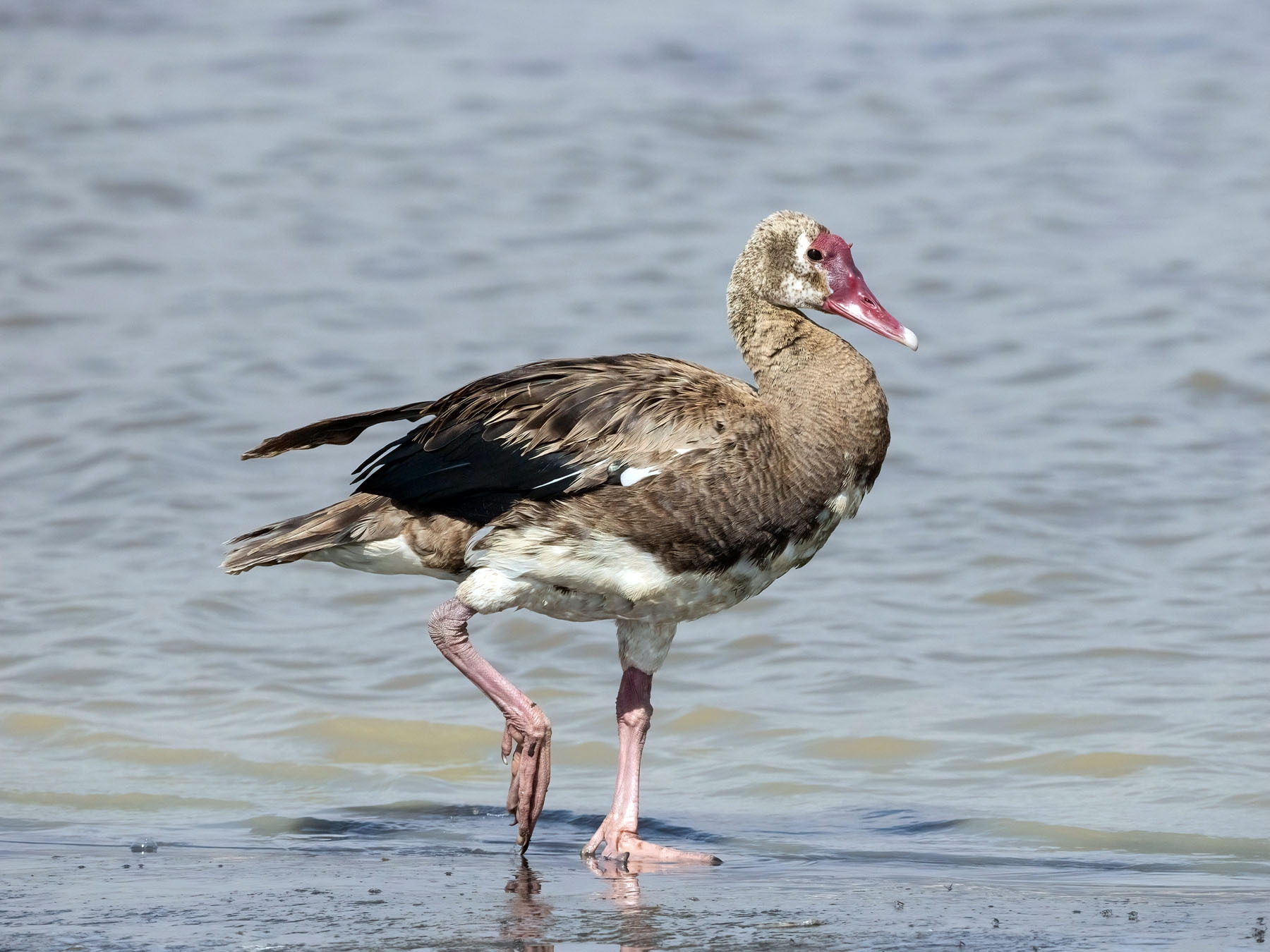
Quick facts
- Length
- 75–115 cm
- Wingspan
- 150–200 cm
- Weight
- 4000–6800 g
- Lifespan
- 8–10 years · oldest recorded 11.3 years
- Family
- Ducks, Geese & Swans
- Migration
- Partial migrant
- Global status (IUCN)
- Least Concern
- World population
- 100,000 - 1,000,000 mature individuals
- Population trend
- Increasing
- Also called
- Gambian Spur-winged Goose
- Scientific name
- Plectropterus gambensis
Sources
3- 1BirdLife International. 2016. Plectropterus gambensis. The IUCN Red List of Threatened Species 2016: e.T22680057A92840685. Source (opens in a new tab)
- 2Wetlands International (2006)
- 3Furter notes on the duration of life in animals. IV. Birds, Proc Zool Soc London, Ser. A:195-235 (1938)

Checked by
Nathan Cope, founder and editor
Nathan founded Birdfact and leads its writers and contributors in the UK, the US and Canada. He has watched and studied birds for more than ten years, and checks every article and species guide before it’s published.