


Spotted Owl
California Spotted Owl, Mexican Spotted Owl, Northern Spotted Owl · Strix occidentalis
By the Birdfact teamChecked by Nathan Cope
On this page12 sections
How to recognise it
What do Spotted Owls look like?
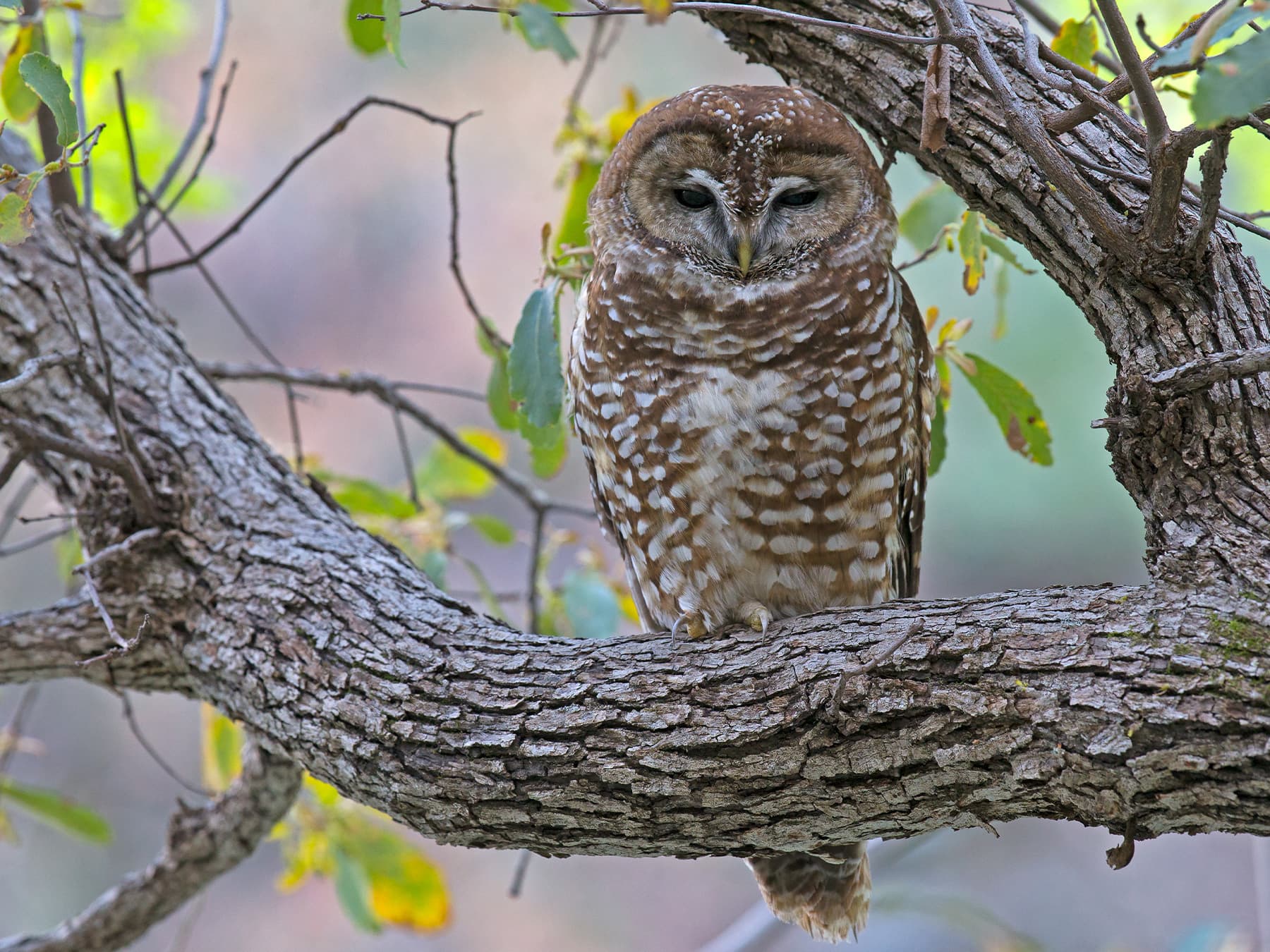
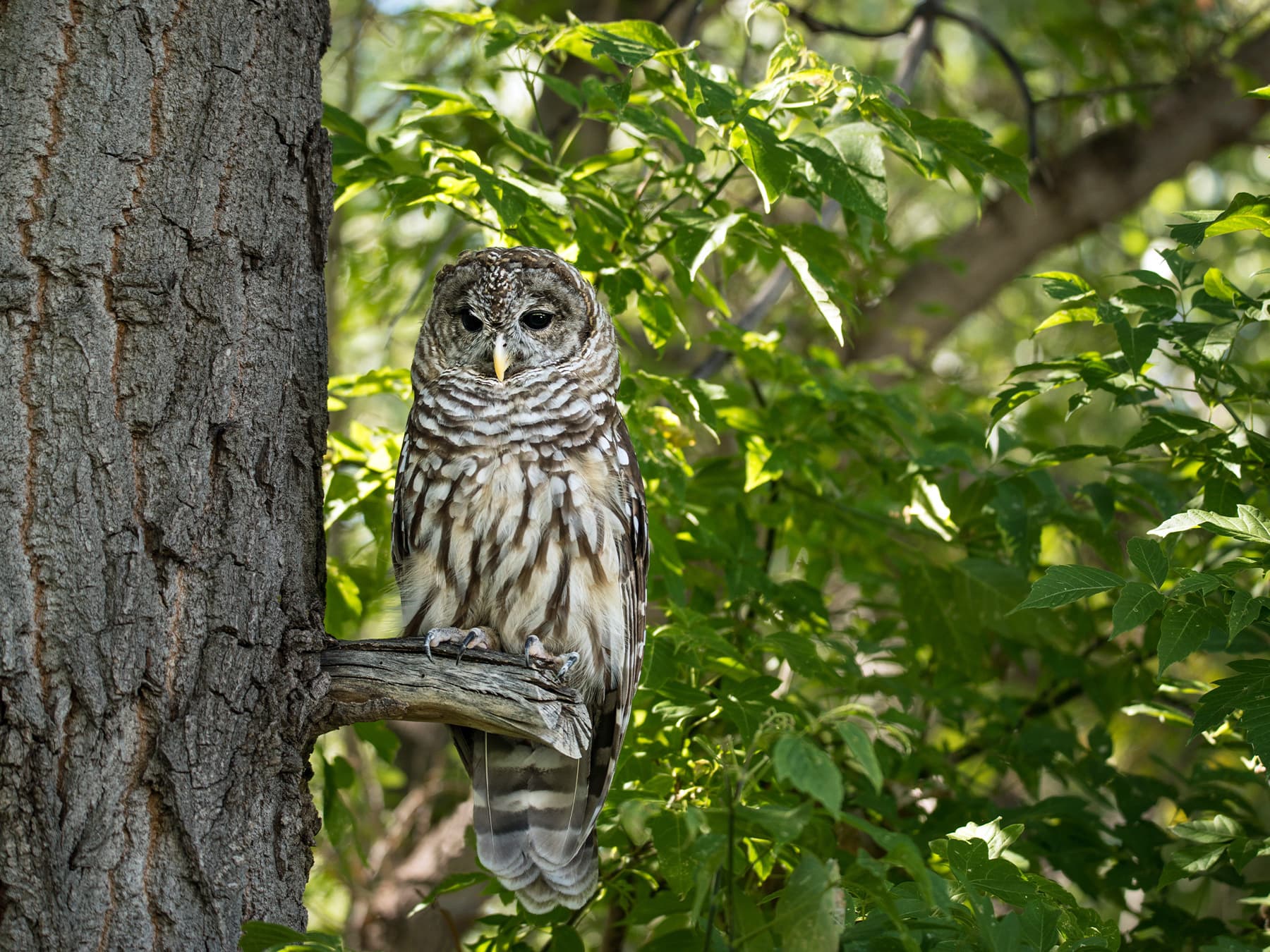
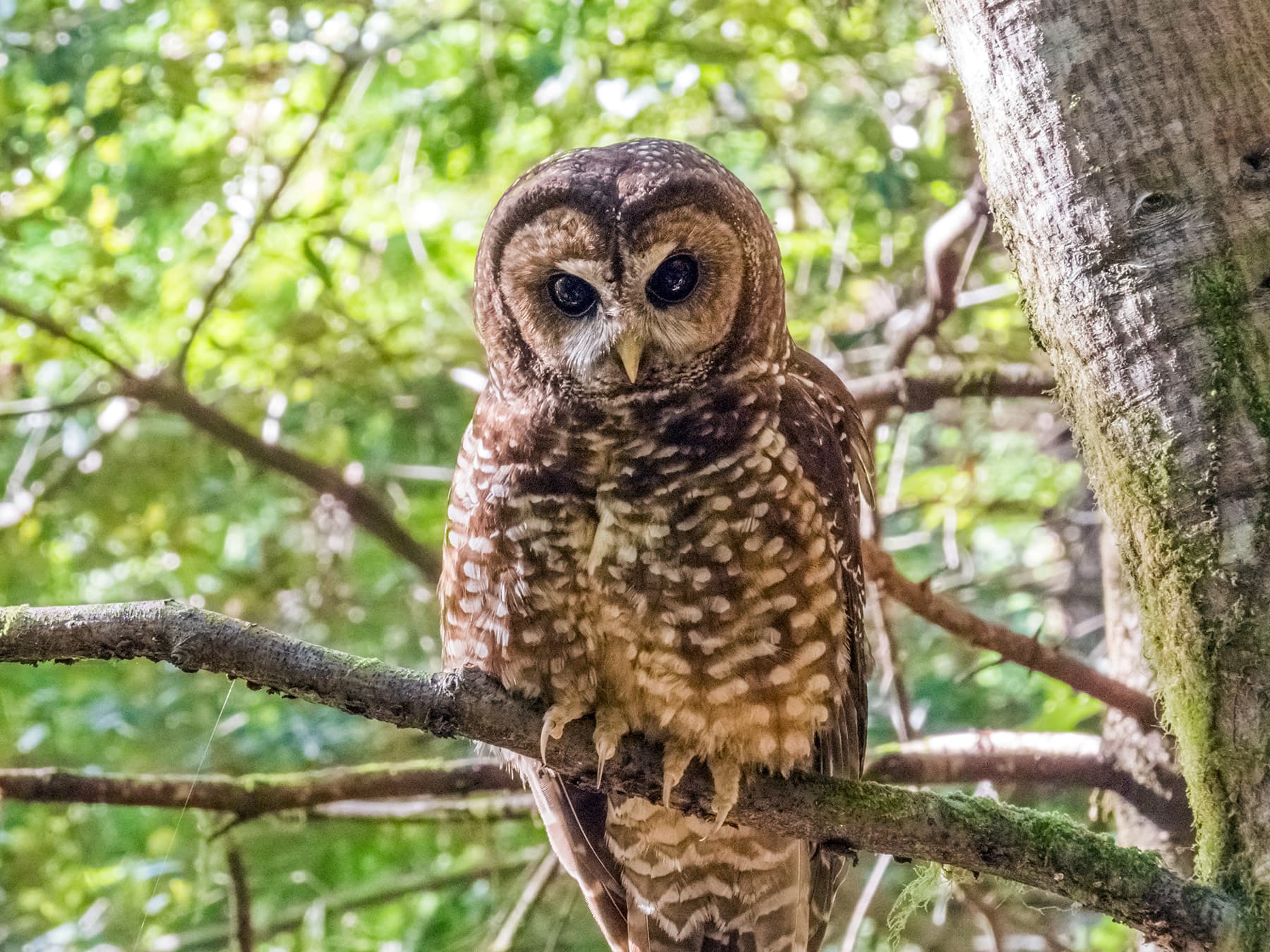
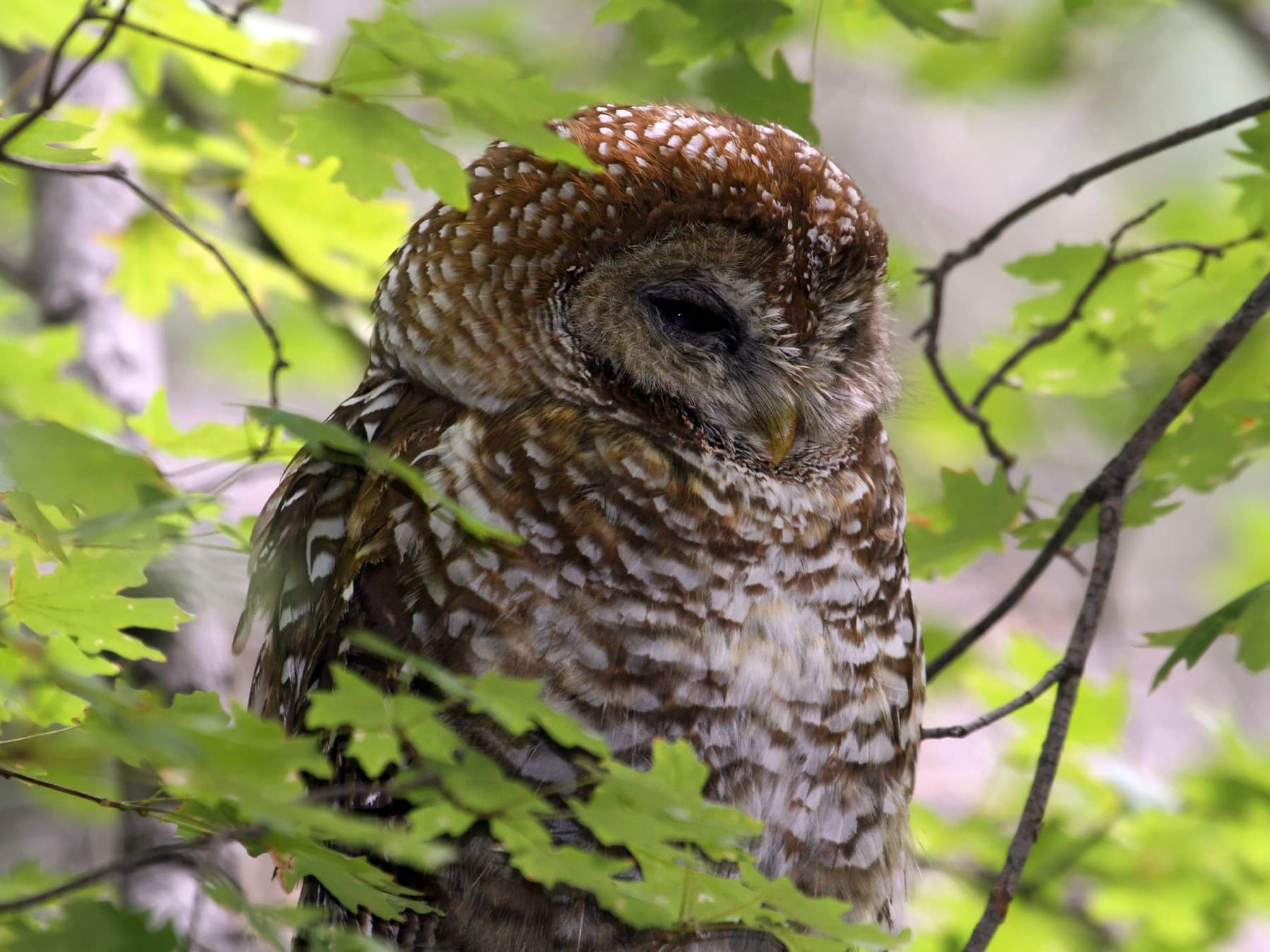
Spotted owls are medium-sized owls with heavily spotted plumage. They are mottled dark and light brown all over and heavily marked with irregular white spots on the head and breast. The tail is barred with light brown and white.
Spotted owls have rounded heads, without ear tufts, and their facial patterning is a distinctive series of light and dark brown concentric circles around each eye. Their eyes are dark brown, and their bill is yellow.
Subspecies found to the north are darker brown than those in southern regions, which are a much lighter shade.
Males and females are similar in appearance and coloring, although females are usually visibly larger.
Juvenile spotted owls retain some down after fledging and have a ‘fluffy’ appearance with light and dark brown barring and some speckled markings on the breast.
How big are Spotted Owls?
Spotted owls are medium-sized owls, falling between the larger barred owl and the smaller barn owl in size. As with most owls, female spotted owls are slightly larger and heavier than males.
- Length: 47 cm to 48 cm (18.5 in to 18.9 in)
- Wingspan: 101 cm (39.8 in)
- Weight: 500 g to 700 g (17.6 oz to 24.7 oz)
Its size
Adults- Length
- 41–48 cm
- Wingspan
- 107–114 cm
- Weight
- 518–760 g
Its song and calls
What sound does a Spotted Owl make?
Altogether spotted owls have a repertoire of 13 different songs and calls, although not all of them are regularly heard.
The most commonly heard call of a spotted owl is a series of four barks. The contact call heard mainly from nesting females, is a hollow two-note whistle that sounds like ‘cooo-weep’.
When and where to see it
What is the habitat of a Spotted Owl?
Natural habitats preferred by spotted owls include old-growth forests and thickly wooded canyons. Areas of cleared forest are usually avoided, although they may venture into redwood forests that were logged in the past and where standing trees have been left to decay.
Coniferous forest is the most popular choice, although at lower altitudes deciduous woodlands, with oaks and other hardwoods may also be used.
What is the range of a Spotted Owl?
Three subspecies of spotted owl exist, distributed across southwest Canada, the western and south-central US, and northern Mexico.
The northern spotted owl is resident from a small region of southwest British Columbia, and southwards through coastal regions of Washington, Oregon, and northern California.
A second subspecies, the California spotted owl, is found at scattered locations across the state, with isolated populations in the south and a more continuous presence further north.
To the east and south, the Mexican spotted owl has a patchy distribution across Utah, Arizona, New Mexico, and Colorado, and parts of northwest Texas. Further south into Mexico, they have a more solid distribution through the Sierra Madre Occidental and Oriental ranges.
Where do Spotted Owls live?
All populations of spotted owls have witnessed declines since the 1960s, with only one individual bird thought to remain in the wild in Canada. Apart from this one individual, the species is only found in the wild in the United States and Mexico, where declines have also been noted.
How rare are Spotted Owls?
Spotted owls are increasingly rare, and there are serious concerns about the long-term survival of the species due to continuing declines in population.
Habitat loss is a major factor, with logging activities having a negative impact on available nesting sites, and the spread of the larger barred owls into the western United States, which has increased competition for prey and nest cavities.
The most recent estimate, from 2004, placed the population of spotted owls at 15,000 individuals, but numbers are believed to have declined even further since then.
Where can you see Spotted Owls in the US?
A rarely spotted nocturnal resident in forests across the western and southern US, sightings of spotted owls are highly prized and never guaranteed. Some sites where successful observations have been made include Gila National Forest and Santa Fe National Forest in New Mexico and Coconino National Forest in Arizona.
Where can you see Spotted Owls in Canada?
The only Canadian region that has native spotted owls is the southwestern corner of British Columbia, and by 2023, only one individual was reported to be resident in the wild, so sightings are only very seldomly reported.
Migration
Do Spotted Owls migrate?
Spotted owls are a non-migratory species, remaining in their resident territories all year round. In the south, occasional short-distance dispersal occurs in winter, with movement to lower altitudes from spotted owls that normally live on slopes and higher ground.
Are Spotted Owls native to the US?
Spotted owls are native to the US and are found in western and certain southern states all year round. They are not present in the eastern US, due to competition for nest sites and hunting grounds from the larger barred owl.
Tips for seeing it
- Look for Spotted Owls in old-growth forests with dense canopy cover
- Listen for their distinctive four-note hooting call at night
- Search for whitewash and pellets beneath large trees to locate roosting sites
- Use playback sparingly and responsibly, as these owls are sensitive to disturbance
What it eats
What do Spotted Owls eat?
Dense forests are typical foraging spots for spotted owls, with small mammals, particularly rodents, detected by sound as well as sight. Flying squirrels and dusky-footed woodrats feature heavily in the diets of all subspecies. Rabbits, bats, voles, and moles are also eaten.
Prey is spotted from perches, and spotted owls swoop silently in pursuit, grabbing with their sharp talons and snapping the animal’s neck with their powerful bills.
What do Spotted Owl chicks eat?
Male spotted owls feed the females while they are nesting and then brooding, and deliver food to the nest so the initial diet of juveniles is largely dictated by what’s available locally. Mice and voles are then torn into scraps by the female and fed directly to the chicks.
Nesting and breeding
Where do Spotted Owls nest?
Spotted owls have an adaptable approach to nesting and will reuse any appropriate nests in their territory that meet their needs. These include platform nests in trees, made of sticks and originally built by crows or hawks, as well as natural cavities in decaying wood in tree trunks or abandoned woodpecker chambers. Cavity nests are generally unlined, although a few feathers may be used to form a light lining.
Nest sites are commonly chosen in Douglas-fir, western hemlock, and redwood trees, and are usually at a height of 6 m to 24 m (20 to 80 ft) above ground. Nests are regularly reused in multiple breeding seasons.
When do Spotted Owls nest?
Spotted owl pairs begin associating more closely early in the spring, roosting together ahead of the breeding season and calling to each other at dawn and dusk from mid-February onwards. The peak egg-laying months are March and April, with incubation (be the female alone) lasting for 28 to 32 days.
What do Spotted Owl eggs look like?
Eggs laid by spotted owls are white to light gray in color, and measure 4.8 cm to 5.5 cm (1.9 in to 2.2 in) by 4.1 cm to 4.7 cm (1.6 in to 1.9 in). A typical clutch consists of between one and four eggs.
Do Spotted Owls mate for life?
Spotted owls form long-term monogamous pairs, but when one mate dies, a replacement will usually be found.
Behaviour
Are Spotted Owls aggressive?
Spotted owls defend their nests both physically and vocally, using agitated shrieks to drive away any intruders. Chasing away potential predators and striking out with talons and wings are both observed when spotted owls are threatened.
Where do Spotted Owls sleep at night?
Spotted owls are a strictly nocturnal species, hunting at night and roosting in sheltered, shady spots close to tree trunks during the day. They are most active following sunset and before sunrise.
Lifespan and predators
How long do Spotted Owls live?
Spotted owls can breed from one year of age, although many pairs do not breed every year. On average, spotted owls are relatively long-lived, with a life expectancy of between 10 and 15 years.
Individuals recovered from banding programs have been observed to have reached 16 to 17 years, while spotted owls in captivity are known to live for more than 25 years.
What are the predators of Spotted Owls?
Great horned owls and northern goshawks are known to prey on spotted owls, particularly on fledglings and newly independent juveniles.
Are Spotted Owls protected?
Canada’s Migratory Birds Convention Act and the United States’ Migratory Bird Treaty Act offer protection to spotted owls against being killed, injured, captured, or traded for sale. Their nest sites, eggs, and young are also included for safeguarding.
Conservation plans are in place to attempt to boost the populations and restrict logging activities, and in California, laws exist to protect spotted owls and their roosting sites on federal forest lands.
Are Spotted Owls endangered?
Spotted owls are currently rated as a near-threatened species globally, due to serious concerns over the decline in numbers, caused by extensive logging of mature forests in the Pacific Northwest.
In Canada, they are designated as an endangered species, while in the US and Mexico, the different subspecies are classified as threatened.
Conservation
Spotted Owls face significant threats due to habitat loss from logging and forest fragmentation. Competition with the invasive Barred Owl further challenges their survival.
Conservation efforts focus on protecting old-growth forests and managing Barred Owl populations in key areas.
Quick facts
- Length
- 41–48 cm
- Wingspan
- 107–114 cm
- Weight
- 518–760 g
- Lifespan
- 15 years · oldest recorded 25 years
- Family
- Owls
- Migration
- Resident
- Global status (IUCN)
- Near Threatened
- World population
- 15,000 mature individuals
- Population trend
- Decreasing
- Also called
- California Spotted Owl, Mexican Spotted Owl, Northern Spotted Owl
- Scientific name
- Strix occidentalis
Questions
2What is the spotted owl controversy?
The Spotted Owl Controversy refers to a long-running political and environmental dispute in the Pacific Northwest, which emerged in the 1980s.
Extensive logging and timber harvesting of old-growth forests in this region were noticeably negatively impacting the population of spotted owls, and increased protection laws were introduced to protect the species, including a ‘Threatened Species’ designation under the Endangered Species Act.
Disputes arose between the logging industry workers and conservationists after restrictions on timber harvests were introduced in the region in line with the conservation laws, leading to job losses and financial hardship for some local workers and businesses. Tensions rose and it continues to be a challenge to find a balance between conservation and economic activity in the area.
Is the spotted owl still an endangered species?
Northern spotted owls are a designated endangered species in Canada and a threatened species in the US. California spotted owls are listed at a state level as a species of conservation concern.
Further south, Mexican spotted owls are recognized as a threatened species in both the US and Mexico. Overall, spotted owls are classified as a Near Threatened species by the IUCN.
Sources
4- 1BirdLife International. 2020. Strix occidentalis. The IUCN Red List of Threatened Species 2020: e.T22689089A180937862. Source (opens in a new tab)
- 2Partners in Flight (2019)
- 3Partners in Flight (2022) Source (opens in a new tab)
- 4Carey and Judge, Longevity Records: Life Spans of Mammals, Birds, Amphibians, Reptiles, and Fish (2000) Source (opens in a new tab)

Checked by
Nathan Cope, founder and editor
Nathan founded Birdfact and leads its writers and contributors in the UK, the US and Canada. He has watched and studied birds for more than ten years, and checks every article and species guide before it’s published.