


Spotted Crake
Water Crake · Porzana porzana
By the Birdfact teamChecked by Nathan Cope
On this page13 sections
How to recognise it
What do Spotted Crakes look like?
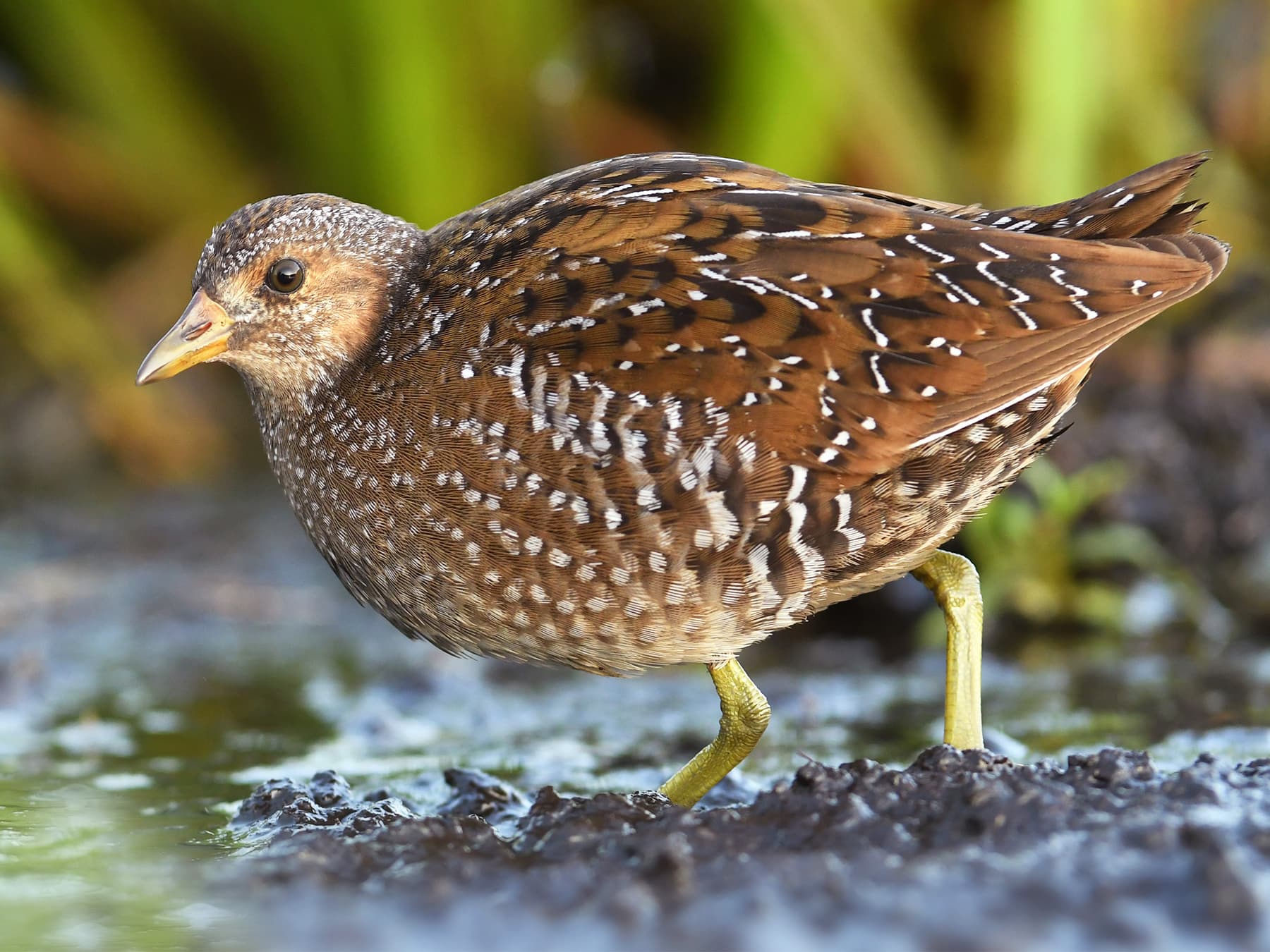
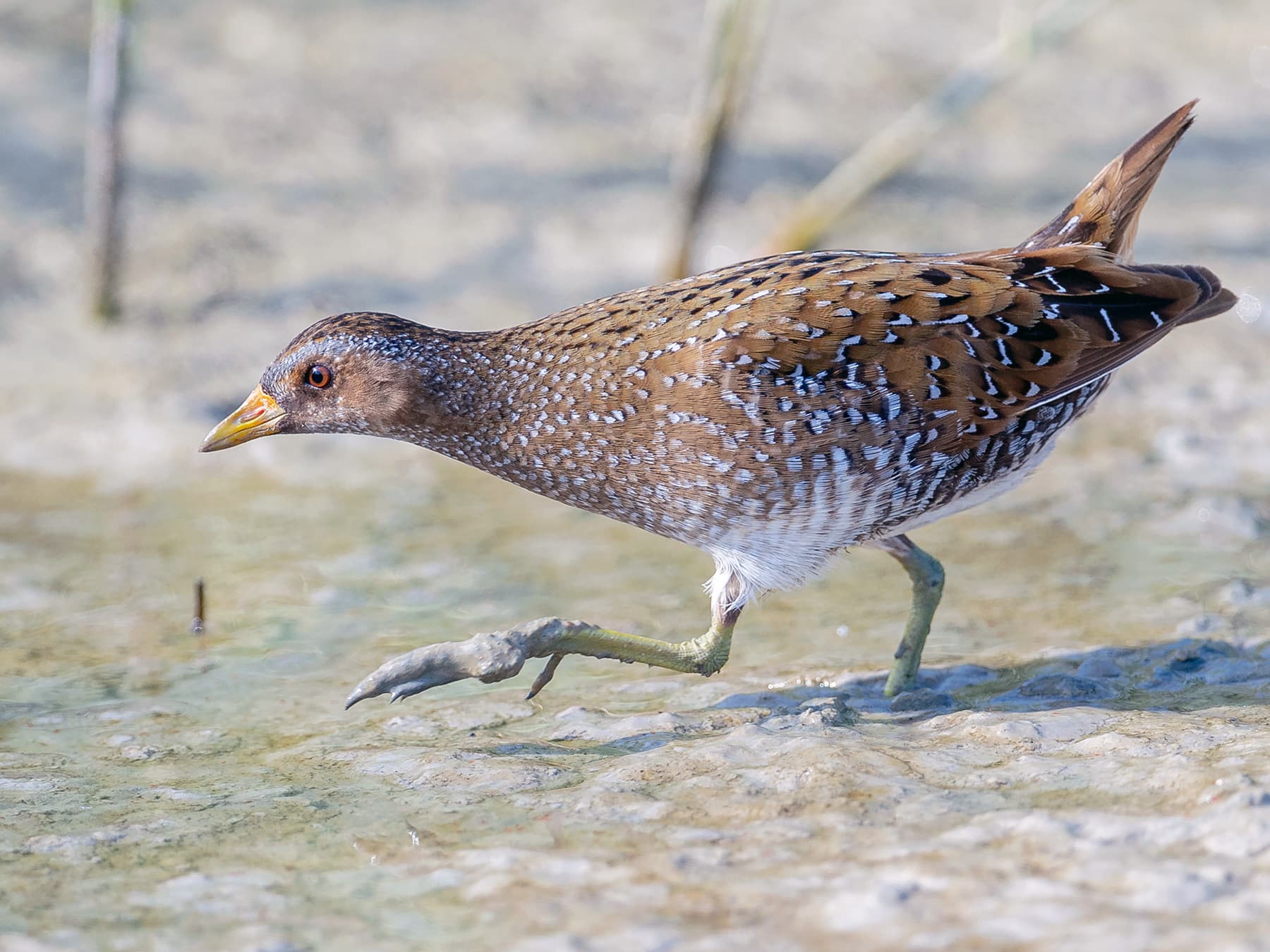
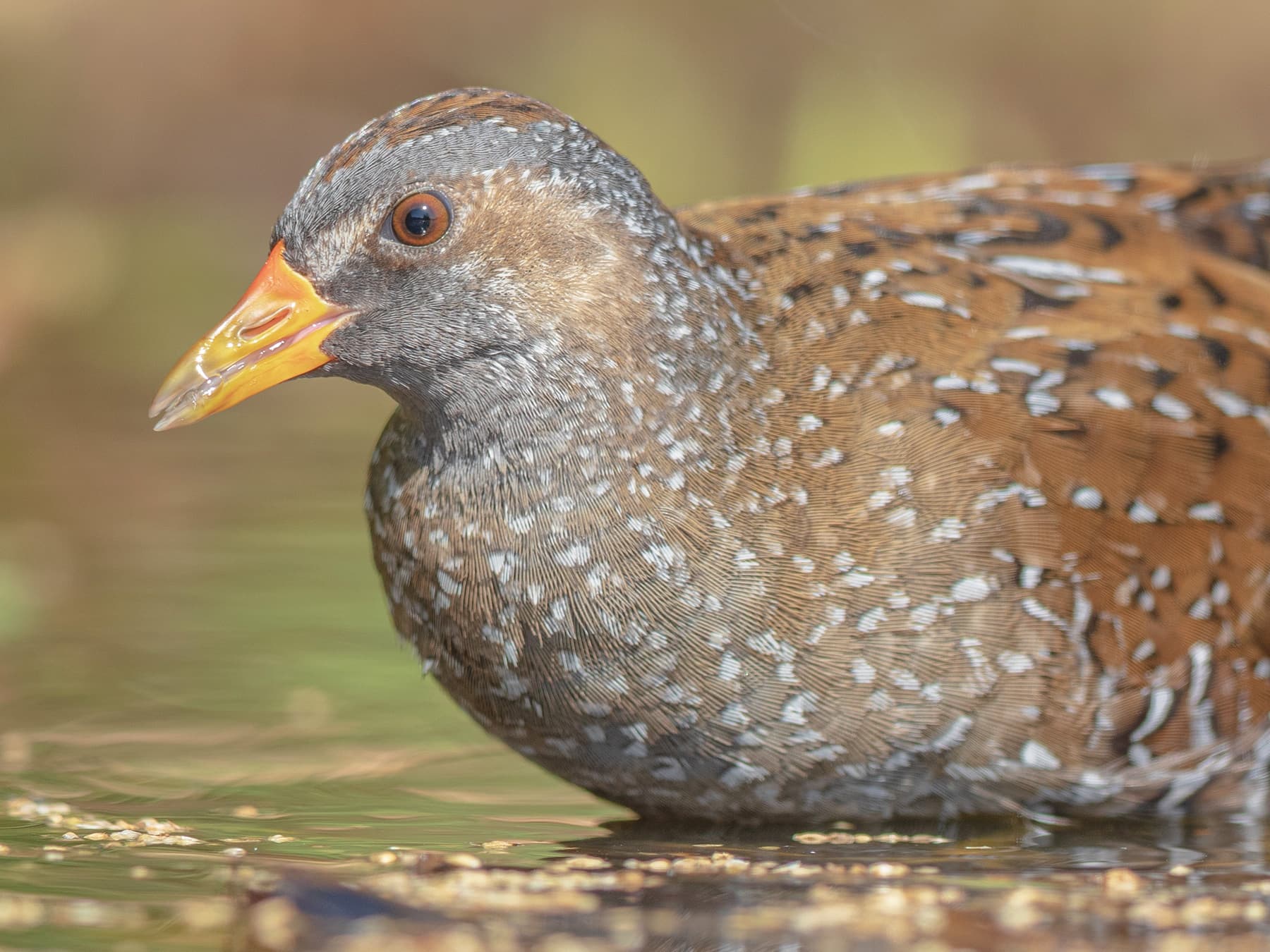
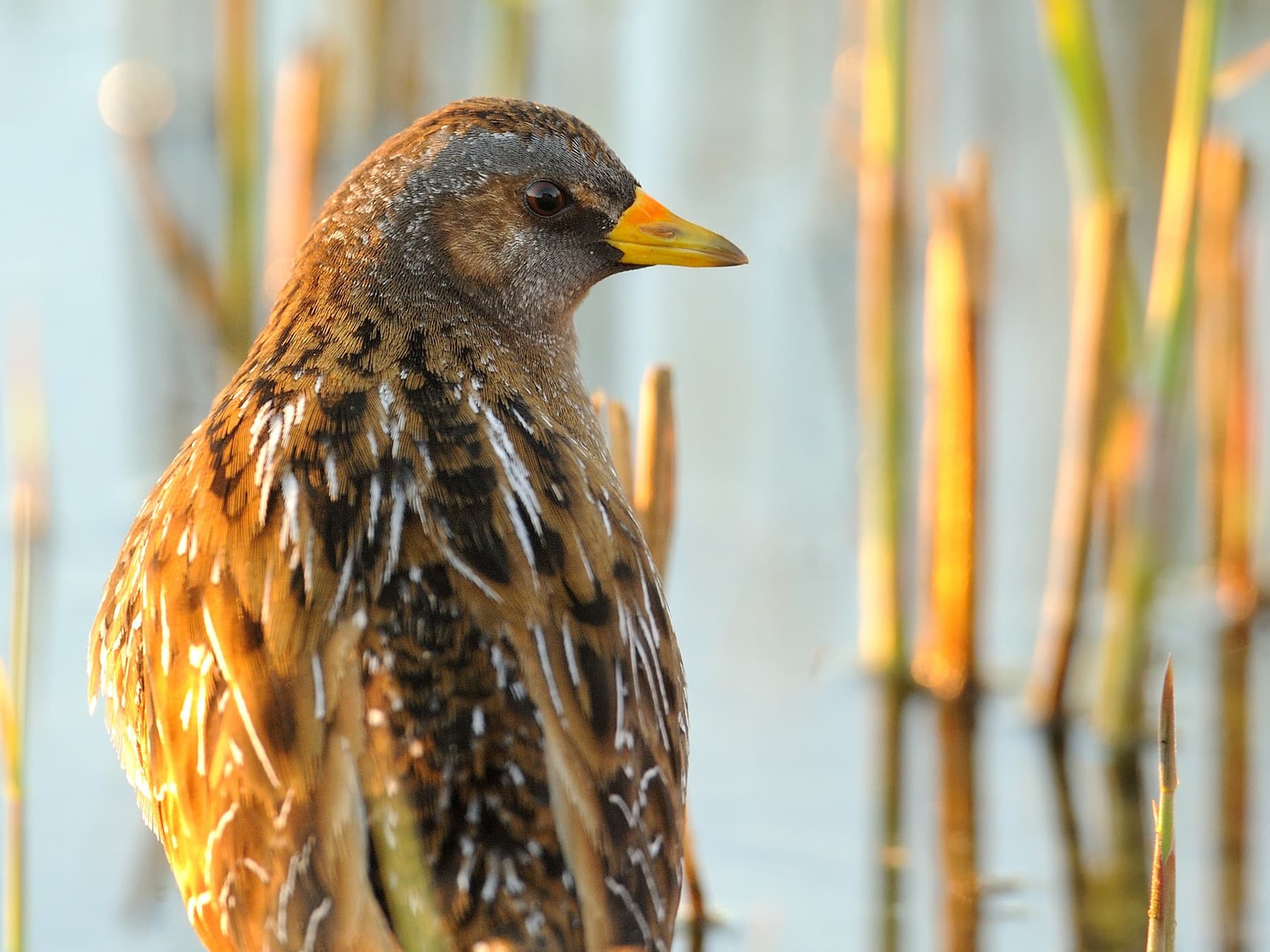
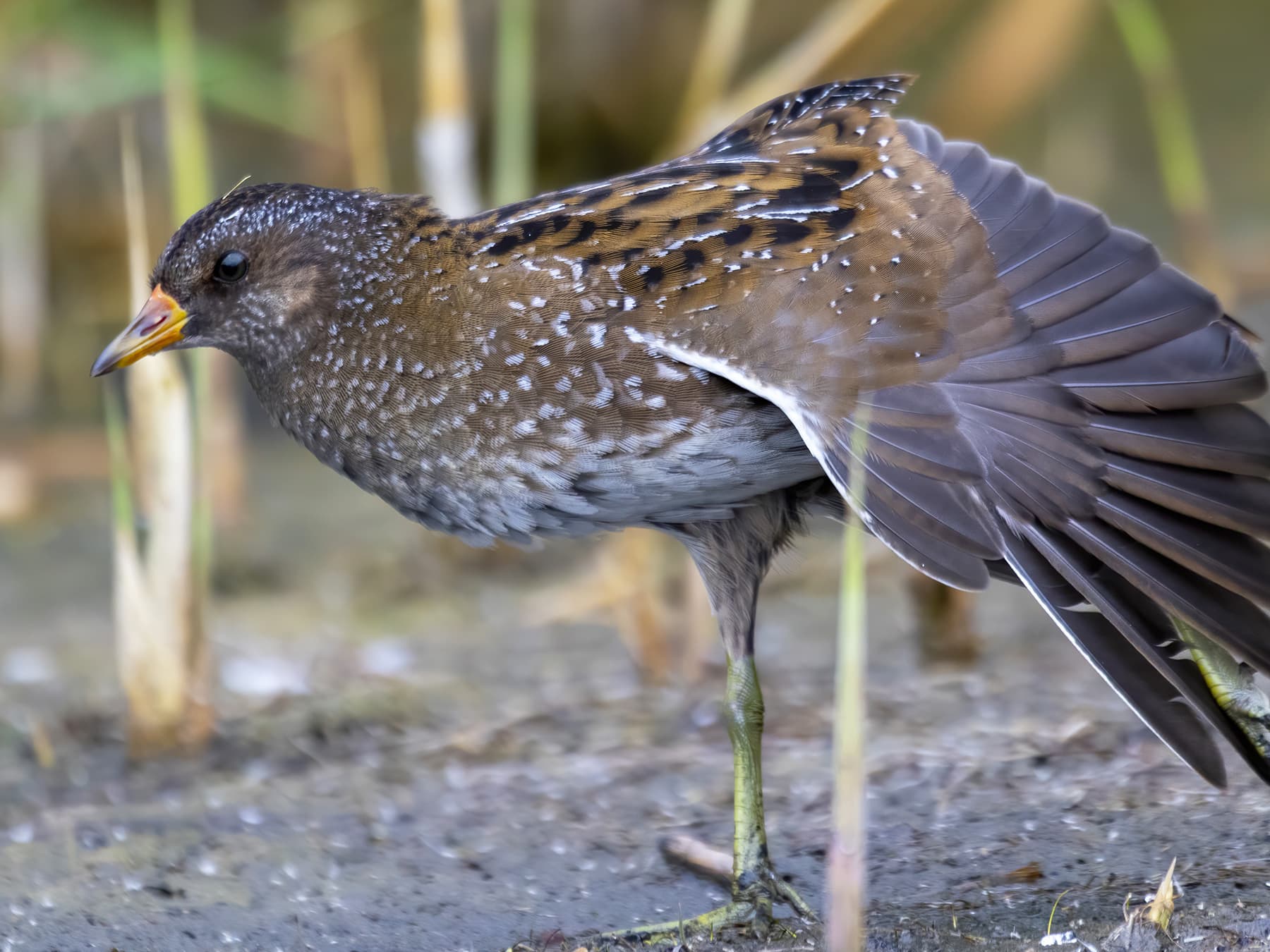
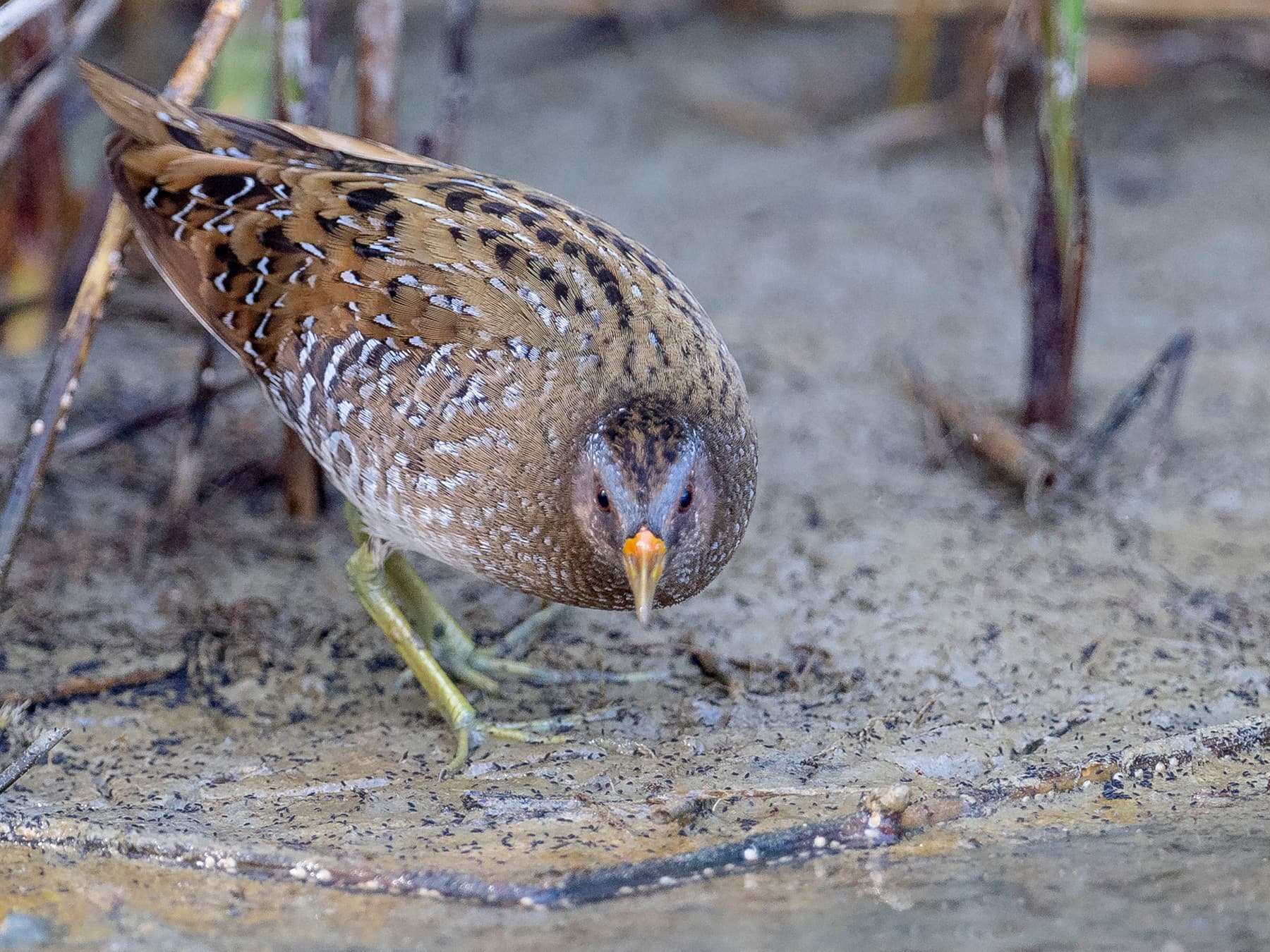
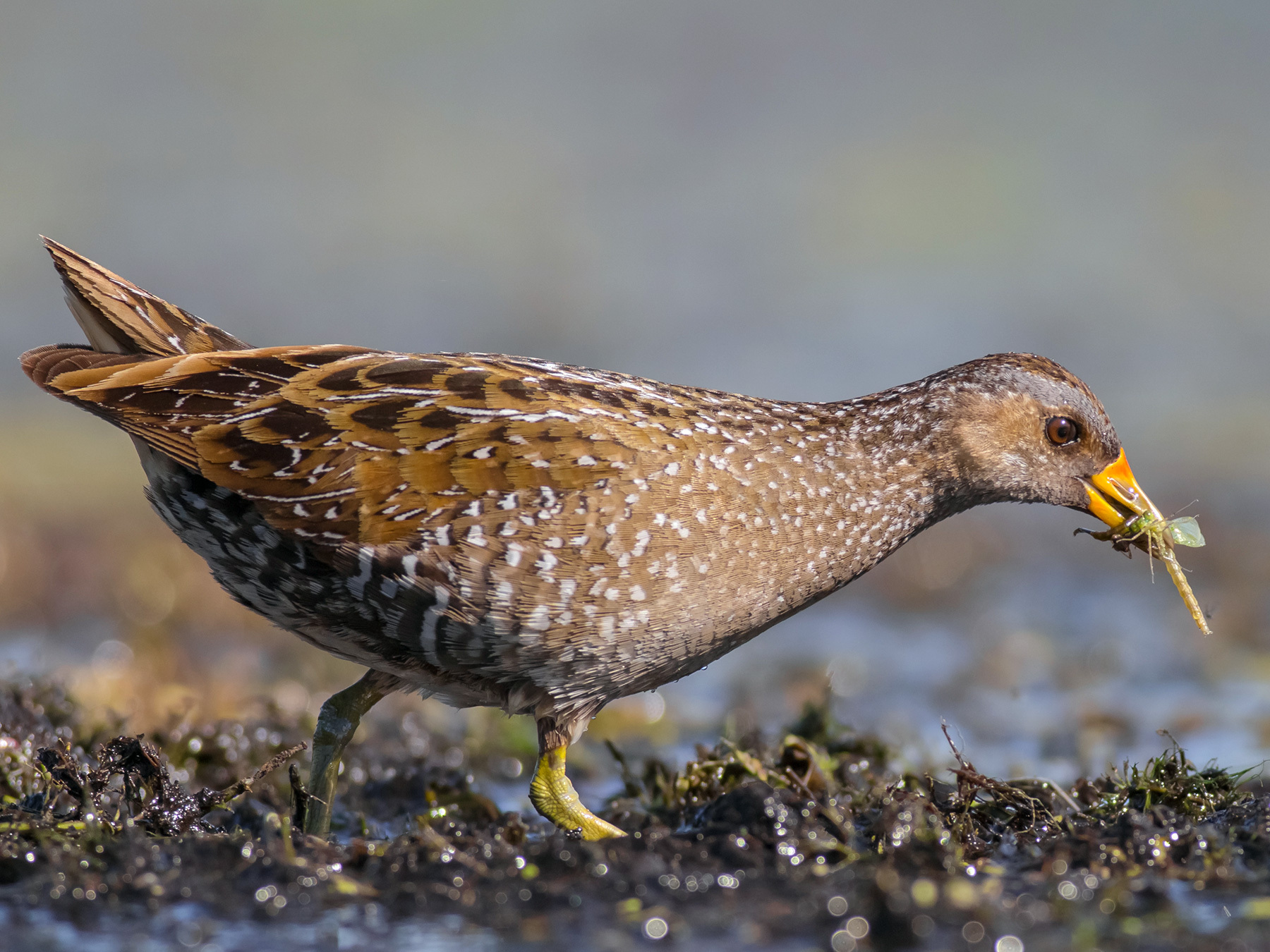
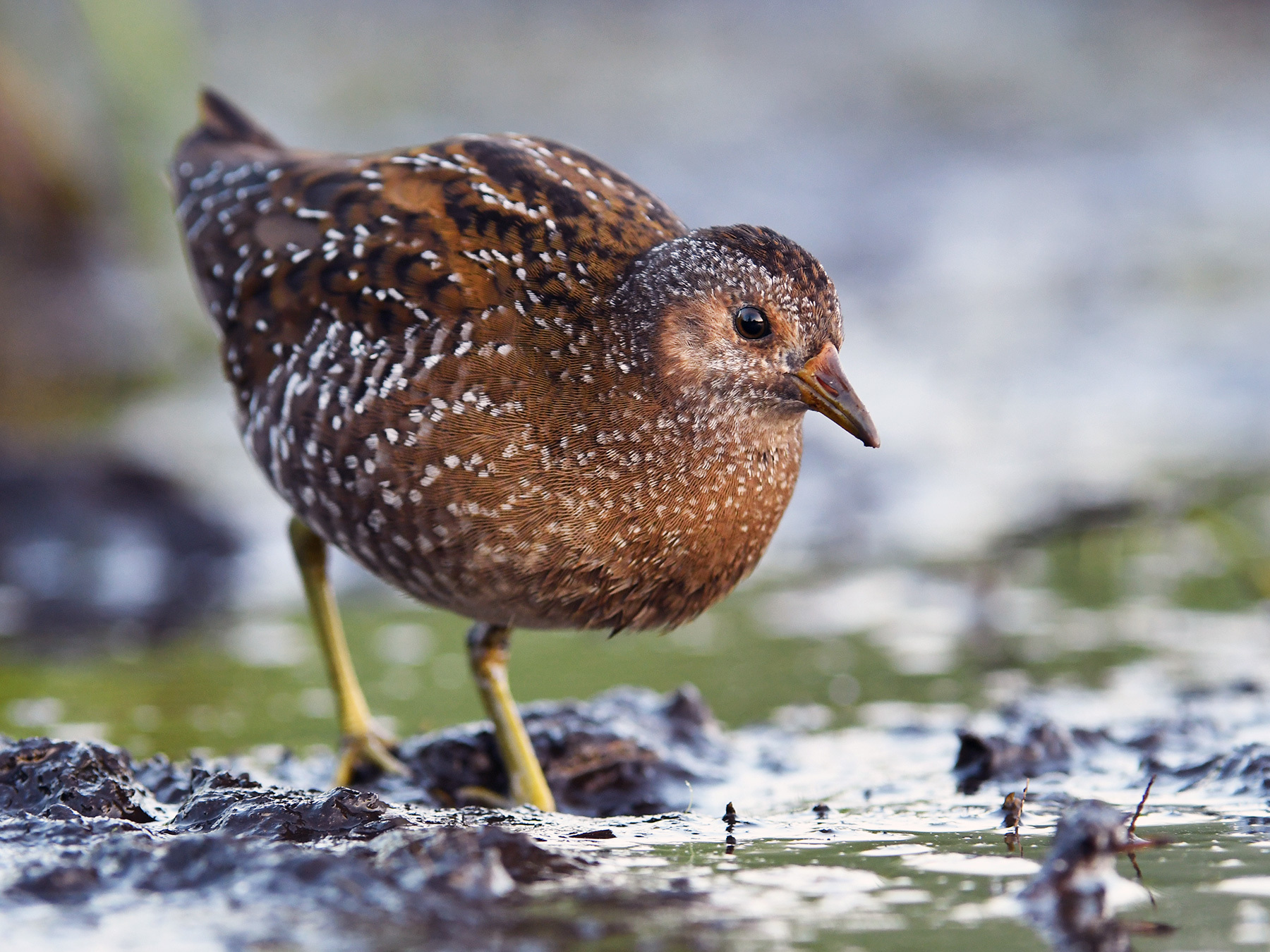
Spotted crakes are smaller and shorter than water rails, but otherwise do have similarities in their heavily speckled, cryptic plumage. Males have a blue-grey face and an olive-brown breast, both dotted with lighter markings. Their backs and wings are mid-brown, streaked with darker tones and feature lighter speckling at the back of the neck.
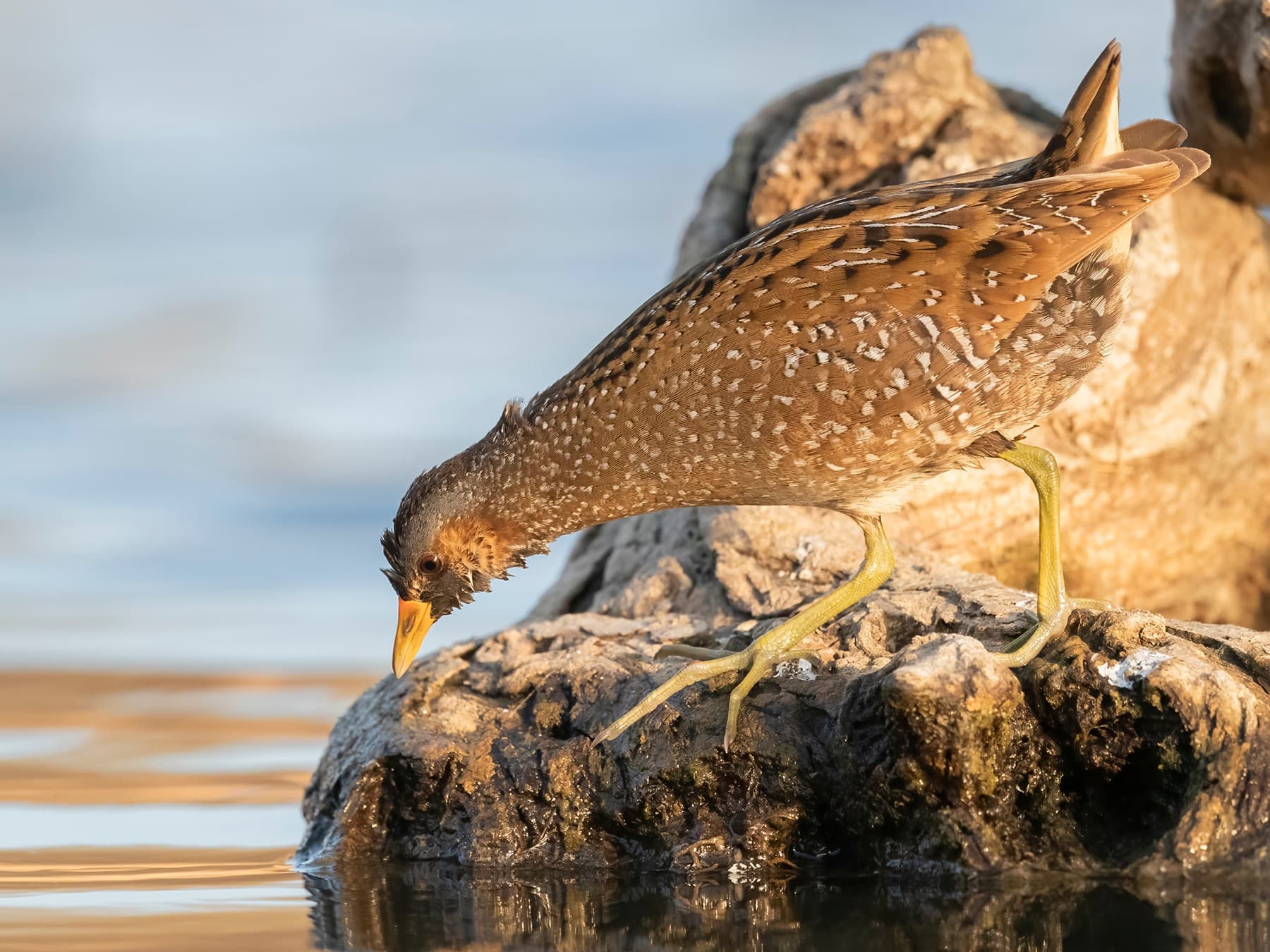
The spotted crake’s yellow-brown bill is short and straight, and has a reddish-orange spot near the base. Their legs are greenish, and they have long toes.
Outside of the breeding season, males’ faces become less grey and more spotted, and their bellies and underparts develop more speckling.
Males and females are alike but some subtle distances make it possible to tell the sexes apart.
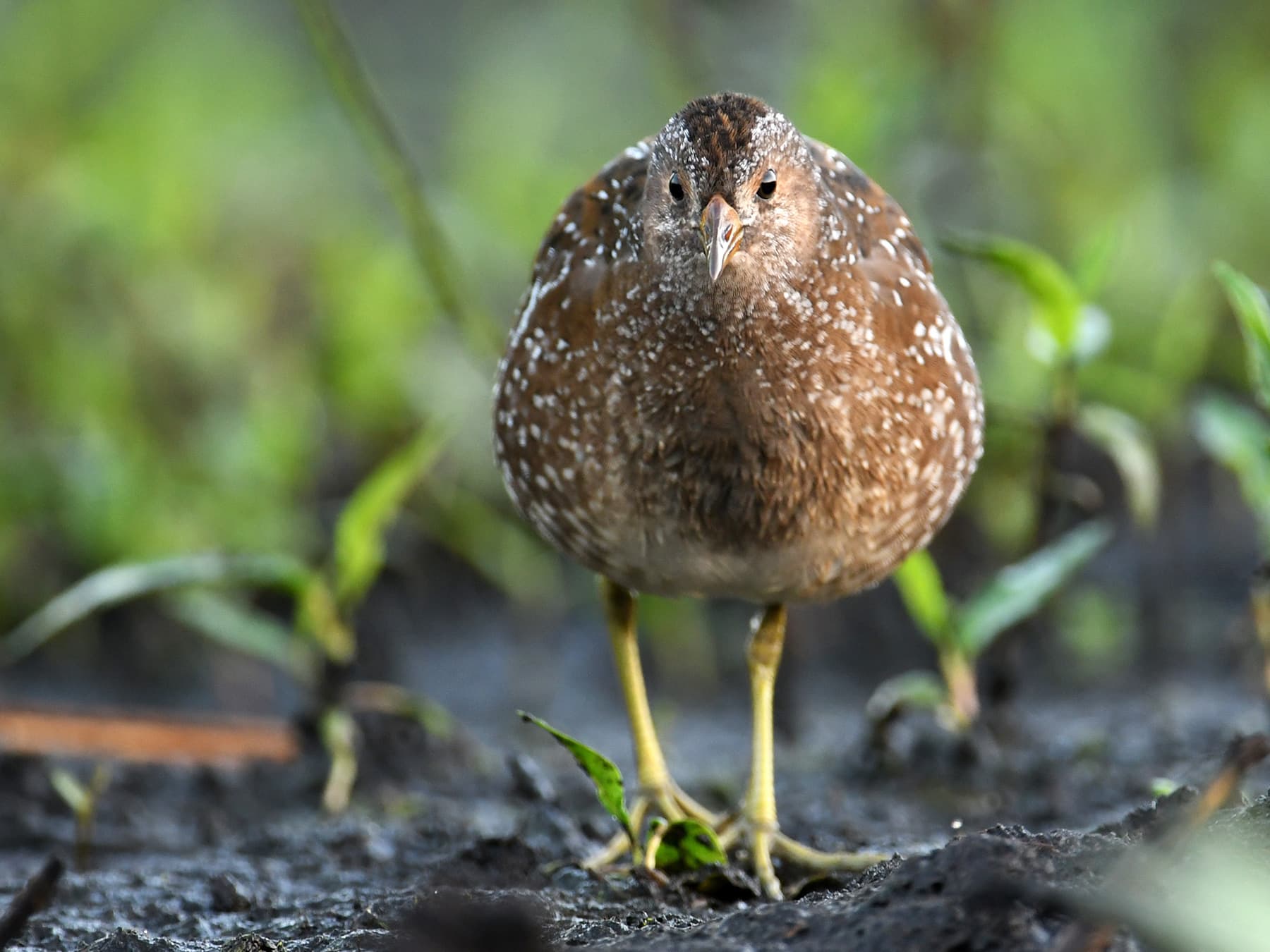
Female spotted crakes are more heavily spotted on their face and underparts and less grey all year round.
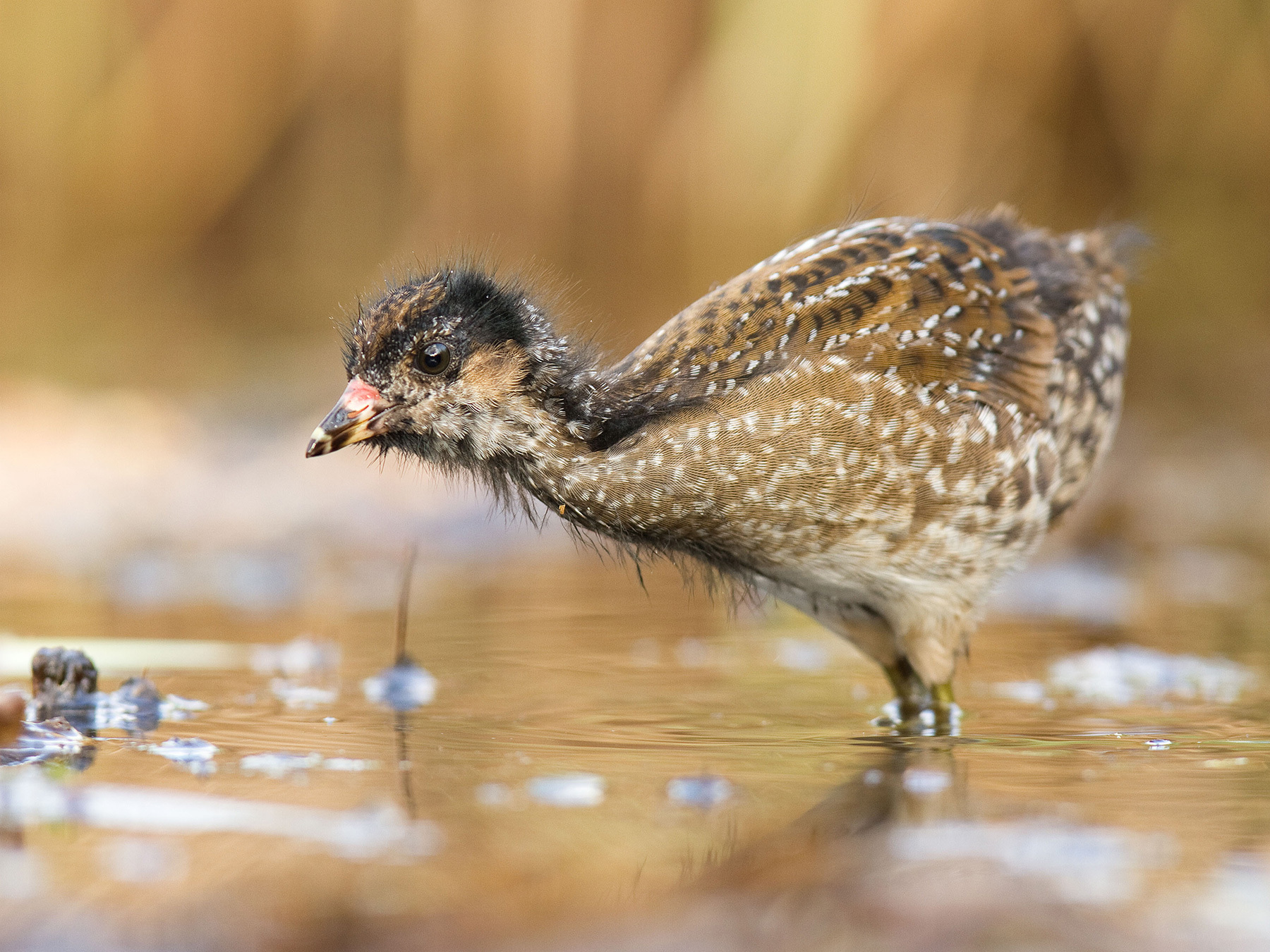
Juvenile spotted crakes have the same overall speckled plumage, but more white spotting is visible on the head, and a paler eyebrow stripe.
How big are Spotted Crakes?
Spotted crakes are only around the same size as blackbirds, although the crake has much longer legs. Males and females are the same size and weight.
- Length: 22 cm to 24 cm (8.7 in to 9.4 in)
- Wingspan: 37 cm to 42 cm (14.6 in to 16.5 in)
- Weight: 70 g to 110 g (2.5 oz to 3.9 oz)
Its size
Adults- Length
- 19–22.5 cm
- Wingspan
- 37–42 cm
- Weight
- 70–110 g
Its song and calls
What sound does a Spotted Crake make?
As a naturally elusive species, spotted crakes are more commonly heard than seen and knowing their calls helps with a positive ID.
When seeking a mate, male spotted crakes make a repetitive sharp ‘hwick’ whistle, repeated from dusk through the night. Females respond with a softer note. Once paired, males become silent. A warning cry of ‘tschick’ is heard when threats are sensed.
- Song0:00 / 1:03
Recorded in United Kingdom
Lawrence Shove / The British Library Board · Wikimedia Commons · CC BY-SA 4.0
- Call0:00 / 0:03
Recorded in Normandie, France · September 2021
When and where to see it
OctoberLeaving
Most recorded in October
- 1. Cornwallunder 0.1%
- 2. Somersetunder 0.1%
- 3. Shetland Islandsunder 0.1%
- 4. Hampshireunder 0.1%
- 5. Hertfordshireunder 0.1%
Each dot is a county, state or province: the bigger and darker, the larger the bird’s share of that place’s bird records that month. Grey dots: no regular records. The ringed point is the centre of the bird’s records this month; the arrow shows how it moved since last month, and the dashed loop its path through the year. “Arrivals” colours places where it becomes regular this month (orange) or is in its last regular month (grey). GBIF eBird Observation Dataset, 2019–2024. Map data: Natural Earth, US Census Bureau; place centres © OpenStreetMap contributors.
In your area
See when the Spotted Crake is recorded in your county, state or province.
How often the Spotted Crake turns up in the UK through the year, from birdwatchers' records.
United Kingdom
Passage migrant · regularly Aug–Oct · most records in August
Show as a table
| Month | United Kingdom |
|---|---|
| January | – |
| February | – |
| March | <0.001% |
| April | – |
| May | – |
| June | – |
| July | – |
| August | 0.007% (regular) |
| September | 0.003% (regular) |
| October | 0.002% (regular) |
| November | – |
| December | – |
Recorded regularly in
Worldwide: recorded regularly in 50 countries
Countries where it was recorded in at least 3 of the 6 years 2019–2024. Linked countries have their own bird list.
Europe (33)
Asia (14)
- Azerbaijan
- China
- Cyprus
- Georgia
- India
- Iran
- Israel
- Jordan
- Kazakhstan
- Kuwait
- Qatar
- Saudi Arabia
- Turkey
- United Arab Emirates
Data: EOD – eBird Observation Dataset (Cornell Lab of Ornithology), accessed via GBIF.org, CC BY 4.0. Records from 2019–2024, aggregated and filtered by Birdfact. How these lists are made
What is the habitat of a Spotted Crake?
Spotted crakes are found at freshwater wetlands, particularly those with shallow waters and surrounded by dense reeds and other aquatic vegetation.
Flooded meadows offer a suitable breeding habitat for spotted cranes, while in the non-breeding season they may become more widespread in brackish marshes.
What is the range of a Spotted Crake?
The breeding range of spotted crakes extends from isolated parts of the British Isles and Spain in the east, across southern Scandinavia in the extreme north, to the Mediterranean coast and Balkan states in the south, and eastwards into Russia, Iran, the Arabian peninsula into north-western China, Mongolia and Siberia.
Spotted crakes spend winters from the Mediterranean coasts of southern Europe and North Africa, across the Middle East, from Sudan southwards to north-eastern South Africa, reaching Namibia in the east.
The species also regularly winters in India and Pakistan, as well as sporadically along the south-western Caspian Sea coastline.
Where do Spotted Crakes live?
Countries with the highest winter concentrations of spotted crakes include Egypt, Senegal and Burundi. Western European breeding numbers are in decline, with but further east strongholds for the species are found in Azerbaijan.
How rare are Spotted Crakes?
In the UK, spotted crakes are a considerably rare breeding bird, with less than 30 pairs per year reported to breed in England and Wales. Sightings of spotted crakes during migratory passage are more likely, with from 60 to 117 individuals reported in most years.
Outside of the UK, spotted crakes are not considered especially rare, although their distribution and nature makes it relatively hard to accurately estimate their population. The European population is thought to be anywhere between 50,000 and 180,000 pairs.
Where can you see Spotted Crakes in the UK?
Spotted cranes are not widespread throughout the UK and their presence is limited to small isolated patches of eastern and south-west England and in western and central Scotland.
Breeding has regularly been reported at the Lower Derwent Valley nature reserve in Yorkshire, but due to their secretive nature, sightings can never be guaranteed.
Migration
Do Spotted Crakes migrate?
Spotted cranes are a fully migratory species, moving between European and Central Asian spring breeding grounds and wintering grounds, located in Africa, southern Europe, the Middle East and southern Asia.
Spotted crakes that breed in Europe tend to move south and south-west in autumn, with some spending winters in North Africa and southern Europe and others travelling further afield, to West, East and South Africa. Those that raise their young further east, across Central Asia are thought to head to wintering grounds in India and Pakistan.
Are Spotted Crakes native to the UK?
Occasionally spotted crakes may be spotted in winter in the UK, although any sightings are rare and sporadic.
The species does breed in England and Wales on a limited basis, although numbers have declined dramatically since the 1990s. Most western European breeding pairs migrate south or southwestwards once they have raised their young.
Tips for seeing it
- Look for Spotted Crakes in dense marsh vegetation, especially at dawn or dusk
- Listen for their distinctive 'whuit' call, which is often the easiest way to detect them
- Scan carefully along the edges of reedbeds and floating vegetation
- In the UK, visit wetland reserves during spring and autumn migration periods
What it eats
What do Spotted Crakes eat?
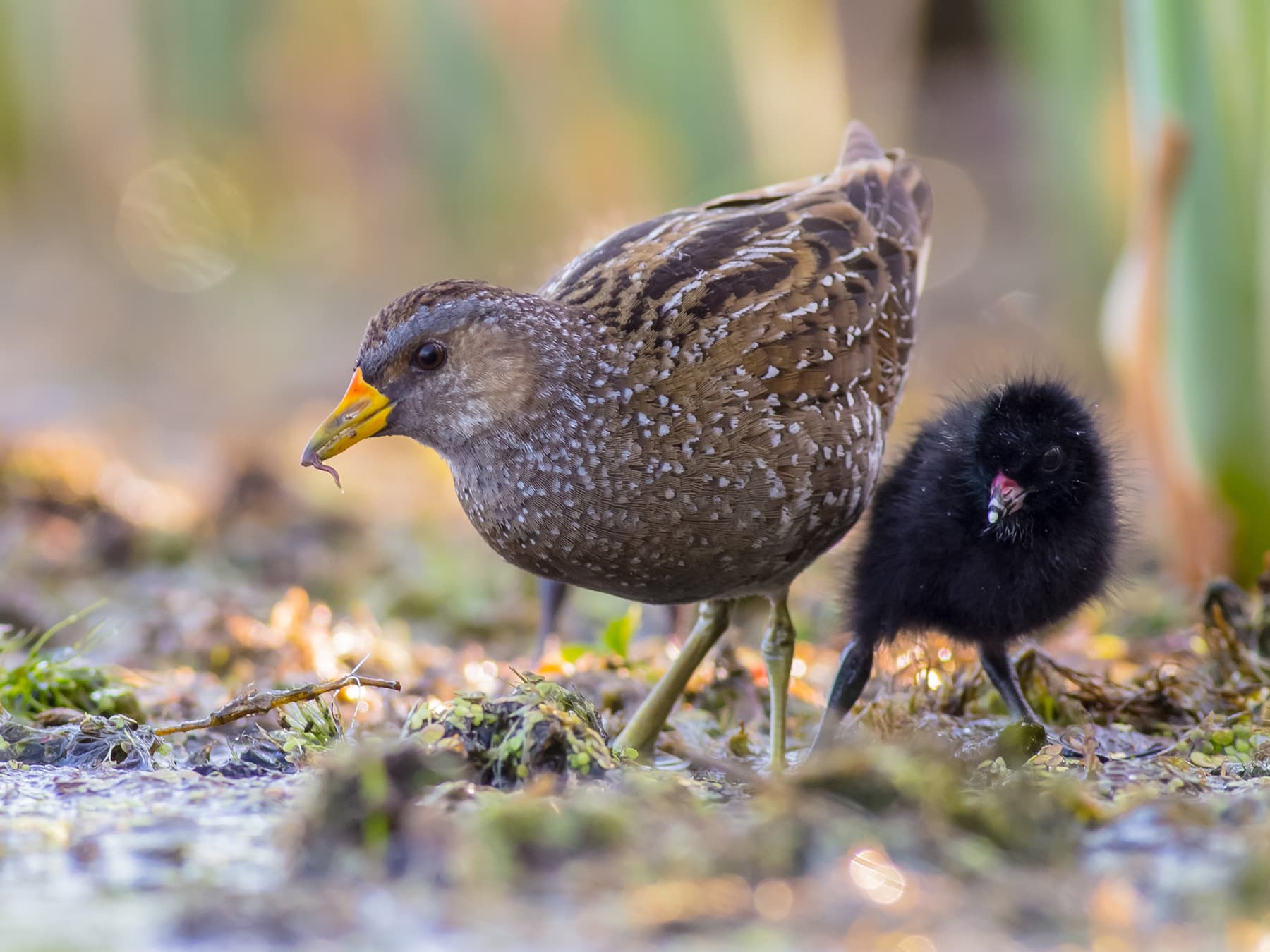
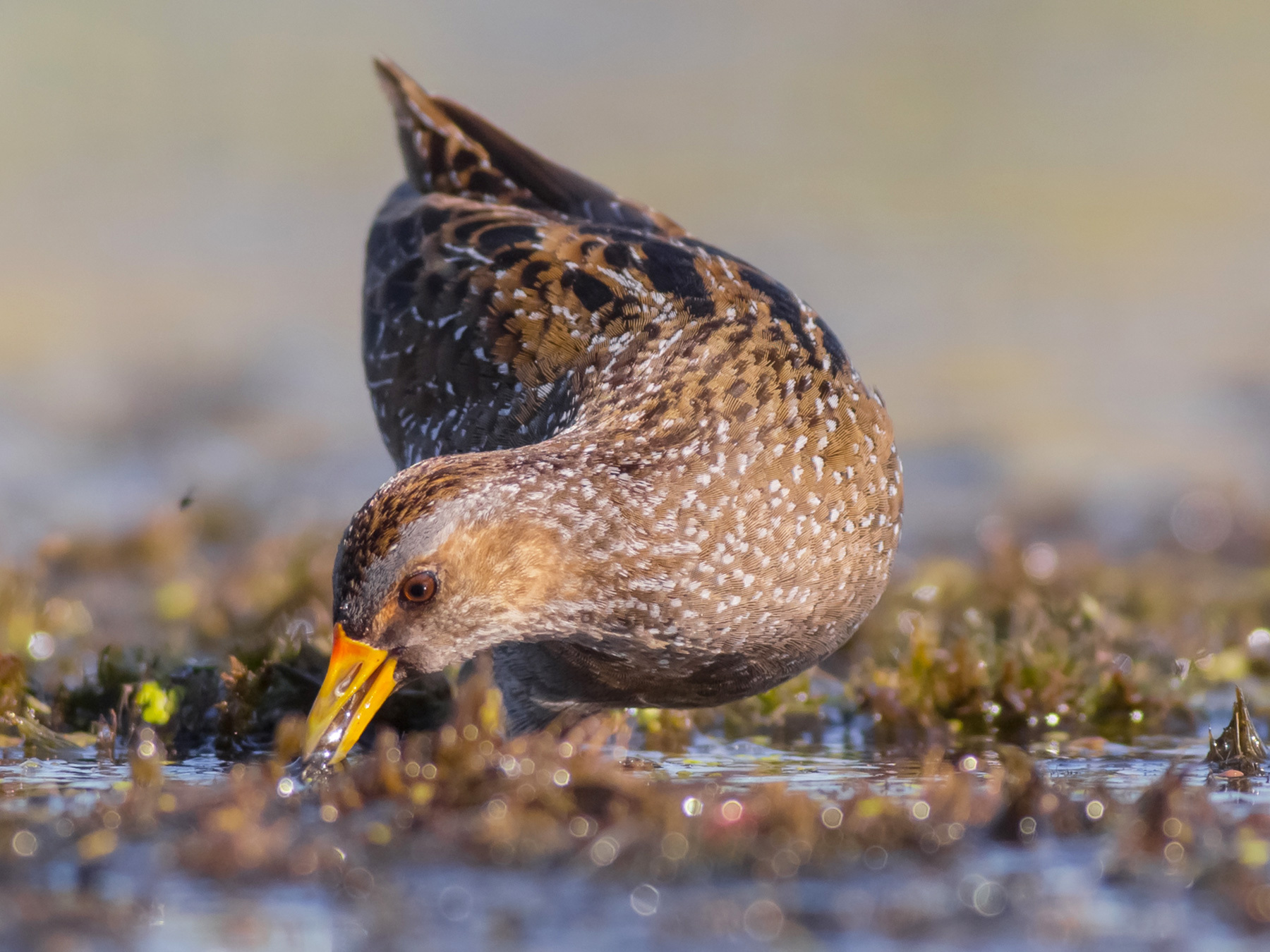
Spotted crakes forage for aquatic invertebrates and their prey by probing mud or shallow water using their bills. They also use sight to pick up prey. Some plant matter is also eaten, such as algae, aquatic grasses and their roots and seeds.
What do Spotted Crake chicks eat?
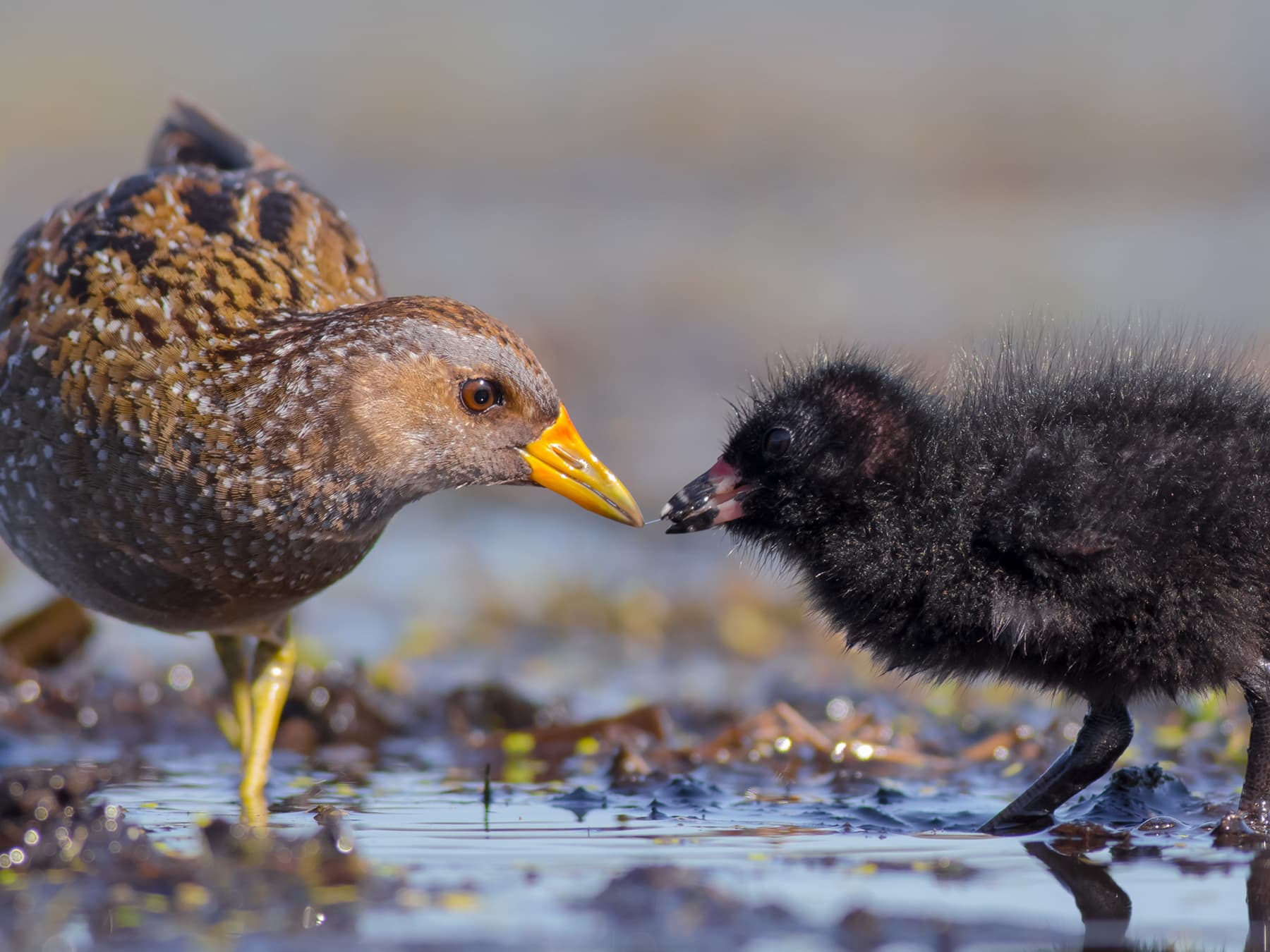
Young spotted crakes quickly master the art of foraging for themselves and feed on soft invertebrates, including coastal worms, earthworms and aquatic insects and their larvae.
Nesting and breeding
Where do Spotted Crakes nest?
Nests constructed by spotted crakes are built in dense reeds and other waterside vegetation next to or above standing water or on a tussock that is raised above the water's surface. Nests are made using plant matter, leaves, stems and rushes, and pulled into a bulky cup shape.
When do Spotted Crakes nest?
In Europe, spotted crakes nest from April to July, while those in Russia and Central Asia nest between May and July. Pairs will typically raise two broods together in a season.
What do Spotted Crake eggs look like?
Between 6 and 14 creamy buff eggs are laid, heavily covered with brown blotches. Eggs measure 34 mm by 24 mm (1.3 in by 0.9 in) and are incubated for between 18 and 24 days by both parents in turn.
Do Spotted Crakes mate for life?
Spotted crake pairs are formed on breeding grounds after spring migration. Pairs remain together for the duration of the breeding season but then separate ahead of the autumn migration.
Most spotted crakes pair up with a new mate each year, although it is not unheard of for pairs to reunite after spending the winter apart.
Behaviour
Are Spotted Crakes aggressive?
As well as being territorial during the breeding season and actively defending their nest and mates against intruders, spotted crakes are also defensive of their feeding grounds and are not tolerant of other birds nearby.
They are usually seen on their own, in pairs, or in small family groups. During migration, larger flocks form and they become temporarily more sociable.
Lifespan and predators
How long do Spotted Crakes live?
Breeding occurs for the first time at one year. Little data is available from ringing or population studies, but it is believed that their average life expectancy is around 7 years.
What are the predators of Spotted Crakes?
Spotted crakes choose waterside locations that are concealed by aquatic vegetation in order to camouflage their nest sites.
Their watery location is a deterrent to many land mammals, although American mink are a relatively common predator of their nests and young. Wetland birds of prey, such as marsh harriers, are another threat, particularly to eggs and young birds.
Are Spotted Crakes protected?
Under the Wildlife and Countryside Act, 1981, spotted crakes are protected against being killed, injured or taken into captivity.
Are Spotted Crakes endangered?
Across their wider range, spotted crakes are not considered to be a species of concern. However, due to their limited breeding activity, they have Amber status on the British Birds of Conservation Concern list.
Populations fluctuate due to habitat changes, and from one year to the next there is no guarantee that conditions will be suitable to attract breeding pairs.
Conservation
While currently listed as Least Concern, Spotted Crakes face threats from wetland drainage and habitat loss.
Conservation efforts focus on protecting and restoring suitable wetland habitats across their range, particularly in Europe, where breeding populations have declined.
More photos
5 photos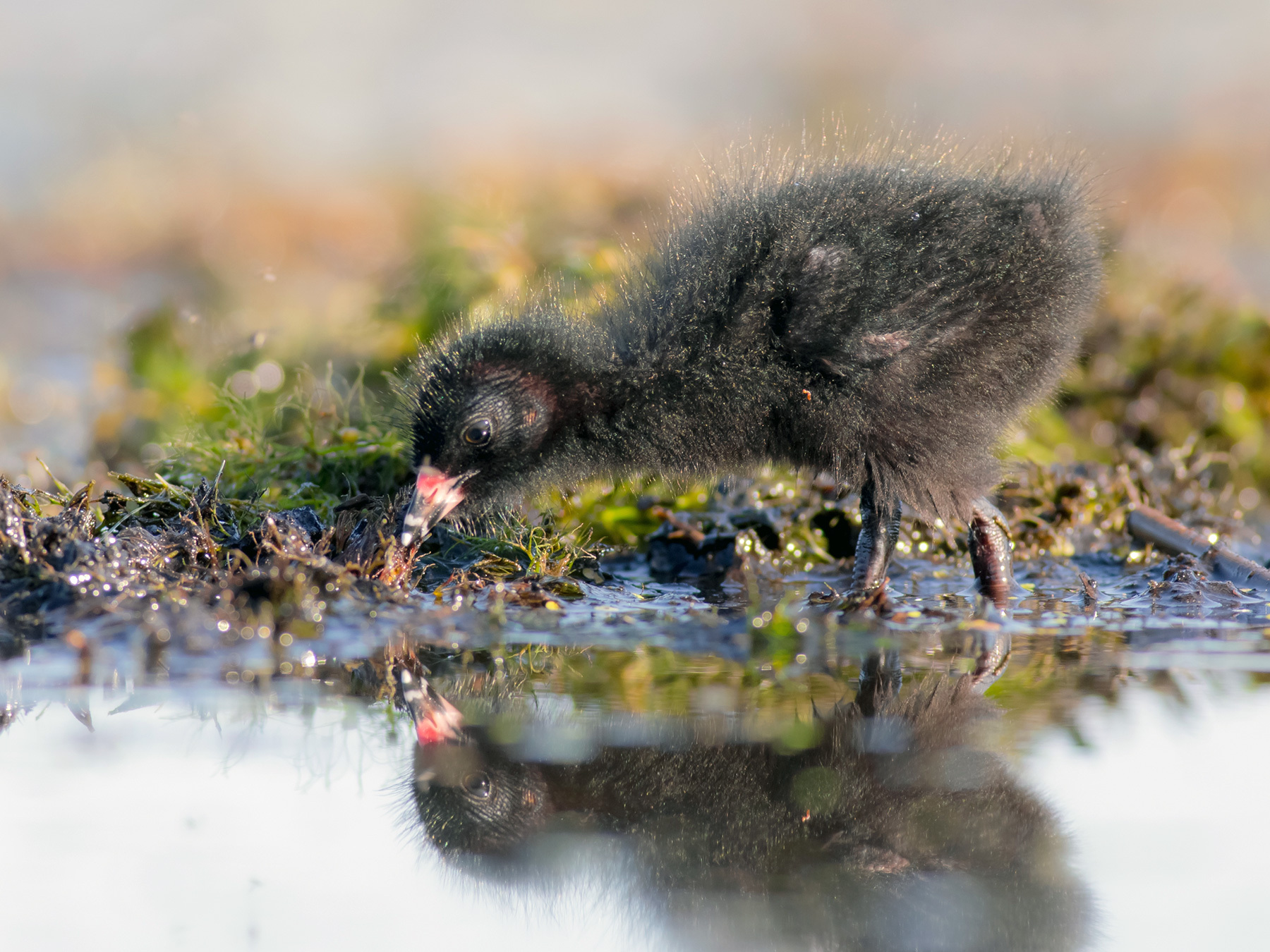
Quick facts
- Length
- 19–22.5 cm
- Wingspan
- 37–42 cm
- Weight
- 70–110 g
- Lifespan
- 5–7 years
- Family
- Rails & Coots
- Migration
- Long-distance Migrant
- Global status (IUCN)
- Least Concern
- World population
- 100,000 - 1,000,000 mature individuals
- Population trend
- Stable
- Also called
- Water Crake
- Scientific name
- Porzana porzana
Questions
1Can Spotted Crakes fly?
Undertaking lengthy migrations twice a year, spotted crakes are proficient at flying and cover vast distances between their breeding grounds and wintering territories.
Spotted crakes are also accomplished swimmers and are also commonly seen on land, walking close to the ground, while busily flicking their tails.
Sources
3- 1BirdLife International. 2016. Porzana porzana. The IUCN Red List of Threatened Species 2016: e.T22692676A86160125. Source (opens in a new tab)
- 2Wetlands International (2015)
- 3Wetlands International (2015)

Checked by
Nathan Cope, founder and editor
Nathan founded Birdfact and leads its writers and contributors in the UK, the US and Canada. He has watched and studied birds for more than ten years, and checks every article and species guide before it’s published.