


Snowy Owl
Arctic Owl, Great White Owl · Bubo scandiacus
By the Birdfact teamChecked by Nathan Cope
On this page14 sections
How to recognise it
What do Snowy Owls look like?
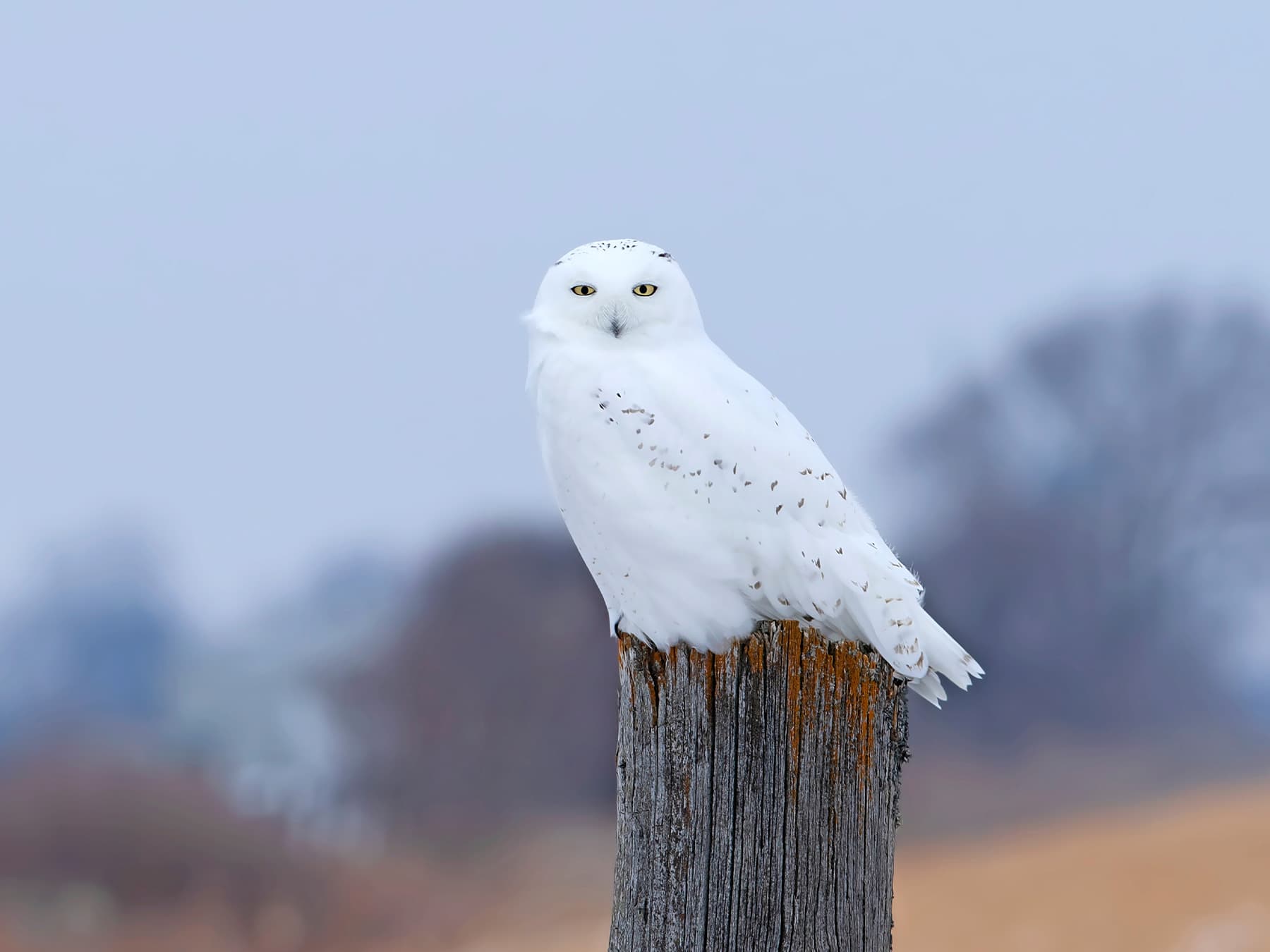
The only white owl species, snowy owls are unmistakable and cannot be confused with any other bird species, let alone any other owl. They are among the largest owls, and their plumage gives important clues to their sex and age.
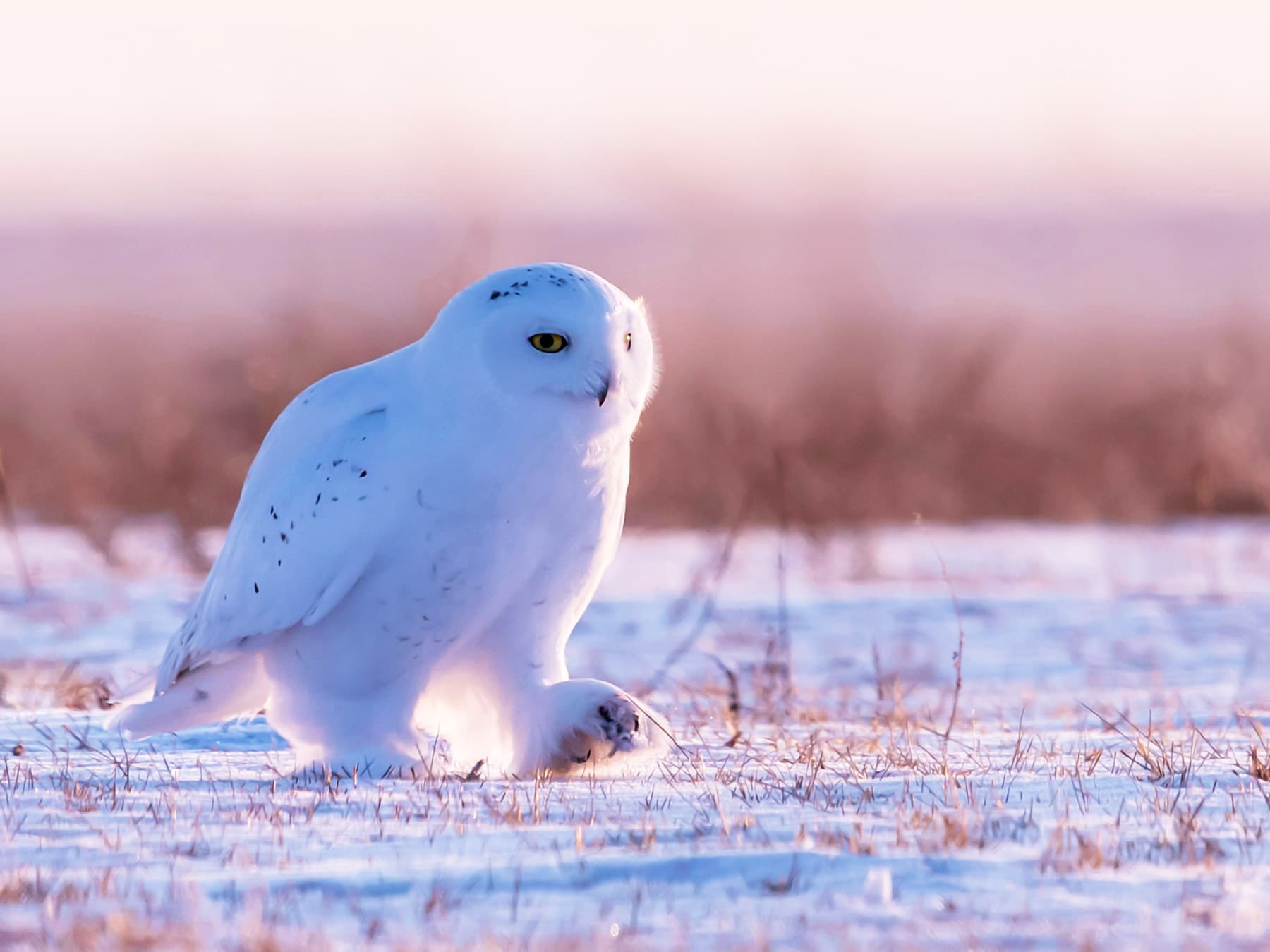
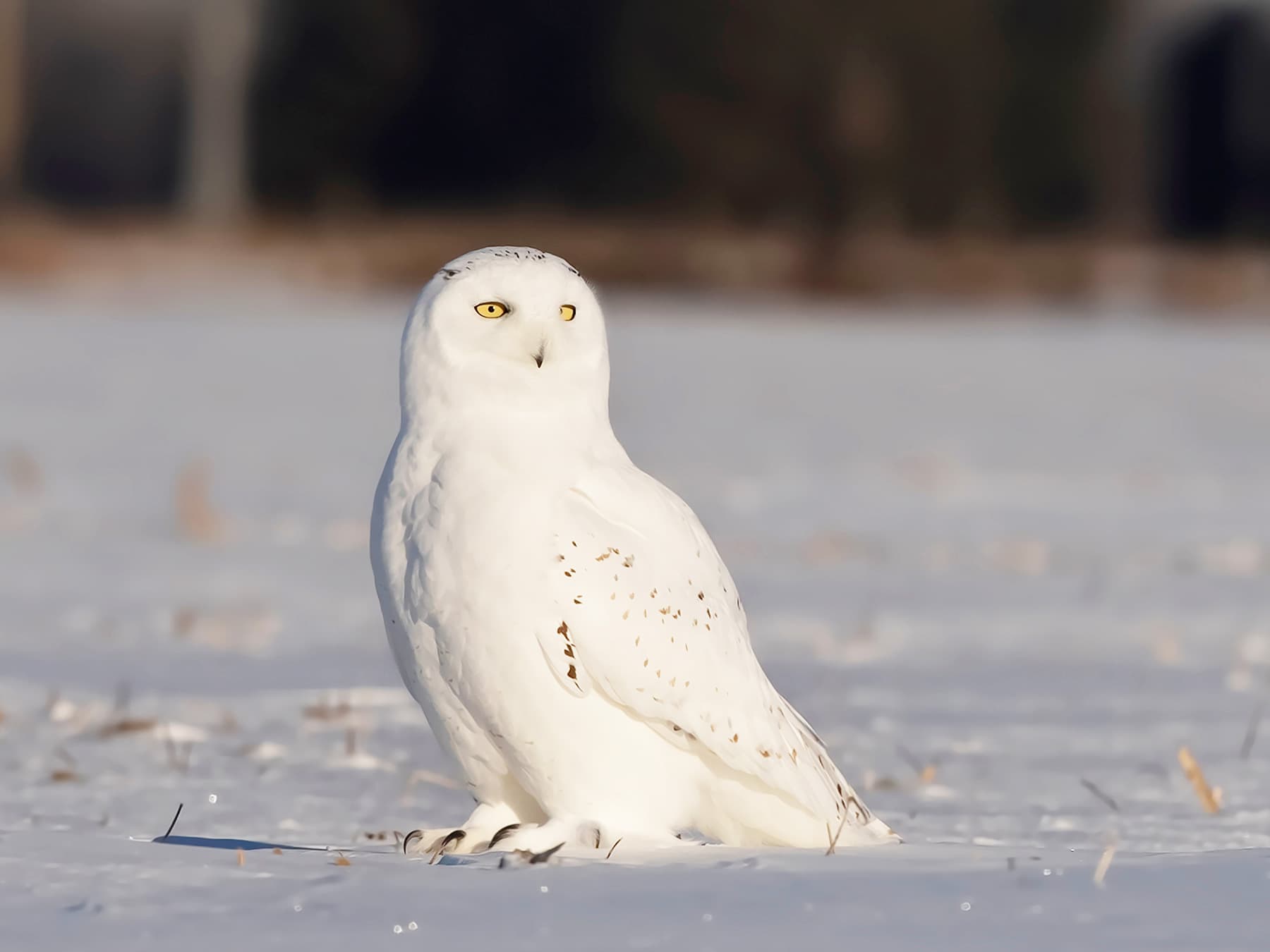
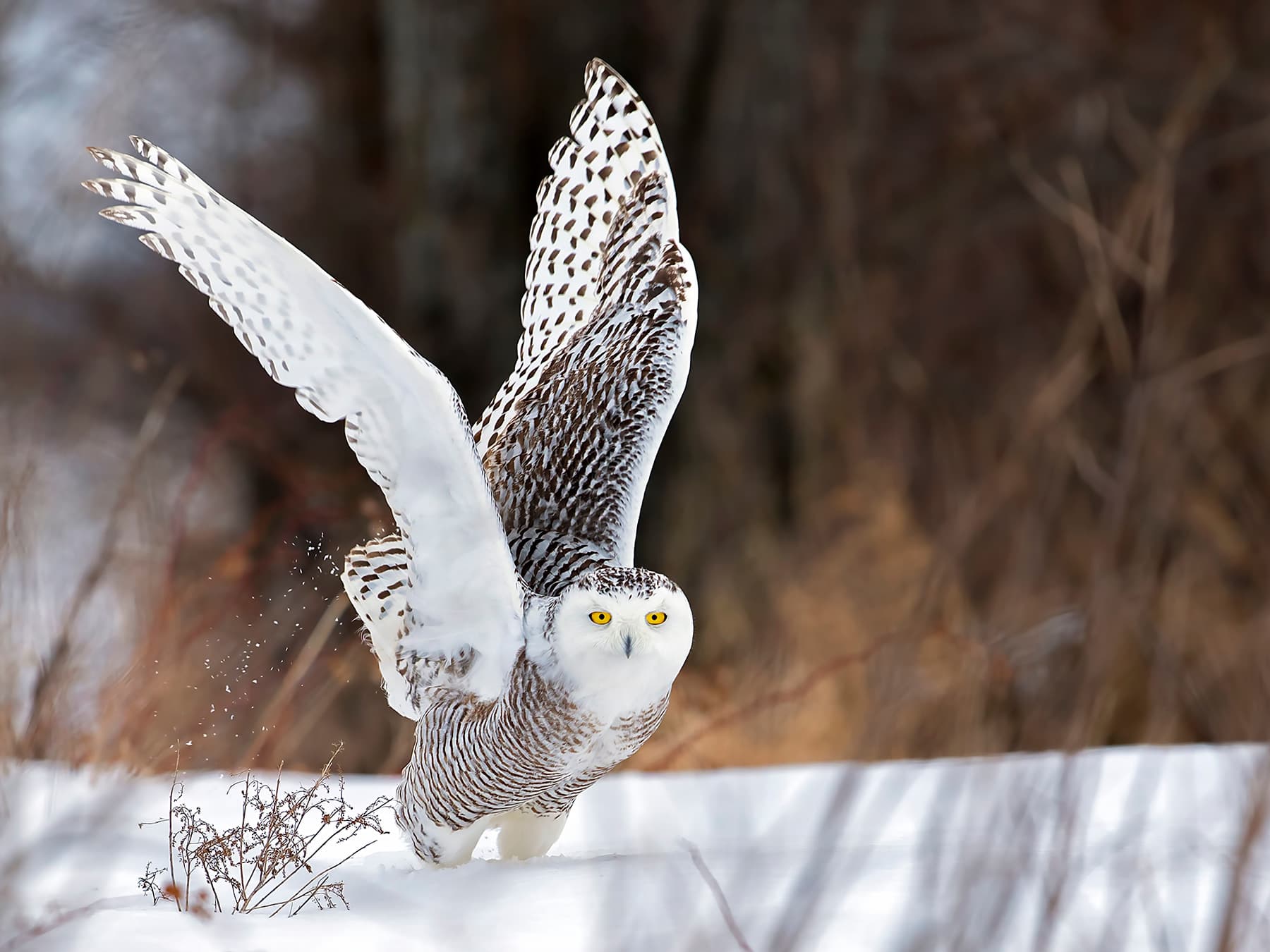
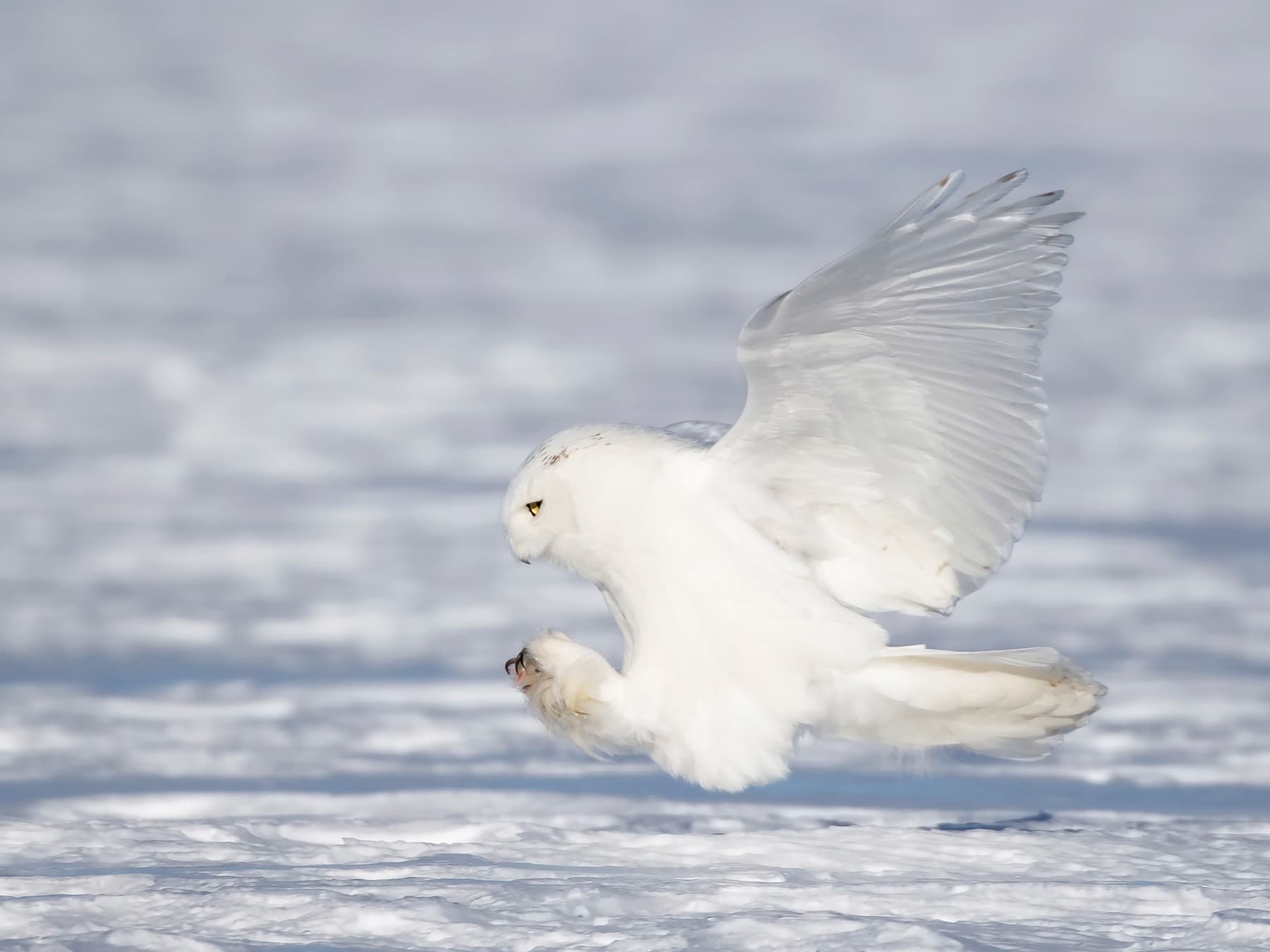
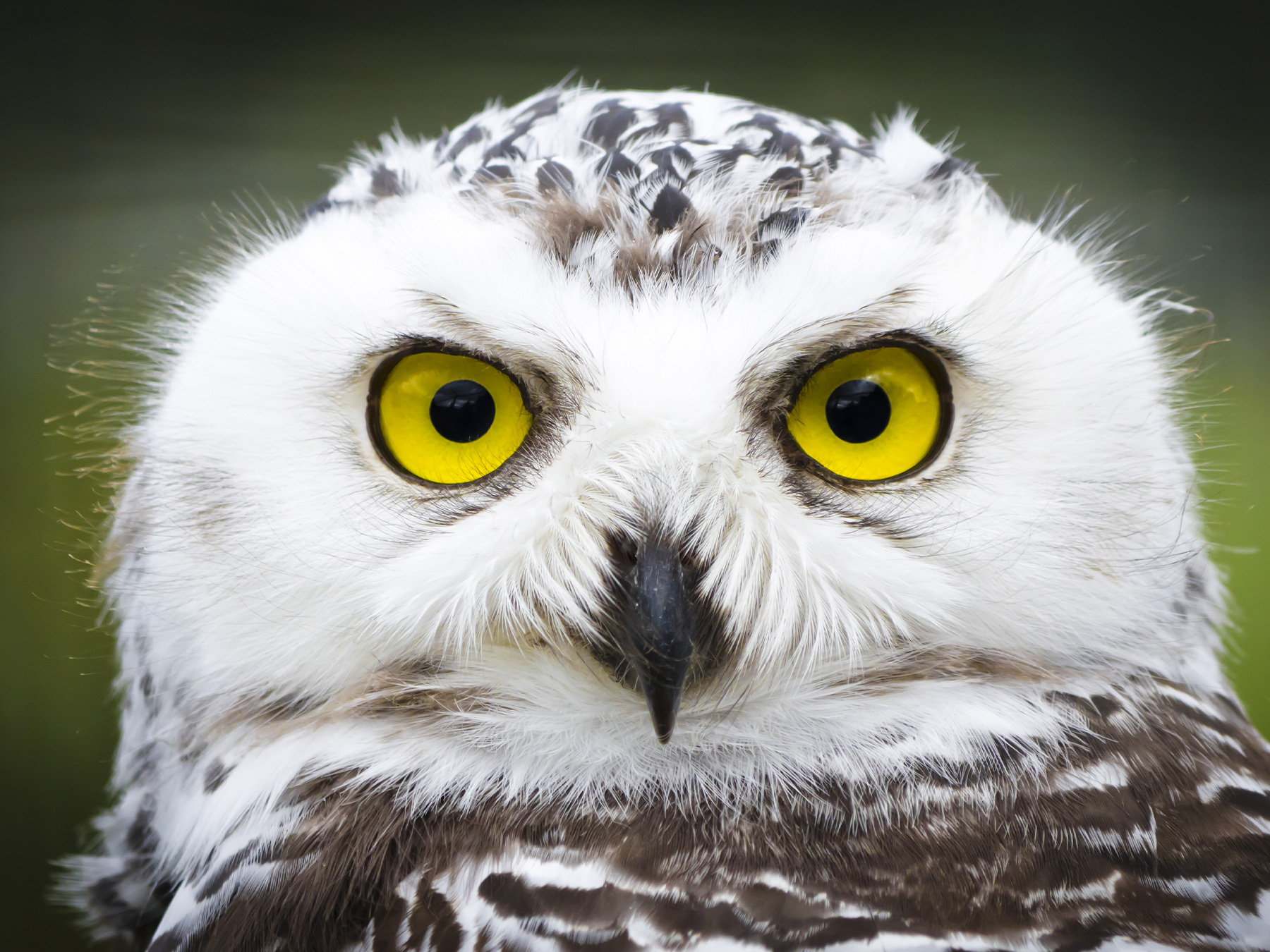
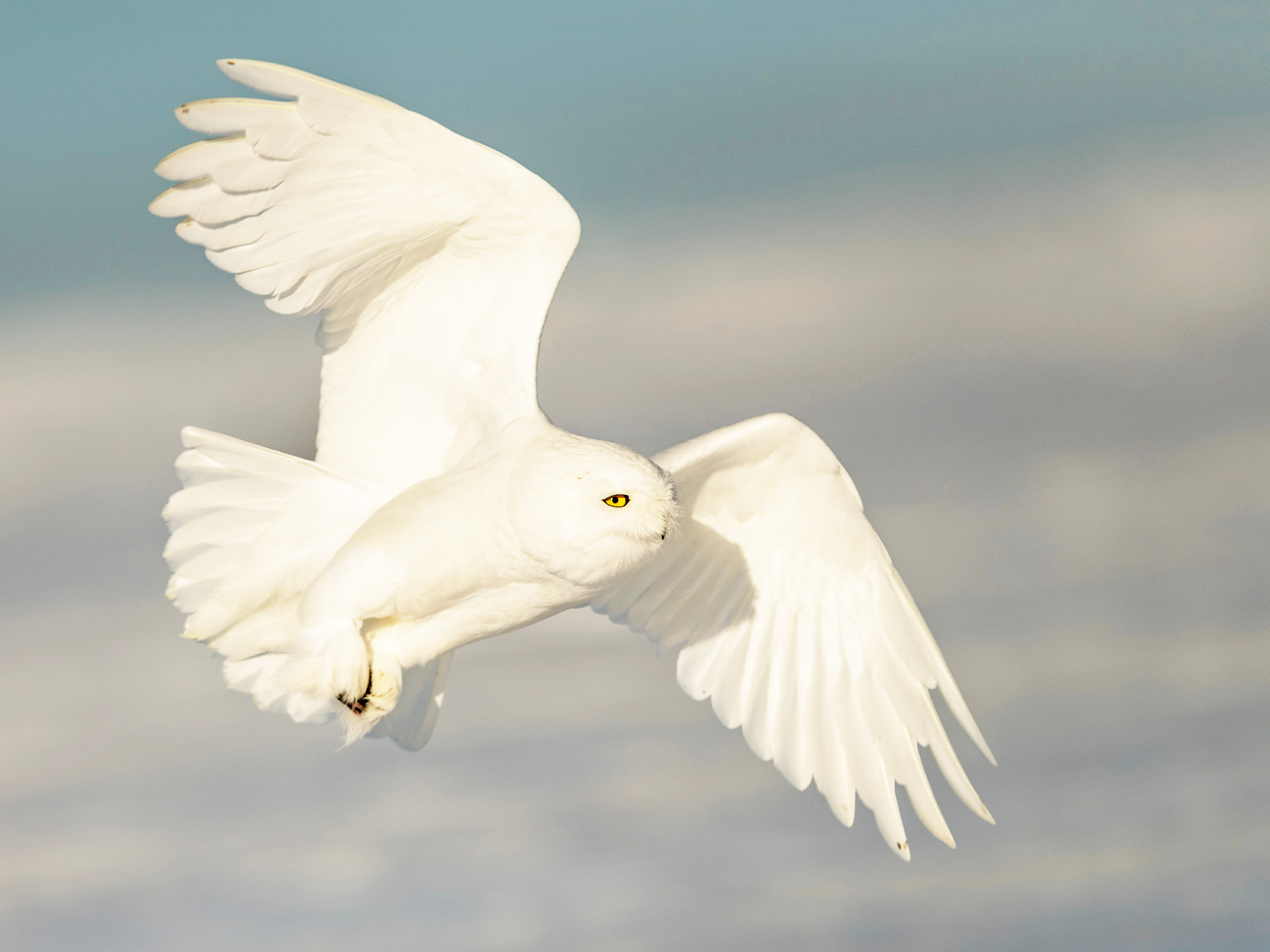
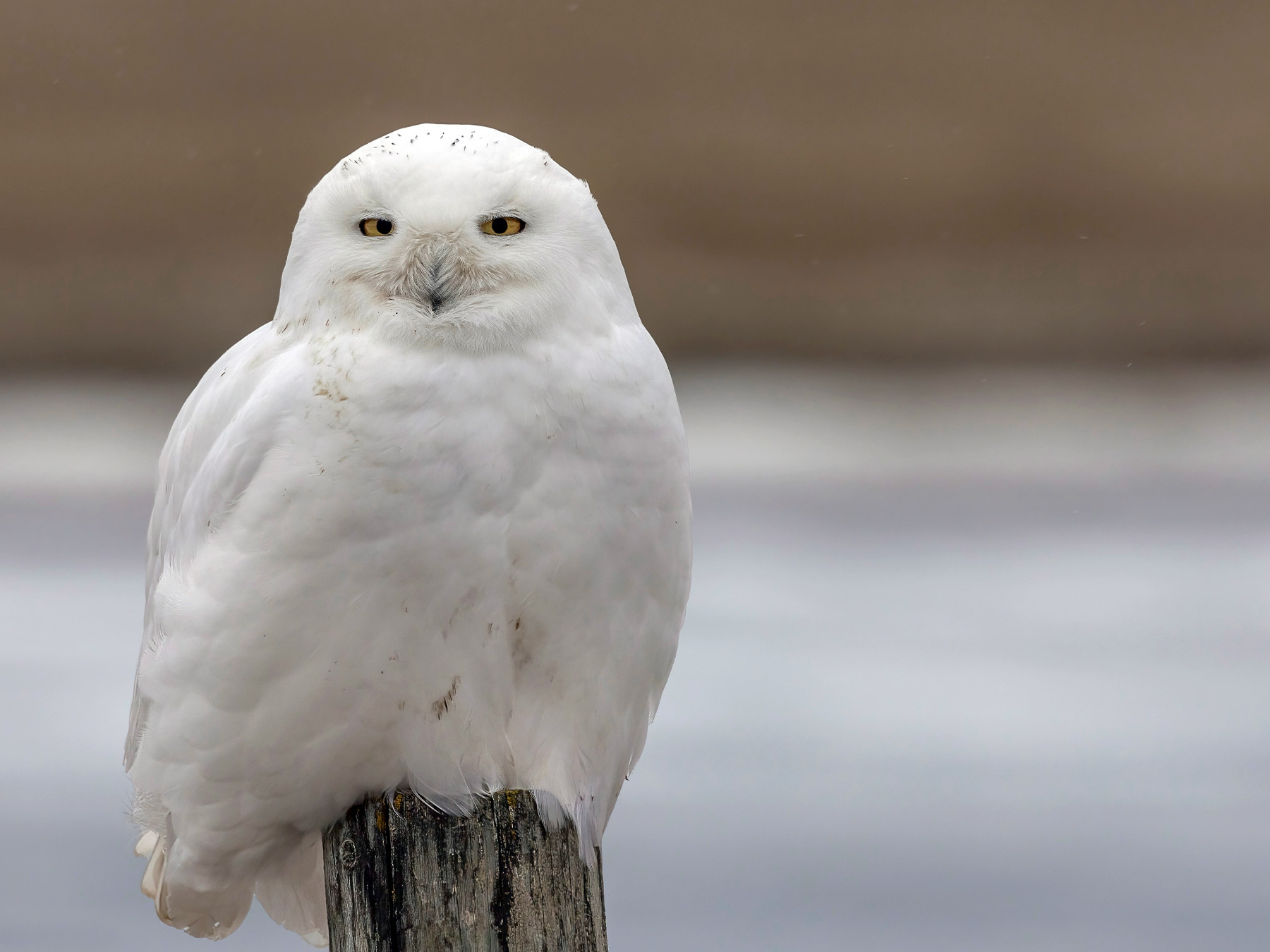
Older male snowy owls may be pure white, with a rounded head and small ear tufts that are not always visible. Their eyes are an intense yellow, and their bill is black, although can barely be seen beneath thick white facial bristling. Feet and legs are covered in dense feathers, and claws are sharp and black.
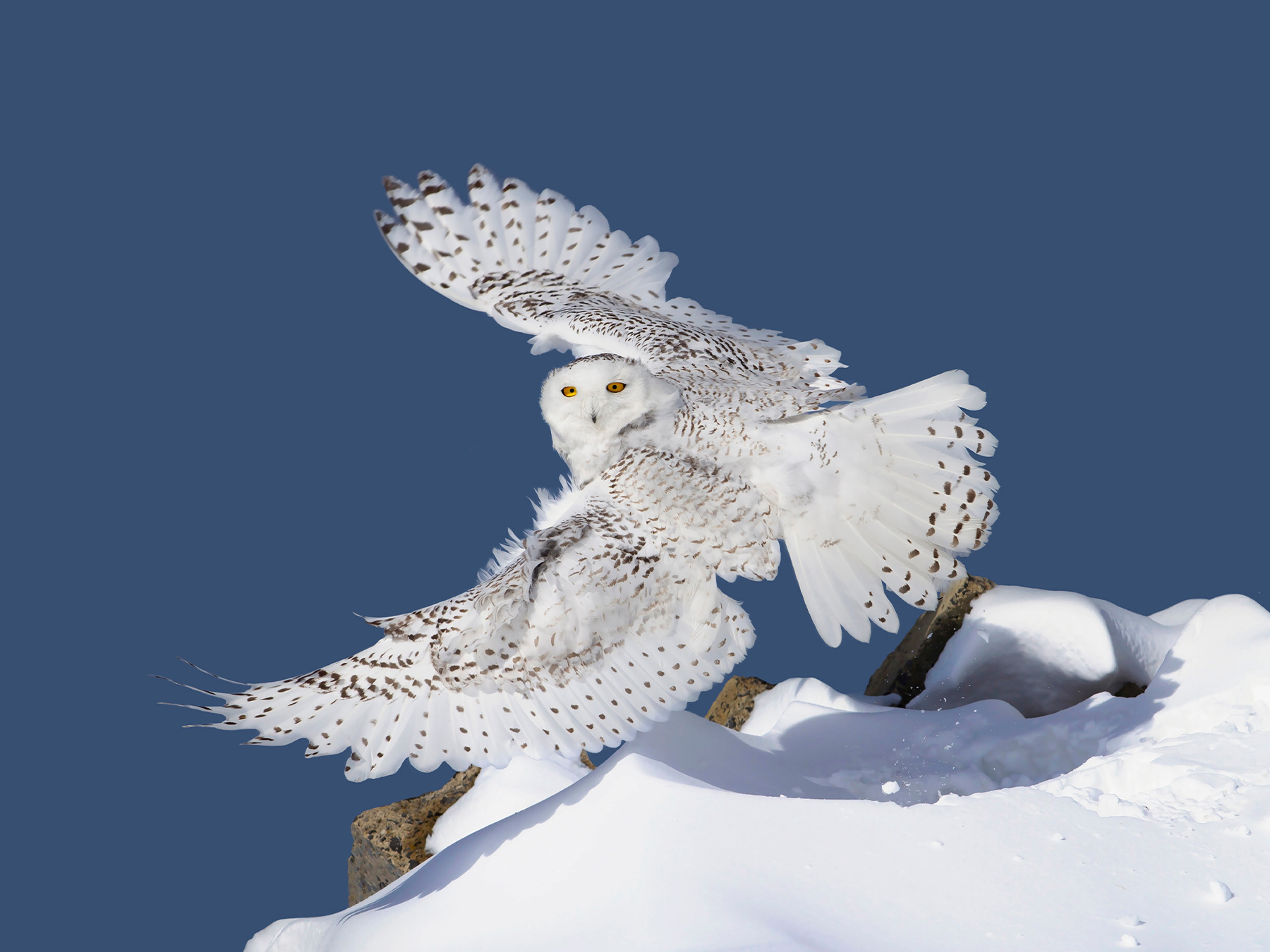
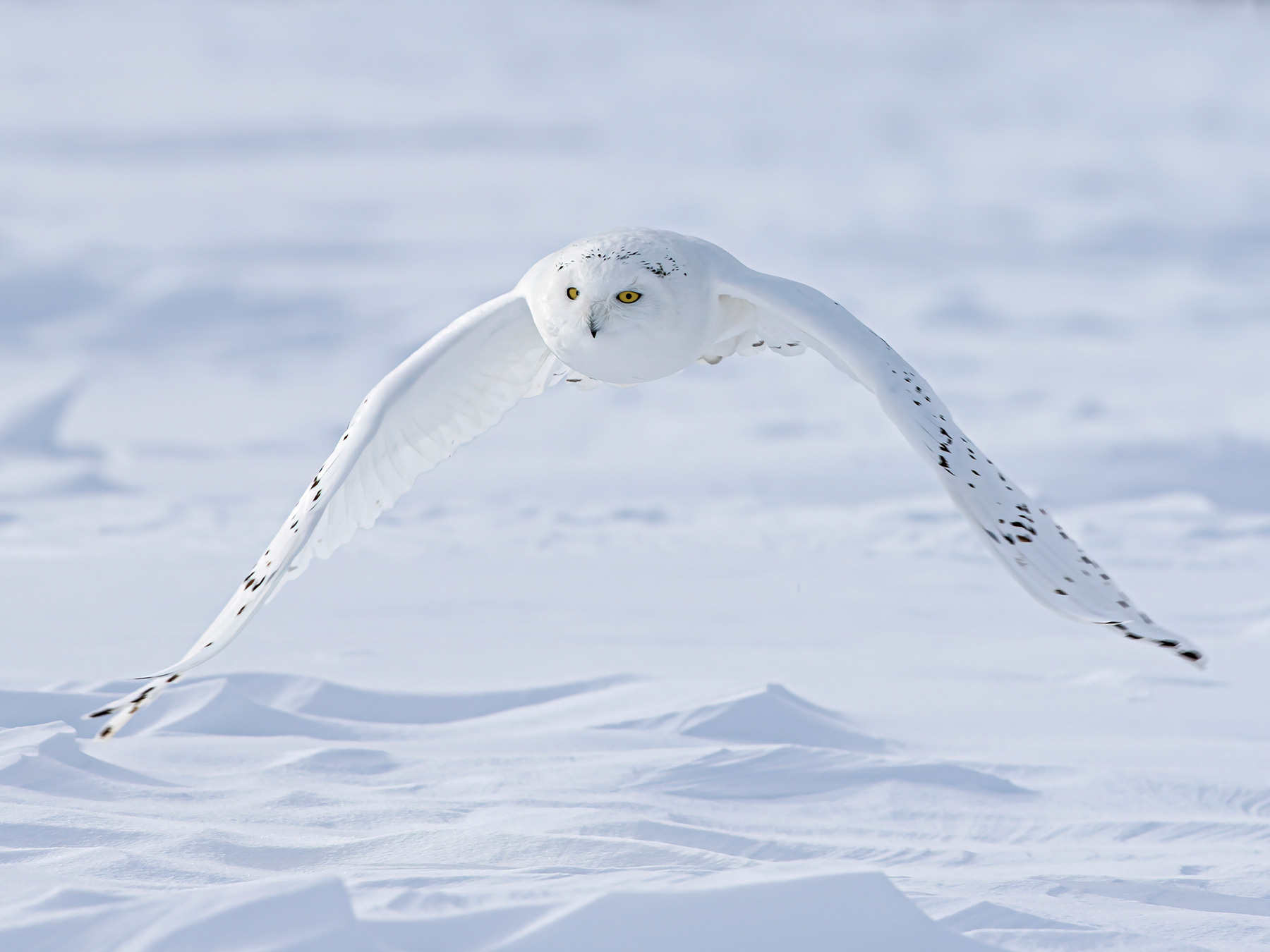
Younger males are mainly white but have dark spotting on their flight feathers, which fade with age.
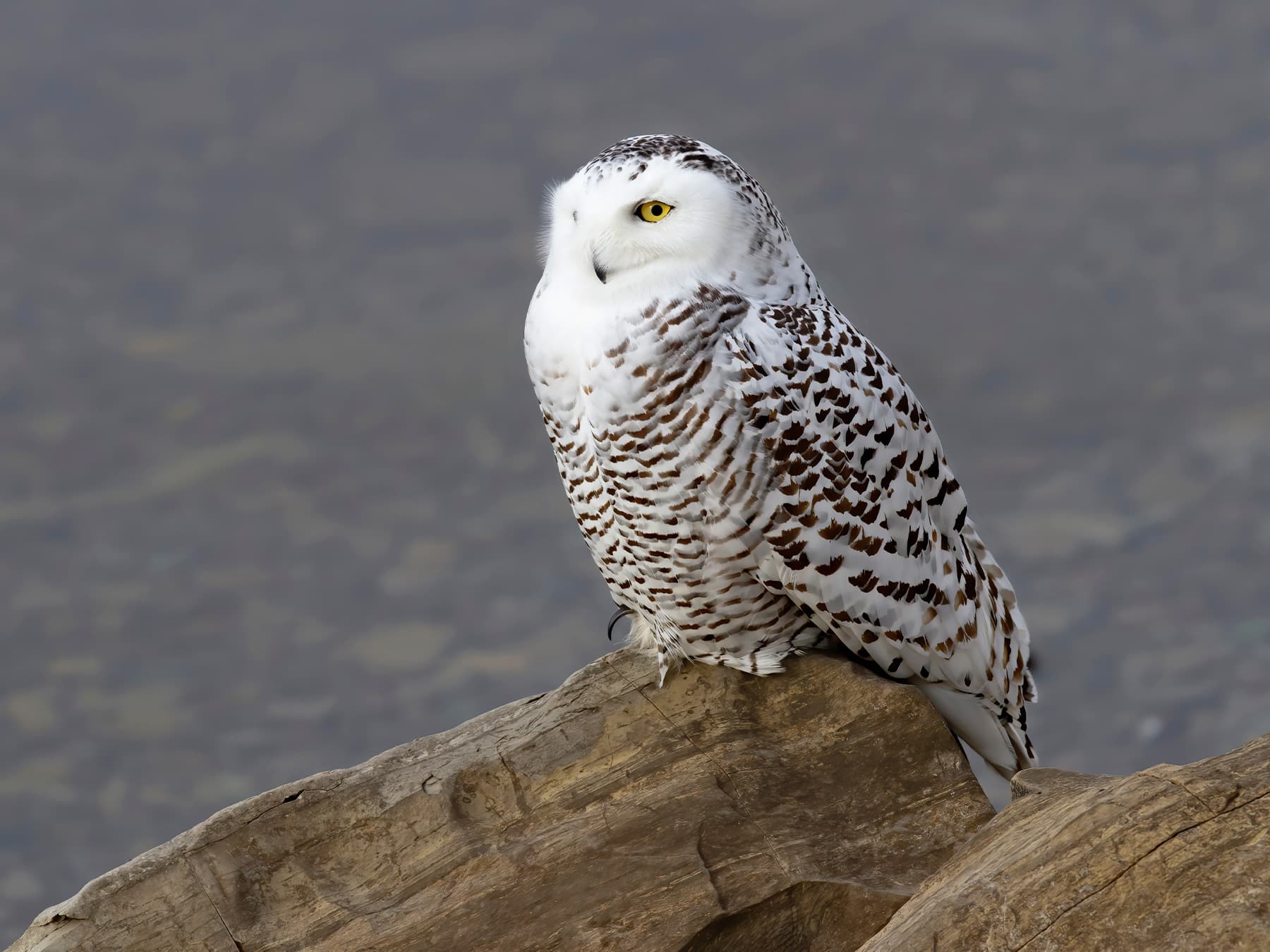
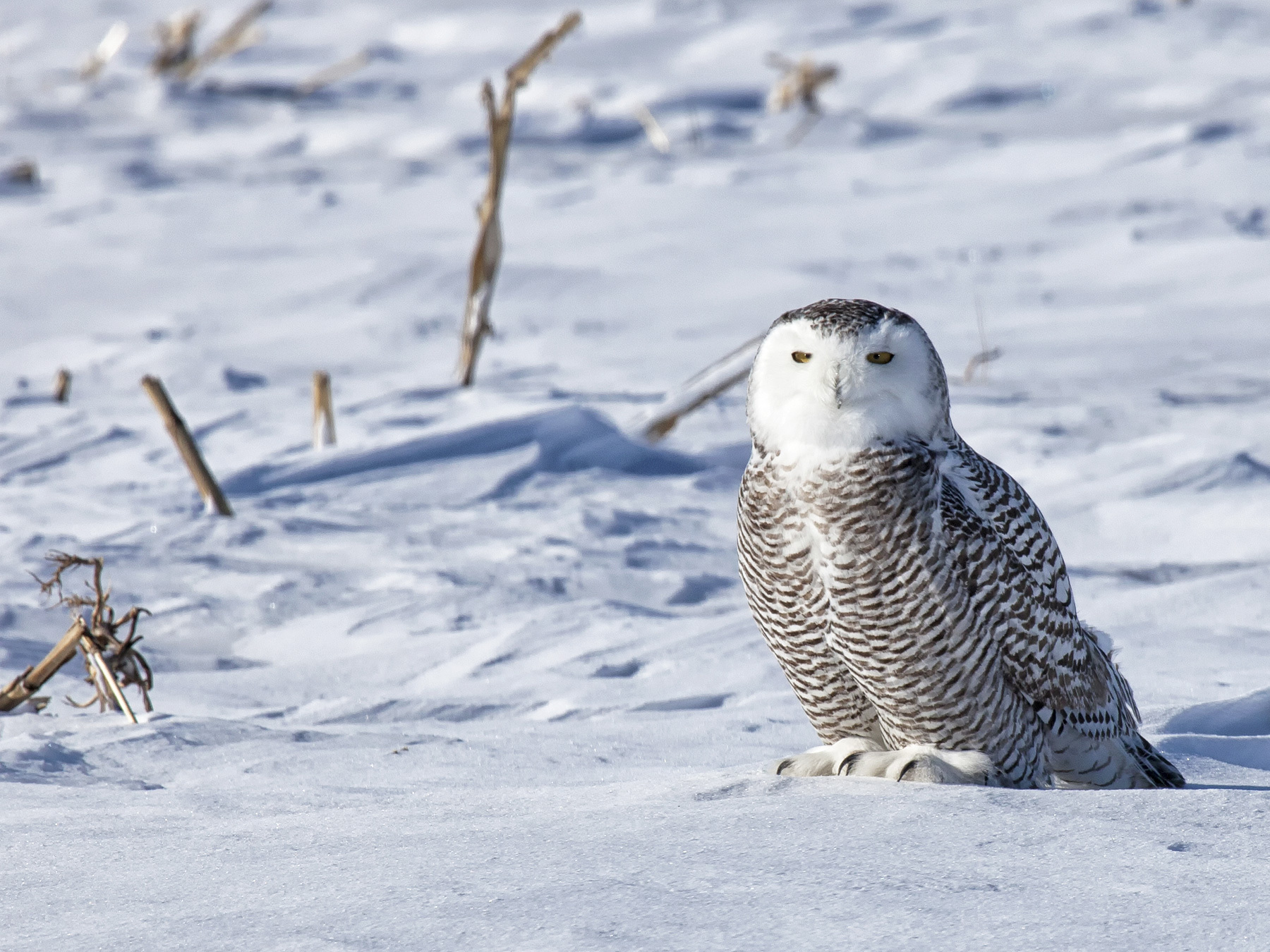
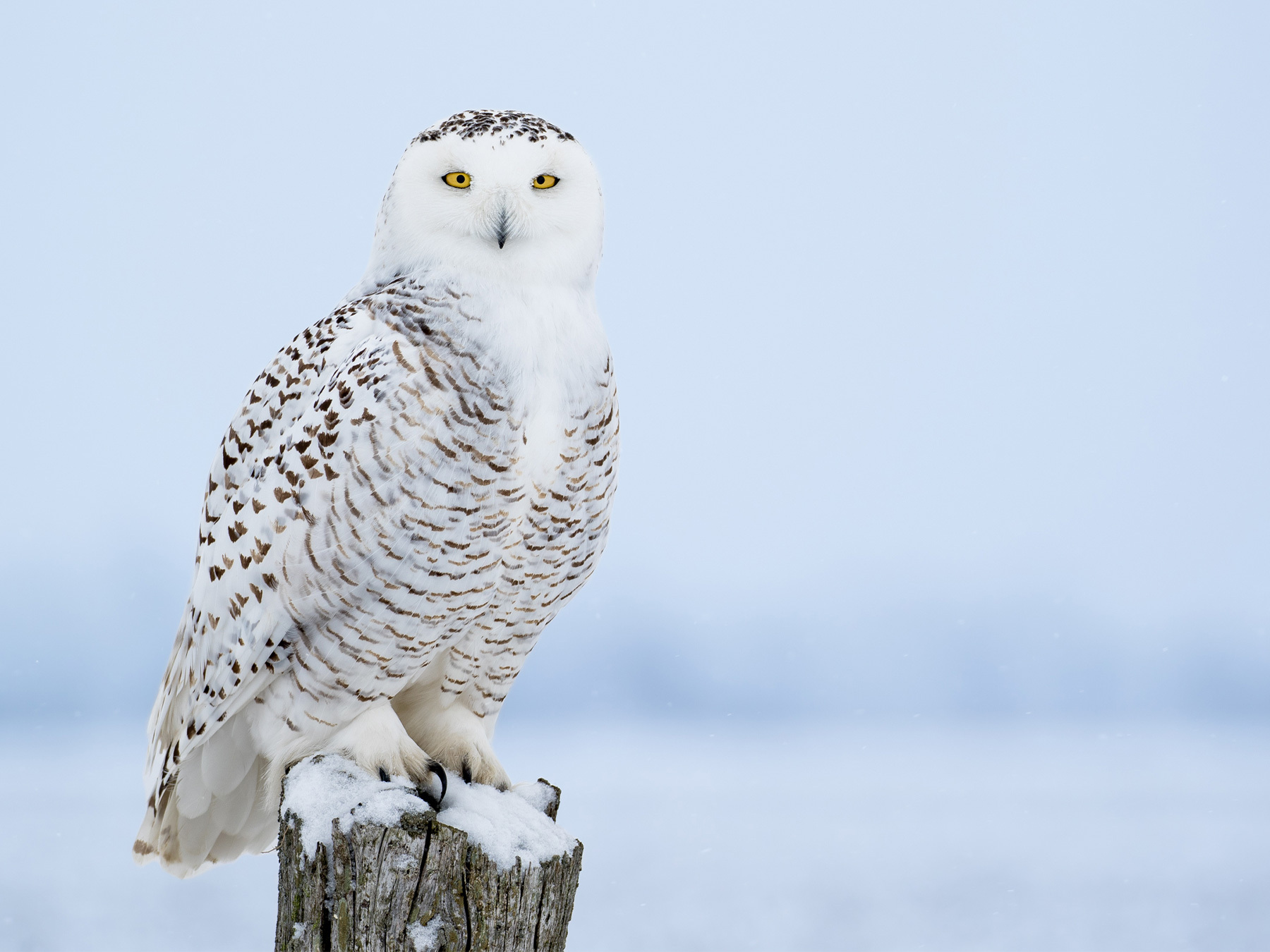
White also dominates the plumage of female snowy owls; however, they can easily be told apart from males due to the presence of heavy dark brown barring on their breasts, wings, back, and crowns. Females are also larger and heavier than males and have more prominent ear tufts.
Young snowy owls have a juvenile plumage that changes as they mature, taking several years before they gain their full adult coloring. Younger snowy owls are far more heavily marked than more mature birds.
How big are Snowy Owls?
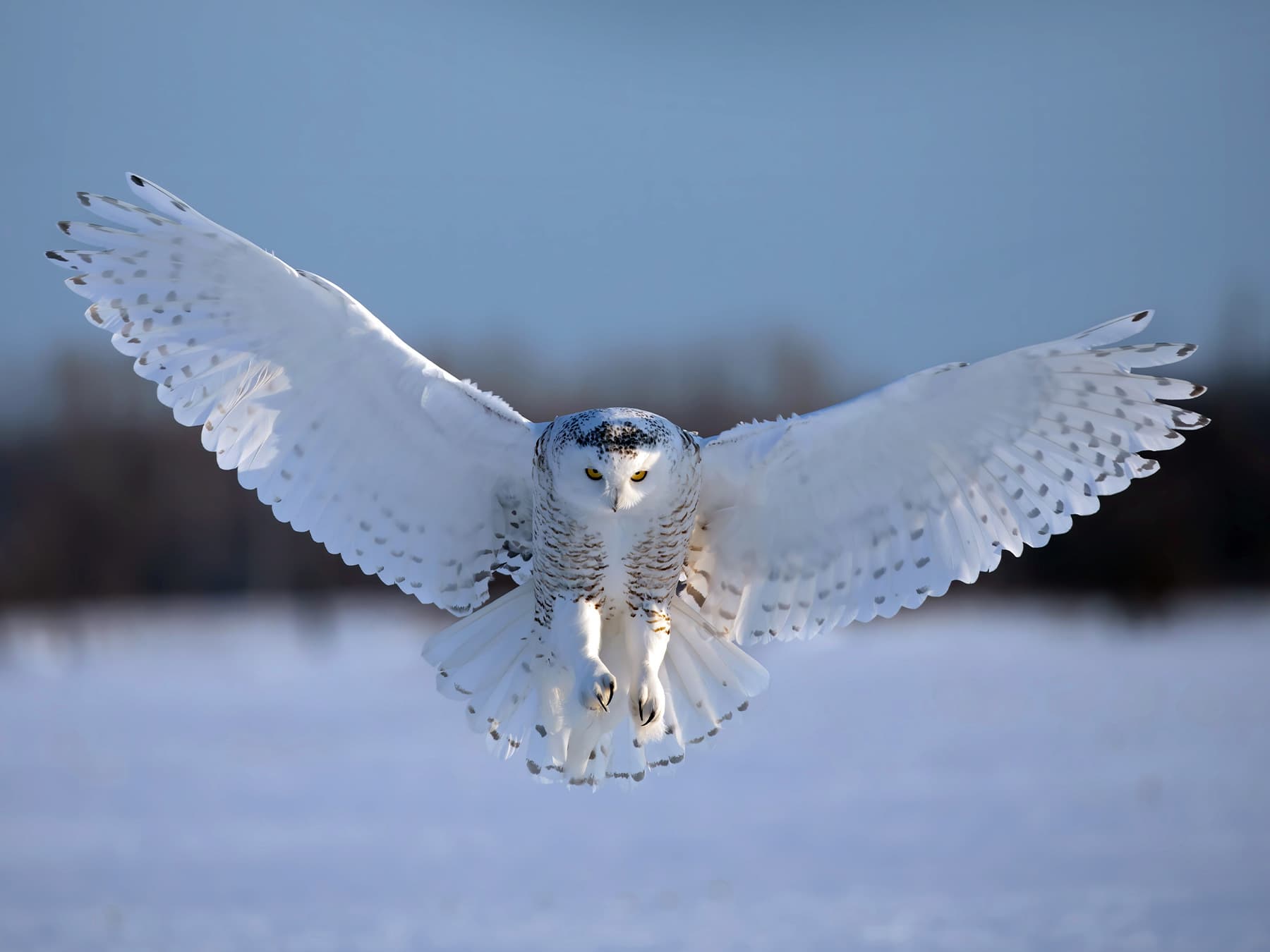
The snowy owl is larger in all aspects than two giants of the owl world: the barred owl and the great horned owl.
In North America, only the great gray owl is larger in stature. However, the snowy owl takes the crown for North America’s heaviest owl, weighing in at around a pound heavier than the great horned owl, and twice the weight of a great gray owl.
- Length: 52 cm to 71 cm (20.5 in to 27.9 in)
- Wingspan: 126 cm to 166 cm (49.6 in to )
- Weight: 700 g to 2950 g ( oz to 104.1 oz)
Its size
Adults- Length
- 52–71 cm
- Wingspan
- 126–145 cm
- Weight
- 1600–2950 g
Its song and calls
What sound does a Snowy Owl make?
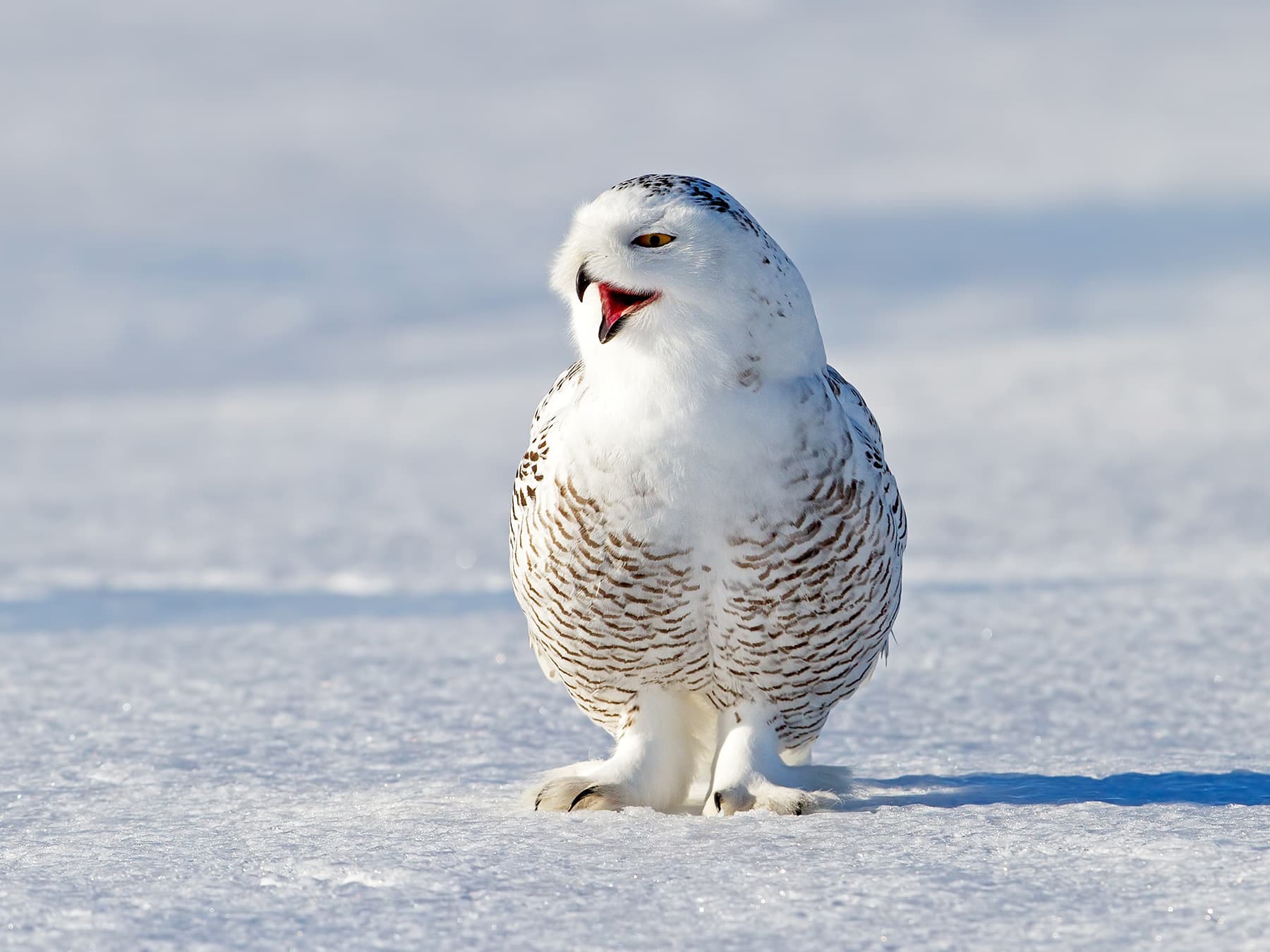
Away from breeding grounds, snowy owls are a relatively silent species. A single or double hoot is heard from males early in the breeding season, with females responding with a whistling mewing call. In nest defense a bark call is used to drive away any potential predators.
When and where to see it
OctoberArriving
Most recorded in October
- 1. Nunavut0.99%
- 2. Alaska0.11%
- 3. Yukon Territoryunder 0.1%
- 4. Manitobaunder 0.1%
- 5. Prince Edward Islandunder 0.1%
Each dot is a county, state or province: the bigger and darker, the larger the bird’s share of that place’s bird records that month. Grey dots: no regular records. The ringed point is the centre of the bird’s records this month; the arrow shows how it moved since last month, and the dashed loop its path through the year. “Arrivals” colours places where it becomes regular this month (orange) or is in its last regular month (grey). GBIF eBird Observation Dataset, 2019–2024. Map data: Natural Earth, US Census Bureau; place centres © OpenStreetMap contributors.
In your area
See when the Snowy Owl is recorded in your county, state or province.
How often the Snowy Owl turns up in the United States and Canada through the year, from birdwatchers' records.
United States
Winter visitor · regularly Nov–Jun · most records in January
Canada
Winter visitor · regularly Nov–Mar · most records in January
Show as a table
| Month | United States | Canada |
|---|---|---|
| January | 0.038% (regular) | 0.37% (regular) |
| February | 0.024% (regular) | 0.28% (regular) |
| March | 0.007% (regular) | 0.11% (regular) |
| April | 0.002% | 0.018% |
| May | <0.001% | 0.001% |
| June | 0.004% (regular) | 0.002% |
| July | <0.001% | 0.002% |
| August | <0.001% | 0.001% |
| September | <0.001% | <0.001% |
| October | <0.001% | 0.001% |
| November | 0.010% (regular) | 0.066% (regular) |
| December | 0.033% (regular) | 0.21% (regular) |
Recorded regularly in
Worldwide: recorded regularly in 6 countries
Countries where it was recorded in at least 3 of the 6 years 2019–2024. Linked countries have their own bird list.
Data: EOD – eBird Observation Dataset (Cornell Lab of Ornithology), accessed via GBIF.org, CC BY 4.0. Records from 2019–2024, aggregated and filtered by Birdfact. How these lists are made
What is the habitat of a Snowy Owl?
High-rolling Arctic tundra landscapes are home to breeding snowy owls, with mounds and hummocks that they can use as perches. Tree cover is unimportant and they are rarely found in forested regions.
Winter habitats include open fields, grasslands, airfields, and moorlands, with stubble fields appearing to be a popular choice. Some snowy owls migrate north to spend winters on sea ice near the open ocean, where they prey on eiders and other sea ducks.
What is the range of a Snowy Owl?
Snowy owls breed in the high Arctic regions of North America and Eurasia, from the western and north coasts of Alaska, across the northern coast of Canada, including the Arctic islands, the north and northeast coasts of Greenland, Scandinavia, and along the entire northern coast of Russia.
Once breeding is complete, snowy owls migrate south, although wintering grounds are irregular and their winter range is influenced heavily by the availability of prey.
Wintering snowy owls are found across much of southern and central Canada, the extreme northern states of the US, parts of western Greenland, Iceland, northern Europe, including occasional visitors to the UK, and across central Russia and northern China.
Where do Snowy Owls live?
Snowy owls inhabit the northernmost regions of the world. Populations are variable, with irruptions to regions with a wealth of lemmings and voles in the breeding season, which makes it more difficult to assess which countries have the highest populations as it changes from year to year.
Canada is one of the primary countries for snowy owl populations, offering both breeding and wintering grounds to the species.
Northern Russia, particularly Siberia, has a considerable number of breeding snowy owls each spring, and birds that breed in Norway, Sweden, and Finland move further inland during the winter.
The northern US is another key winter destination, with Alaska, Minnesota, Wisconsin, and New York among the states with the highest numbers.
How rare are Snowy Owls?
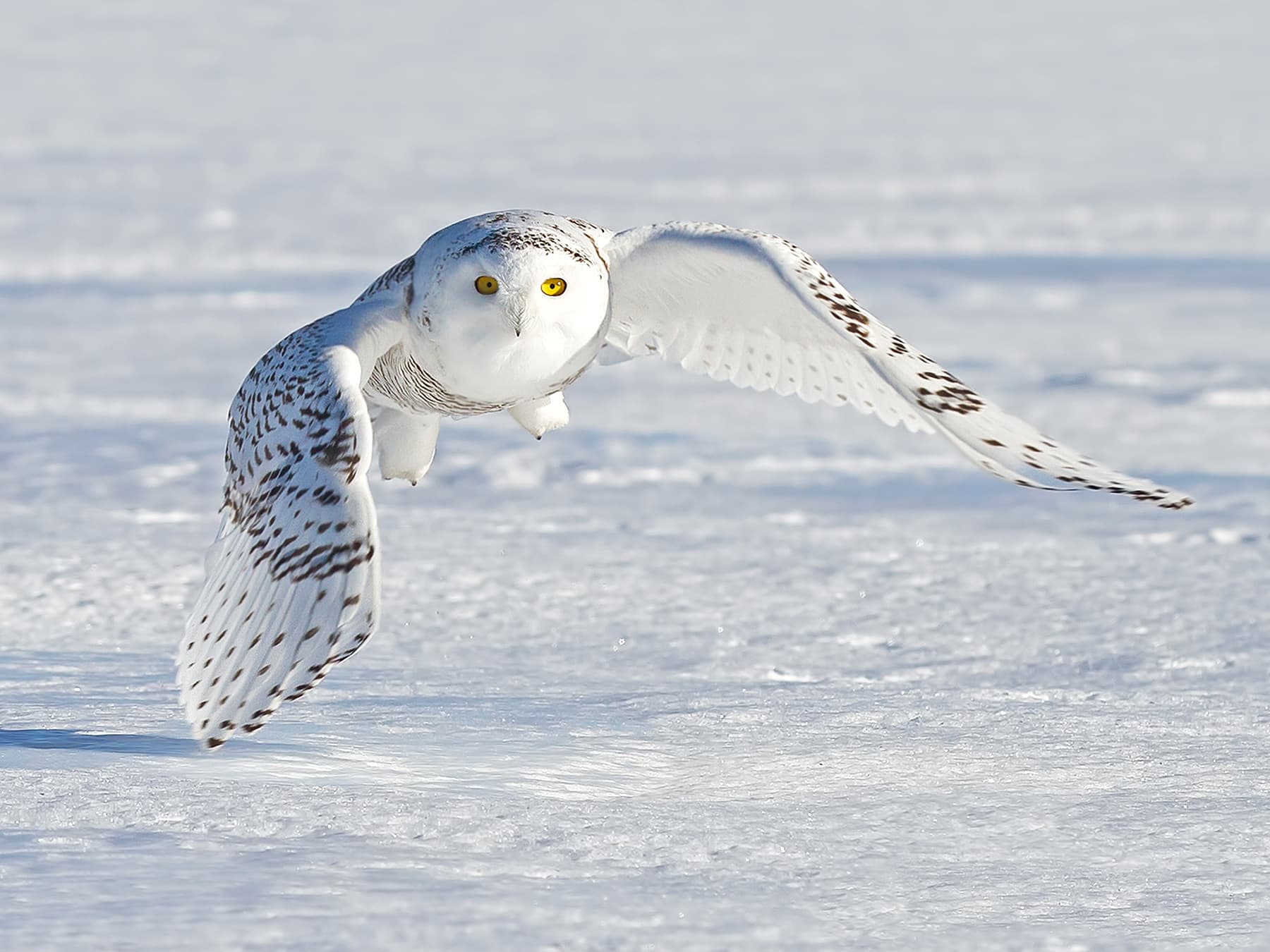
Snowy owls are declining in number fairly rapidly and are now considered both rare and vulnerable. Their preference for isolated breeding grounds in the far north makes sightings during the breeding season particularly uncommon.
In 2013 the population was estimated at around 200,000 individuals, but current estimates suggest it is considerably lower and may even be only around 28,000 individuals.
Where can you see Snowy Owls in the US?
In the US, snowy owl sightings are most commonly reported in winter months in the northeastern states but are found in the Pacific Northwest and Midwest. The only US state where breeding occurs is Alaska.
Sightings are unusual, although one particular spot that welcomes winter visitors each year is Logan Airport in Boston, where up to 23 individuals were counted in one year.
Where can you see Snowy Owls in Canada?
In winter, Quebec’s Gaspé Peninsula offers a fair chance of a snowy owl sighting, with ideal landscapes. Winter sightings are regularly reported in Churchill, Manitoba, the ‘Polar Bear’ capital, particularly late afternoon when they are at their most active.
Migration
Do Snowy Owls migrate?
Snowy owls leave their frozen High Arctic breeding grounds when prey becomes scarce and have no set migration routes or patterns, instead showing up wherever there is an abundance of suitable prey.
Are Snowy Owls native to the US?
Up to 24 percent of the world’s snowy owls are believed to spend winter months in the United States, but their range is limited to the extreme northern border with Canada. Breeding occurs annually along the western and northern coastal regions of Alaska.
Tips for seeing it
- Look for Snowy Owls in open, treeless areas like fields or coastal dunes
- Scan the tops of poles, fence posts, or small hills for perched owls
- Visit northern coastal areas in winter for better chances of sightings
- Be patient and use binoculars or a spotting scope for distant viewing
- Respect the owl's space and avoid approaching too closely
What it eats
What do Snowy Owls eat?
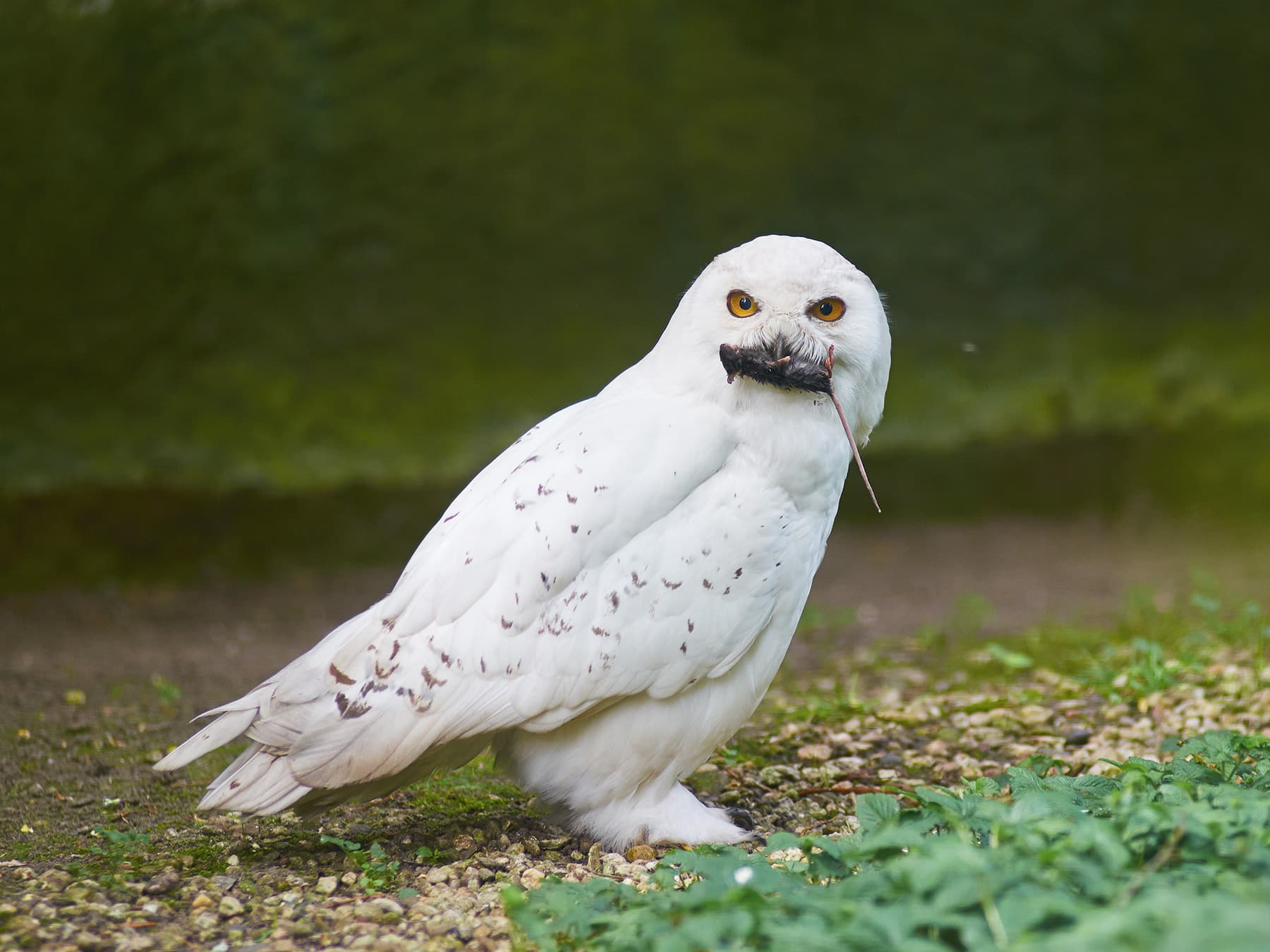
During the breeding season, lemmings and voles are among the chief prey and populations of snowy owls fluctuate according to the local availability of these small mammals. In winter, diet becomes more varied depending on location, with mice and rats becoming more important. Much larger prey is taken too, including geese, ducks, grebes, and hares.
Where available, snowy owls will also feed on carrion, including walrus, seal, and fox carcasses.
What do Snowy Owl chicks eat?
Snowy owl chicks are fed on prey brought to the nest by the male and ripped into small pieces by the female. The early diet consists largely of voles and lemmings, depending on what is readily available on their breeding grounds. Gradually larger chunks of food are offered until the young master the art of swallowing whole prey.
Nesting and breeding
Where do Snowy Owls nest?
The Arctic terrain is treeless, giving snowy owls no other option than to find a suitable ground-level spot on snow-free land. Where available, mounds, hummocks, and ridges will be selected, offering a greater view of the surrounding area.
Males establish a territory, and females choose the site and dig out a hollow in the ground using their razor-sharp talons. They use their body shape to form a bowl-shaped depression, and in the process, some feathers will create a patchy lining. Moss and lichens may also be added, but the nest is generally unlined.
When do Snowy Owls nest?
Snowy owls arrive back on their breeding grounds from April onwards, with pairs forming shortly afterward. Eggs are usually laid in May and June, with an incubation period of around 31 to 32 days. Only the female incubates, and for the duration of her time in the nest, her mate brings her food.
After hatching, young snowy owls are brooded by the female part-time for a further 3 weeks, at which point they begin to leave the nest, departing on foot with flight skills developing later, at between 50 and 60 days.
What do Snowy Owl eggs look like?
Freshly laid snowy owl eggs are creamy white and unmarked. However, as nesting progresses, eggs become stained by the soil from the nest bowl. A typical clutch consists of between 3 and 11 eggs, which measure 5.7 cm by 4.5 cm (2.2 in by 1.8 in).
Do Snowy Owls mate for life?
Snowy owls form pairs at the beginning of the breeding season and remain together until the young have gained independence and it’s time to depart for wintering grounds. They raise a single brood together.
No information is available about long-term pairings or reuniting pairs in subsequent seasons, and it’s thought to be unlikely, as the choice of breeding sites is heavily influenced by the availability of prey, and there is no routine return to a location used the previous year.
Behaviour
Are Snowy Owls aggressive?
Aggression during the breeding season is relatively rare but can reach quite intense levels, with territorial males defending nest sites and mates. Intruders are chased, and physical confrontations occur, with the male snowy owl using his bill, wings, and talons to strike and swipe at the unwanted visitor.
Outside of the breeding season, aggressive behavior is not regularly observed, as snowy owls become solitary and no longer need to defend territories, although reports of small groups roosting in relatively close proximity to one another are also regularly reported.
Where do Snowy Owls sleep at night?
Because of the highly variable daylight hours in their preferred territories, snowy owls are not strictly nocturnal or diurnal, and in their summer breeding territories on the Arctic tundra, it’s common for them to find overnight roosting spots behind hummocks or raised ground on the tundra floor.
Wintering grounds may extend into areas that overlap with human habitation, and they will readily settle on fenceposts or building ledges overnight.
Lifespan and predators
How long do Snowy Owls live?
The average life expectancy of snowy owls in the wild can be as high as 15 to 20 years, although some research suggests that around 10 years is more likely.
A banded female identified in Massachusetts was 23 years and 10 months. In captivity, survival rates are even higher, with one individual in Ontario reaching around 30 years of age.
What are the predators of Snowy Owls?
Due to their position high up in the food chain, snowy owls have few natural predators. Despite building nests on potentially vulnerable sites on the ground, their fierce nest defense behavior makes predation of young relatively rare too.
Possible predators include bears, owls, foxes, Arctic wolves, peregrine falcons, jaegers, eagles, and corvids.
Are Snowy Owls protected?
The Migratory Birds Convention Act of 1994 and the Migratory Bird Treaty Act of 1918 protect snowy owls in Canada and the US respectively. Under this legislation, it is an offense to kill, injure, capture, or sell a snowy owl, or to interfere with their nest site or eggs.
Further afield, snowy owls are also protected under the UK’s Wildlife and Countryside Act of 1981, Annex I of the EU Birds Directive, and Appendix II of the Berne Convention.
Are Snowy Owls endangered?
Snowy owls are classed as a Vulnerable species by the IUCN, with declining populations thought to be linked to climate change and availability of prey.
Rising temperatures in the Arctic tundra impact the habitats of the prey they depend on for food, making survival more of a challenge as lemmings and voles become more widely dispersed.
Conservation
Snowy Owls face threats from climate change, which affects their Arctic breeding grounds and prey availability. Collisions with vehicles and human structures during winter migrations are also significant risks.
Conservation efforts focus on habitat protection and reducing human-related mortality.
More photos
8 photos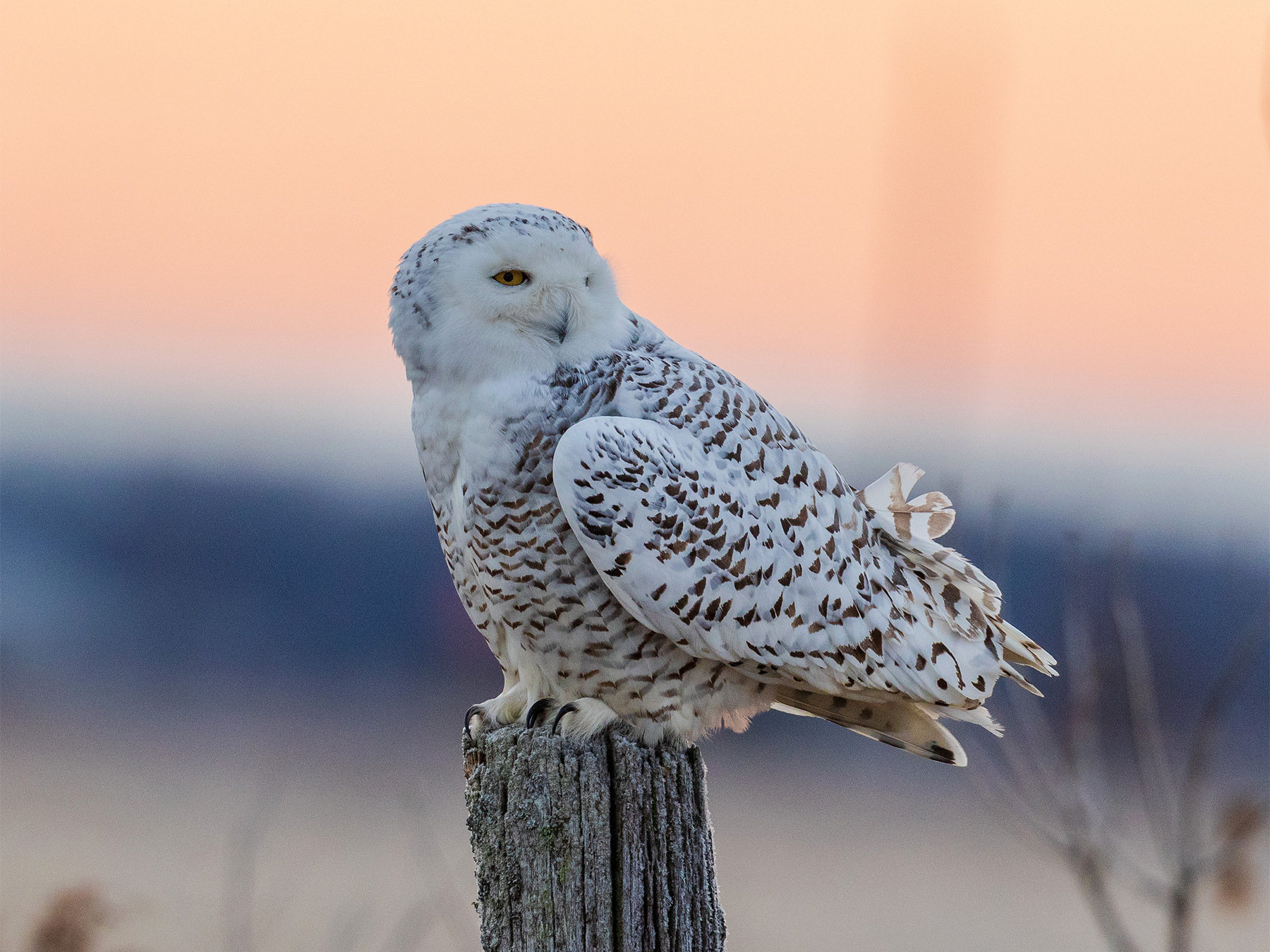
Snowy Owl guides
5 guidesQuick facts
- Length
- 52–71 cm
- Wingspan
- 126–145 cm
- Weight
- 1600–2950 g
- Lifespan
- 9–10 years · oldest recorded 23 years
- Family
- Owls
- Migration
- Irruptive migrant
- Global status (IUCN)
- Vulnerable
- World population
- 29,000 mature individuals
- Population trend
- Decreasing
- Also called
- Arctic Owl, Great White Owl
- Scientific name
- Bubo scandiacus
Questions
3Are Snowy Owls white all year?
Snowy owls do not change their plumage seasonally and are white or mostly white all year round. Throughout the year, they use their white plumage to reflect the sun, causing a “flash” signal that allows them to assert their claim to a territory and deters other owls from approaching.
What time of day are Snowy Owls most active?
Due to the extreme changing patterns of daylight hours in their Arctic habitats, snowy owls do not have the same nocturnal habits as other owls. Typically they are most active in the evening and overnight, even in periods with zero darkness.
How do you attract Snowy Owls?
Snowy owls live in particularly inhospitable environments within the Arctic Circle and attracting them to live in your yard would be highly challenging.
Encouraging snowy owls onto your property is not particularly recommended due to their aggressive reaction to being disturbed by humans and a need for vast open landscapes, such as fields and airport runways, to meet their foraging needs.
Sources
4- 1BirdLife International. 2021. Bubo scandiacus. The IUCN Red List of Threatened Species 2021: e.T22689055A205475036. Source (opens in a new tab)
- 2Partners in Flight (2019)
- 3Partners in Flight (2019) Source (opens in a new tab)
- 4Longevity Records Of North American Birds. Version 2023.1 Source (opens in a new tab)

Checked by
Nathan Cope, founder and editor
Nathan founded Birdfact and leads its writers and contributors in the UK, the US and Canada. He has watched and studied birds for more than ten years, and checks every article and species guide before it’s published.