


Short-toed Lark
Greater Short-toed Lark · Calandrella brachydactyla
By the Birdfact teamChecked by Nathan Cope
On this page10 sections
How to recognise it
The Short Toed Lark is a summer migrant limited to specific locations and sightings will probably require special visits. The region known as Es Blanquer is probably the best place to see them, an area they also share with Stone Curlews and Thekla's Larks. The arable land near the coast to the north of Porto Colom is also a good location where Quail are often sighted in the spring.
Technical description
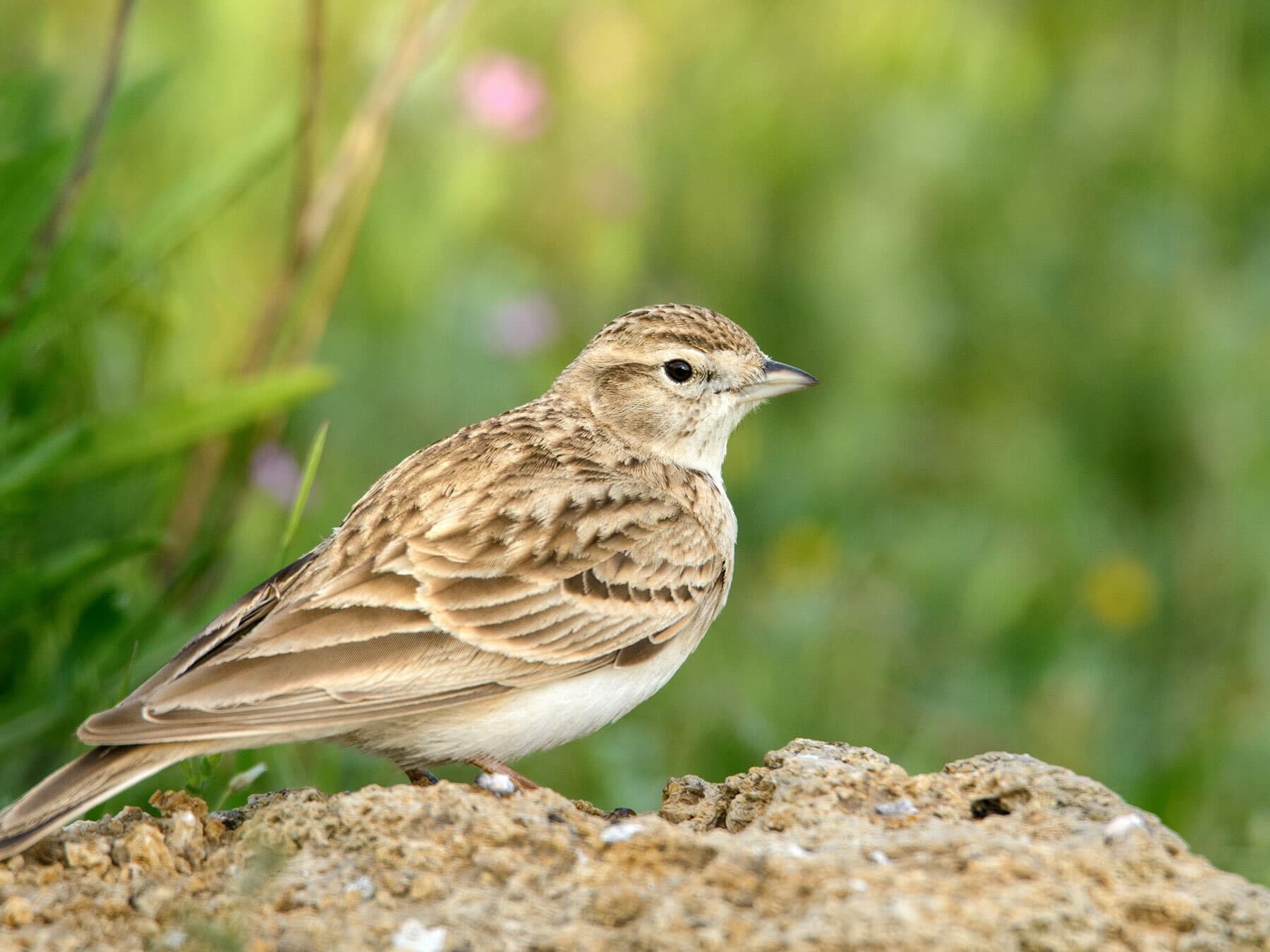
Short-Toed Lark (Calandrella brachydactyla) sometimes known as the greater short-toed lark is a small passerine bird. It breeds in southern Europe, north-west Africa, and across temperate Asia from Turkey and southern Russia to Mongolia. This is a small pale lark, smaller than the skylark. It is dark-streaked greyish-brown above and white below. It has a strong pointed bill that is pinkish with a grey culmen. It has a pale supercilium, dark patches on each side of its neck and a dark tail.
Its size
Adults- Length
- 14–17 cm
- Wingspan
- 27–32 cm
- Weight
- 20–25 g
Its song and calls
The Short-toed Lark's song is a melodious, trilling warble, often delivered in flight. It typically begins with a series of 'tiri-tiri' notes, followed by a more varied sequence.
The call is a soft, rolling 'prrrrt' or a short 'tit' used for communication within flocks.
- Song0:00 / 0:49
Recorded in Provence-Alpes-Côte d'Azur, France · May 2024
When and where to see it
OctoberPeak season
Most recorded in October
- 1. Donegal0.17%
- 2. Cornwallunder 0.1%
- 3. Wicklowunder 0.1%
- 4. North Yorkshireunder 0.1%
- 5. Shetland Islandsunder 0.1%
Each dot is a county, state or province: the bigger and darker, the larger the bird’s share of that place’s bird records that month. Grey dots: no regular records. The ringed point is the centre of the bird’s records this month; the arrow shows how it moved since last month, and the dashed loop its path through the year. “Arrivals” colours places where it becomes regular this month (orange) or is in its last regular month (grey). GBIF eBird Observation Dataset, 2019–2024. Map data: Natural Earth, US Census Bureau; place centres © OpenStreetMap contributors.
In your area
See when the Short-toed Lark is recorded in your county, state or province.
How often the Short-toed Lark turns up in the UK through the year, from birdwatchers' records.
United Kingdom
Passage migrant · regularly May–Nov · most records in October
Show as a table
| Month | United Kingdom |
|---|---|
| January | – |
| February | <0.001% |
| March | <0.001% |
| April | <0.001% |
| May | <0.001% (regular) |
| June | <0.001% (regular) |
| July | – |
| August | <0.001% |
| September | 0.003% (regular) |
| October | 0.006% (regular) |
| November | 0.002% (regular) |
| December | – |
Recorded regularly in
Worldwide: recorded regularly in 57 countries
Countries where it was recorded in at least 3 of the 6 years 2019–2024. Linked countries have their own bird list.
Europe (25)
Africa (7)
- Algeria
- Egypt
- Mauritania
- Morocco
- Senegal
- Tunisia
- Western Sahara
Asia (25)
- Armenia
- Azerbaijan
- Bahrain
- Bhutan
- China
- Cyprus
- Georgia
- India
- Iran
- Israel
- Jordan
- Kazakhstan
- Kuwait
- Kyrgyzstan
- Lebanon
- Mongolia
- Nepal
- Oman
- Pakistan
- Palestinian Territories
- Qatar
- Saudi Arabia
- Turkey
- United Arab Emirates
- Uzbekistan
Data: EOD – eBird Observation Dataset (Cornell Lab of Ornithology), accessed via GBIF.org, CC BY 4.0. Records from 2019–2024, aggregated and filtered by Birdfact. How these lists are made
Tips for seeing it
- Look for Short-toed Larks in open, dry habitats with sparse vegetation
- Listen for their distinctive trilling song, often given in flight
- Observe their quick, scurrying movements on the ground
- Use binoculars to spot the pale supercilium and short bill, distinguishing them from other lark species
What it eats
Short-toed Larks primarily feed on seeds from grasses and other plants. During the breeding season, they supplement their diet with insects and other small invertebrates, which are crucial for feeding their young.
They forage by walking and pecking on the ground, occasionally catching insects in short flights.
Nesting and breeding
Breeding occurs from April to July, with males establishing territories through song flights. Pairs form monogamous bonds for the breeding season.
The nest is a simple scrape on the ground, lined with grass and plant material. It is often placed next to a small plant or rock for protection. The female typically lays 3-5 eggs, which are pale and speckled.
Incubation lasts about 11-13 days, primarily done by the female. Both parents feed the chicks, which fledge after 8-10 days but remain dependent on their parents for several more weeks.
Behaviour
Short-toed Larks are ground-dwelling birds, often seen running rather than hopping. They forage in small flocks outside the breeding season, pecking at seeds on the ground.
During courtship, males perform short, fluttering song flights, rising a few meters before descending.
Conservation
While listed as Least Concern globally, Short-toed Larks face localised threats from habitat loss due to agricultural intensification and urbanisation.
Conservation efforts focus on maintaining suitable breeding habitats and protecting stopover sites along migration routes.
Quick facts
- Length
- 14–17 cm
- Wingspan
- 27–32 cm
- Weight
- 20–25 g
- Lifespan
- 3–5 years
- Family
- Larks
- Migration
- Long-distance Migrant
- Global status (IUCN)
- Least Concern
- World population
- 9,460,000 - 18,100,000 mature individuals
- Population trend
- Stable
- Also called
- Greater Short-toed Lark
- Scientific name
- Calandrella brachydactyla
Sources
3- 1BirdLife International. 2018. Calandrella brachydactyla. The IUCN Red List of Threatened Species 2018: e.T103766207A132042070. Source (opens in a new tab)
- 2EBCC (2015)
- 3BirdLife International. 2018. Calandrella brachydactyla. The IUCN Red List of Threatened Species 2018: e.T103766207A132042070. Source (opens in a new tab)

Checked by
Nathan Cope, founder and editor
Nathan founded Birdfact and leads its writers and contributors in the UK, the US and Canada. He has watched and studied birds for more than ten years, and checks every article and species guide before it’s published.