


Scaly-breasted Munia
Nutmeg Finch, Nutmeg Mannikin, Nutmeg Munia, Ricebird, Scaly-breasted Mannikin, Spice Finch, Spice Munia, Spice Bird, Spotted Mannikin, Spotted Munia, Barred Munia, Mascot Finch · Lonchura punctulata
By the Birdfact teamChecked by Nathan Cope
On this page19 sections
- How to recognise it
- Its size
- Its song and calls
- When and where to see it
- What it eats
- Nesting and breeding
- Behaviour
- Lifespan and predators
- Conservation
- What does a Scaly-breasted Munia look like?
- How big is a Scaly-breasted Munia?
- How much does a Scaly-breasted Munia weigh?
- What is the Scaly-breasted Munias wingspan?
- What is the scientific name of a Scaly-breasted Munia?
- Are Scaly-breasted Munias friendly or aggressive?
- Are Scaly-breasted Munias endangered?
- Do Scaly-breasted Munias mate for life?
- Quick facts
- Sources
How to recognise it
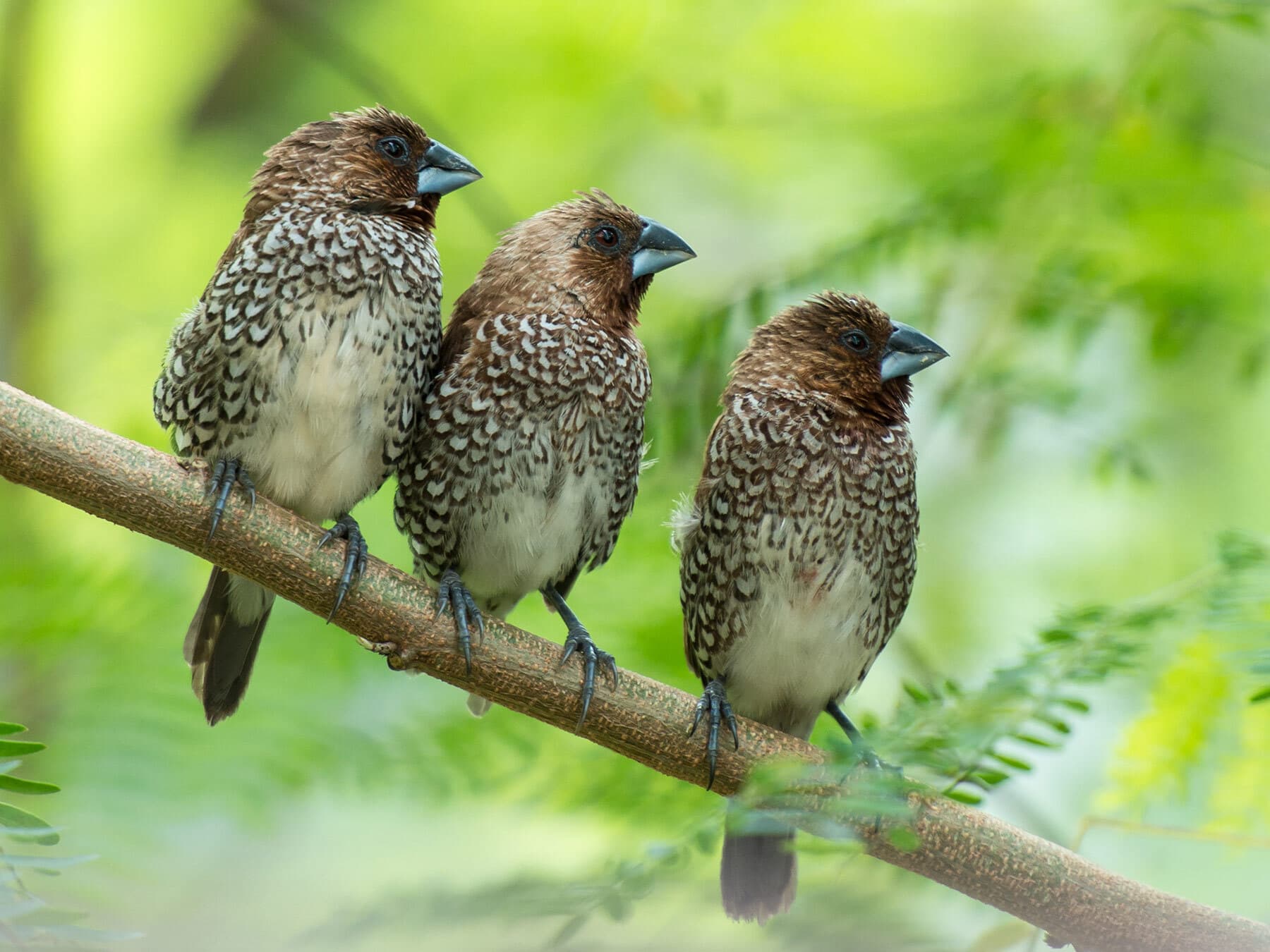
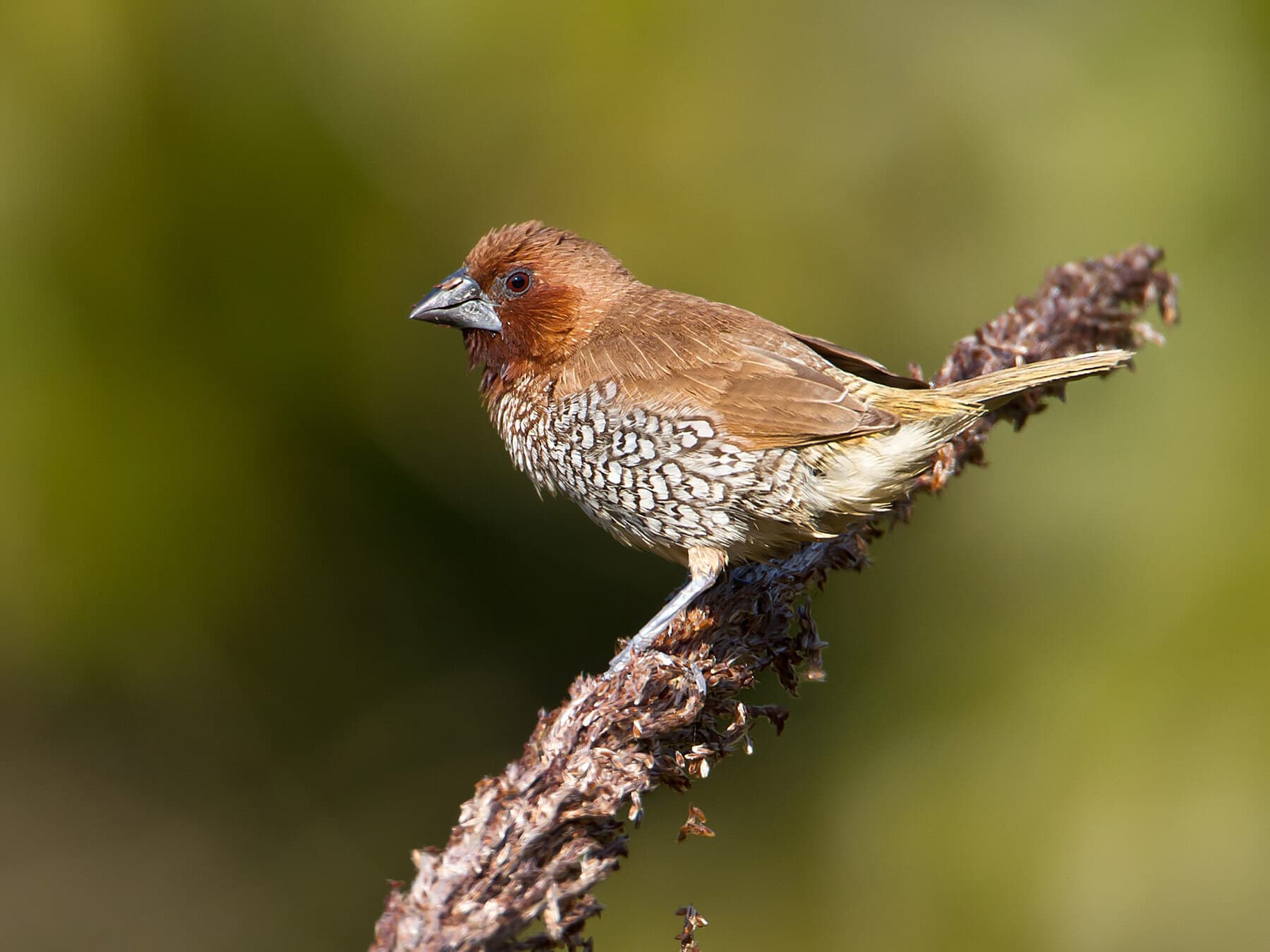
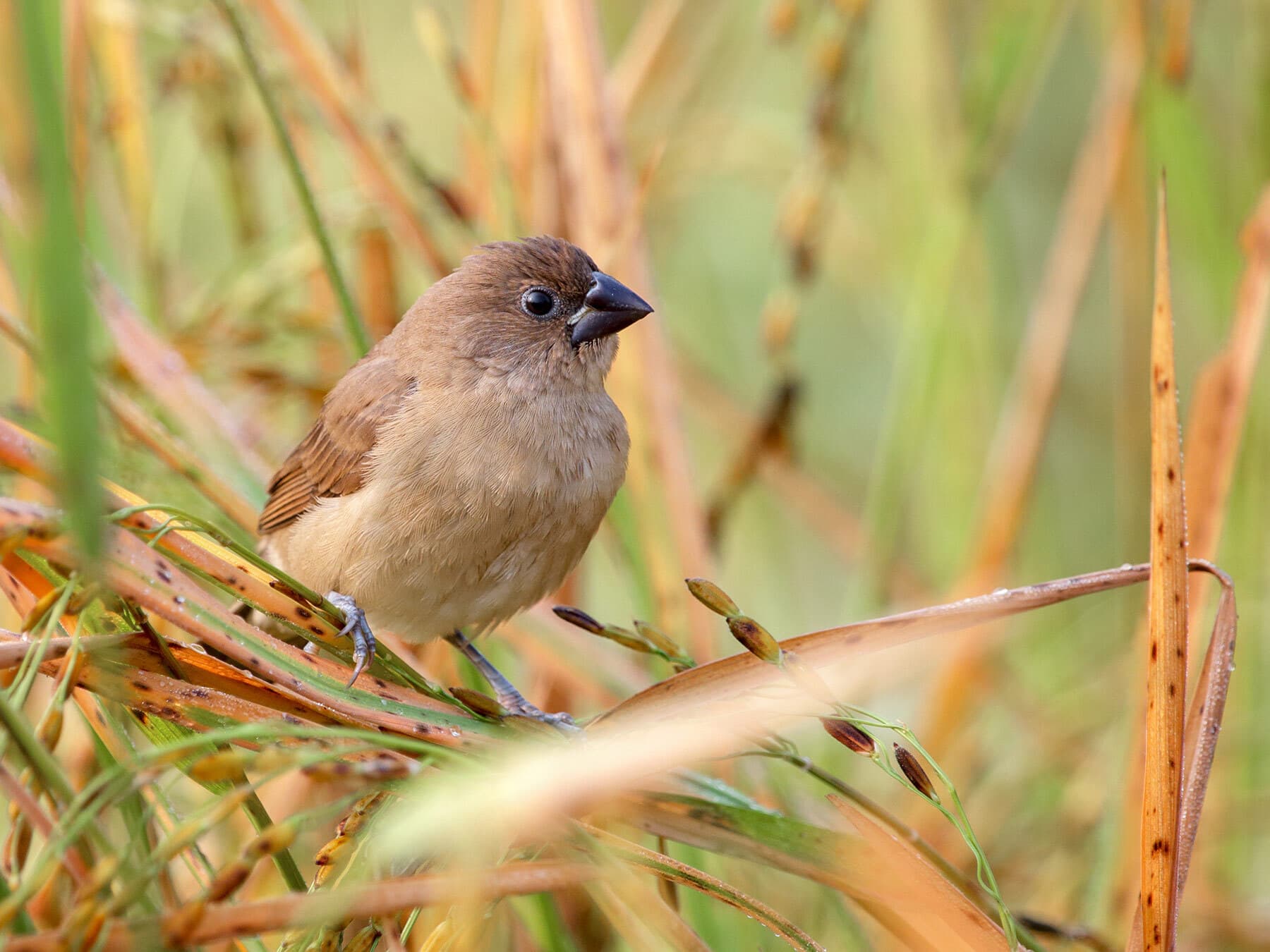
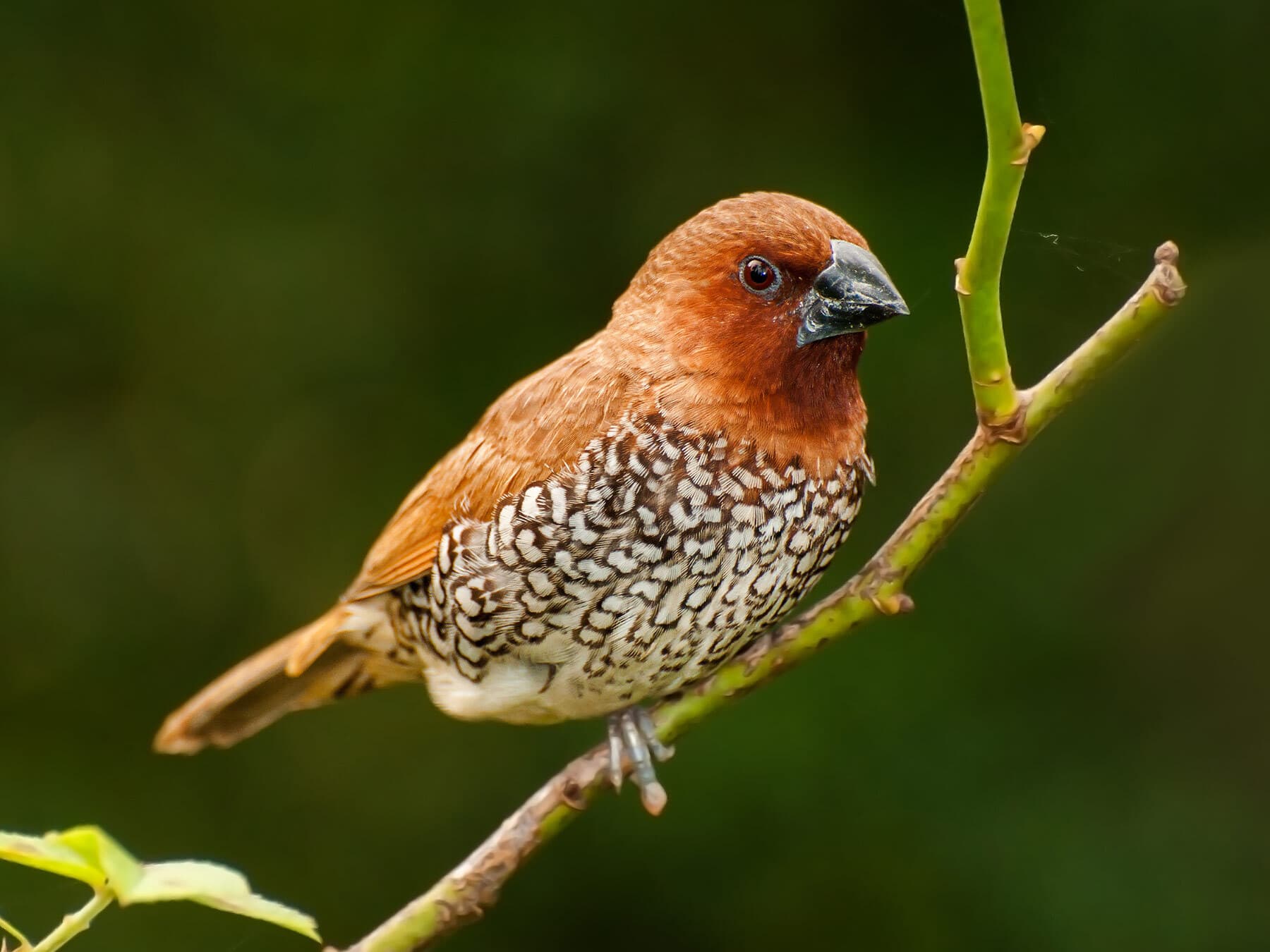
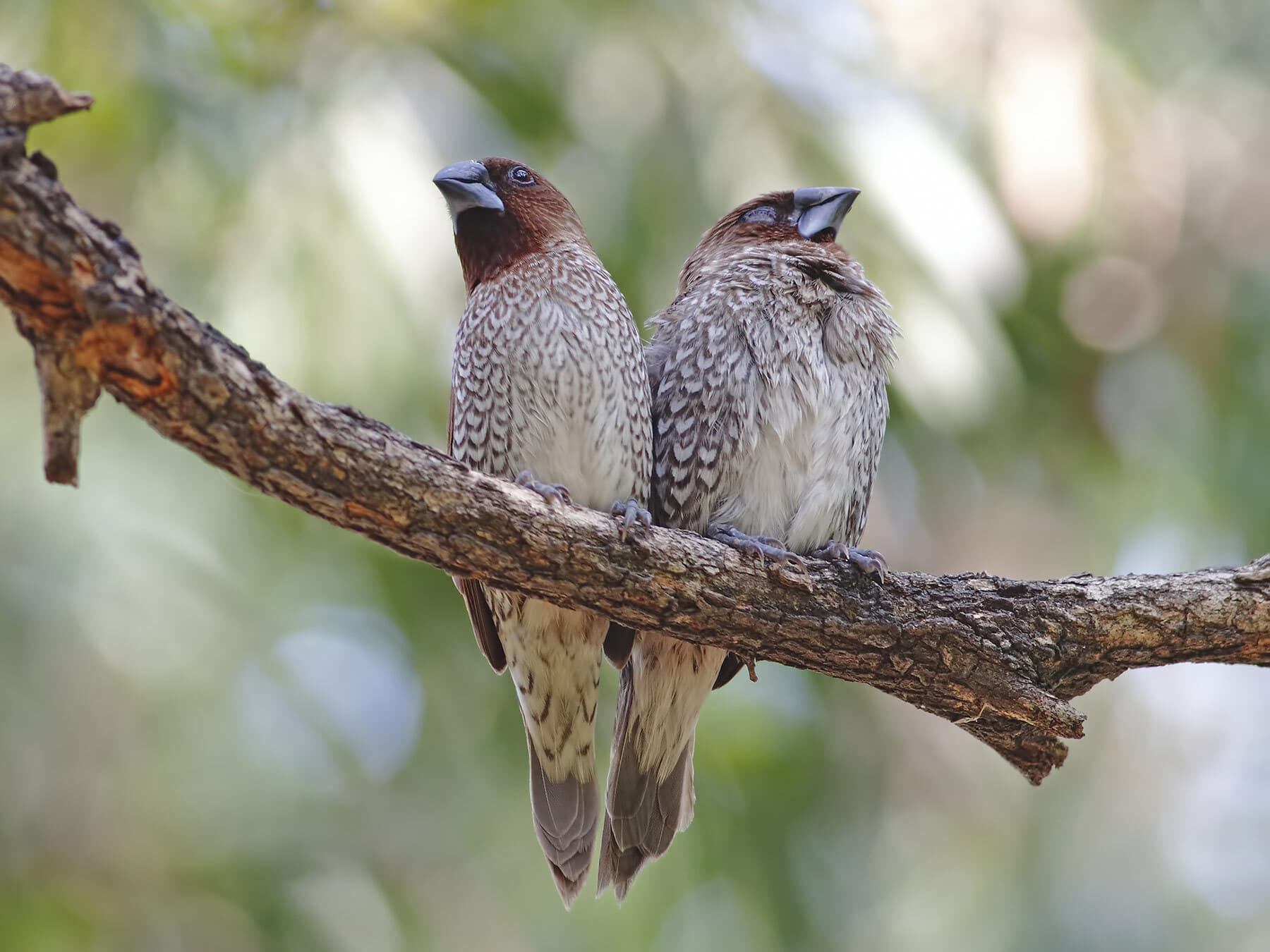
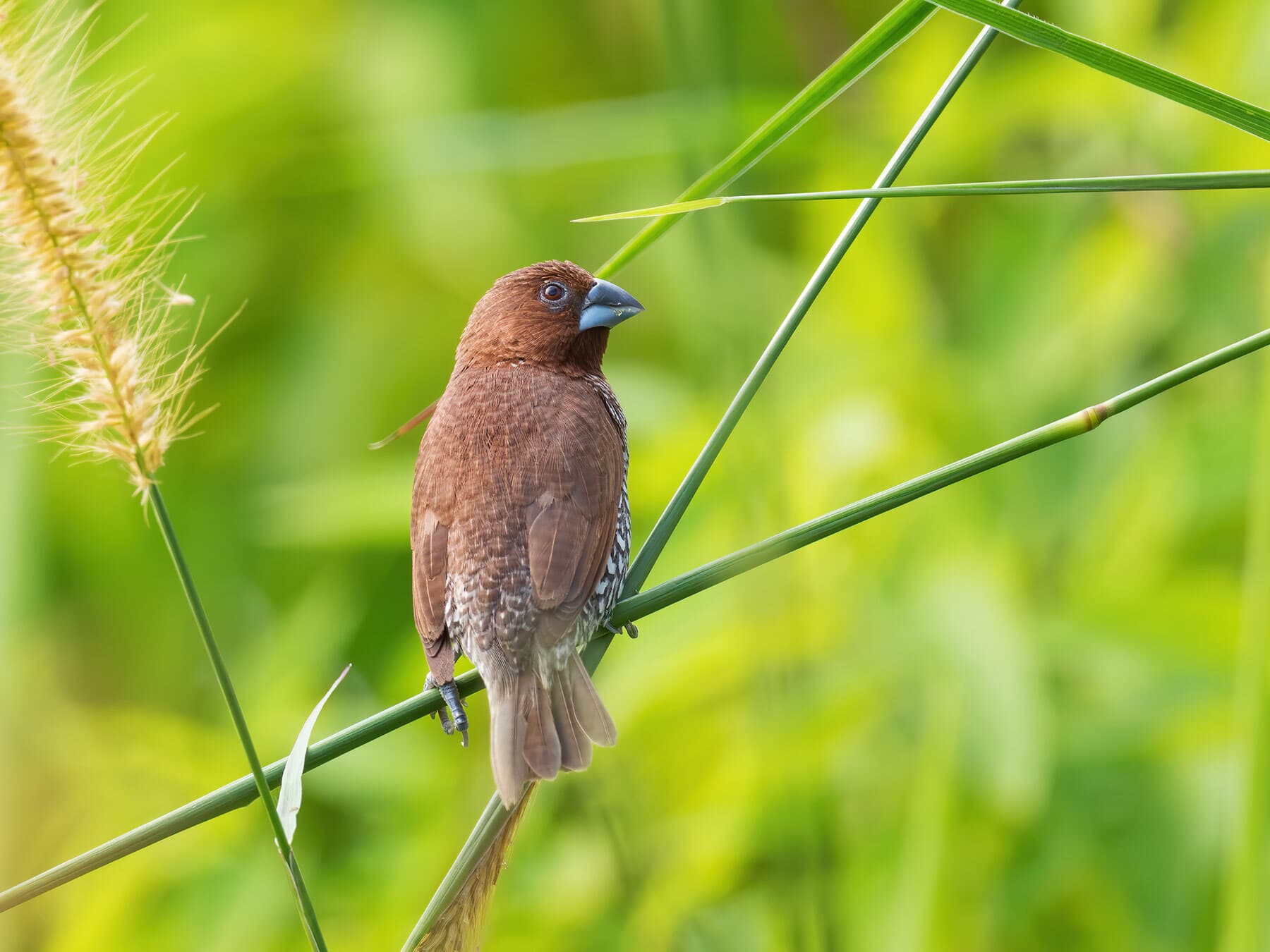
The Scaly-breasted Munia is a small, plump finch with distinctive scale-like markings on its breast and belly. Its upper parts are rich brown, contrasting with the white and dark brown scaly pattern below. The head is uniformly brown, the tail is short and dark, the legs are grey, and the conical bill is dark.
Both sexes look similar, with juveniles appearing paler and lacking the scaly breast pattern. During the breeding season, adults' bills darken slightly, but overall plumage remains consistent year-round.
There are 12 sub-species of Scaly-breasted Munias, which slightly differ in the colour of their plumage and size.
Its size
Adults- Length
- 11–12 cm
- Wingspan
- 16–18 cm
- Weight
- 12–16 g
Its song and calls
They are fairly vocal birds and will communicate with one another with a short whistling 'kitty-kitty-kitty' sound. The tone does differ between the sexes. Both the flock and flight call are simple 'puip' or 'sieuw!'.
The song of the Scaly-breasted munia is a succession of whistles followed by a long 'weee'.
- Call0:00 / 1:00
Recorded in Andhra Pradesh, India · September 2020
When and where to see it
OctoberPeak season
Most recorded in October
- 1. California0.30%
- 2. Alabama0.16%
- 3. Texasunder 0.1%
- 4. Mississippiunder 0.1%
- 5. Floridaunder 0.1%
Each dot is a county, state or province: the bigger and darker, the larger the bird’s share of that place’s bird records that month. Grey dots: no regular records. The ringed point is the centre of the bird’s records this month; the arrow shows how it moved since last month, and the dashed loop its path through the year. “Arrivals” colours places where it becomes regular this month (orange) or is in its last regular month (grey). GBIF eBird Observation Dataset, 2019–2024. Map data: Natural Earth, US Census Bureau; place centres © OpenStreetMap contributors.
In your area
See when the Scaly-breasted Munia is recorded in your county, state or province.
How often the Scaly-breasted Munia turns up in the United States through the year, from birdwatchers' records.
United States
Resident · all year · most records in October
Show as a table
| Month | United States |
|---|---|
| January | 0.027% (regular) |
| February | 0.028% (regular) |
| March | 0.023% (regular) |
| April | 0.015% (regular) |
| May | 0.011% (regular) |
| June | 0.019% (regular) |
| July | 0.026% (regular) |
| August | 0.038% (regular) |
| September | 0.049% (regular) |
| October | 0.050% (regular) |
| November | 0.041% (regular) |
| December | 0.034% (regular) |
Worldwide: recorded regularly in 42 countries
Countries where it was recorded in at least 3 of the 6 years 2019–2024. Linked countries have their own bird list.
Europe (1)
Africa (2)
- Mauritius
- Réunion
Asia (26)
North America (12)
- Antigua & Barbuda
- Cayman Islands
- Cuba
- Dominica
- Dominican Republic
- Guadeloupe
- Haiti
- Jamaica
- Mexico
- Puerto Rico
- St Kitts & Nevis
- United States
Oceania (1)
Data: EOD – eBird Observation Dataset (Cornell Lab of Ornithology), accessed via GBIF.org, CC BY 4.0. Records from 2019–2024, aggregated and filtered by Birdfact. How these lists are made
The nests are generally built in trees in bushes of heights between 4 and 13 metres. The construction of the nest is shared between both the male and female.
Nests are loose ball-shaped and are made out of a mixture of grasses, ferns and orchids. It's also known for these birds to use old nests of other birds when the opportunity arises.
What is the habitat of a Scaly-breasted Munia?
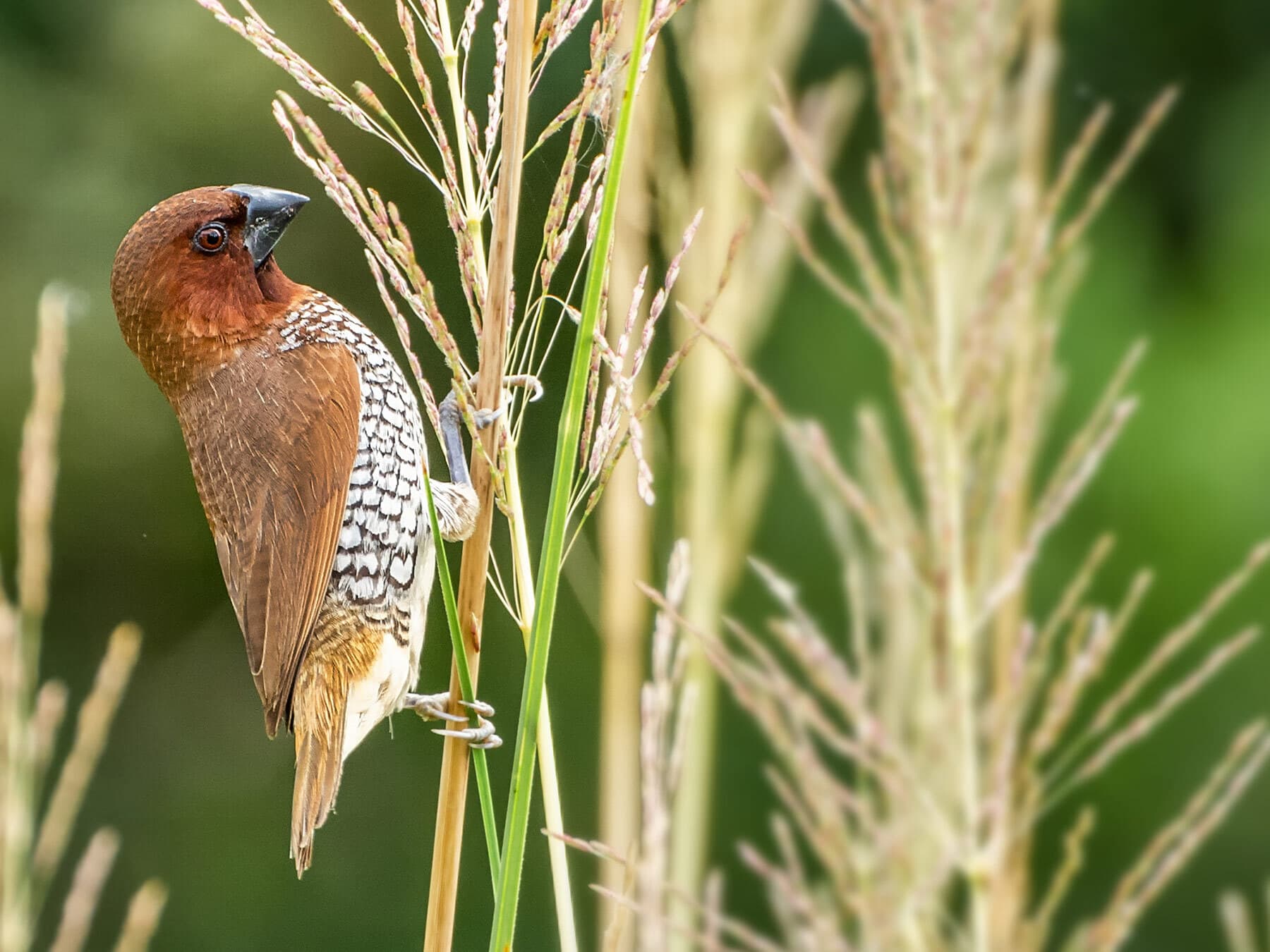
Scaly-breasted Munias are found across a whole variety of habitats, but they mostly prefer areas near grassland and water. In India, they are common in paddy fields where they will happily feed on the grain - this is an example of where they are considered pests to agricultural practices.
As well as being nearby to grassland and water, they also do prefer locations with bushes, trees and scrubs which is all useful when it comes around to breeding season.
Where do Scaly-breasted Munias live?
Scaly-breasted Munias natural range is across both South and South-East parts of Asia, including the Philipines and Indonesia.
Because these birds can adapt really well to a vast array of habitats, escaped birds have successfully established populations in other parts of the world. As such, populations have been recorded in the West Indies, Hawaii, Australia, Japan and southern states of the US - most common in parts of Florida and California.
Do Scaly-breasted Munias migrate?
No, they are resident birds within their range.
Small movements can occur from time to time, with this being influenced by the ripening of grain crops.
Tips for seeing it
- Look for flocks in grassy areas, especially near water sources
- Listen for their soft, musical chirping and twittering
- Observe their distinctive scaly breast pattern through binoculars
- Check bird feeders in urban and suburban areas, as they readily visit these
What it eats
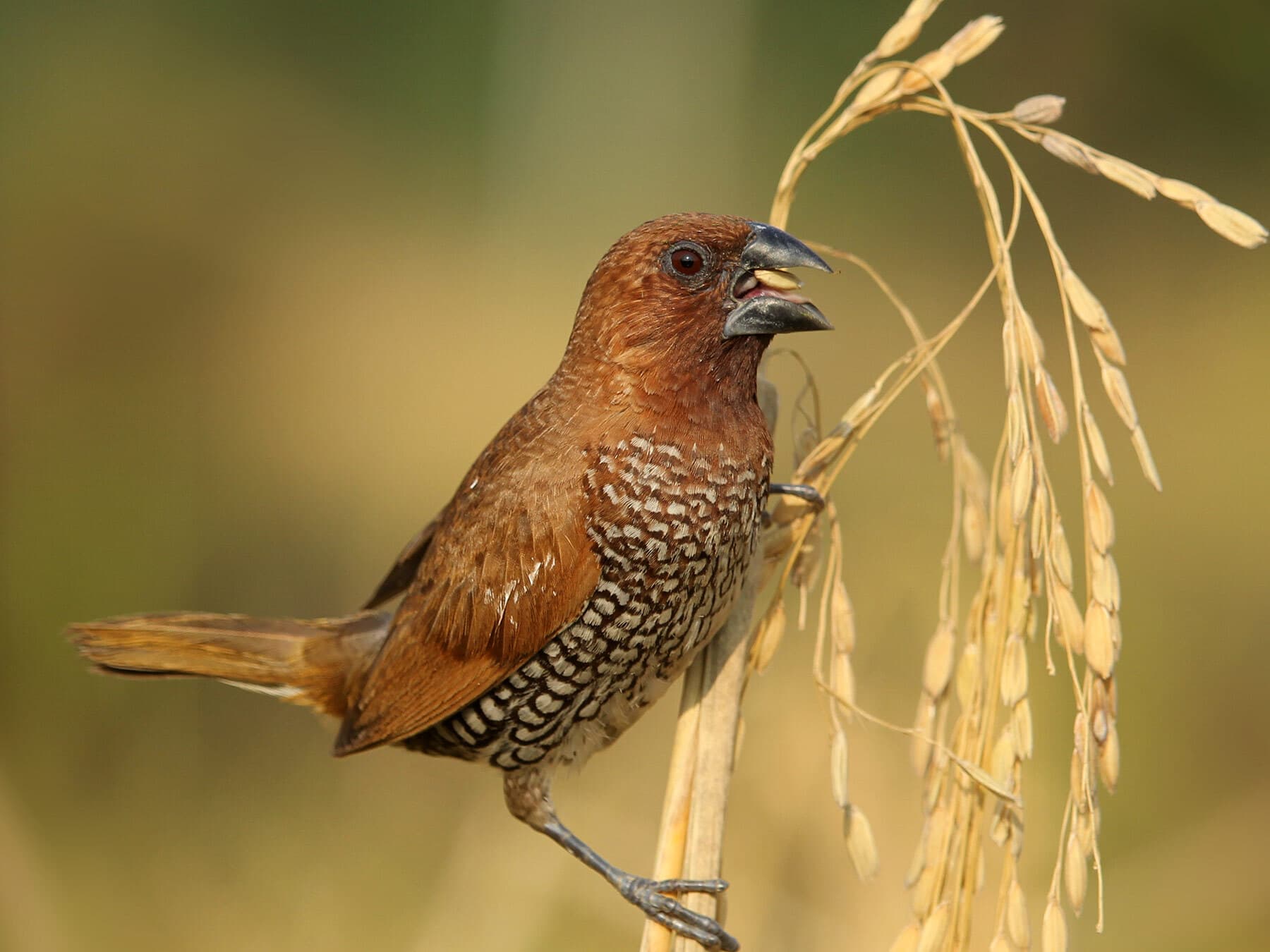
The diet of a Scaly-breasted munia is mainly made up of grass seeds, insects and berries - they have a particular fondness for those of Lantana. Not so commonly, they are also known to eat household scraps.
Birds will forage on both the ground and in vegetation; this is usually in large groups outside the breeding season and smaller social flocks during. They are also known to mix with other seed-eating species in the estrildid family.
Nesting and breeding
Clutches usually contain between 3 and 6 eggs but can be more. Both parents will share the incubation duty of the eggs, which usually lasts for 14 days. Birds will generally fledge the best between 18 and 21 days of age.
Larger clutches observed are presumed to be two females laying eggs in the same nest and have been recorded in the Malay Peninsula. Some nests can contain large broods where newly hatched, and advanced nestlings can be beside newly laid eggs.
Breeding season varies depending on the range. In India, breeding can occur all year round, but during monsoon season between May and September is usually a popular time. In the Philippines and Thailand this is mostly the same case - where breeding and nest building occurs all year round.
What do Scaly-breasted Munia eggs look like?
The eggs are white and very small, weighing approximately 1.8g.
Behaviour
Scaly-breasted Munias are highly social birds, often seen in flocks of 10 to 60 individuals. They forage on the ground, moving with quick, jerky hops.
When alarmed, the flock will burst into flight, emitting sharp contact calls before resettling nearby.
Lifespan and predators
The typical lifespan for these birds is between 6 and 8 years.
Conservation
The Scaly-breasted Munia is listed as Least Concern by the IUCN due to its large range and stable population. However, habitat loss in some areas and trapping for the pet trade pose localised threats.
Conservation efforts focus on maintaining suitable grassland and woodland habitats.
What does a Scaly-breasted Munia look like?
Adult birds are mostly dark brown on the upperparts and have light bellies with dark edges below that look like they are scaled. The iris is dark brown and the eyering is dark grey. The legs are grey and the conical bill is dark. There are no plumage differences between the male and females.
Juvenile birds are mostly plain brown, lighter underneath and lack markings.
There are 12 sub-species of scaly-breasted munias, which slightly differ in the colour of their plumage and size.
How big is a Scaly-breasted Munia?
On average, the scaly-breasted munia grows to be between 10 and 12.5cm (roughly 4 and 5 inches) in length.
How much does a Scaly-breasted Munia weigh?
The scaly-breasted munia weighs between 12 and 16g (0.42 and 0.46 ounces).
What is the Scaly-breasted Munias wingspan?
The wingspan for these birds ranges anywhere from 20 to 25cm (roughly 8 and 10 inches).
What is the scientific name of a Scaly-breasted Munia?
The Latin name given to a Scaly-breasted munia is Lonchura punctulata.
In modern Latin, punctulatus means either 'spotted' or 'dotted'. The Lonchura part is because they are part of the estrildid finch family, which includes munias.
Are Scaly-breasted Munias friendly or aggressive?
Generally speaking, these birds aren't particularly aggressive and are mostly peaceful and sociable. They are known to form flocks with up to as many as 100 birds and roost communally. They are rarely hostile toward other birds but are known to sometimes quarrel with one another.
However, studies have shown that they do get more aggressive when the amount of food available decreases. This revealed that in their foraging groups, there is a link between the number of 'aggressive' interactions with other groups of birds as the resource density lowers.
As with most wild birds, they won't interact with humans and will generally keep to themselves.
Are Scaly-breasted Munias endangered?
Scaly-breasted Munia's are currently listed with a Least Concern status and have large, stable numbers, and are mostly very common throughout their range.
In some parts of the world, these birds are considered pests, typically in the agricultural sector, because of their love of cereal grains and rice. They will feed on cultivated fields in large flocks.
In southeast Asia, large numbers of scaly-breasted munias are captured for Buddhist religious purposes, although most birds are released back into the wild.
Do Scaly-breasted Munias mate for life?
Scaly-breasted Munias are generally monogamous, but little is currently known if they will mate for life with one bird.
Quick facts
- Length
- 11–12 cm
- Wingspan
- 16–18 cm
- Weight
- 12–16 g
- Lifespan
- 6–8 years
- Family
- Waxbills & Finches
- Migration
- Resident
- Global status (IUCN)
- Least Concern
- World population
- Not quantified, but abundant in its range
- Population trend
- Stable
- Also called
- Nutmeg Finch, Nutmeg Mannikin, Nutmeg Munia, Ricebird, Scaly-breasted Mannikin, Spice Finch, Spice Munia, Spice Bird, Spotted Mannikin, Spotted Munia, Barred Munia, Mascot Finch
- Scientific name
- Lonchura punctulata
Sources
2- 1BirdLife International. 2016. Lonchura punctulata. The IUCN Red List of Threatened Species 2016: e.T22719821A94646304. Source (opens in a new tab)
- 2BirdLife International. 2016. Lonchura punctulata. The IUCN Red List of Threatened Species 2016: e.T22719821A94646304. Source (opens in a new tab)

Checked by
Nathan Cope, founder and editor
Nathan founded Birdfact and leads its writers and contributors in the UK, the US and Canada. He has watched and studied birds for more than ten years, and checks every article and species guide before it’s published.