


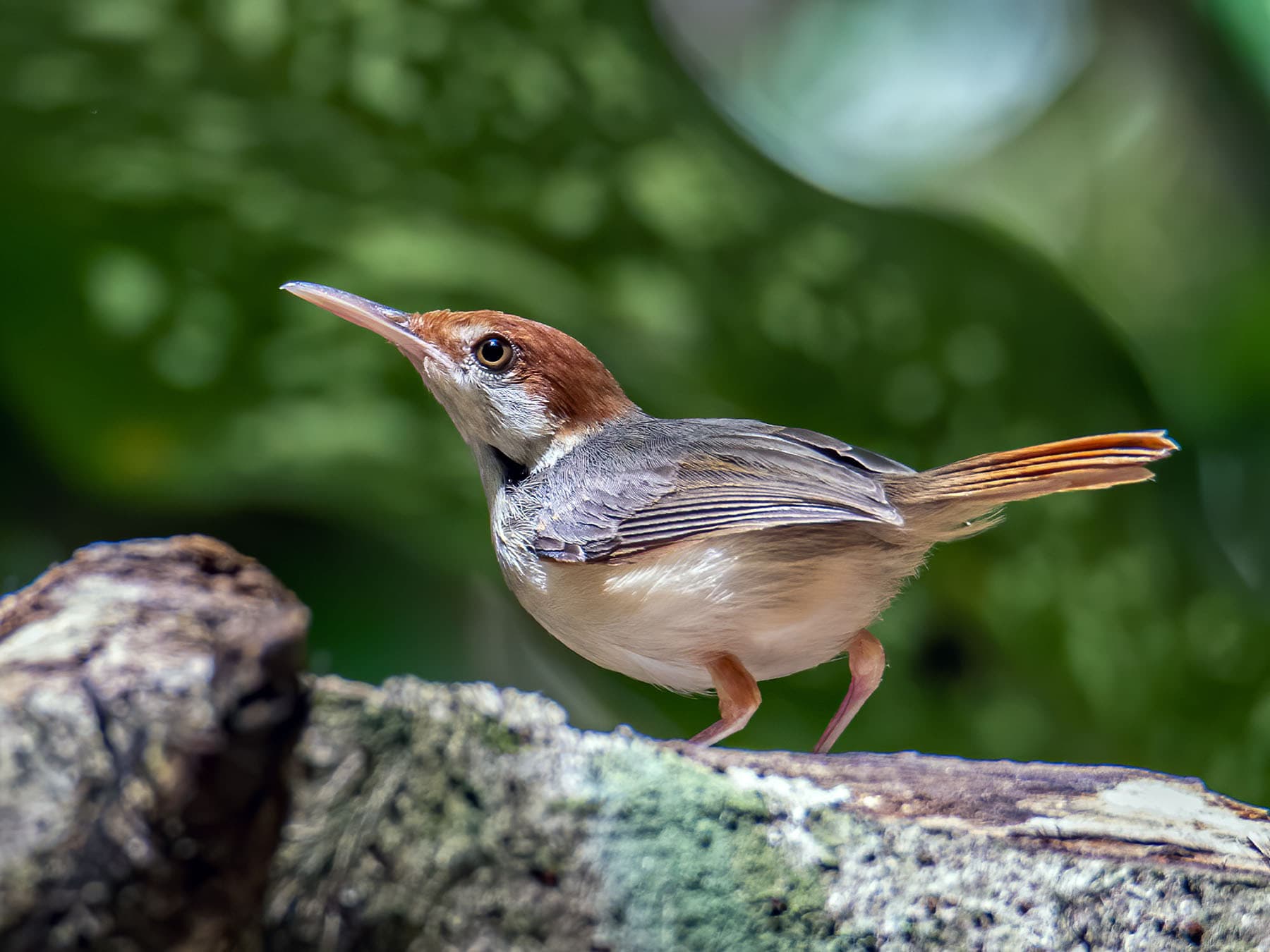
Rufous-tailed Tailorbird
Orthotomus sericeus
By the Birdfact teamChecked by Nathan Cope
On this page11 sections
How to recognise it
The Rufous-tailed Tailorbird is a small bird with a bright chestnut hood and rufous tail. The upperparts are dark ashy grey, while its throat and underparts are creamy white, with a slight cinnamon wash on the breast and flanks. It has a relatively long, slightly curved bill and pinkish legs.
Males and females appear nearly identical, except females have black markings on their tail feathers. Juveniles have olive-brown upperparts with a subtle rufous crown, and their tails are duller with black markings. They also show a creamy underside with a pale yellow tinge.
Its size
Adults- Length
- 10–13.5 cm
- Wingspan
- 14–16 cm
- Weight
- 6–9 g
Its song and calls
The Rufous-tailed Tailorbird has a loud, distinctive call often described as a repeated 'cheeup-cheeup-cheeup' or 'tee-tee-tee'.
During territorial disputes or when alarmed, they may produce a rapid series of harsh chattering sounds. Their vocalisations are an important tool for locating these often-hidden birds.
- Song and calls0:00 / 0:25
Recorded in East Kalimantan, Indonesia · February 2025
When and where to see it
The Rufous-tailed Tailorbird is not recorded regularly in the UK, Ireland, the United States or Canada.
Worldwide: recorded regularly in 6 countries
Countries where it was recorded in at least 3 of the 6 years 2019–2024. Linked countries have their own bird list.
Data: EOD – eBird Observation Dataset (Cornell Lab of Ornithology), accessed via GBIF.org, CC BY 4.0. Records from 2019–2024, aggregated and filtered by Birdfact. How these lists are made
Tips for seeing it
- Look for movement in the mid to lower levels of forest undergrowth
- Listen for their distinctive, high-pitched calls
- Observe their characteristic tail-cocking behaviour
- Be patient, as they often remain hidden in dense foliage
What it eats
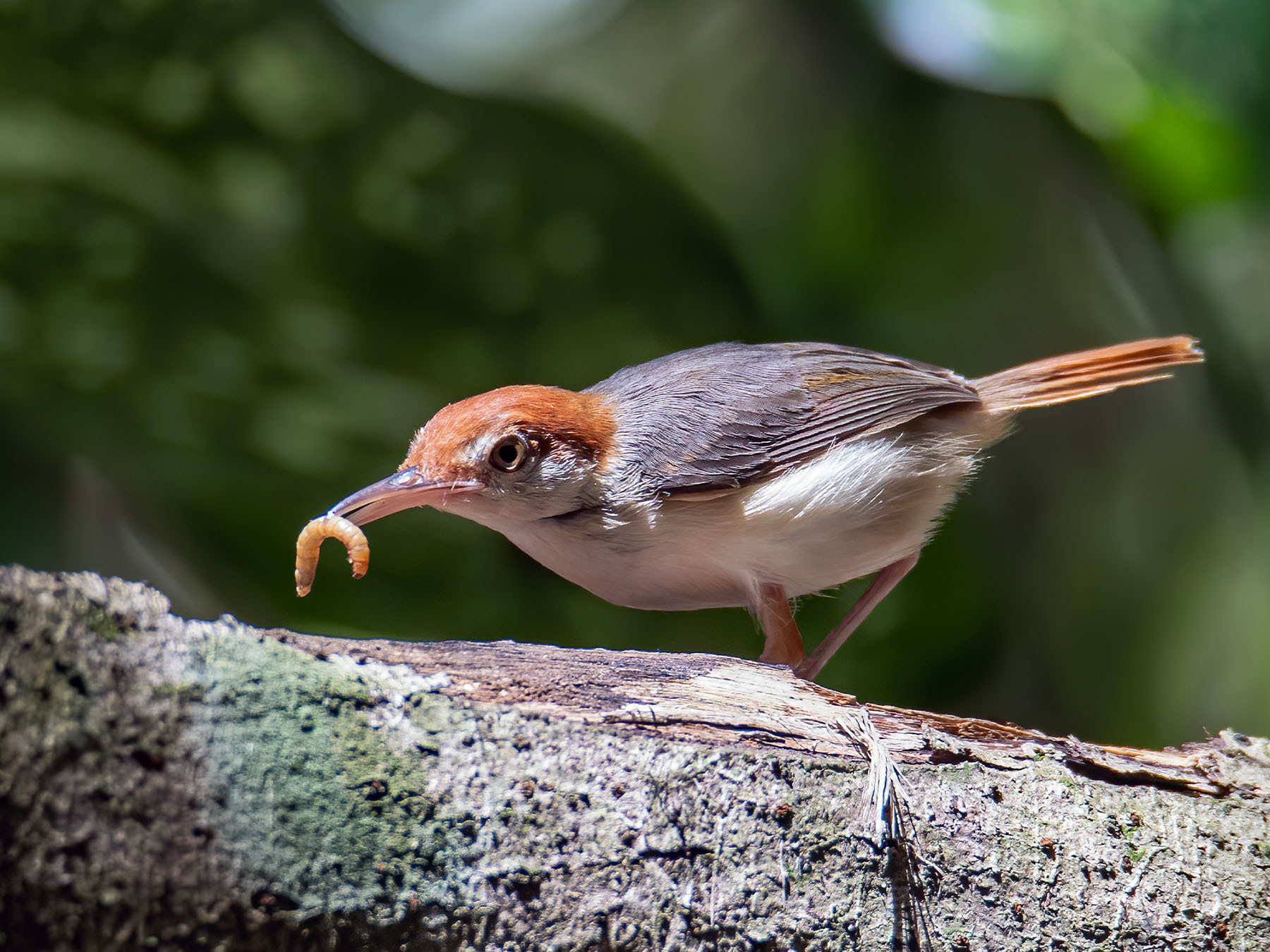
The Rufous-tailed Tailorbird primarily feeds on small insects and spiders. It forages by methodically searching through leaves and branches, often hanging upside down to reach prey on the undersides of foliage. Occasionally, it may also consume small berries or fruit.
Nesting and breeding
Breeding occurs year-round in most of their range, with peaks during the local dry season. Pairs form strong, monogamous bonds and defend their territories vigorously.
True to their name, these tailorbirds construct remarkable nests by 'sewing' large leaves together using plant fibres or spider silk. The nest is a deep cup lined with soft materials, usually hidden in dense foliage.
The female typically lays 2-3 eggs, which are white with reddish-brown spots. Both parents share incubation duties for about 12 days and continue to care for the young after hatching.
Behaviour
Rufous-tailed Tailorbirds are agile and restless, constantly moving through dense vegetation in search of insects. They often forage in pairs or small family groups, gleaning prey from leaves and branches.
These birds are known for their bold and inquisitive nature, sometimes approaching human observers with curiosity.
Conservation
While the Rufous-tailed Tailorbird is currently listed as Least Concern, it faces localised threats from habitat loss due to deforestation and urban development.
Conservation efforts focus on preserving its rainforest and woodland habitats across Southeast Asia.
More photos
2 photos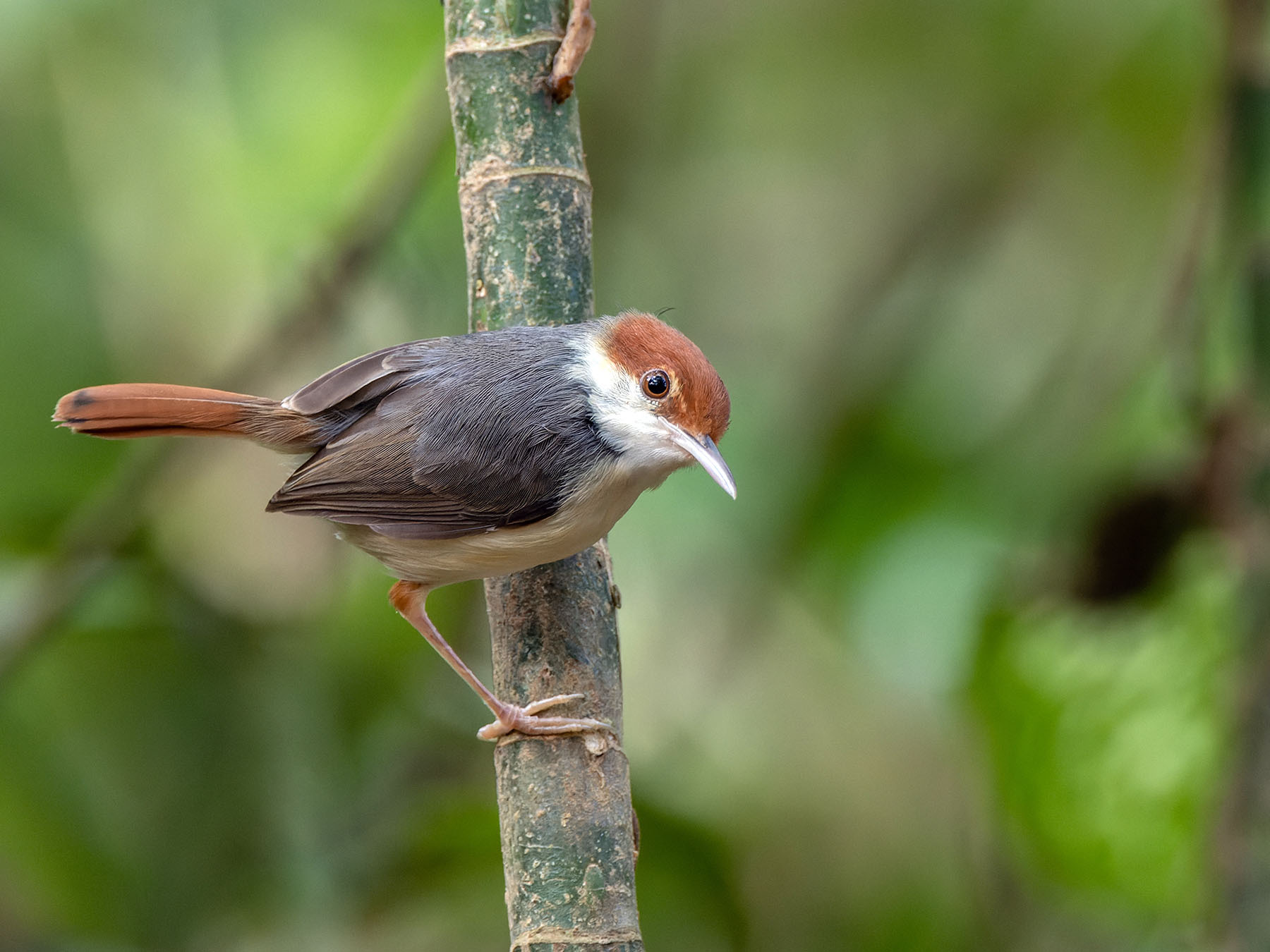
Quick facts
- Length
- 10–13.5 cm
- Wingspan
- 14–16 cm
- Weight
- 6–9 g
- Lifespan
- 3 years
- Family
- Cisticolas & Allies
- Migration
- Resident
- Global status (IUCN)
- Least Concern
- World population
- Not quantified, but reported as rather scarce and local
- Population trend
- Stable
- Scientific name
- Orthotomus sericeus
Sources
3- 1BirdLife International. 2024. Orthotomus sericeus. The IUCN Red List of Threatened Species 2024: e.T22714997A263897312. Source (opens in a new tab)
- 2BirdLife International. 2024. Orthotomus sericeus. The IUCN Red List of Threatened Species 2024: e.T22714997A263897312. Source (opens in a new tab)
- 3Baker (1997)

Checked by
Nathan Cope, founder and editor
Nathan founded Birdfact and leads its writers and contributors in the UK, the US and Canada. He has watched and studied birds for more than ten years, and checks every article and species guide before it’s published.