


Ruffed Grouse
Partridge · Bonasa umbellus
By the Birdfact teamChecked by Nathan Cope
On this page11 sections
How to recognise it
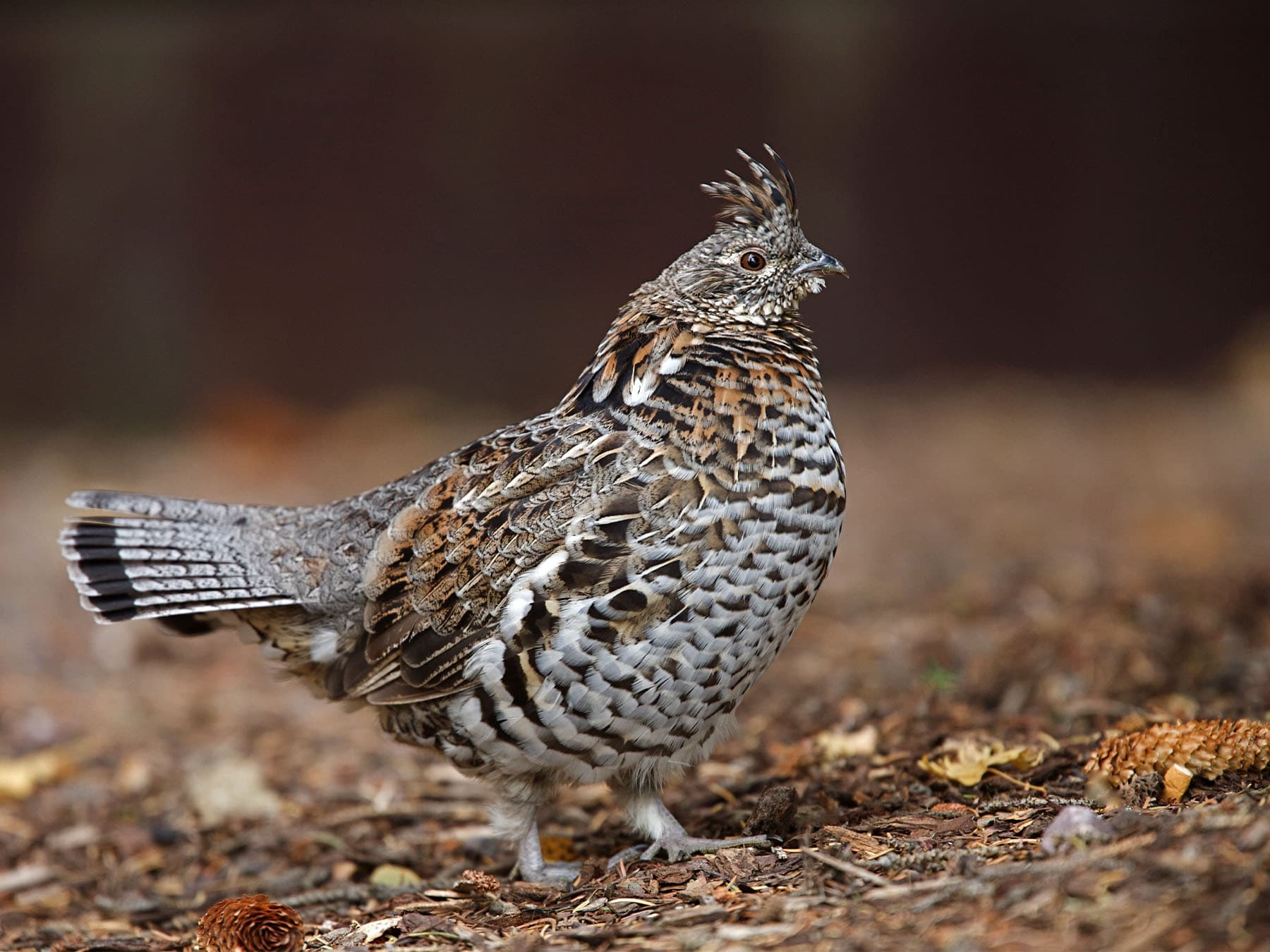
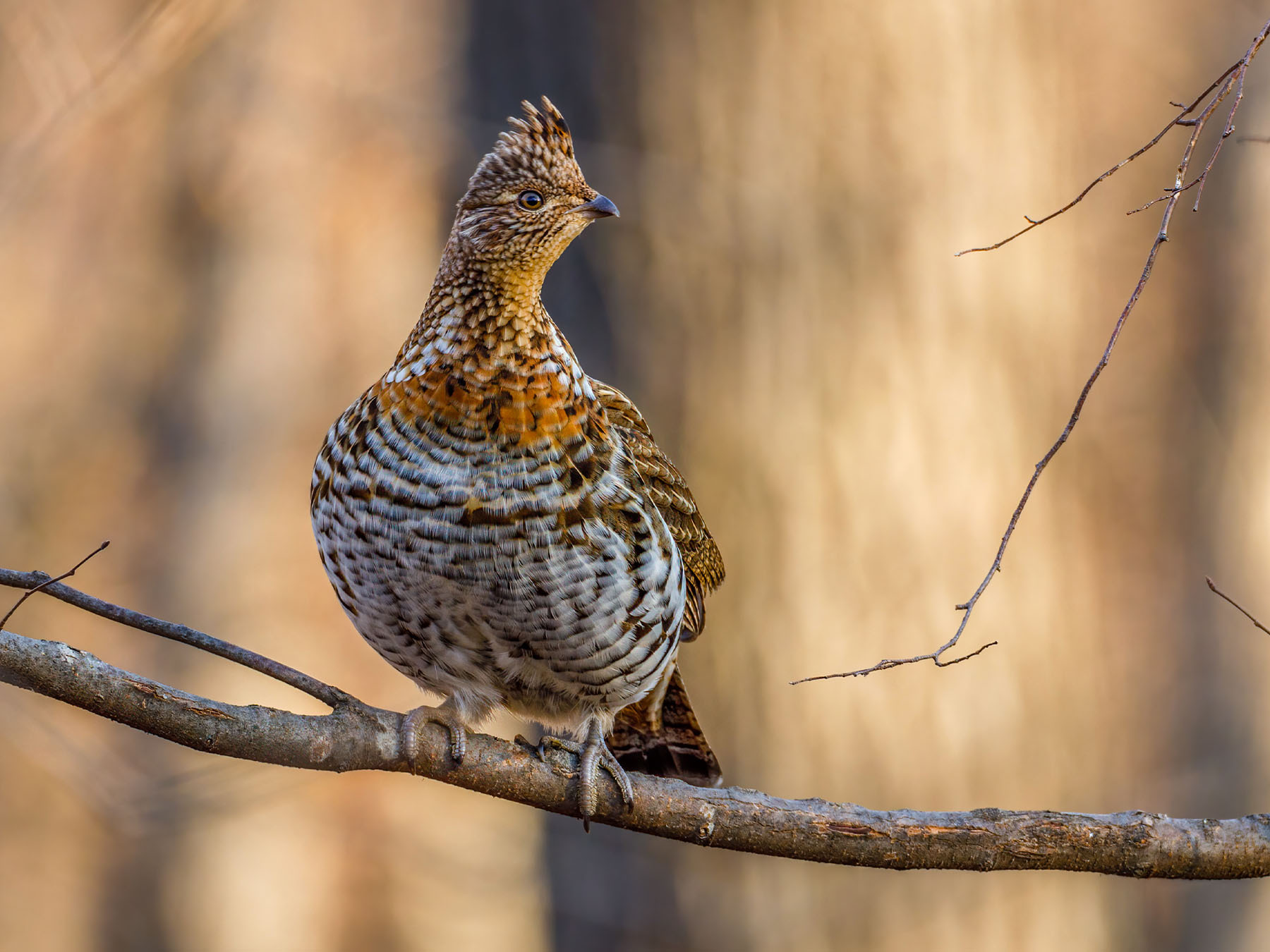
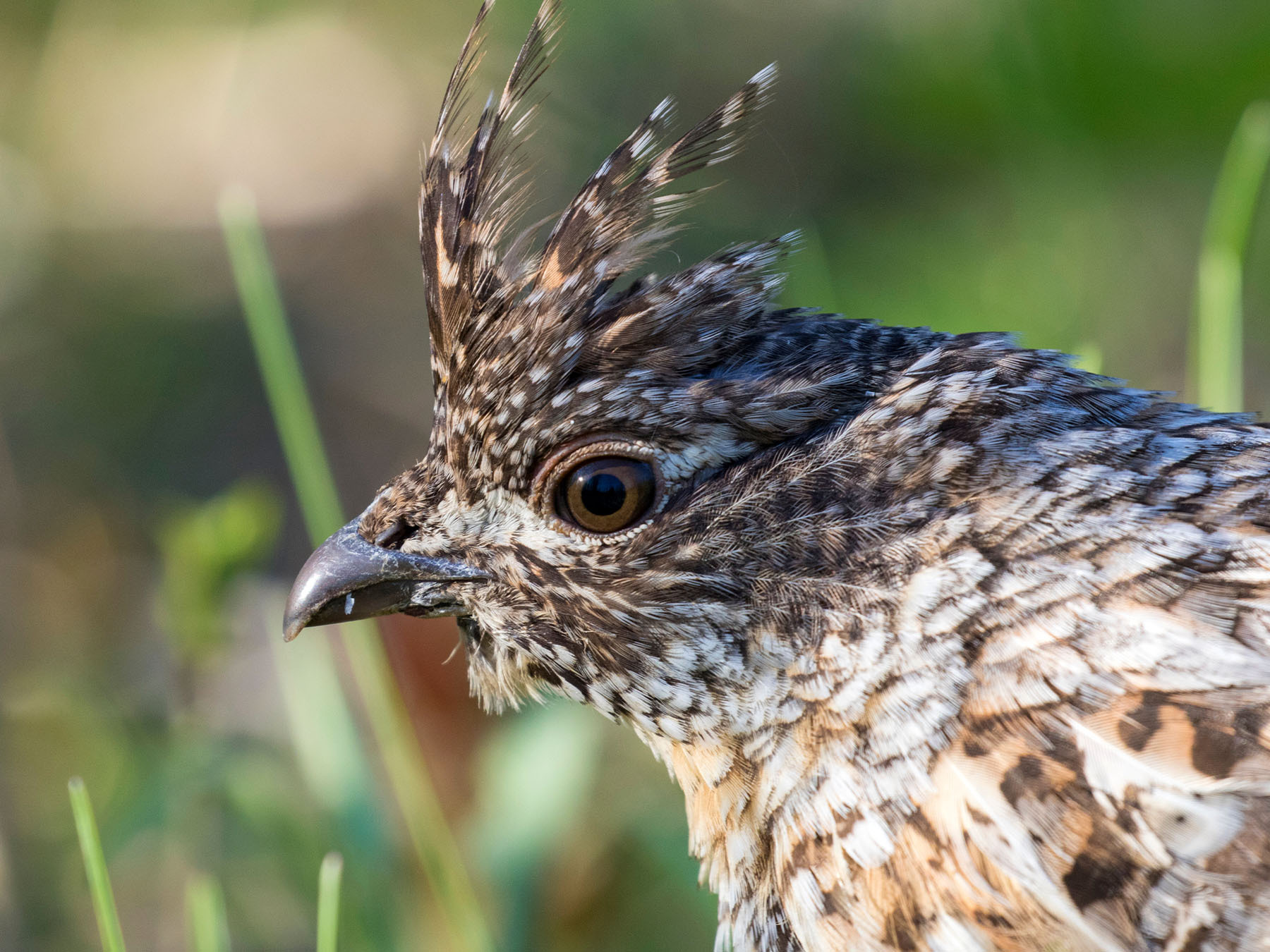
The Ruffed Grouse is a medium-sized game bird with mottled brown, black, and grey plumage. It has a small crest, a fan-shaped tail with a dark band, and feathered legs. The bird's most distinctive feature is the dark ruff of feathers around its neck.
Both sexes look similar, with slight variations in coloration - females are usually less vivid and have smaller ruffs. Some individuals may have a more reddish-brown or greyish overall appearance, depending on their habitat and region.
Its size
Adults- Length
- 41–50 cm
- Wingspan
- 50–64 cm
- Weight
- 450–750 g
Its song and calls
Ruffed Grouse are generally quiet birds, but they produce a variety of soft clucks, whines, and peeps.
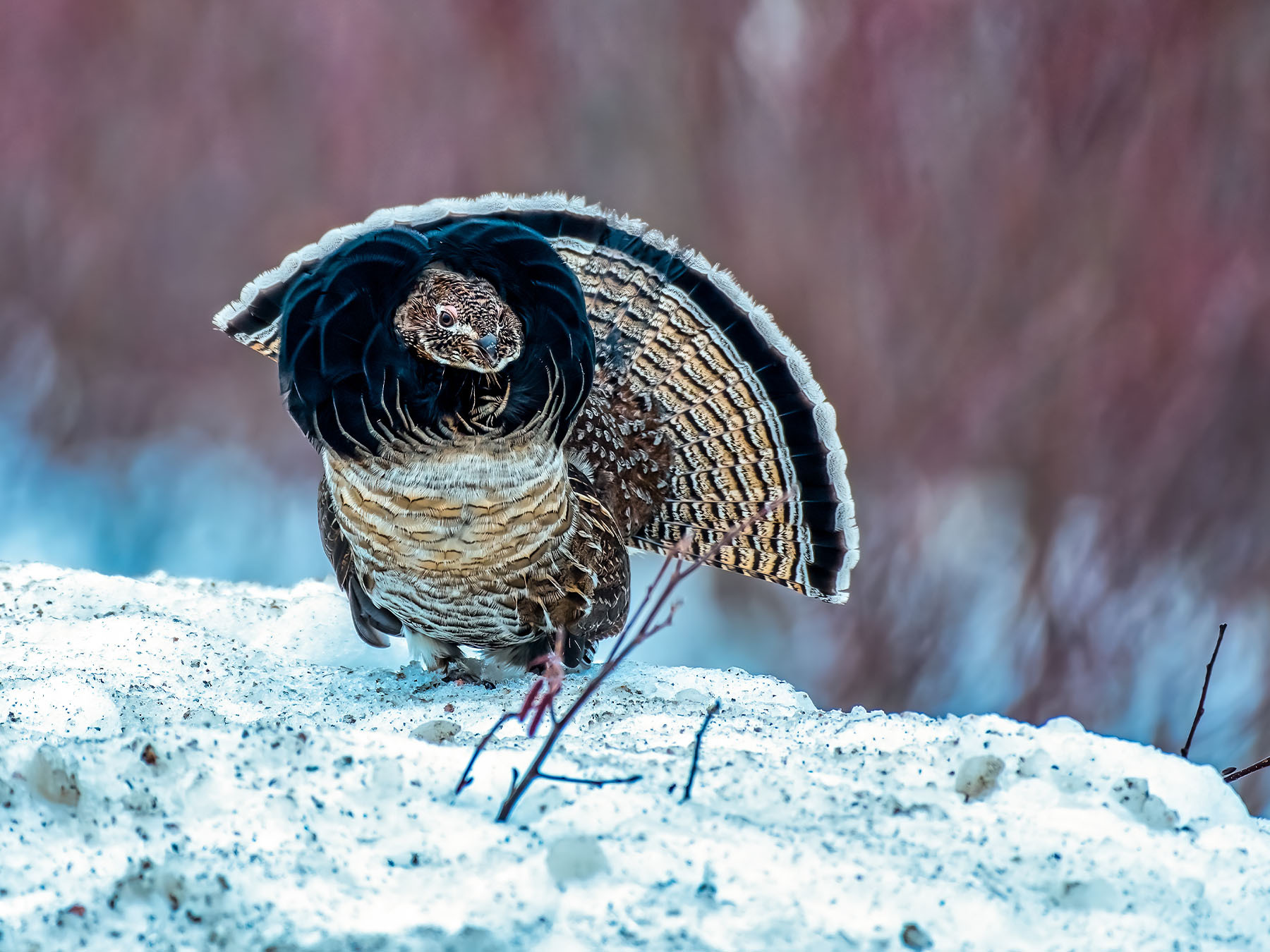
Their most distinctive sound is not vocal but mechanical - the male's drumming display. This sound starts slowly and builds to a rapid crescendo, often described as an accelerating 'thump-thump-thump'.
- Call0:00 / 0:07
Recorded in Minnesota, United States · August 2010
- Drumming0:00 / 0:13
Recorded in Minnesota, United States · May 2013
When and where to see it
OctoberPeak season
Most recorded in October
- 1. Yukon Territory0.68%
- 2. Northwest Territories0.50%
- 3. Manitoba0.39%
- 4. New Brunswick0.36%
- 5. Prince Edward Island0.35%
Each dot is a county, state or province: the bigger and darker, the larger the bird’s share of that place’s bird records that month. Grey dots: no regular records. The ringed point is the centre of the bird’s records this month; the arrow shows how it moved since last month, and the dashed loop its path through the year. “Arrivals” colours places where it becomes regular this month (orange) or is in its last regular month (grey). GBIF eBird Observation Dataset, 2019–2024. Map data: Natural Earth, US Census Bureau; place centres © OpenStreetMap contributors.
In your area
See when the Ruffed Grouse is recorded in your county, state or province.
How often the Ruffed Grouse turns up in the United States and Canada through the year, from birdwatchers' records.
United States
Resident · all year · most records in May
Canada
Resident · all year · most records in April
Show as a table
| Month | United States | Canada |
|---|---|---|
| January | 0.015% (regular) | 0.20% (regular) |
| February | 0.018% (regular) | 0.20% (regular) |
| March | 0.014% (regular) | 0.15% (regular) |
| April | 0.029% (regular) | 0.26% (regular) |
| May | 0.040% (regular) | 0.25% (regular) |
| June | 0.034% (regular) | 0.16% (regular) |
| July | 0.020% (regular) | 0.10% (regular) |
| August | 0.013% (regular) | 0.086% (regular) |
| September | 0.019% (regular) | 0.14% (regular) |
| October | 0.025% (regular) | 0.24% (regular) |
| November | 0.018% (regular) | 0.22% (regular) |
| December | 0.015% (regular) | 0.23% (regular) |
Worldwide: recorded regularly in 2 countries
Countries where it was recorded in at least 3 of the 6 years 2019–2024. Linked countries have their own bird list.
North America (2)
Data: EOD – eBird Observation Dataset (Cornell Lab of Ornithology), accessed via GBIF.org, CC BY 4.0. Records from 2019–2024, aggregated and filtered by Birdfact. How these lists are made
Tips for seeing it
- Listen for the male's drumming sound in spring, which can be heard up to a quarter-mile away
- Look for them in dense, mixed forests with plenty of understory
- Be patient and move slowly, as they often freeze in place when threatened
- In winter, search for their distinctive snowshoe-like tracks in snowy areas
What it eats
Ruffed Grouse have a varied diet that changes seasonally. In spring and summer, they consume leaves, buds, and insects. During fall and winter, they primarily feed on berries, nuts, and tree buds.
They have a specialized digestive system that allows them to eat fibrous plant material.
Nesting and breeding
Ruffed Grouse breeding season begins in early spring. Males attract females through drumming displays, but they do not form lasting pair bonds.
Females create a shallow depression on the ground, often at the base of a tree or stump, lined with leaves and grass. They typically lay 9-14 cream-colored eggs with brown speckles.
Incubation lasts about 24 days, carried out solely by the female. Chicks are precocial, leaving the nest within 24 hours of hatching and can fly short distances after 10-12 days.
Behaviour
Ruffed Grouse are known for their explosive takeoff when startled, creating a loud whirring sound with their wings. They are primarily ground-dwelling birds but can fly short distances through dense forests.
During mating season, males perform a distinctive drumming display by rapidly beating their wings while standing on a log.
Conservation
While the Ruffed Grouse is currently listed as Least Concern, some populations have experienced declines due to habitat loss and fragmentation.
Conservation efforts focus on maintaining diverse forest habitats and promoting sustainable forestry practices that benefit the species.
More photos
4 photos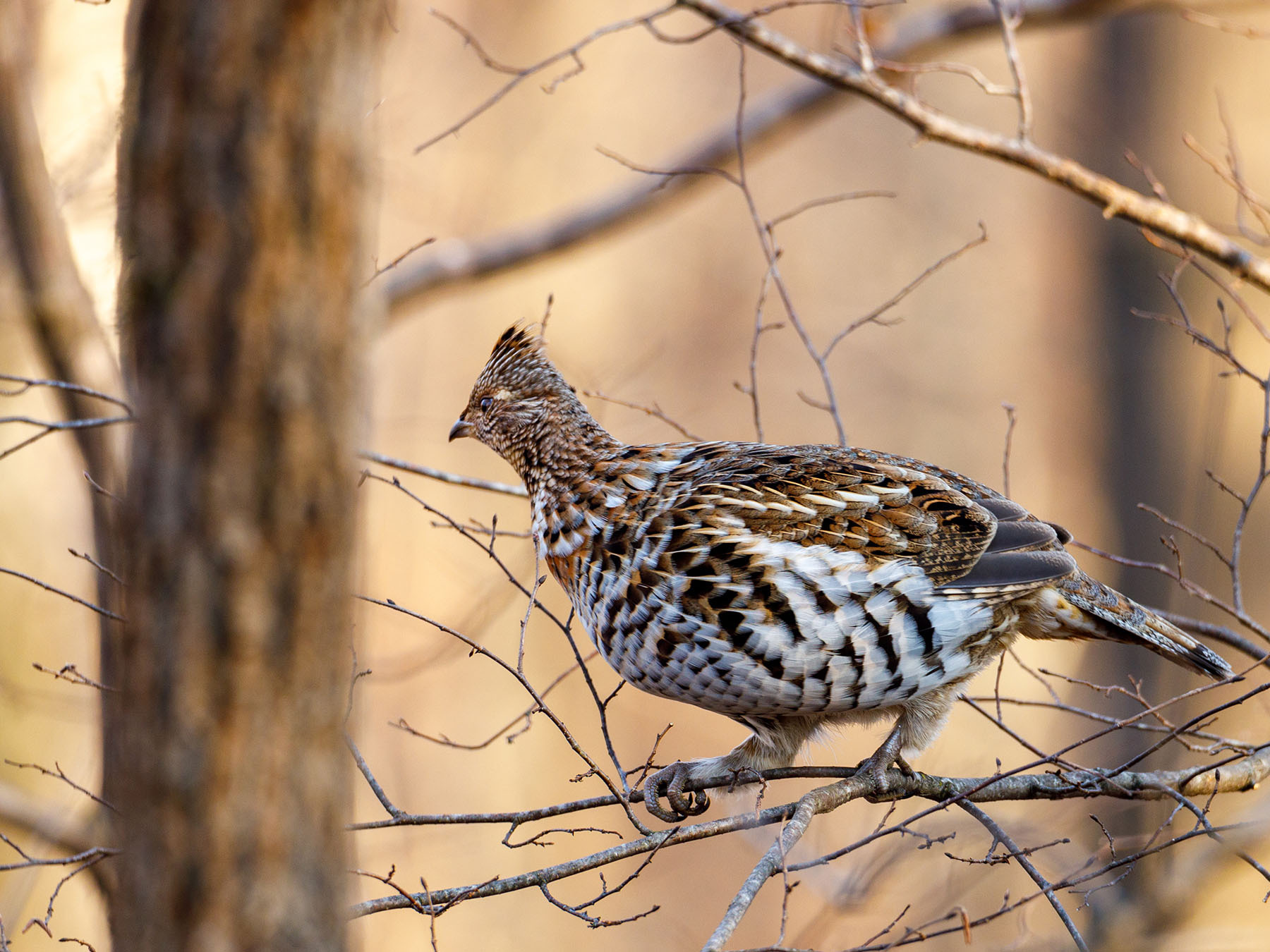
Quick facts
- Length
- 41–50 cm
- Wingspan
- 50–64 cm
- Weight
- 450–750 g
- Lifespan
- 1–3 years · oldest recorded 11 years
- Family
- Pheasants & Grouse
- Migration
- Resident
- Global status (IUCN)
- Least Concern
- World population
- 18,000,000 mature individuals
- Population trend
- Population slightly decreasing due to habitat loss and hunting, but considered stable due to their large population size
- Also called
- Partridge
- Scientific name
- Bonasa umbellus
Sources
3- 1BirdLife International. 2021. Bonasa umbellus. The IUCN Red List of Threatened Species 2021: e.T22679500A139379109. Source (opens in a new tab)
- 2Pardieck et al. (2018)
- 3Partners in Flight (2019) Source (opens in a new tab)

Checked by
Nathan Cope, founder and editor
Nathan founded Birdfact and leads its writers and contributors in the UK, the US and Canada. He has watched and studied birds for more than ten years, and checks every article and species guide before it’s published.