


Red-breasted Sapsucker
Red-breasted Woodpecker · Sphyrapicus ruber
By the Birdfact teamChecked by Nathan Cope
On this page13 sections
How to recognise it
What do Red-breasted Sapsuckers look like?
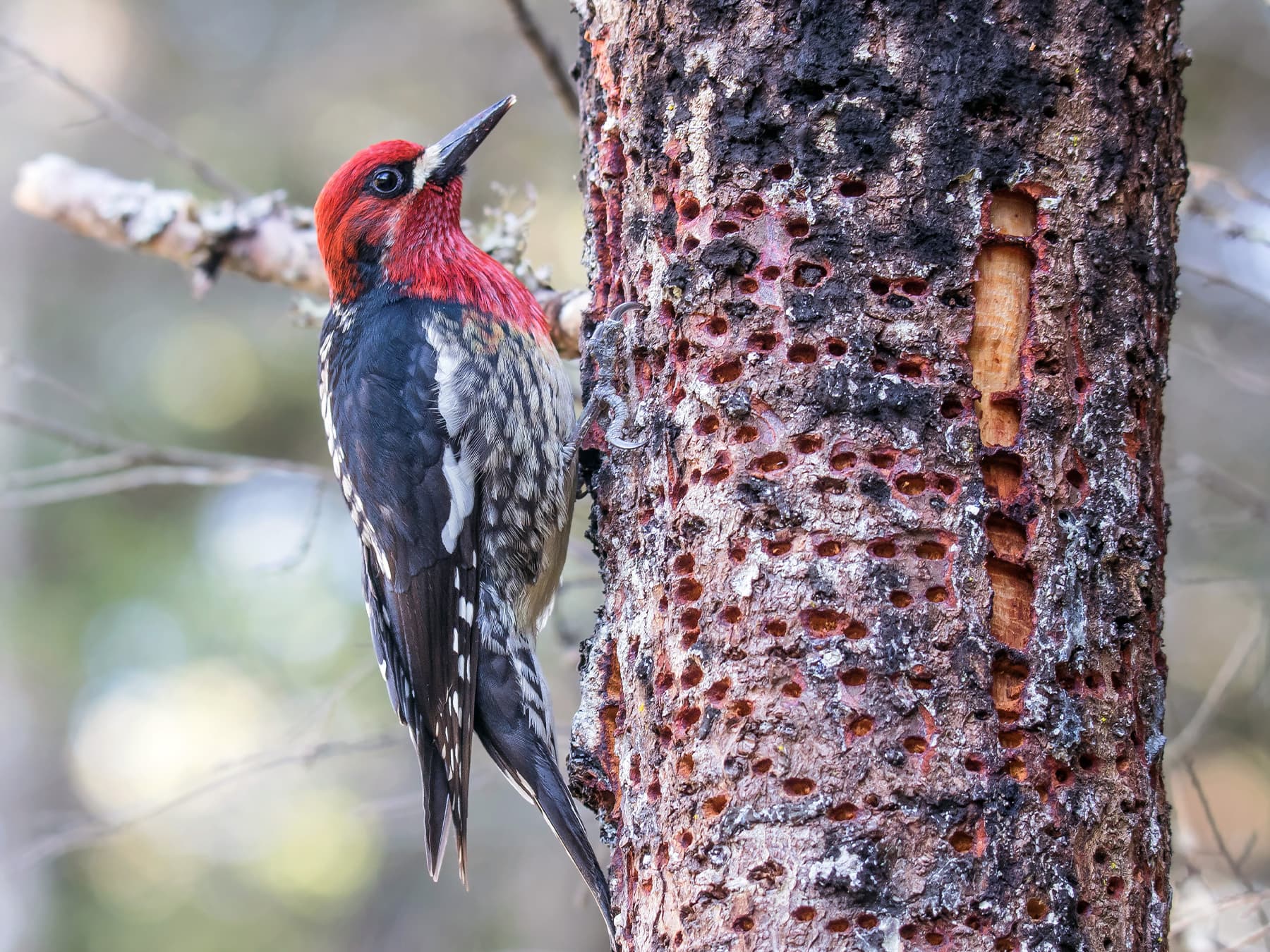
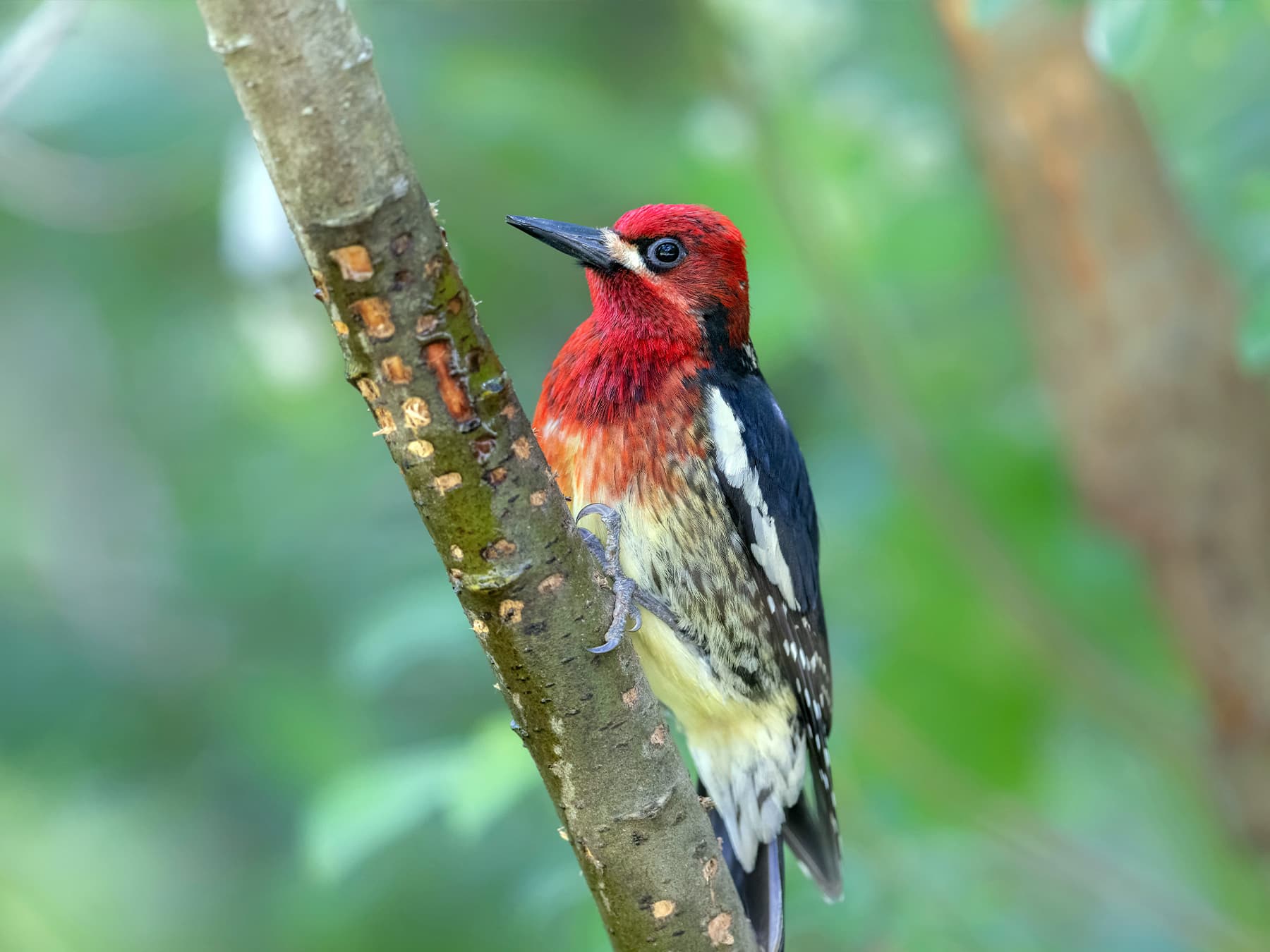
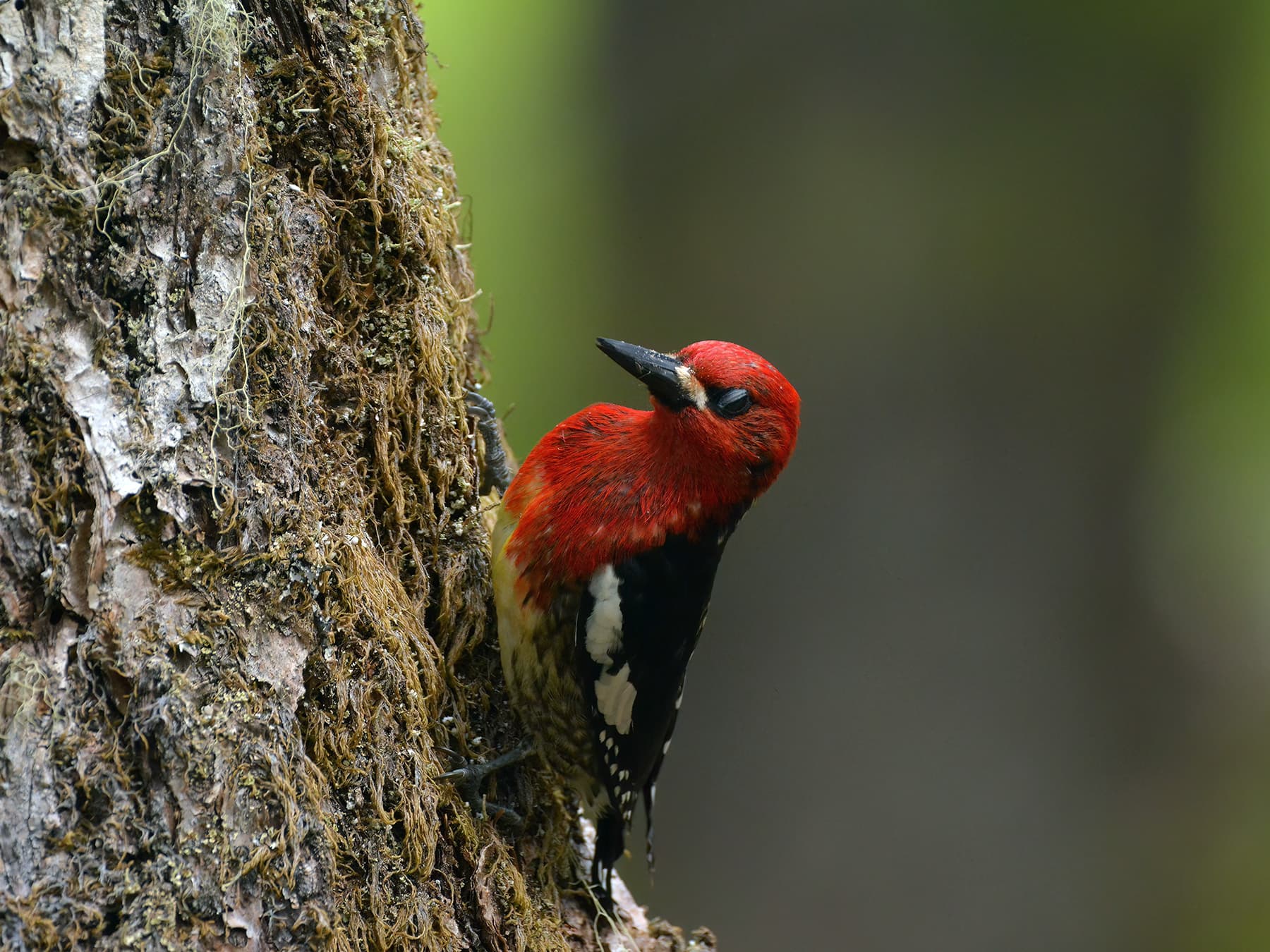
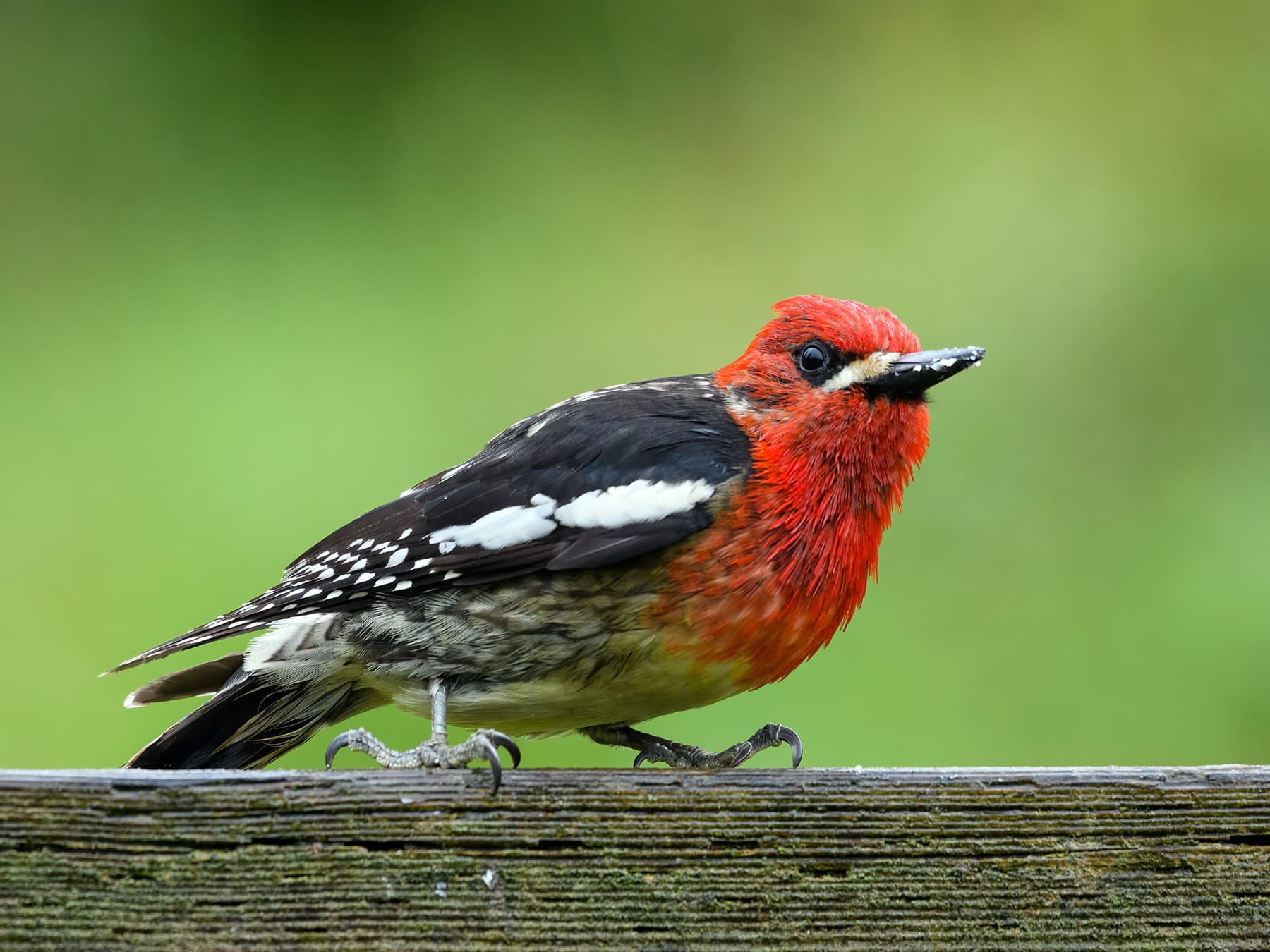
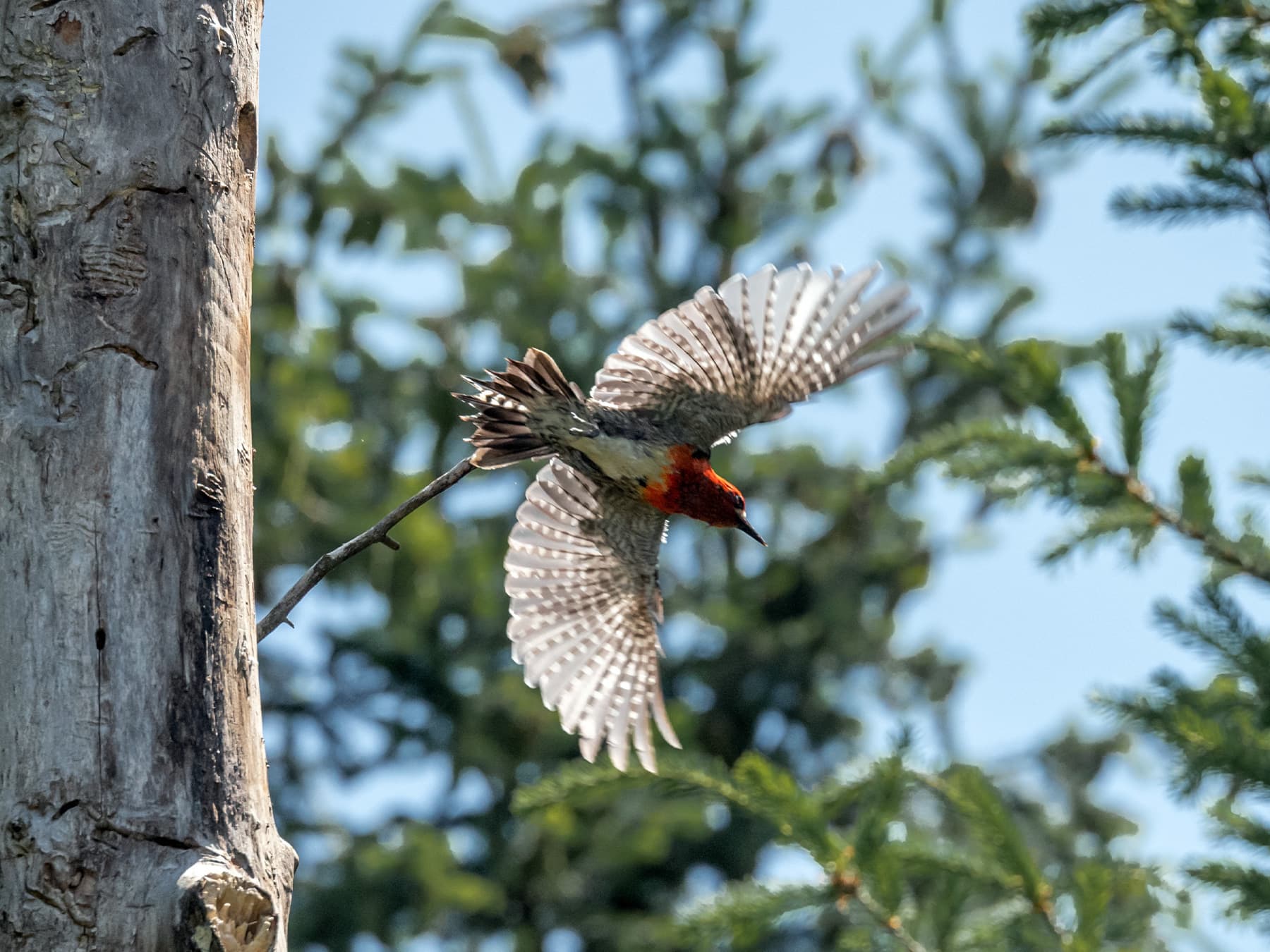
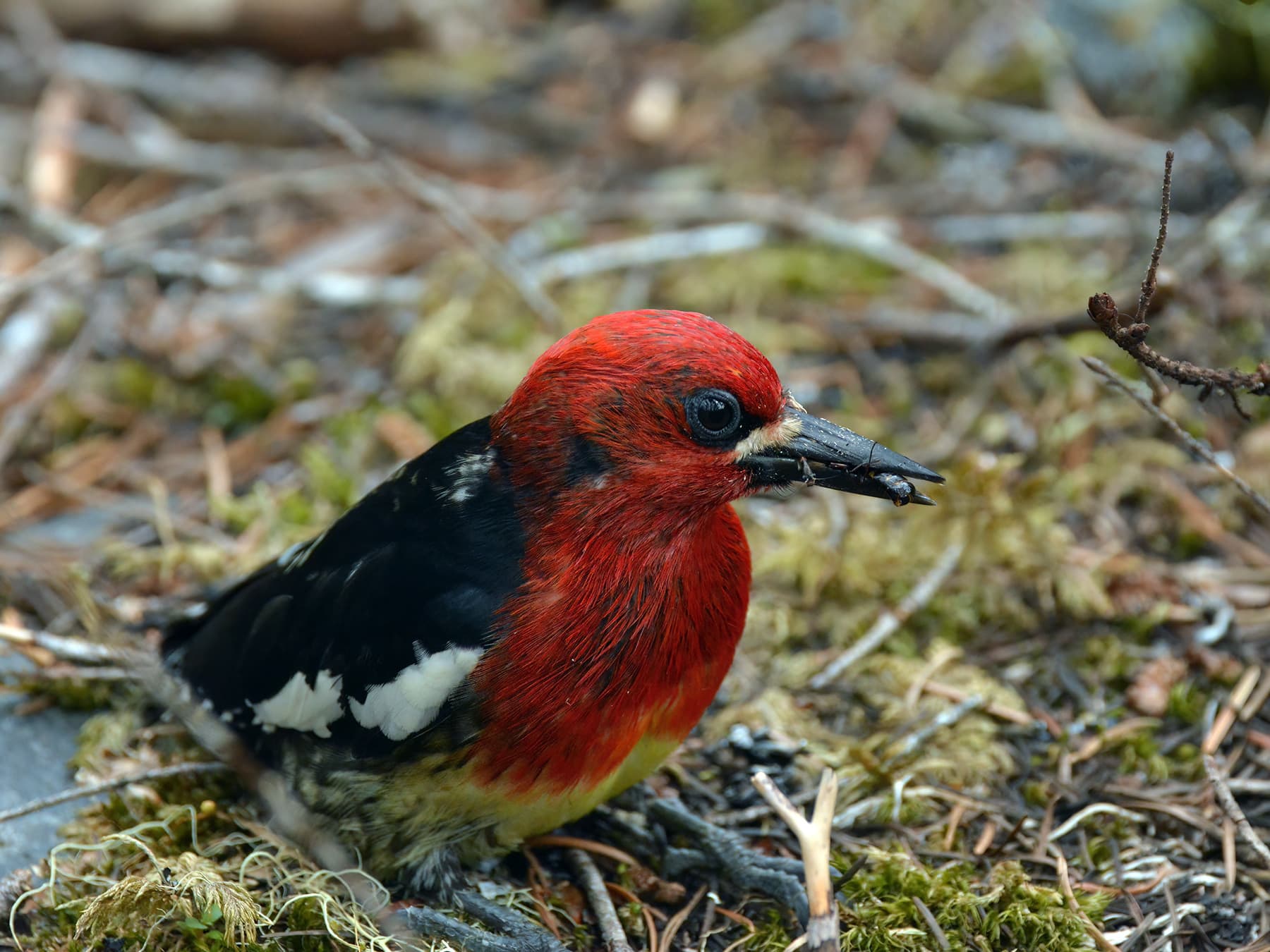
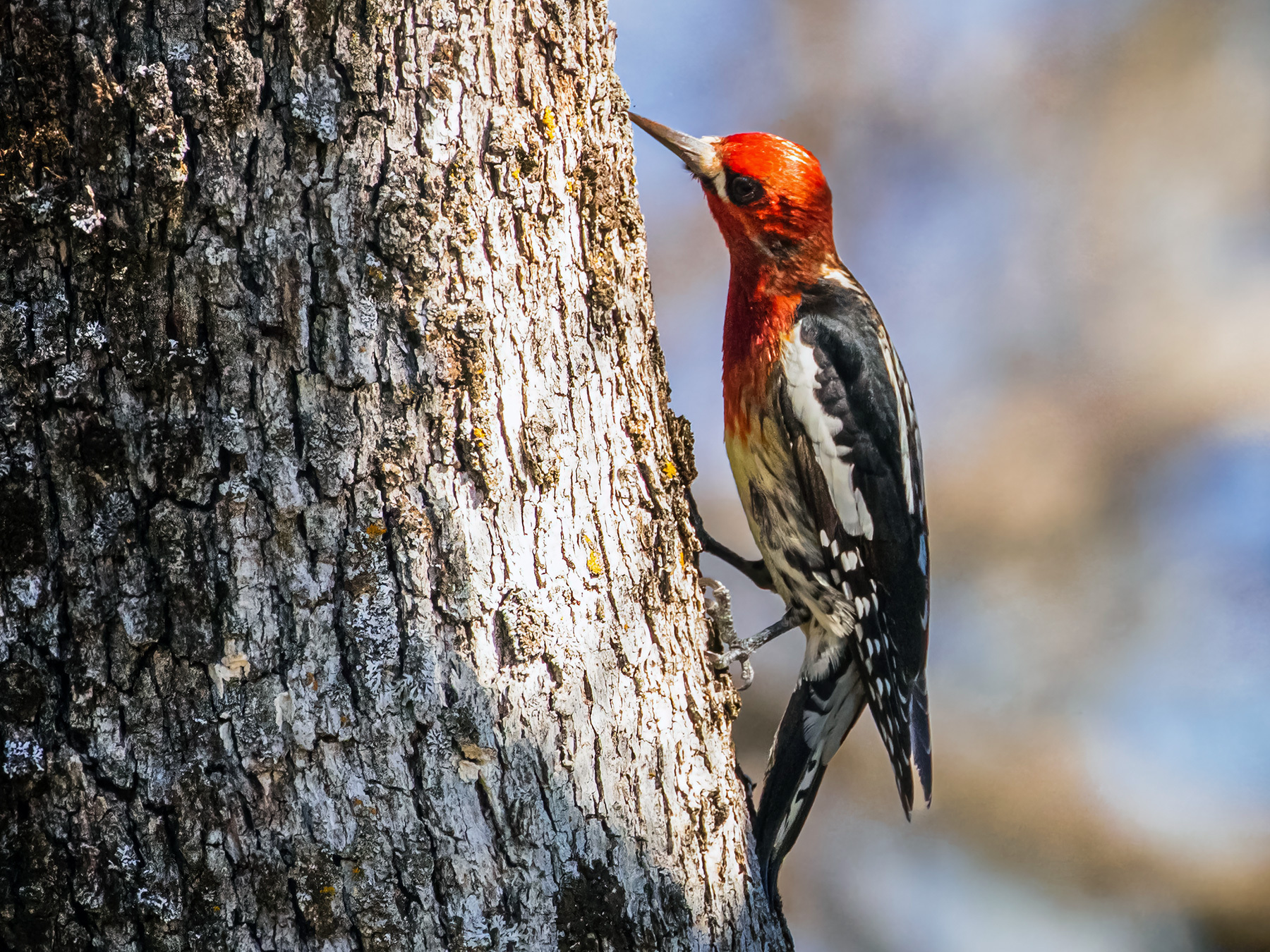
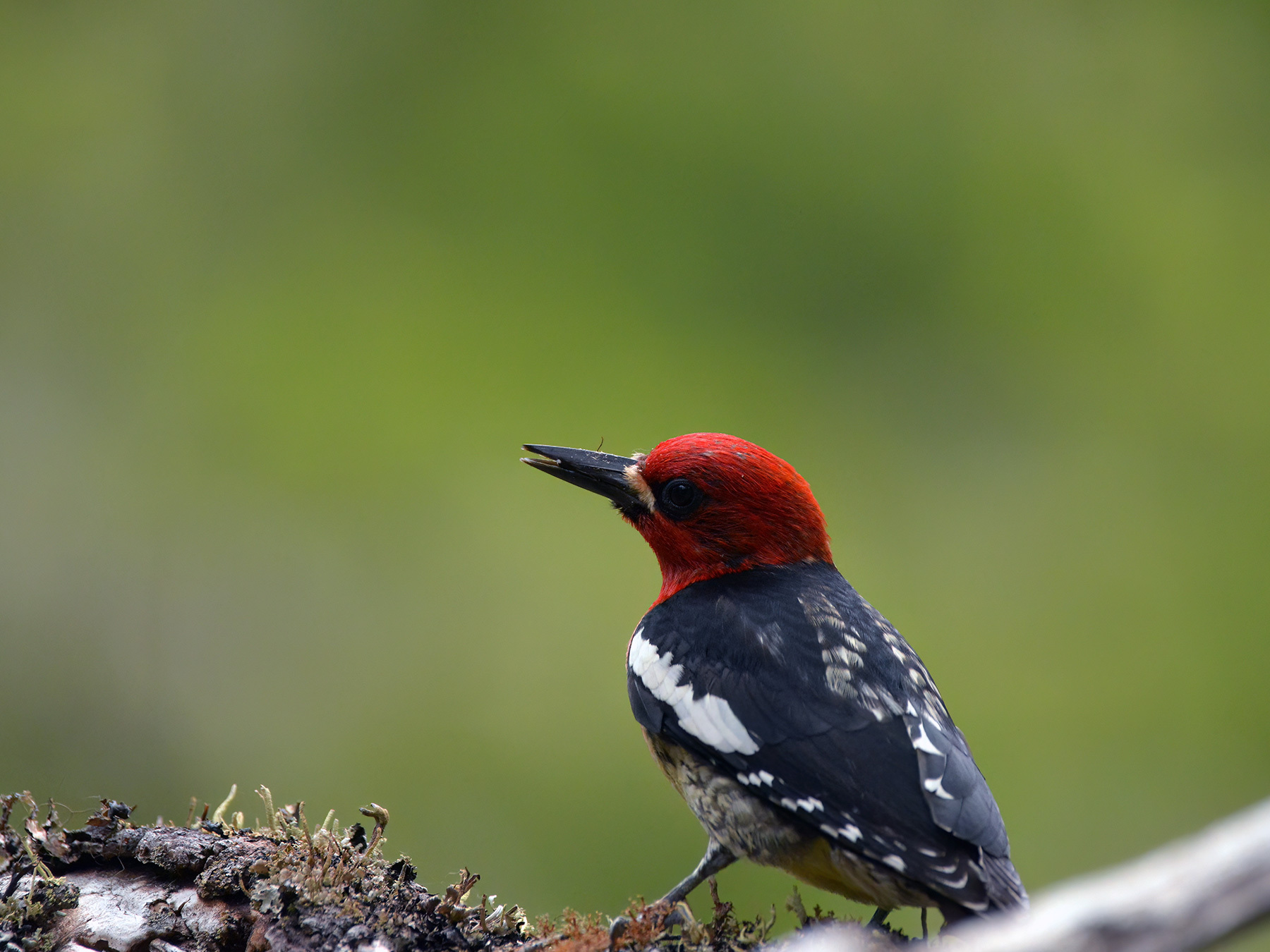
Male red-breasted sapsuckers are boldly colored with a red head and facial plumage that extends into the upper breast and to the nape. Their back is black, with small yellow spots, a distinct white shoulder patch, black wings with light yellow spotting, a white rump, and a black tail.
Below the scarlet upper breast, the lower breast and belly are yellow, marked on the flanks with black spots, and the underparts are yellowish-white. A white bar is present across the top of the bill, which is horn gray and slightly upturned.
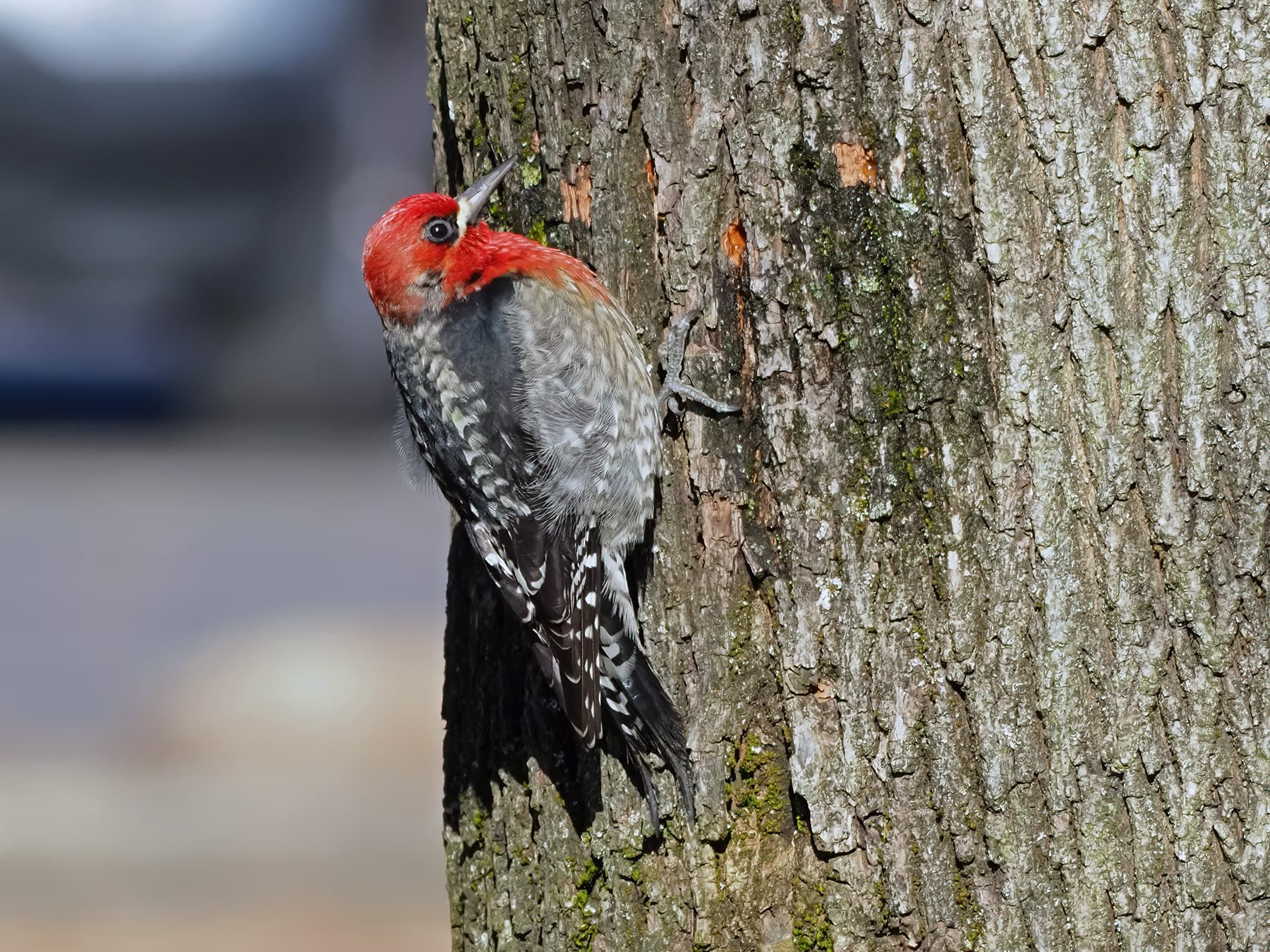
In female red-breasted sapsuckers, the red coloring is less vibrant, and their heads are paler red, washed with white markings. The breast is also a patchier red, and their backs and wings feature more light-colored patterning than seen in males.
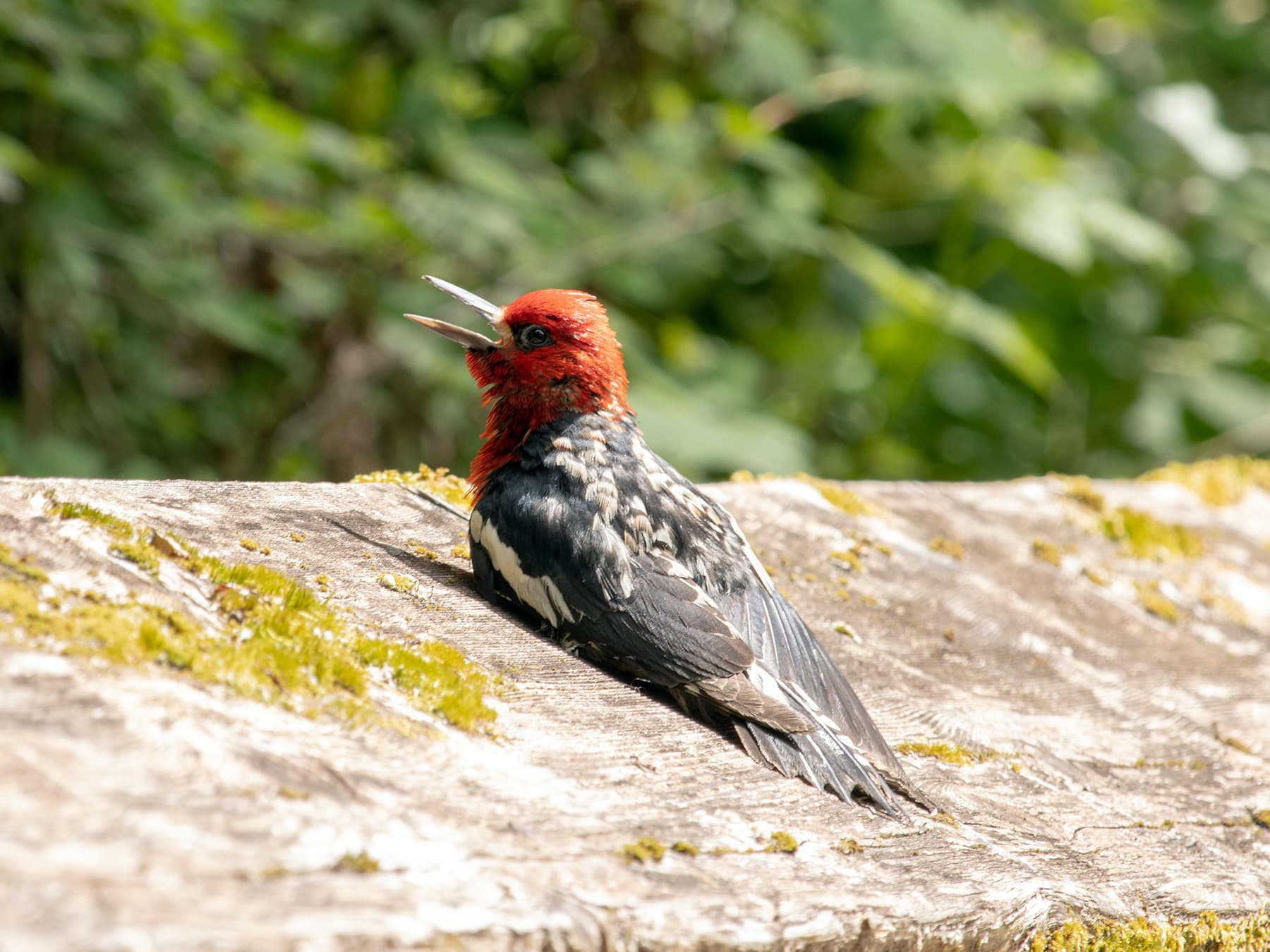
Juvenile red-breasted sapsuckers are darker than adults but have the same visible white wing patches seen in mature birds. Instead of the bold red coloring of adult birds, young red-breasted sapsuckers have brown feathers on their heads, and the breast is lighter brownish-buff, mottled with heavy brown markings.
How big are Red-breasted Sapsuckers?
Red-breasted sapsuckers are the same size as their closely related species, the red-naped and yellow-bellied sapsuckers, and roughly the same size as an American robin.
No major difference in size is evident between males and females, which all fall within the measurement ranges below:
- Length: 20 cm to 22 cm (7.9 in to 8.7 in)
- Wingspan: 37 cm to 41 cm (15 in to 16 in)
- Weight: 53 g to 64 g (1.9 oz to 2.2 oz)
Its size
Adults- Length
- 19–22 cm
- Wingspan
- 35–40 cm
- Weight
- 50–80 g
Its song and calls
What sound does a Red-breasted Sapsucker make?
Red-breasted sapsuckers make a low, rasping call, with harsh notes and repeated phrases. A ‘waa’ call is used to signal distress and warning, particularly when a threat is detected nearby. Nasal squealing calls are heard between pairs.
Both sexes use drumming to communicate, with the species being associated with a slow and irregular pace.
When and where to see it
OctoberIn season
Most recorded in October
- 1. Oregon0.29%
- 2. Washington0.21%
- 3. British Columbia0.15%
- 4. California0.15%
- 5. Alaskaunder 0.1%
Each dot is a county, state or province: the bigger and darker, the larger the bird’s share of that place’s bird records that month. Grey dots: no regular records. The ringed point is the centre of the bird’s records this month; the arrow shows how it moved since last month, and the dashed loop its path through the year. “Arrivals” colours places where it becomes regular this month (orange) or is in its last regular month (grey). GBIF eBird Observation Dataset, 2019–2024. Map data: Natural Earth, US Census Bureau; place centres © OpenStreetMap contributors.
In your area
See when the Red-breasted Sapsucker is recorded in your county, state or province.
How often the Red-breasted Sapsucker turns up in the United States and Canada through the year, from birdwatchers' records.
United States
Resident · all year · most records in June
Canada
Resident · all year · most records in June
Show as a table
| Month | United States | Canada |
|---|---|---|
| January | 0.039% (regular) | 0.035% (regular) |
| February | 0.033% (regular) | 0.032% (regular) |
| March | 0.036% (regular) | 0.054% (regular) |
| April | 0.028% (regular) | 0.048% (regular) |
| May | 0.026% (regular) | 0.031% (regular) |
| June | 0.059% (regular) | 0.061% (regular) |
| July | 0.034% (regular) | 0.041% (regular) |
| August | 0.017% (regular) | 0.023% (regular) |
| September | 0.024% (regular) | 0.034% (regular) |
| October | 0.035% (regular) | 0.030% (regular) |
| November | 0.035% (regular) | 0.022% (regular) |
| December | 0.043% (regular) | 0.043% (regular) |
Worldwide: recorded regularly in 3 countries
Countries where it was recorded in at least 3 of the 6 years 2019–2024. Linked countries have their own bird list.
North America (3)
Data: EOD – eBird Observation Dataset (Cornell Lab of Ornithology), accessed via GBIF.org, CC BY 4.0. Records from 2019–2024, aggregated and filtered by Birdfact. How these lists are made
What is the habitat of a Red-breasted Sapsucker?
Pine forests, at elevations of up to 2900 m (9500 ft) offer ideal breeding grounds for red-breasted sapsuckers.
Preferred tree species include white pine, lodgepole pine, white fir, hemlock, Douglas fir and spruce. Some mixed deciduous woodlands may also attract breeding red-breasted sapsuckers, particularly along rivers and streams, where cottonwood and quaking aspen are favored.
Outside of the breeding season, lowland environments dominate, with many red-breasted sapsuckers moving from inland forests toward coastal woodland habitats.
What is the range of a Red-breasted Sapsucker?
Red-breasted sapsuckers are confined to the westernmost region of North America, with a range that extends from the southern coastal regions of Alaska and British Columbia in the north, southwards through western Washington, Oregon, and into California. In winter, northern breeders temporarily relocate as far south as the northern part of Baja California.
Interior uplands of British Columbia and northern California are popular as breeding grounds, with populations moving towards lowland coastal regions as summer ends.
Where do Red-breasted Sapsuckers live?
Oregon’s Douglas fir forests in the Coastal Ranges to the south of the state have the largest concentrations of red-breasted sapsuckers.
How rare are Red-breasted Sapsuckers?
Within much of their range, red-breasted sapsuckers are relatively common and widespread, with an estimated overall population of 2.3 million individuals. In the south of the range, they are fairly common in the
Where can you see Red-breasted Sapsuckers in the US?
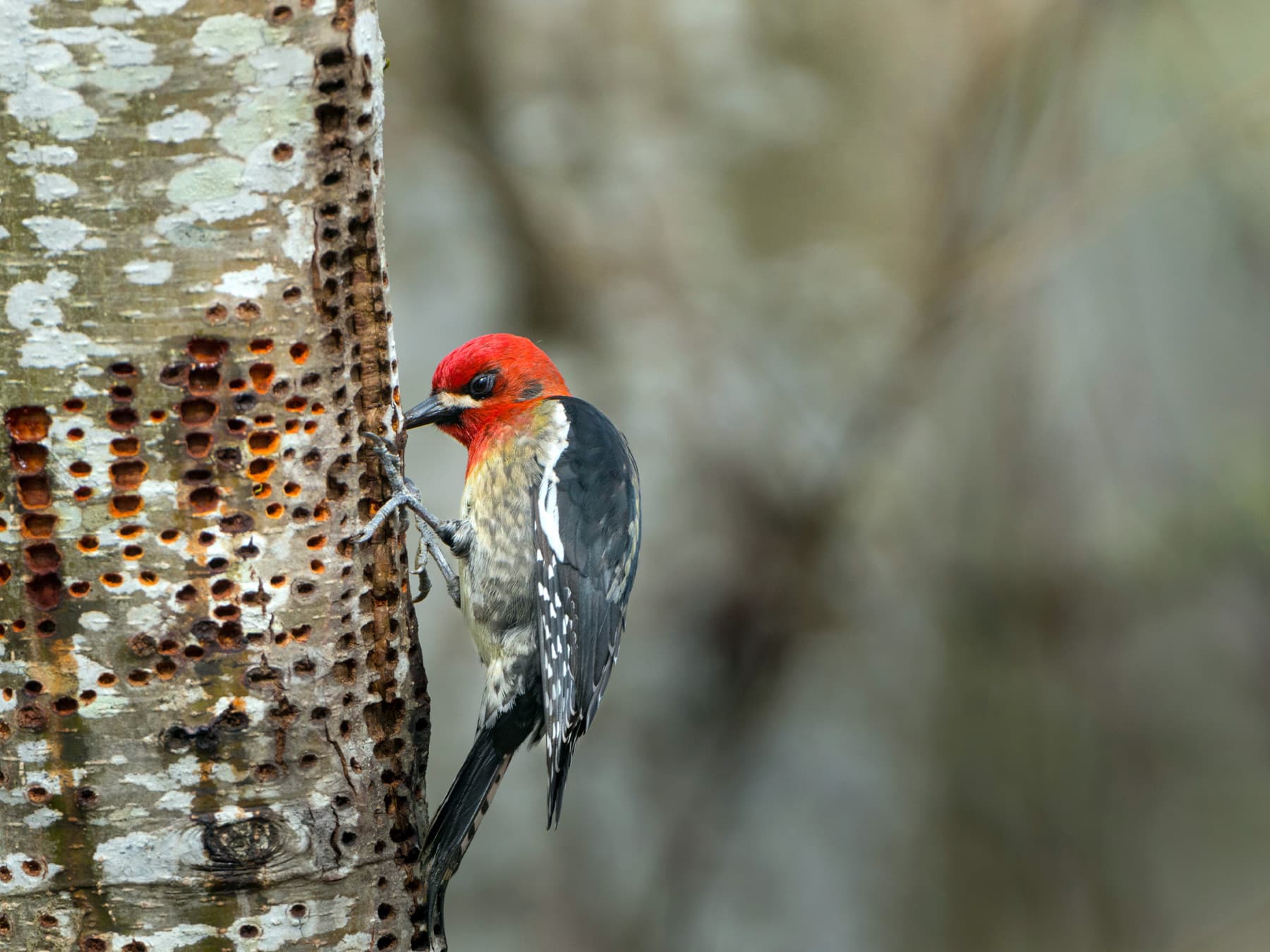
Washington’s Mount Rainier National Park is a known spot for red-breasted sapsuckers, with its rich forests offering an ideal habitat. Look for their rows of neatly drilled out sap wells in tree trunks.
Spring is a particularly good time of year for sightings as the increased activity levels at nest sites with regular feeding visits to nestlings make them more visible than usual.
Where can you see Red-breasted Sapsuckers in Canada?
Canada’s population of red-breasted sapsuckers is based entirely in British Columbia. During the breeding season, their range extends inland and they are found mostly in aspen, willow, and birch trees among mixed coniferous-deciduous woodlands. Regular sightings are reported to the west of the Cascade Ranges.
Migration
Do Red-breasted Sapsuckers migrate?
Some populations of red-breasted sapsuckers are migratory, although many do remain in the same breeding territories all year round. Most of British Columbia’s inland population relocates to coastal lowlands and warmer southern habitats once winter approaches. In winter, the species range reaches the northernmost regions of Mexico’s Baja California peninsula.
Are Red-breasted Sapsuckers native to the US?
Red-breasted sapsuckers are native to the US, with some populations resident in the same territories all year round, and others that are present only for breeding or wintering.
Tips for seeing it
- Look for neat rows of small holes on tree trunks, a telltale sign of sapsucker activity
- Listen for their distinctive cat-like mewing call
- Observe deciduous and coniferous trees in western North American forests
- Visit sap wells regularly, as these birds often return to the same feeding sites
What it eats
What do Red-breasted Sapsuckers eat?
The main food of red-breasted sapsuckers is sap. They drill out horizontal rows of ‘sap wells’ in tree trunks to access the internal sap, and to ensure it continues to flow, they use a system of rectangular and circular holes.
Their tongues are shorter than those of other woodpeckers, and specially adapted with barbed edges at the tip, which helps them to extract as much sap as possible.
Fruit, seeds, and tree cambium are also eaten. Insects are sometimes caught in flight, as well as caught in sap (particularly ants).
What do Red-breasted Sapsucker chicks eat?
Invertebrates, especially ants, are the chief food of young red-breasted sapsuckers. Insects fed to young are often dipped in sap, to provide extra energy. Spiders, caterpillars, and flies are also important in a young red-breasted sapsucker’s diet.
Nesting and breeding
Where do Red-breasted Sapsuckers nest?
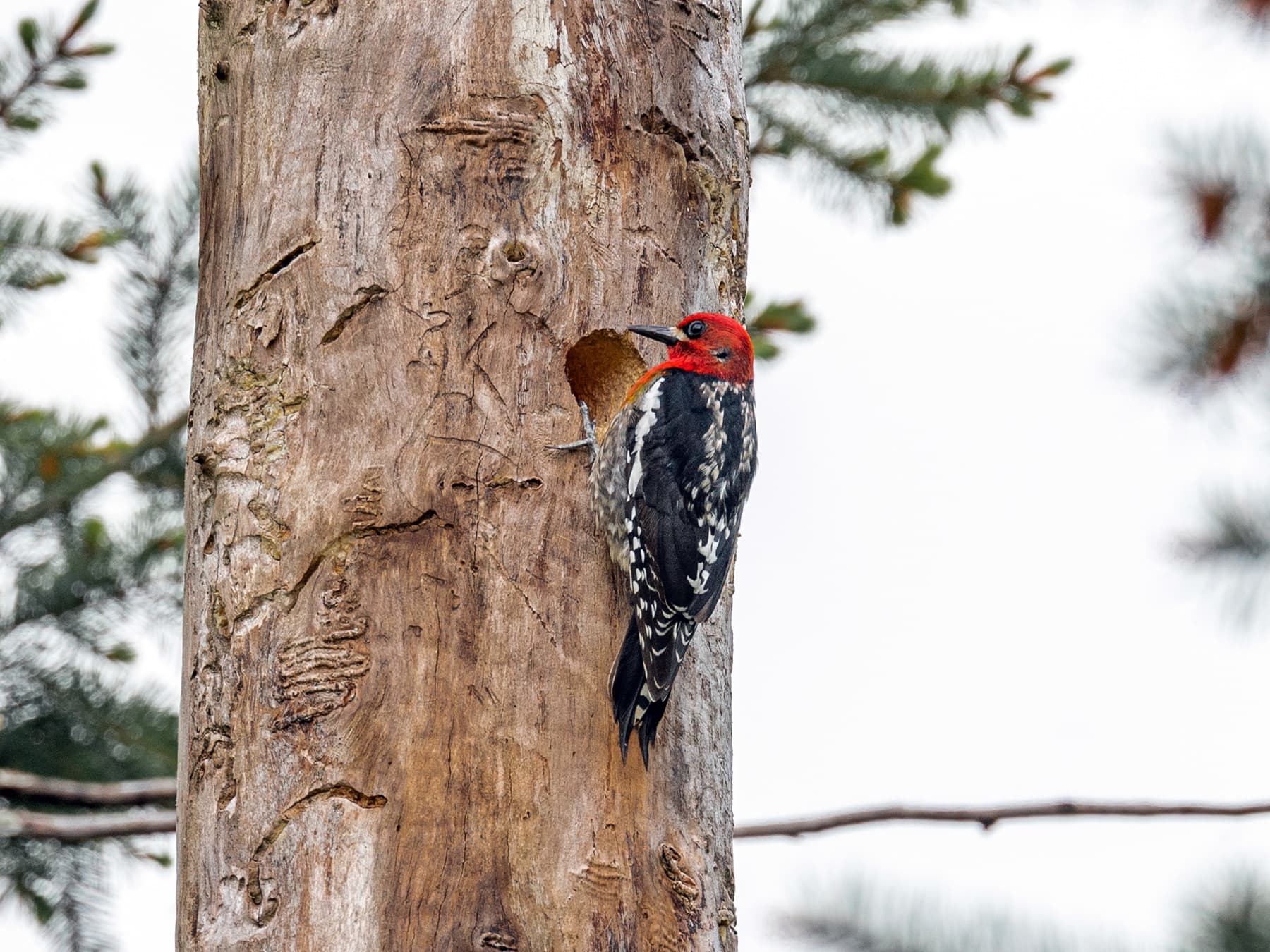
Nest cavities are usually constructed in snags or dead or decaying trees. A variety of both deciduous and coniferous species are used for nesting, including western hemlock, white pine, cottonwood, Douglas fir, quaking aspen, broadleaf maple and spruce.
Males do the bulk of the cavity excavation, assisted by the female, with sites on average 30 m above ground. Cavities are lined with wood chips, but no additional material is added, and nests are not reused in subsequent years.
When do Red-breasted Sapsuckers nest?
Cavity construction begins in April to May, with the earliest eggs observed to be laid in late April. Incubation, shared between males and females, lasts for at least 11 days, but 14 to 15 days is most common.
Eggs are barely left unattended, with males remaining in the cavity overnight, and alternating with females during the day. Young red-breasted sapsuckers are ready to leave the nest after between 23 and 28 days.
What do Red-breasted Sapsucker eggs look like?
Between 4 and 7 plain white eggs are laid by red-breasted sapsuckers. Eggs measure 23 mm by 18 mm (0.9 in by 0.7 in). One single clutch is laid each season. If a clutch fails early in the breeding season, it’s likely that a replacement brood will be attempted in a different cavity.
Do Red-breasted Sapsuckers mate for life?
Red-breasted sapsuckers are monogamous during the breeding season and maintain a pair bond until their young gain independence. Pairs may reunite in the following breeding season if both mates have survived the winter.
Behaviour
Are Red-breasted Sapsuckers aggressive?
Early in the breeding season, aggressive interactions between rival males are not uncommon, which escalate quickly to include physical bill-to-bill grappling as well as hostile posturing, crest raising and wing flicking. Both males and females will aggressively guard their sap wells against other birds and mammals.
Where do Red-breasted Sapsuckers sleep at night?
Overnight roosting spots are found close to the trunk or underneath a main limb of a tree. After fledging, young red-breasted sapsuckers do not return to the nest cavity to roost.
Lifespan and predators
How long do Red-breasted Sapsuckers live?
On average, red-breasted sapsuckers have an expected lifespan of between 2 and 3 years and usually breed for the first time at one year old. The oldest recorded individual was identified from a banding program having reached 5 years of age.
What are the predators of Red-breasted Sapsuckers?
House wrens and deer mice are known to raid red-breasted sapsuckers’ nest cavities for unhatched eggs, while nestlings are documented to have been preyed on by gopher snakes and black bears. Hawks, including Cooper’s hawks and northern goshawks, have been observed to attack adult red-breasted sapsuckers.
Are Red-breasted Sapsuckers protected?
Red-breasted sapsuckers were once extensively hunted for their colorful feathers or shot as a pest in orchards, which led to population declines in the late 19th century. The Migratory Bird Treaty Act of 1918 has given the species protection against being killed, injured, captured, or traded, and also extends these conditions to their eggs, feathers, nests and their young.
Are Red-breasted Sapsuckers endangered?
Currently listed as a species of least concern, red-breasted sapsucker populations are considered stable in much of their range, with increases apparent in Oregon at the end of the 20th century. In California, however, some slight declines in numbers were recorded.
Conservation
While currently listed as Least Concern, Red-breasted Sapsuckers face threats from habitat loss due to logging and urban development.
Conservation efforts focus on preserving mature forests and maintaining suitable nesting trees in managed woodlands.
More photos
3 photos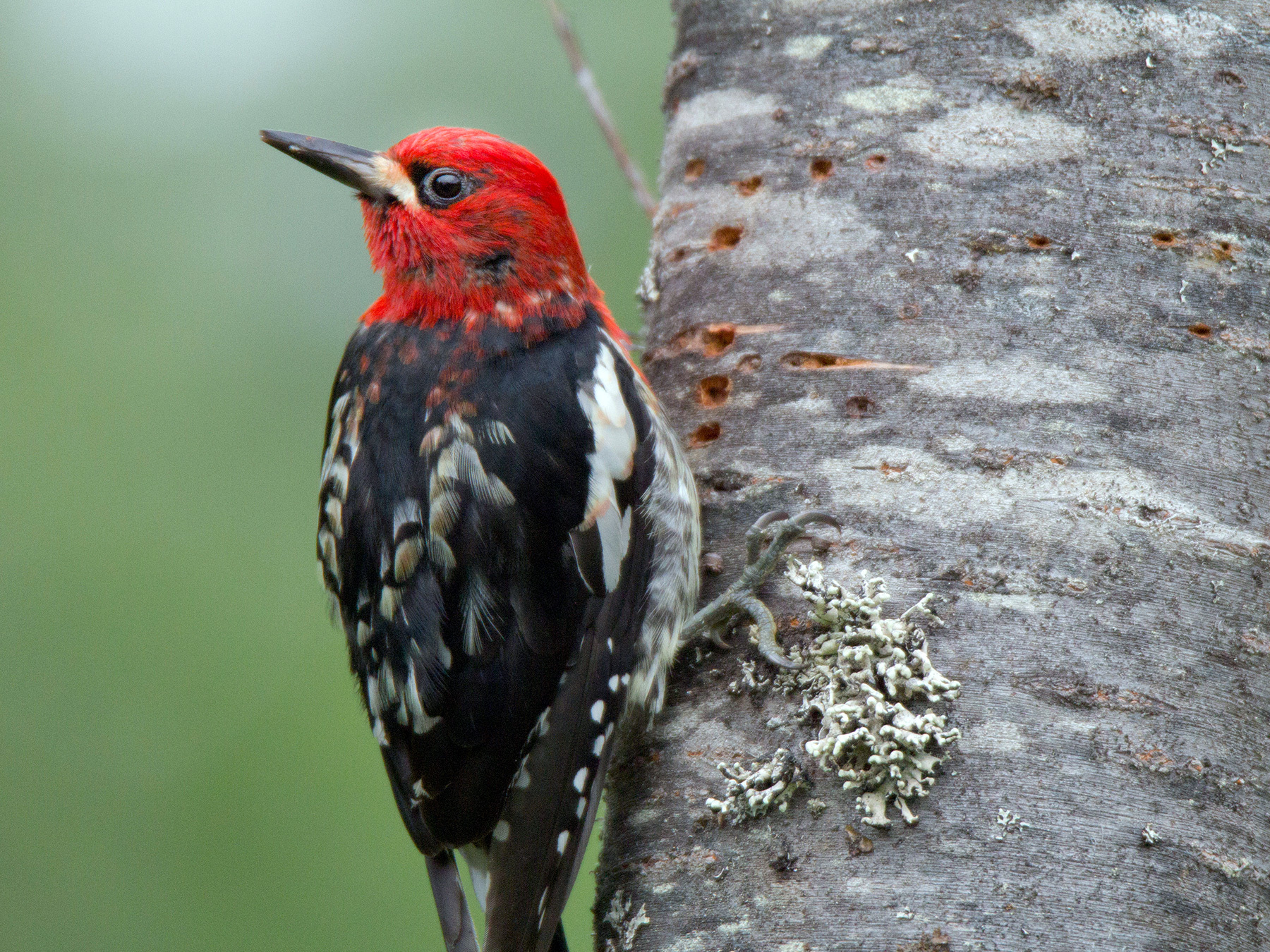
Quick facts
- Length
- 19–22 cm
- Wingspan
- 35–40 cm
- Weight
- 50–80 g
- Lifespan
- 2–3 years · oldest recorded 4.8 years
- Family
- Woodpeckers
- Migration
- Partial migrant
- Global status (IUCN)
- Least Concern
- World population
- 2,800,000 mature individuals
- Population trend
- Decreasing
- Also called
- Red-breasted Woodpecker
- Scientific name
- Sphyrapicus ruber
Questions
4What attracts Red-breasted Sapsuckers?
Mature trees and deadwood snags will both give you a headstart in attracting red-breasted woodpeckers if you live within their range on the western coast of Canada or the US. Suet feeders may also boost their chances of visiting, particularly in winter and early spring.
What trees do Red-breasted Sapsuckers prefer?
Red-breasted sapsuckers are known to visit a diverse list of tree species, including coniferous hemlock and spruce forests and aspen groves. In southern parts of the range, they are mostly found in pine forests but are always within easy reach of woodlands with deciduous trees, in particular aspen, alder and willow.
Do Red-breasted Sapsuckers harm trees?
Red-breasted sapsuckers are known for drilling out rows of sap wells in tree trunks. Extensive drilling can cause major harm to trees, with their rings of holes stopping sap from flowing to the roots. In most cases, however, no lasting damage is done to the tree, as the tree quickly seals off the hole so the sap flow is not interrupted.
Do Red-breasted Sapsuckers go to bird feeders?
In yards with aspen, birch, or pine trees, red-breasted sapsuckers may be tempted to investigate hanging suet feeders and large nectar feeders.
Sources
4- 1BirdLife International. 2018. Sphyrapicus ruber. The IUCN Red List of Threatened Species 2018: e.T22680874A130036416. Source (opens in a new tab)
- 2Tracewski et al. (2016)
- 3Partners in Flight (2022) Source (opens in a new tab)
- 4Longevity Records Of North American Birds. Version 2023.1 Source (opens in a new tab)

Checked by
Nathan Cope, founder and editor
Nathan founded Birdfact and leads its writers and contributors in the UK, the US and Canada. He has watched and studied birds for more than ten years, and checks every article and species guide before it’s published.