


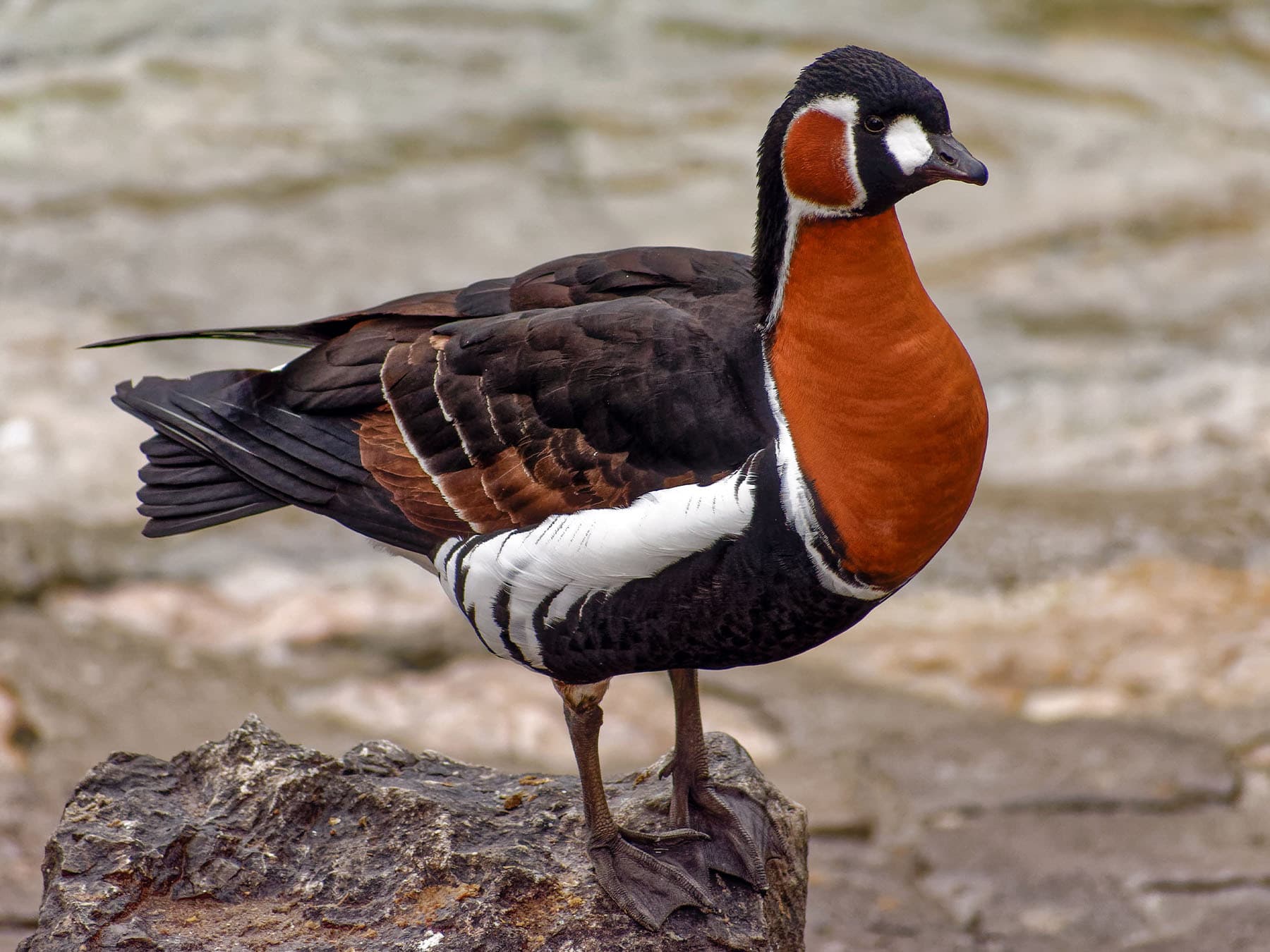
Red-breasted Goose
Red-breasted Brent Goose · Branta ruficollis
By the Birdfact teamChecked by Nathan Cope
On this page11 sections
How to recognise it
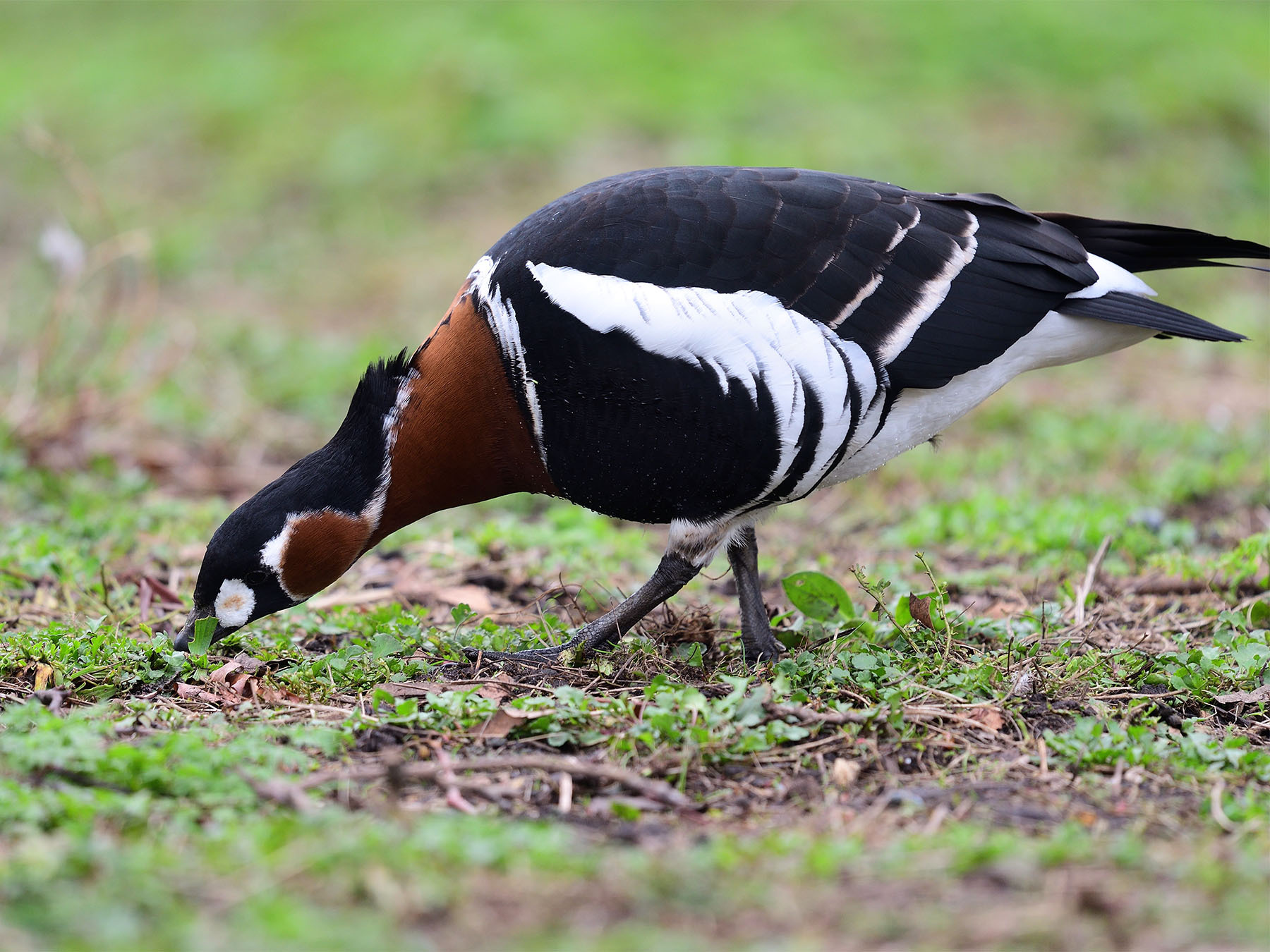
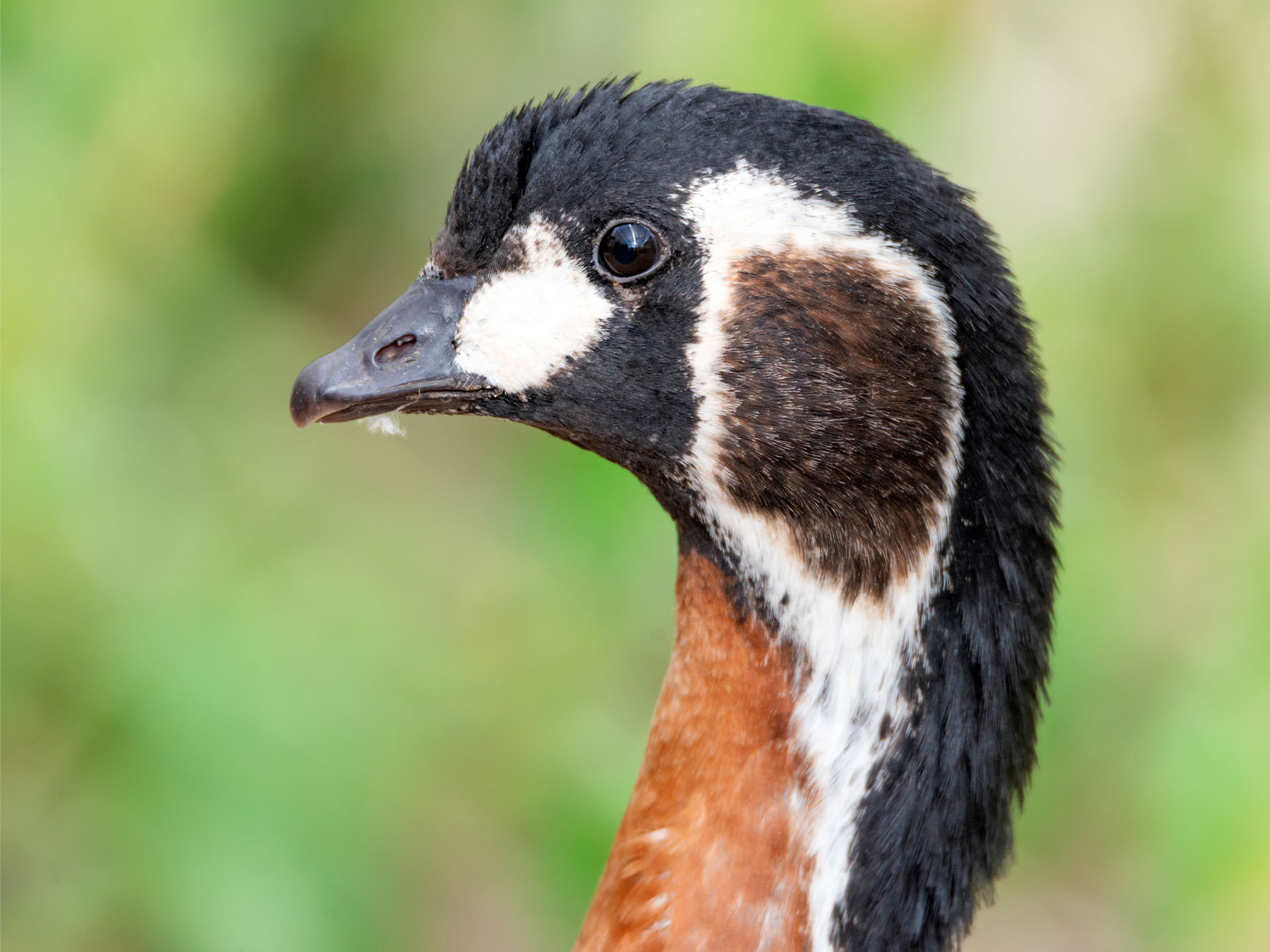
The Red-breasted Goose is a striking bird with a distinctive black head, neck, and back contrasting sharply with its bright chestnut-red breast, foreneck and head-sides. White patches on the face and a white stripe along the flanks add to its unique appearance.
Both sexes look similar, although the forehead of the male rises more vertically from the top of the bill than the female. Juveniles have duller colouration, with less barring on the flanks. The plumage remains consistent throughout the year, with no significant seasonal changes.
Its size
Adults- Length
- 53–56 cm
- Wingspan
- 116–135 cm
- Weight
- 1000–1500 g
Its song and calls
The Red-breasted Goose has a distinctive, high-pitched call often described as a rapid 'kik-kik' or 'ki-kui'.
During flight, they produce a chorus of yelping sounds, creating a cacophony that's particularly noticeable when large flocks are on the move.
- Song0:00 / 0:10
Recorded in Genève, Switzerland · January 2022
- Call0:00 / 0:35
Recorded in Genève, Switzerland · April 2023
When and where to see it
OctoberIn season
Most recorded in October
- 1. Argyll and Buteunder 0.1%
- 2. Northumberlandunder 0.1%
- 3. Lincolnshireunder 0.1%
- 4. East Sussexunder 0.1%
Each dot is a county, state or province: the bigger and darker, the larger the bird’s share of that place’s bird records that month. Grey dots: no regular records. The ringed point is the centre of the bird’s records this month; the arrow shows how it moved since last month, and the dashed loop its path through the year. “Arrivals” colours places where it becomes regular this month (orange) or is in its last regular month (grey). GBIF eBird Observation Dataset, 2019–2024. Map data: Natural Earth, US Census Bureau; place centres © OpenStreetMap contributors.
In your area
See when the Red-breasted Goose is recorded in your county, state or province.
How often the Red-breasted Goose turns up in the UK through the year, from birdwatchers' records.
United Kingdom
Winter visitor · regularly Sep–Jun · most records in February
Show as a table
| Month | United Kingdom |
|---|---|
| January | 0.008% (regular) |
| February | 0.014% (regular) |
| March | 0.004% (regular) |
| April | 0.005% (regular) |
| May | 0.003% (regular) |
| June | 0.001% (regular) |
| July | <0.001% |
| August | <0.001% |
| September | 0.004% (regular) |
| October | 0.002% (regular) |
| November | 0.004% (regular) |
| December | 0.005% (regular) |
Recorded regularly in
Worldwide: recorded regularly in 28 countries
Countries where it was recorded in at least 3 of the 6 years 2019–2024. Linked countries have their own bird list.
Data: EOD – eBird Observation Dataset (Cornell Lab of Ornithology), accessed via GBIF.org, CC BY 4.0. Records from 2019–2024, aggregated and filtered by Birdfact. How these lists are made
Tips for seeing it
- Look for them in coastal areas and wetlands during winter in the UK
- Observe large flocks of geese for their distinctive red and black colouration
- Listen for their high-pitched, yelping calls
- Visit nature reserves in eastern England, where they occasionally appear
What it eats
Red-breasted Geese primarily feed on grasses, sedges, and other vegetation. During the breeding season, they consume Arctic plants like cotton grass.
In winter, they often graze on agricultural fields, particularly winter wheat and other cereal crops.
Nesting and breeding
Red-breasted Geese form monogamous pairs, often reuniting in successive breeding seasons. They typically breed from late May to early July in the Arctic tundra.
Nests are built on cliff ledges or elevated areas near water, often close to Peregrine Falcon or Rough-legged Buzzard nests for added protection. The female lays 3-7 cream-coloured eggs with a greenish tinge in a shallow depression lined with down.
Incubation lasts about 25 days, performed solely by the female while the male stands guard. Goslings fledge after approximately 35-40 days.
Behaviour
Red-breasted Geese are highly social, often seen in large flocks during migration and winter. They exhibit strong pair bonds and family groups.
These geese are primarily grazers, feeding on short grass and sedges in tundra and agricultural fields.
Conservation
The Red-breasted Goose faces threats from habitat loss, hunting, and climate change.
Conservation efforts focus on protecting key breeding and wintering sites, as well as working with local communities to reduce hunting pressure and promote sustainable land use practices.
More photos
3 photos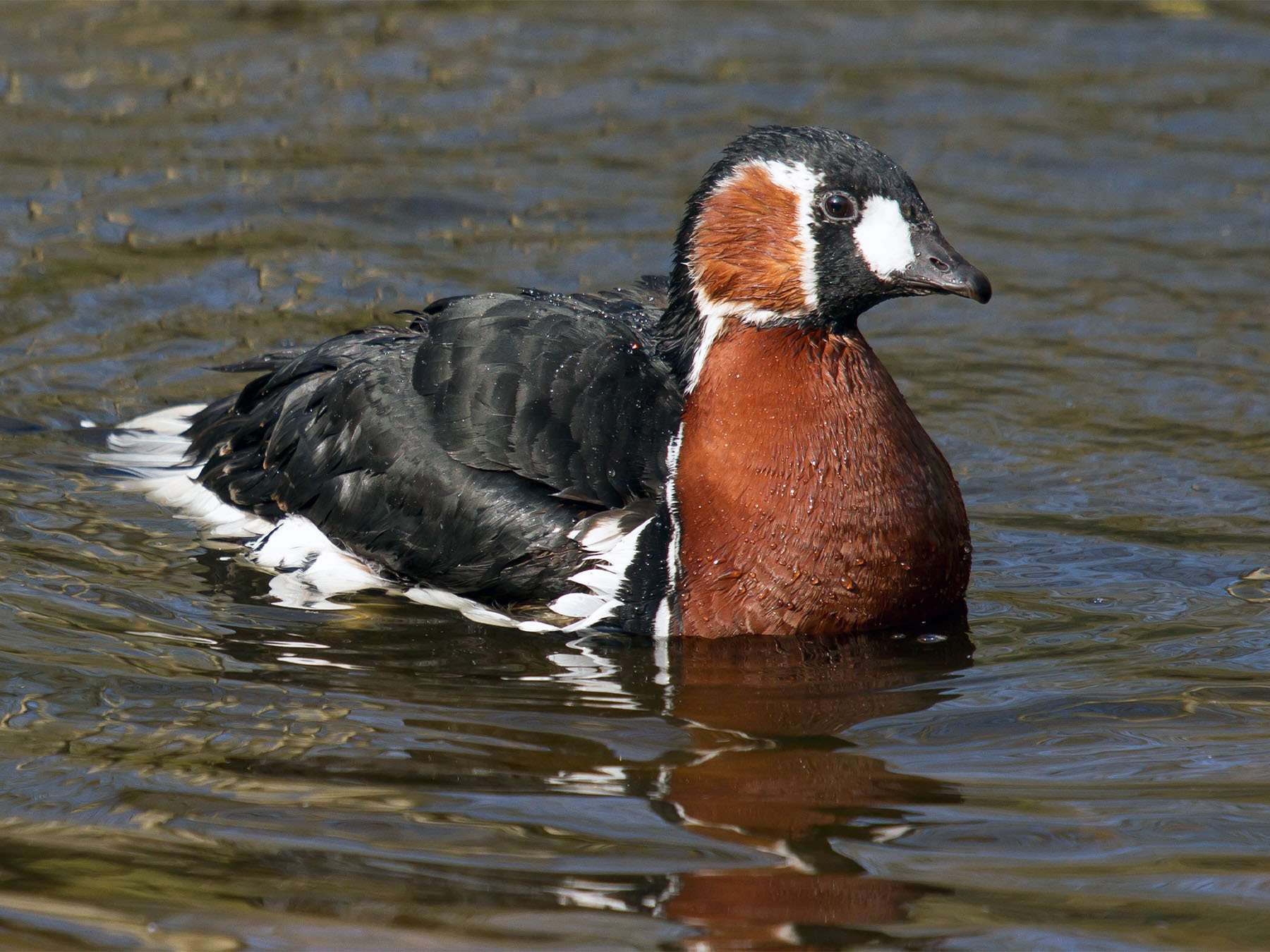
Quick facts
- Length
- 53–56 cm
- Wingspan
- 116–135 cm
- Weight
- 1000–1500 g
- Lifespan
- 10–15 years · oldest recorded 25 years
- Family
- Ducks, Geese & Swans
- Migration
- Long-distance Migrant
- Global status (IUCN)
- Vulnerable
- World population
- 44,000 to 56,000 mature individuals
- Population trend
- Decreasing
- Also called
- Red-breasted Brent Goose
- Scientific name
- Branta ruficollis
Sources
4- 1Bulgarian Society for the Protection of Birds (2013) Source (opens in a new tab)
- 2BirdLife International. 2017. Branta ruficollis (amended version of 2017 assessment). The IUCN Red List of Threatened Species 2017: e.T22679954A118577901. Source (opens in a new tab)
- 3BirdLife International. 2017. Branta ruficollis (amended version of 2017 assessment). The IUCN Red List of Threatened Species 2017: e.T22679954A118577901. Source (opens in a new tab)
- 4Wetlands International (2015)

Checked by
Nathan Cope, founder and editor
Nathan founded Birdfact and leads its writers and contributors in the UK, the US and Canada. He has watched and studied birds for more than ten years, and checks every article and species guide before it’s published.