


Red-and-yellow Barbet
Trachyphonus erythrocephalus
By the Birdfact teamChecked by Nathan Cope
On this page11 sections
How to recognise it
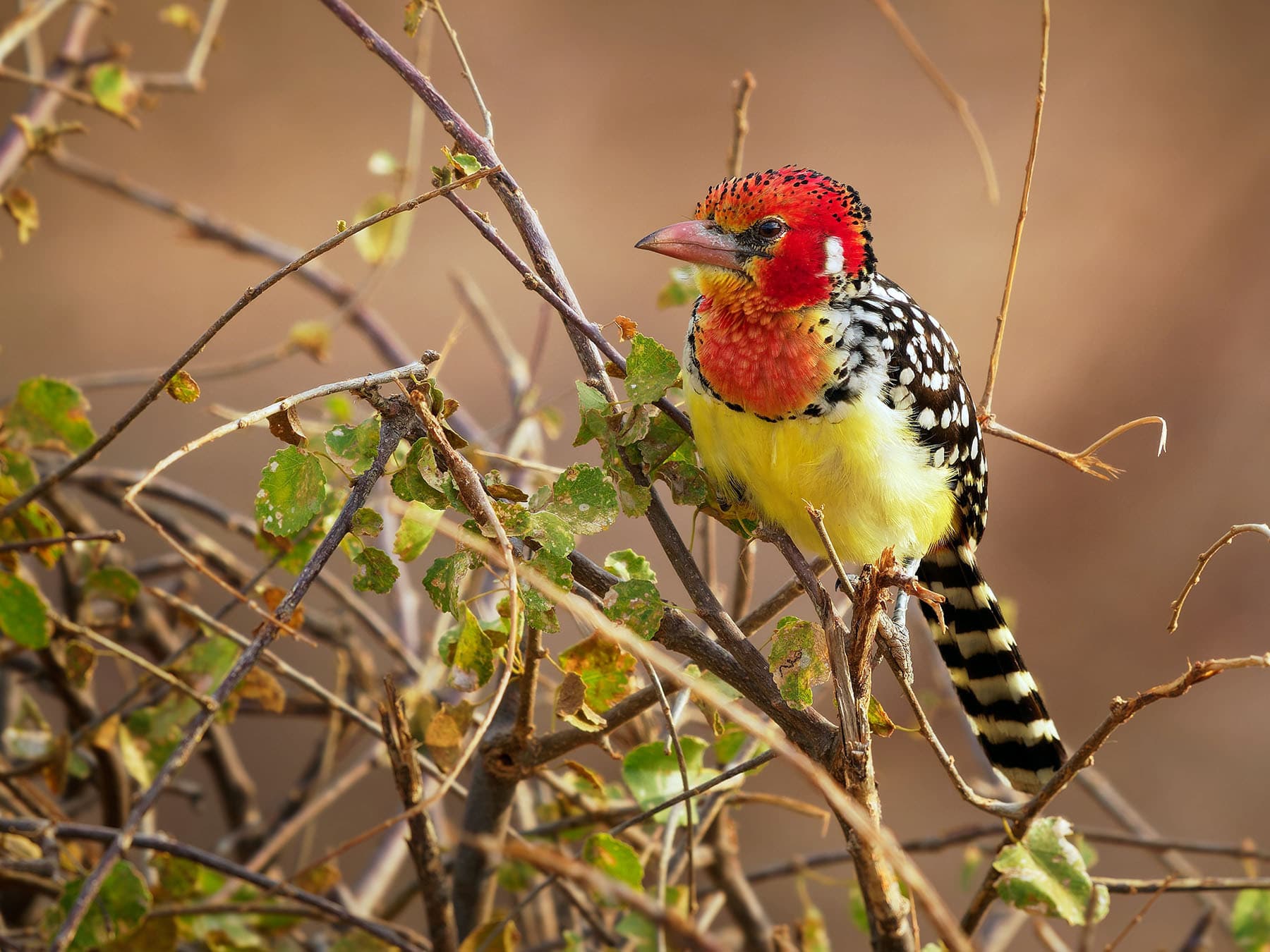
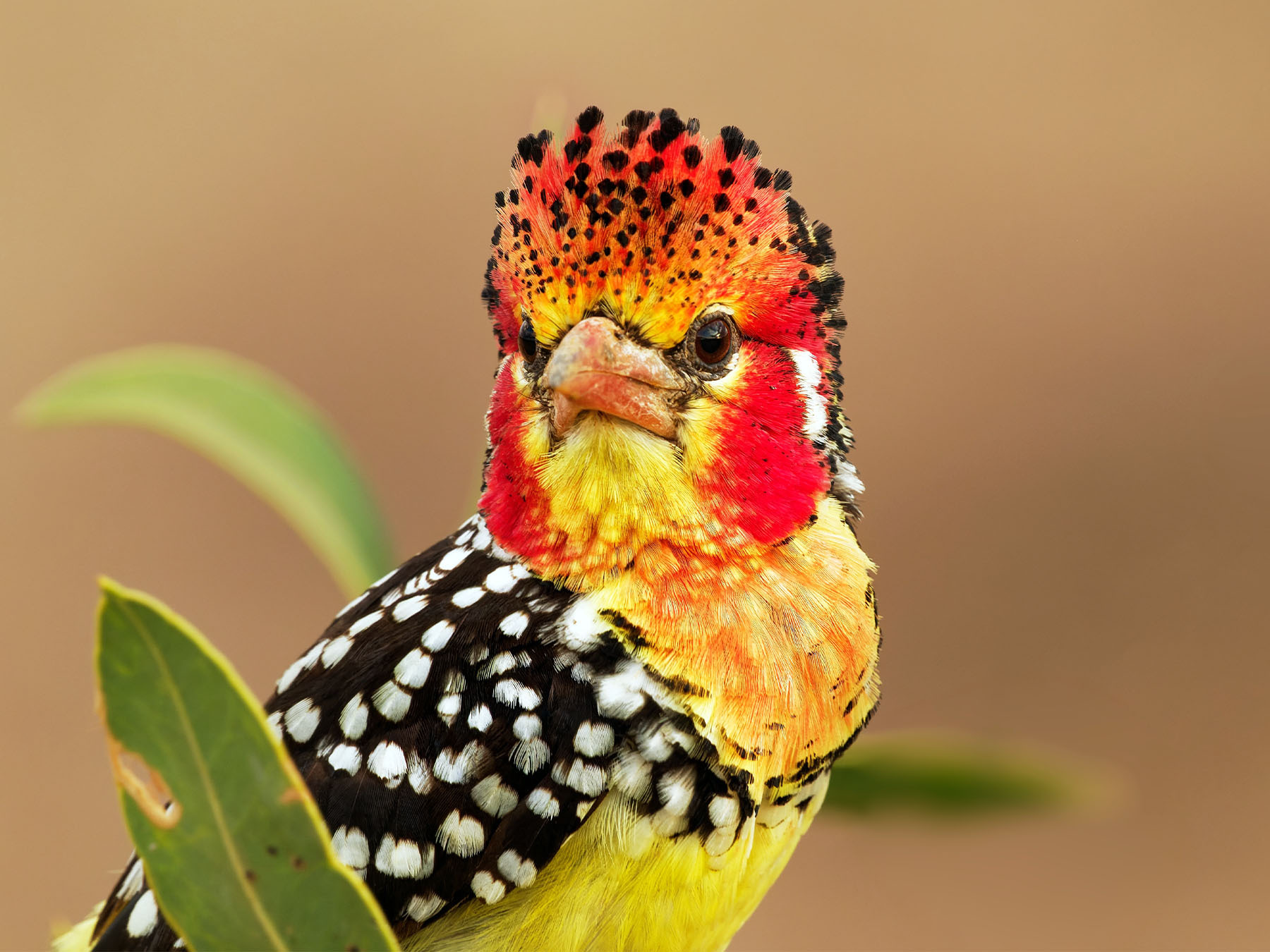
The Red-and-yellow Barbet is a striking bird with a vibrant red head and neck, contrasting with its bright yellow underparts. Its back is mottled black and white, creating a distinctive pattern. Their long, pointed bill is orange or red and is well-suited for its feeding habits.
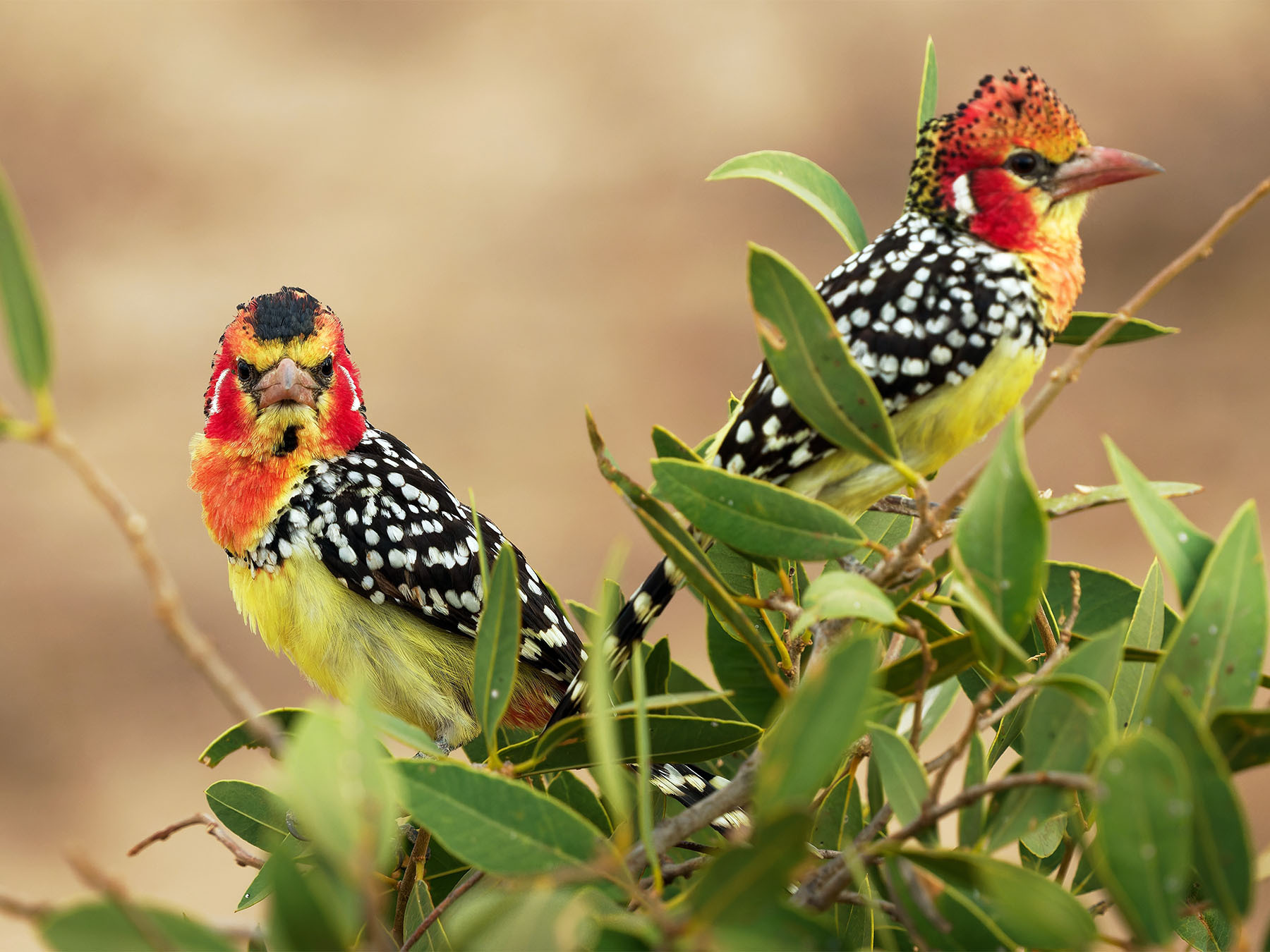
Males have a black cap and throat, with females showing red-yellow on the crown instead. Juveniles have duller colouration, with less pronounced red on the head and neck, as well as more yellow and brown colouring.
Its size
Adults- Length
- 20–23 cm
- Wingspan
- 30–35 cm
- Weight
- 40–75 g
Its song and calls
The Red-and-yellow Barbet has a distinctive call described as a loud, repetitive 'poo-poo-poo' or 'woop-woop-woop'. This vocalisation is often heard in duets between pairs.
Their drumming on branches produces a resonant 'tok-tok-tok' sound, which serves as both a territorial signal and a form of communication.
- Song0:00 / 0:33
When and where to see it
The Red-and-yellow Barbet is not recorded regularly in the UK, Ireland, the United States or Canada.
Worldwide: recorded regularly in 5 countries
Countries where it was recorded in at least 3 of the 6 years 2019–2024. Linked countries have their own bird list.
Data: EOD – eBird Observation Dataset (Cornell Lab of Ornithology), accessed via GBIF.org, CC BY 4.0. Records from 2019–2024, aggregated and filtered by Birdfact. How these lists are made
Tips for seeing it
- Look for these birds in open woodlands and savannahs with scattered trees.
- Listen for their distinctive drumming sound on branches.
- Observe fruiting trees, where they often feed in small groups.
- Watch for their acrobatic movements as they forage for insects and fruits.
What it eats
Red-and-yellow Barbets have a varied diet consisting of fruits, insects, and small vertebrates. They are particularly fond of figs and other soft fruits.
These birds use their strong bills to probe bark for insects and have been observed catching flying termites during their nuptial flights.
Nesting and breeding
Red-and-yellow Barbets form monogamous pairs and breed during the rainy season, which varies across their range. They are cavity nesters, often excavating their nests in dead trees or termite mounds.
The female typically lays 2-6 white eggs in the nest cavity. Both parents share incubation duties, which last about 13-15 days.
After hatching, the chicks remain in the nest for approximately 31 days before fledging. Parents continue to feed and care for the young for several weeks after they leave the nest.
Behaviour
Red-and-yellow Barbets are social birds, often seen in small groups or pairs. They have a unique habit of drumming on tree branches with their beaks, creating a resonant sound that serves as a form of communication.
These birds are also known for their acrobatic feeding behaviour, often hanging upside down to reach fruits and insects.
Conservation
While the Red-and-yellow Barbet is currently listed as Least Concern, habitat loss due to agricultural expansion and deforestation poses a potential threat.
Conservation efforts focus on preserving its savanna and woodland habitats across its range in East Africa.
More photos
3 photos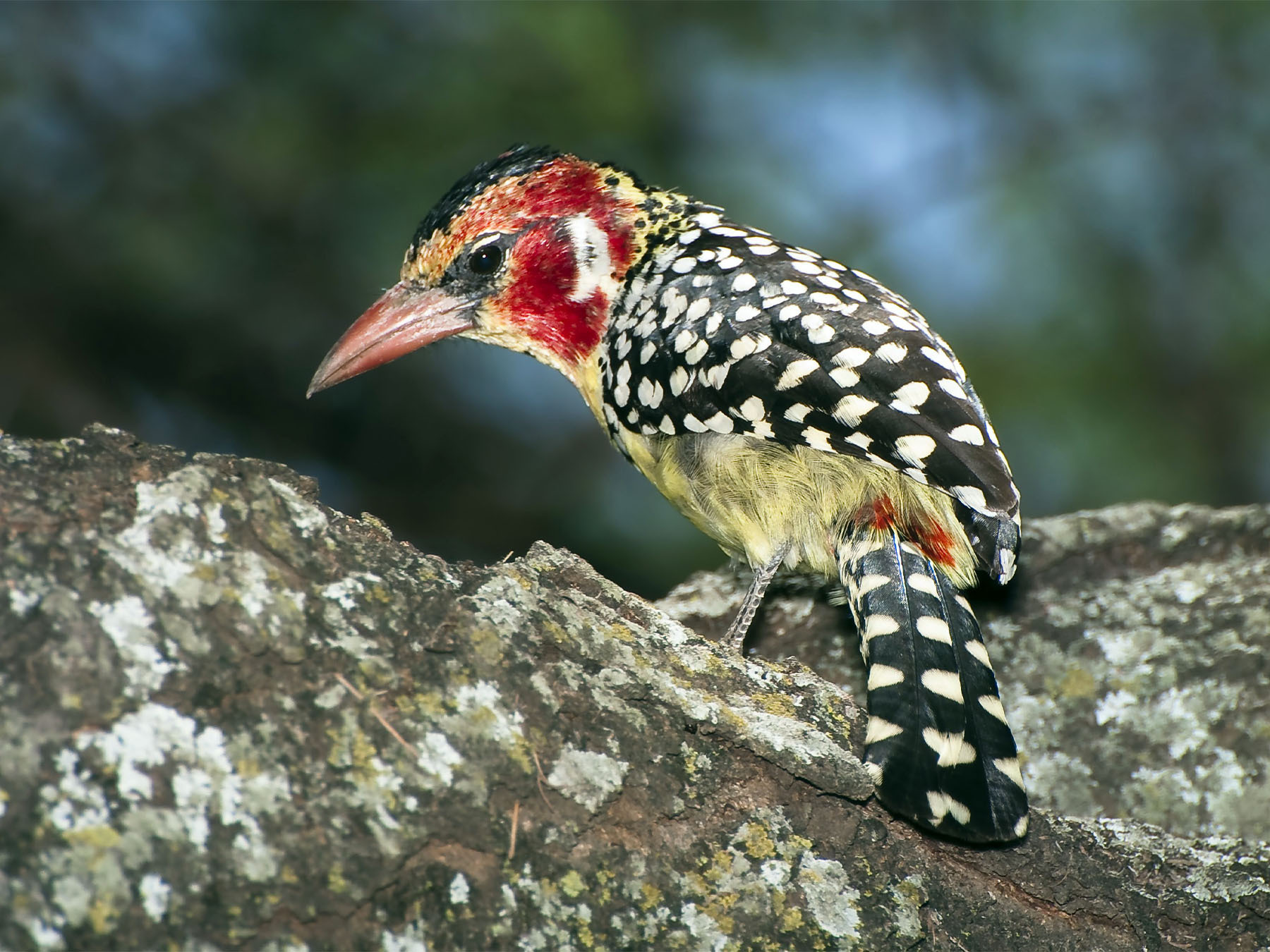
Quick facts
- Length
- 20–23 cm
- Wingspan
- 30–35 cm
- Weight
- 40–75 g
- Lifespan
- 3 years
- Family
- African Barbets
- Migration
- Resident
- Global status (IUCN)
- Least Concern
- World population
- Not quantified, but generally common throughout its range
- Population trend
- Stable
- Scientific name
- Trachyphonus erythrocephalus
Sources
3- 1BirdLife International. 2024. Trachyphonus erythrocephalus. The IUCN Red List of Threatened Species 2024: e.T22681889A263599187. Source (opens in a new tab)
- 2BirdLife International. 2024. Trachyphonus erythrocephalus. The IUCN Red List of Threatened Species 2024: e.T22681889A263599187. Source (opens in a new tab)
- 3del Hoyo et al. (2002)

Checked by
Nathan Cope, founder and editor
Nathan founded Birdfact and leads its writers and contributors in the UK, the US and Canada. He has watched and studied birds for more than ten years, and checks every article and species guide before it’s published.