


Purple Heron
Eastern Purple Heron · Ardea purpurea
By the Birdfact teamChecked by Nathan Cope
On this page14 sections
How to recognise it
What do Purple Herons look like?
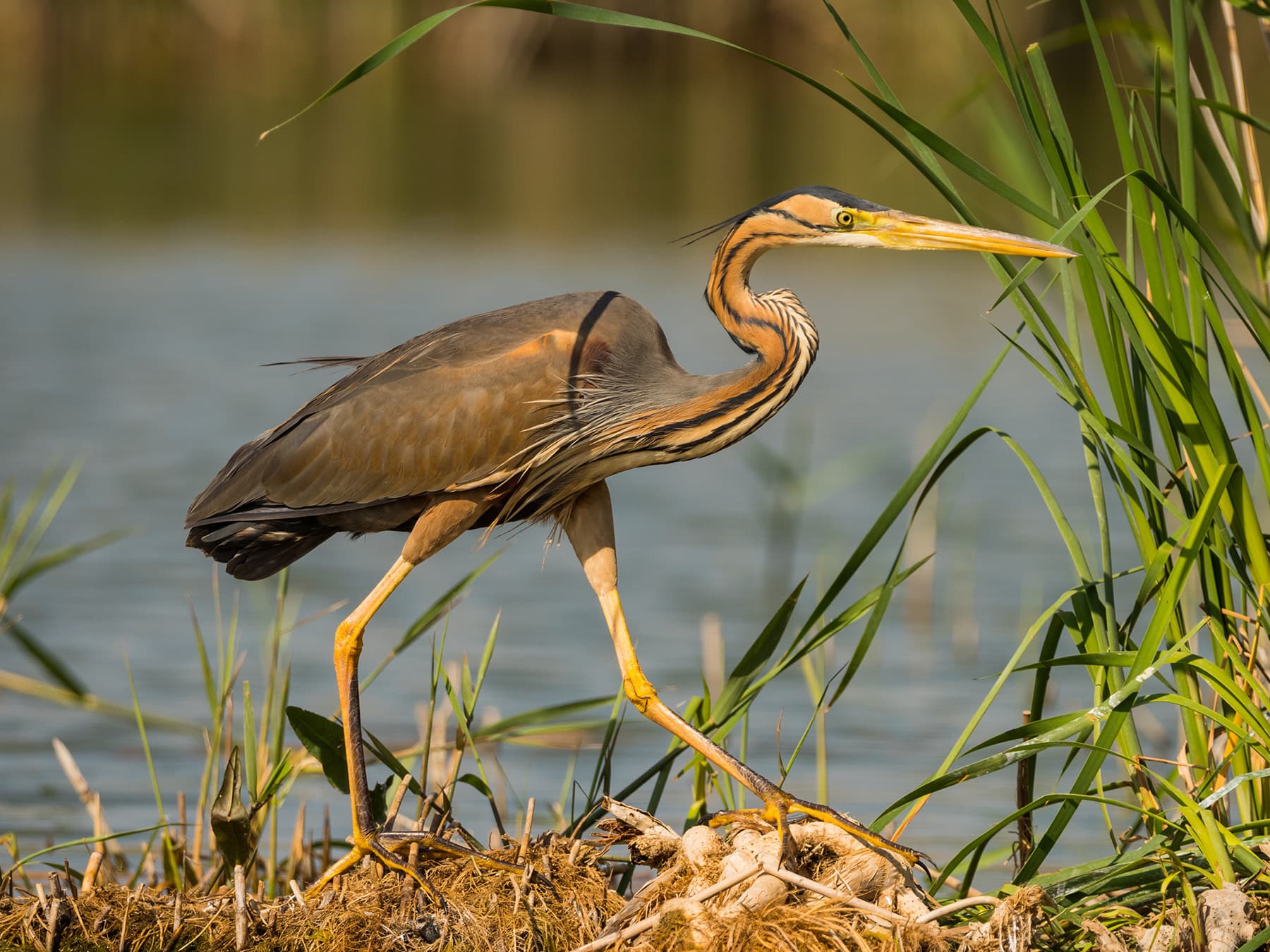
Purple herons are similar in stature to the more commonly spotted grey heron, although obvious differences are immediately visible between the two species.
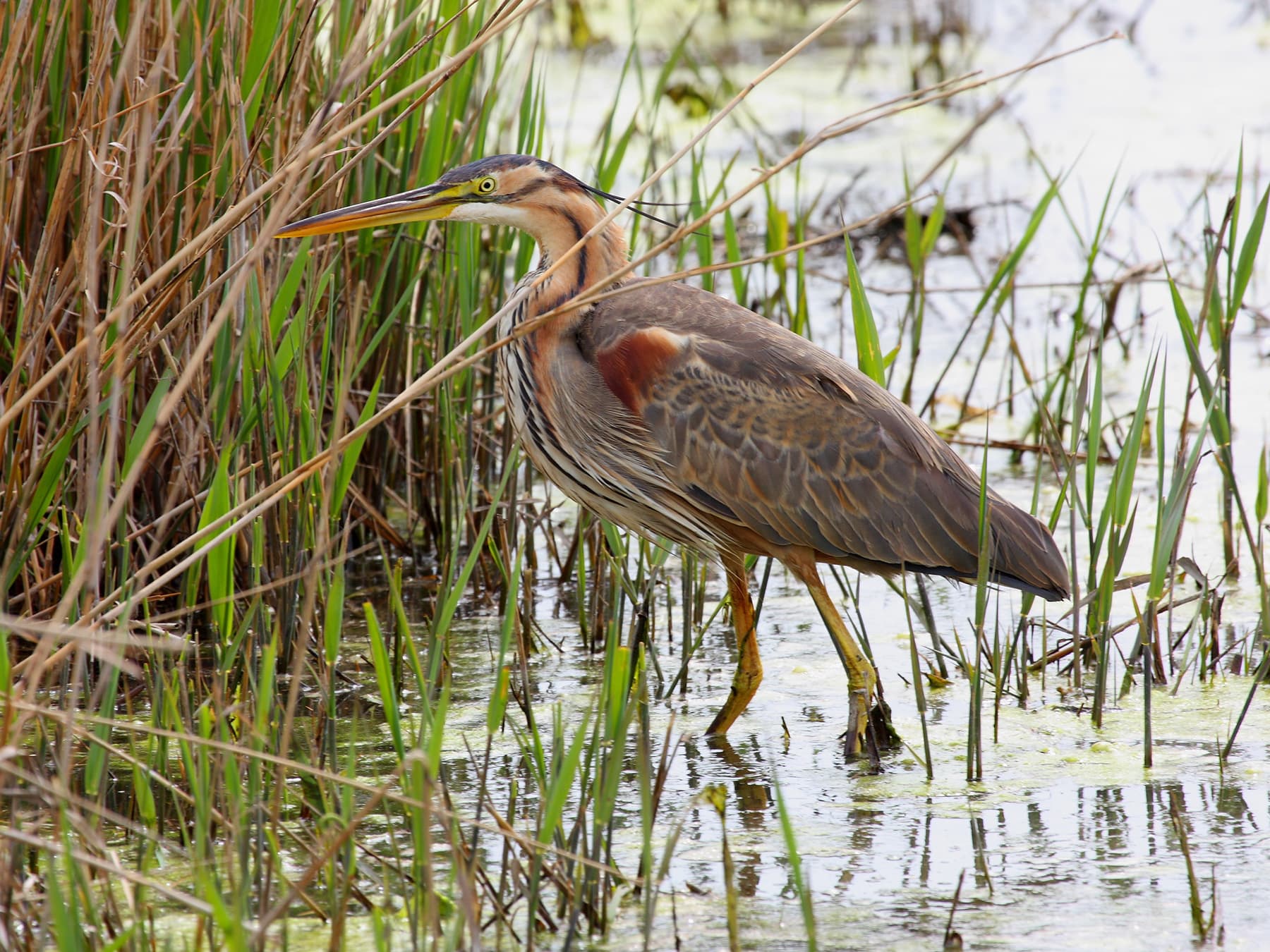
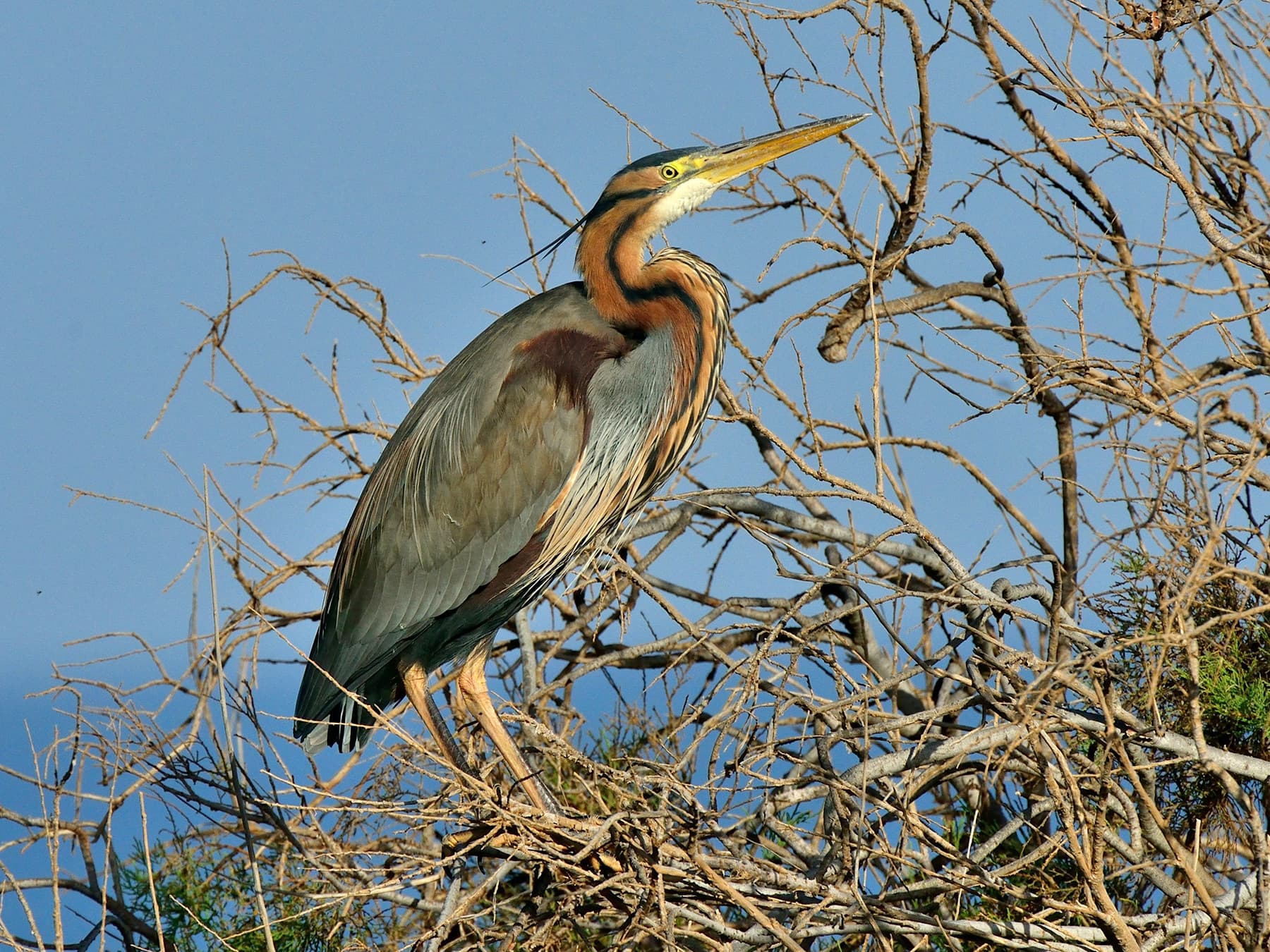
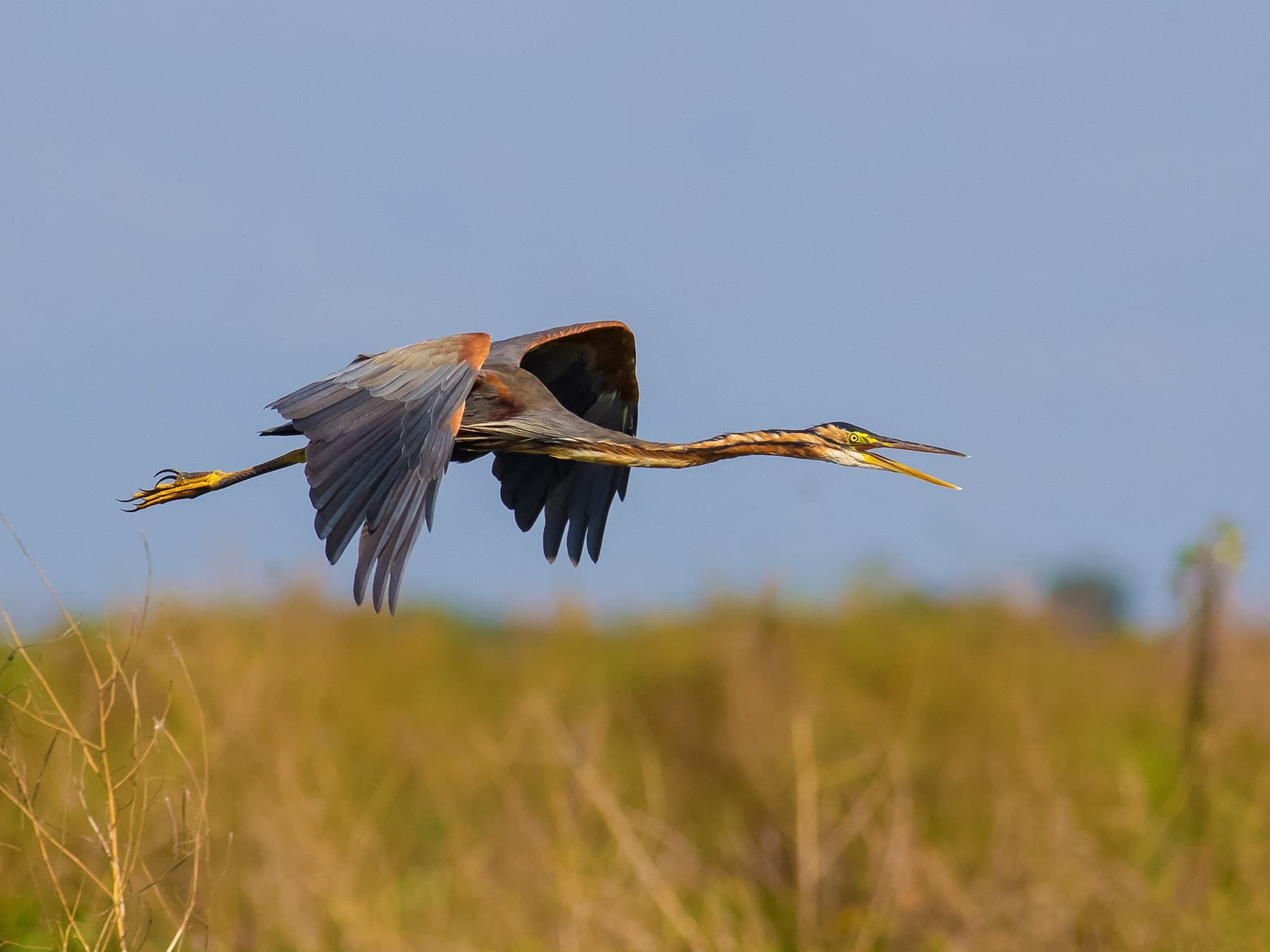
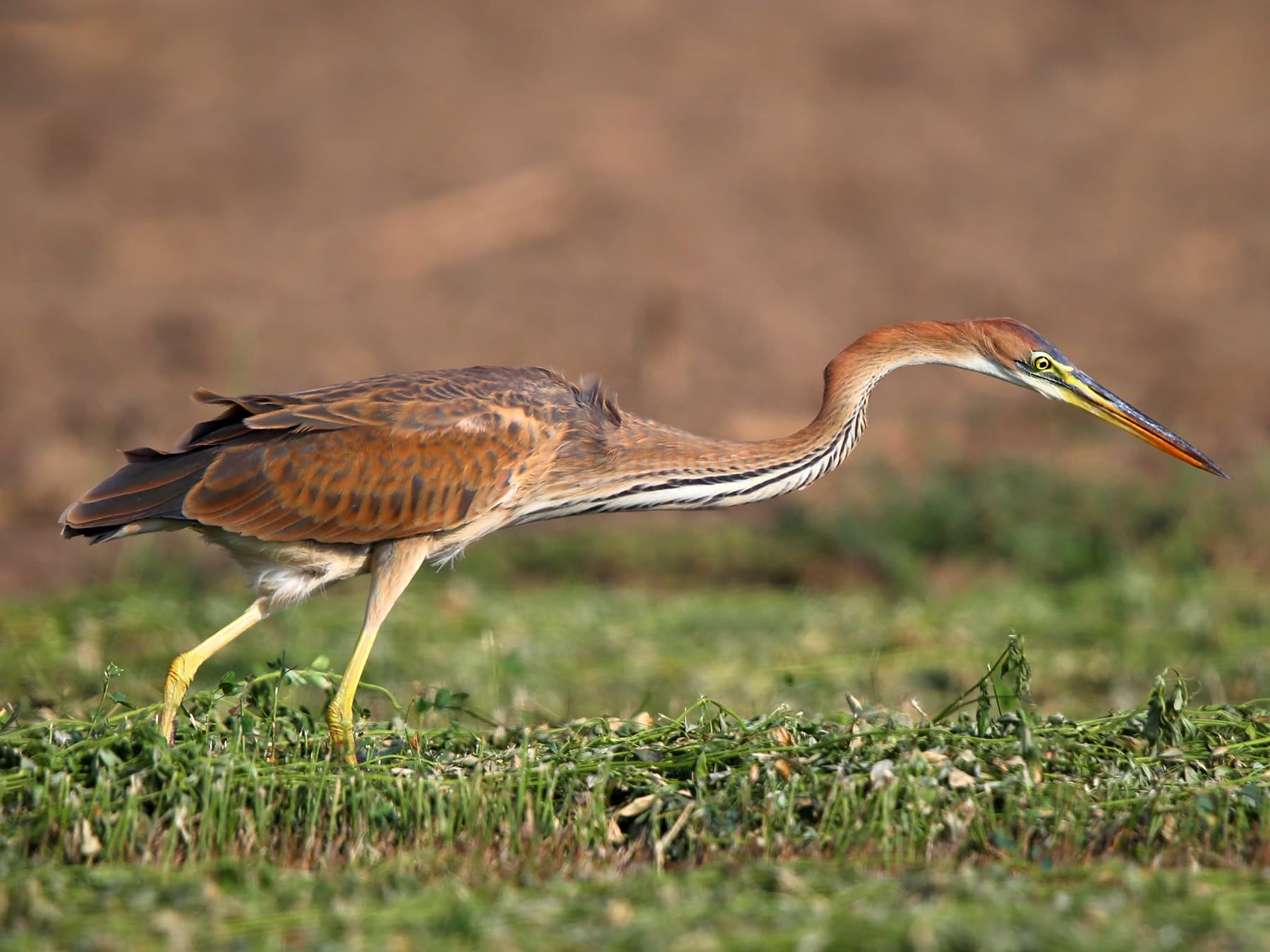
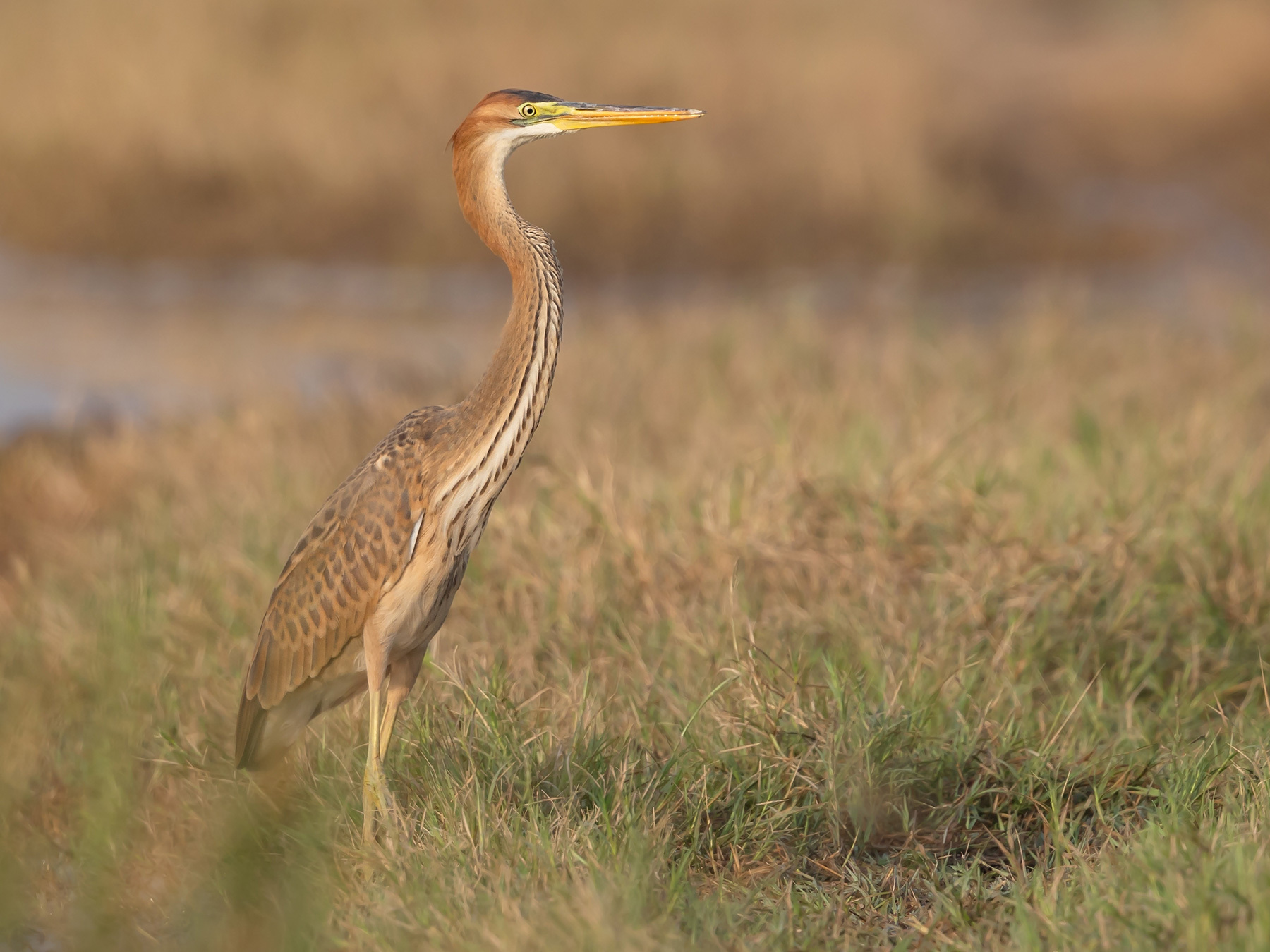
An elongated, slim heron species, the purple heron has a narrow body and streamlined long, thin neck. Despite their name, a purple heron’s plumage is more of a dark grey colour than any real bold mauves or violet hues, with an orange-chestnut head and neck, and a rich chestnut breast. A deep red shoulder patch is visible on its upper wings, and its dusky grey wing edges are tipped with black.
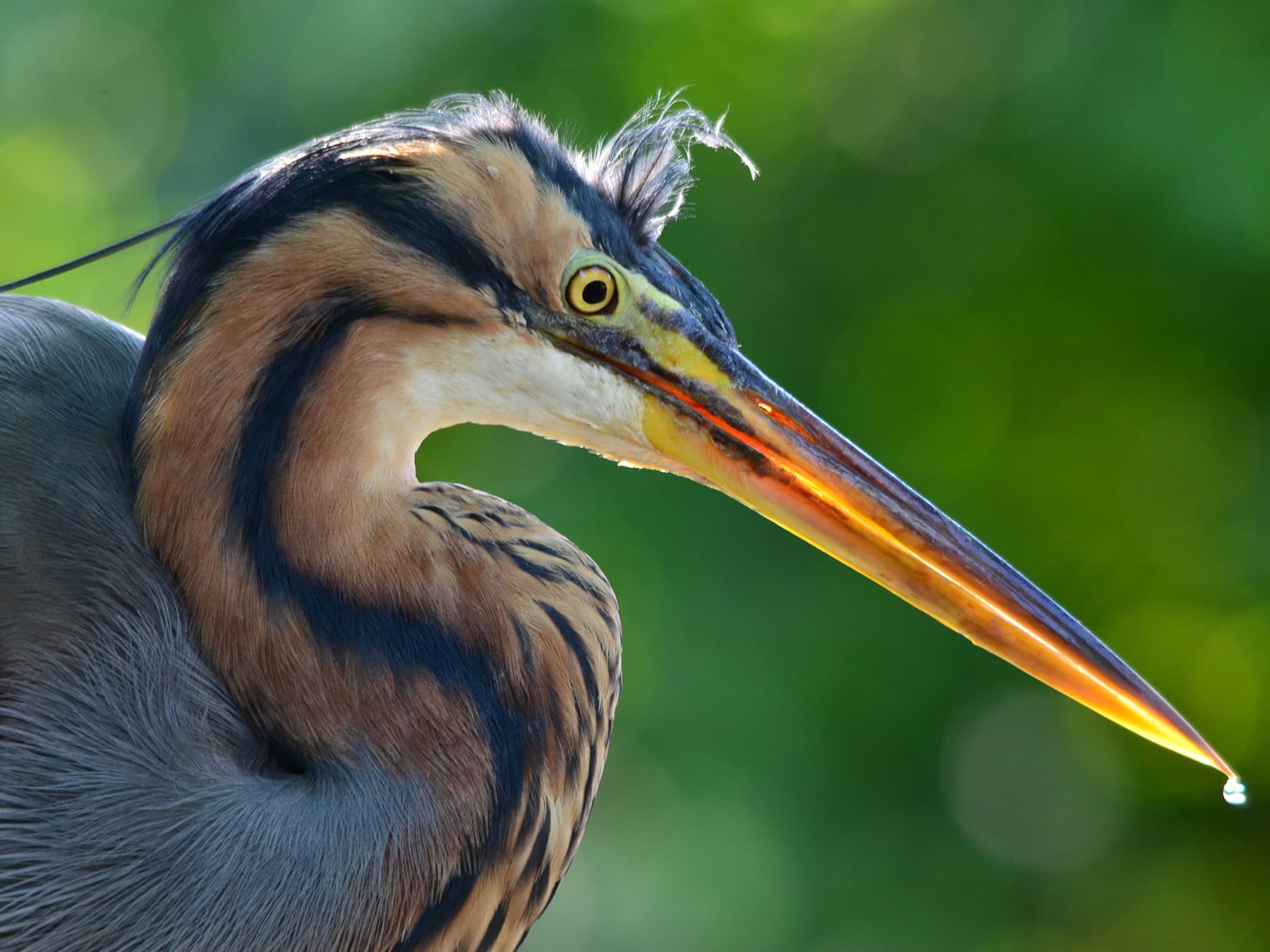
The purple heron’s crown is black, with a 15-cm (6-in) long plume on each side of the head. A thin black stripe runs down each side of the neck from the eye to the belly, which is striped with chestnut and black.
The yellow bill of a purple heron is slightly longer than the bill of other members of the heron family. Their legs and irises of adult birds are also yellowish-green, although legs appear to darken to an orange-red shade during the breeding season.
Female purple herons are smaller, lighter and paler in colour than males, with more of an olive-grey appearance to their back and wings, and buff-pinkish upper wings rather than the glossy red patch seen on males.
Juvenile purple herons are lighter in colour than adults, with mainly brown upperparts with buff edging visible on their feathers. Their underparts are buff, and their breasts are streaked with dark brown. Young purple herons have a black crown with a short crest and lack the facial stripes seen in adult birds.
Its size
Adults- Length
- 78–90 cm
- Wingspan
- 120–150 cm
- Weight
- 500–1400 g
Its song and calls
What sound does a Purple Heron make?
Largely less vocal than the closely related grey heron, purple herons’ calls include a high-pitched ‘frank’ call, heard in flight and a louder ‘quark’ cry to signal alarm or distress.

- Flight call0:00 / 0:25
Recorded in Bretagne, France · July 2025
When and where to see it
OctoberIn season
Most recorded in October
- 1. Gloucestershireunder 0.1%
- 2. West Sussexunder 0.1%
- 3. Shropshireunder 0.1%
- 4. Cornwallunder 0.1%
- 5. Lancashireunder 0.1%
Each dot is a county, state or province: the bigger and darker, the larger the bird’s share of that place’s bird records that month. Grey dots: no regular records. The ringed point is the centre of the bird’s records this month; the arrow shows how it moved since last month, and the dashed loop its path through the year. “Arrivals” colours places where it becomes regular this month (orange) or is in its last regular month (grey). GBIF eBird Observation Dataset, 2019–2024. Map data: Natural Earth, US Census Bureau; place centres © OpenStreetMap contributors.
In your area
See when the Purple Heron is recorded in your county, state or province.
How often the Purple Heron turns up in the UK and Ireland through the year, from birdwatchers' records.
United Kingdom
Summer visitor · regularly Apr–Nov · most records in May
Ireland
Passage migrant · regularly Jun · most records in April
Show as a table
| Month | United Kingdom | Ireland |
|---|---|---|
| January | <0.001% | – |
| February | <0.001% | – |
| March | – | – |
| April | 0.003% (regular) | 0.008% |
| May | 0.007% (regular) | 0.002% |
| June | 0.004% (regular) | 0.006% (regular) |
| July | 0.002% (regular) | – |
| August | 0.004% (regular) | – |
| September | 0.003% (regular) | – |
| October | 0.003% (regular) | – |
| November | <0.001% (regular) | – |
| December | <0.001% | – |
Recorded regularly in
Worldwide: recorded regularly in 116 countries
Countries where it was recorded in at least 3 of the 6 years 2019–2024. Linked countries have their own bird list.
Europe (31)
- Albania
- Austria
- Belgium
- Bosnia & Herzegovina
- Bulgaria
- Croatia
- Czechia
- France
- Germany
- Greece
- Hungary
- Ireland
- Italy
- Kosovo
- Luxembourg
- Malta
- Moldova
- Montenegro
- Netherlands
- North Macedonia
- Poland
- Portugal
- Romania
- Russia
- Serbia
- Slovakia
- Slovenia
- Spain
- Switzerland
- Ukraine
- United Kingdom
Africa (43)
- Algeria
- Angola
- Benin
- Botswana
- Burkina Faso
- Burundi
- Cameroon
- Cape Verde
- Chad
- Congo - Brazzaville
- Congo - Kinshasa
- Côte d’Ivoire
- Djibouti
- Egypt
- Eswatini
- Ethiopia
- Gabon
- Gambia
- Ghana
- Guinea
- Guinea-Bissau
- Kenya
- Liberia
- Madagascar
- Malawi
- Mauritania
- Morocco
- Mozambique
- Namibia
- Nigeria
- Rwanda
- Senegal
- Seychelles
- Sierra Leone
- South Africa
- South Sudan
- Sudan
- Tanzania
- Togo
- Tunisia
- Uganda
- Zambia
- Zimbabwe
Asia (42)
- Armenia
- Azerbaijan
- Bahrain
- Bangladesh
- Brunei
- Cambodia
- China
- Cyprus
- Georgia
- Hong Kong SAR China
- India
- Indonesia
- Iran
- Iraq
- Israel
- Japan
- Jordan
- Kazakhstan
- Kuwait
- Laos
- Lebanon
- Macao SAR China
- Malaysia
- Myanmar (Burma)
- Nepal
- Oman
- Pakistan
- Palestinian Territories
- Philippines
- Qatar
- Saudi Arabia
- Singapore
- South Korea
- Sri Lanka
- Taiwan
- Tajikistan
- Thailand
- Turkey
- United Arab Emirates
- Uzbekistan
- Vietnam
- Yemen
Data: EOD – eBird Observation Dataset (Cornell Lab of Ornithology), accessed via GBIF.org, CC BY 4.0. Records from 2019–2024, aggregated and filtered by Birdfact. How these lists are made
What is the habitat of a Purple Heron?
Preferred habitats of purple herons include shallow swamps and freshwater marshes, with dense vegetation for foraging and camouflage.
Reedbeds and papyrus offer ideal spots for nesting, although foraging sites may be located a short distance away, including rice fields, ditches, riverbanks, forest clearings and cultivated plantations.
What is the range of a Purple Heron?
Purple herons are resident all year round in southern and eastern Asia and throughout sub-Saharan Africa, although not present in Namibia.
Breeding occurs throughout central and southern Europe, with occasional reports of pairs further afield including the UK, and even as far as isolated sightings in Barbados, Trinidad and Tobago and Brazil.
Where do Purple Herons live?
Resident populations of purple herons in Africa include up to 10,000 birds in both Tanzania and Madagascar, and 1,475 in Niger.
Within its European breeding range, numbers are concentrated around the Black Sea, with an estimated 9,000 to 14,000 pairs in this region during the breeding season. Other countries with notable breeding populations include Hungary, Spain, Romania and Turkey.
How rare are Purple Herons?
Only around 20 to 30 sightings of purple herons are reported each year in the UK, and they are considered a rare vagrant species.
Breeding has been suggested but is hard to confirm. In North America, only the scarcest reports of visiting purple herons exist, with occasional mentions of individuals in the Caribbean islands of Barbados and Trinidad and Tobago.
Where can you see Purple Herons in the UK?
Purple herons are extremely rare, sporadic and unpredictable visitors to in the UK, and as they are notoriously elusive birds, no site can guarantee even the slimmest chance of a sighting.
Migration
Do Purple Herons migrate?
While many African and Asian purple heron populations are resident in their territories all year round, a substantial number arrive in Europe from African wintering grounds each spring to breed. The entire European population is migratory, with no individuals remaining beyond the end of the breeding season.
Tips for seeing it
- Look for Purple Herons in dense reedbeds and marshes
- Listen for their distinctive 'frarnk' call, especially at dawn and dusk
- Observe their slow, deliberate movements when hunting
- In the UK, visit wetland reserves in East Anglia for the best chance of spotting them
What it eats
What do Purple Herons eat?
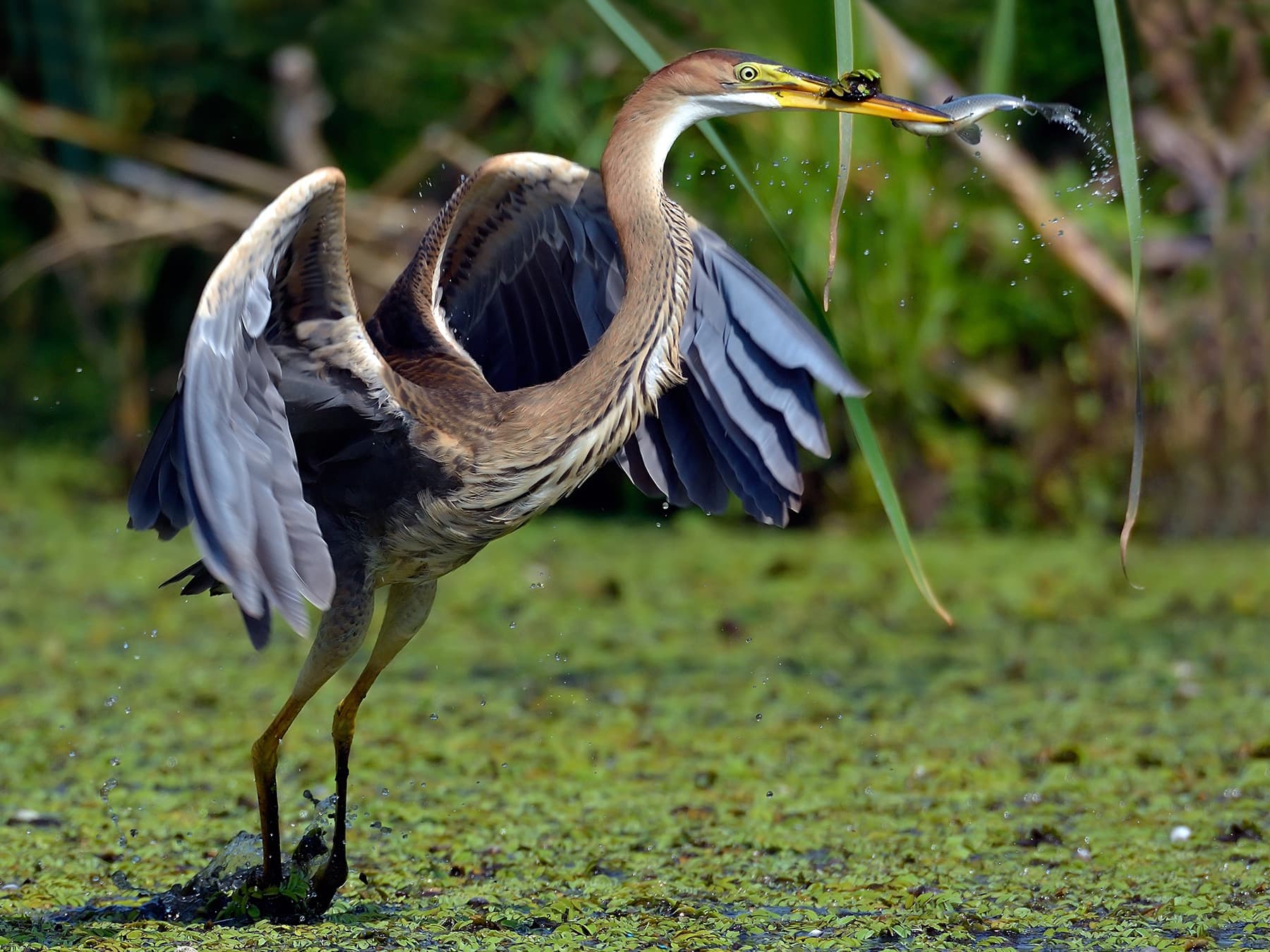
Purple herons hunt prey by stalking prey or waiting in ambush for an opportunity to jab into the water or undergrowth for fish, small rodents, amphibians, small birds and invertebrates.
They are a crepuscular species, feeding mainly at dawn and dusk and resting during the day and night.
Studies of purple herons in France over a 20-year period indicates a shift from a mainly fish-based diet to one that now consists of more insects, such as beetles, dragonflies and bugs.
What do Purple Heron chicks eat?
Young purple herons are fed regurgitated food by their parents, so their diet is ultimately the same as an adult’s and can include insects, fish, small birds, rodents, frogs and salamander.
Nesting and breeding
Where do Purple Herons nest?
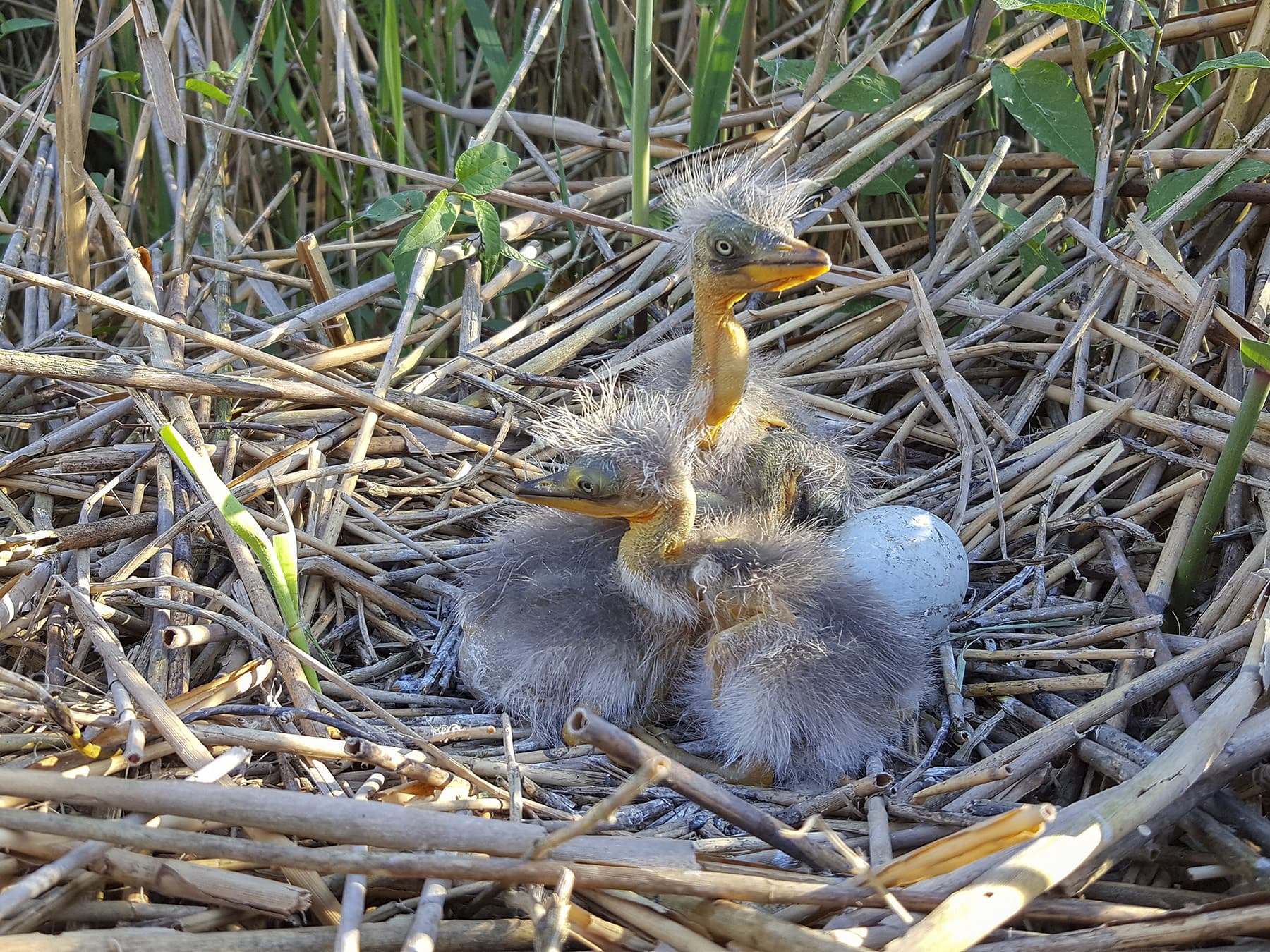
Purple herons are colonial nesters with many pairs breeding in fairly close proximity to one another. Colonies of over 100 pairs are common, and sites with up to 1,000 nests have been observed.
Nests are built in reedbeds, concealed by rushes and dense vegetation, close to the edge of the water. Purple herons’ nests are bulky constructions, made from dead reeds and other plant matter.
When do Purple Herons nest?
In Europe and north Africa, the nesting season is usually between April and June, with the peak time for eggs to be laid being between late April and mid-May.
Within this part of their range, purple herons will typically only raise one brood a year, although in parts of the world where they are year-round residents, two broods are also relatively common.
What do Purple Heron eggs look like?
Purple herons’ eggs are pale blue-green and measure 56 mm by 41 mm (2.2 in by 1.4 in). A typical clutch consists of between 2 and 8 eggs, which are incubated by both parents in turn for 25 to 30 days.
Do Purple Herons mate for life?
Although the species is mainly monogamous for the duration of a breeding season, male purple herons have been observed to raise broods with two females simultaneously.
Behaviour
Are Purple Herons aggressive?
Although they may live and breed colonially, purple herons are territorial about their feeding sites and may display aggression when competing birds arrive to attempt to forage on their patch.
Where do Purple Herons sleep at night?
Purple herons are solitary nesters spending nights alone or in small groups in the branches of trees that are frequently located a short distance away from their breeding or foraging grounds.
Lifespan and predators
How long do Purple Herons live?
The average expected lifespan for a purple heron is around 4 years, with the oldest known individual recorded claimed to be 23 years old.
What are the predators of Purple Herons?
Wetland birds of prey, including marsh harriers, are a common predator of purple heron nests, eggs and young.
Black crakes may also target purple herons’ eggs. In parts of their range, predatory mammals, such as clawless otters may also pose a threat to their nests and young.
Are Purple Herons protected?
Despite being only scarce and occasional visitors to Britain, purple herons are offered protection against being knowingly killed, injured or taken into captivity. Their additional status as Schedule 1 birds offers further protection for their eggs, nests and young against being destroyed or damaged.
Are Purple Herons endangered?
Across their global range, purple herons are considered a species of least concern, and are widespread and common across sub-Saharan Africa. Central European populations have declined due to loss of wetland habitats, although recoveries and expansions have been noted in parts of Spain, France, the Netherlands and Germany.
Conservation
While listed as Least Concern globally, Purple Herons face localised threats from habitat loss and degradation.
Wetland conservation efforts, particularly in Europe and parts of Asia, are crucial for maintaining stable populations. Climate change and water pollution also pose potential long-term risks to their habitats.
How big are Purple Herons?
Purple herons are smaller and slimmer than grey herons, but larger and longer and slimmer than bitterns. Males are significantly larger and heavier than females.
- Length: 78 cm to 90 cm (30.1 in to 35.4 in)
- Weight: Male 617 g to 1218 g (21.8 oz to 43 oz) Female 525 g to 1135 g (18.5 oz to 40 oz)
- Wingspan: 120 cm to 150 cm (47.2 in to 59 in)

More photos
3 photos

Purple Heron guides
2 guidesQuick facts
- Length
- 78–90 cm
- Wingspan
- 120–150 cm
- Weight
- 500–1400 g
- Lifespan
- 4–6 years · oldest recorded 25 years
- Family
- Herons & Egrets
- Migration
- Partial migrant
- Global status (IUCN)
- Least Concern
- World population
- 270,000 - 570,000 individuals
- Population trend
- Decreasing
- Also called
- Eastern Purple Heron
- Scientific name
- Ardea purpurea
Sources
4- 1BirdLife International. 2019. Ardea purpurea. The IUCN Red List of Threatened Species 2019: e.T22697031A154816177. Source (opens in a new tab)
- 2Wetlands International (2015)
- 3Wetlands International (2015)
- 4Fransson et al., EURING list of longevity records for European birds (2010) Source (opens in a new tab)

Checked by
Nathan Cope, founder and editor
Nathan founded Birdfact and leads its writers and contributors in the UK, the US and Canada. He has watched and studied birds for more than ten years, and checks every article and species guide before it’s published.