


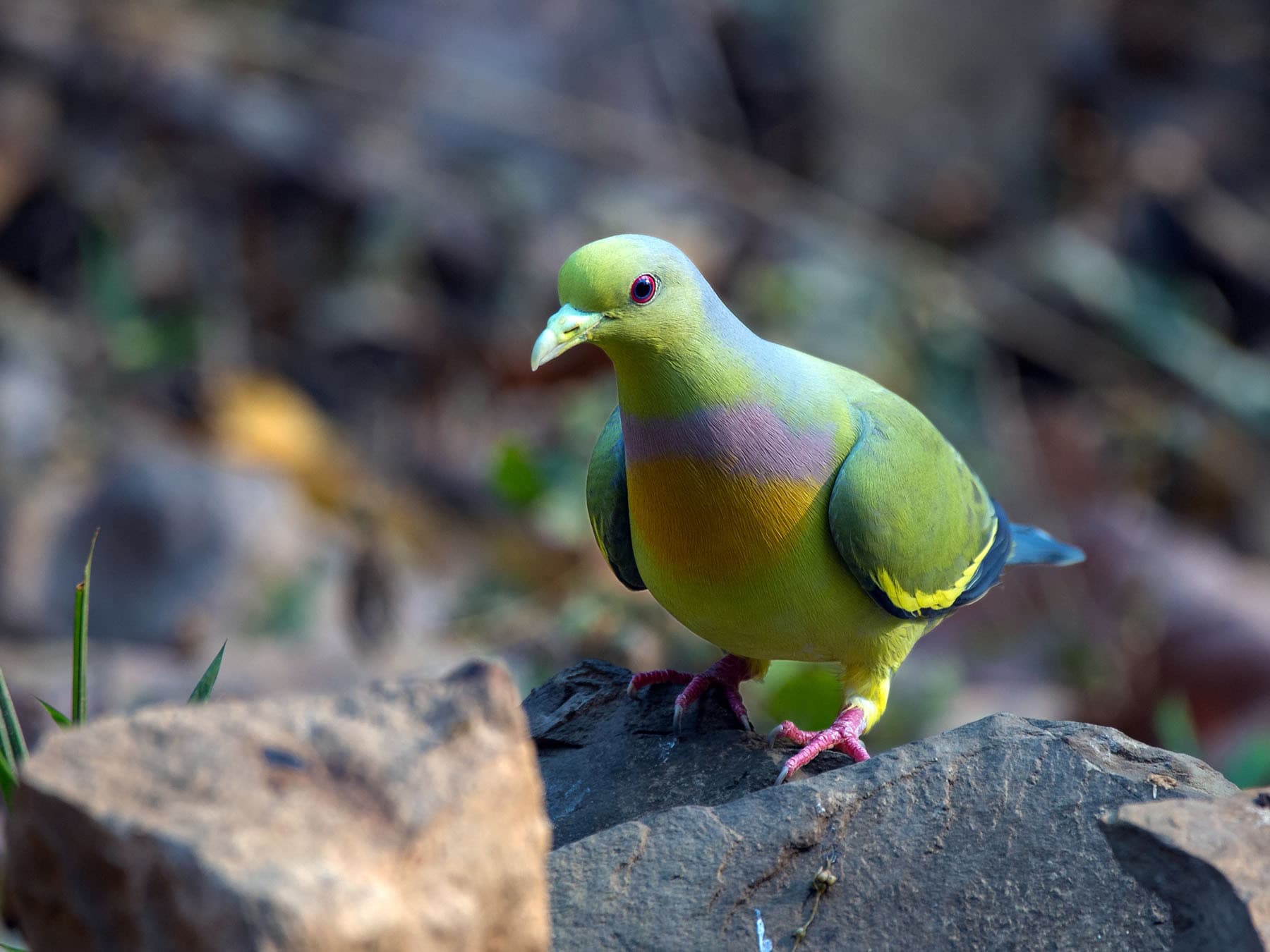
Orange-breasted Green-pigeon
Orange-breasted Fruit Dove · Treron bicinctus
By the Birdfact teamChecked by Nathan Cope
On this page11 sections
How to recognise it
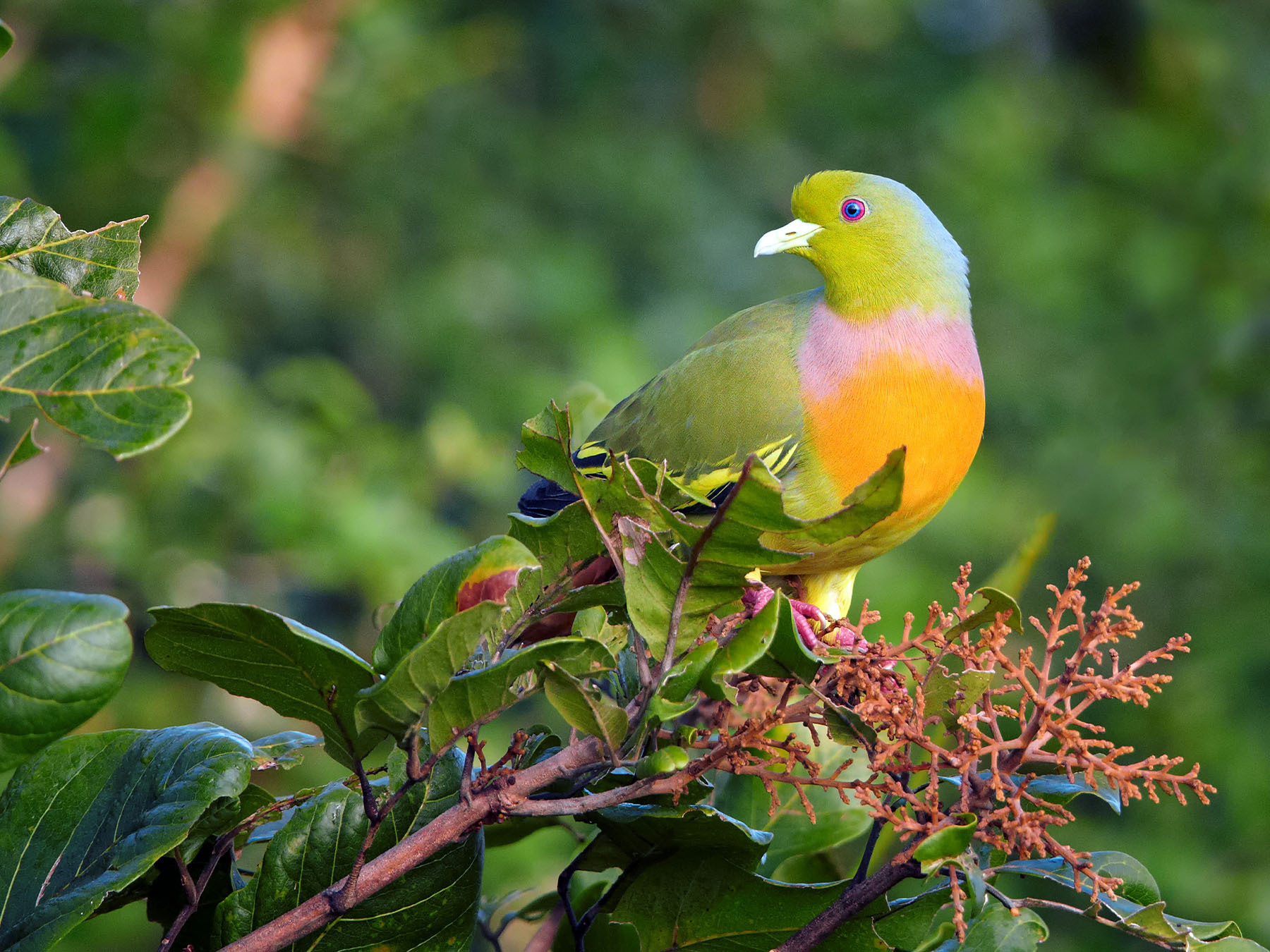
The Orange-breasted Green-pigeon is a striking bird with predominantly green plumage. Males feature a distinctive orange breast band, grey head, and yellow belly, while their wings display black and yellow patterning.
Females lack the orange breast band and have a more uniform green colouration. Both sexes have red legs and feet and a pale grey beak with a greenish or bluish base.
Its size
Adults- Length
- 25–30 cm
- Wingspan
- 45–50 cm
- Weight
- 150–200 g
Its song and calls
The Orange-breasted Green-pigeon has a soft, melodious call often described as a series of 'woo-woo' sounds.
During courtship, males produce a more elaborate cooing, sometimes accompanied by a gentle whistling note. Their calls are typically heard in the early morning or late afternoon.
When and where to see it
The Orange-breasted Green-pigeon is not recorded regularly in the UK, Ireland, the United States or Canada.
Worldwide: recorded regularly in 11 countries
Countries where it was recorded in at least 3 of the 6 years 2019–2024. Linked countries have their own bird list.
Data: EOD – eBird Observation Dataset (Cornell Lab of Ornithology), accessed via GBIF.org, CC BY 4.0. Records from 2019–2024, aggregated and filtered by Birdfact. How these lists are made
Tips for seeing it
- Look for them in fruiting trees, especially figs
- Listen for their soft, melodious calls in the early morning
- Observe their behaviour during the breeding season for courtship displays
- Use binoculars to spot their distinctive colouration high in the canopy
What it eats
The Orange-breasted Green-pigeon primarily feeds on fruits, with a particular preference for figs. They use their specialised bills to pluck and swallow fruits whole. Occasionally, they supplement their diet with buds, shoots, and small invertebrates.
Nesting and breeding
Breeding typically occurs during the dry season, with timing varying across their range. Males attract females with cooing calls and bowing displays on tree branches.
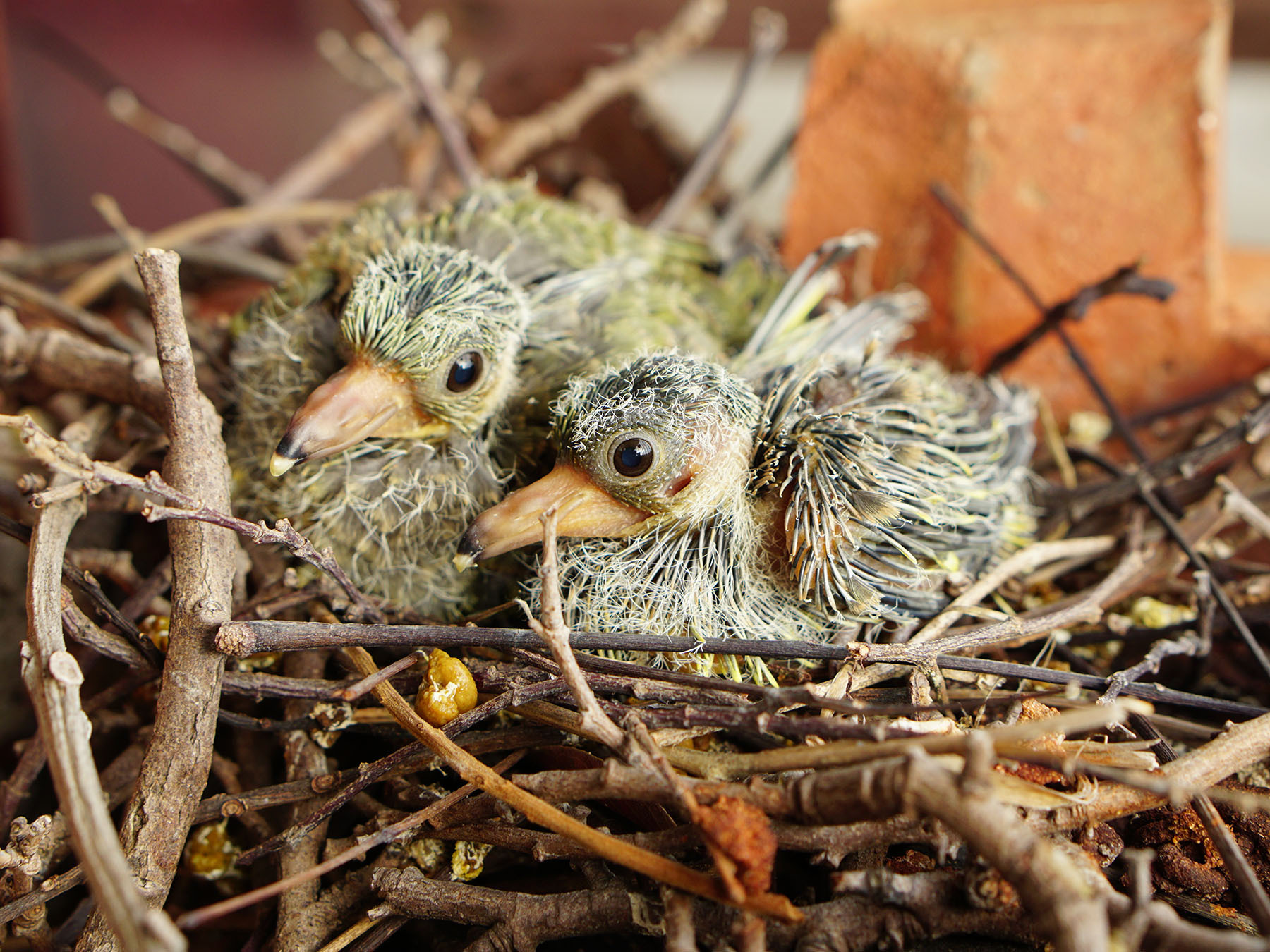
Nests are simple platforms of twigs, usually placed in the fork of a tree or dense foliage. Females lay 1-2 white eggs per clutch.
Both parents share incubation duties, which last about 14 days. Chicks fledge after approximately 12-14 days but may remain dependent on parents for several more weeks.
Behaviour
These pigeons are typically observed in small flocks, often perched high in fruiting trees. They are known for their agile movements among branches while foraging.
During courtship, males perform elaborate bowing displays and soft cooing to attract females.
Conservation
While currently listed as Least Concern, the Orange-breasted Green-pigeon faces threats from habitat loss due to deforestation.
Conservation efforts focus on protecting tropical and subtropical forests within their range, which is crucial for maintaining stable populations.
More photos
3 photos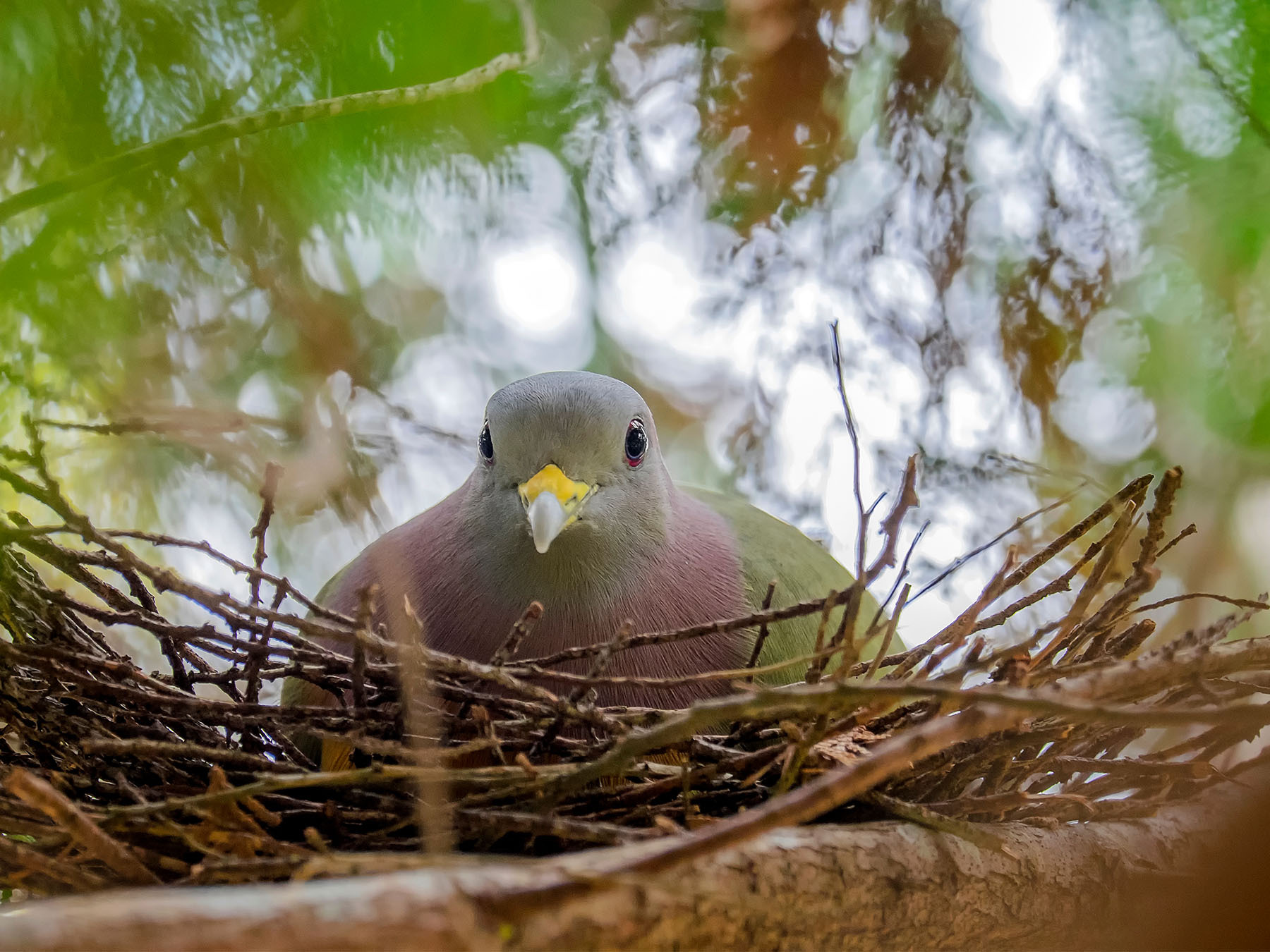
Quick facts
- Length
- 25–30 cm
- Wingspan
- 45–50 cm
- Weight
- 150–200 g
- Family
- Pigeons & Doves
- Migration
- Resident
- Global status (IUCN)
- Least Concern
- World population
- Not quantified, but usually uncommon
- Population trend
- Decreasing
- Also called
- Orange-breasted Fruit Dove
- Scientific name
- Treron bicinctus
Sources
3- 1BirdLife International. 2024. Treron bicinctus. The IUCN Red List of Threatened Species 2024: e.T22691142A263964794. Source (opens in a new tab)
- 2Global Forest Watch 2022, using Hansen et al. [2013] data and methods disclosed therein
- 3Gibbs et al. (2001)

Checked by
Nathan Cope, founder and editor
Nathan founded Birdfact and leads its writers and contributors in the UK, the US and Canada. He has watched and studied birds for more than ten years, and checks every article and species guide before it’s published.