


Mottled Owl
Central American Mottled Owl · Strix virgata
By the Birdfact teamChecked by Nathan Cope
On this page13 sections
How to recognise it
What do Mottled Owls look like?
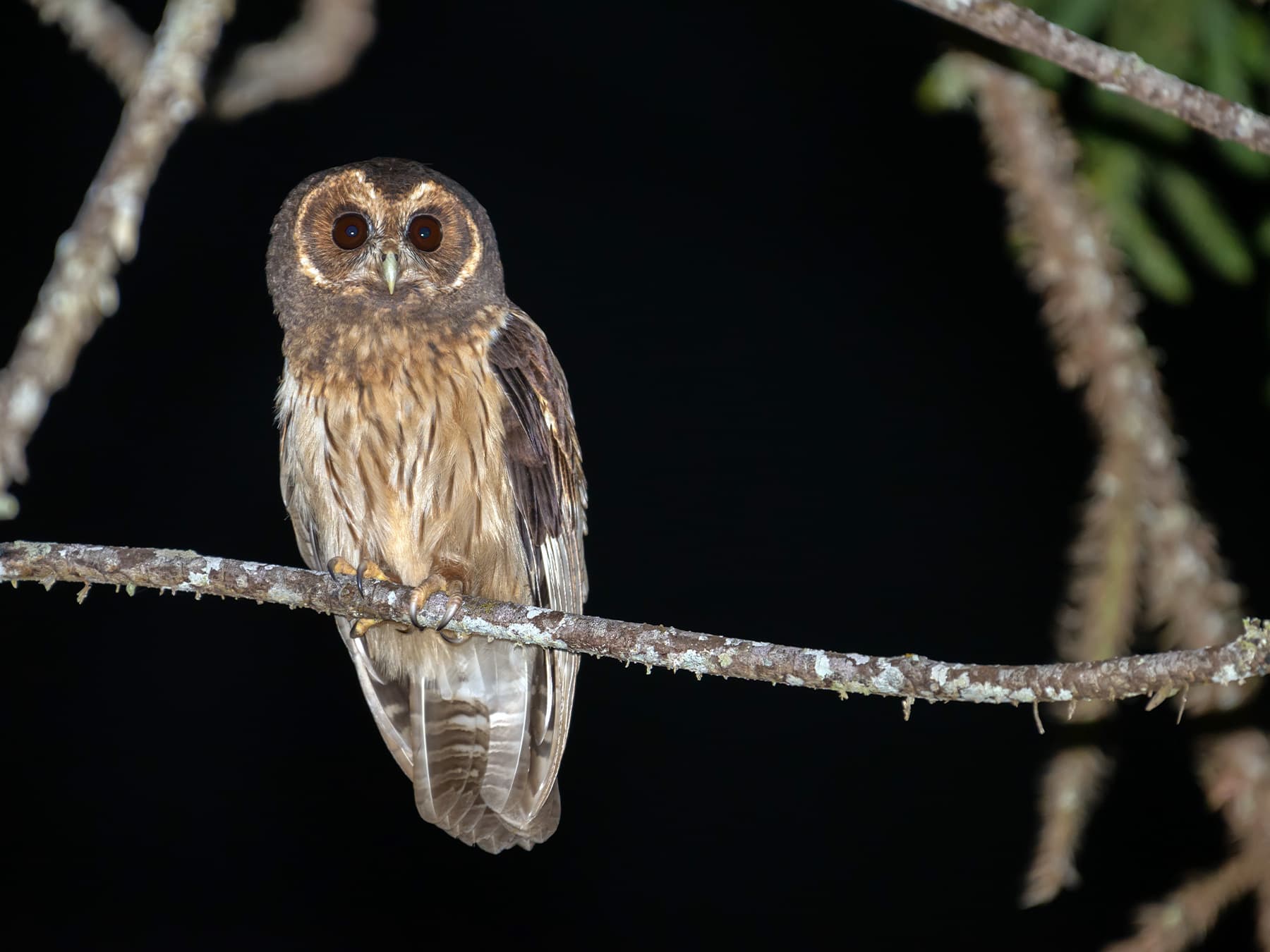
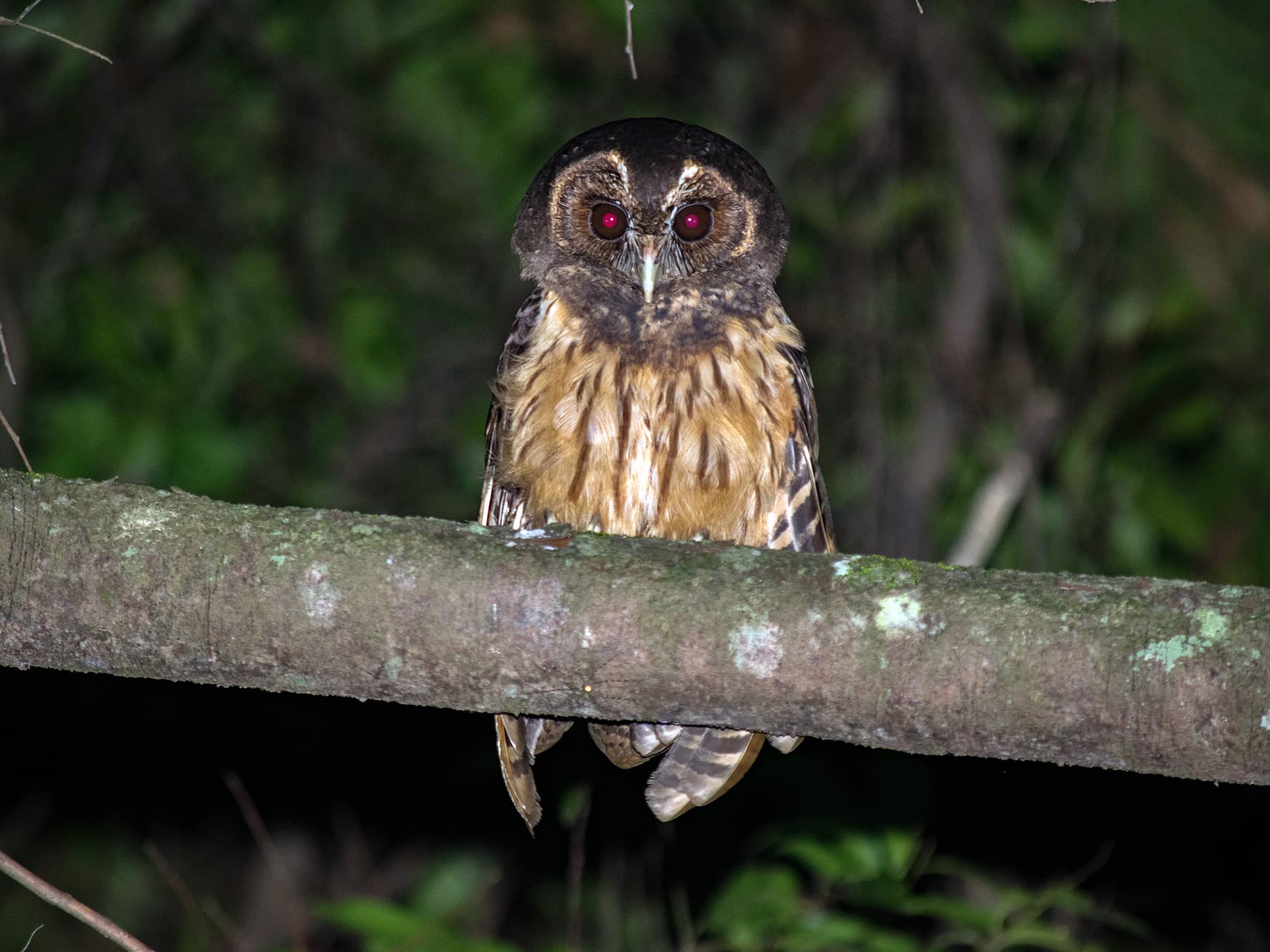
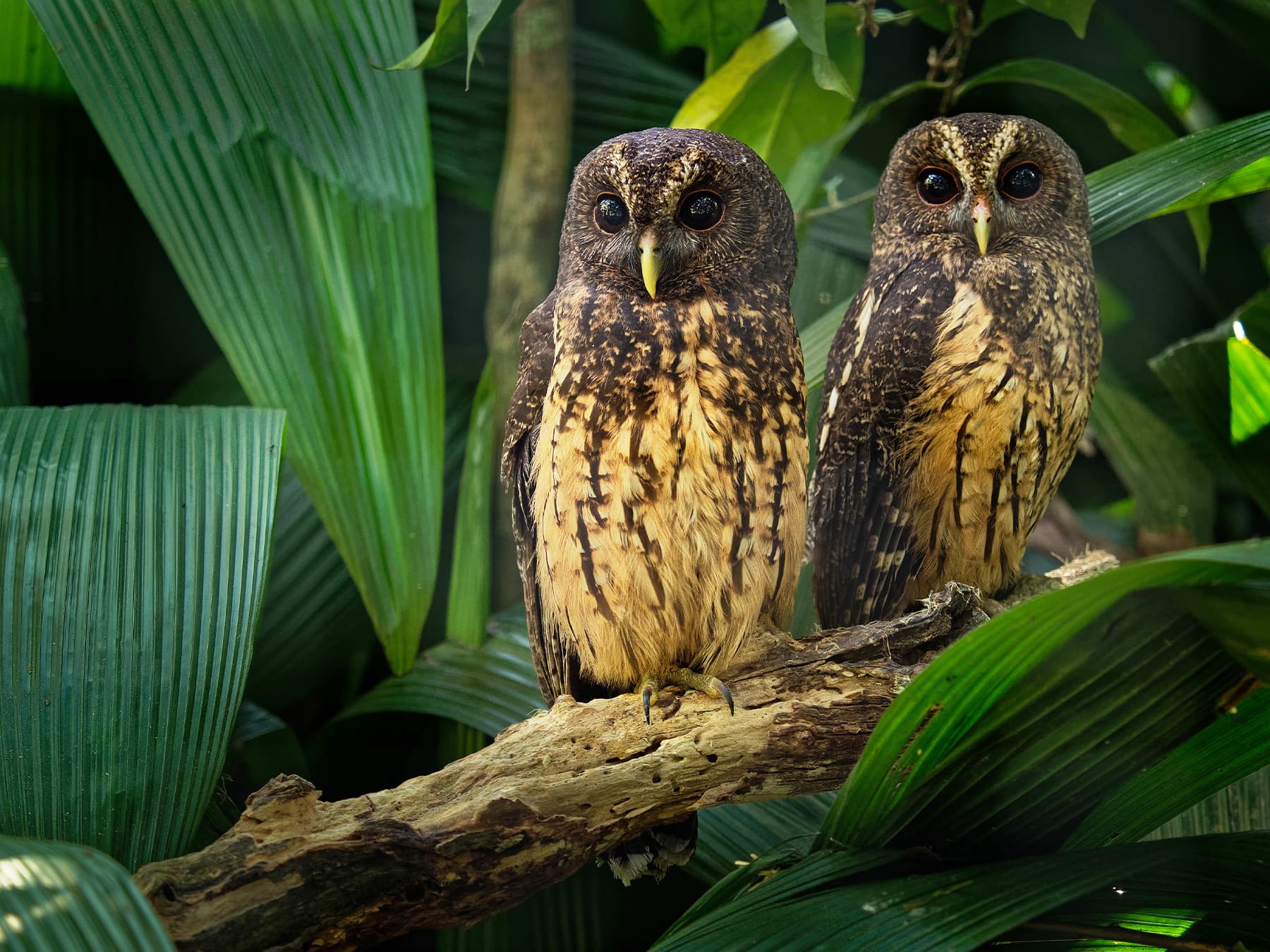
As you might expect from the species name, a heavily mottled plumage is a key feature of mottled owls, with dark brown upperparts, densely streaked with yellowish barring, and a mottled buffy-yellow and dark brown upper breast, which becomes gradually unmarked towards the belly.
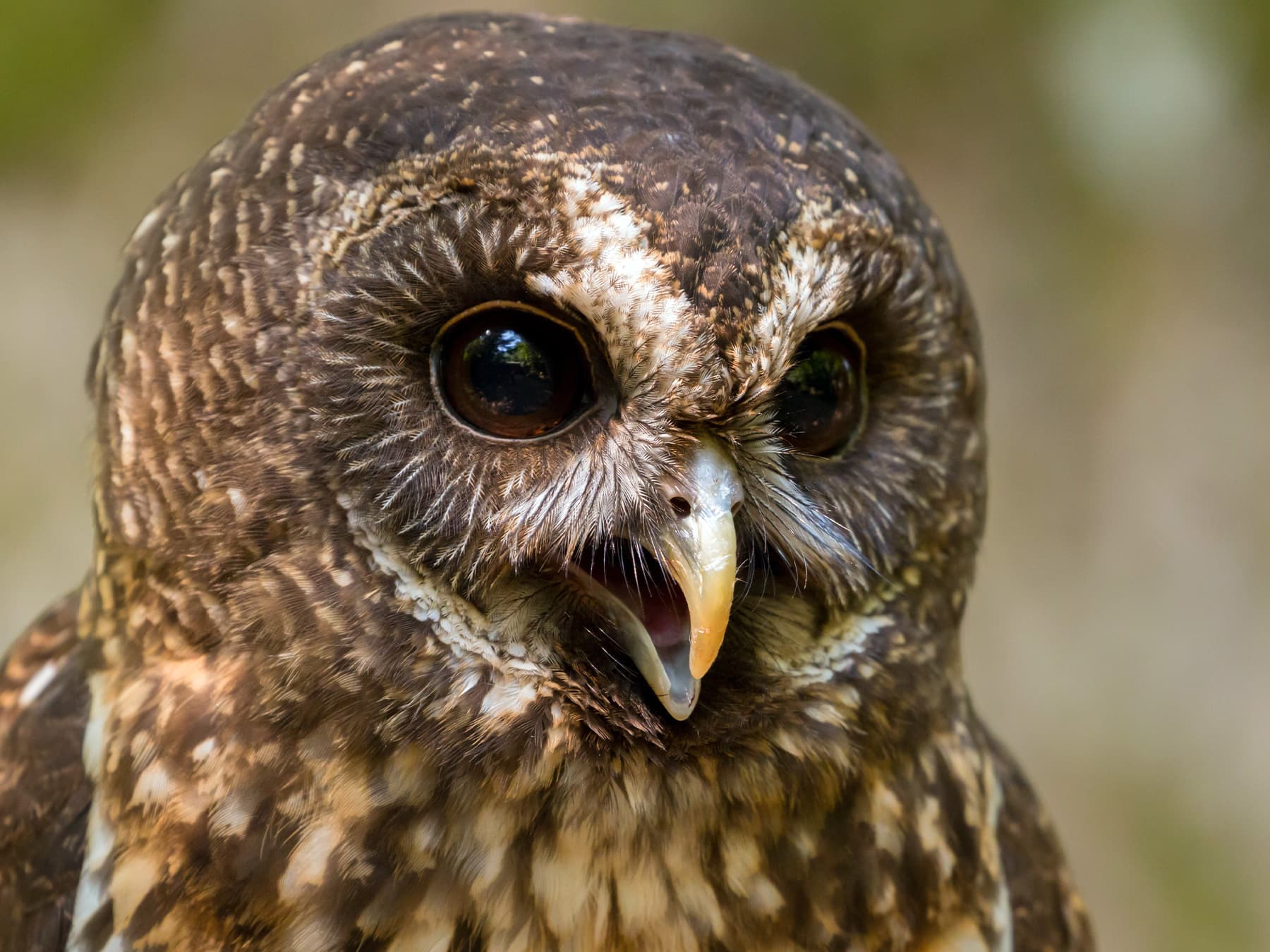
The face is brown, with lighter buff v-shaped eyebrow markings, and some light orange-brown coloring between and below their deep brown eyes. The facial disk is ringed with buff and the bill is a yellowish-gray.
A lighter color morph also exists, with whiter markings replacing the buff shades seen in the darker morph birds.
Female and male mottled owls are alike in coloring, but there is a noticeable difference in size, with females taller and heavier than males.
Juvenile mottled owls have whitish faces and are buff-colored, with darker barring on their backs. They gain their full adult plumage by around 4 months.
How big are Mottled Owls?
A mid-sized owl species, the mottled owl is smaller than a barn owl and around the same size or slightly smaller than both long-eared and short-eared owls. Females are considerably larger than males in every aspect.
- Length: 29 cm to 38 cm (11 in to 15 in)
- Wingspan: 84 cm to 91 cm (33 in to 36 in)
- Weight: 175 g to 405 g (6.2 oz to 14.3 oz)
Its size
Adults- Length
- 30–38 cm
- Wingspan
- 80–95 cm
- Weight
- 320–450 g
Its song and calls
What sound does a Mottled Owl make?
A series of deep croaky hoots increasing in both pitch and volume are used in defense of a territory, with the female’s cry being higher in pitch than the male's. Nesting female mottled owls are also heard making a catlike wail when asking their mate to bring them food.
- Call0:00 / 0:16
Recorded in Napo: Napo Galeras, Ecuador · March 2005
When and where to see it
The Mottled Owl is not recorded regularly in the UK, Ireland, the United States or Canada.
United States: recorded in 2 of the 6 years. Too few years to count as a regular visitor.
Worldwide: recorded regularly in 19 countries
Countries where it was recorded in at least 3 of the 6 years 2019–2024. Linked countries have their own bird list.
North America (9)
- Belize
- Costa Rica
- El Salvador
- Guatemala
- Honduras
- Mexico
- Nicaragua
- Panama
- Trinidad & Tobago
Data: EOD – eBird Observation Dataset (Cornell Lab of Ornithology), accessed via GBIF.org, CC BY 4.0. Records from 2019–2024, aggregated and filtered by Birdfact. How these lists are made
What is the habitat of a Mottled Owl?
At home in forested environments, including tropical rainforests, woodland scrubs, coffee and cacao plantations, and dry lowland forests, mottled owls thrive in landscapes with dense tree cover as well as regions with scattered trees, up to altitudes of around 2500 m (8200 ft).
What is the range of a Mottled Owl?
Mottled owls are widely distributed across Central and South America, with a presence in southern Mexico. Their range extends throughout all of Central America into the Amazonian basin of South America.
To the southeast of the main range, mottled owls are present in a region that extends across northeastern Argentina, eastern Paraguay, and southeastern Brazil.
Where do Mottled Owls live?
Mottled owls are resident across Central and South America and have regular and stable breeding populations in Mexico, Guatemala, Belize, Honduras, El Salvador, Nicaragua, Costa Rica, Panama, Suriname, French Guiana, Guyana, Venezuela, Colombia, Ecuador, Peru, Bolivia, Paraguay, Brazil, and Argentina.
How rare are Mottled Owls?
Within parts of their range, mottled owls are widespread and common, particularly in humid lowland forests, with the species particularly widely distributed in southern Mexico and throughout Panama. Only the vaguest population estimates exist, with Bird Life International placing the species in the range of 500,000 to 4,999,999.
Where can you see Mottled Owls in the US?
Although the United States is outside of the distribution range of mottled owls, rare vagrants show up from time to time in Texas. A resident population of owls is present in Mexico’s Sierra Picacho mountain range, only around 90 km from the Texas border, so although highly slim, this region would possibly offer the greatest chance of any sightings.
Where can you see Mottled Owls in Canada?
Mottled owls have never been recorded in Canada, and the vast distance from their usual geographical range makes it unlikely that vagrant birds will accidentally occur there.
Migration
Do Mottled Owls migrate?
Mottled owls are sedentary and remain in the same habitats all year round.
Are Mottled Owls native to the US?
Mottled owls are not native in the US and only scarce reports of vagrant individuals have ever been recorded, with the first verified record from 1983 when an owl discovered as roadkill in Texas was identified as the species.
Tips for seeing it
- Listen for their distinctive calls at night, especially in forested areas
- Look for them perched on low branches in dense vegetation
- Search for pellets or whitewash beneath potential roosting sites
- Use a spotlight with a red filter to minimize disturbance when owling
What it eats
What do Mottled Owls eat?
The diet of mottled owls varies according to what prey is available locally and can include small mammals (fulvous rice rats and hispid cotton rats), large insects (cockroaches, grasshoppers, beetles), reptiles (snakes, lizards), tree frogs, small birds, and bats. They hunt from low perches and catch prey on the ground.
What do Mottled Owl chicks eat?
Juvenile mottled owls are brought small prey to the nest, which is then torn into smaller shreds before they attempt to eat it. Mammals including voles, shrews, and mice are initially offered, with larger items including squirrels, bats, ducklings, and rabbits introduced gradually as they grow.
Nesting and breeding
Where do Mottled Owls nest?
Mottled owls are known to reuse cavities excavated and later abandoned by other species, as well as naturally occurring tree hollows and artificial nest boxes. Occasionally they have been observed to take over stick nests in trees that other birds have constructed, but do not build their own nests. Leaves and bark may be added as an interior lining before eggs are laid.
When do Mottled Owls nest?
Nesting varies widely according to location. In the northern extremes of their range, mottled owls lay their eggs between February and May, while further south, in Argentina, southern Brazil, and Paraguay, September to November is most usual.
Only females incubate and are brought food to the nest for the duration of their brooding time. Eggs hatch after 28 to 30 days and parental care of the young in the nest continues until they are ready to fledge after between 27 and 33 days. Once fledged, young mottled owls continue to rely on parents for support with feeding.
What do Mottled Owl eggs look like?
Mottled owls’ eggs are a dull white color, measuring 42 mm by 36 mm (1.7 in by 1.4 in). A typical clutch consists of between 1 and 3 eggs, and one brood is raised in a season.
Do Mottled Owls mate for life?
The limited evidence we have available indicates that mottled owls do mate for life, breeding together once a year and reuniting the following spring after a renewed courtship period, where the bond is strengthened by males bringing food to females.
Behaviour
Are Mottled Owls aggressive?
A highly territorial species, mottled owls will readily attack any other owls that stray too close to their nest sites or young. Despite their reputation as fearless hunters and vicious predators, there are no reports of a mottled owl ever attacking a human.
Where do Mottled Owls sleep at night?
Mottled owls hunt nocturnally and roost during the daytime. Roosting spots are found in trees, with males finding an overnight perch around 250 m (820 ft) from the nest cavity while the female is incubating.
Lifespan and predators
How long do Mottled Owls live?
Banding records for mottled owls are not widespread, making it challenging to estimate an average or maximum lifespan for this species. It is also unclear at what age mottled owls breed for the first time.
What are the predators of Mottled Owls?
Large raptors are among the chief predators of mottled owls, including the black hawk-eagle, the crested eagle, and the collared forest falcon. Nests may be raided for eggs by mammals including hairy porcupines, margays, white-nosed coatis, and tayras.
Are Mottled Owls protected?
No information is available on specific legislation that offers protection to mottled owls across their range in Central and South America.
Are Mottled Owls endangered?
No concerns are currently expressed for the future survival of mottled owls, and they have the lowest conservation status, rated as a species of least concern globally.
Conservation
While the Mottled Owl is currently listed as Least Concern, it faces threats from deforestation and habitat fragmentation.
Conservation efforts focus on preserving large tracts of tropical and subtropical forests, which are crucial for this species' long-term survival.
More photos
1 photos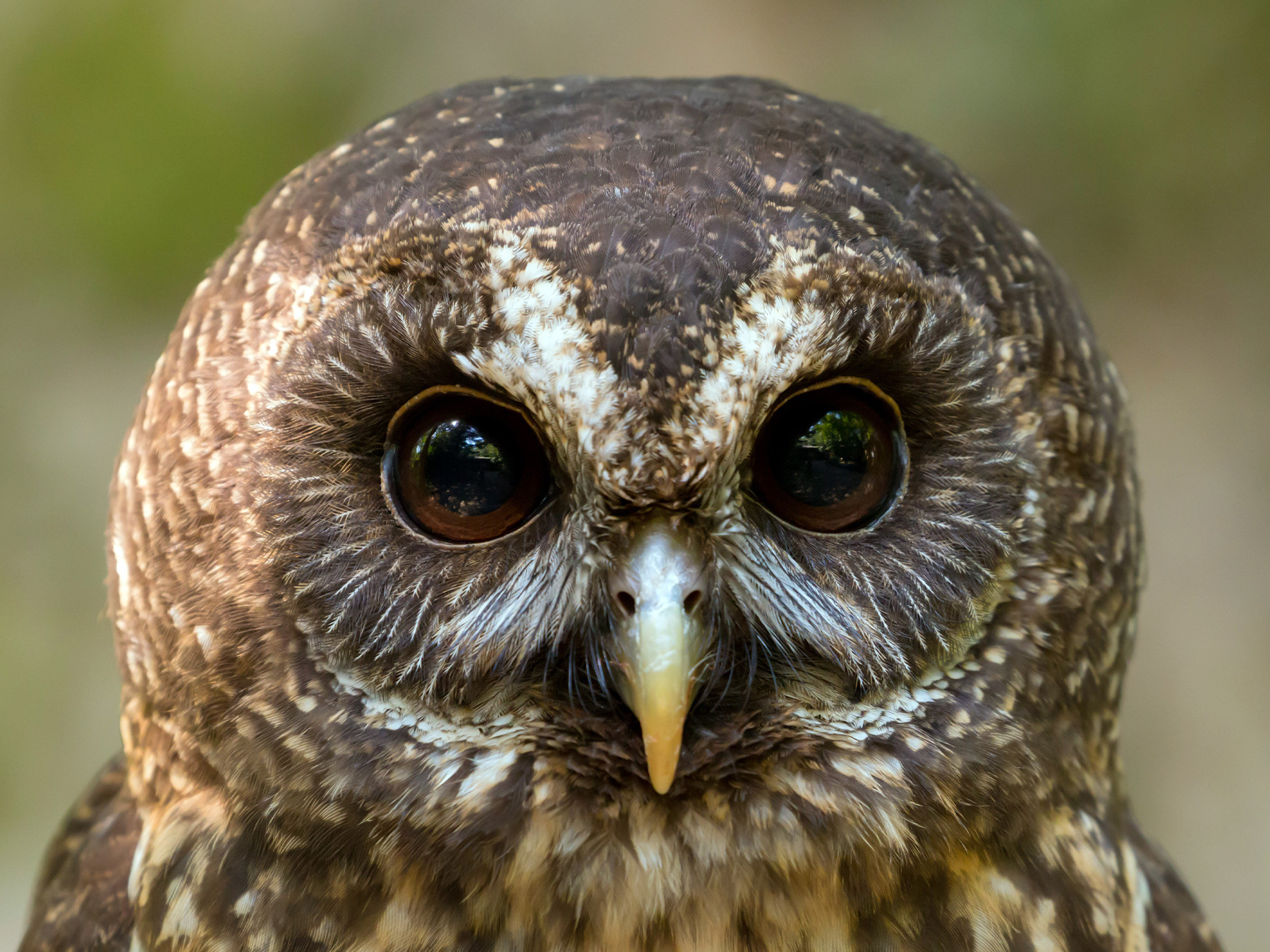
Quick facts
- Length
- 30–38 cm
- Wingspan
- 80–95 cm
- Weight
- 320–450 g
- Lifespan
- 10–15 years
- Family
- Owls
- Migration
- Resident
- Global status (IUCN)
- Least Concern
- World population
- 500,000 - 4,999,999 mature individuals
- Population trend
- Decreasing
- Also called
- Central American Mottled Owl
- Scientific name
- Strix virgata
Questions
1What is the difference between a Mottled Owl and a Barred Owl?
Mottled owls and barred owls are visually fairly similar, although barred owls are at least 10 cm (4 in) larger. Both share a heavily patterned plumage that allows them to be well camouflaged against the forest landscapes they both inhabit.
However, barred owls are typically paler than mottled owls: their plumage is mainly light brown and white, with a marked black border to their facial disk. In contrast, mottled owls are richer shades of buffy-yellow streaked against a deep brown.
Sources
3- 1BirdLife International. 2022. Ciccaba virgata. The IUCN Red List of Threatened Species 2022: e.T22689122A167859687. Source (opens in a new tab)
- 2BirdLife International. 2022. Ciccaba virgata. The IUCN Red List of Threatened Species 2022: e.T22689122A167859687. Source (opens in a new tab)
- 3Partners in Flight (2022) Source (opens in a new tab)

Checked by
Nathan Cope, founder and editor
Nathan founded Birdfact and leads its writers and contributors in the UK, the US and Canada. He has watched and studied birds for more than ten years, and checks every article and species guide before it’s published.