


Little Penguin
Blue Penguin, Fairy Penguin · Eudyptula minor
By the Birdfact teamChecked by Nathan Cope
On this page10 sections
How to recognise it
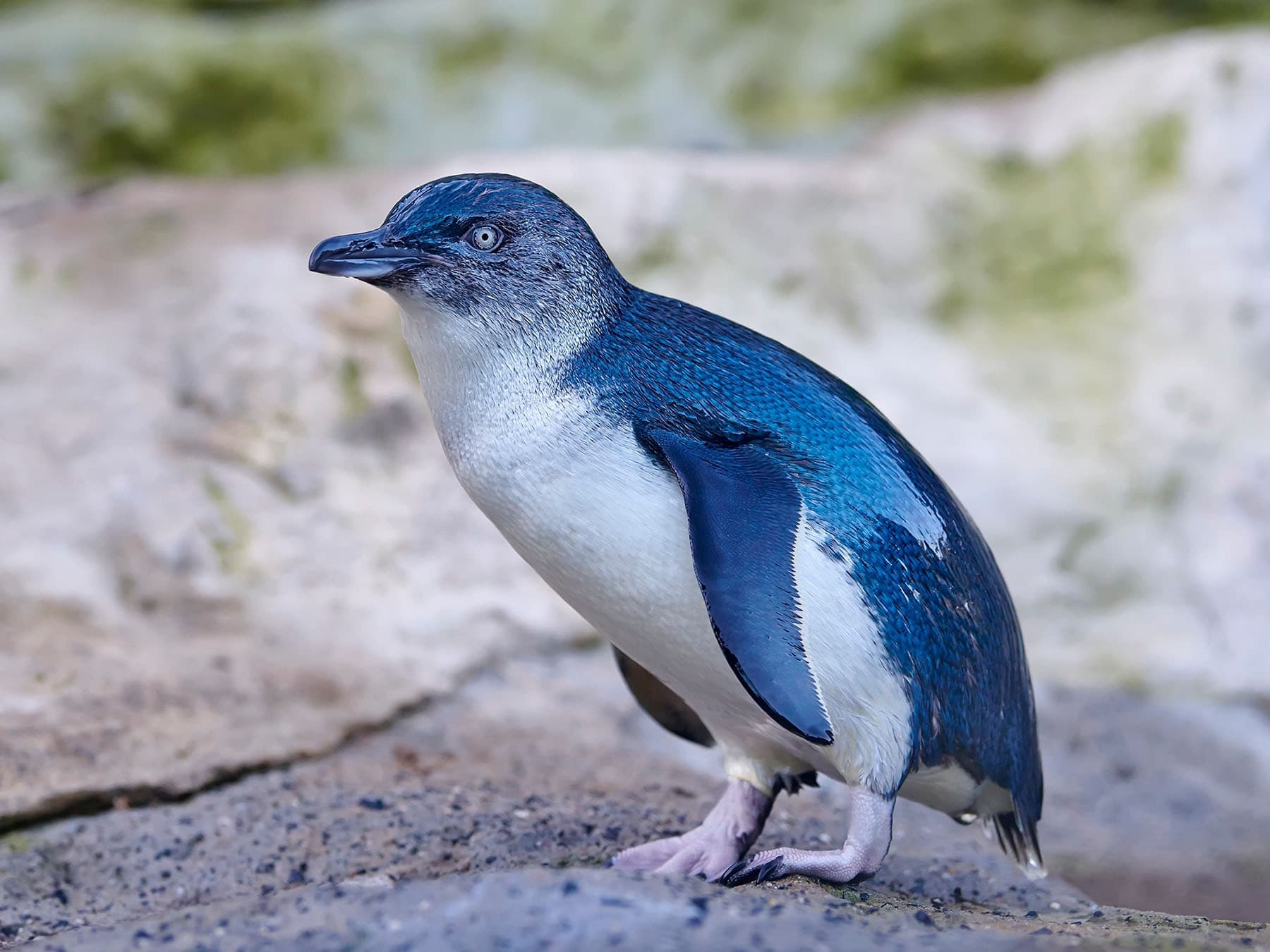
Little Penguins are the smallest penguin species, with distinctive blue and white plumage. Their upperparts are slate-blue to indigo-blue, while their underparts are white. They have a short, dark bill and pink feet with black soles.
Both sexes look similar, with juveniles having a lighter blue colouration. Their feathers may appear brown during moulting before the new blue feathers grow in.
Its size
Adults- Length
- 30–40 cm
- Wingspan
- 43–55 cm
- Weight
- 1000–1200 g
Its song and calls
Little Penguins are quite vocal, especially in their breeding colonies. Their calls include a high-pitched trumpeting sound often described as a 'braying' call, similar to a donkey's.
They also make softer contact calls, described as 'grunts' or 'growls', when interacting with mates or chicks.
- Call0:00 / 0:16
When and where to see it
The Little Penguin is not recorded regularly in the UK, Ireland, the United States or Canada.
Worldwide: recorded regularly in 2 countries
Countries where it was recorded in at least 3 of the 6 years 2019–2024. Linked countries have their own bird list.
Oceania (2)
Data: EOD – eBird Observation Dataset (Cornell Lab of Ornithology), accessed via GBIF.org, CC BY 4.0. Records from 2019–2024, aggregated and filtered by Birdfact. How these lists are made
Tips for seeing it
- Visit coastal areas in southern Australia or New Zealand at dusk to observe their return from the sea
- Look for their distinctive blue colouration and small size compared to other penguins
- Listen for their high-pitched vocalisations in breeding colonies
- Respect viewing guidelines and maintain a safe distance to avoid disturbing the birds
What it eats
Little Penguins primarily feed on small schooling fish such as anchovies, sardines, and squid. They are pursuit divers, catching prey by swimming at high speeds underwater. Their foraging trips can last several hours and extend up to 20 km from the shore during breeding season.
Nesting and breeding
Little Penguins typically form monogamous pairs and breed annually. The breeding season varies by location but generally occurs between August and February.
Nests are built in burrows, rock crevices, or under dense vegetation, often lined with grass and feathers. Females lay two eggs, which are pale white and slightly pointed at one end.
Both parents share incubation duties for about 35 days. Both parents feed chicks and fledge after 7-9 weeks, becoming independent at about 10-11 weeks old.
Behaviour
Little Penguins are excellent swimmers, using their flippers to 'fly' underwater at speeds up to 6 km/h. They are social birds, often foraging in small groups during the day and returning to their colonies at dusk in what's known as a 'penguin parade'. On land, they waddle with an upright posture and can be quite vocal in their colonies.
Conservation
While listed as Least Concern globally, Little Penguins face localised threats from habitat loss, introduced predators, and climate change impacts on their food supply.
Conservation efforts include predator control, habitat protection, and the establishment of monitored breeding colonies in some areas.
Quick facts
- Length
- 30–40 cm
- Wingspan
- 43–55 cm
- Weight
- 1000–1200 g
- Lifespan
- 6–7 years · oldest recorded 42.2 years
- Family
- Penguins
- Migration
- Resident
- Global status (IUCN)
- Least Concern
- World population
- 469,760 mature individuals
- Population trend
- Stable
- Also called
- Blue Penguin, Fairy Penguin
- Scientific name
- Eudyptula minor
Sources
4- 1BirdLife International. 2020. Eudyptula minor (errata version published in 2021). The IUCN Red List of Threatened Species 2020: e.T22697805A202126091. Source (opens in a new tab)
- 2Cannel et al. 2016; Chiaradia 2013, Dann 2013
- 3BirdLife International. 2020. Eudyptula minor (errata version published in 2021). The IUCN Red List of Threatened Species 2020: e.T22697805A202126091. Source (opens in a new tab)
- 4ABBBS - Australian Bird and Bat Banding Scheme Source (opens in a new tab)

Checked by
Nathan Cope, founder and editor
Nathan founded Birdfact and leads its writers and contributors in the UK, the US and Canada. He has watched and studied birds for more than ten years, and checks every article and species guide before it’s published.