


Lewis's Woodpecker
Lewis Woodpecker · Melanerpes lewis
By the Birdfact teamChecked by Nathan Cope
On this page13 sections
How to recognise it
What do Lewis's Woodpeckers look like?
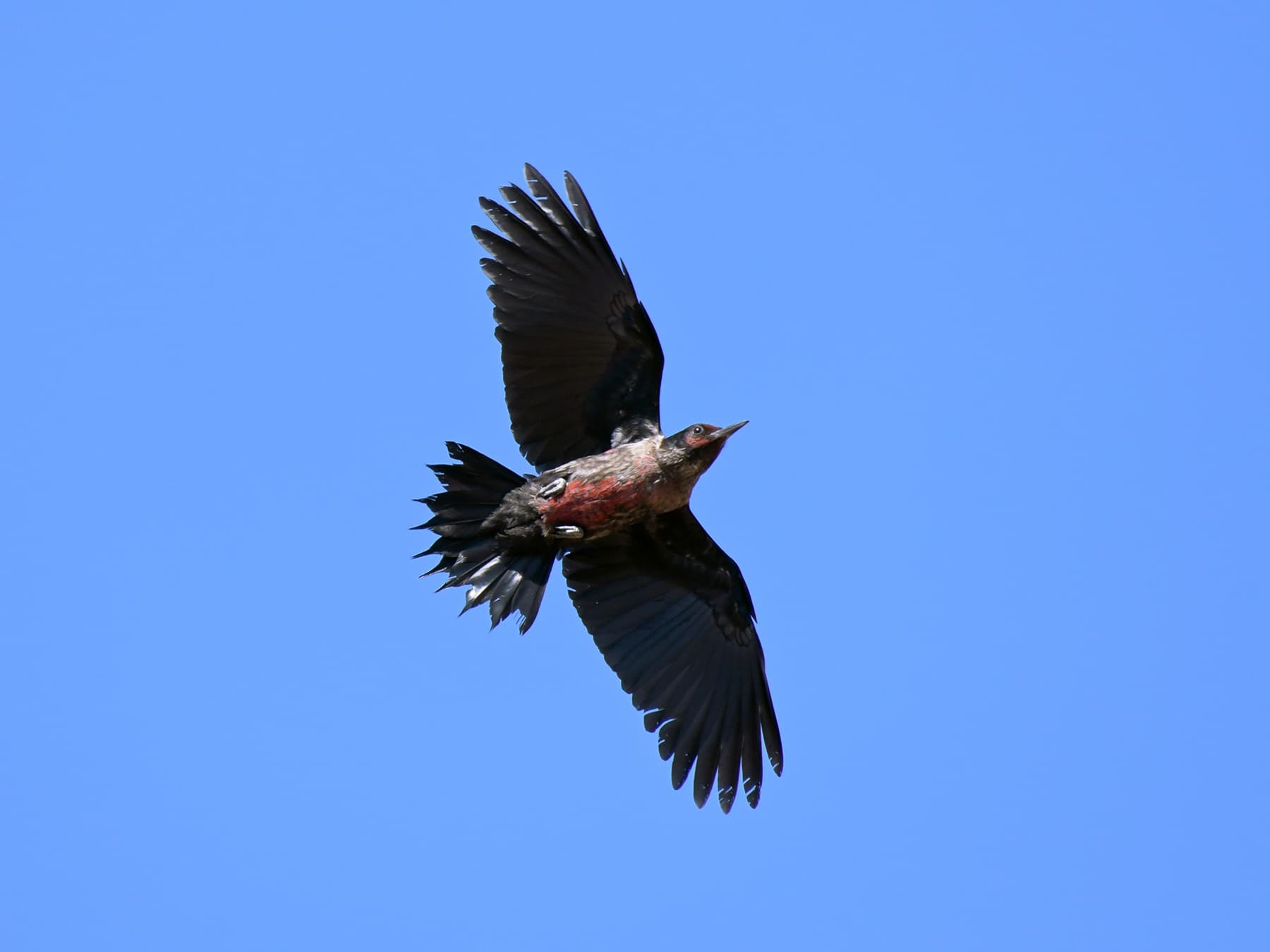
In flight, Lewis’s woodpeckers resemble crows, with their dark plumage and slow wingbeats.
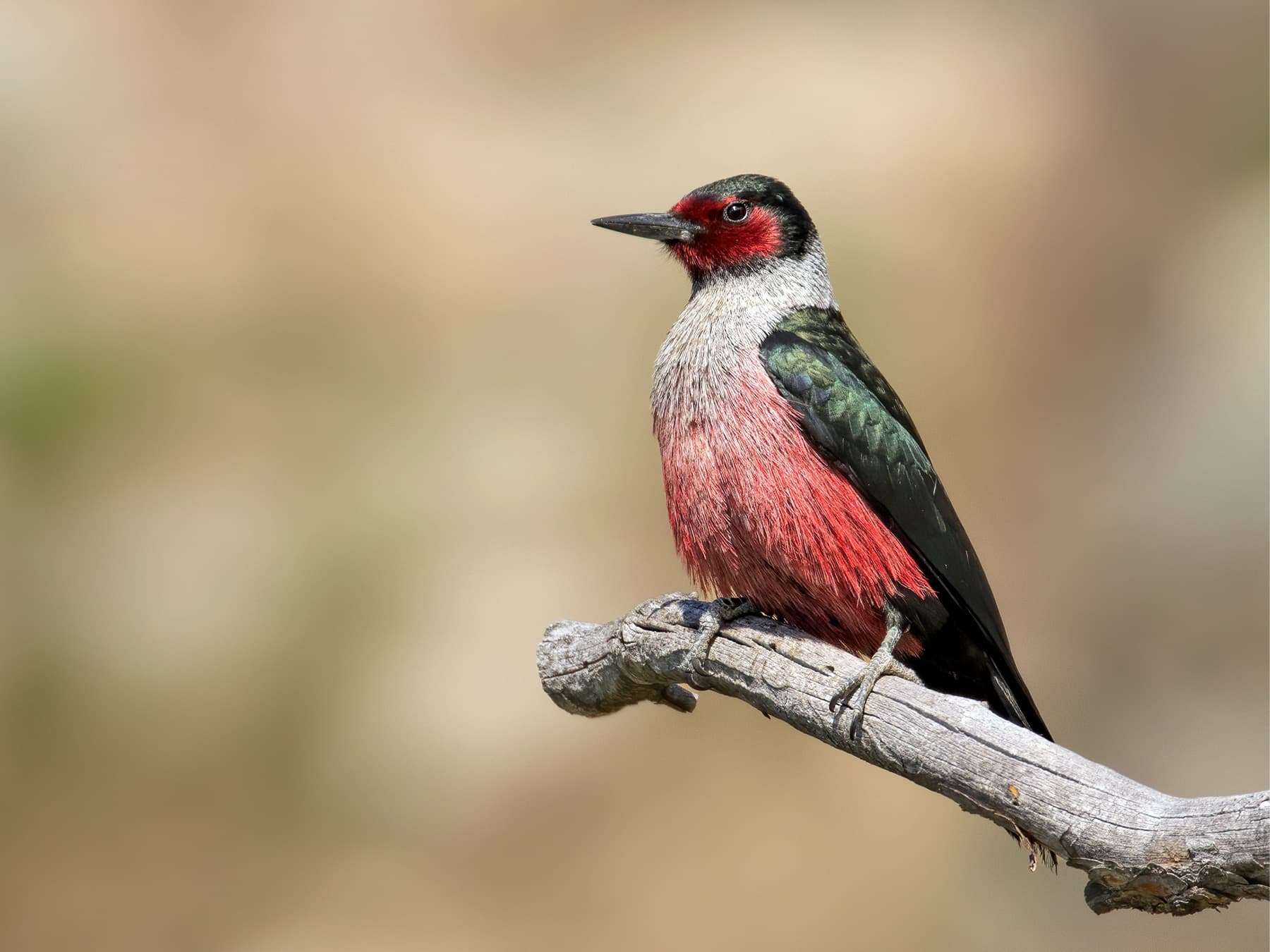
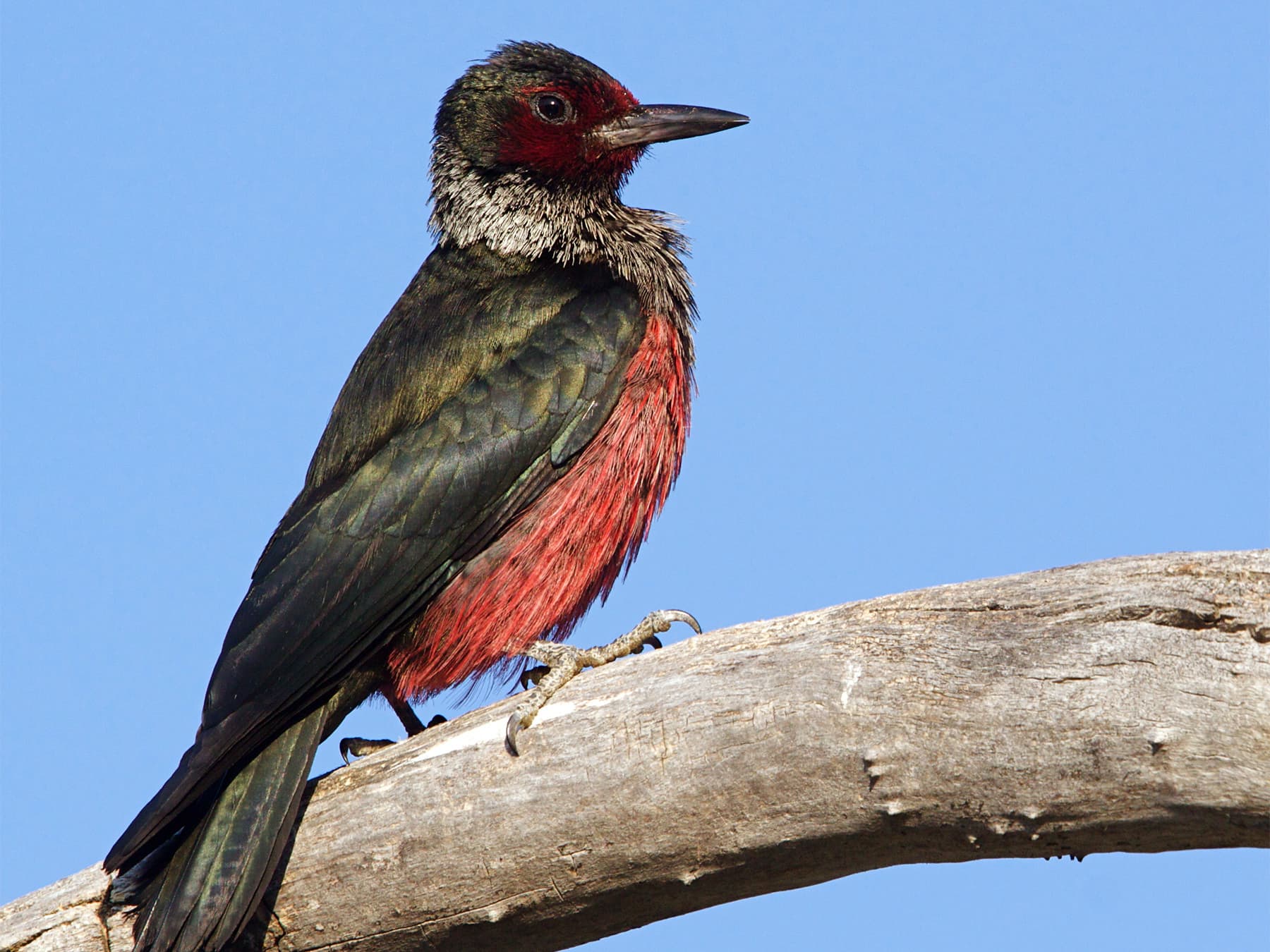
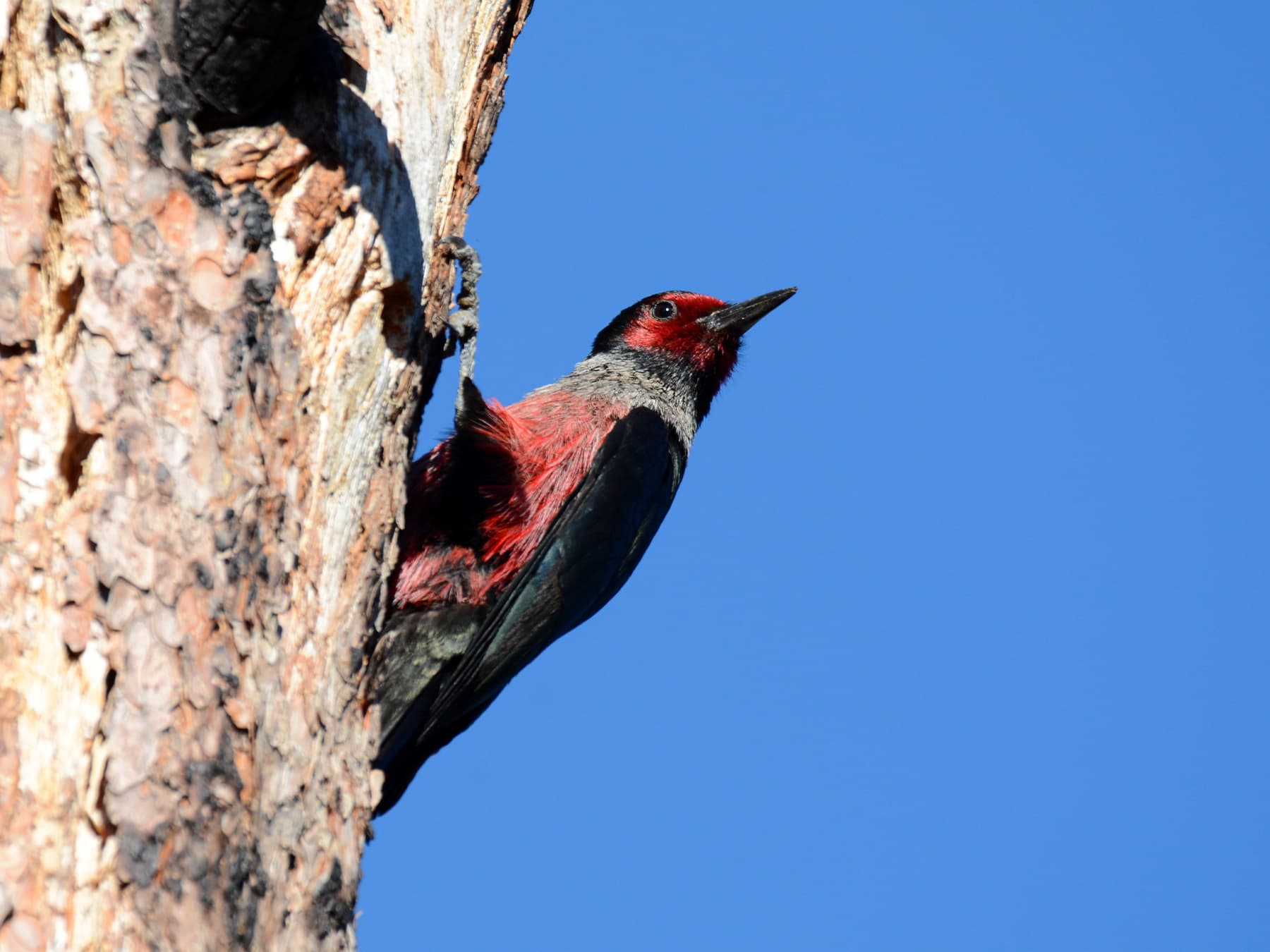
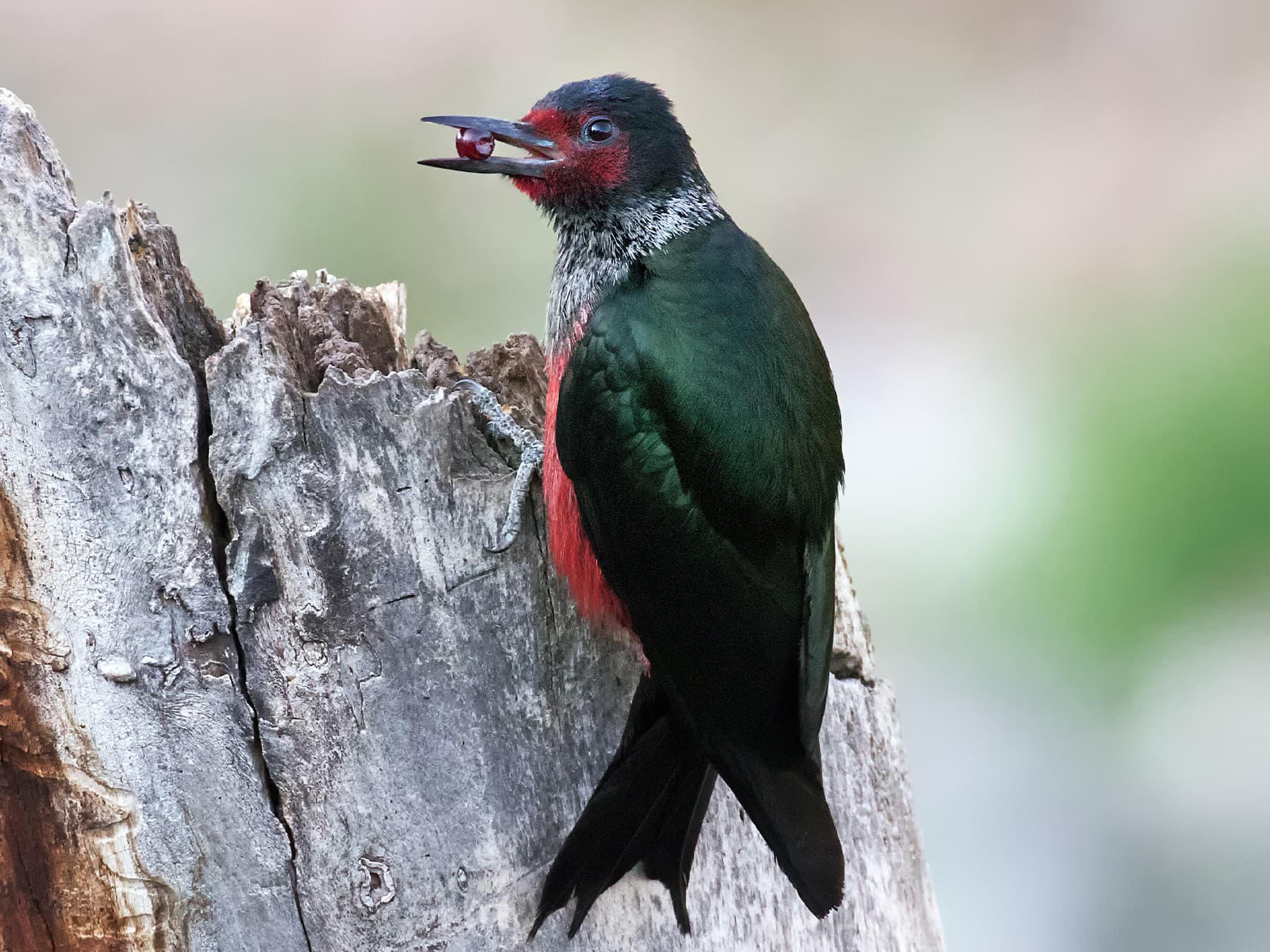
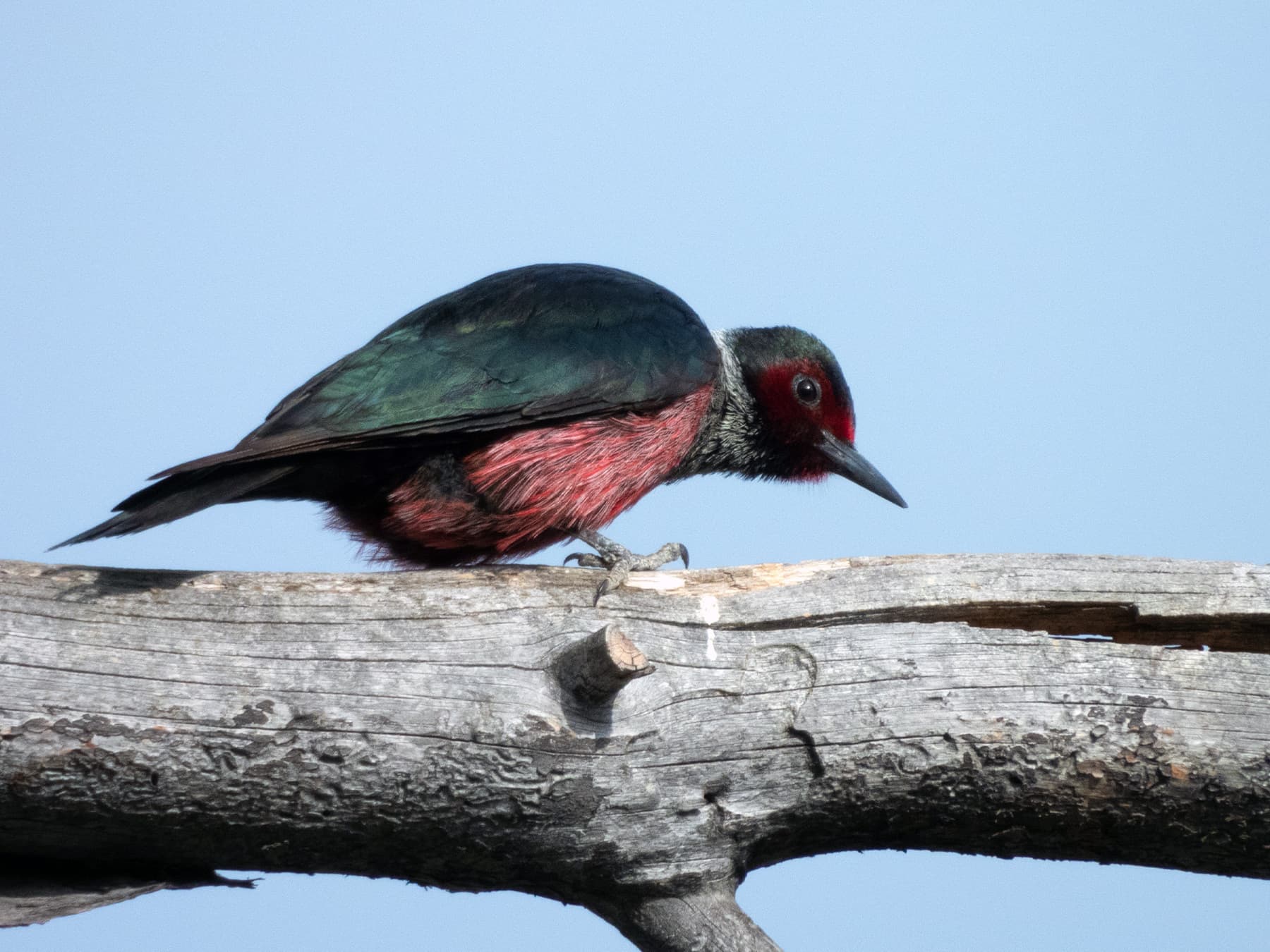
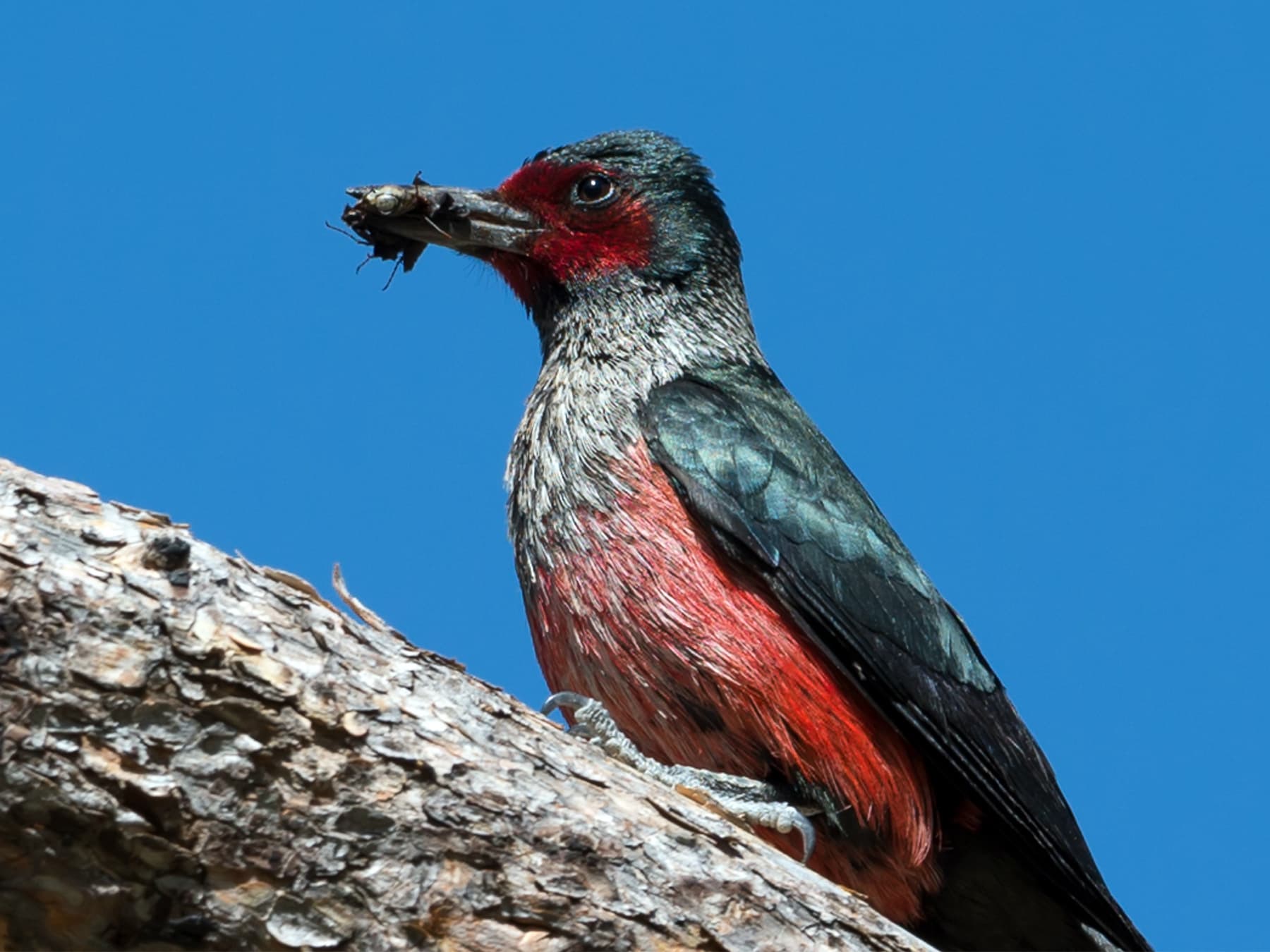
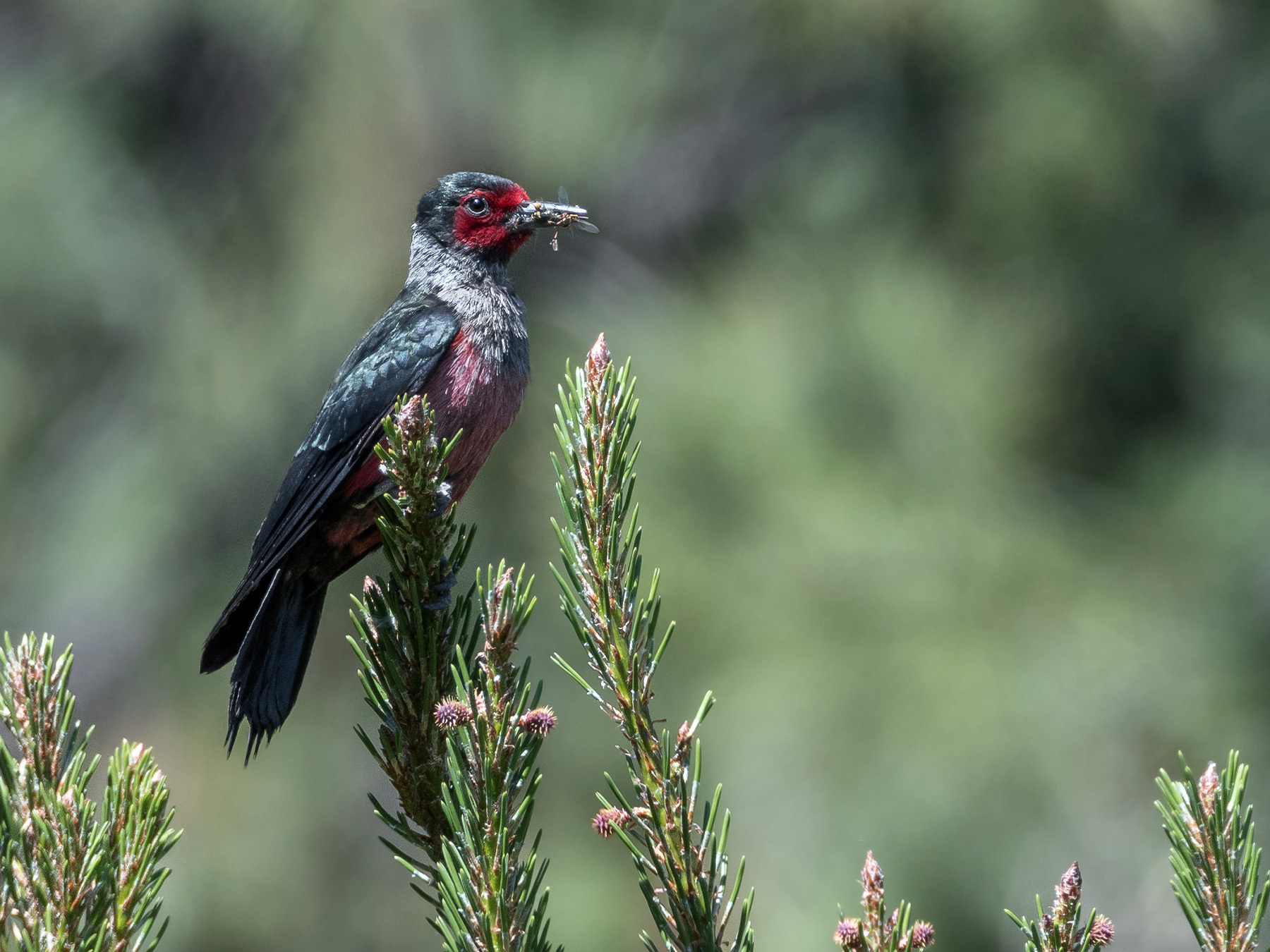
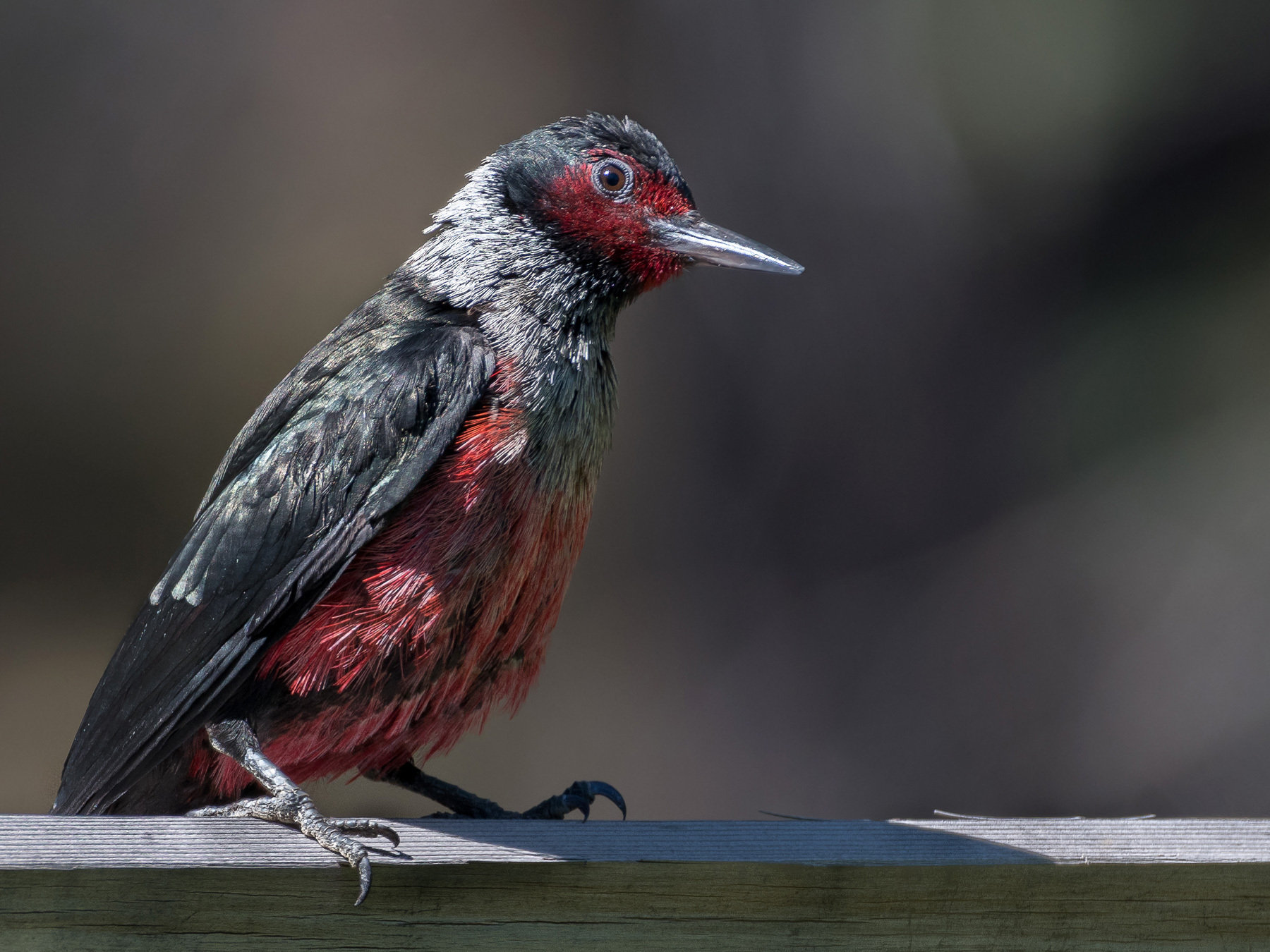
At close range, their markings make them easy to identify, with a greenish-black head, back, wings, and tail, a silvery-white collar that extends into a whitish-gray breast flecked with red, which becomes more heavily tinged with pinkish-red towards the belly. They have dark red facial markings that extend from the bill, across the cheeks to the eye.
Female Lewis’s woodpeckers are identical in markings and coloring to males, and although males are usually marginally larger than females, there is no reliable way of telling sexes apart by sight alone.
Juvenile Lewis’s woodpeckers do not have the white collar or red facial plumage of adults and their bellies may lack the pink tinge seen in mature birds. By late fall, they become harder to distinguish from older birds.
How big are Lewis's Woodpeckers?
A relatively large woodpecker species, Lewis’s woodpeckers are slightly smaller than northern flickers. Males are usually slightly larger than females in length, weight and wingspan.
- Length: 26 cm to 28 cm (10.2 in to 11.0 in)
- Wingspan: 49 cm to 52 cm (19.3 in to 20.5 in)
- Weight: 88 g to 139 g (3.1 oz to 4.9 oz)
Its size
Adults- Length
- 26–28 cm
- Wingspan
- 49–52 cm
- Weight
- 88–138 g
Its song and calls
What sound does a Lewis's Woodpecker make?
Compared to other woodpecker species, Lewis’s woodpeckers are less vocal and do not engage in as much drumming. Churring and chattering calls are used for contact, while a single squeaky ‘yick’ sound is heard as a distress signal.
- Call0:00 / 0:18
Recorded in South Dakota, United States · June 2015
When and where to see it
OctoberLeaving
Most recorded in October
- 1. Nevada0.13%
- 2. Utahunder 0.1%
- 3. New Mexicounder 0.1%
- 4. Coloradounder 0.1%
- 5. Californiaunder 0.1%
Each dot is a county, state or province: the bigger and darker, the larger the bird’s share of that place’s bird records that month. Grey dots: no regular records. The ringed point is the centre of the bird’s records this month; the arrow shows how it moved since last month, and the dashed loop its path through the year. “Arrivals” colours places where it becomes regular this month (orange) or is in its last regular month (grey). GBIF eBird Observation Dataset, 2019–2024. Map data: Natural Earth, US Census Bureau; place centres © OpenStreetMap contributors.
In your area
See when the Lewis's Woodpecker is recorded in your county, state or province.
How often the Lewis's Woodpecker turns up in the United States and Canada through the year, from birdwatchers' records.
United States
Resident · all year · most records in June
Canada
Summer visitor · regularly Apr–Oct · most records in June
Show as a table
| Month | United States | Canada |
|---|---|---|
| January | 0.015% (regular) | 0.002% |
| February | 0.012% (regular) | <0.001% |
| March | 0.009% (regular) | <0.001% |
| April | 0.009% (regular) | <0.001% (regular) |
| May | 0.014% (regular) | 0.009% (regular) |
| June | 0.020% (regular) | 0.010% (regular) |
| July | 0.018% (regular) | 0.009% (regular) |
| August | 0.015% (regular) | 0.008% (regular) |
| September | 0.018% (regular) | 0.005% (regular) |
| October | 0.012% (regular) | <0.001% (regular) |
| November | 0.013% (regular) | <0.001% |
| December | 0.013% (regular) | <0.001% |
Worldwide: recorded regularly in 3 countries
Countries where it was recorded in at least 3 of the 6 years 2019–2024. Linked countries have their own bird list.
North America (3)
Data: EOD – eBird Observation Dataset (Cornell Lab of Ornithology), accessed via GBIF.org, CC BY 4.0. Records from 2019–2024, aggregated and filtered by Birdfact. How these lists are made
What is the habitat of a Lewis's Woodpecker?
Preferred breeding habitats for a Lewis’s woodpecker include forests, particularly those with ponderosa pine and cottonwood trees, interspersed with low-level bushy ground vegetation, offering cover and foraging opportunities. Dead or dying trees are necessary for nest cavities, and rich insect life is also vital.
In the non-breeding season, oak woodlands and orchards provide ideal foraging and roosting grounds, and dead woody trees or posts are used as storage posts for grains, nuts and acorns.
What is the range of a Lewis's Woodpecker?
The main distribution range of a Lewis’s woodpecker covers the west-central United States, west of the Great Plains. In summer, the range expands as far south as the US border with Mexico and in summer as far north as Canada.
Where do Lewis's Woodpeckers live?
Year-round populations of Lewis’s woodpeckers are concentrated in Oregon, California, Arizona, New Mexico and Oklahoma. Breeding takes place in summer in Nevada, Idaho, Montana, Wyoming, and parts of Utah as well as across the Canadian border in British Columbia. Additional winter territories are found in southern California, southern Nevada, southern Arizona, and southern New Mexico.
How rare are Lewis's Woodpeckers?
The global population of Lewis’s woodpeckers is estimated by the American Bird Conservancy to be around 130,000 individuals. Not as prevalent or widespread as many other woodpeckers species in North America, the Lewis’s woodpecker would count as a fairly rare sighting, although in the breeding season, opportunities for sightings increase with adults performing regular insect-catching flights to keep on top of the feeding demands of their hungry nestlings.
Where can you see Lewis's Woodpeckers in the US?
Open ponderosa pine savanna landscapes in north-central Oregon, in the region around Mount Hood, offer good opportunities for sightings, where a corridor of protected land is a key stronghold for the species.
Where can you see Lewis's Woodpeckers in Canada?
Breeding of Lewis’s woodpeckers in Canada is limited to regions of south-eastern British Columbia, and extends into the far southwest corner of Alberta, although they are considered a rare presence in these areas.
Migration
Do Lewis's Woodpeckers migrate?
Where migration does occur, Lewis’s woodpeckers only disperse short distances from their breeding grounds, with many remaining resident in their territories all year round. Breeding grounds to the north of their range, in southern Canada and the northeastern reaches of their US range, are vacated once the young have fully fledged, and a temporary shift southwards, as far as the border with Mexico, follows.
Are Lewis's Woodpeckers native to the US?
Lewis’s woodpeckers are only found in the US and a small local area of British Columbia across the Canadian border. Some small-scale seasonal movement across the Mexican border may also occur.
Tips for seeing it
- Look for them perched on dead trees or utility poles in open woodlands
- Listen for their distinctive harsh 'churr' calls
- Observe their flycatcher-like behavior of catching insects in mid-air
- In the western United States, check burned forest areas where they often nest
What it eats
What do Lewis's Woodpeckers eat?
Rather than drilling into tree trunks and dead wood for wood-boring insects, Lewis’s woodpeckers mainly catch their prey in flight or glean bugs from the surface of leaves and bark.
Insect prey includes ants, bees, wasps, beetles, and grasshoppers. Acorns, nuts, and other fruits are also important to their diet.
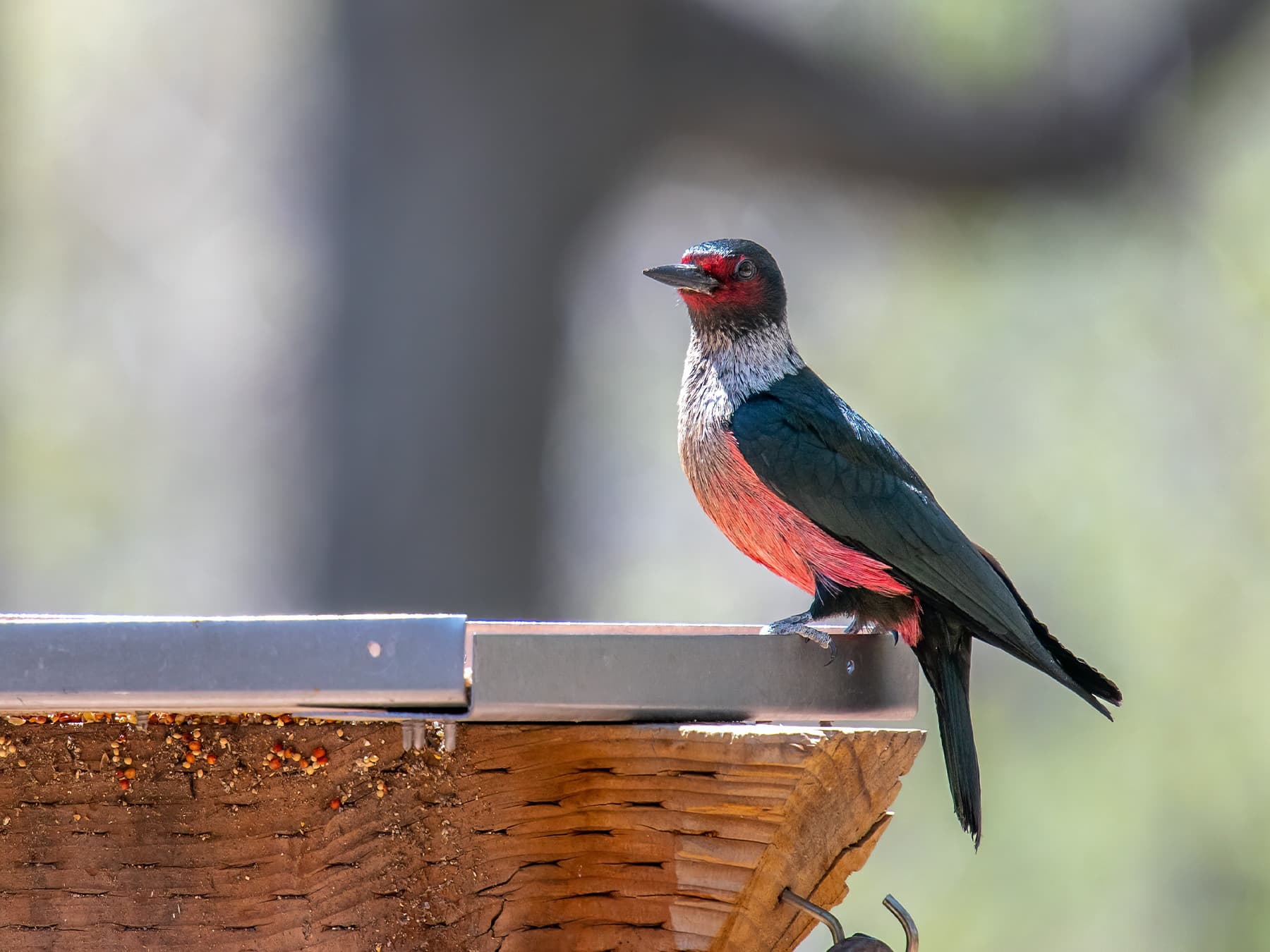
Lewis’s woodpeckers may visit backyard feeders, particularly flat tray-style feeders, where they may display aggression towards other species that attempt to share the food source.
Acorns and nuts are shelled and stored in crevices in trees, and serve as a back-up food source during the winter and the breeding season when insect supplies may not be sufficient to feed themselves or their young.
What do Lewis's Woodpecker chicks eat?
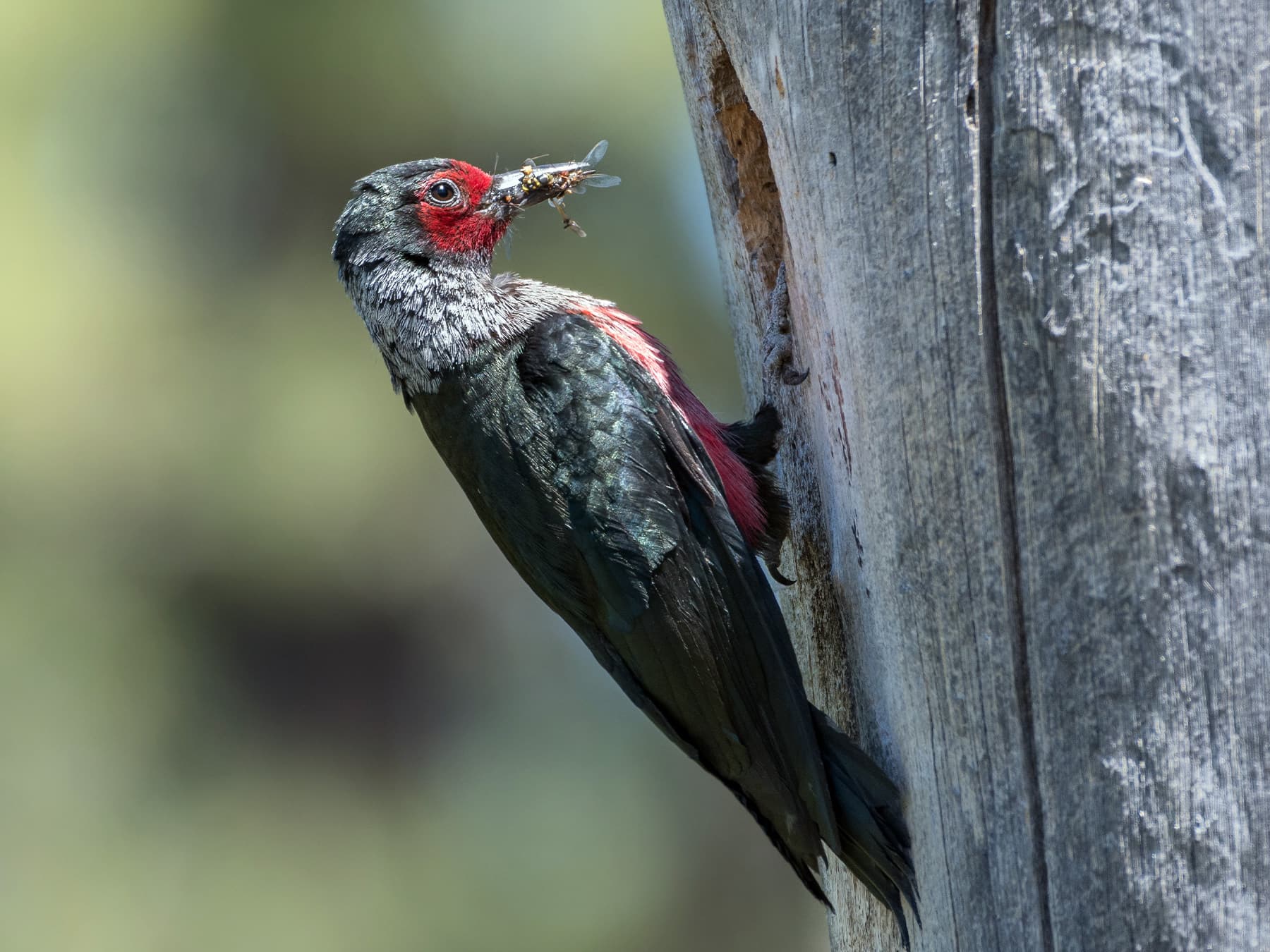
Young Lewis’s woodpeckers are fed on an initial diet of insects, with beetles, ants, and termites the leading prey. Small pieces of acorn and other nuts are brought to nestlings as supplementary food.
Nesting and breeding
Where do Lewis's Woodpeckers nest?
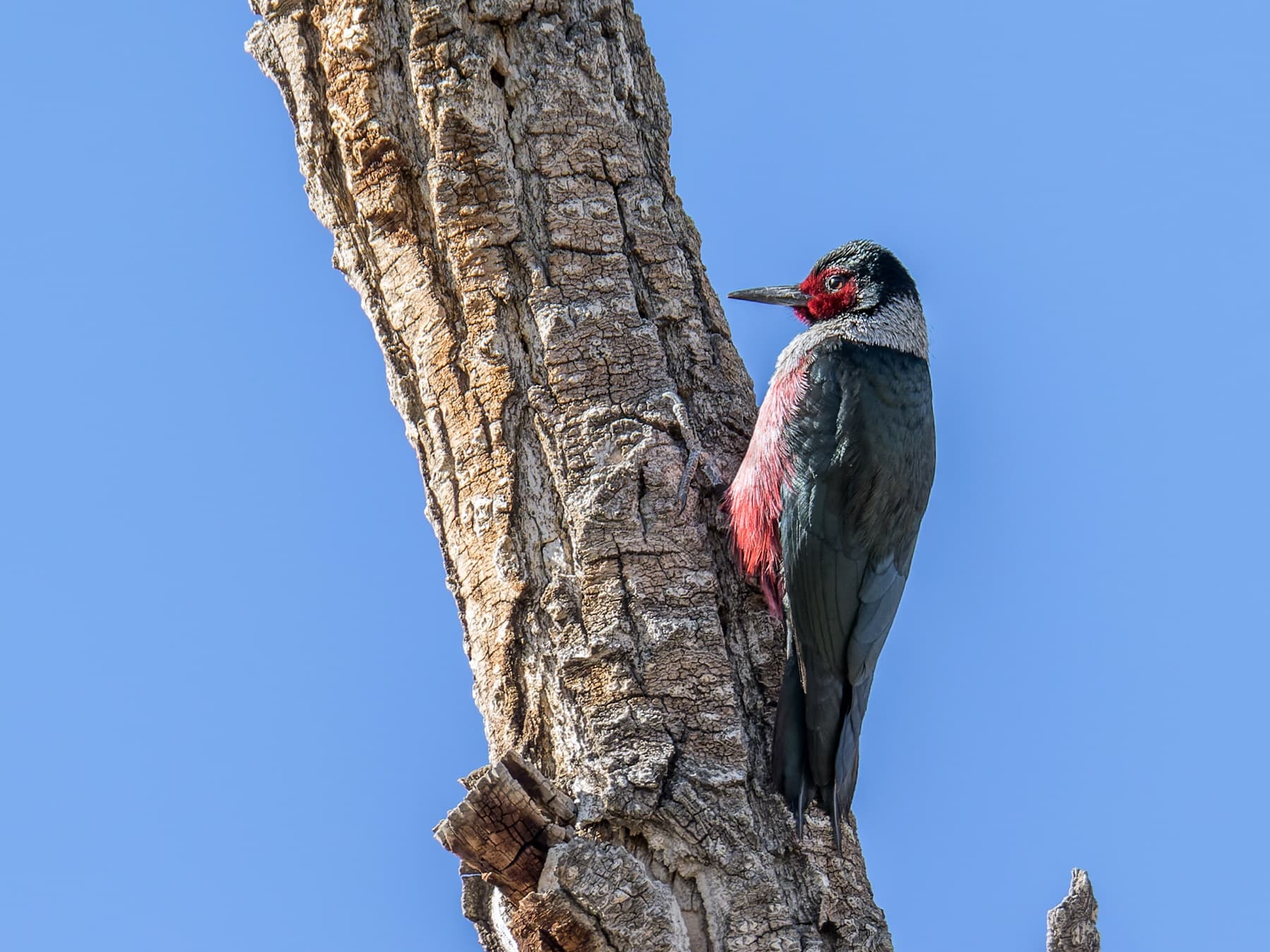
Like all woodpecker species, Lewis’s woodpeckers are cavity nesters and lay their eggs in hollowed-out chambers in dead or rotting tree trunks. Unlike many other species, they rarely excavate their own chambers, choosing instead to reuse abandoned holes made by other birds, or finding naturally formed hollows in cracks and crevices in dead wood.
No lining material is added to the nest chambers, apart from a layer of wood chips, often up to 8 cm (3 in) deep.
When do Lewis's Woodpeckers nest?
Eggs are laid between late April and June, with the peak laying period in May and early June. Incubation lasts for 12 to 16 days, and is shared between the sexes: males incubate overnight, while daytime shifts alternate between the pair. Hatchlings are fed in the nest by both parents and are ready to fledge between 28 and 34 days.
What do Lewis's Woodpecker eggs look like?
Lewis’s woodpecker eggs vary in shape and can be spherical, oval, or elliptical. They are plain white, measuring 26 mm by 20 mm (1 in by 0.8 in). A typical clutch contains 3 to 7 eggs, with 4 to 6 most common.
Do Lewis's Woodpeckers mate for life?
Lewis’s woodpeckers are assumed to be monogamous during the breeding season, with some evidence of pair bonds lasting for four consecutive seasons.
Behaviour
Are Lewis's Woodpeckers aggressive?
Known to be aggressive and particularly possessive over access to their food stores, Lewis’s woodpeckers use posturing, chattering calls, and confrontational flight to drive off challengers. These confrontations reach a peak in winter months, with other woodpecker species attempting to raid stores of acorns that have been cached by Lewis’s woodpeckers earlier in the year.
Where do Lewis's Woodpeckers sleep at night?
Roosting cavities in trees are used overnight, offering shelter and safety from attacks by predators. Old cavities drilled out by other species and naturally occurring crevices are both used by single Lewis’s woodpeckers.
Lifespan and predators
How long do Lewis's Woodpeckers live?
Only sketchy data is available for the lifespan and first breeding age of Lewis’s woodpeckers, due to the absence of records of banded individual birds being recaptured at a later date. A maximum average lifespan of around 10 years is assumed.
What are the predators of Lewis's Woodpeckers?
Hawks appear to be the most common predators of Lewis’s woodpeckers, with sharp-shinned, Cooper’s, and red-tailed hawks noted to prey on fledglings. Kestrels and ravens are also a threat, particularly to young birds, while weasels are known to target eggs and nestlings.
Are Lewis's Woodpeckers protected?
Lewis’s woodpeckers are included in the Migratory Bird Treaty Act of 1918, which offers protection to the species against being killed, injured, or captured for sale. Their nests, young, and eggs are also protected under this legislation. In Canada, Lewis’s woodpeckers are included for protection by the Species at Risk Act.
Are Lewis's Woodpeckers endangered?
Despite witnessing small population declines in the last 40 years, Lewis’s woodpeckers are rated as a species of least concern globally. In Canada, declines of up to 82 percent have been observed from 1966 to 2015, and less than 1000 individuals are now present in the country, leading to the species being registered as ‘threatened’.
Conservation
Although classified as Least Concern, the Lewis's Woodpecker faces threats to habitat loss and degradation. Conservation efforts focus on preserving mature forest stands and maintaining snags for nesting.
Climate change and competition with European Starlings for nest cavities pose additional challenges.
More photos
3 photos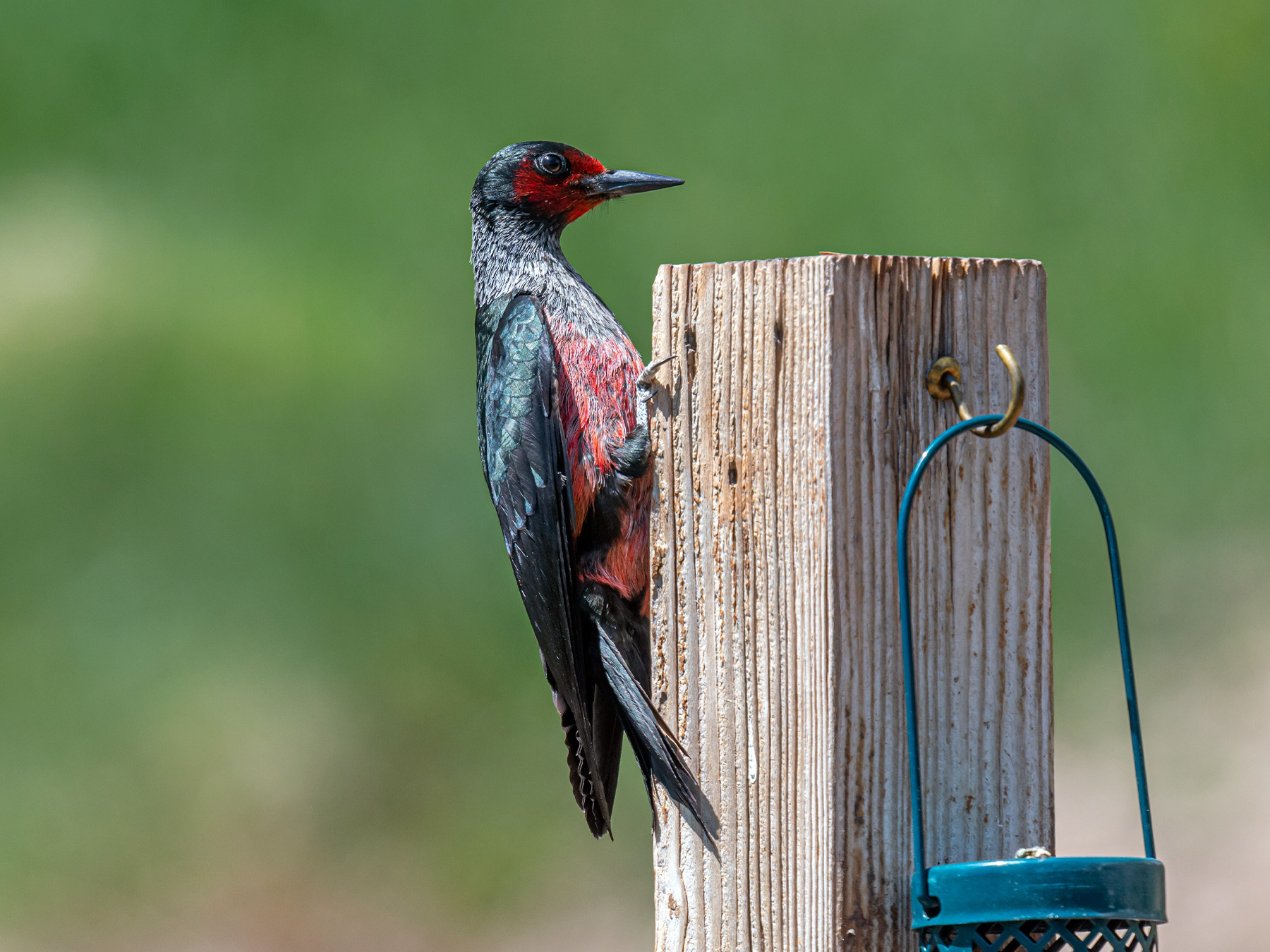
Quick facts
- Length
- 26–28 cm
- Wingspan
- 49–52 cm
- Weight
- 88–138 g
- Lifespan
- 5–7 years
- Family
- Woodpeckers
- Migration
- Partial migrant
- Global status (IUCN)
- Least Concern
- World population
- 82,000 mature individuals
- Population trend
- Decreasing
- Also called
- Lewis Woodpecker
- Scientific name
- Melanerpes lewis
Questions
4Are Lewis's Woodpeckers protected in the US?
Under the 1918 Migratory Bird Treaty Act, Lewis’s woodpeckers are protected from being killed, injured, or traded for sale in the United States. It is also unlawful to destroy or damage a nest site or to take eggs or young from the wild.
What attracts Lewis's Woodpeckers?
Lewis’s woodpeckers seek dead or decaying trees in which to nest, so leaving any dying tree to rot naturally will increase the chances of the arrival of these birds. Try not to get your hopes up, as they rarely visit backyard feeders, but may occasionally turn up and feast on suet.
Why are they called the Lewis’s Woodpecker?
Lewis’s woodpeckers are named after American explorer Meriwether Lewis, who with William Clark was the first to describe the species during the 1805 expedition to explore lands acquired during the Louisiana Purchase. Ornithologist Alexander Wilson named the bird ‘Lewis’s woodpecker’ in 1811.
When did Lewis and Clark discover the Lewis’s woodpecker?
The first record of an observation of a bird thought to be the Lewis’s woodpecker during the Lewis and Clark expedition was by Meriwether Lewis on 20 July 1805. Notes from the expedition recorded his experience in the following words: “I saw a black woodpecker (or crow) today… it is a distinct species of woodpecker; it has a long tail and flys a good deal like the jay bird”.
Sources
3- 1BirdLife International. 2016. Melanerpes lewis. The IUCN Red List of Threatened Species 2016: e.T22680801A92879169. Source (opens in a new tab)
- 2Breeding Bird Survey and/or Christmas Bird Count: Butcher and Niven 2007
- 3Partners in Flight (2019) Source (opens in a new tab)

Checked by
Nathan Cope, founder and editor
Nathan founded Birdfact and leads its writers and contributors in the UK, the US and Canada. He has watched and studied birds for more than ten years, and checks every article and species guide before it’s published.