
Leach's Storm-petrel
Leach's Petrel · Hydrobates leucorhous
By the Birdfact teamChecked by Nathan Cope
On this page11 sections
How to recognise it
What do Leach's Petrels look like?
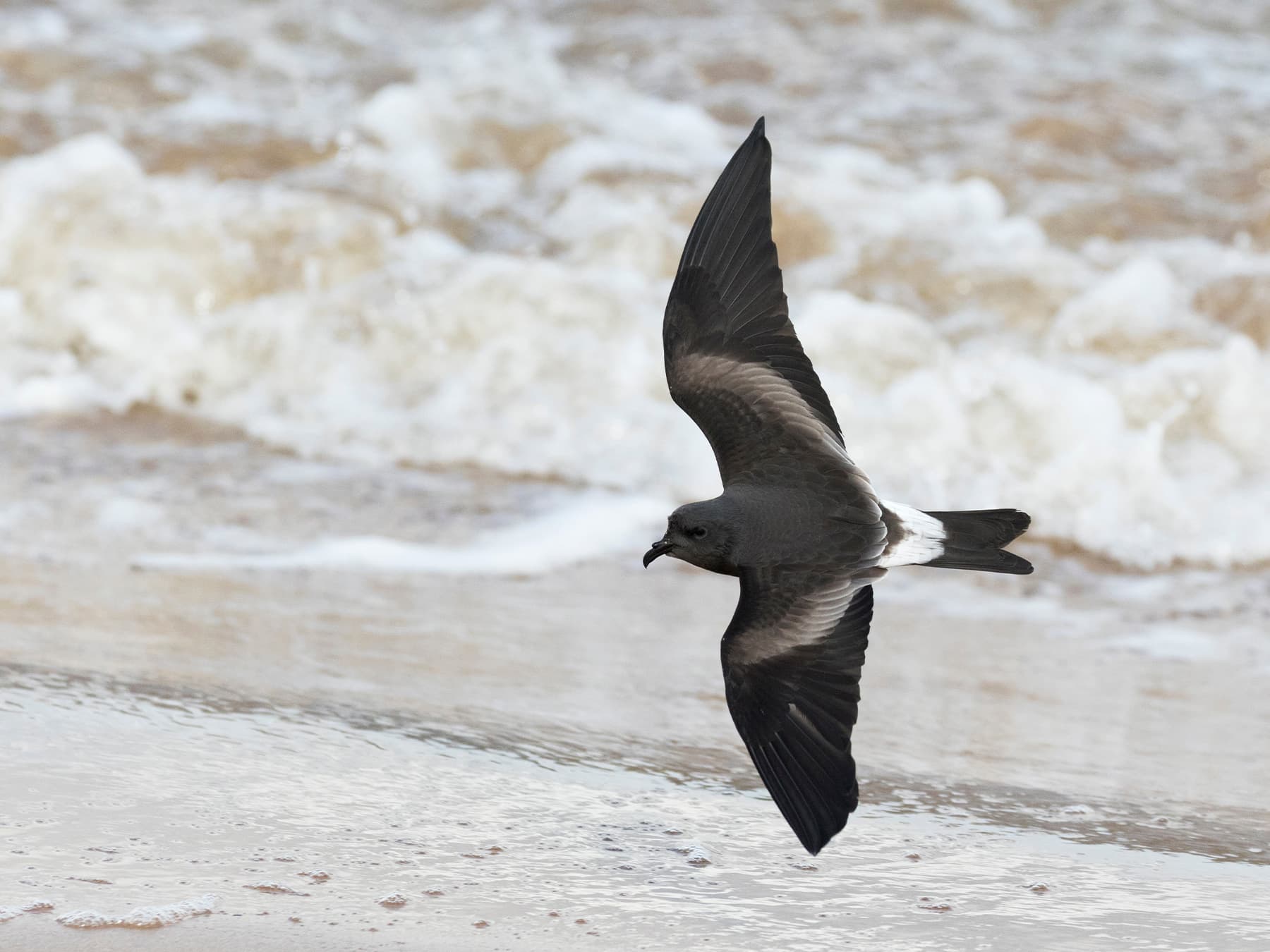
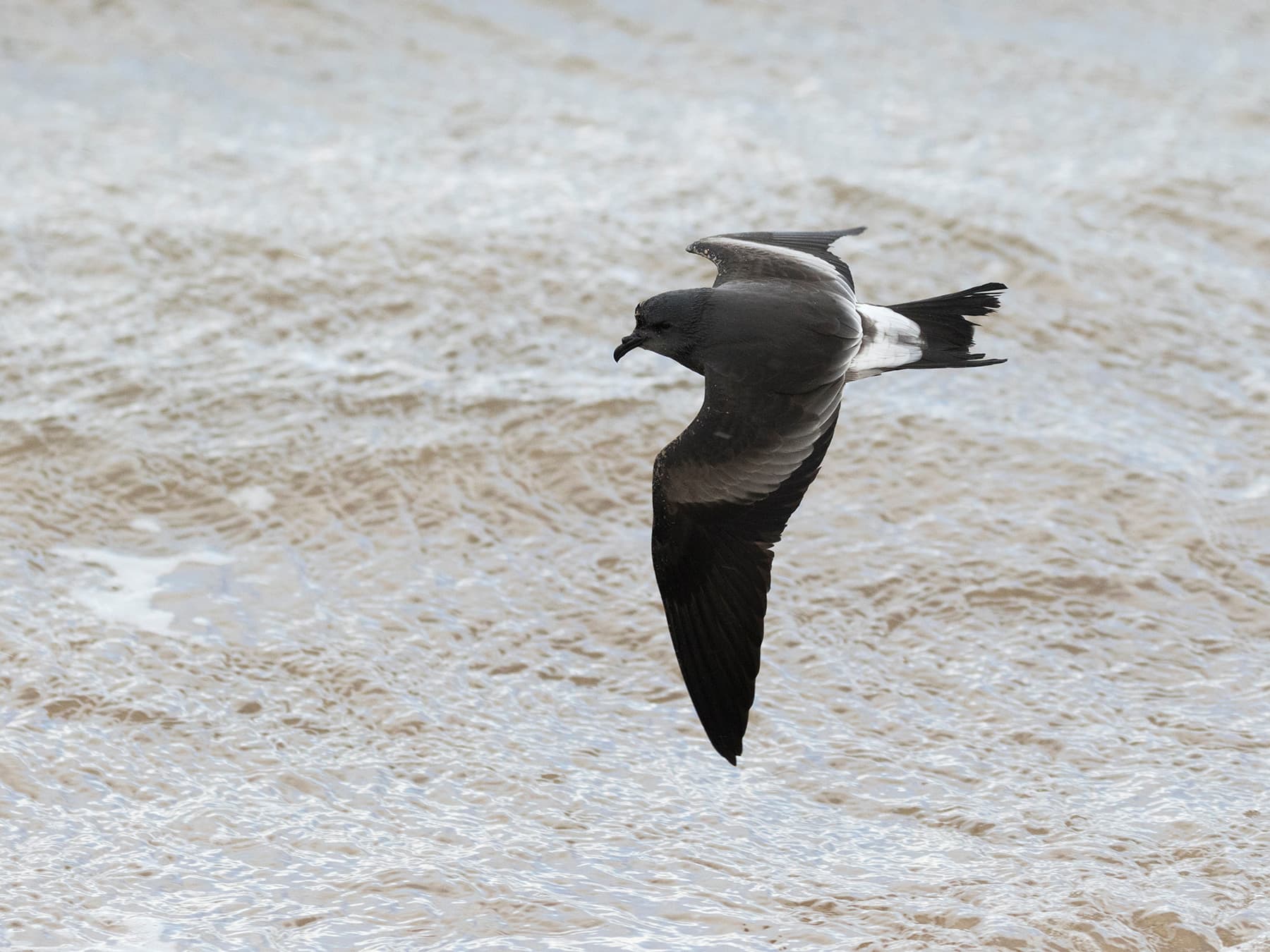
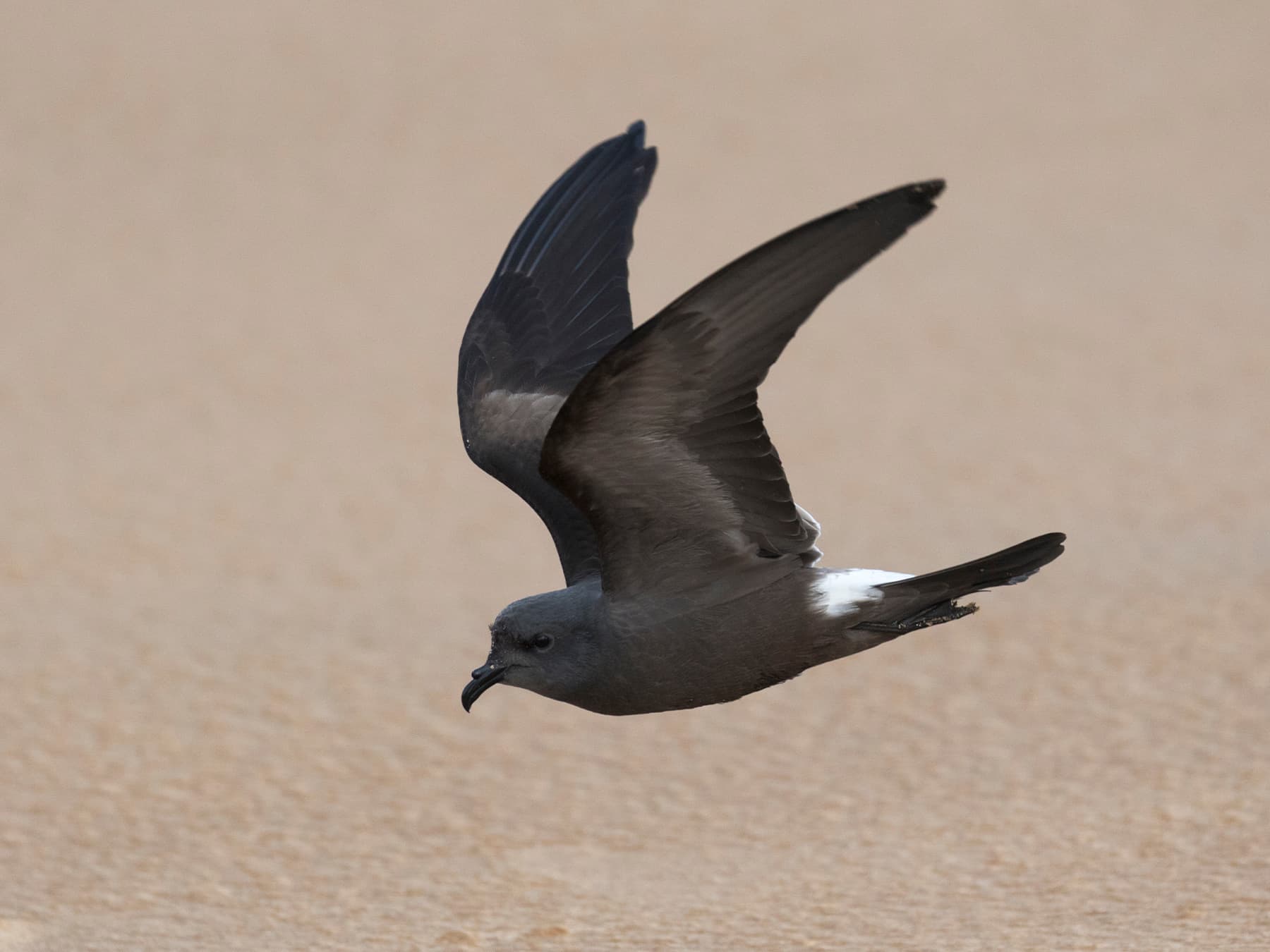
Male and female leach’s petrels are alike in appearance and size. They have angled wings, a short forked tail and tubelike nostrils at the top of their black hooked bill.
Leach’s petrels are a dusky black-brown, with a white rump patch visible in flight. Their upperparts have a grayish wash, and their wingtips and tail are darker. A pale wingbar runs diagonally from the bend in the wings.
Although Leach’s petrels do not molt into an alternative plumage post-breeding, their feathers develop a browner, worn appearance.
Juvenile Leach’s petrels have the same plumage as adults and are initially very heavy and rounded, but slim down ahead of their first winter migration and are only distinguished from adult birds as their coloring is richer and less worn.
How big are Leach's Petrels?
Leach’s petrels are relatively small seabirds, larger than the European petrel and Wilson’s storm-petrel. Male and female Leach’s petrels are the same size and weight, making it impossible to tell them apart on sight.
- Length: 19 cm to 22 cm (7.9 in to 8.7 in)
- Wingspan: 45 cm to 48 cm (17.7 in to 18.9 in)
- Weight: 40 g to 50 g (1.4 g to 1.8 g)
Its size
Adults- Length
- 18–21 cm
- Wingspan
- 43–48 cm
- Weight
- 35–50 g
Its song and calls
What sound does a Leach's Petrel make?
Chattering calls can be heard on the ground at breeding colonies as well as in flight overhead. Purring sounds are made within breeding burrows both while incubating and post-hatching. A harsh shrieking cry signals alarm or distress at the presence of a threat or predator.
- Song and calls0:00 / 0:08
Recorded in Nova Scotia, Canada · June 2022
- Call0:00 / 0:30
Recorded in Nova Scotia, Canada · July 2024
When and where to see it
OctoberIn season
Most recorded in October
- 1. Clare0.12%
- 2. Northamptonshireunder 0.1%
- 3. Eilean Siarunder 0.1%
- 4. Fifeunder 0.1%
- 5. Edinburghunder 0.1%
Each dot is a county, state or province: the bigger and darker, the larger the bird’s share of that place’s bird records that month. Grey dots: no regular records. The ringed point is the centre of the bird’s records this month; the arrow shows how it moved since last month, and the dashed loop its path through the year. “Arrivals” colours places where it becomes regular this month (orange) or is in its last regular month (grey). GBIF eBird Observation Dataset, 2019–2024. Map data: Natural Earth, US Census Bureau; place centres © OpenStreetMap contributors.
In your area
See when the Leach's Storm-petrel is recorded in your county, state or province.
How often the Leach's Storm-petrel turns up in the UK, Ireland, the United States and Canada through the year, from birdwatchers' records.
United Kingdom
Passage migrant · regularly Jul–Dec · most records in November
Ireland
Passage migrant · regularly Aug–Oct · most records in August
United States
Summer visitor · regularly Apr–Oct · most records in August
Canada
Summer visitor · regularly May–Nov · most records in August
Show as a table
| Month | United Kingdom | Ireland | United States | Canada |
|---|---|---|---|---|
| January | <0.001% | – | <0.001% | – |
| February | <0.001% | – | <0.001% | <0.001% |
| March | <0.001% | – | <0.001% | – |
| April | <0.001% | – | 0.001% (regular) | <0.001% |
| May | <0.001% | – | 0.003% (regular) | <0.001% (regular) |
| June | <0.001% | <0.001% | 0.005% (regular) | 0.004% (regular) |
| July | 0.001% (regular) | – | 0.009% (regular) | 0.007% (regular) |
| August | 0.001% (regular) | 0.057% (regular) | 0.019% (regular) | 0.015% (regular) |
| September | 0.006% (regular) | 0.043% (regular) | 0.009% (regular) | 0.014% (regular) |
| October | 0.004% (regular) | 0.012% (regular) | 0.002% (regular) | 0.004% (regular) |
| November | 0.007% (regular) | 0.003% | <0.001% | 0.002% (regular) |
| December | <0.001% (regular) | – | <0.001% | <0.001% |
Recorded regularly in
Worldwide: recorded regularly in 26 countries
Countries where it was recorded in at least 3 of the 6 years 2019–2024. Linked countries have their own bird list.
Europe (14)
Africa (2)
- Cape Verde
- Senegal
Asia (1)
North America (7)
South America (2)
- Ecuador
- French Guiana
Data: EOD – eBird Observation Dataset (Cornell Lab of Ornithology), accessed via GBIF.org, CC BY 4.0. Records from 2019–2024, aggregated and filtered by Birdfact. How these lists are made
What is the habitat of a Leach's Petrel?
Leach’s petrels breed on islands that are as free as possible from land predators, with remote offshore islands with adequate soil for borrowing a popular choice. Sometimes rocky crevices are used if the landscape is lacking soil.
They feed out at sea in deep water over the continental shelf, undertaking mammoth journeys of up to 800 km (500 mi) to foraging grounds before returning to their colonies.
Winters are spent at sea, and once breeding is complete, Leach’s petrels do not come inland unless blown off-course by strong and stormy weather.
What is the range of a Leach's Petrel?
Leach’s petrels breed on remote, offshore islands across the entire northern hemisphere, including Atlantic islands in the Atlantic Ocean from Norway westwards to Massachusetts and on islands in the Pacific Ocean from Baja California east to Hokkaido, Japan. No breeding occurs in Greenland.
Once breeding is finished, Leach’s petrels leave their breeding grounds and disperse southwards to spend winter months at sea, as far south as the tropical oceans.
Where do Leach's Petrels live?
Among the largest breeding settlements of Leach’s petrels are the Newfoundland islands of Baccalieu Island, with 1.95 million pairs, Great Island, with 134,139 pairs and Gull Island, with 179,743 pairs, in eastern Canada.
Colonies on Daikoku Island in Japan are home to 276,000 breeding pairs, and up to a further million pairs breed at Buldir Island in Alaska’s Aleutian Islands.
The wide winter dispersal of Leach’s petrels makes it particularly difficult to estimate populations in different parts of the world. Between 300,000 and 2 million birds spend winter in the Bay of Biscay between France and Spain.
How rare are Leach's Petrels?
The global population of Leach’s petrels was estimated at 20 million in 2004, and more recently estimated at between 6.7 and 8.3 million breeding pairs. So while they are a numerous species and have a large distribution range, particularly during the non-breeding season, sightings are rare due to their preferred surroundings of ocean waters far from land and their nocturnal habits on breeding grounds.
On a handful of UK islands, Leach’s petrels are not uncommon, with around 48,000 breeding pairs on islands off the northern and western coasts of Scotland.
Where can you see Leach's Petrels in the US?
Leach’s petrels breed in Alaska’s islands, as well as off the Pacific Coast from Washington to California. Alaska’s Buldir and Chagaluk islands have 900,000 and 250,000 breeding pairs respectively, and Oregon’s offshore islands welcome around 241,000 pairs annually.
On the east coast, some smaller-scale breeding also takes place on the Atlantic islands offshore of Massachusetts and Maine. As they are nocturnal birds when breeding, sightings are not common.
Where can you see Leach's Petrels in Canada?
Newfoundland is home to the world’s largest breeding colony of Leach’s petrels: Baccalieu Island welcomes up to 1.95 million pairs, estimated to be around 25 percent of the global population.
Where can you see Leach's Petrels in the UK?
The best time of year for spotting a Leach's petrel is autumn, as birds are migrating towards tropical seas. Strong winds frequently blow petrels closer to shore, so look for them after stormy weather, particularly along the south coast of England and the north coast of Wales. Breeding in the UK is limited to five sites in the Western Isles, including the St Kilda archipelago and the Flannan Isles and two islands in Shetland.
Migration
Do Leach's Petrels migrate?
Leach’s petrels leave their breeding grounds once their young are independent and head to tropical ocean waters where they spend the winter months out at sea.
Why do Leach's Petrels migrate?
Leach’s petrels only come inland during the breeding season and survive on a diet of marine fish during winter months. They have no need to be ashore once breeding has finished and the tropical oceans support all their feeding requirements until they return north the following spring.
Tips for seeing it
- Look for Leach's Storm-petrels far offshore, especially during storms or strong winds
- Observe their distinctive flight pattern: erratic and bat-like with rapid wingbeats
- Listen for their eerie, chuckling calls at night near breeding colonies
- Join pelagic birding trips for the best chances of spotting these elusive seabirds
What it eats
What do Leach's Petrels eat?
The main prey of Leach’s petrels includes fish, crustaceans, squid, octopus and jellyfish. Chief fish species eaten are rockfish, sand lance and cod.
What do Leach's Petrel chicks eat?
Leach’s petrels initially regurgitate an oily substance produced in their own stomachs into the bills of their young. After a few days, partially digested shrimp and squid, coated in the same musky stomach oils, are also added to their diet.
Nesting and breeding
Where do Leach's Petrels nest?
Males build nest burrows into the earth at breeding colonies, always at night and under cover of darkness. Soil is scooped out using the bill and feet, and a burrow of around 45 cm (18 in) long and 13 cm (5 in) deep is created. Some lining material may be added, such as moss, grass, or twigs. Burrows may be reused by returning pairs the following year.
When do Leach's Petrels nest?
The peak laying time for Leach petrels falls in late May to mid-June, although the further north, the later in the year nesting begins. Incubation is shared between both mates, with males taking longer shifts, lasting around 3 days at a time. Hatching begins after between 32 and 50 days.
What do Leach's Petrel eggs look like?
A single egg is laid each season, measuring 33 mm by 24 mm (1.2 in by 0.9 in). Eggs are creamy white in color and speckled with reddish-purple flecks.
Do Leach's Petrels mate for life?
It’s common for leach petrel pairs to reunite and breed together at the same nest site for several successive years. If a previous breeding attempt has been successful, it is likely that the pair bond will be strong and they will breed together again the following year. The longest-recorded pair bond survived for 22 years.
Behaviour
Are Leach's Petrels aggressive?
Leach’s petrels are communal nesters, raising their young in colonies that range from a couple of pairs to up to 2 million pairs. No territorial behavior is displayed and leach’s petrels are regularly observed foraging in flocks.
Where do Leach's Petrels sleep at night?
During winter, Leach’s petrels are thought to roost on the waves out at sea. During the breeding season, adults sleep in burrows on land while incubating eggs or brooding young.
Lifespan and predators
How long do Leach's Petrels live?
Leach’s petrels have an average life expectancy of around 13 years, although the oldest recorded individual reached 29 years and 5 months. They breed for the first time from 5 years old, although pairs may form a couple of years before the first breeding attempt.
What are the predators of Leach's Petrels?
During the breeding season, land mammals are a serious threat to Leach’s petrels. Nest burrows are frequently dug up by rats, dogs, cats, pigs, and Arctic and red foxes. Several owl species, including little owls, barn owls, long-eared owls and great-horned owls, are known avian predators on breeding grounds.
At sea, sharks can pose a major threat to Leach’s petrels in tropical waters.
Are Leach's Petrels protected?
Leach’s petrels are protected by the Canadian Migratory Birds Convention Act of 1994 and the Migratory Bird Treaty Act of 1918 in the United States. In the UK, similar protection is given to the species as Schedule I birds on the Wildlife and Countryside Act, 1981, making it an offense to destroy or damage their nests, young, or eggs, and kill, injure, or capture an adult bird.
Are Leach's Petrels endangered?
Leach’s petrels are rated as a Vulnerable species on the IUCN list, and classified as Near-Threatened under the Species of European Conservation Concern framework. In the UK, Leach’s petrels have Red status on the British Birds of Conservation Concern list. Numbers are hard to estimate due to the wide range and offshore wintering grounds, but estimates suggest significant declines since the 1990s.
Conservation
Leach's Storm-petrel is classified as Vulnerable due to significant population declines. Major threats include predation by introduced mammals at breeding sites, light pollution causing disorientation, and climate change affecting food availability. Conservation efforts focus on predator control and habitat protection on breeding islands.
Quick facts
- Length
- 18–21 cm
- Wingspan
- 43–48 cm
- Weight
- 35–50 g
- Lifespan
- 20–25 years
- Family
- Storm Petrels
- Migration
- Long-distance Migrant
- Global status (IUCN)
- Vulnerable
- World population
- 20,000,000 individuals
- Population trend
- Decreasing
- Also called
- Leach's Petrel
- Scientific name
- Hydrobates leucorhous
Sources
3- 1BirdLife International. 2018. Hydrobates leucorhous. The IUCN Red List of Threatened Species 2018: e.T132438298A132438484. Source (opens in a new tab)
- 2Huntingdon et al. 1996, Lormee et al. 2012, BirdLife International 2015, Environment Canada unpublished data, Japanese Ministry of Environment, unpublished data
- 3Brooke (2004)

Checked by
Nathan Cope, founder and editor
Nathan founded Birdfact and leads its writers and contributors in the UK, the US and Canada. He has watched and studied birds for more than ten years, and checks every article and species guide before it’s published.