


Lavender Waxbill
Lavender Finch, Red-tailed Waxbill · Glaucestrilda coerulescens
By the Birdfact teamChecked by Nathan Cope
On this page11 sections
How to recognise it
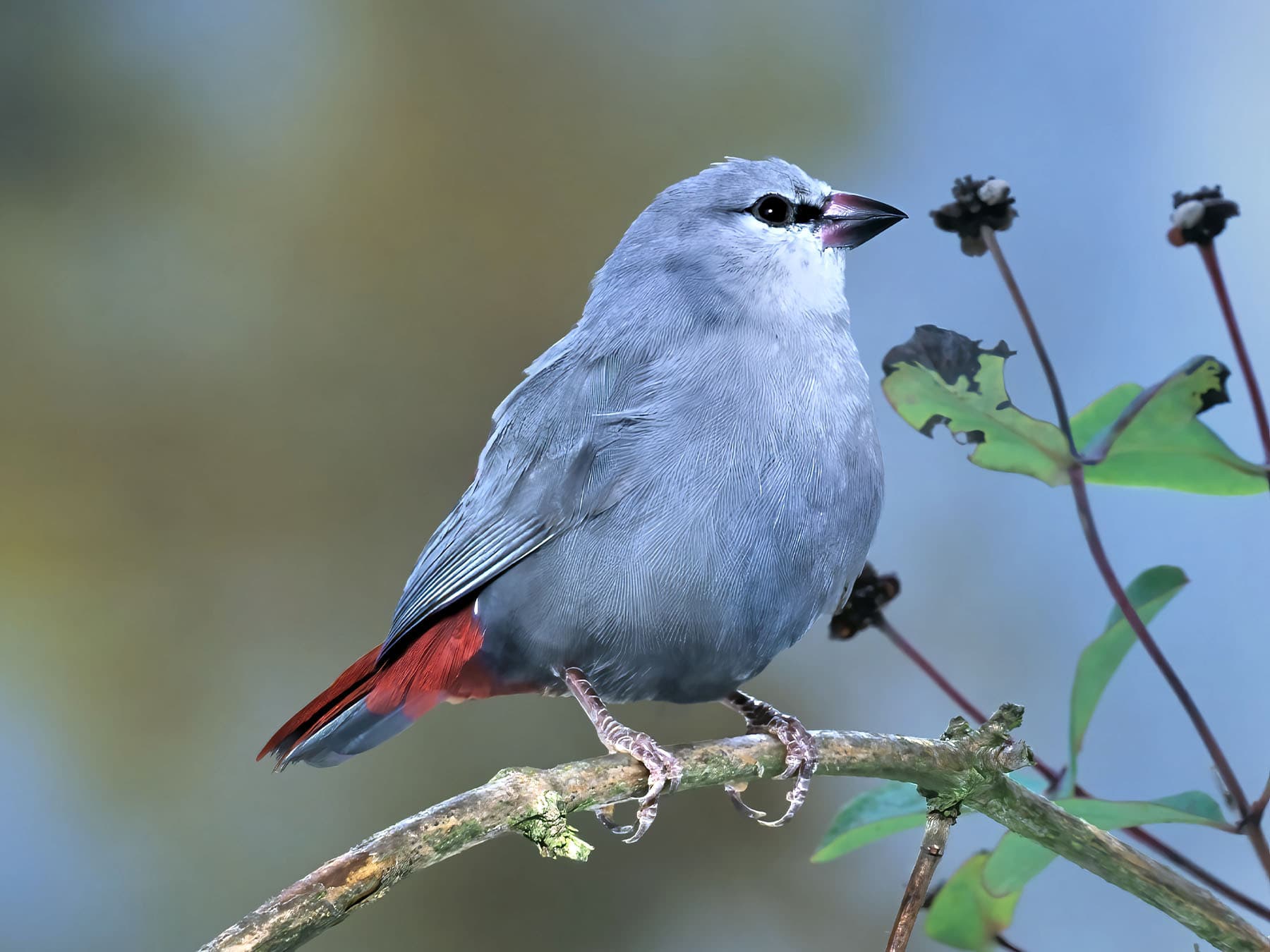
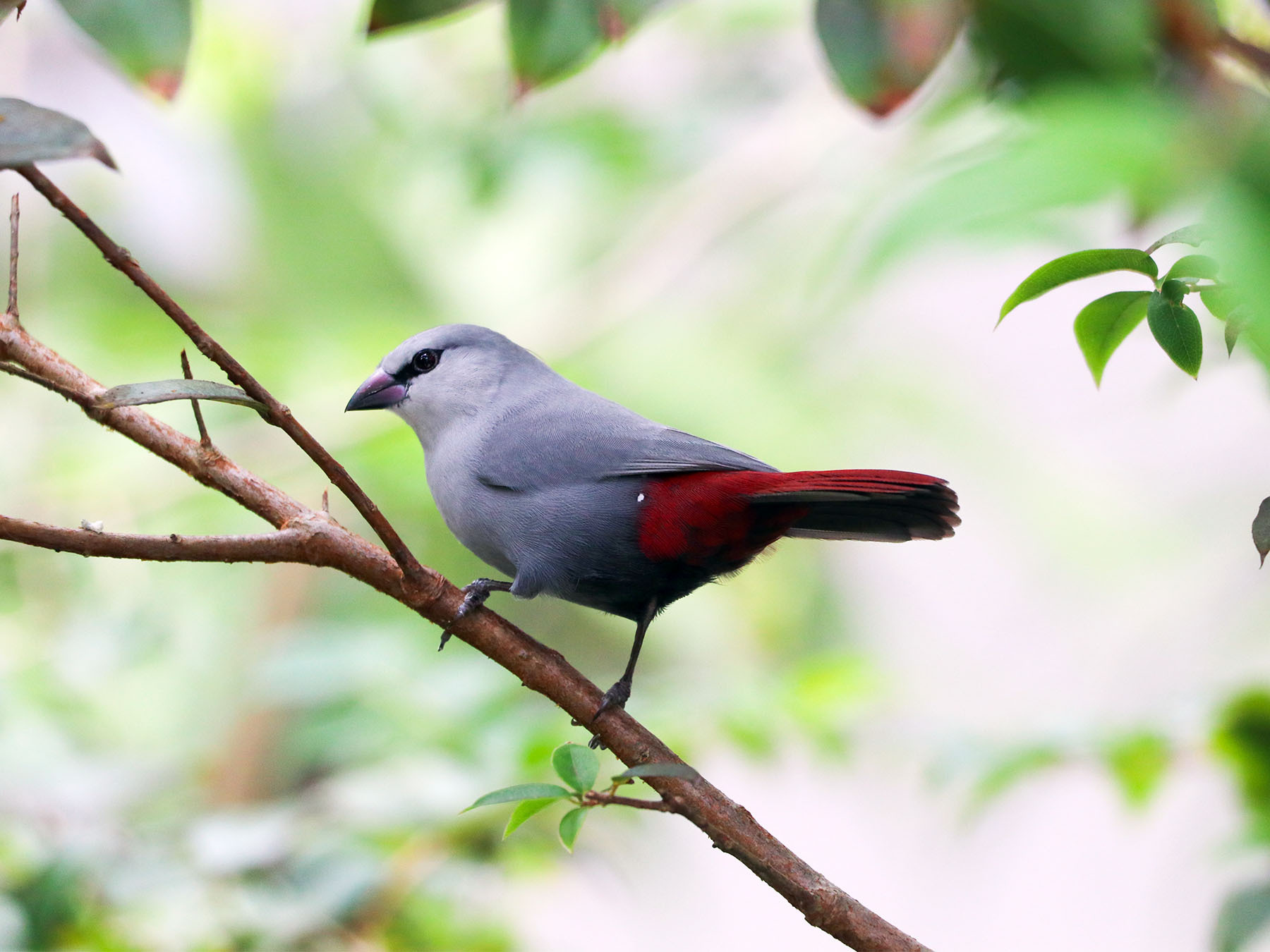
The Lavender Waxbill is a tiny, slender finch with a distinctive lavender-grey plumage that covers most of its body. Its face, throat, and upper breast are washed with a soft blue tint, while the top of the tail and undertail coverts are red.
Both sexes look mostly similar, with a small, bright, pinkish-grey beak, a small black stripe across the eyes and black legs. Females usually have darker underparts, although its hard to tell the sexes apart.
Juveniles have paler plumage, no black eyestripe and less red colouring on the undertail coverts and tail.
Its size
Adults- Length
- 9–10 cm
- Wingspan
- 12–14 cm
- Weight
- 8–15 g
Its song and calls
The Lavender Waxbill has a high-pitched, thin voice. Their most common call is a soft, sweet 'tseee-tseee' or 'tsit-tsit'.
During courtship, males produce a more complex song, a series of rapid, tinkling notes that sound like 'tsee-tsee-tsee-tseewee-tseewee', often accompanied by their bouncing dance.
When and where to see it
The Lavender Waxbill is not recorded regularly in the UK, Ireland, the United States or Canada.
United States: recorded in 6 of the 6 years. Too few years to count as a regular visitor.
Worldwide: recorded regularly in 8 countries
Countries where it was recorded in at least 3 of the 6 years 2019–2024. Linked countries have their own bird list.
Africa (8)
- Burkina Faso
- Gambia
- Ghana
- Guinea
- Guinea-Bissau
- Mali
- Nigeria
- Senegal
Data: EOD – eBird Observation Dataset (Cornell Lab of Ornithology), accessed via GBIF.org, CC BY 4.0. Records from 2019–2024, aggregated and filtered by Birdfact. How these lists are made
Tips for seeing it
- Look for small flocks in grassy areas near water sources
- Listen for their soft, high-pitched 'tseee-tseee' calls
- Observe their distinctive lavender-grey plumage and red beak
- Watch for their characteristic bouncing movements while foraging
What it eats
Lavender Waxbills primarily feed on small grass seeds, which they gather from the ground or directly from seed heads.
They supplement their diet with insects, especially during the breeding season when protein-rich food is essential for chick development. They often forage in mixed-species flocks.
Nesting and breeding
Breeding occurs during the rainy season, which varies across their range (August to September in Senegal and Gambia, October to November in Nigeria). Lavender Waxbills form monogamous pairs and engage in mutual preening and courtship feeding before mating.
The nest is a large, domed structure made of fine grasses with a side entrance. It's typically built in low bushes or tall grass, often near the ground. The female lays 4-6 small white eggs.
Both parents share incubation duties for about 11-12 days. The chicks fledge after approximately 17-21 days but continue to be fed by their parents for several weeks after leaving the nest.
Behaviour
Lavender Waxbills are highly social birds, often seen in small flocks of 10-20 individuals, sometimes with other finches. They forage on the ground, moving with quick, jerky movements as they search for seeds.
During courtship, males perform a bouncing dance, holding a piece of grass in their beak while singing to attract females.
Conservation
While the Lavender Waxbill is currently listed as Least Concern, habitat loss due to agricultural expansion and overgrazing poses a potential threat.
Conservation efforts focus on preserving grassland and savannah habitats, which are crucial for this species and many other African birds.
More photos
2 photos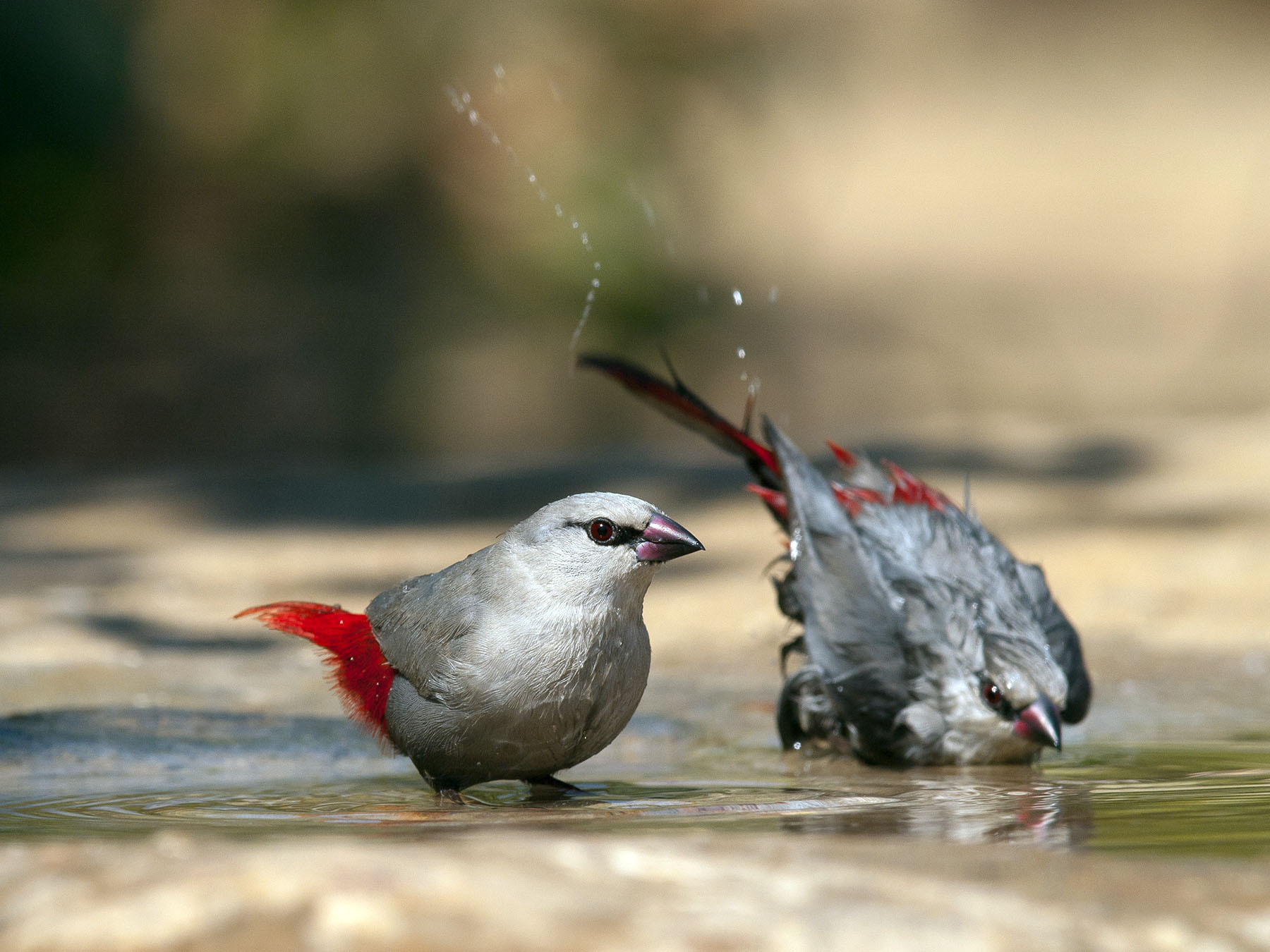
Quick facts
- Length
- 9–10 cm
- Wingspan
- 12–14 cm
- Weight
- 8–15 g
- Lifespan
- 5–7 years
- Family
- Waxbills & Finches
- Migration
- Resident
- Global status (IUCN)
- Least Concern
- World population
- Not quantified, but reported to be uncommon to common
- Population trend
- Stable
- Also called
- Lavender Finch, Red-tailed Waxbill
- Scientific name
- Glaucestrilda coerulescens
Sources
3- 1BirdLife International. 2018. Estrilda coerulescens. The IUCN Red List of Threatened Species 2018: e.T22719518A131994177. Source (opens in a new tab)
- 2BirdLife International. 2018. Estrilda coerulescens. The IUCN Red List of Threatened Species 2018: e.T22719518A131994177. Source (opens in a new tab)
- 3Fry and Keith (2004)

Checked by
Nathan Cope, founder and editor
Nathan founded Birdfact and leads its writers and contributors in the UK, the US and Canada. He has watched and studied birds for more than ten years, and checks every article and species guide before it’s published.