Species Profile
King Eider
Somateria spectabilis
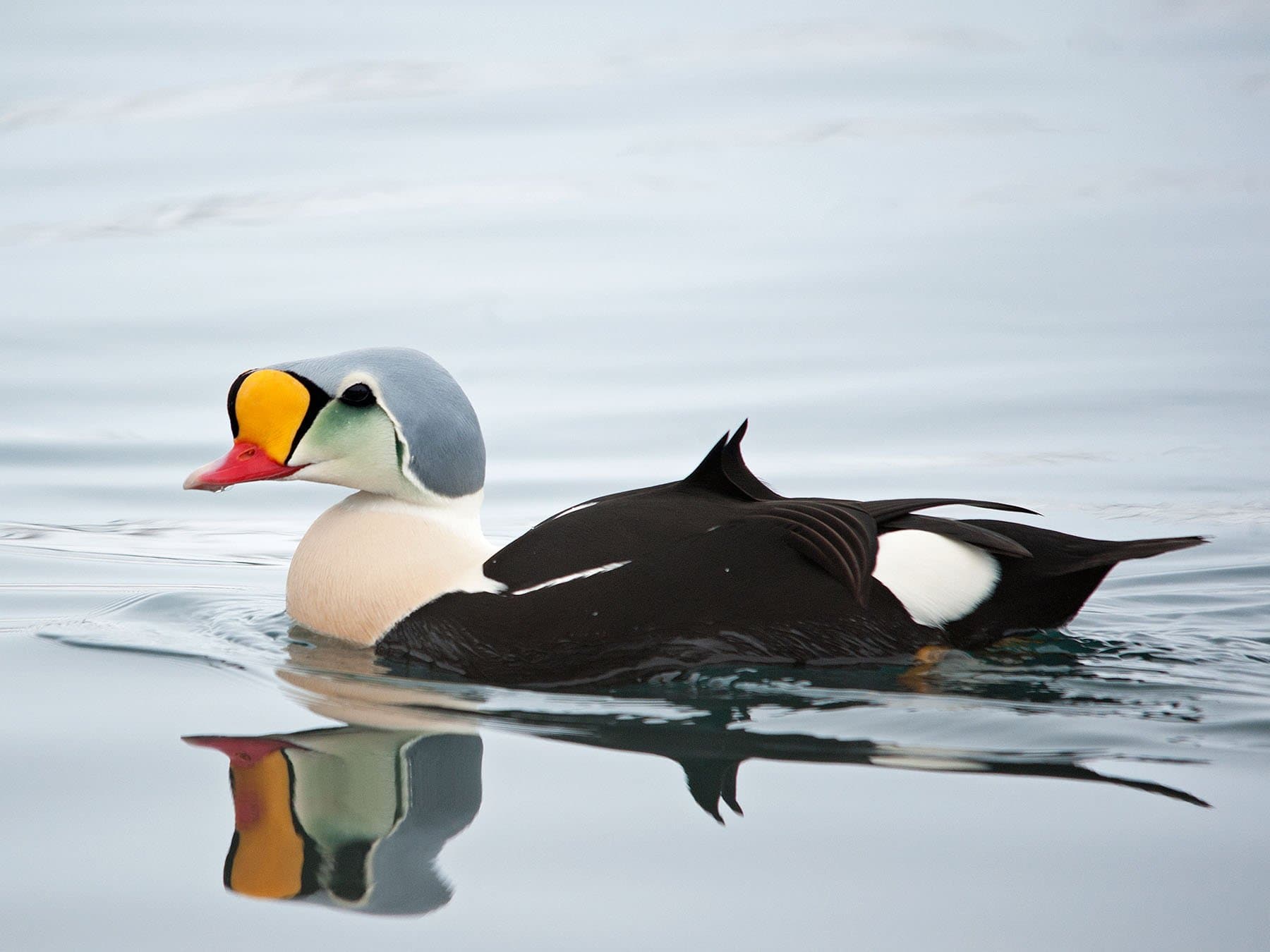
King Eider swimming in calm water, showing its distinctive yellow, red, blue-grey, and green head plumage with a black and white body.
Quick Facts
Conservation
LCLeast ConcernLifespan
10–18 years
Length
46–64 cm
Weight
1200–2100 g
Wingspan
86–102 cm
Migration
Long-distance Migrant
No other duck wears a frontal knob like a crown, curves jet-black scapular feathers into twin sails above its back, or migrates in flocks so dense that 360,000 birds can stream past a single headland in ten hours. The King Eider is an Arctic specialist of extraordinary plumage and remarkable physical capability — and one of the most sought-after waterfowl on Earth.
Appearance
The breeding male King Eider is unmistakable. His body is predominantly black, with a buff-tinged white breast and a large white patch across the wing coverts. The head is a mosaic of colour: the crown, nape, and eyebrow stripe are pale bluish-grey, the cheeks are iridescent pale green, and the lower face and neck are white. The bill is bright red-orange, separated from the face by a thin black line, and topped by a large, distinctive yellow-orange frontal knob — the "shield" — rimmed in black.
The feet are yellow with blackish nails. Most distinctive of all are two elongated black scapular feathers that curve upward from the back, forming a pair of vertical "sails". No other duck species possesses these. The genus name Somateria means "woolly body" — a reference to the famously dense, insulating down — while the species name spectabilis is Latin for "showy" or "worth seeing".
In eclipse plumage, worn from mid-summer through early autumn, the male becomes dull grey-brown overall, similar to the female. He retains a white patch on the forewing and rump, the bill fades to pale orange, and the frontal knob shrinks. Full adult breeding plumage takes three years to develop. Juvenile birds of both sexes are pale buffy-brown with black-olive streaks along the sides, a grey chin and throat, a blackish back and rump, and barred breast feathers; the sails are absent. Late in their first autumn, young males begin moulting into a darker plumage with white on the breast and rump.
The female is warm reddish-brown overall, slightly paler on the head and neck. Her feathers have dark brown to black centres outlined in tawny brown, creating a distinctive scalloped or chevron pattern — not the barred pattern of female Common Eiders. She has a buffy spot at the base of her bill, a buffy eye ring, and a downward-curving buff stripe behind the eye — details confirmed by primary sources including Animal Diversity Web and Birds of the World.
Her bill is olive or yellowish-grey with a less pronounced frontal lobe than the male's. Compared to female Common Eiders, female King Eiders have a rounder, more compact head, a shorter bill, and a distinctive upturned "smiling" gape line visible at close range.
Identification & Characteristics
Male Colors
- Primary
- Black
- Secondary
- White
- Beak
- Orange
- Legs
- Yellow
Female Colors
- Primary
- Brown
- Secondary
- Brown
- Beak
- Olive
- Legs
- Grey
Male Markings
Breeding male: large yellow-orange frontal knob (\"shield\") above the red-orange bill; pale blue-grey crown and nape; iridescent green cheeks; two elongated black scapular \"sail\" feathers curving upward from the back; large white wing covert patch. These sail feathers are unique among all duck species.
Tail: Short, rounded tail; in breeding males, the black tail contrasts with the white rump and flanks. In eclipse plumage, the tail is dull brown.
Female Markings
Warm reddish-brown overall with a distinctive scalloped or chevron pattern on the upperparts and flanks (not barred as in female Common Eider). Rounder, more compact head than female Common Eider; shorter bill with a visible upturned \"smiling\" gape line; buffy spot at the base of the bill and a buffy eye ring.
Tail: Short and rounded, dark brown, blending with the overall reddish-brown body plumage.
Attributes
Understanding Attributes
Rated 0–100 based on research and observation. A score of 50 is average across all bird species. These attributes are relative and don't necessarily indicate superiority.
Habitat & Distribution
The King Eider is a circumpolar Arctic species with a vast range spanning four continents. It breeds along the Arctic coasts of northeast Europe — Svalbard, northern Norway, and Russia from east of the White Sea to Chukotka — as well as across the Arctic Coastal Plain of Alaska, northern Canada (Northwest Territories, Nunavut, and associated Arctic islands), the west shore of Hudson Bay, and Greenland. Breeding habitat is varied Arctic tundra, both wet and dry, always close to water. Common plants in nesting areas include purple saxifrage, crowberry, bearberry, Labrador tea, dwarf birch, arctic willow, pendant grass, and various sedges.
Outside the breeding season, King Eiders are almost entirely marine. They prefer shallow seas averaging around 38 m depth, with low ice cover and low salinity, generally occurring about 11 km from shore. Unlike Common and Spectacled Eiders, King Eiders are restricted to waters with less than about 25% ice cover; if ice restricts access, they relocate to more open foraging areas. In Norway, they show a preference for cobble substrate at depths up to 40 m.
The North American population divides into two subpopulations. The Pacific population breeds from Alaska to the Queen Maud Gulf and winters in the Bering Sea — Olyutor and Bristol Bays, the Gulf of Alaska, and along the Alaska and Kamchatka Peninsulas. The Atlantic population breeds from Victoria Island east to Greenland and winters from Newfoundland and the Gulf of St. Lawrence south to New Jersey, with small numbers reaching the Great Lakes, especially Lake Ontario.
In the UK, the King Eider is a rare but annual vagrant, most frequently recorded in Scotland — particularly the Northern Isles (Shetland and Orkney) and the northeast coast — with occasional records in Northumberland, Norfolk, Suffolk, and Yorkshire. Birds typically appear between October and May, often associating with flocks of Common Eiders. Scanning eider flocks carefully along the Scottish coast in winter gives the best chance of finding one. In the US, the species occurs annually off the New England and mid-Atlantic coasts and throughout Alaska; rare strays have reached Florida, Louisiana, Kansas, and southern California.
Where to See This Bird
Explore regional guides for locations where this bird has been recorded.
Diet
For most of the year, the King Eider is a specialist benthic diver, targeting the invertebrate communities of the Arctic seafloor. Molluscs form the core of the marine diet — blue mussel, Icelandic scallop, Greenland cockle, and various sea snails among them. Crustaceans such as arctic lyre crab, hermit crabs, shrimp, and barnacles are also important, alongside echinoderms including green sea urchin, brittle stars, and sand dollar. The diet extends further to sea anemones, marine worms, bryozoans, hydroids, algae, and occasionally fish eggs from sculpin and lumpfish.
In the Great Lakes, birds have been recorded feeding on introduced zebra mussels — an opportunistic adaptation that illustrates the species' flexibility when familiar prey is available in unfamiliar settings. King Eiders dive to depths typically up to 55 m (180 ft), though most foraging occurs shallower; they have been caught in fishing nets at 50 m depth. They open their wings underwater to help manoeuvre while diving, a technique shared with other sea ducks.
The breeding season brings a dramatic dietary switch. On the tundra, insects and their larvae dominate: beetles, water bugs, caddisflies, stoneflies, midges, and various flies are all consumed. Aquatic invertebrates — marine worms, isopods, water fleas, fairy shrimp, and tadpole shrimp — supplement the insect intake. Some plant material is also eaten, including eelgrass, sedges, bur reeds, and aquatic mosses. On land, birds forage by tipping up, sieving, and probing in shallow freshwater environments rather than diving.
Behaviour
Outside the breeding season, King Eiders are highly gregarious, gathering in enormous flocks on Arctic and subarctic seas. Wintering aggregations can exceed 100,000 birds, often concentrated near the edge of pack ice or in open-water polynyas where benthic prey is accessible. The sexes tend to segregate during migration, with males typically moving earlier in both spring and autumn than females.
At sea, King Eiders spend most of their time diving for food, resting on the water between bouts. They are capable of diving to 55 metres (180 ft), using both feet and wings to manoeuvre underwater — a technique that allows them to forage on the seafloor in conditions that would defeat less powerful swimmers. During the vulnerable moulting period, Alaskan birds forage in coastal areas with silty benthic substrate at depths of 15–25 m, moving further offshore to rest at night.
On the breeding tundra, behaviour shifts markedly. Males are attentive to their mates during egg laying but abandon them once incubation begins, departing in groups to moulting areas at sea. Females incubate alone and sit extraordinarily tightly throughout — a commitment that reflects the short Arctic summer and the absence of any help from the male. Broods from multiple females often merge into crèches, with several adult females collectively tending the combined group of chicks.
King Eiders occasionally hybridise with Common Eiders in the wild, producing intermediate-plumaged birds that can confuse observers. Predators of eggs and young include glaucous gull, common raven, parasitic jaeger, and Arctic fox.
Calls & Sounds
The King Eider is not a particularly vocal species outside the breeding season, and its calls are softer and more varied than most people expect from a large sea duck. The male's song — given while sitting on the water during courtship displays in late winter and spring — is a soft, quavering, dove-like cooing, variously transcribed as "croo-croo-croo", "hoo-hoo-hooo", or "urrr, urrr". It is an unexpectedly gentle sound for such a boldly coloured bird, carrying little distance across the water.
The female is more vocally diverse. Her calls include a deep, rhythmic "gook-gook-gook", low clucks, grunts, growls, and a murmuring growl sometimes given in flight during migration. These calls serve a range of social functions — maintaining contact within flocks, coordinating brood behaviour, and signalling alarm. Both sexes may give threat displays that closely resemble courtship postures, making behavioural context important for correct interpretation in the field.
The vocal tract of King Eiders shows measurable sexual dimorphism, with males and females differing in allometry and bilateral asymmetry — a structural difference that underlies the contrast between the male's soft cooing and the female's gruff, guttural repertoire (Miller et al. 2007). Xeno-canto documents 17 foreground recordings of the species, including songs from displaying males and calls from females, providing a useful reference for anyone hoping to identify the species by ear in the field.
King Eiders are largely silent during the non-breeding season at sea, and large wintering flocks are often surprisingly quiet. The best chance of hearing the male's courtship call is on late-winter or spring migration, when paired birds are actively displaying on open water.
Flight
In flight, the King Eider is a powerful and direct flier, with the stocky, front-heavy silhouette typical of large sea ducks. The wings are relatively narrow and pointed, producing a fast, whirring wingbeat that carries the bird at speeds up to 64 km/h (40 mph) — faster still with a tailwind. Flocks typically fly low over the water in loose lines or irregular bunches rather than the tight formations of geese, though they may gain altitude when crossing land.
The male in breeding plumage is distinctive in flight: the large white wing covert patch contrasts sharply with the black back and flight feathers, and the pale head is visible at considerable distance. In eclipse plumage, the white forewing patch is retained and remains the most reliable feature for identifying a moulting male at range. Females are dark brown overall in flight, with whitish tips to the secondaries forming a faint wing bar — less bold than in Common Eider.
King Eiders migrate during daylight, in darkness, and through thick fog, demonstrating a navigational capability that does not depend on visual landmarks. Satellite tracking has confirmed that some individuals cross the Alaska Peninsula or the Kamchatka Peninsula at altitude, traversing mountain passes that would challenge many landbirds. Spring migrants past Point Barrow fly north over still-frozen seas, following leads and polynyas in the ice.
During the moulting period, King Eiders become temporarily flightless as they shed and regrow their flight feathers simultaneously. Birds gather in large, specific moulting areas — the western Beaufort Sea for western birds, Disko Island (Greenland) and Baffin Island for eastern birds — where they remain until flight is restored.
Nesting & Breeding
King Eiders are seasonally monogamous, forming new pair bonds each year during winter and spring migration. Most pairs are established before or during the northward journey to breeding grounds, with courtship taking place on the water. Several males may court a single female simultaneously, performing elaborate displays: turning the head rapidly from side to side, rearing up out of the water while rotating the head, flapping wings, stretching the neck, and calling softly.
Nest sites are selected by both sexes flying over the tundra together, with the female making the final choice. The nest is a shallow scrape in the ground, typically near a rock, hummock, or ridge, always concealed by low vegetation and close to water. Island nest sites offer considerably higher success rates than mainland sites — 30–89% on islands versus just 0–22% on the mainland (Kellett & Alisauskas 2000) — likely because islands provide better protection from terrestrial predators such as Arctic fox. The female lines the scrape with grasses, sedges, and lichens, adding large amounts of her own down after laying the third or fourth egg; the finished nest averages about 25 cm across (Cramp & Simmons 1977).
Clutch size is typically 4–5 eggs (range 2–7), pale olive or olive-buff in colour, measuring approximately 6.6–7.6 cm × 4.1–4.8 cm (Cramp & Simmons 1977). Incubation is by the female alone for 22–24 days. She sits extraordinarily tightly throughout — one individual was recorded not leaving the nest for seven consecutive days before being flushed by an Arctic fox. The male departs once incubation begins, joining other males at moulting areas at sea. Most females first breed at age three, though some two-year-olds attempt nesting.
Chicks are precocial — covered in down and mobile within hours of hatching — and find all their own food from the outset. Broods frequently merge into crèches accompanied by several adult females, and fledging occurs at approximately 50 days, in saltwater. King Eiders do not renest if a clutch is lost; the Arctic summer is simply too short. The breeding season runs from late June to early July across most of the range.
Lifespan
King Eiders are relatively long-lived for ducks, with a typical lifespan of 10–18 years in the wild. The maximum recorded age is 24 years, set by a male with an exceptional history: rescued after an oil spill in the Pribilof Islands, Alaska in 1996, banded during rehabilitation by International Bird Rescue, and re-encountered alive in 2019 — 23 years after his treatment. His survival is both a longevity record and a data point for the effectiveness of oiled-bird rehabilitation programmes.
Survival rates vary considerably with age and season. First-year birds face the highest mortality, with inexperienced juveniles vulnerable to predation, starvation during their first Arctic winter, and the physical demands of their first long-distance migration. Adults that survive to breeding age benefit from accumulated experience in finding food and avoiding predators, which is reflected in the relatively high upper end of the lifespan range.
The main natural mortality causes include predation (glaucous gull, Arctic fox, and parasitic jaeger take eggs and chicks; large raptors occasionally take adults), starvation during severe winters when sea ice restricts access to foraging areas, and the physical toll of long-distance migration. Human-related mortality includes subsistence and sport hunting, bycatch in fishing nets, and mortality from oil spills. Compared to the closely related Common Eider, which has a similar maximum lifespan, King Eiders face additional pressure from their more remote and climatically extreme wintering grounds.
Conservation
The King Eider is listed as Least Concern on the IUCN Red List — but that designation sits uneasily alongside a very different assessment from North American monitoring programmes. The 2025 State of the Birds report classifies the species as an Orange Alert Tipping Point bird, meaning it has lost more than 50% of its population over the past 50 years and has shown accelerated declines within the past decade. Spring migration counts at Point Barrow, Alaska — the most reliable long-term index of population size — showed declines of more than 50% between 1976 and 1996, though counts between 1994 and 2016 suggest the population has since stabilised or even partially recovered. Partners in Flight rates the species 15 out of 20 on the Continental Concern Score.
Global population estimates vary considerably by source and methodology. BirdLife International and the IUCN estimated 800,000–900,000 mature individuals in their 2018 assessment; Partners in Flight puts the global breeding population at over 830,000; Ducks Unlimited cites a broader figure of 1.5–3 million total birds, with 1–2 million in North America. Both the Pacific and Atlantic North American subpopulations are considered to be declining.
Climate change is the chief long-term threat, already altering sea ice extent and timing, changing prey availability, and modifying tundra breeding habitats. Oil and gas development and oil spills pose acute risks, particularly in the Bering Sea and other key wintering areas.
Subsistence and sport hunting is substantial: an estimated 20,000 King Eiders are harvested annually in Alaska and Canada alone, with tens of thousands more taken in Greenland and Russia. The species is also subject to bycatch in fishing nets. The King Eider is listed under the Agreement on the Conservation of African-Eurasian Migratory Waterbirds (AEWA), which requires range states to coordinate management plans, protect key staging and wintering sites, and regulate harvest levels across national boundaries.
Population
Estimated: 800,000–900,000 mature individuals (BirdLife/IUCN 2018); broader estimates of 1.5–3 million total birds (Ducks Unlimited)
Trend: Declining
Declining. Listed as an Orange Alert Tipping Point species by the 2025 State of the Birds report, indicating a loss of more than 50% of the population over the past 50 years. Spring migration counts at Point Barrow showed declines of over 50% between 1976 and 1996, with some stabilisation since 1994.
Elevation
Sea level to low Arctic tundra; occasionally crosses mountain passes (up to alpine elevations) during overland migration segments across the Alaska and Kamchatka Peninsulas.
Additional Details
- Family:
- Anatidae (Ducks, Geese & Swans)
- Predators:
- Eggs and chicks are predated by glaucous gull, common raven, parasitic jaeger, and Arctic fox. Adults are occasionally taken by large raptors. Island nest sites achieve 30–89% success versus 0–22% on the mainland, largely due to reduced terrestrial predator access.
- Hybridisation:
- King Eiders occasionally hybridise with Common Eiders in the wild, producing intermediate-plumaged birds. Hybrids can be difficult to identify and may be overlooked in mixed eider flocks.
- Similar species:
- Most likely to be confused with the Common Eider (Somateria mollissima). Male King Eiders are distinguished by the frontal knob, blue-grey crown, green cheeks, and sail feathers. Female King Eiders differ from female Common Eiders in their rounder head, shorter bill, chevron (not barred) flank pattern, and upturned gape line. The Spectacled Eider (Somateria fischeri) has a distinctive white spectacle patch around the eye.
- Cultural significance note:
- Known as qengallek in Yup'ik. Historically and currently important to Arctic indigenous peoples (Yup'ik, Inuit) for subsistence: meat, eggs, and down. An estimated 20,000 are subsistence harvested annually in Alaska and Canada, with additional harvest in Greenland and Russia.
Courtship & Display
King Eider courtship is a prolonged affair, beginning on wintering grounds in late winter and continuing through spring migration. Several males typically court a single female simultaneously, competing through a series of ritualised water displays rather than outright aggression. The male's repertoire includes rapid side-to-side head turns, rearing up out of the water while rotating the head, neck stretching, wing flapping, and the soft cooing call — a combination that shows off the frontal knob, iridescent cheeks, and "sail" feathers to maximum effect.
Females are not passive participants. A receptive female responds by dipping her bill to the water surface, bathing, preening, and flapping her wings — signals that encourage the male to intensify his display. Pair bonds are formed gradually over weeks of repeated interaction, with the female ultimately selecting her mate from among the competing males. Once a pair bond is established, the male guards his mate closely during the journey to breeding grounds and through the egg-laying period, driving off rival males with threat postures.
The male's frontal knob — the yellow-orange shield above the bill — is thought to function as a sexual ornament, with larger, more brightly coloured knobs potentially signalling male quality. The knob grows and brightens as males approach breeding condition, then shrinks and fades during eclipse moult. Both sexes may give displays that superficially resemble courtship postures in aggressive contexts, which can make field interpretation challenging without careful attention to the social setting.
Cultural Significance
The King Eider has been woven into the culture of Arctic peoples for thousands of years. Among the Yup'ik of western Alaska, the bird is known as qengallek — a name that reflects the frontal knob, or "nose". King Eiders and other eiders have historically provided food (meat and eggs), warm clothing (the dense down is among the finest natural insulation known), and materials for tools and decoration.
Subsistence harvest of King Eiders continues today across Alaska, Canada, Greenland, and Russia, where the species has been hunted by Inuit and other indigenous communities for generations. This harvest remains an important part of food security and cultural practice in remote Arctic communities, though its scale — and the species' declining population — has brought it into focus for conservation managers.
The species also holds a place in the history of natural history illustration. John James Audubon painted the King Eider for The Birds of America, and the male's extraordinary plumage has made it a recurring subject for wildlife artists and photographers. The frontal knob and "sail" feathers have no close parallel in any other duck, making the species a favourite among collectors of taxidermy and natural history specimens — a popularity that contributed to historic hunting pressure before legal protections were established.
In contemporary conservation culture, the King Eider's migration past Point Barrow has become something of a pilgrimage for serious waterfowl enthusiasts. The spectacle of hundreds of thousands of birds streaming north over the Arctic Ocean in May draws observers from around the world to the remote community of Utqiaġvik (formerly Barrow), the northernmost city in the United States.
Birdwatching Tips
The spring migration past Point Barrow, Alaska is one of the great wildlife spectacles on Earth and a genuine bucket-list experience for waterfowl enthusiasts. Two observers once counted 360,000 King Eiders passing in just 10 hours — with 113,000 birds flying past in a single 30-minute window. The peak movement occurs in May, when several hundred thousand birds stream north over the still-frozen Chukchi Sea. Barrow (now Utqiaġvik) is accessible by scheduled flights from Fairbanks and Anchorage, and the migration can be watched from the beach at the point itself.
In the UK, the best strategy is to scan eider flocks carefully along the Scottish coast, particularly around Shetland, Orkney, and the Aberdeenshire coast, between October and April. King Eiders almost always associate with Common Eiders, so patience and a good telescope are essential. Look for the male's distinctive frontal knob and the pale blue-grey head among the black-and-white Common Eider males; females are harder, but the rounder head, shorter bill, and "smiling" upturned gape line are diagnostic at close range.
On the Atlantic coast of North America, small numbers winter regularly from Newfoundland south to New Jersey. Montauk Point, Long Island and Cape Ann, Massachusetts are reliable sites. In Alaska, the Bering Sea coast and the waters around the Pribilof Islands hold large wintering flocks. Scan from headlands or take a pelagic trip for the best views.
In eclipse plumage (July–October), males are easily confused with females. Look for the retained white forewing patch and the pale orange bill — both absent in females — to confirm a moulting male. The frontal knob, though reduced, is still visible at close range.
Did You Know?
- The male's name is doubly royal: "king" is a direct translation of the Icelandic name, inspired by the orange crown-like frontal knob, while the species name spectabilis is Latin for "showy" or "worth seeing", and the genus name Somateria means "woolly body" — a reference to the famously dense insulating down.
- Among the Yup'ik of western Alaska, the King Eider is known as qengallek — a name that directly references the frontal knob, or "nose". The species has provided food, warm clothing, and materials for tools and decoration to Arctic peoples for thousands of years.
- During the annual moult, King Eiders shed all their flight feathers simultaneously and become temporarily flightless. Birds gather at specific moulting areas — the western Beaufort Sea for western birds, Disko Island in Greenland and Baffin Island for eastern birds — and remain grounded until their flight feathers regrow.
- King Eiders occasionally hybridise with Common Eiders in the wild, producing intermediate-plumaged birds that can puzzle even experienced observers. Hybrids may be overlooked in mixed eider flocks, meaning the true frequency of hybridisation is likely underestimated.
- Satellite tracking has revealed that some King Eiders migrate overland, crossing the Alaska Peninsula or the Kamchatka Peninsula of Russia and traversing high-elevation mountain passes — an unexpected route for a sea duck that spends most of its life on open ocean.
Records & Accolades
Deepest Diver
Up to 55 m (180 ft)
King Eiders can dive to 55 metres to forage on benthic invertebrates — among the deepest dives recorded for any duck. They have been caught in fishing nets at 50 metres depth.
Marathon Migrant
Over 14,500 km per year
Satellite tracking shows individual King Eiders can cover more than 14,500 km in a single annual cycle, sometimes crossing high mountain passes on the Alaska or Kamchatka Peninsulas during overland migration segments.
Oldest Known Banded Individual
24 years
The oldest known banded King Eider — a male rescued after an oil spill in the Pribilof Islands in 1996 — was re-encountered alive in 2019, 23 years after his rehabilitation.
Greatest Migration Spectacle
360,000 birds in 10 hours
Two observers at Point Barrow, Alaska once counted 360,000 King Eiders passing in just 10 hours — with 113,000 birds flying past in a single 30-minute window during May migration.
Community Photos
Be the first to share a photo of the King Eider
Upload a PhotoIdentify Any Bird Instantly
- Upload a photo from your phone or camera
- Get an instant AI identification
- Ask follow-up questions about the bird
Monthly Birds in Your Area
- Personalised for your location
- Seasonal tips and garden advice
- Updated every month with new species