


Humboldt Penguin
Peruvian Penguin, Patranca · Spheniscus humboldti
By the Birdfact teamChecked by Nathan Cope
On this page10 sections
How to recognise it
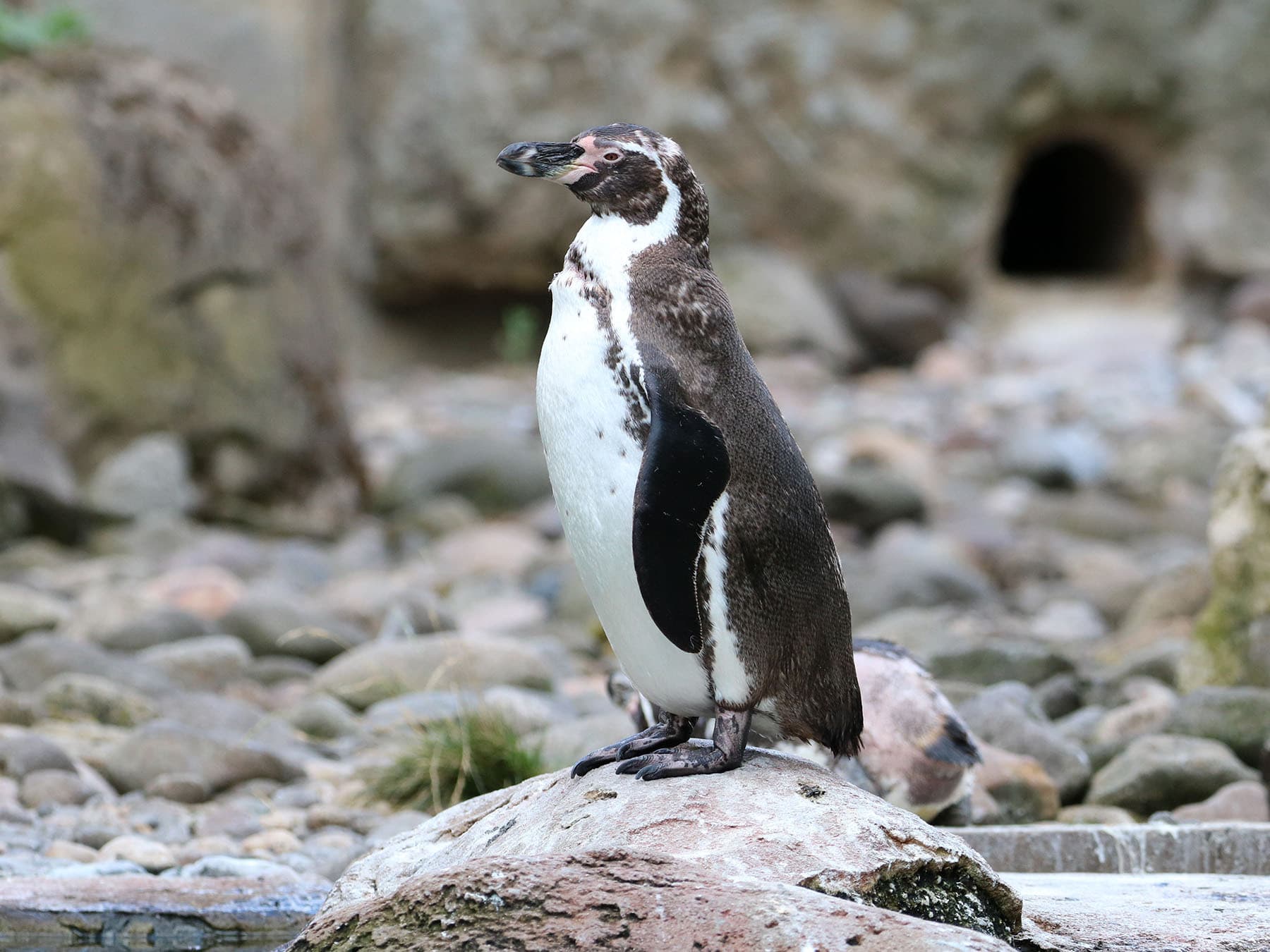
The Humboldt Penguin is characterised by its black back and white front, with a distinctive black band across the chest. Its face, bill, and feet have pink patches of bare skin that help regulate body temperature. The penguin's body is streamlined for efficient swimming.
Juveniles resemble adults but have greyer plumage and lack the defined chest band. There is no significant difference between male and female appearances, making visual sex determination challenging.
Its size
Adults- Length
- 65–70 cm
- Wingspan
- 75–85 cm
- Weight
- 3400–4500 g
Its song and calls
Humboldt Penguins produce a variety of vocalisations. Their most common call is a loud, braying sound, often described as a donkey-like 'haw-he, haw-he'.
During courtship, they use softer, more melodious calls. Chicks emit high-pitched peeping sounds to beg for food from their parents.
When and where to see it
The Humboldt Penguin is not recorded regularly in the UK, Ireland, the United States or Canada.
Worldwide: recorded regularly in 2 countries
Countries where it was recorded in at least 3 of the 6 years 2019–2024. Linked countries have their own bird list.
South America (2)
- Chile
- Peru
Data: EOD – eBird Observation Dataset (Cornell Lab of Ornithology), accessed via GBIF.org, CC BY 4.0. Records from 2019–2024, aggregated and filtered by Birdfact. How these lists are made
Tips for seeing it
- Look for Humboldt Penguins along rocky coastlines in Peru and Chile
- Observe their distinctive swimming and diving behaviours from coastal viewpoints
- Visit protected areas like Punta San Juan in Peru for guaranteed sightings
- Bring binoculars to spot their unique facial markings
- Join guided tours to responsibly view nesting colonies
What it eats
Humboldt Penguins primarily feed on small schooling fish such as anchovies, sardines, and herring. They also consume squid and crustaceans.
These penguins are pursuit divers, chasing prey underwater and catching it with their sharp, hook-tipped beaks. They can dive up to 150 meters deep in search of food.
Nesting and breeding
Humboldt Penguins form monogamous pairs and breed year-round, with peak activity between March and December. Courtship involves vocalisations, head-swinging displays, and mutual preening.
Nests are built in burrows, caves, or crevices in rocky areas lined with guano and feathers. Females typically lay two eggs per clutch. The eggs are white and slightly larger than chicken eggs.
Both parents take turns incubating the eggs for about 40-42 days. Chicks are cared for by both parents for about 10 weeks before fledging. They reach sexual maturity at around 2-3 years of age.
Behaviour
Humboldt Penguins are social birds, often seen in large colonies. They are excellent swimmers, using their wings as flippers to 'fly' underwater at speeds up to 30 km/h. On land, they waddle upright or slide on their bellies.
These penguins are known for their head-swinging displays during courtship and territorial disputes.
Conservation
Humboldt Penguins face threats from overfishing, which reduces their food supply, and entanglement in fishing nets. Climate change and El Niño events disrupt their breeding patterns.
Conservation efforts focus on protecting breeding sites, regulating fisheries, and establishing marine protected areas to safeguard their habitat and food sources.
Quick facts
- Length
- 65–70 cm
- Wingspan
- 75–85 cm
- Weight
- 3400–4500 g
- Lifespan
- 15–20 years · oldest recorded 30 years
- Family
- Penguins
- Migration
- Non-migratory
- Global status (IUCN)
- Vulnerable
- World population
- 23,800 mature individuals
- Population trend
- Decreasing
- Also called
- Peruvian Penguin, Patranca
- Scientific name
- Spheniscus humboldti
Sources
3- 1BirdLife International. 2020. Spheniscus humboldti. The IUCN Red List of Threatened Species 2020: e.T22697817A182714418. Source (opens in a new tab)
- 2BirdLife International. 2020. Spheniscus humboldti. The IUCN Red List of Threatened Species 2020: e.T22697817A182714418. Source (opens in a new tab)
- 3BirdLife International. 2020. Spheniscus humboldti. The IUCN Red List of Threatened Species 2020: e.T22697817A182714418. Source (opens in a new tab)

Checked by
Nathan Cope, founder and editor
Nathan founded Birdfact and leads its writers and contributors in the UK, the US and Canada. He has watched and studied birds for more than ten years, and checks every article and species guide before it’s published.