Species Profile
Hudsonian Whimbrel
Numenius hudsonicus
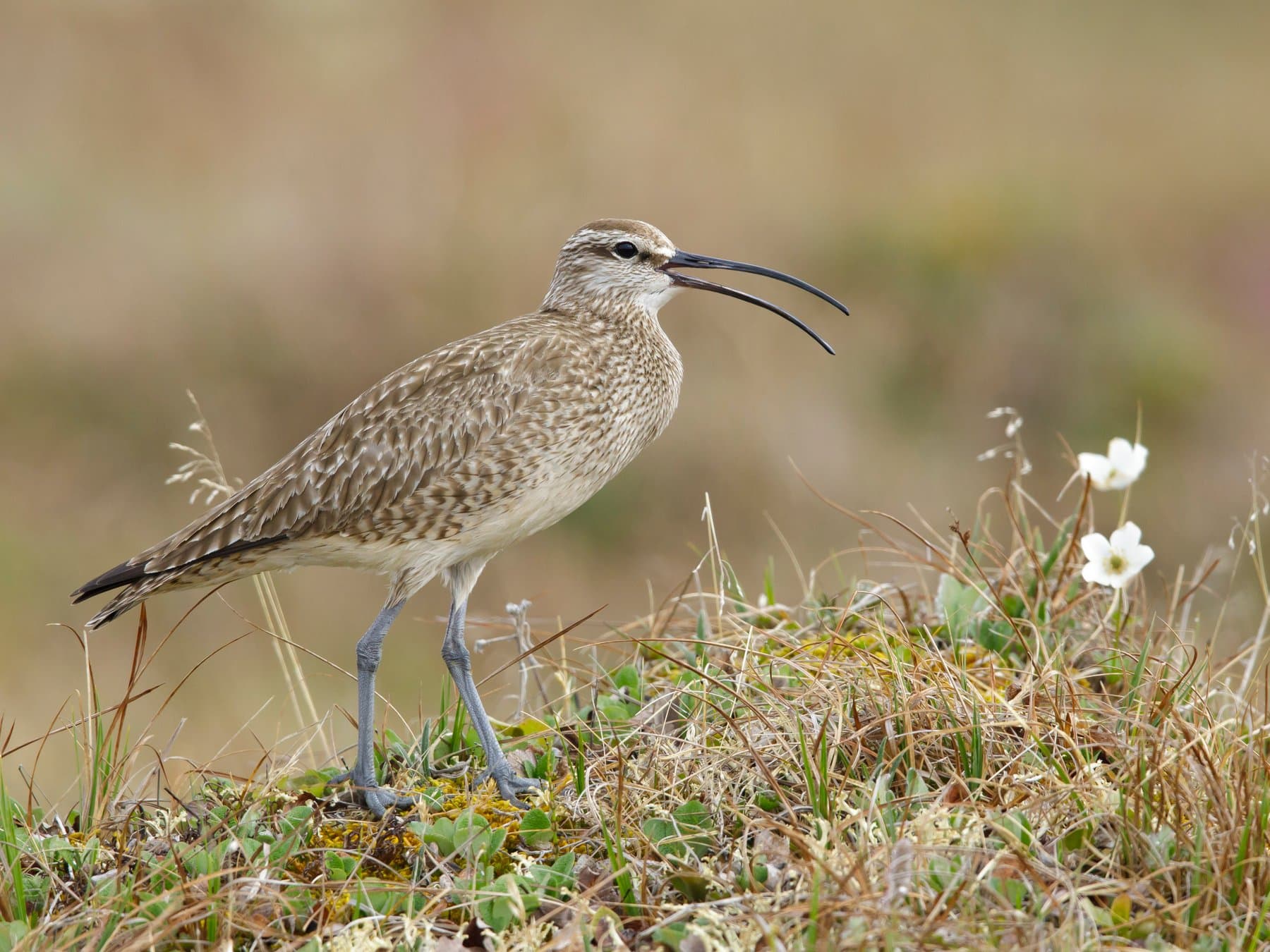
Hudsonian Whimbrel standing on grassy ground with two white flowers. Features long, downcurved bill slightly open, mottled brown plumage.
Quick Facts
Conservation
LCLeast ConcernLifespan
10–14 years
Length
37–47 cm
Weight
270–493 g
Wingspan
75–90 cm
Migration
Long-distance Migrant
With a bill that curves like a scimitar and a migration route that spans continents, the Hudsonian Whimbrel is one of North America's most impressive shorebirds. This large, streaky-brown wader breeds on the Arctic tundra and winters along the coasts of South America — a round trip of up to 22,800 km — navigating open ocean, hurricanes, and hunters along the way.
Think you've spotted a Hudsonian Whimbrel?
Upload a photo and we'll confirm it instantly
Confirm with a PhotoAppearance
The Hudsonian Whimbrel's most arresting feature is its bill: long, strongly decurved, and kinked rather than smoothly curved, it can reach up to 10 cm in adult females. The overall plumage is greyish-brown above, with pale feather edges creating a scalloped effect across the back and wings. The underparts are tan to creamy-buff, with neat dark stippling and streaking on the breast and fine barring on the upper flanks.
The head pattern is bold and distinctive. A dark brown crown is bisected by a conspicuous pale central stripe, and a broad pale supercilium runs above a narrow dark eyeline. The lateral crown stripes and eye-stripe are so dark they appear almost black at a distance, creating a strongly contrasting head pattern that is one of the species' most reliable field marks. The fore-supercilium, just in front of the eye, can look almost whitish in good light.
Legs are bluish-grey. In flight, the Hudsonian Whimbrel is distinguished from the closely related Eurasian Whimbrel by its uniformly dark brown rump and tail — the Eurasian species shows a conspicuous white rump patch. The underwing is cinnamon-brown and appears uniform in flight, strongly barred at close range, with little contrast between the under-primary tips and the rest of the underwing.
Compared to the Eurasian Whimbrel, the Hudsonian is slightly smaller, plainer, and more buff overall, with a neater and more contrasting head pattern. The underparts are less coarsely marked and appear more uniform from a distance. There is no contrast between the lesser and median upperwing coverts, unlike in the Eurasian species. Juveniles have slightly shorter bills and buffier underparts. There is little seasonal variation in plumage, though adults may show slightly richer colouration during the breeding season.
Identification & Characteristics
Colors
- Primary
- Brown
- Secondary
- Buff
- Beak
- Black
- Legs
- Blue-grey
Markings
Strongly decurved (kinked) bill; bold head pattern with dark lateral crown stripes bisected by a pale central stripe and a broad pale supercilium above a dark eyeline; uniformly dark brown rump (no white rump patch); cinnamon-brown underwing.
Tail: Short, dark brown, finely barred; no white rump patch — the uniformly dark brown rump and tail is the key feature distinguishing this species from the Eurasian Whimbrel in flight.
Attributes
Understanding Attributes
Rated 0–100 based on research and observation. A score of 50 is average across all bird species. These attributes are relative and don't necessarily indicate superiority.
Habitat & Distribution
On the breeding grounds, the Hudsonian Whimbrel occupies subarctic and alpine tundra and taiga across northern North America. It nests in a variety of tundra types: drier upland heath with berry-bearing shrubs, and wetter lowlands with grasses, sedges, mosses, lichens, and stunted trees. Two disjunct breeding populations exist. The western subspecies (N. h. rufiventris) breeds in Alaska and northwestern Canada, including the Mackenzie Delta region. The eastern subspecies (N. h. hudsonicus) breeds around Hudson Bay and northeastern Canada, including northern Manitoba and northern Ontario.
Outside the breeding season, the species is strongly coastal. On wintering grounds along the northern coast of South America — particularly Brazil, Guyana, and Suriname — it feeds on tidal mudflats and sandflats, saltmarshes, lagoons, estuaries, reefs, and rocky shorelines. In tropical areas, hard mudbanks and mangrove swamps are important habitats. The species winters as far south as Tierra del Fuego in southern Chile and Argentina.
In the United States, the Hudsonian Whimbrel is a regular passage migrant along both coasts. The Atlantic and Gulf coasts see the highest numbers, with key staging areas on the Delmarva Peninsula of Virginia, and regular passage through Massachusetts, Maine, New Jersey, North Carolina, Georgia, and Florida. California hosts an uncommon wintering and resident population. Along the Texas Gulf Coast, birds appear in spring and autumn migration and occasionally in winter. Inland records are uncommon to rare, though storm-grounded birds may turn up at farm fields, airports, and lakeshores.
In the UK, the Hudsonian Whimbrel is a very rare vagrant with fewer than 20 accepted records since the first in 1955. Most records fall between late April and November, with a handful of birds overwintering.
Where to See This Bird
Explore regional guides for locations where this bird has been recorded.
Diet
Fiddler crabs are the cornerstone of the Hudsonian Whimbrel's diet on the wintering grounds — and the bird's bill is precisely engineered to reach them. Research in Panama confirmed that the degree of bill decurvature matches the curve of local fiddler crab burrows almost exactly, allowing the bird to probe in, grip the crab, and extract it cleanly. After extraction, the whimbrel rinses the crab to remove mud, then typically removes the largest claw before swallowing. Indigestible parts are later excreted in fecal pellets.
Other prey taken in intertidal zones includes swimming crabs, mud crabs, crayfish, mole crabs, small fish, marine worms, sea cucumbers, sand shrimp, and small molluscs such as coffee bean snails. The bird hunts primarily by sight, first locating the entrance to a crab's burrow, then probing with its long bill. It also picks prey directly off the surface when conditions allow.
On the breeding grounds, the diet shifts dramatically. Birds arriving in the Arctic feed on berries left over from the previous summer — cranberry, blueberry, bearberry, and crowberry — along with insects including flies, beetles, and grasshoppers, and spiders. In autumn migration, birds staging in Atlantic Canada feed heavily on blueberries, huckleberries, and cloudberries, plucking them with the bill tip and tossing them back to swallow. These berries are not incidental snacks — they are critical fuel for the long overwater flights to South America, allowing birds to build up the fat reserves needed for non-stop transoceanic crossings of approximately 4,000 km.
Behaviour
Outside the breeding season, Hudsonian Whimbrels are strongly territorial on their feeding grounds. Individual birds maintain and actively defend feeding territories on wintering grounds and at migratory staging areas, chasing away other whimbrels with persistent pursuit flights and loud calling. This is unusual behaviour for a shorebird — most waders feed communally — and reflects the high value of productive intertidal patches where fiddler crabs are concentrated.
On the breeding grounds, territorial defence is equally vigorous. Adults will drive out other Hudsonian Whimbrels and even pursue larger shorebirds such as godwits and Bristle-thighed Curlews that stray into their territory. Territory size varies from around 5 hectares to over 36 hectares, though defence wanes once the eggs hatch and the chicks become mobile.
The species is highly vocal in flight, frequently calling as birds move between roosting and feeding areas. Flocks form during migration and at staging areas, where birds may roost together in marshes, meadows, dunes, and even mangrove trees. When not feeding, birds stand quietly in sheltered spots, often in loose groups. On the wintering grounds, they spend approximately 7.3 months of the year — far longer than the 1.5 months spent on the breeding grounds — making South America, in a real sense, their primary home.
When alarmed, adults call loudly and may dive-bomb intruders approaching the nest. Pairs maintain their bond during shared incubation duties with soft trilling calls, and both parents continue to protect chicks after they leave the nest.
Calls & Sounds
The Hudsonian Whimbrel earned the nickname "Seven Seas Whistler" for its far-carrying calls, and the common name "whimbrel" is itself imitative of the sound. The most characteristic call is a series of mellow, piping whistles all delivered on the same pitch — typically 6–7 notes in rapid succession, transcribed as tee-tee-tee-tee-tee-tee-tee or ti-ti-ti-ti-ti-ti-ti. This call is given frequently in flight and can be heard from a considerable distance, making it one of the most useful identification cues for the species.
The song is a prolonged trill — an extension of the usual rippling whistle call — delivered by males during their dramatic aerial display flights on the breeding grounds. Males sing during the gliding phases of their circling flights, ascending as high as 300 m before gliding back down, the song carrying across the open tundra. A soft, whistled cur-lee is also noted in flight.
In courtship or conflict situations on the breeding grounds, birds give a scream-like whistle. When alarmed or defending the nest, adults call loudly and may dive-bomb intruders. Pairs maintain their bond during shared incubation duties with soft trilling calls exchanged between partners. Flocks moving between roosting and feeding areas are consistently vocal, and the calls of migrating birds overhead are often the first indication of their presence — particularly at night, when the species migrates regularly.
Flight
In the air, the Hudsonian Whimbrel is a powerful and direct flier, built for long-distance travel rather than aerial acrobatics. The wings are long and pointed, and the wingbeat is steady and purposeful — deeper and more languid than smaller waders, with a quality reminiscent of a large gull at a distance. Birds often fly in loose lines or V-formations during migration, calling frequently as they go.
The uniformly dark brown rump is the single most important flight identification feature, immediately separating the Hudsonian Whimbrel from the Eurasian Whimbrel, which shows a conspicuous white rump patch. The underwing is cinnamon-brown and appears uniform, strongly barred at close range but lacking the pale contrast visible in the Eurasian species. The long, drooping bill is visible at considerable range and gives the bird a front-heavy silhouette.
On migration, some birds make non-stop overwater flights of approximately 4,000 km from southern Canada or New England directly to South America — a journey that can take around 48 hours of continuous flight. The Mackenzie Delta population makes a loop migration of approximately 22,800 km per year, flying out over the open Atlantic in autumn to bypass the Caribbean Basin. The Hudson Bay population covers approximately 17,500 km on a more direct route. Spring migration is significantly faster than autumn, achieved through fewer and shorter stopovers rather than faster flight speeds.
Nesting & Breeding
Hudsonian Whimbrels are monogamous and show strong fidelity to both their breeding sites and their mates, often returning to the same area with the same partner in successive seasons. The breeding season begins in late May or early June, timed to coincide with the brief Arctic summer. Birds nest in loose associations of a few pairs rather than dense colonies.
Nest sites are chosen on raised ground — hummocks, small ridges, or elevated patches — usually near a shrub that provides wind shelter, in areas with good visibility over the surrounding landscape. The nest itself is a simple bowl pressed into the ground and lined with leaves, grasses, or lichens. The interior averages about 14 cm across and 3.8 cm deep.
The clutch typically consists of four eggs, described as blue-green to brownish or buff with brown blotching that provides excellent camouflage against the tundra substrate. Eggs measure approximately 5.1–6.6 cm long and 3.6–4.3 cm wide. Incubation lasts 22–28 days and is shared equally by both parents. Only one brood is raised per year.
Chicks are precocial and downy at hatching, capable of leaving the nest within one to two hours and feeding themselves almost immediately. Both parents continue to protect the chicks after they leave the nest, though territorial defence wanes once the eggs hatch. Males perform dramatic aerial song flights early in the breeding season, ascending as high as 300 m and flying in large circles, gliding downward and climbing back up while singing during the glides — a display visible from a considerable distance across the open tundra.
Lifespan
Hudsonian Whimbrels typically live between 10 and 14 years, with a maximum recorded lifespan of 14 years. This is a relatively long lifespan for a shorebird of this size, reflecting the species' investment in individual survival over rapid reproduction — a strategy common among long-distance migrants that face high annual mortality risks during migration.
The greatest mortality risks occur during migration. Long overwater flights expose birds to exhaustion, storms, and disorientation. The Hudson Bay population, which flies directly through the Caribbean Basin, faces additional exposure to hunters and hurricane-force winds. A satellite-tracked female named Hope survived Tropical Storm Gert in 2011 but is believed to have been killed by Hurricane Maria in 2017 — illustrating how even experienced, well-travelled adults can be lost to a single catastrophic weather event.
On the breeding grounds, nest predation by Arctic foxes, ravens, and raptors is a significant source of egg and chick mortality. Adults are vulnerable to falcons and other raptors during migration. Pollution — including cadmium contamination from mining waste documented in Chilean wintering birds — may also affect long-term survival. Compared to the closely related Eurasian Whimbrel, the Hudsonian Whimbrel faces a more perilous annual cycle, with longer overwater crossings and greater exposure to hunting pressure along its migration routes.
Conservation
The Hudsonian Whimbrel is listed as Least Concern by the IUCN, but this designation masks a serious and accelerating decline. The species has lost more than 50% of its population over the last 50 years, and Partners in Flight rated it 13 out of 20 on the Continental Concern Score. The 2025 State of the Birds report designated it an Orange Alert Tipping Point species. The global breeding population is estimated at approximately 1.8 million individuals, though the Alaska population alone is estimated at around 36,000 birds.
Hunting has been a persistent threat. Near the end of the 19th century, market hunting on migration routes took a heavy toll on populations across North America. The Migratory Birds Convention of 1916 provided protection in the US and Canada, but hunting continues in parts of South America and the Caribbean. The Hudson Bay population, which flies directly through the Caribbean Basin, is particularly exposed — both to hunters and to hurricane-force storms. A female named Hope, tracked by satellite from 2009, flew through Tropical Storm Gert for 27 hours over the open Atlantic in August 2011, demonstrating the peril these birds face. Hope is believed to have been killed by Hurricane Maria in 2017.
Habitat loss threatens both wintering and breeding grounds. Coastal wetland destruction reduces feeding habitat, while oil and gas infrastructure development encroaches on tundra breeding sites. Climate change is shifting the timing of Arctic insect emergence, disrupting food availability for breeding birds and chicks. Rising sea levels threaten intertidal feeding habitats. A study in Chile found high levels of cadmium in whimbrels and their prey, caused by untreated mining waste — a specific and underreported pollution threat.
Both populations depend on very few, highly specific staging areas, making them acutely vulnerable to habitat loss at any single site. Conservation responses include the Whimbrel Working Group (established 2021), satellite tracking programmes, and habitat protection at key sites such as Great Pond, St. Croix, US Virgin Islands — a site preserved partly as a direct result of Hope's story. The species has been proposed for listing under the Convention on Migratory Species (CMS COP15, 2025).
Population
Estimated: Approximately 1.8 million individuals (Partners in Flight global breeding population estimate)
Trend: Decreasing
Decreasing — the species has lost more than 50% of its population over the last 50 years, with declines accelerating over the past decade. Designated an Orange Alert Tipping Point species in the 2025 State of the Birds report.
Elevation
Breeds at low to moderate elevations on Arctic and subarctic tundra; winters at sea level on coastal mudflats and intertidal zones.
Additional Details
- Family:
- Scolopacidae (Sandpipers & Snipes)
- Predators:
- Arctic foxes, ravens, and raptors on the breeding grounds; falcons during migration
- Subspecies:
- N. h. hudsonicus (Hudson Bay, northeastern Canada); N. h. rufiventris (Alaska, Mackenzie Delta)
- Similar species:
- Eurasian Whimbrel (Numenius phaeopus) — distinguished by white rump patch and pale underwing; Long-billed Curlew (Numenius americanus) — much larger with longer, more uniformly curved bill and no head stripes
Courtship & Display
Male Hudsonian Whimbrels perform some of the most dramatic aerial displays of any North American shorebird. Early in the breeding season, males ascend sharply to heights of up to 300 m above the tundra, then fly in large, sweeping circles — gliding downward and climbing back upward with exaggerated, buoyant movements while delivering their prolonged trilling song during the glides. These flights are visible from a great distance across the open tundra and serve both to advertise territory and to attract females.
On the ground, courting males chase females both on foot and in flight. A receptive female signals her willingness by drooping her wings, cocking her tail upward, and leaning forward — a posture that triggers the male to mount. Pairs also perform alternating displays involving a raised tail and lowered breast, reinforcing the pair bond. Once paired, partners maintain their bond throughout the incubation period with soft trilling calls exchanged during nest changeovers.
The species is monogamous and shows strong mate fidelity, with pairs often reuniting at the same breeding site in successive seasons. Territorial defence is vigorous in the weeks before and during incubation — adults will pursue not only rival whimbrels but also much larger shorebirds such as godwits and Bristle-thighed Curlews that enter their territory. This aggression wanes markedly once the eggs hatch and the precocial chicks begin to disperse across the tundra.
Subspecies And Taxonomy
The Hudsonian Whimbrel has a convoluted taxonomic history that illustrates how our understanding of bird species continues to evolve. The American Ornithologists' Union originally treated it as a full species — Numenius hudsonicus — as far back as 1886. In the mid-20th century it was lumped with the Eurasian Whimbrel (Numenius phaeopus) as a single wide-ranging species. Genetic and morphological research in the late 2010s confirmed the two as distinct species, and the split was formalised by major world checklists in 2019–2020, with the global AviList confirming it in 2025.
Two subspecies of the Hudsonian Whimbrel are currently recognised. The nominate subspecies N. h. hudsonicus breeds around Hudson Bay and northeastern Canada, including northern Manitoba and northern Ontario. The subspecies N. h. rufiventris breeds in Alaska and northwestern Canada, including the Mackenzie Delta region; it is slightly more rufous on the underparts than the nominate form, as its name suggests.
The evolutionary divergence between the Hudsonian and Eurasian Whimbrels is thought to have occurred during the Pleistocene glaciations, when populations became isolated on opposite sides of the Atlantic. The key visual differences that resulted from this long separation are the Hudsonian's uniformly dark brown rump (versus the Eurasian's white rump), its cinnamon-brown underwing with little contrast (versus the Eurasian's pale, lightly barred underwing), and its neater, more contrasting head pattern. These differences are consistent and reliable in the field, making identification straightforward when the rump or underwing is visible.
Uk And European Records
In the UK, the Hudsonian Whimbrel is one of the rarest American waders on the British list, with fewer than 20 accepted records since the first in 1955. All records are assessed by the British Birds Rarities Committee (BBRC). The first British record was a bird on Fair Isle, Shetland, from 27–31 May 1955 — a fitting location, given Fair Isle's reputation as a magnet for transatlantic vagrants.
Subsequent records have been scattered across the decades and around the British coastline: Out Skerries, Shetland (1974); Goldcliff Lagoons, Gwent (2000, with the same bird returning in 2002); Walney Island, Cumbria (2007); Fair Isle again (2007); Isles of Scilly (2008); Outer Hebrides (2009 and 2019); Shetland (2013); Church Norton/Pagham Harbour, West Sussex (2015); and Caithness, Cleveland, and Orkney in 2020 and 2025. Most records fall between late April and November, with the majority in autumn.
The most celebrated British record involved a first-year bird that arrived on the Isles of Scilly in October 2015, then moved to Cornwall, where it remained until March 2017 — overwintering for two consecutive winters and becoming one of the longest-staying vagrant Hudsonian Whimbrels ever recorded in Britain. It was watched by hundreds of birders and provided exceptional opportunities to study the identification features at length. The pattern of UK records — predominantly from northern and western Scotland and the southwest — reflects the species' transatlantic vagrancy route, with birds most likely displaced from the Mackenzie Delta population's autumn migration across the North Atlantic.
Birdwatching Tips
Along the US Atlantic coast, late July through September is the prime window for Hudsonian Whimbrel. Tidal mudflats, saltmarshes, and estuaries are the most productive habitats — look for birds probing methodically in exposed mud or standing sentinel on a marsh edge. The Delmarva Peninsula of Virginia is one of the most reliable staging sites in North America, where hundreds of birds can gather to feed on fiddler crabs before their transoceanic flight south. In Texas, check coastal mudflats and rice fields during April–May and again in August–September.
The call is your best initial alert: a rapid series of 6–7 mellow, piping whistles all on the same pitch — once heard, it is unmistakable and carries far. Birds frequently call in flight, so listen before you look. In flight, the long, drooping bill and uniformly dark brown rump are the key features to confirm identification.
Separating the Hudsonian Whimbrel from the Eurasian Whimbrel requires attention to the rump and underwing. The Eurasian shows a bright white rump patch and a pale, lightly barred underwing; the Hudsonian has a uniformly dark brown rump and a cinnamon-brown underwing with little contrast. The Hudsonian's head pattern is also neater and more contrasting, with a bolder pale central crown stripe.
In the UK, the Hudsonian Whimbrel is a genuine rarity — fewer than 20 records in 70 years. Any whimbrel seen between August and November on the Isles of Scilly, Shetland, or the Outer Hebrides is worth scrutinising carefully for the dark rump and cinnamon underwing. Most UK records have involved single birds associating with flocks of Eurasian Whimbrels, so checking through any whimbrel flock in autumn is worthwhile.
Did You Know?
- The Hudsonian Whimbrel's bill curve is not random — research in Panama confirmed it matches the shape of local fiddler crab burrows almost exactly, allowing the bird to reach in, grip the crab, and extract it cleanly. After extraction, it rinses the crab and removes the largest claw before swallowing — a precise, repeatable technique refined over thousands of generations.
- A satellite-tracked female named Hope flew through Tropical Storm Gert for 27 hours over the open Atlantic in August 2011, battling fierce headwinds before correcting course toward Cape Cod. She survived that storm, but is believed to have been killed by Hurricane Maria in 2017 — after logging more than 80,000 km of tracked migration over three years.
- The Hudsonian Whimbrel was treated as a full species — Numenius hudsonicus — by the American Ornithologists' Union as far back as 1886, then lumped with the Eurasian Whimbrel in the mid-20th century, and finally re-split in 2019–2020 based on genetic and morphological research. It took over 130 years to come full circle.
- The two breeding populations spend approximately 7.3 months per year on their South American wintering grounds, compared to just 1.5 months on the Arctic breeding grounds. By time spent, this bird is more South American than North American.
- Individual Hudsonian Whimbrels show 98% fidelity to their staging areas, returning year after year to the same fields or patches of marsh — a level of site loyalty that makes the loss of any single key staging site potentially catastrophic for the birds that depend on it.
Records & Accolades
Ocean Crosser
~4,000 km non-stop
Makes non-stop transoceanic flights of approximately 4,000 km from southern Canada or New England directly to South America — one of the longest overwater flights of any shorebird.
Precision Predator
Bill curve matches burrow curve
The bill's decurvature matches the shape of local fiddler crab burrows almost exactly — a co-evolutionary adaptation confirmed by field research in Panama.
Loop Migrator
~22,800 km per year
The Mackenzie Delta population completes one of the longest loop migrations of any shorebird — using different routes in autumn and spring to cover approximately 22,800 km annually.
Community Photos
Be the first to share a photo of the Hudsonian Whimbrel
Upload a PhotoIdentify Any Bird Instantly
- Upload a photo from your phone or camera
- Get an instant AI identification
- Ask follow-up questions about the bird
Monthly Birds in Your Area
- Personalised for your location
- Seasonal tips and garden advice
- Updated every month with new species