


Grey Phalarope
Red Phalarope · Phalaropus fulicarius
By the Birdfact teamChecked by Nathan Cope
On this page13 sections
How to recognise it
What do Grey Phalaropes look like?
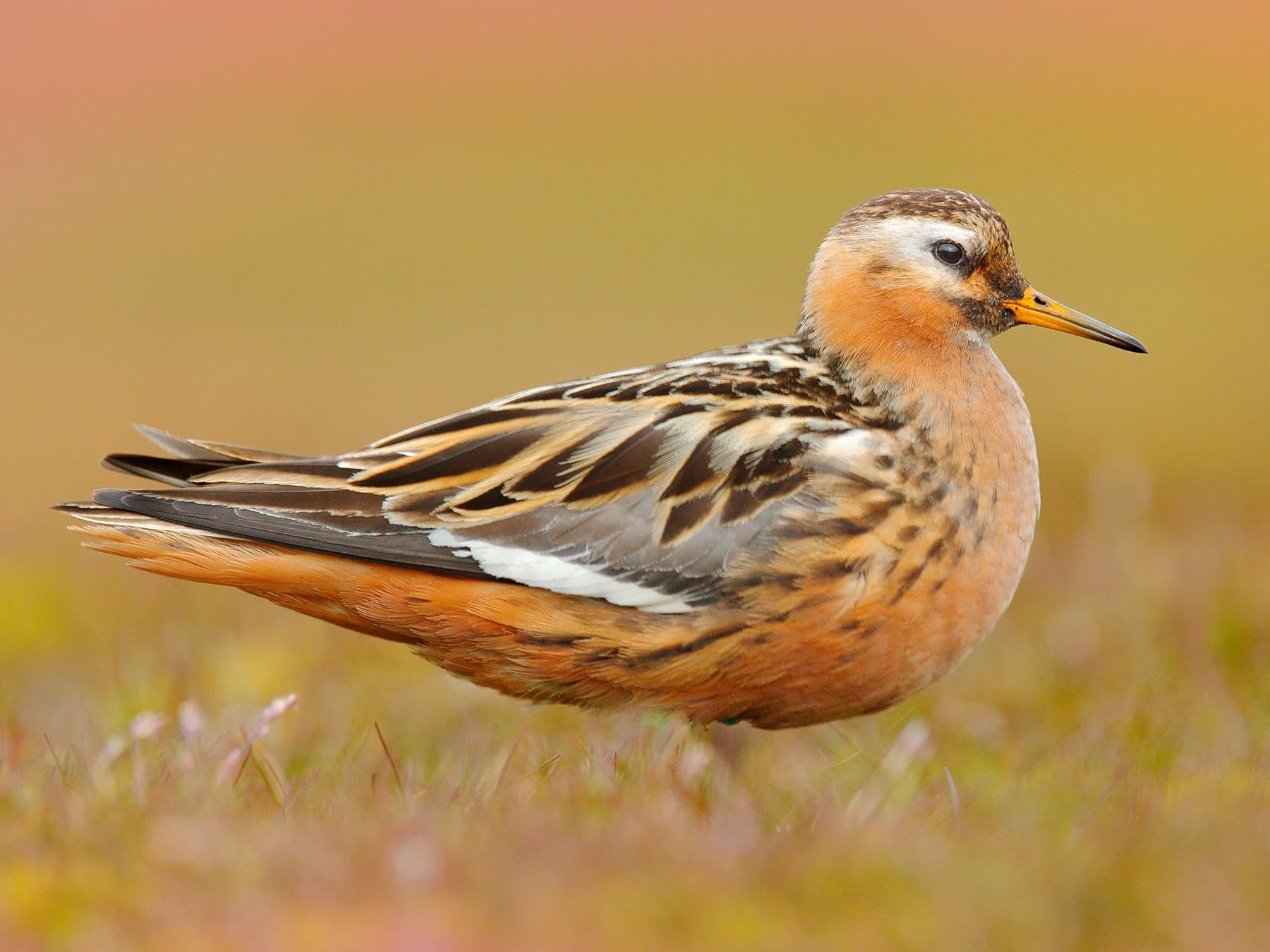
Grey phalaropes have striking breeding plumage, which contrasts hugely with their grey-and-white gull-like appearance in winter months. During the breeding season, males and females are unalike, with females more colourful than males.
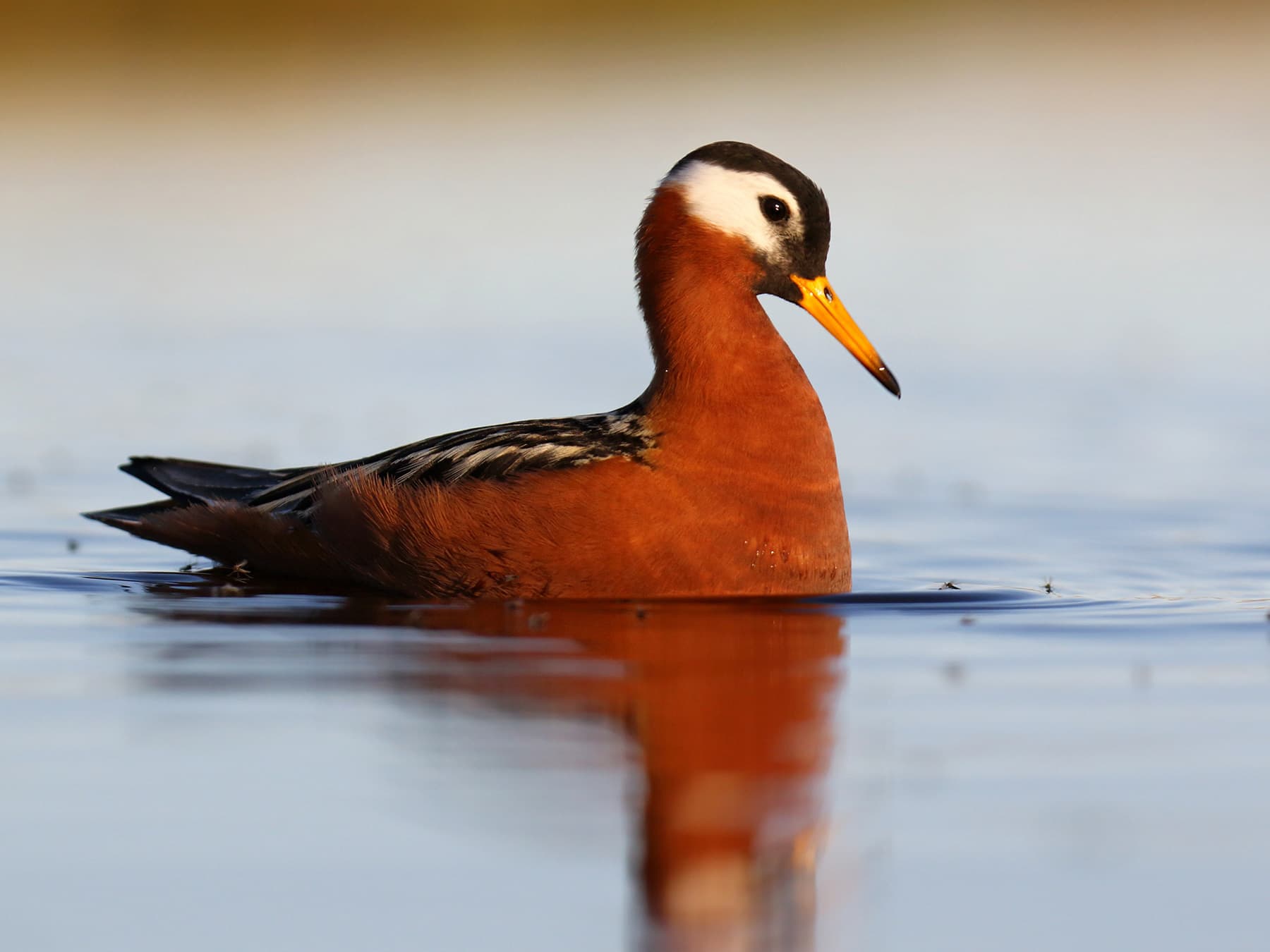
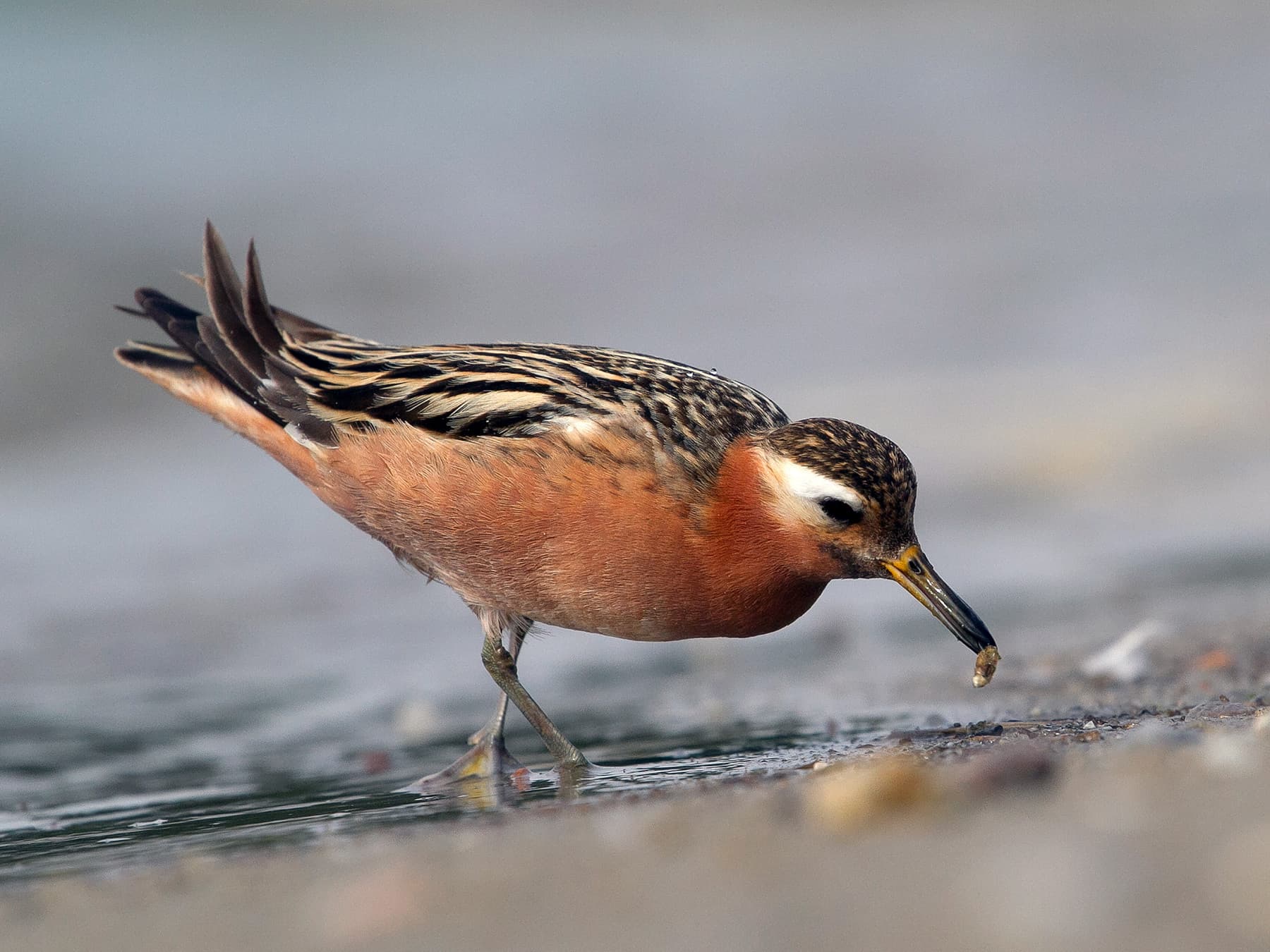
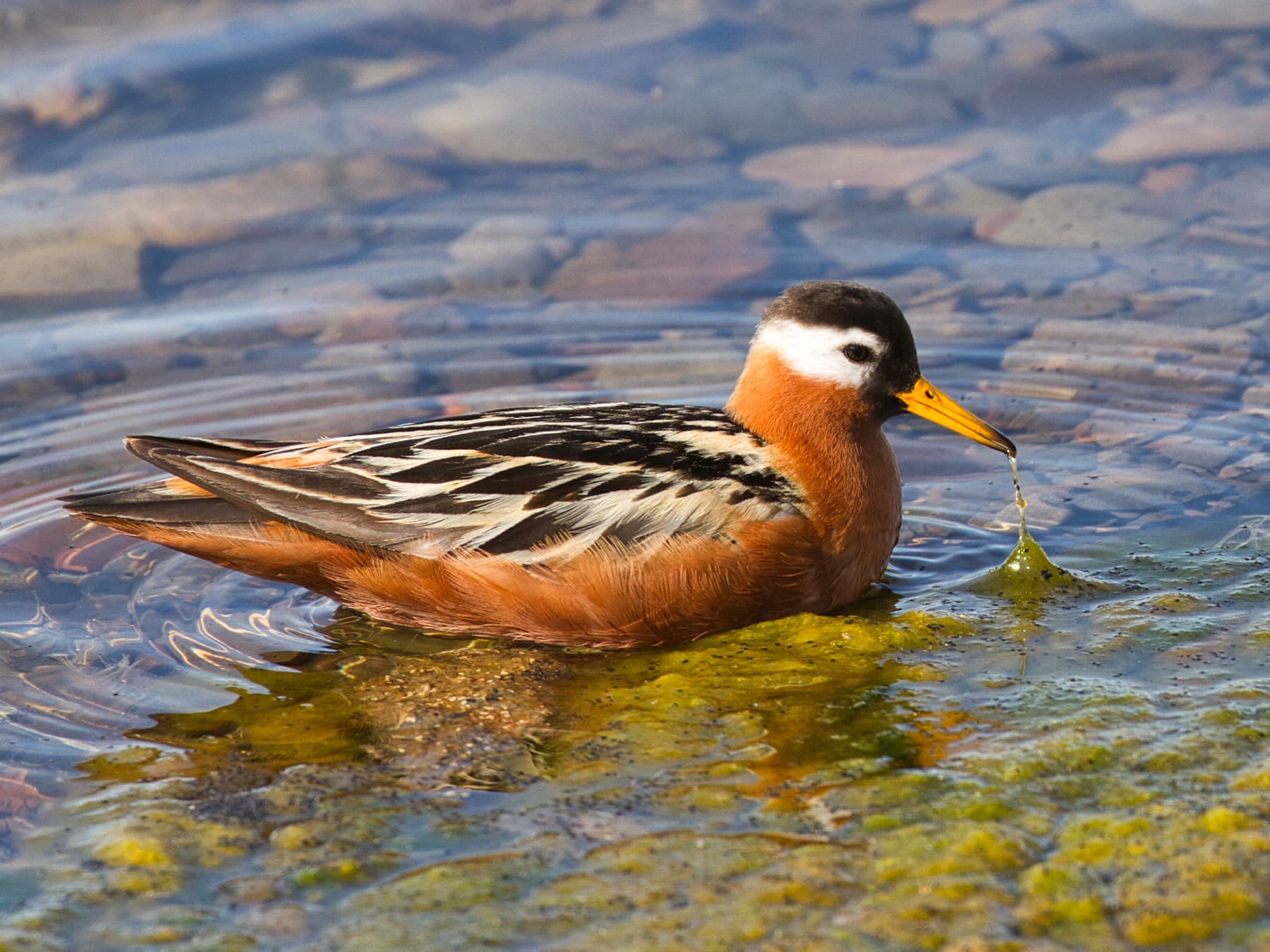
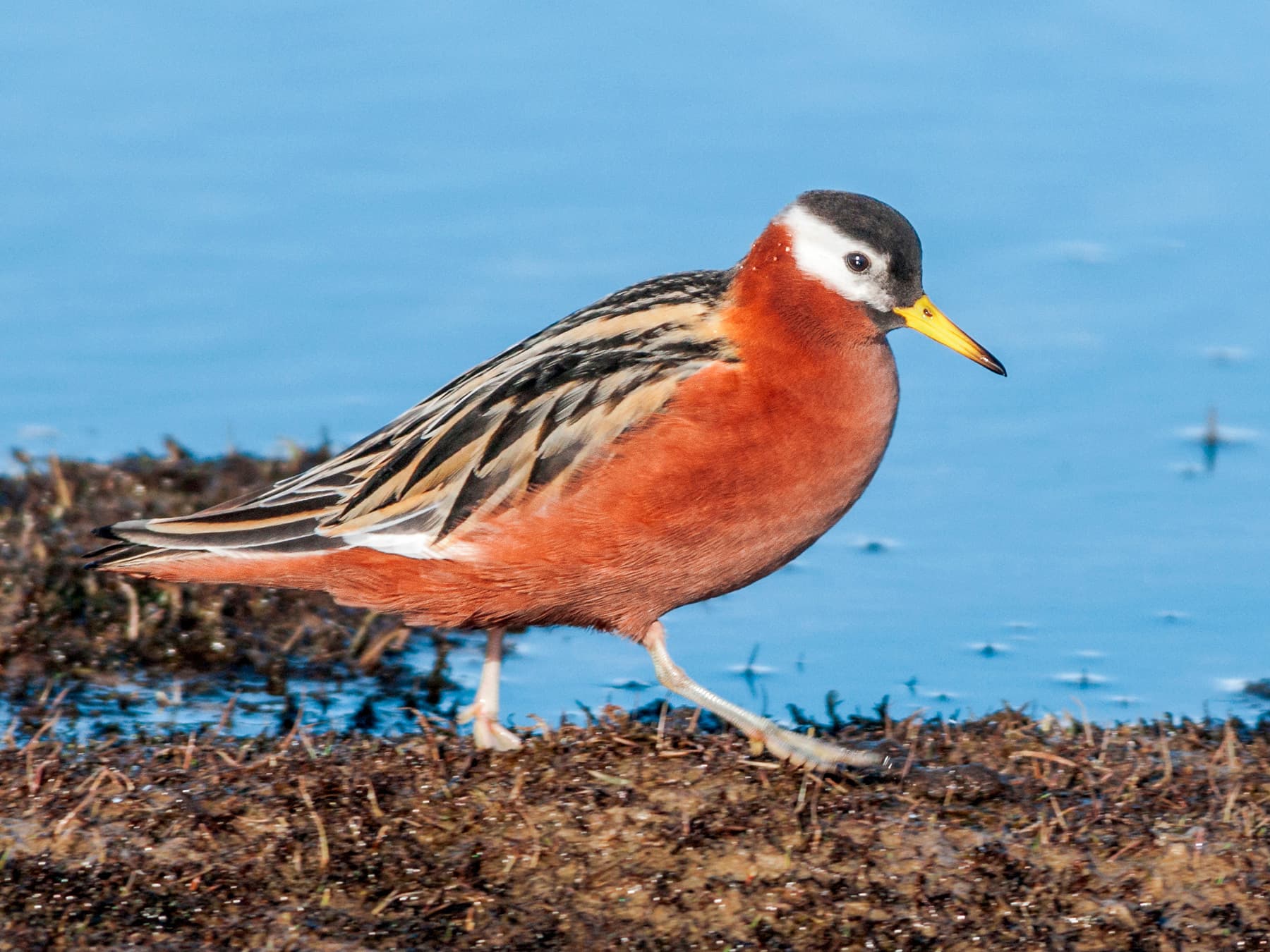
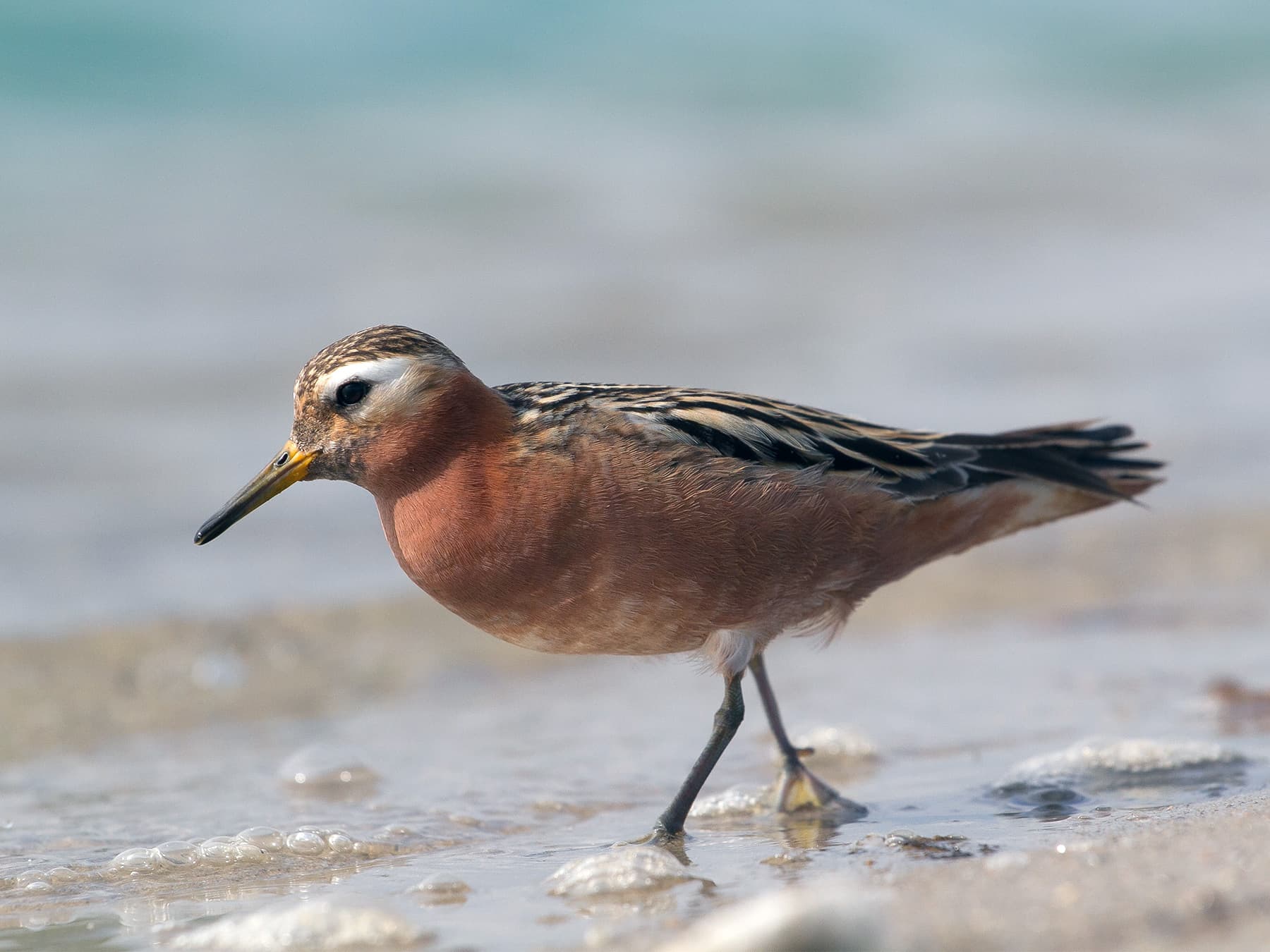
In summer, male grey phalaropes have a chestnut-red belly, breast and cheeks, and a black back, with feathers edged with buff, giving a patterned appearance. Their crown is streaked with black, and they have a large white eye patch and a yellow bill. In comparison to the female’s more vibrant appearance, males are more muted and dull.
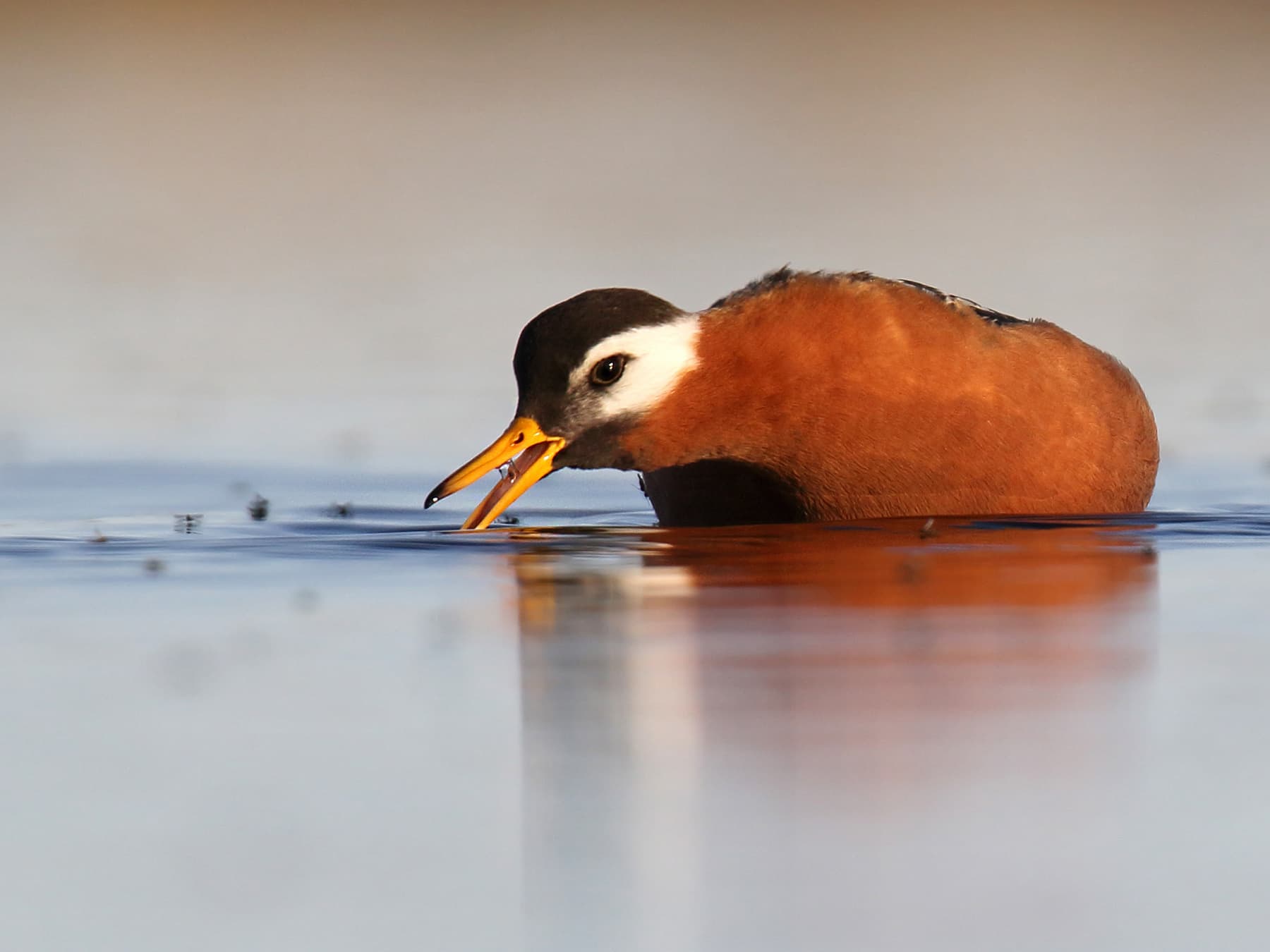
Female grey phalaropes in breeding plumage have brighter, more vivid orange-red colouring than males. Their facial markings are bolder, with their crown a deeper solid black, and they have a wider white band around their eyes, which extends to the back of the head.
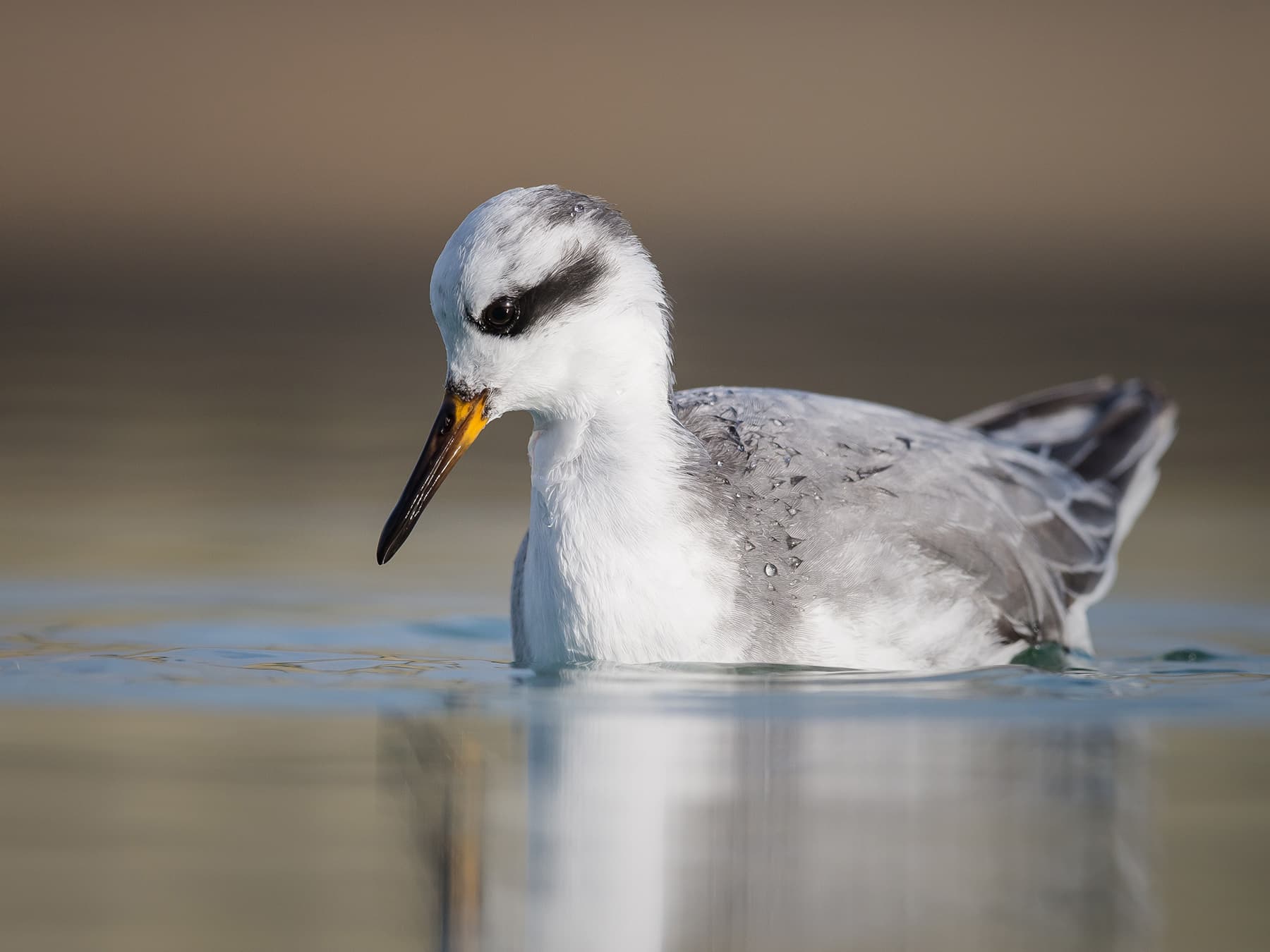
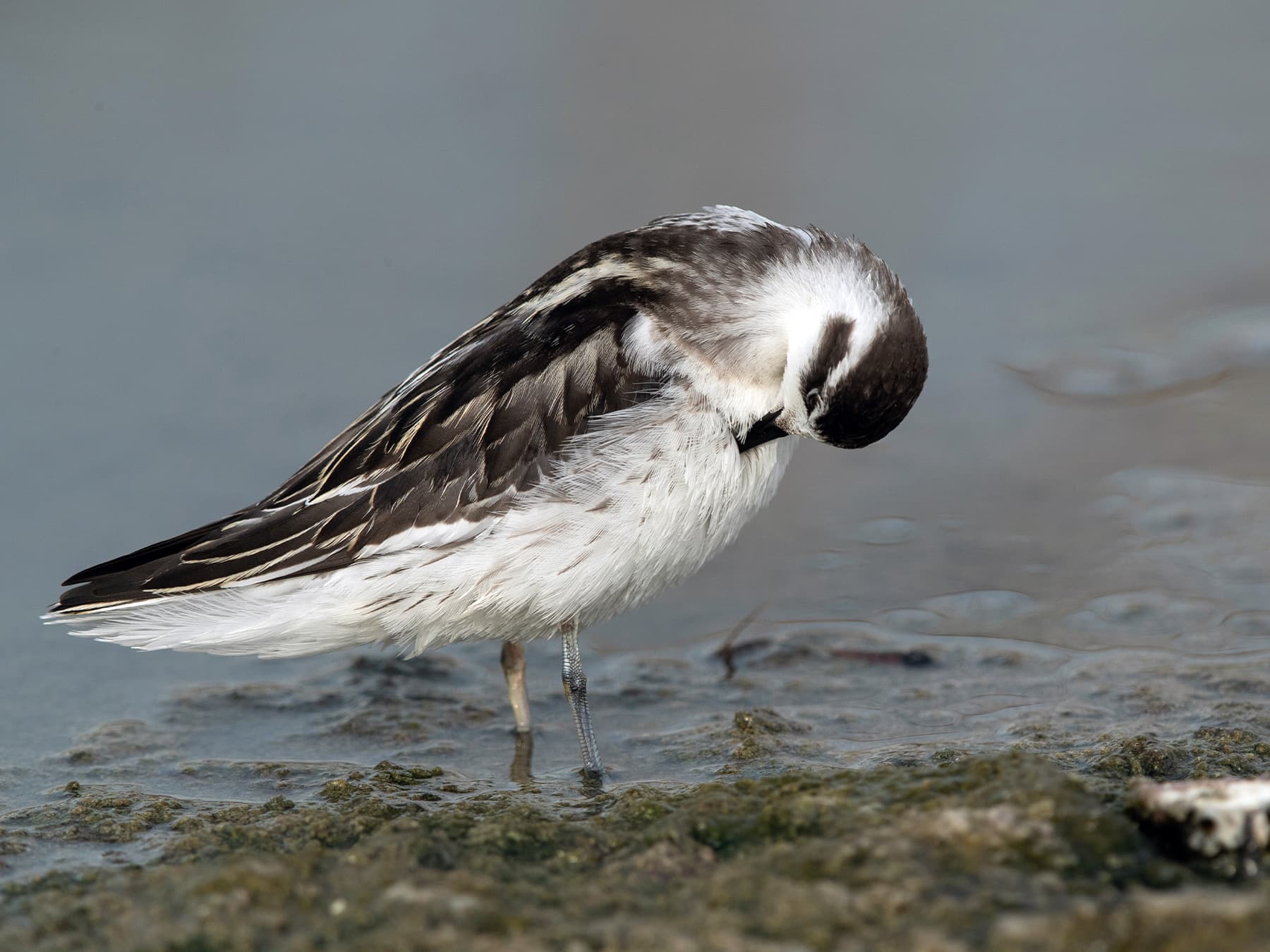
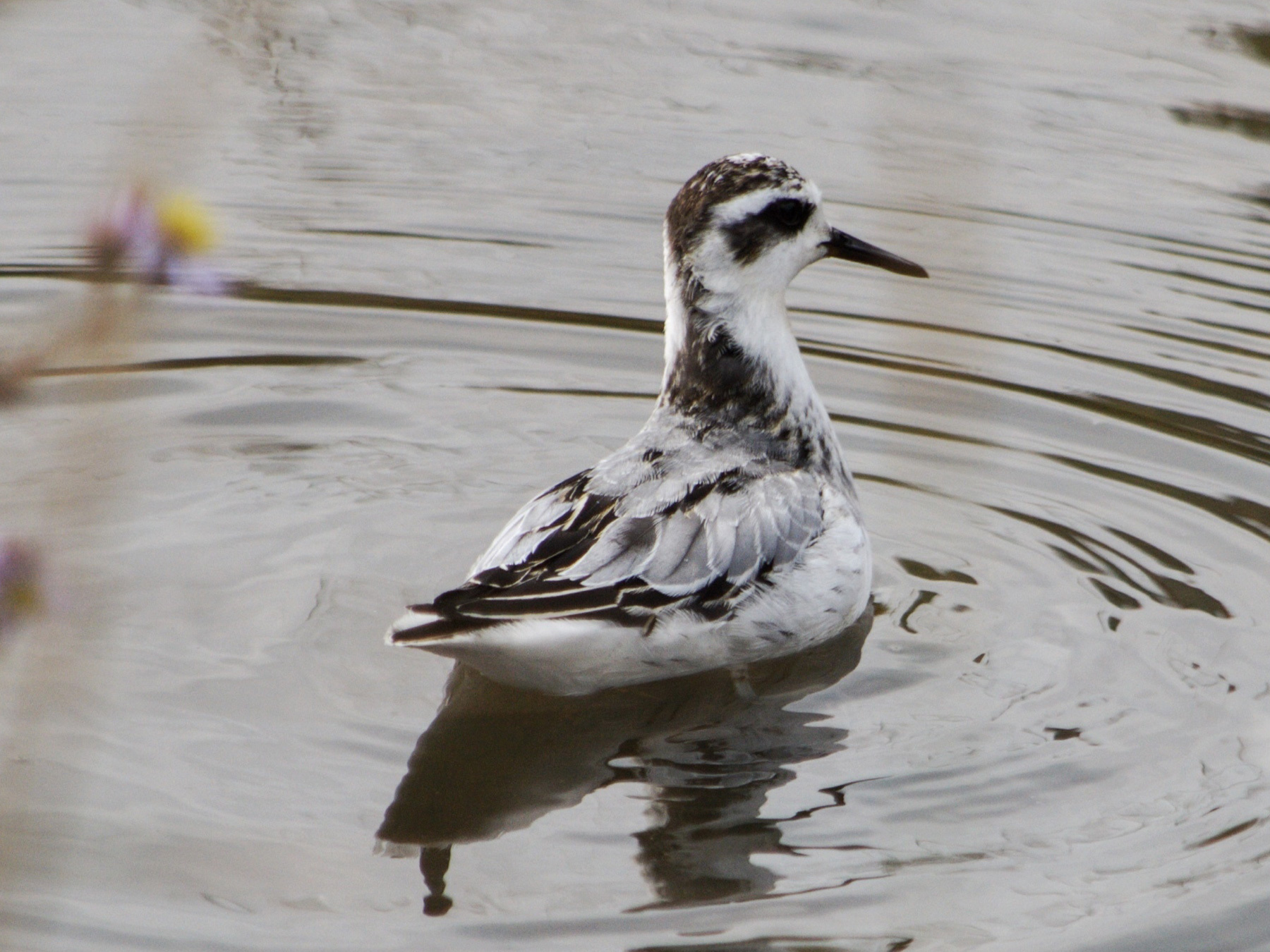
In non-breeding plumage, male and female grey phalaropes are alike: they have a white neck, face and underparts, with darker grey-black mottled wings, back and upper tail. A bold white wing bar is visible in flight. Their crown is streaked with dark grey and they have a slight black eye patch. Their bill is black with a faint yellow tinge, and their legs are grey.
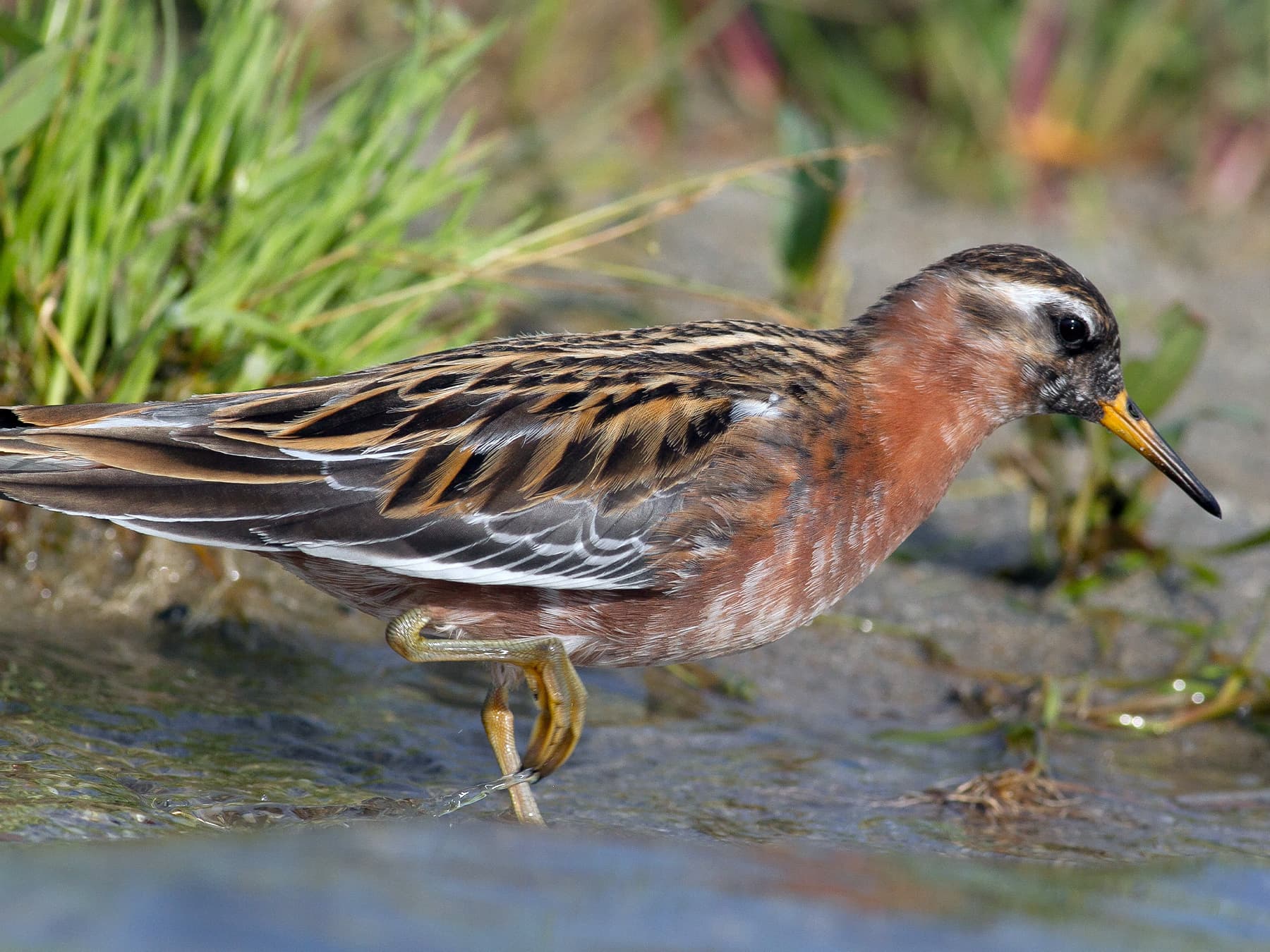
Juvenile grey phalaropes’ upperparts are dark brown, streaked with white. Their underparts are mainly white but with a pinkish wash on the sides of the breast. Similar to adults in winter plumage, juveniles have a dark grey streaked crown, whitish-pink face and neck, and black markings next to their eyes.
How big are Grey Phalaropes?
As well as being more colourful than males, female grey phalaropes are also slightly larger. They rank as small-to-medium shorebirds, roughly the same size as a common sandpiper and dunlin and considerably smaller than a woodcock.
- Length: 20 cm to 22 cm (7.9 in to 8.7 in)
- Wingspan: 34 cm to 41 cm (13.4 in to 16.1 in)
- Weight: 50 g to 75 g (1.8 oz to 2.6 oz)
Its size
Adults- Length
- 20–22 cm
- Wingspan
- 40–44 cm
- Weight
- 40–60 g
Its song and calls
What sound does a Grey Phalarope make?
The most familiar call of a grey phalarope is heard on breeding grounds, is a wheezy ‘peet’ or a variation, used in alarm, excitement, or as a contact call.
In winter, occasional short, sharp ‘pit-pit-pit’ flight calls are heard at sea, but otherwise, they are relatively silent until they return to their breeding grounds.
When and where to see it
OctoberIn season
Most recorded in October
- 1. Newport0.46%
- 2. Clare0.23%
- 3. Eilean Siar0.15%
- 4. Angus0.14%
- 5. Belfast0.11%
Each dot is a county, state or province: the bigger and darker, the larger the bird’s share of that place’s bird records that month. Grey dots: no regular records. The ringed point is the centre of the bird’s records this month; the arrow shows how it moved since last month, and the dashed loop its path through the year. “Arrivals” colours places where it becomes regular this month (orange) or is in its last regular month (grey). GBIF eBird Observation Dataset, 2019–2024. Map data: Natural Earth, US Census Bureau; place centres © OpenStreetMap contributors.
In your area
See when the Grey Phalarope is recorded in your county, state or province.
How often the Grey Phalarope turns up in the UK, Ireland, the United States and Canada through the year, from birdwatchers' records.
United Kingdom
Passage migrant · regularly Aug–Jan · most records in October
Ireland
Passage migrant · regularly Aug–Oct · most records in August
United States
Resident · all year · most records in September
Canada
Passage migrant · regularly Jun–Dec · most records in September
Show as a table
| Month | United Kingdom | Ireland | United States | Canada |
|---|---|---|---|---|
| January | 0.002% (regular) | <0.001% | 0.007% (regular) | <0.001% |
| February | 0.001% | – | 0.003% (regular) | – |
| March | <0.001% | – | <0.001% (regular) | <0.001% |
| April | 0.002% | – | 0.001% (regular) | <0.001% |
| May | – | 0.004% | 0.004% (regular) | <0.001% |
| June | <0.001% | – | 0.015% (regular) | 0.003% (regular) |
| July | – | <0.001% | 0.005% (regular) | 0.005% (regular) |
| August | 0.005% (regular) | 0.055% (regular) | 0.017% (regular) | 0.012% (regular) |
| September | 0.016% (regular) | 0.041% (regular) | 0.017% (regular) | 0.018% (regular) |
| October | 0.023% (regular) | 0.028% (regular) | 0.009% (regular) | 0.003% (regular) |
| November | 0.009% (regular) | 0.014% | 0.011% (regular) | 0.013% (regular) |
| December | 0.005% (regular) | 0.010% | 0.005% (regular) | 0.003% (regular) |
Recorded regularly in
Worldwide: recorded regularly in 40 countries
Countries where it was recorded in at least 3 of the 6 years 2019–2024. Linked countries have their own bird list.
Europe (20)
Africa (5)
North America (7)
- Canada
- Costa Rica
- El Salvador
- Greenland
- Mexico
- St Pierre & Miquelon
- United States
South America (4)
- Argentina
- Chile
- Ecuador
- Peru
Oceania (1)
- US Outlying Islands
Data: EOD – eBird Observation Dataset (Cornell Lab of Ornithology), accessed via GBIF.org, CC BY 4.0. Records from 2019–2024, aggregated and filtered by Birdfact. How these lists are made
What is the habitat of a Grey Phalarope?
Grey phalaropes breed on high Arctic tundra landscapes, in marshy landscapes, including damp meadows and the fringes of lagoons. Coastal regions, particularly isolated environments such as fiords, and boggy islets offer ideal nesting spots.
Winters are spent at sea, with birds rarely coming inland as the ocean waters meet all of their foraging needs. Occasionally, particularly after stormy weather and high winds, grey phalaropes may temporarily turn up at inland lakes and reservoirs, having been blown off course.
What is the range of a Grey Phalarope?
In North America, where the species is known as a red phalarope, breeding is limited to the west and north coast of Alaska, along the entire northern coast of mainland Canada, from Yukon to Newfoundland, as well as on the Arctic islands of Nunavut and Northwest Territories, as well as in a small region in south-west Greenland.
Grey phalaropes arrive in Iceland, the Svalbard Archipelago, Novaya Zemlya and Siberian Russia to breed each spring. No breeding is established in continental Europe.
Winters are spent offshore, in coastal waters along the Pacific Coast of North and South America, as well as in the eastern Caribbean region, and along the Atlantic coast of West Africa and South Africa.
Where do Grey Phalaropes live?
The global population of grey (or red) phalaropes is estimated to be around 5 million, with 3.4 million adult birds and 1.6 million juveniles. Of these, up to 2.5 million live in North America, with 750,000 in Alaska, 500,000 in Canada, and around 1.9 million in Russia.
Estimates at sea are more difficult to ascertain, but around 700,000 individuals are believed to pass through the Bering Sea and large numbers spend winter in the Atlantic Ocean waters, up to 300 km (200 mi) off the coast of West Africa.
How rare are Grey Phalaropes?
With an estimated global population of up to 5 million individual birds, grey phalaropes are not especially rare, yet their range and habitat preferences make it unlikely that you’ll spot one inland, unless you’re visiting the bleak Arctic tundra landscapes during their breeding season.
Landfall may be made after heavy storms or gales, with birds blown inland, but they will quickly look to return to their preferred ocean water environment.
In the UK, they can regularly be spotted in passage from September to November, but most frequently remain a fair distance off the coast, foraging in open marine waters.
Where can you see Red Phalaropes in North America?
An estimated 1 to 2.5 million red phalaropes live in North America, with the largest number breeding annually in Alaska and Canada. Nunavut’s Prince Charles Island is believed to host around 283,200 breeding pairs annually, while around 23,000 pairs breed at Alaska’s Arctic National Wildlife Refuge.
Where can you see Grey Phalaropes in the UK?
Grey phalaropes can be seen off the coast of the UK during their autumn migration, with around 200 sightings reported annually.
The best time to see these elusive seabirds is following a storm, when strong winds and unsettled weather may blow them off course, with some individuals briefly appearing at inland wetlands. Locations that may offer the best chances of a sighting include the southern and eastern coasts of England and Scotland.
Migration
Do Grey Phalaropes migrate?
Grey phalaropes breed on Arctic shores and then spend winters at sea, migrating south from breeding grounds between July and November. They are a fully migratory species and are not year-round residents in any part of the world.
Are Red Phalaropes native to North America?
Red phalaropes breed across the northernmost regions of the continent, from Alaska in the west through northern Canada to the extreme northern tip of Newfoundland in the east.
After breeding, they head south to wintering grounds off the west coast of Mexico and off South America’s Pacific coast.
Are Grey Phalaropes native to the UK?
Around 200 grey phalaropes are spotted in the UK during migration southwards from their Arctic breeding grounds.
They are only temporary residents, on their way to tropical ocean waters in the southern hemisphere: no grey phalaropes are not native to Britain, and neither do they remain there all year round.
Tips for seeing it
- Look for Grey Phalaropes on coastal waters during migration
- Observe their distinctive spinning feeding behaviour
- In breeding season, focus on tundra pools and wetlands
- Listen for their sharp 'pit' or 'wit' calls
What it eats
What do Grey Phalaropes eat?
What grey phalaropes eat changes widely during the year, reflecting their different winter and summer habitats. In winter, their diet consists solely of marine zooplankton plucked from the surface of the ocean.
On summer breeding grounds, the diet changes to become more focused on small insects and their larvae, in particular midges and cranefly larvae.
They swim on the waves with a spinning motion, which helps to bring insects to the surface, making them easier to pick up with their short slender bills.
Plant material is also sometimes eaten while grey phalarope forage on marshes for seeds if other sources of food are limited. Post-breeding, crustaceans and other aquatic creatures, including tadpoles and water snails, from freshwater marshes become more important.
What do Grey Phalarope chicks eat?
Chicks follow a similar diet to adults from the outset, feeding on crane flies, caddisflies and midges. Parents do not feed their young but they are led to marshy foraging ground by the male after hatching where they quickly learn the skills needed to catch insects.
Nesting and breeding
Where do Grey Phalaropes nest?
Grey phalaropes build their nests within a short distance of coastal waters, on marshy tundra landscapes, usually concealed by hummocks and other low-level vegetation.
The nest itself is a shallow scrape on the ground, lined with mosses, grasses, stones, lichen and feathers.
When do Grey Phalaropes nest?
Laying begins in late May in southern Alaska and extends through June (northern Canada) and between June to mid-July in Iceland and Russia.
Incubation takes 18 to 21 days, and the young are almost immediately able to leave the nest. Parental care by the male usually continues until the hatchlings are ready to fledge, from 16 to 20 days, although the young may be abandoned at any time after hatching.
What do Grey Phalarope eggs look like?
Grey phalaropes lay three to four pale olive or olive-brown eggs, heavily marked with brown specks and blotches. Eggs, which are glossy and smooth, measure 31 mm by 22 mm (1.2 in by 0.9 in) and are incubated by the male alone for 18 to 20 days.
Do Grey Phalaropes mate for life?
Grey phalaropes do not generally form long-term pairs, and it’s far more normal for them to go their separate ways as incubation begins.
Frequently males outnumber females, which leads to polyandry, with females breeding with more than one male each season. Females leave their eggs in the sole care of the male, and disperse from the nest site, often in search of a new mate.
Behaviour
Are Grey Phalaropes aggressive?
Aggressive interaction between male grey phalaropes is at its height during the breeding season, particularly when there are more available males than females vying for a mate.
Physical contact is not unheard of, with confrontational flight displays, biting, striking with wings and pushing with feet on their rival’s back. These clashes may be brief but are also notoriously vocal.
Where do Grey Phalaropes sleep at night?
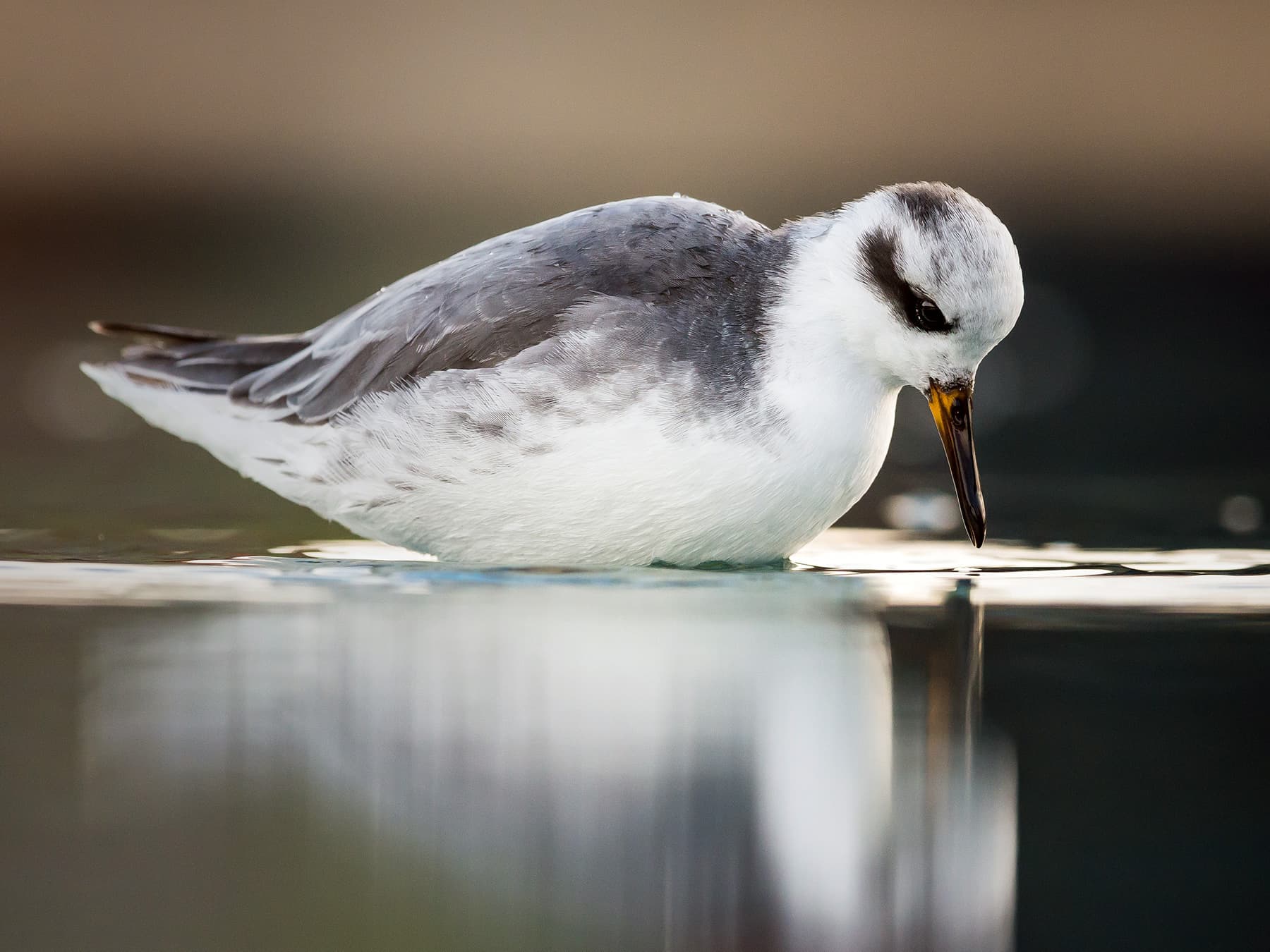
Grey phalaropes spend winters at sea, sleeping on the waves’ surface each night and feeding by day.
Lifespan and predators
How long do Grey Phalaropes live?
Ring recoveries of grey phalaropes are particularly rare, making it difficult to judge how long is the typical lifespan of a grey phalarope, or identify how old the oldest recorded individual was. Breeding is assumed to happen for the first time at 1 year. Some evidence suggests that adult birds can live for at least 5 or 6 years.
What are the predators of Grey Phalaropes?
On breeding grounds, the largest threat to grey phalaropes comes in the form of Arctic and red foxes, weasels, polar bears, gyrfalcons, peregrine falcons and skuas. Sandhill cranes and ground squirrels are common raiders of grey phalaropes’ nests.
Despite using a technique to flatten their body against the water’s surface and avoid predators at sea, grey phalaropes may also be targeted by Arctic skuas (parasitic jaegers) and glaucous gulls during winter.
Are Grey Phalaropes protected?
Grey phalaropes are included in the Wildlife and Countryside Act, 1981, which protects the species against being killed, injured, or taken into captivity. In the United States, red phalaropes and their eggs and young are protected under the Migratory Bird Treaty Act of 1918.
Are Grey Phalaropes endangered?
Precise population estimates for grey phalaropes are hard to determine due to the extensive periods they spend offshore and their breeding grounds in areas largely inaccessible to humans.
The global number of grey phalaropes is roughly estimated to be up to 5 million individuals, with the species classed as of least concern.
Conservation
While currently listed as Least Concern, Grey Phalaropes face threats from climate change affecting their Arctic breeding grounds. Oil spills and marine pollution also pose risks during their pelagic phase. Conservation efforts focus on protecting key stopover sites and breeding habitats.
More photos
2 photos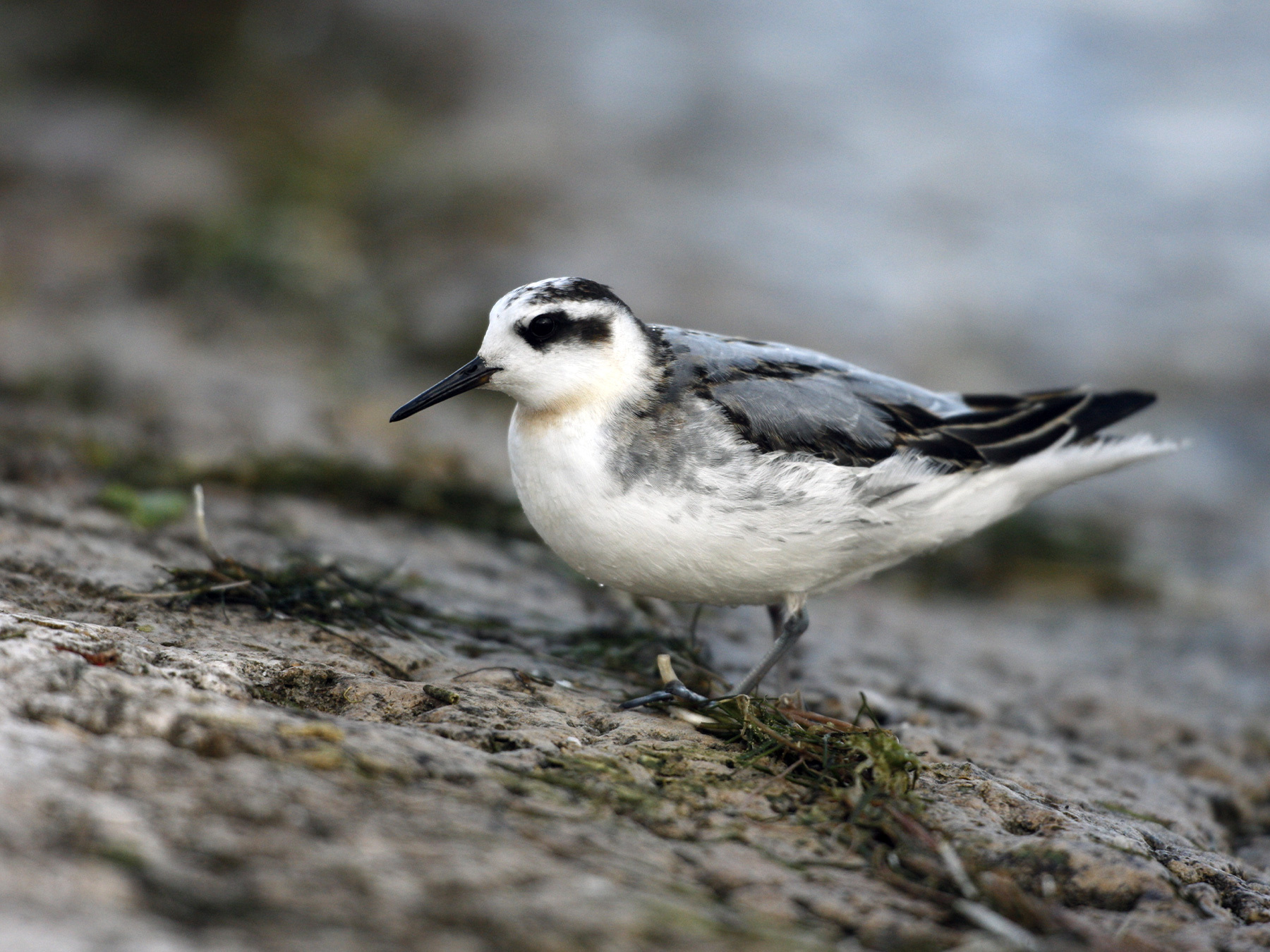
Quick facts
- Length
- 20–22 cm
- Wingspan
- 40–44 cm
- Weight
- 40–60 g
- Lifespan
- 5–10 years
- Family
- Sandpipers & Snipes
- Migration
- Long-distance Migrant
- Global status (IUCN)
- Least Concern
- World population
- 1,350,000 - 2,980,000 individuals
- Population trend
- Decreasing
- Also called
- Red Phalarope
- Scientific name
- Phalaropus fulicarius
Questions
3Are Brant and Grey Phalaropes the same?
Brant (known in the UK as Brent geese) and grey phalaropes are not the same species. Brant are geese, and grey phalaropes are shorebirds that breed in the Arctic and migrate southwards in winter.
Is a Grey Phalarope a Canada goose?
The grey phalarope is an entirely different species to a Canada goose. Canada geese are geese, while grey phalaropes are wading birds, related to sandpipers.
How did the Grey Phalarope get its name?
The grey phalarope’s name has Latin roots, with the word “Phalaropus” derived from Ancient Greek words meaning ‘coot’ and ‘foot’.
This reflects the lobed toes of grey phalaropes, also seen in coots. The ‘grey’ part of their name comes from their winter plumage, while in North America, they are known as ‘red phalaropes’ in recognition of their more eye-catching orange-red breeding plumage.
Sources
2- 1BirdLife International. 2018. Phalaropus fulicarius. The IUCN Red List of Threatened Species 2018: e.T22693494A132531581. Source (opens in a new tab)
- 2Wetlands International (2015)

Checked by
Nathan Cope, founder and editor
Nathan founded Birdfact and leads its writers and contributors in the UK, the US and Canada. He has watched and studied birds for more than ten years, and checks every article and species guide before it’s published.