


Great Grey Owl
Phantom of the North, Great Gray Owl, Lapland Owl · Strix nebulosa
By the Birdfact teamChecked by Nathan Cope
On this page13 sections
How to recognise it
What do Great Gray Owls look like?
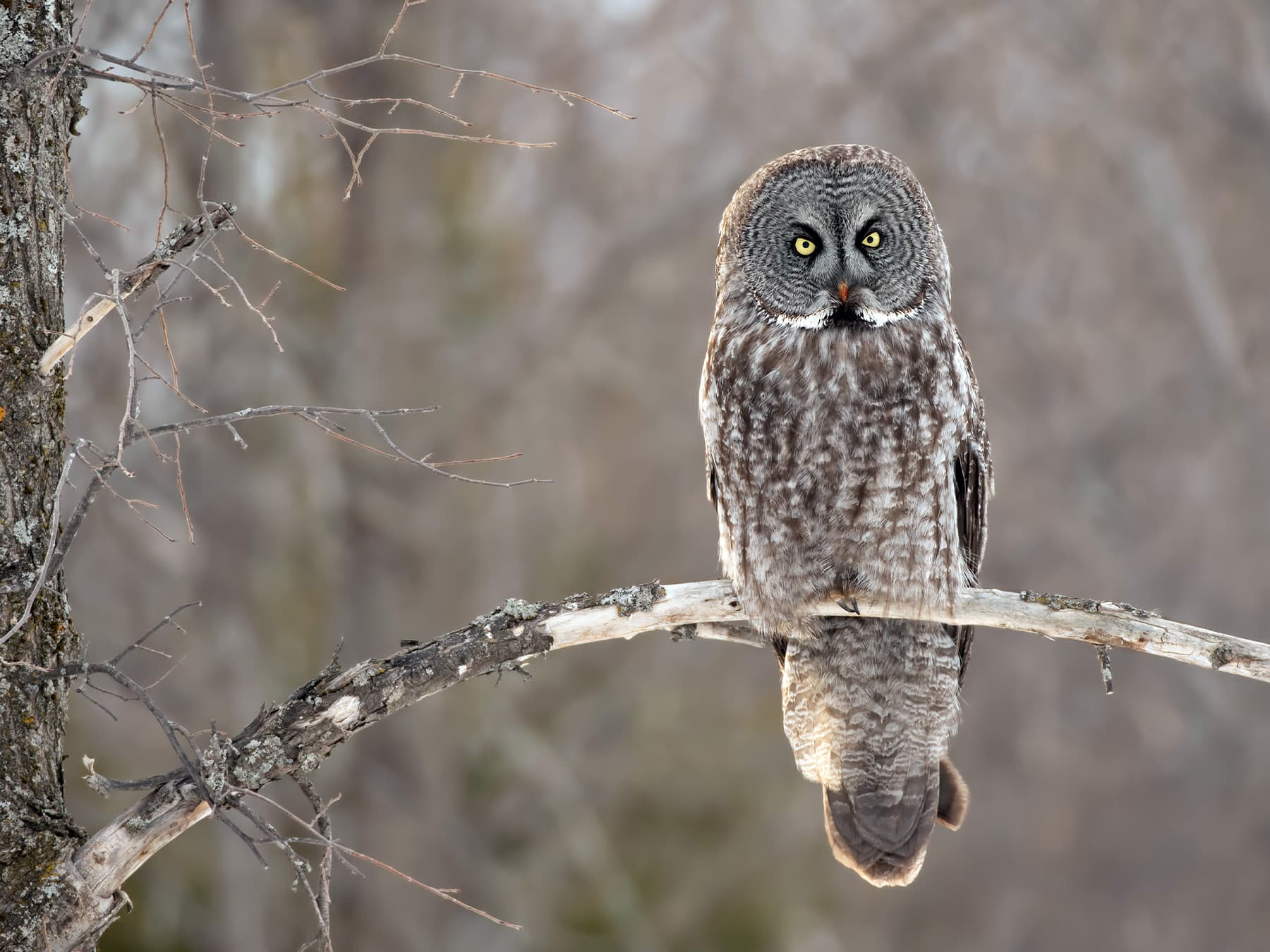
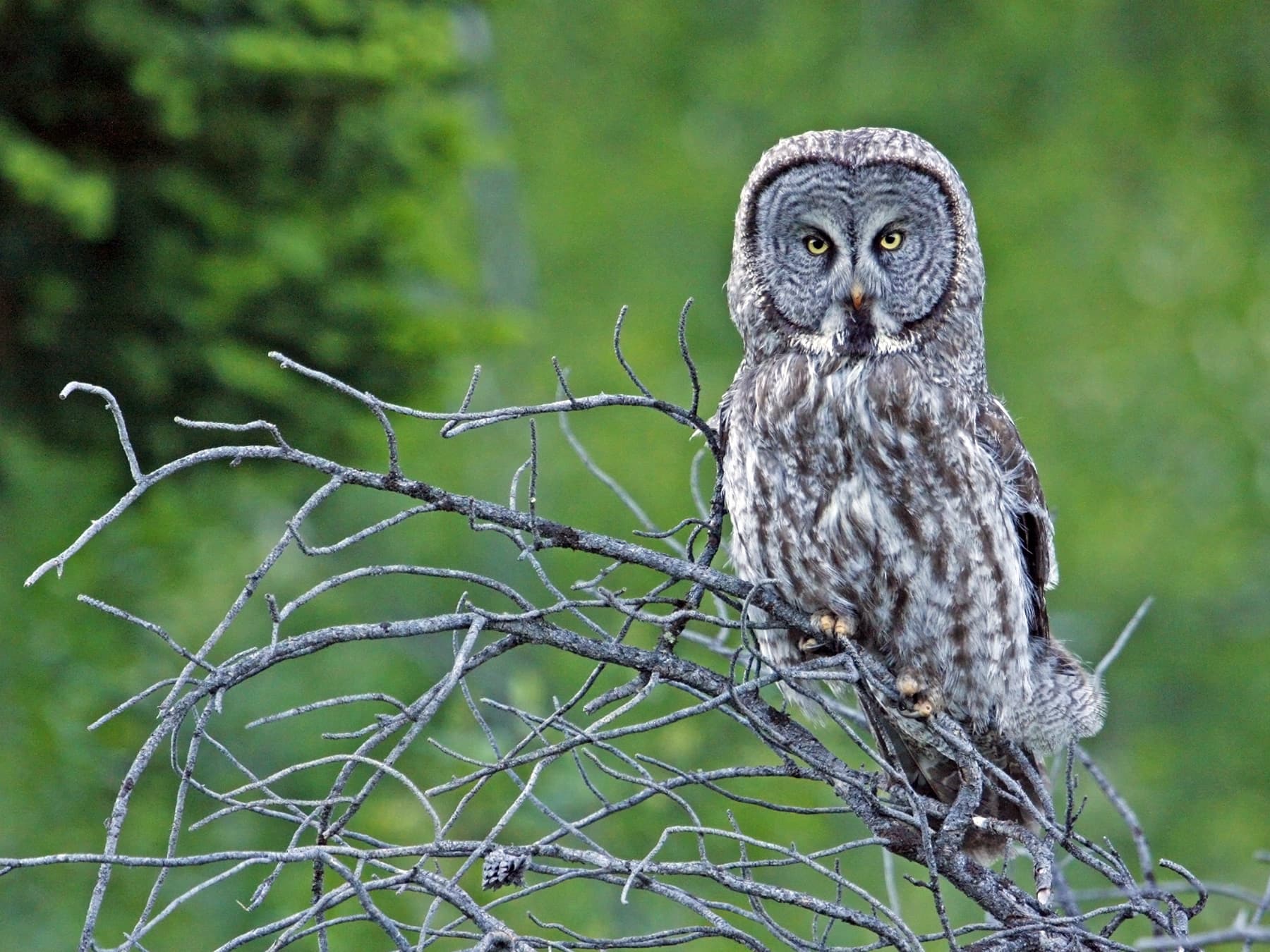
Great gray owls are instantly recognizable and not easily confused with any other owl species, due to their extra large stature and distinctive facial patterning.
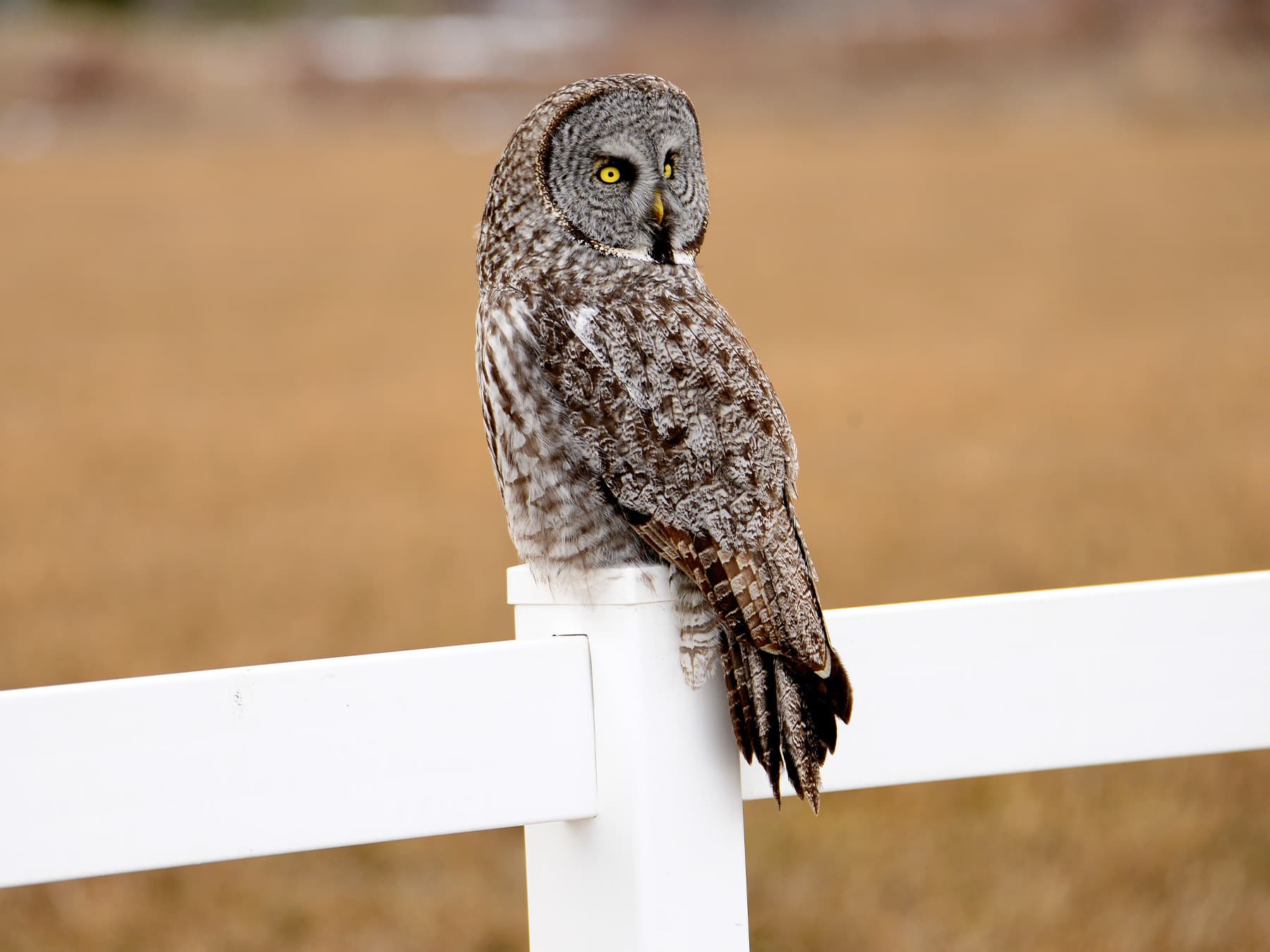
As their name suggests, their plumage consists of a large amount of gray, with white and brown patterning across the wings, back, belly, and breast. Wings are barred with lighter gray, darker gray, and some brown, with pale gray streaking, and the breast and belly have fine dark barring and are overall mottled with gray and brown. Their long tail is rounded and barred with brown, gray, and white.
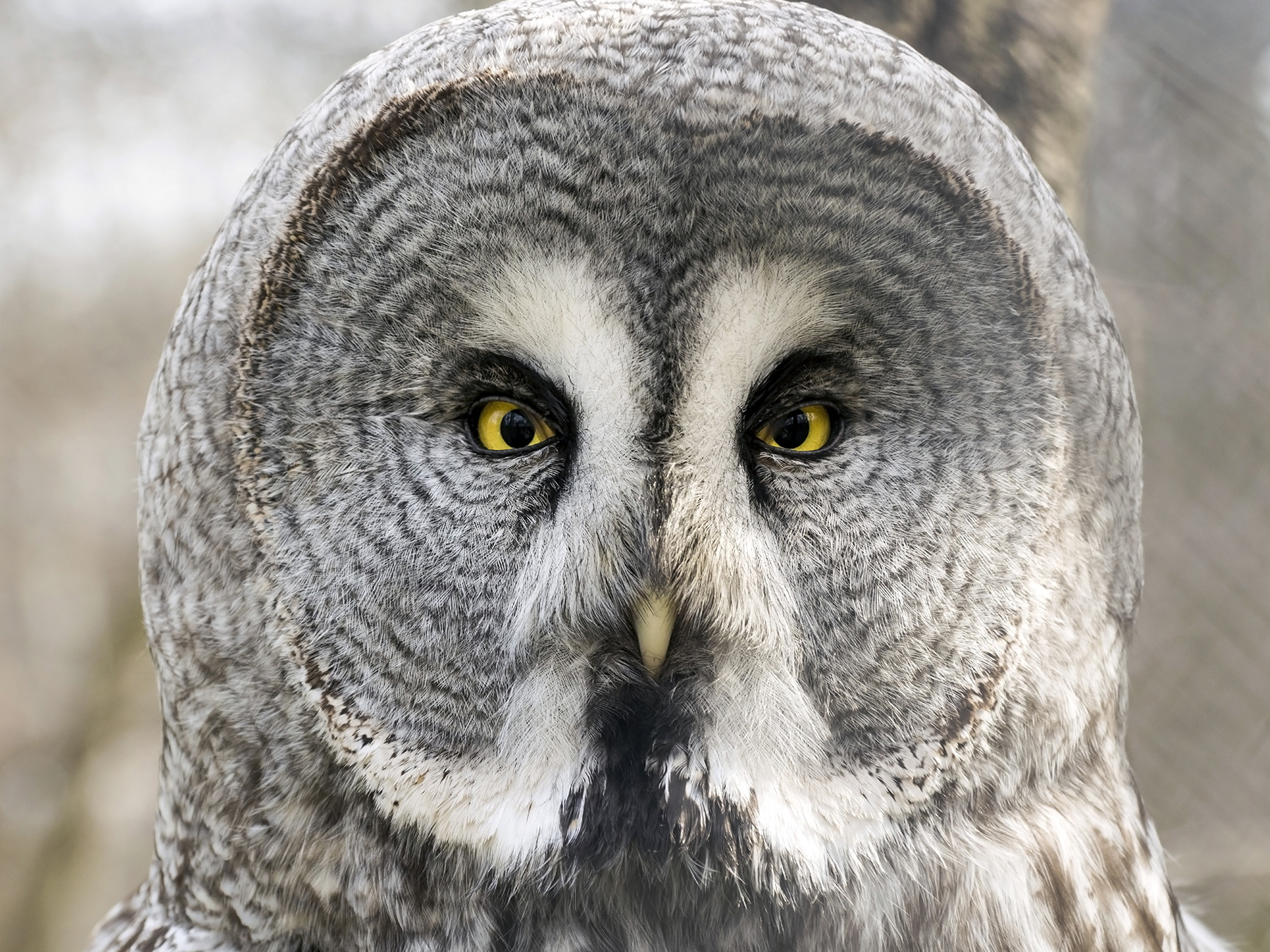
The facial disc of a great gray owl is the largest of any owl species and features concentric gray and dark brown rings around the eyes, which are bright yellow and look relatively small, topped with strong white eyebrows. The bill is yellow, with a black patch immediately below, and a white collar is visible between the face and the neck.
Females and males are alike in plumage, but larger in all aspects than males.
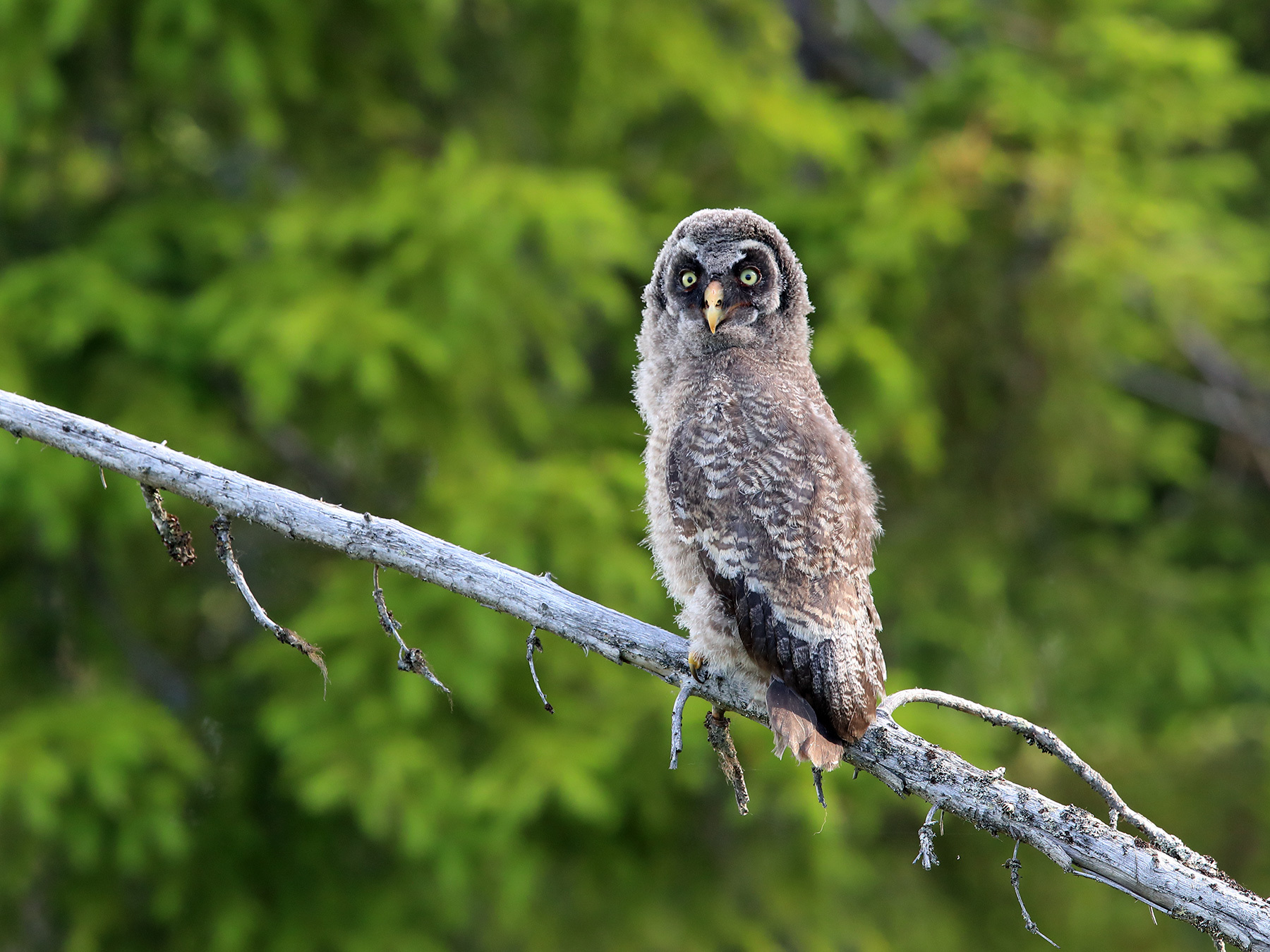
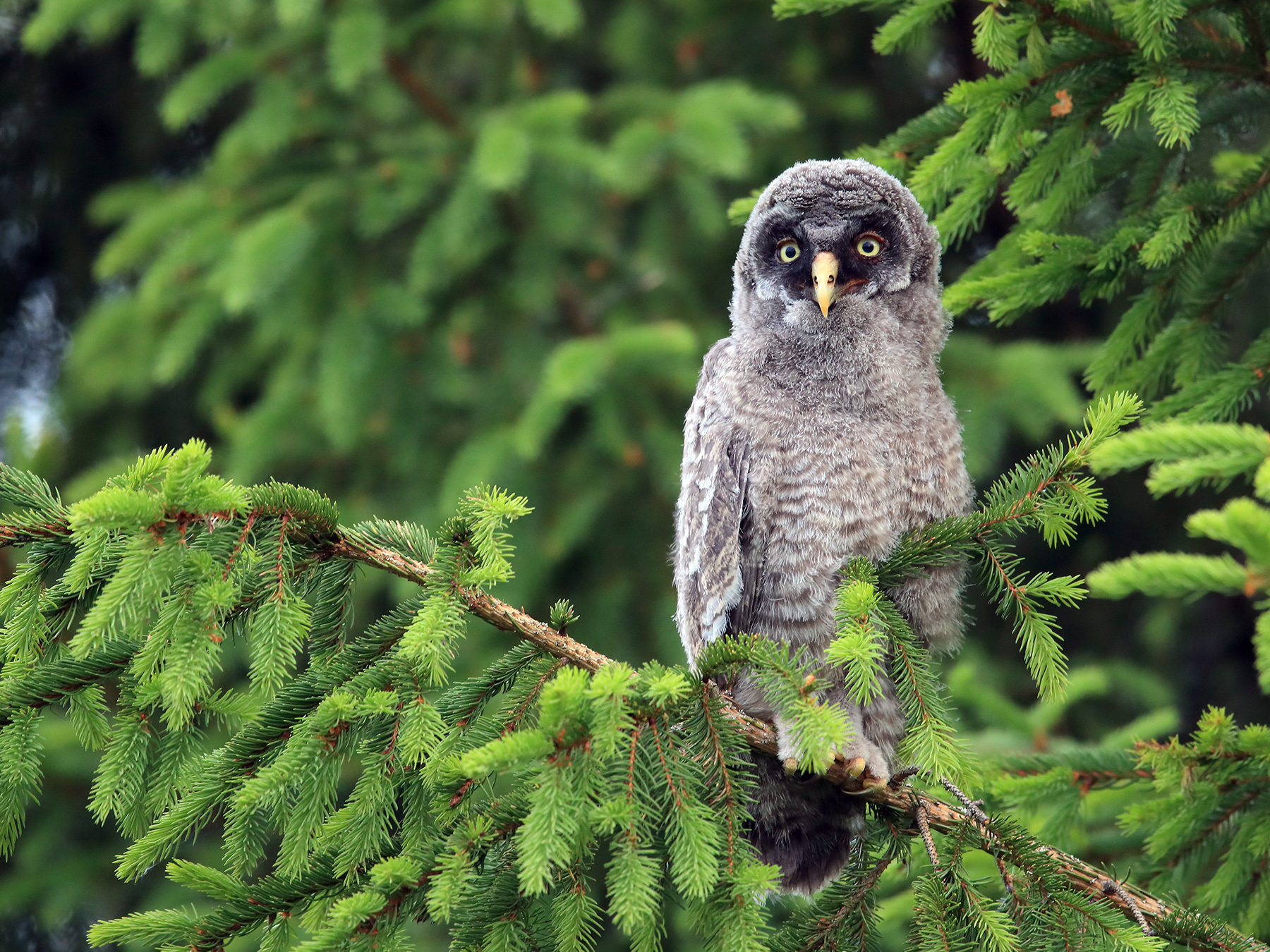
Juvenile great gray owls are not as vividly marked as adults and have a more cryptic appearance, with mottled shades of gray and white, and develop a more adult-like plumage after 5 months.
How big are Great Gray Owls?
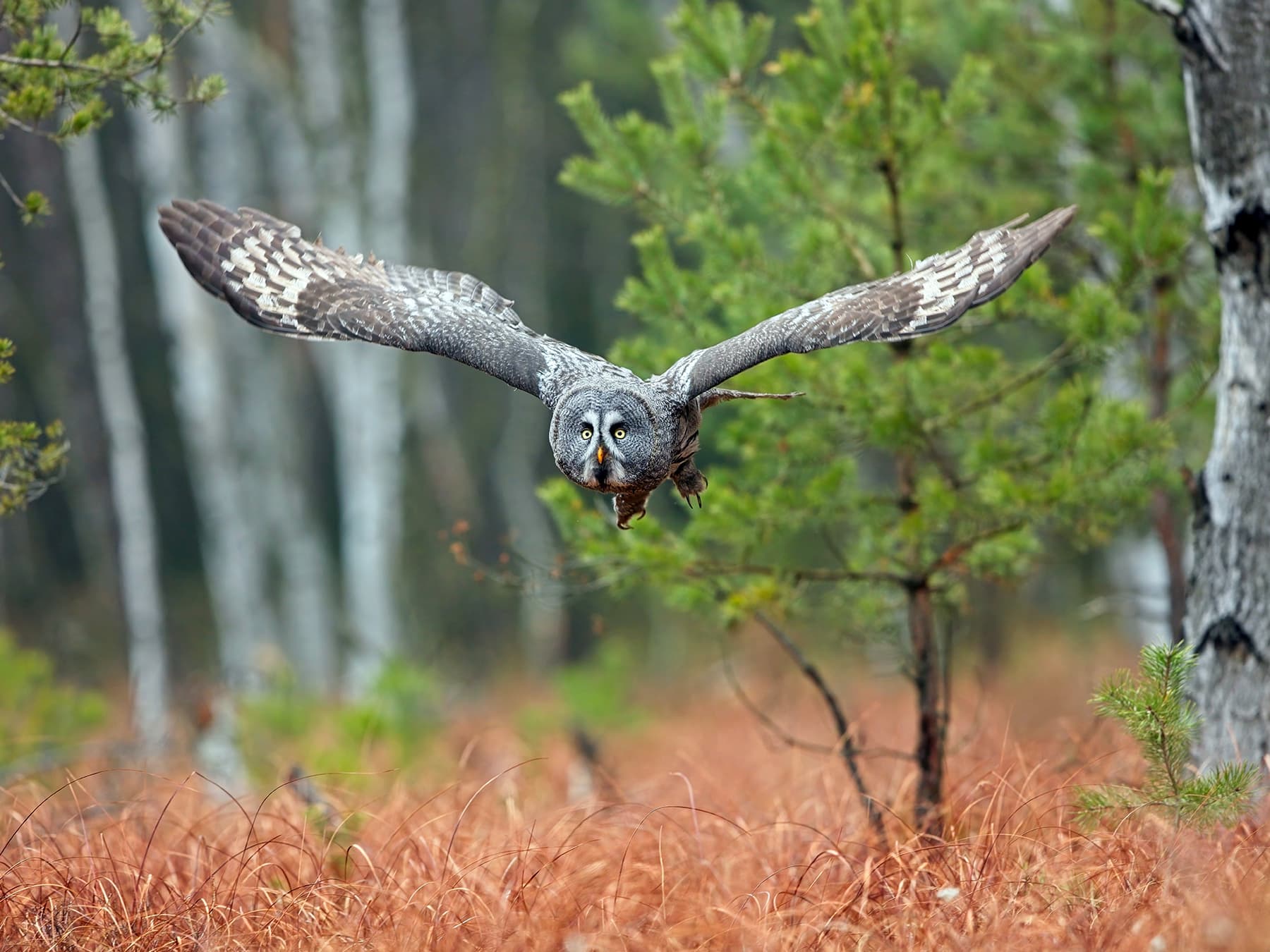
Great gray owls are undeniably large and powerful, but in terms of body mass, they trail behind the snowy owl and great horned owl, with much of their dense plumage accounting for much of their bulky size.
Female great gray owls are normally larger than males, and heavier too.
- Length: 61 cm to 84 cm (24 in to 33.1 in)
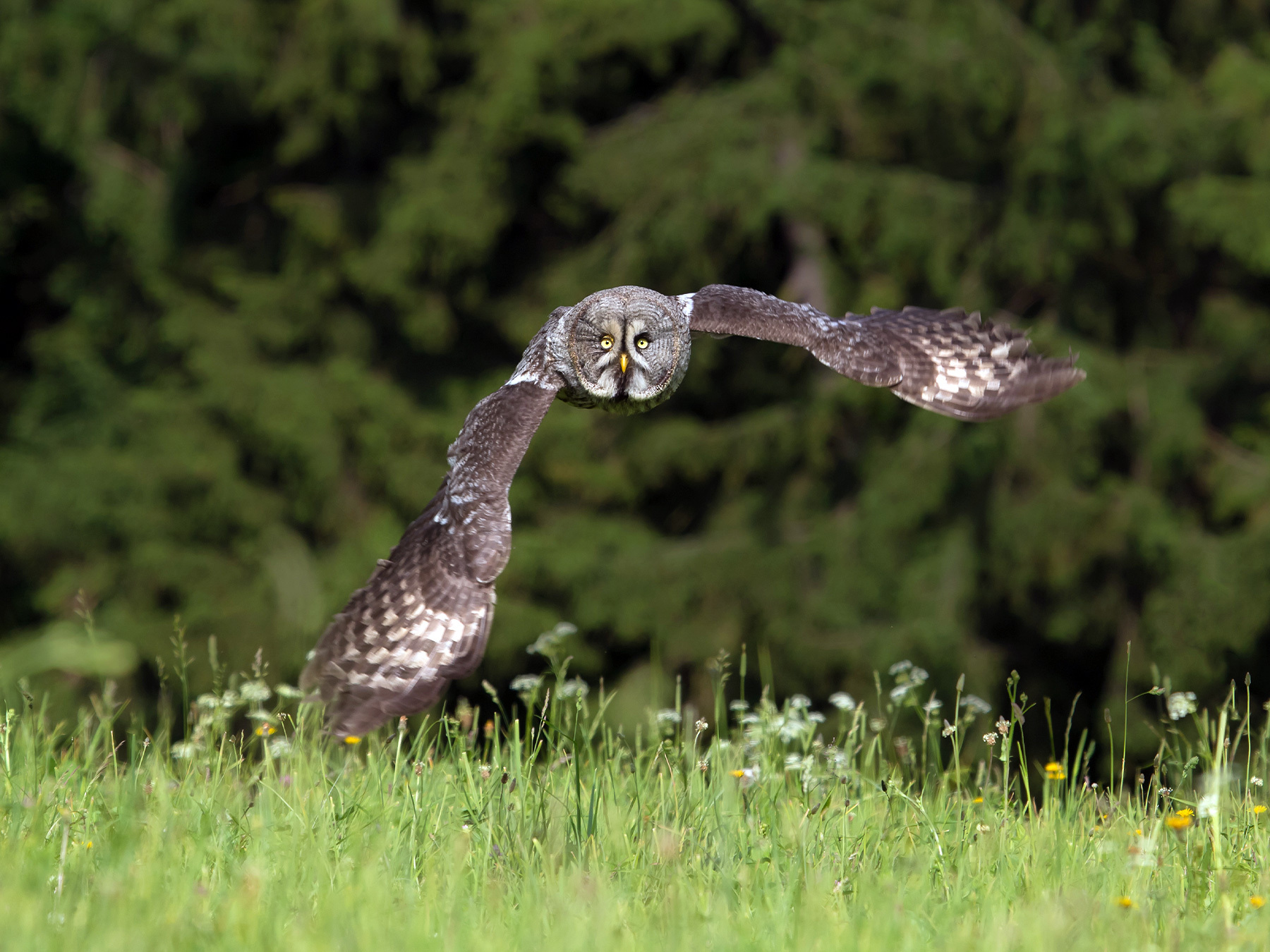
- Wingspan: 137 cm to 153 cm (53.9 in to 60.2 in)
- Weight: 700 g to 1700 g (24.7 oz to 60 oz)
Its size
Adults- Length
- 61–84 cm
- Wingspan
- 137–152 cm
- Weight
- 790–1454 g
Its song and calls
What sound does a Great Gray Owl make?
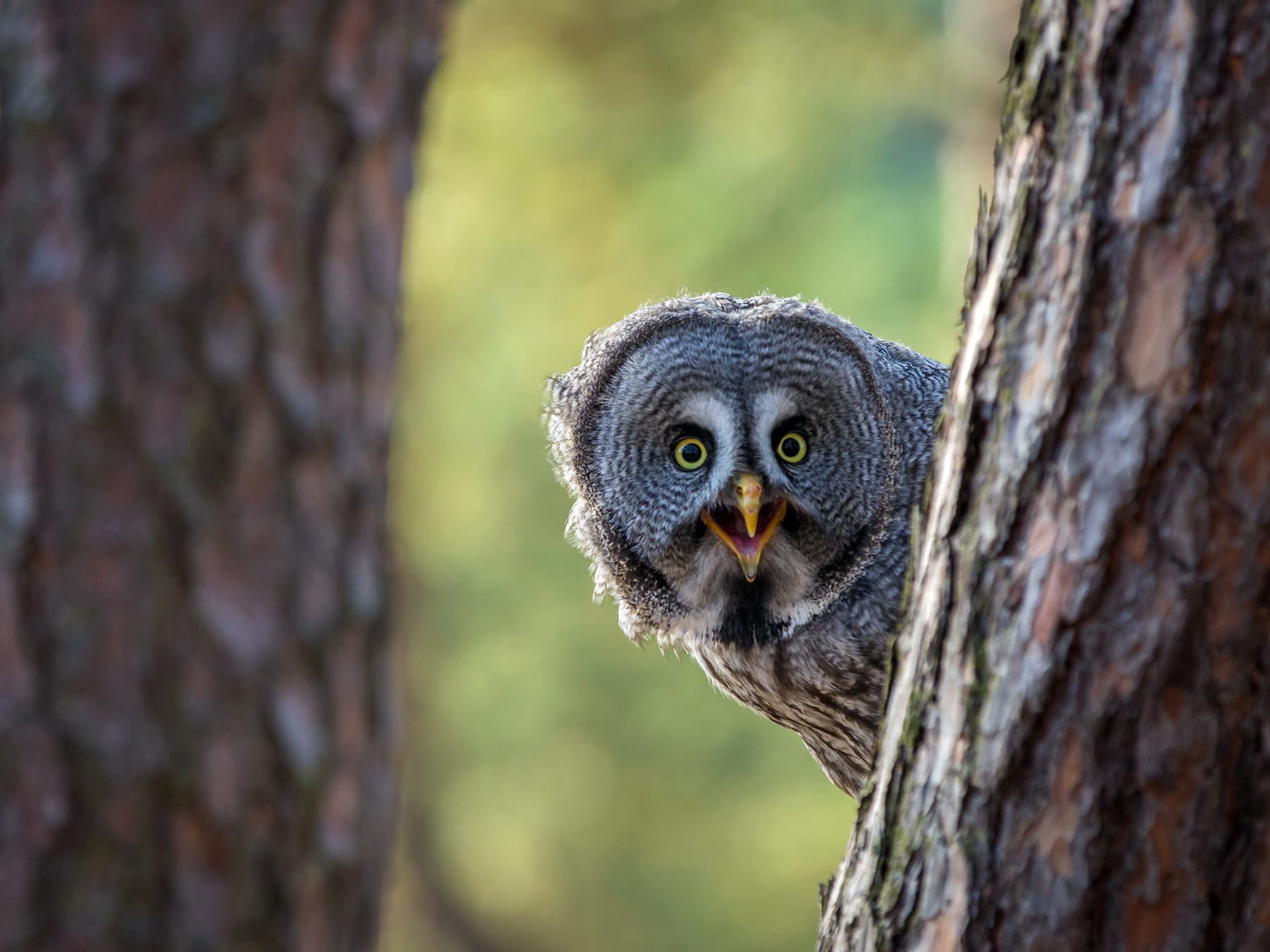
An evenly spaced series of whoo notes is used by both male and female great gray owls as a territorial call, with the male’s voice deeper in pitch than the female’s. Double hoots are used as a contact call between mates. A chattering cry is heard when the nest site is threatened or when intruders are sensed.
- Song0:00 / 0:11
Recorded in Örebro County, Sweden · April 2025
When and where to see it
The Great Grey Owl is not recorded regularly in the UK, Ireland, the United States or Canada.
Canada: recorded in 1 of the 6 years. Too few years to count as a regular visitor.
Data: EOD – eBird Observation Dataset (Cornell Lab of Ornithology), accessed via GBIF.org, CC BY 4.0. Records from 2019–2024, aggregated and filtered by Birdfact. How these lists are made
What is the habitat of a Great Gray Owl?
Dense coniferous forests are the preferred habitat of great gray owls, particularly those that contain a mix of old-growth trees and younger plantations. Nearby meadows, marshes, and swamps offer important hunting grounds, as they normally have abundant populations of voles, mice, and other small mammals.
What is the range of a Great Gray Owl?
The primary range of great gray owls extends across the northern hemisphere, encompassing much of western, central, and southern Canada, parts of the northwestern US, and northern Eurasia, from Finland eastwards through Russia, Mongolia, and northeastern China.
In winter, occasional irruptions further south occur and nomadic wanderings may take some individuals outside of their regular breeding territories.
Where do Great Gray Owls live?
The overall global population of great gray owls is thought to be around 80,000 mature individuals, with around 38,000 of these resident in North America, and up to 19,900 in Europe.
How rare are Great Gray Owls?
Sightings of great gray owls are relatively uncommon, due to their nocturnal behavior, effectively camouflaged plumage, and preference for dense coniferous forests. However, they are not a particularly rare species and are widespread across forested landscapes of the northern hemisphere.
Where can you see Great Gray Owls in the US?
Montana’s Glacier National Park and the Bitterroot Valley are known for their great gray owl populations. Similarly, sightings are also regularly reported in Idaho’s Bitterroot Mountains and the Panhandle region. To the west, great gray owls are also occasionally spotted at Okanogan-Wenatchee National Forest, in Washington.
Where can you see Great Gray Owls in Canada?
Great gray owls are widespread across much of western and central Canada, and a visit to any densely forested landscape in this region may reward you with a sighting.
The forests and meadows of Riding Mountain National Park in Manitoba offer a particularly decent chance of spotting a great gray owl. Ontario’s Algonquin Provincial Park is known for its diverse resident wildlife, including great gray owls.
Migration
Do Great Gray Owls migrate?
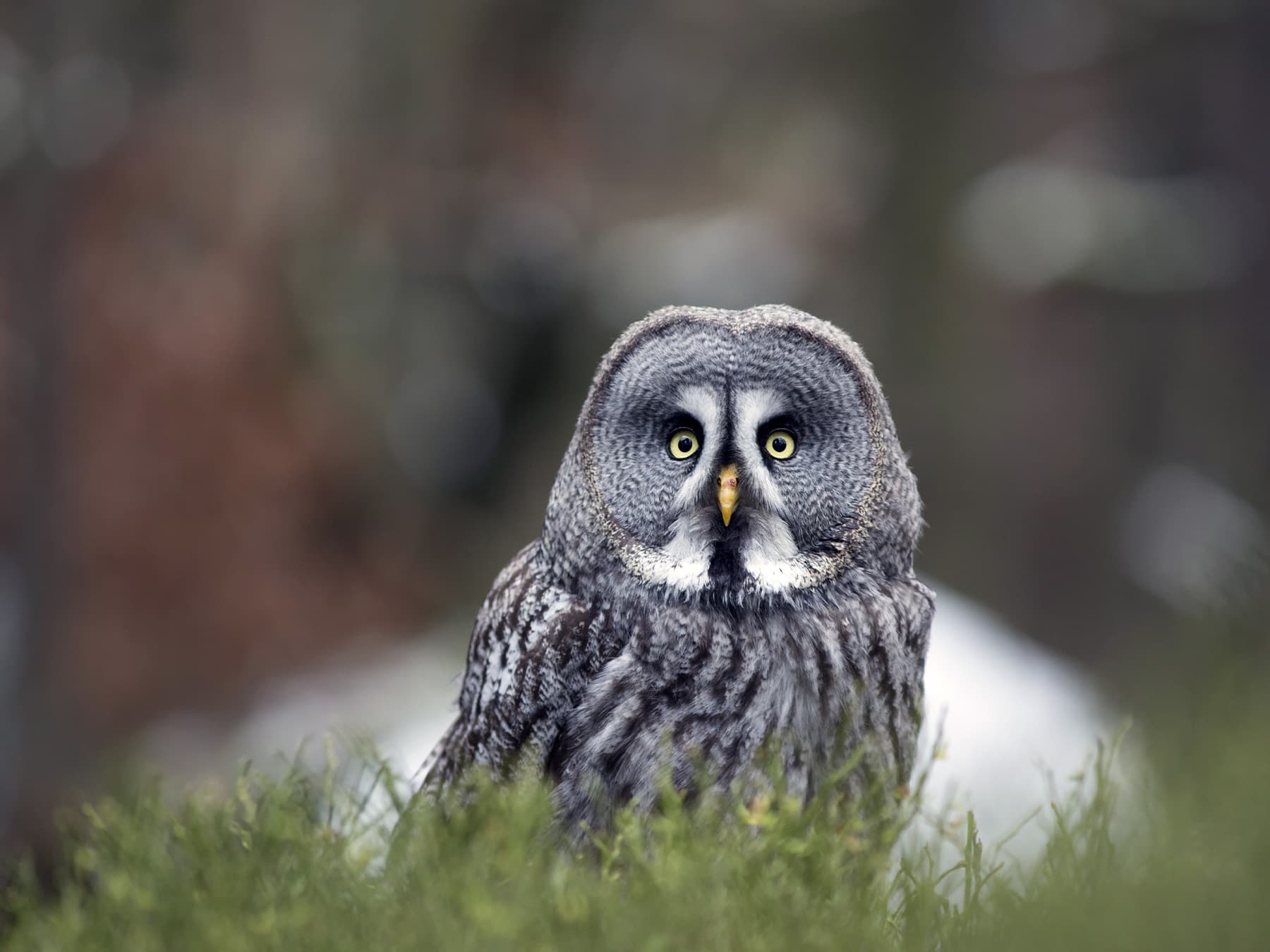
Great gray owls are usually resident birds, remaining in or close to their home territories for their entire lives. However, this can vary depending on prey availability.
Many great gray owls are nomadic, and wander from place to place outside of the breeding season and dispersing to regions with less snow cover in winter.
Are Great Gray Owls native to the US?
The main range of great gray owls lies to the north of the United States, although the southern extremes do extend across the border with Canada, and resident great gray owls are found across the northwestern states, through the Rocky Mountains, and as far south as the Sierra Nevada in California.
Tips for seeing it
- Look for them in dense coniferous or mixed forests near open areas
- Listen for their deep, resonant hooting calls at night
- Scan for their distinctive large, round head shape silhouetted against the sky
- In winter, watch for them hunting in meadows or clearings during daylight hours
- In North America, visit boreal forests in Canada or northern US states for the best chances of spotting them
What it eats
What do Great Gray Owls eat?
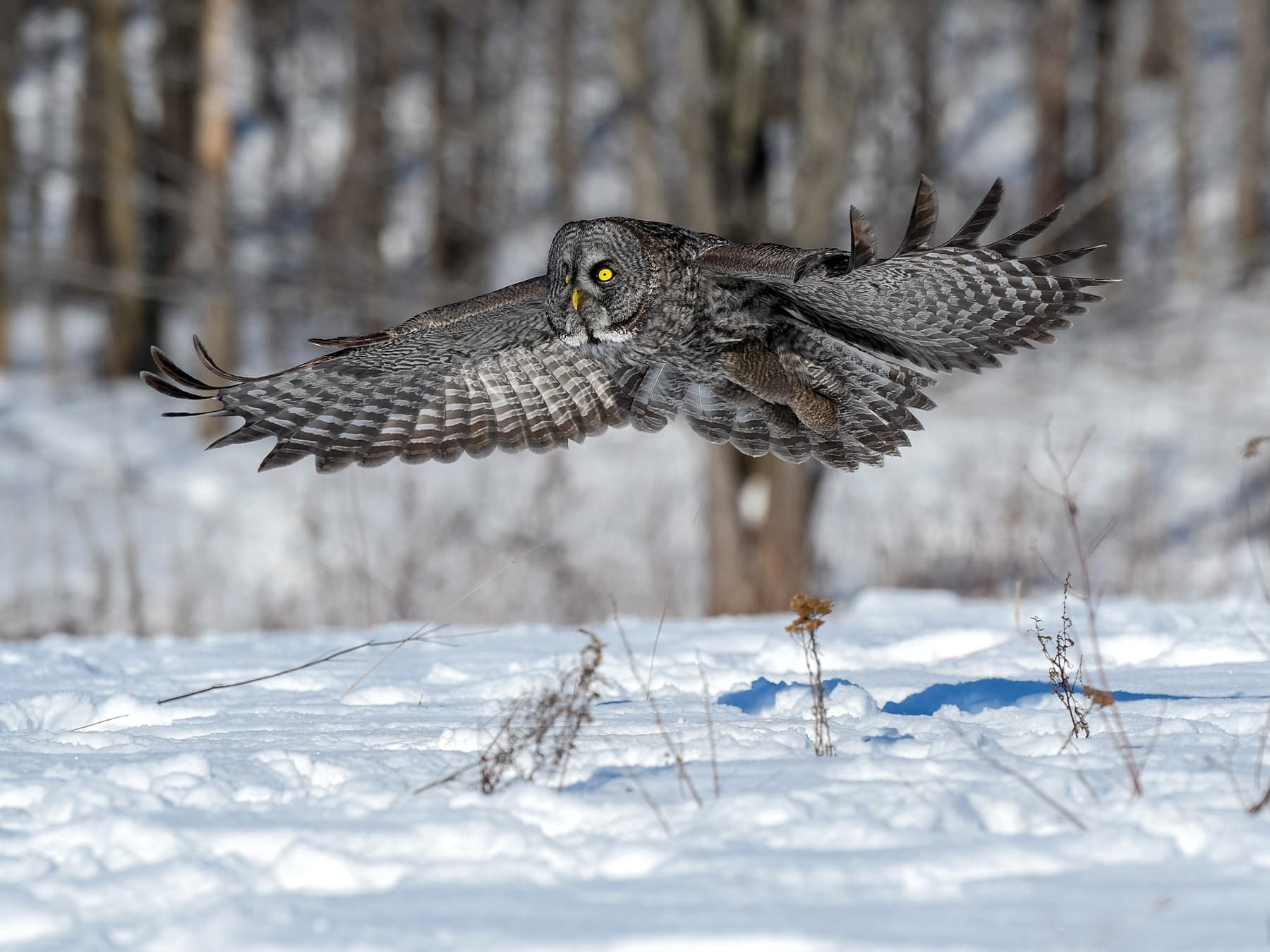
Small mammals are the primary prey of great gray owls, which are experts at catching rodents even when deep snow covers the ground.
Voles, pocket gophers, shrews, red and flying squirrels, mice, lemmings, weasels, and chipmunks are the most commonly caught prey. Birds are also taken but do not represent as important a share as mammals, with ducks, grouse, and songbirds.
Although most hunting is done during darkness, males may forage during the daytime in the breeding season to keep up with the demands of feeding hungry young.
What do Great Gray Owl chicks eat?
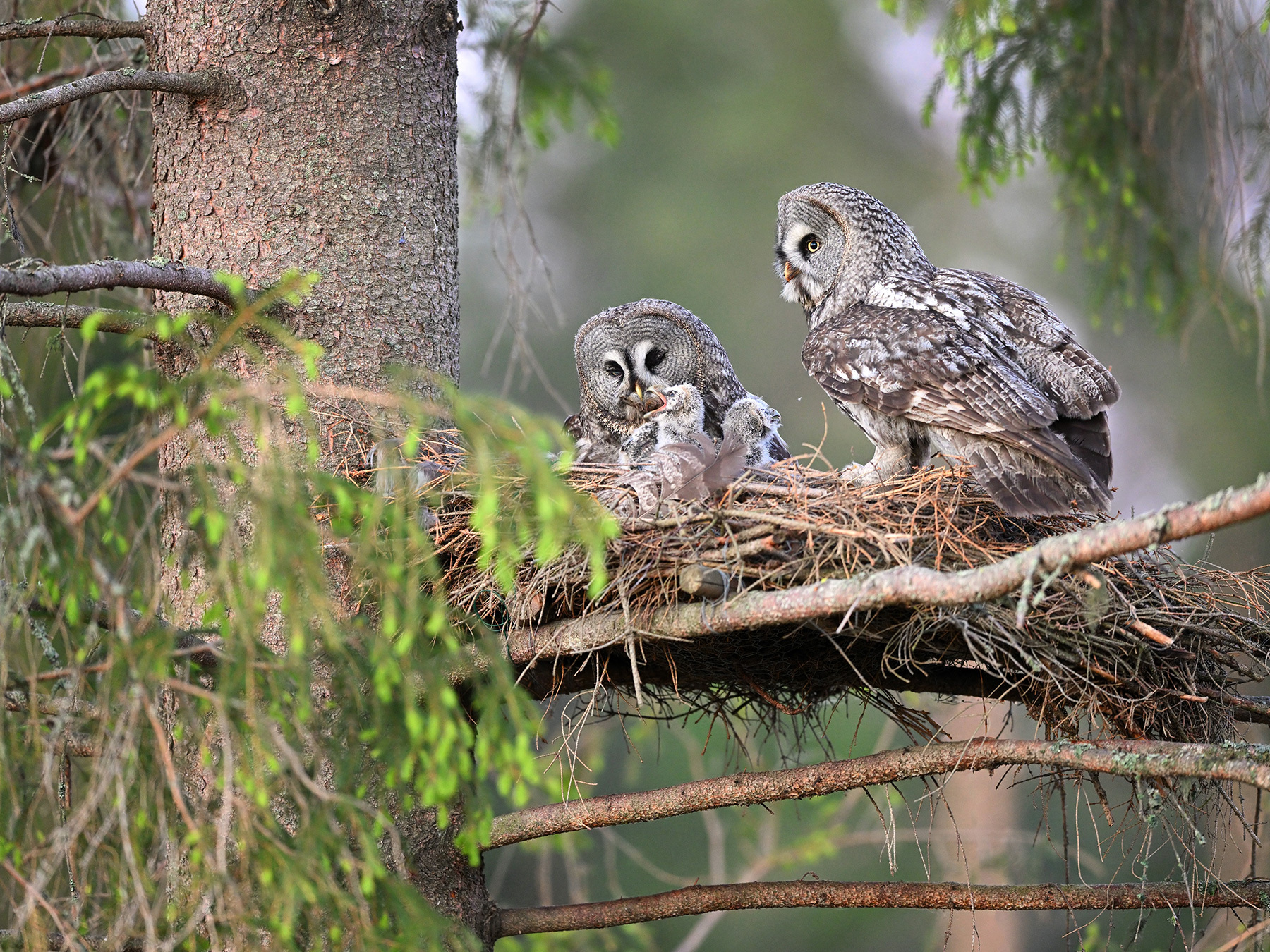
Great gray owl chicks feed on whatever the male parent brings to the nest, which varies according to location but is frequently small voles, shrews, and pocket gophers. Initially, the female will shred the prey into pieces small enough for the young to swallow, but gradually young great gray owl chicks master the art of swallowing prey whole.
Nesting and breeding
Where do Great Gray Owls nest?
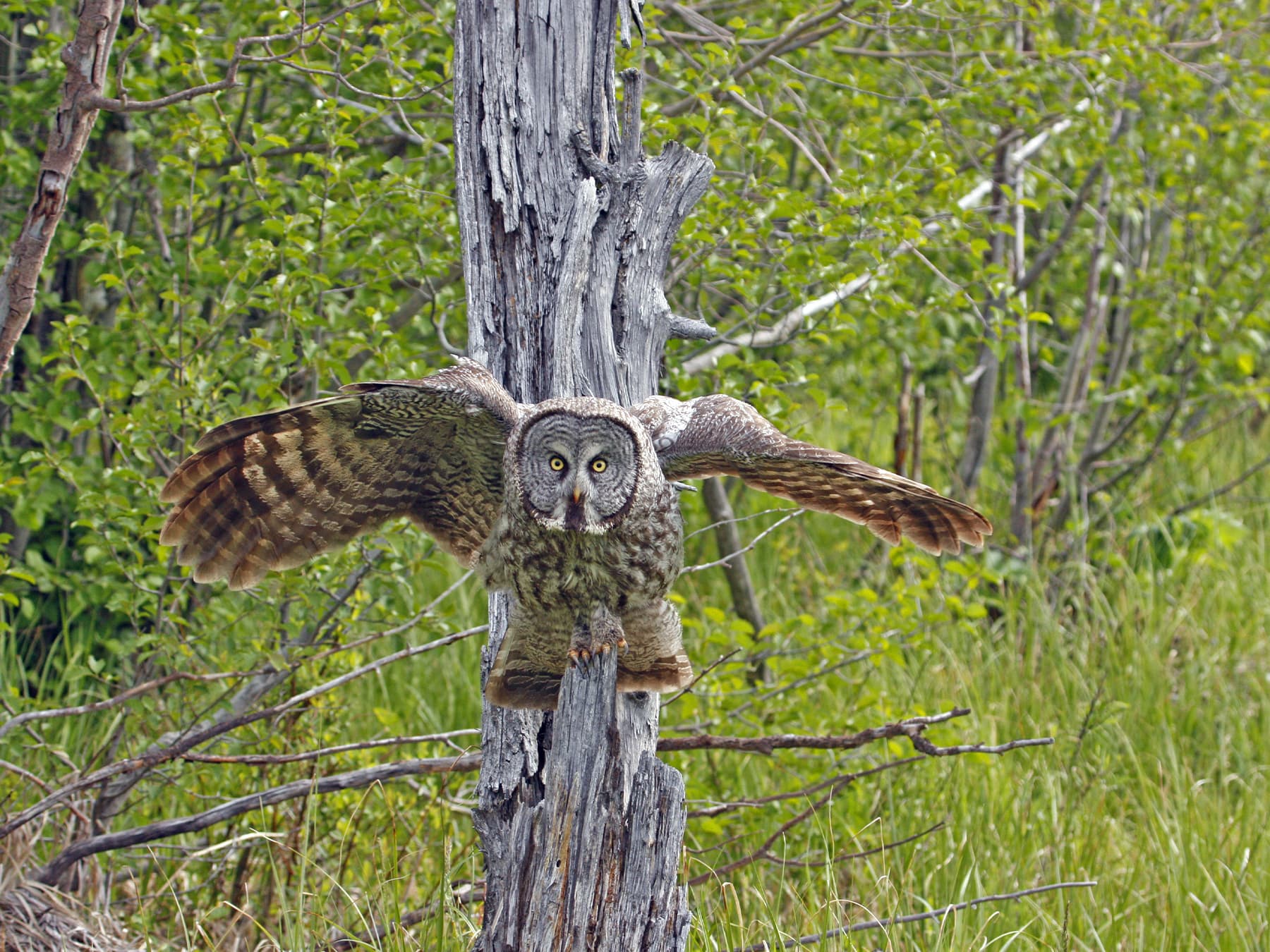
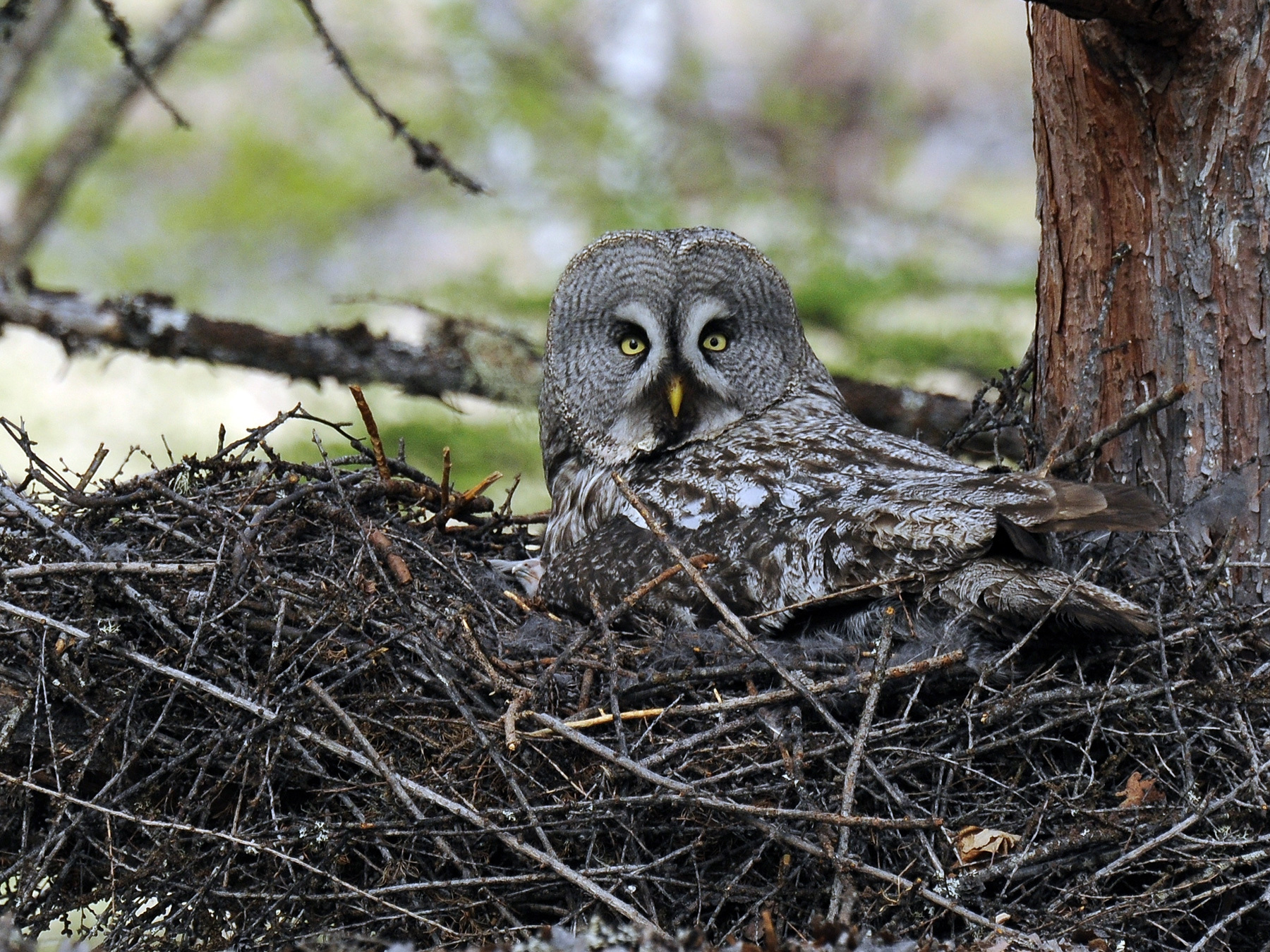
Unlike many other owl species, great gray owls do not nest in cavities, perhaps due to their vast size. Instead, they reuse old nest platforms abandoned by other birds that are bulky and strong enough to support them. The old nests of ospreys, ravens and goshawks - and even squirrels - are ideal.
Large snags – standing dead trees with broken tops – are also used. Nests are flat, to offer good visibility, and no additional material is added, although a depression is usually created by the female as a nest bowl before she starts laying.
In some regions, conservation projects are in place that aim to boost and manage populations of great gray owls, and artificial nest platforms have been introduced and successfully used to raise young.
When do Great Gray Owls nest?
Pairs form from early January onwards, and the important job of nest prospecting takes place over the course of three to four weeks before a final choice is made and eggs are laid. The peak months for eggs in North America are late March to early May.
Only female great gray owls incubate and are brought prey to the nest by their mate. Eggs hatch after 28 to 36 days, and young continue to be brooded in the nest by the female for a further two to three weeks. By between 26 and 29 days, young great gray owls are ready to fledge but continue to be fed outside of the nest by parents until they are around 3 months old.
What do Great Gray Owl eggs look like?
Great gray owls’ eggs are a dull white in color, and slightly elongated. They measure around 5.4 cm (2.1 in) by 4.3 cm (1.7 in). A typical clutch consists of between 2 and 7 eggs.
Do Great Gray Owls mate for life?
Courtship begins as early as January, with males using ‘snow plunging’ displays to attract females at the start of the breeding season. Pairs remain together as they raise their young.
In some regions, pair bonds dissolve after young gain independence and become solitary and nomadic during winter months. In regions to the south, pairs remain bonded throughout the year but will seek a new mate if their original one dies.
Behaviour
Are Great Gray Owls aggressive?
Great gray owls have a reputation as being savage and fierce nest defenders and will strike with their razor-sharp talons at any potential predator that approaches too closely.
Intruders will be chased, and there are reports of humans sustaining slash injuries when they have disturbed a nesting great gray owl. Predators as large as bears have been driven away from nest sites by the vicious displays, and bill snapping and low hoots may be given as a warning to immediately precede an attack.
Where do Great Gray Owls sleep at night?
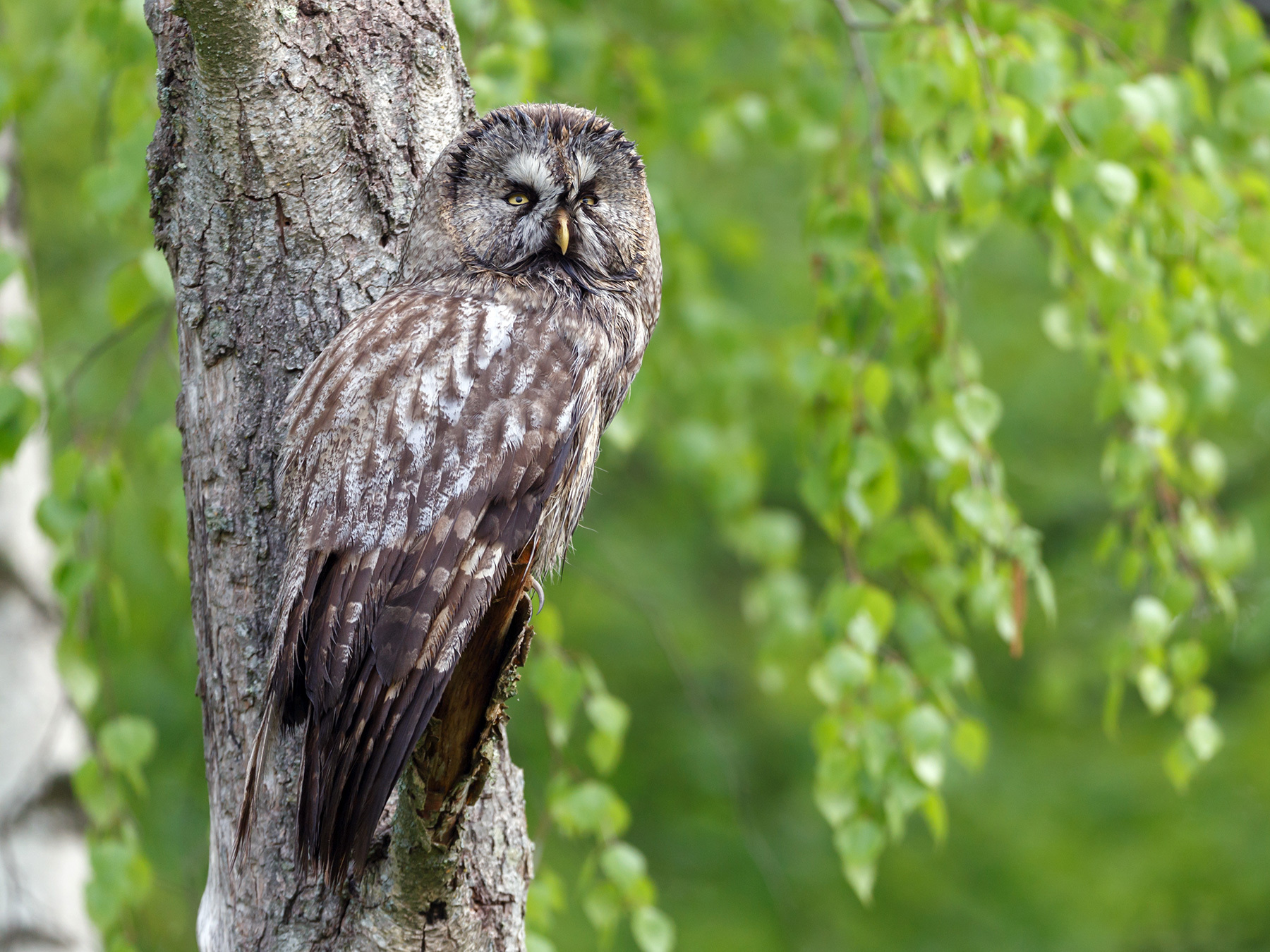
As a nocturnal species, great gray owls are active at night and sleep during the day, finding a spot close to the trunk where their plumage provides effective camouflage against the bark. In summer, spots near to the dense upper canopy are often chosen, offering relief from intense heat.
When raising young, male great gray owls may frequently hunt during the day too, to keep up with the feeding demands of their rapidly growing chicks.
Lifespan and predators
How long do Great Gray Owls live?
First-time breeding is possible at one year of age, but rare. Young great gray owls usually breed for the first time at three years old, but occasionally will raise a successful brood at two years of age.
On average, the lifespan of a great gray owl in the wild is around 9 to 10 years, but individuals can live as long as 13 to 15 years, or in captivity for at least 27 years.
What are the predators of Great Gray Owls?
Great horned owls and ravens are both known to predate nests and take young birds. Great horned owls will also hunt adult great gray owls.
Are Great Gray Owls protected?
Great gray owls are included in CITES Appendix II, which legislates trade. In the US, the Migratory Bird Treaty Act of 1918 makes it illegal to kill, trap, injure, or trade great gray owls without a license. A similar law in Canada, the Migratory Birds Convention Act, offers the same level of protection to great gray owls in Canada.
Are Great Gray Owls endangered?
Currently classed as a species of least concern, there are no immediate or current threats to the future survival of great gray owls, and their population is secure and increasing.
Conservation
While listed as Least Concern globally, Great Grey Owls face localized threats from habitat loss due to logging and climate change. Conservation efforts focus on preserving large tracts of mature forest and maintaining suitable hunting grounds in open areas adjacent to forests.
More photos
8 photos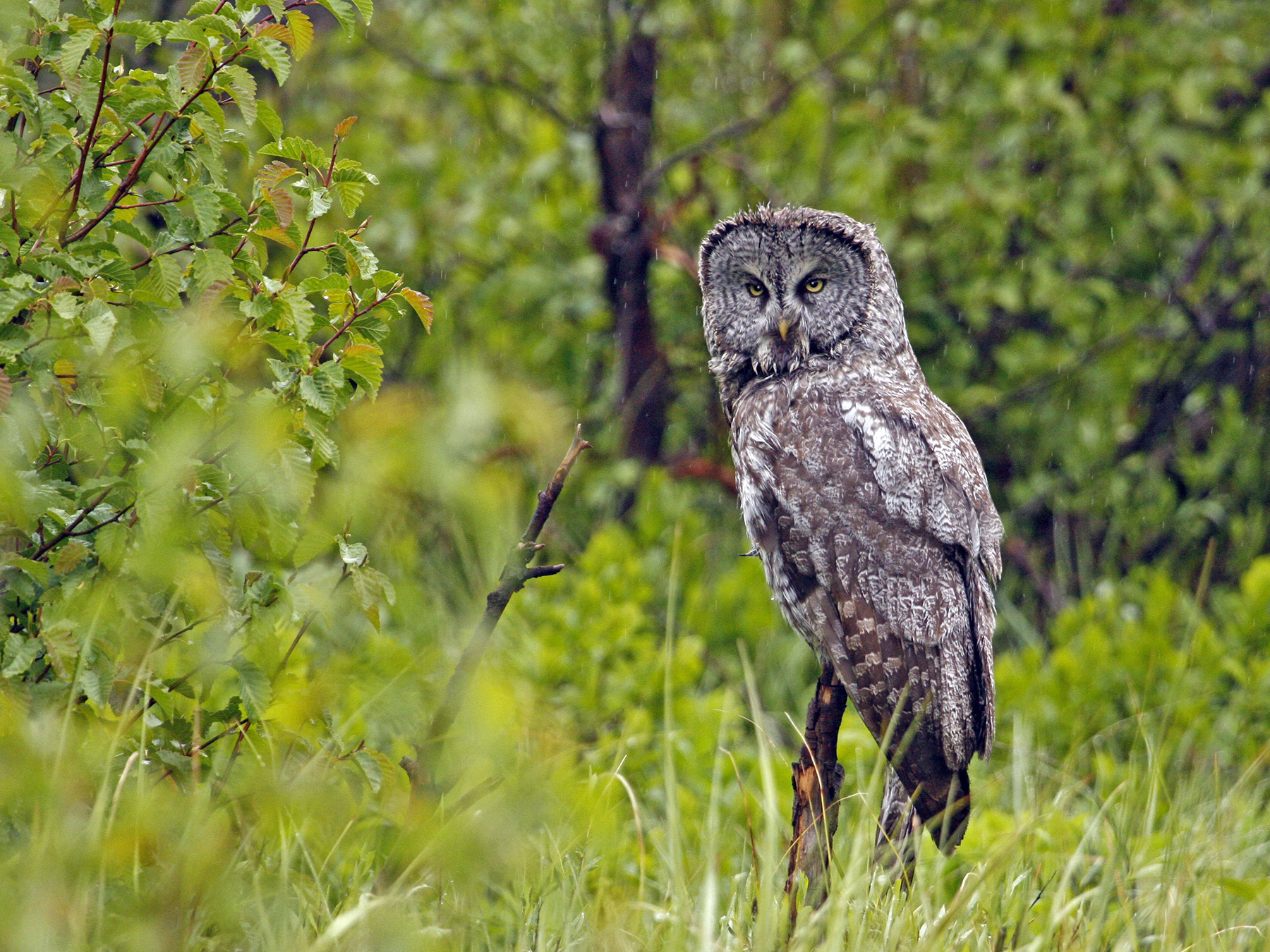
Quick facts
- Length
- 61–84 cm
- Wingspan
- 137–152 cm
- Weight
- 790–1454 g
- Lifespan
- 10–15 years
- Family
- Owls
- Migration
- Partial migrant
- Global status (IUCN)
- Least Concern
- World population
- 80,000 mature individuals
- Population trend
- Increasing
- Also called
- Phantom of the North, Great Gray Owl, Lapland Owl
- Scientific name
- Strix nebulosa
Questions
2How many great gray owls are left in the world?
The global population of great gray owls is estimated at around 80,000 mature individuals or an overall population of approximately 120,000 individuals.
Is the Great Gray Owl the largest owl?
While great gray owls are North America’s largest owl species in terms of body length, they are not the world’s largest or heaviest owl.
Blakiston’s fish owl, resident in Russia, China, and the Japanese island of Hokkaido, is the world’s largest and heaviest owl, while in Europe, Asia, and Africa, the Eurasian eagle owl also eclipses the great gray owl in both length and weight.
Sources
3- 1BirdLife International. 2021. Strix nebulosa. The IUCN Red List of Threatened Species 2021: e.T22689118A199144259. Source (opens in a new tab)
- 2Partners in Flight (2021)
- 3Partners in Flight (2021)

Checked by
Nathan Cope, founder and editor
Nathan founded Birdfact and leads its writers and contributors in the UK, the US and Canada. He has watched and studied birds for more than ten years, and checks every article and species guide before it’s published.