


Flammulated Owl
Flammulated Screech Owl · Psiloscops flammeolus
By the Birdfact teamChecked by Nathan Cope
On this page12 sections
How to recognise it
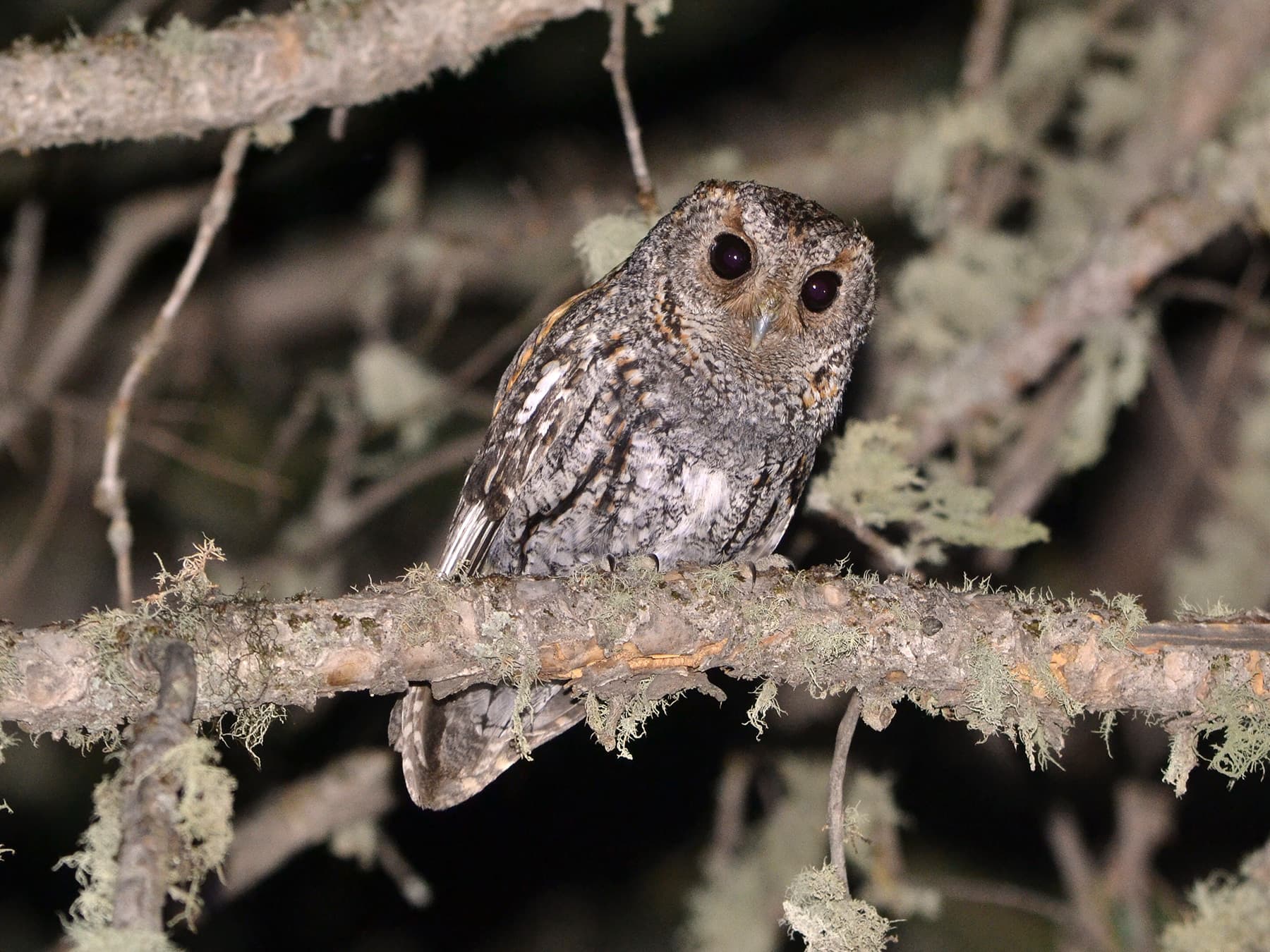
What do Flammulated Owls look like?
Two different color types of flammulated owls exist, with grayish coloring prominent in the northwestern Great Basin Range and a reddish variation further to the southeastern part of their range.
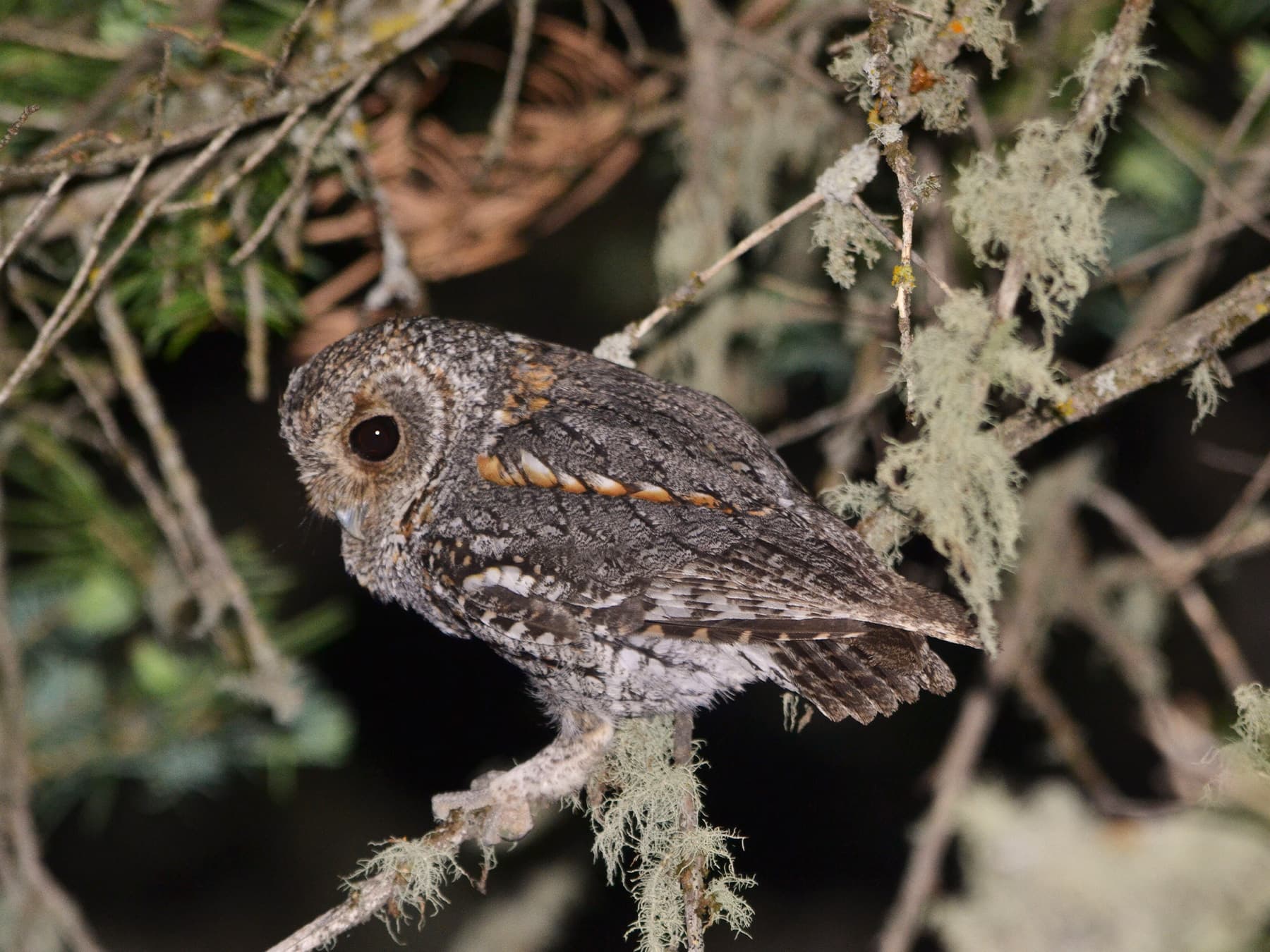
In both color variations, flammulated owls are brownish-gray barred with small white and rufous markings. Their underparts are paler, streaked with buff and white. Gray birds are paler with finer pale feathering mixed in with their mottled plumage, while the reddish variation has a visible chestnut-colored wash.
Flammulated owls have rounded heads, with a faint facial disk and small, often indistinct ear tufts. They have fiery orange facial markings and deep brown eyes.
Females are identical to males in coloring and markings and can be told apart only when the two sexes are side by side, as females are marginally larger and heavier than males.
Juveniles are mostly barred with gray and dusky markings, with dull rusty gray or grayish-white streaked underparts.
How big are Flammulated Owls?
One of the world’s tiniest owls, the flammulated owl is less than a quarter the size of the giant of the North American owl world, the great gray owl. Males are slightly smaller and lighter in weight than females.
- Length: 15 cm to 17 cm (5.9 in to 6.7 in)
- Wingspan: 41 cm (16 in)
- Weight: 43 g to 63 g (1.5 oz to 2.2 oz)
Its size
Adults- Length
- 15–17 cm
- Wingspan
- 36–42 cm
- Weight
- 45–63 g
Its song and calls
What sound does a Flammulated Owl make?
The deep, throaty hoot of a flammulated owl does not match its tiny stature and can confuse observers who are expecting to see a much larger bird.
Flammulated owls are able to project their low-pitched hooting so it sounds as if it is coming from elsewhere and call from high up in the crowns of tall pines. During courtship, females use a mewing call to beg for food.
When and where to see it
OctoberLeaving
Most recorded in October
- 1. Idahounder 0.1%
- 2. New Mexicounder 0.1%
- 3. Utahunder 0.1%
- 4. Arizonaunder 0.1%
- 5. Wyomingunder 0.1%
Each dot is a county, state or province: the bigger and darker, the larger the bird’s share of that place’s bird records that month. Grey dots: no regular records. The ringed point is the centre of the bird’s records this month; the arrow shows how it moved since last month, and the dashed loop its path through the year. “Arrivals” colours places where it becomes regular this month (orange) or is in its last regular month (grey). GBIF eBird Observation Dataset, 2019–2024. Map data: Natural Earth, US Census Bureau; place centres © OpenStreetMap contributors.
In your area
See when the Flammulated Owl is recorded in your county, state or province.
How often the Flammulated Owl turns up in the United States and Canada through the year, from birdwatchers' records.
United States
Summer visitor · regularly Apr–Sep · most records in June
Canada
Summer visitor · regularly May–Aug · most records in June
Show as a table
| Month | United States | Canada |
|---|---|---|
| January | – | – |
| February | – | – |
| March | <0.001% | – |
| April | <0.001% (regular) | – |
| May | 0.002% (regular) | <0.001% (regular) |
| June | 0.005% (regular) | 0.001% (regular) |
| July | 0.003% (regular) | <0.001% (regular) |
| August | <0.001% (regular) | <0.001% (regular) |
| September | <0.001% (regular) | <0.001% |
| October | <0.001% | – |
| November | <0.001% | – |
| December | – | – |
Worldwide: recorded regularly in 4 countries
Countries where it was recorded in at least 3 of the 6 years 2019–2024. Linked countries have their own bird list.
North America (4)
Data: EOD – eBird Observation Dataset (Cornell Lab of Ornithology), accessed via GBIF.org, CC BY 4.0. Records from 2019–2024, aggregated and filtered by Birdfact. How these lists are made
What is the habitat of a Flammulated Owl?
Mid-elevation, dry, mature pine forests provide a favorite nesting habitat for flammulated owls, with ponderosa pine the preferred species. Other conifers, as well as mixed aspen and oak woodlands with a densely vegetated forest floor, are also popular choices. Vital factors include an abundance and diversity of insect prey and a semi-arid climate.
What is the range of a Flammulated Owl?
Flammulated owls breed in scattered locations across western North America. Their distribution range is mainly centered on the western regions of the United States, but breeding extends from southern British Columbia and Alberta in Canada, southwards through the US into northern Mexico.
Winter migration takes the breeding populations further south into Mexico and beyond, as far as Guatemala and El Salvador.
Where do Flammulated Owls live?
Flammulated owls have a patchy distribution and are not evenly distributed across all the western US states.
The species is known to be widely present throughout Colorado, New Mexico, and Arizona. Established nesting grounds also are found in the montane forests of British Columbia, Washington, Oregon, California Nevada, Idaho, Utah, Wyoming, Montana, and Texas.
How rare are Flammulated Owls?
Flammulated owl populations are largely undocumented and it’s impossible to say how accurate the Partners in Flight estimated global population figure of 12,000 individuals is. Recent studies have indicated that they are perhaps the ‘most abundant owl of western pine forests.
Where can you see Flammulated Owls in the US?
Across the western United States, dry montane pine forests offer perfect landscapes for hunting and nesting for flammulated owls. Locations in which sightings may be likely include Grand Teton National Park in Wyoming, Rocky Mountain National Park in Colorado, and Yosemite National Park in California.
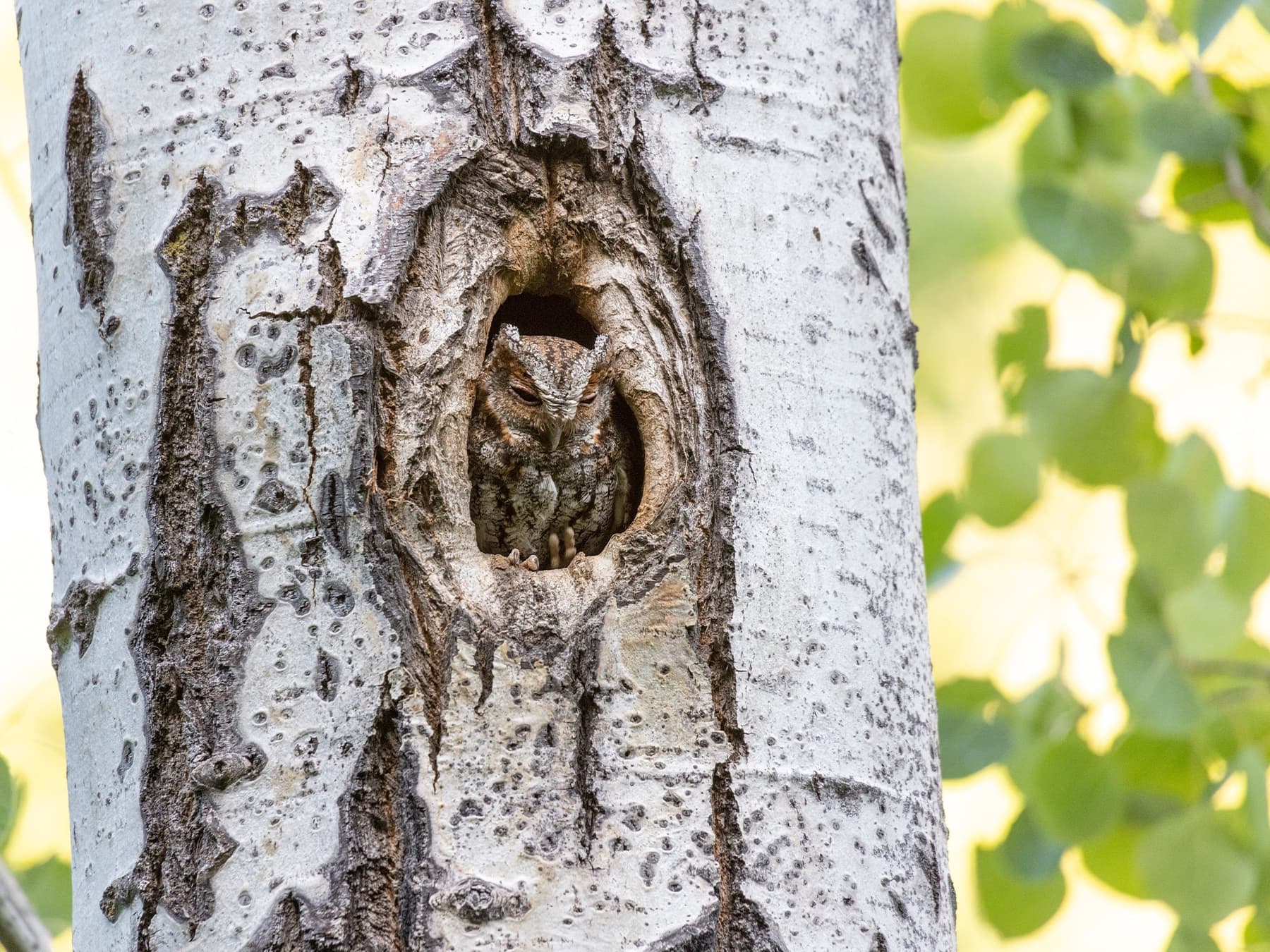
Daytime sightings of flammulated owls are rare, due to their impressive camouflaged plumage that allows them to blend in unseen among the bark and branches of tall pines. Once darkness falls, the male’s tell-tale low hooting is a giveaway sign that one is nearby.
Where can you see Flammulated Owls in Canada?
British Columbia and Alberta are the only two Canadian provinces with established breeding populations, and forested mountainous regions offer the best chances of a sighting.
Kootenay National Park in British Columbia and Jasper and Banff National Parks in Alberta have the exact habitat types that are preferred by flammulated owls and may offer opportunities for seeing or hearing one.
Migration
Do Flammulated Owls migrate?
A fully migratory species, flammulated owls breed in the western regions of North America, from southwestern Canada, through the western US and into northwest Mexico, with an isolated breeding population in northeast Mexico.
Post-breeding, from August onwards, they begin their southward migrations deeper into Mexico, reaching as far south as Guatemala and El Salvador, returning north to breed the following spring, in April or May.
Are Flammulated Owls native to the US?
Flammulated owls breed in the US but no established wintering grounds used by the species are located north of Mexico. Occasional winter sightings have been reported, but are not sufficient for it to be classified as a resident species.
Tips for seeing it
- Listen for their low-pitched, ventriloquial hoots at night during the breeding season
- Search for them in mature pine or fir forests at higher elevations
- Look for small, motionless shapes against tree trunks during the day
- Use playback sparingly and responsibly to attract them
What it eats
What do Flammulated Owls eat?
The diet of a flammulated owl is primarily insect-based, with crickets, grasshoppers, beetles, bugs, and moths among the most commonly caught prey. Larger prey may also be eaten occasionally, including small voles, mice, and songbirds, although insects and invertebrates are by far the largest element of their food intake.
What do Flammulated Owl chicks eat?
Young flammulated owls are fed on a diet that is similar to that of adults, consisting of grasshoppers, crickets, and beetles. Occasionally larger items of prey are brought to the nest site by the male, including shrews, bats, voles, and mice. These are then ripped into smaller pieces by the female and fed to her young.
Nesting and breeding
Where do Flammulated Owls nest?
Flammulated owls use existing cavities as their nests and do not build their own. Natural hollows in tree trunks or snags are used, as well as disused chambers excavated by woodpeckers. In the absence of a cavity, an artificial nest box may be used.
Eggs are laid on the cavity base, which is left bare with no additional nesting materials used as a lining. Nests are not reused in subsequent seasons.
When do Flammulated Owls nest?
Pairs form or reunite shortly after arriving on breeding grounds from April onwards, with the earliest eggs laid in late April. May is the peak month for eggs to be laid, but later broods or replacement clutches may be as late as mid-June.
Only the female incubates, remaining in the nest cavity for between 21 and 24 days before the eggs hatch. During this time, males bring food to their mates.
What do Flammulated Owl eggs look like?
Usually three or four creamy white, semi-glossy eggs are laid by female flammulated owls. Eggs measure a maximum of 32 mm by 26 mm (1.3 in by 1.1 in) and are oval in shape.
Do Flammulated Owls mate for life?
Long-term pair bonds form between male and female flammulated owls, but they do not always last a lifetime.
Observations from Colorado over a number of years recorded a ‘same mate retention rate’ of 74 percent from year to year. Individuals have a strong record of fidelity to a previous nest site and as pairs separate after breeding to migrate, many do reunite in the spring.
Behaviour
Are Flammulated Owls aggressive?
Despite being territorial and keen to assert the boundaries of their own patch, flammulated owls have a reputation as being mild and unaggressive, Shrieking and chasing are usually as intense as any confrontation gets, and interactions with intruders rarely escalate to a physical attack.
Where do Flammulated Owls sleep at night?
A nocturnal species, flammulated owls sleep by day and hunt by night. The female roosts in the nest cavity with her eggs or young during the breeding season, but apart from this roosting is always done among the foliage of the upper branches of a tall tree.
In the breeding season, males find a nearby daytime roosting spot and remain motionless tucked against a tree trunk until night falls.
Lifespan and predators
How long do Flammulated Owls live?
Breeding is possible in yearling birds, but many individuals delay breeding and pair up with a mate the first time when they are at least two years old. The average life expectancy for flammulated owls is between 8 years and a maximum of 14 years.
What are the predators of Flammulated Owls?
Squirrels are a leading predator of the eggs and young of flammulated owls, raiding nest cavities. Avian predators may occasionally attack adult birds, including Cooper’s hawks and great horned owls.
Are Flammulated Owls protected?
Canada’s Migratory Birds Convention Act and the United States’ Migratory Bird Treaty Act legislate against flammulated owls being killed or harmed, traded for sale, or taken into captivity. It is also an offense to destroy or damage nest sites or take eggs, feathers, or nestlings.
Are Flammulated Owls endangered?
Currently rated as a species of least concern, flammulated owls are not under any immediate threat of becoming endangered. Habitat loss is a potential concern, combined with a low annual reproductive rate for the species, meaning that future conservation may be required.
Conservation
While currently listed as Least Concern, Flammulated Owls face threats from habitat loss due to logging and forest management practices. Climate change may also impact their distribution and prey availability. Conservation efforts focus on maintaining mature forest habitats and promoting sustainable forestry practices.
Quick facts
- Length
- 15–17 cm
- Wingspan
- 36–42 cm
- Weight
- 45–63 g
- Lifespan
- 7–10 years
- Family
- Owls
- Migration
- Long-distance Migrant
- Global status (IUCN)
- Least Concern
- World population
- 12,000 mature individuals
- Population trend
- Decreasing
- Also called
- Flammulated Screech Owl
- Scientific name
- Psiloscops flammeolus
Questions
1What does Flammulated Owl mean?
The word ‘flammulated’ has Latin roots, meaning flame-colored, and refers to the fiery, flamelike markings on their plumage that help provide effective camouflage among the tree trunks in their forest habitats.
Sources
3- 1BirdLife International. 2016. Psiloscops flammeolus. The IUCN Red List of Threatened Species 2016: e.T22688637A93203659. Source (opens in a new tab)
- 2BirdLife International. 2016. Psiloscops flammeolus. The IUCN Red List of Threatened Species 2016: e.T22688637A93203659. Source (opens in a new tab)
- 3Partners in Flight (2019)

Checked by
Nathan Cope, founder and editor
Nathan founded Birdfact and leads its writers and contributors in the UK, the US and Canada. He has watched and studied birds for more than ten years, and checks every article and species guide before it’s published.