


Elf Owl
Whitney's Elf Owl · Micrathene whitneyi
By the Birdfact teamChecked by Nathan Cope
On this page12 sections
How to recognise it
What do Elf Owls look like?
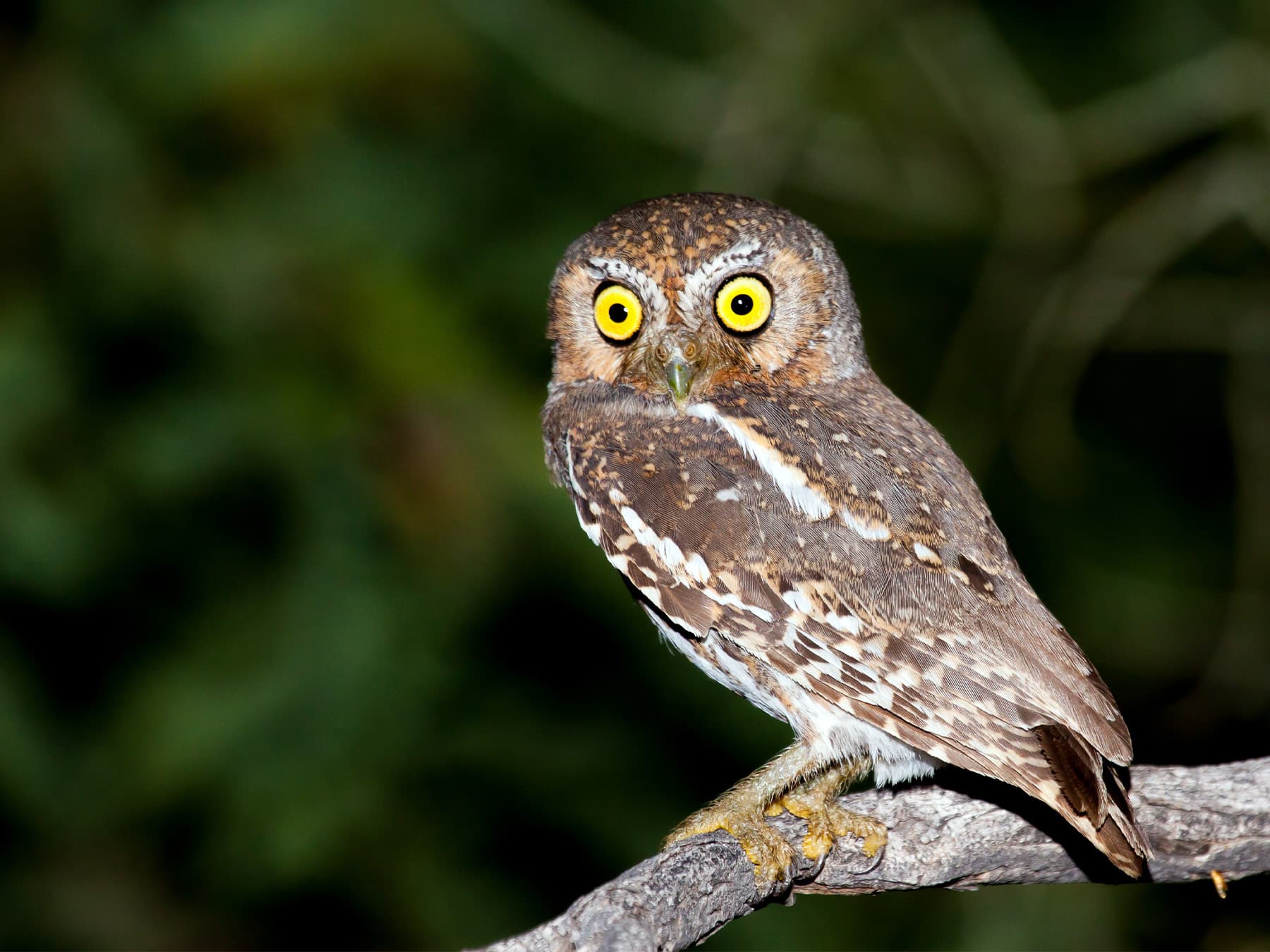
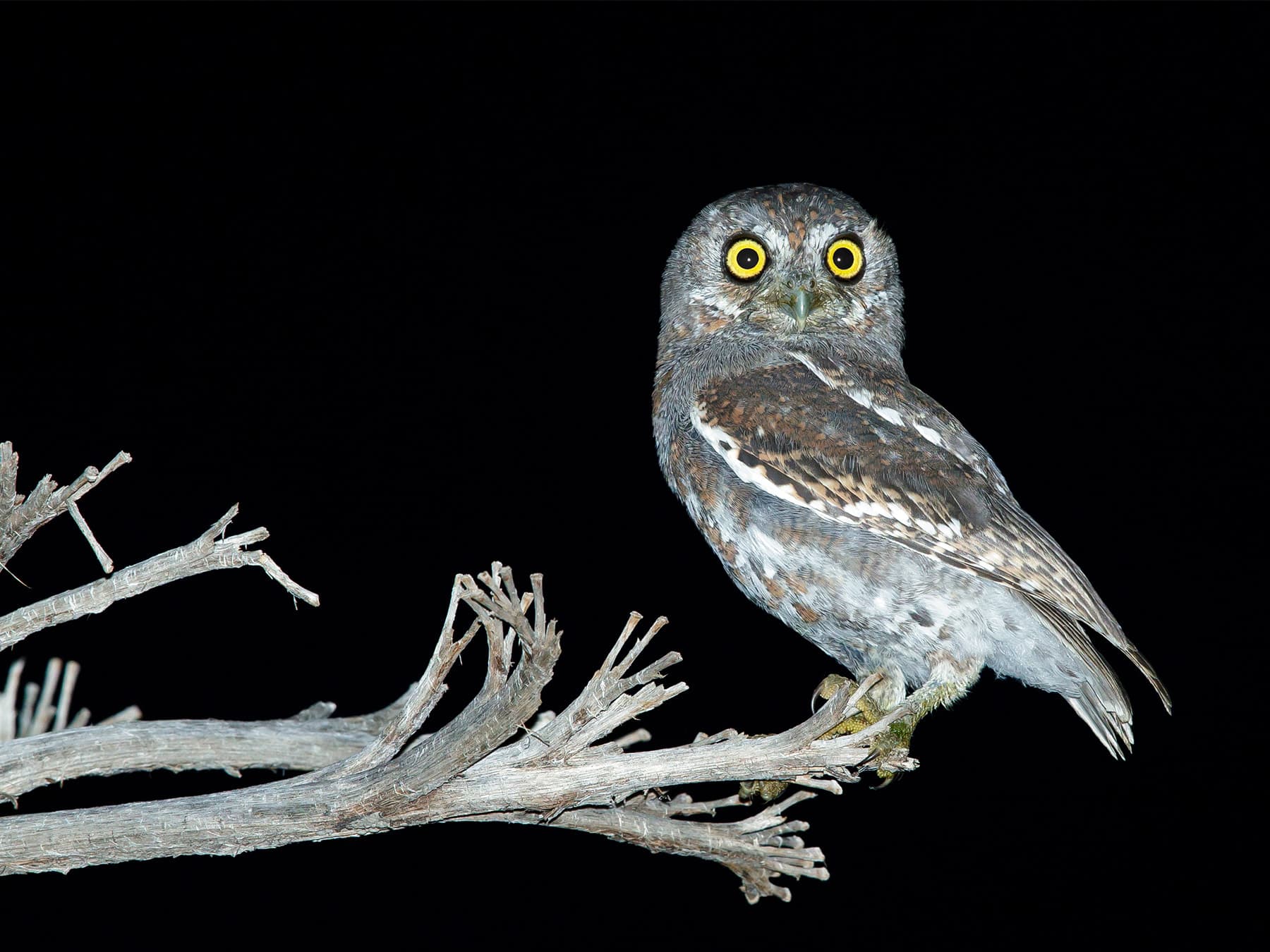
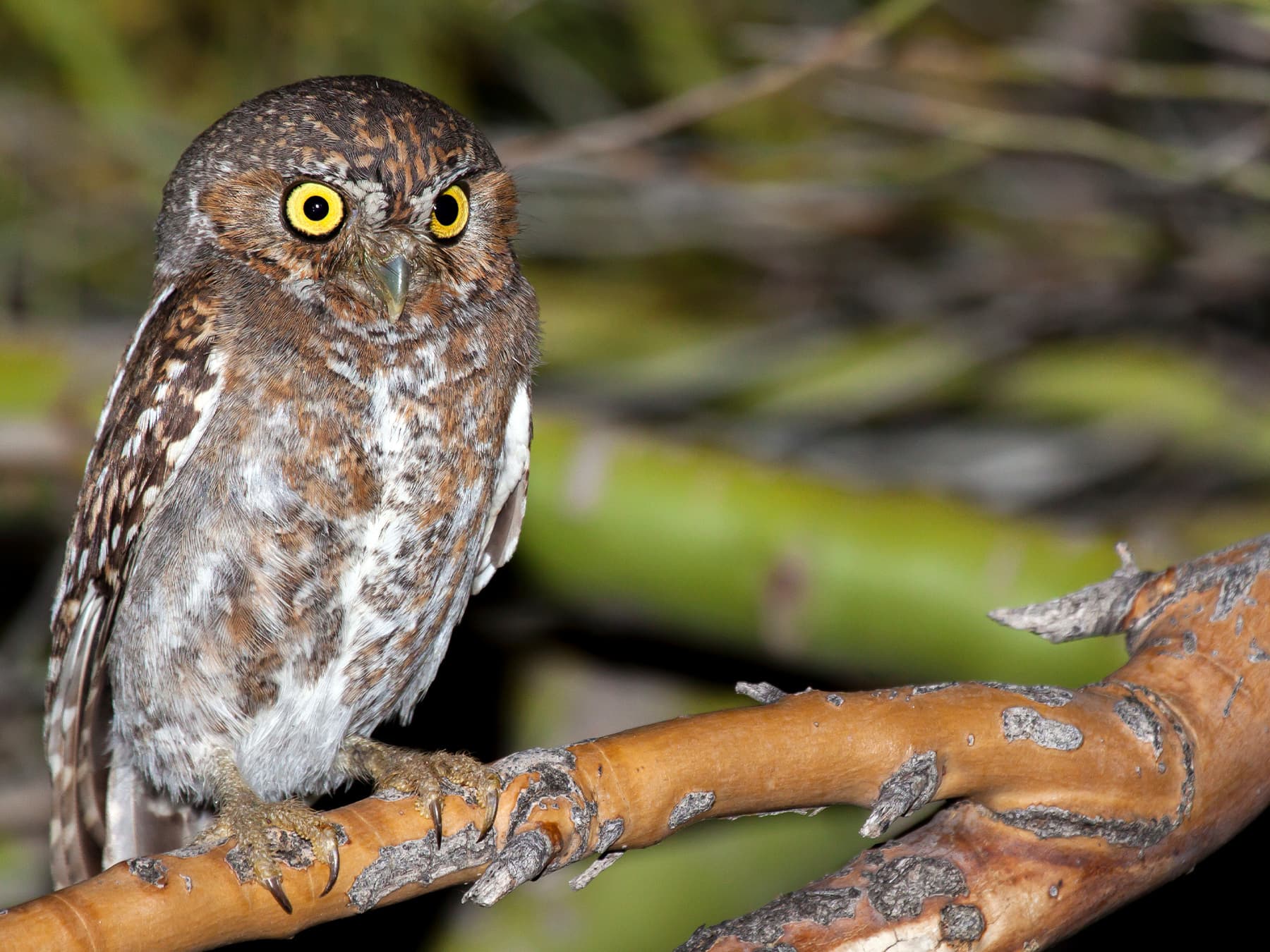
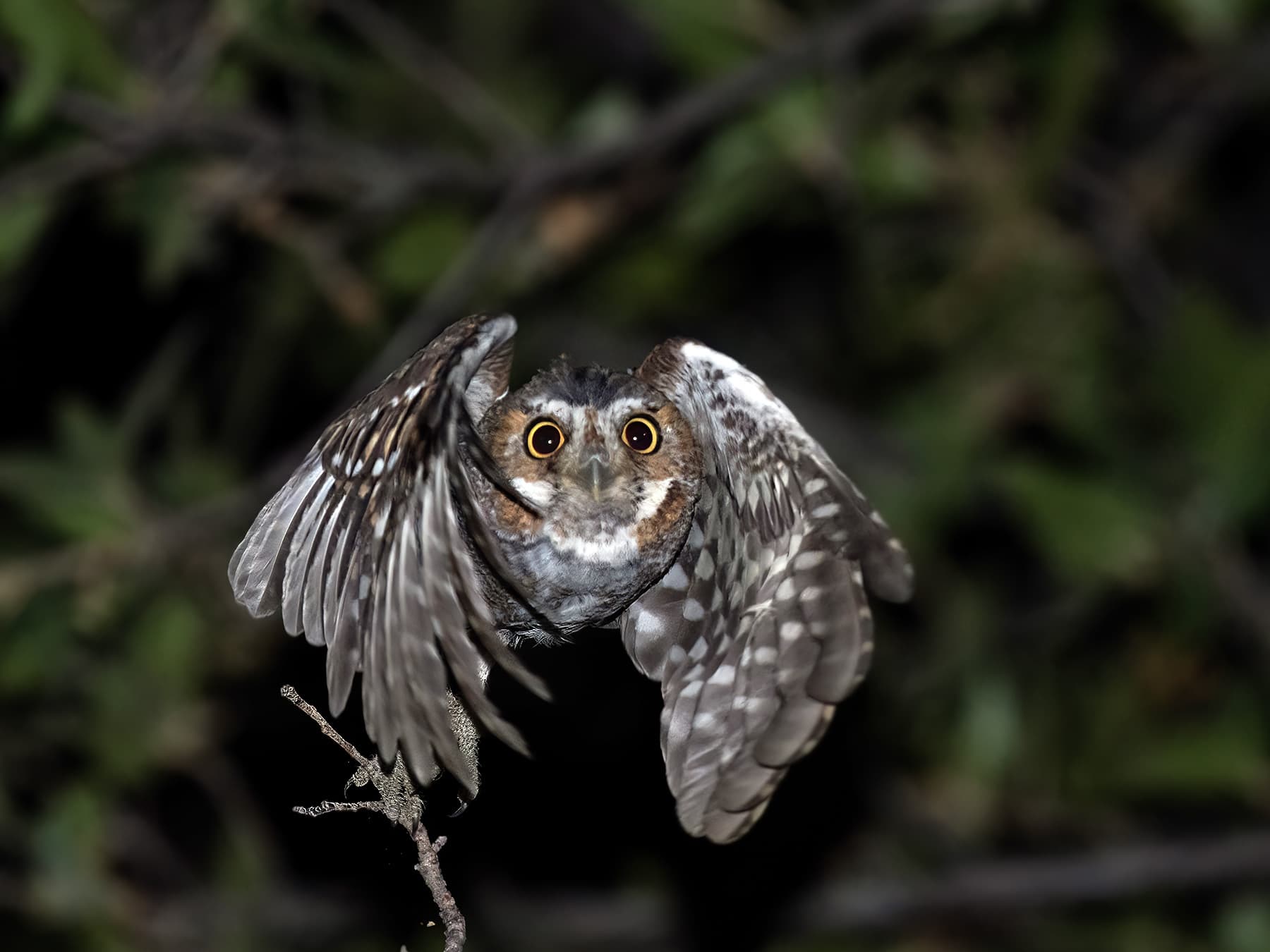
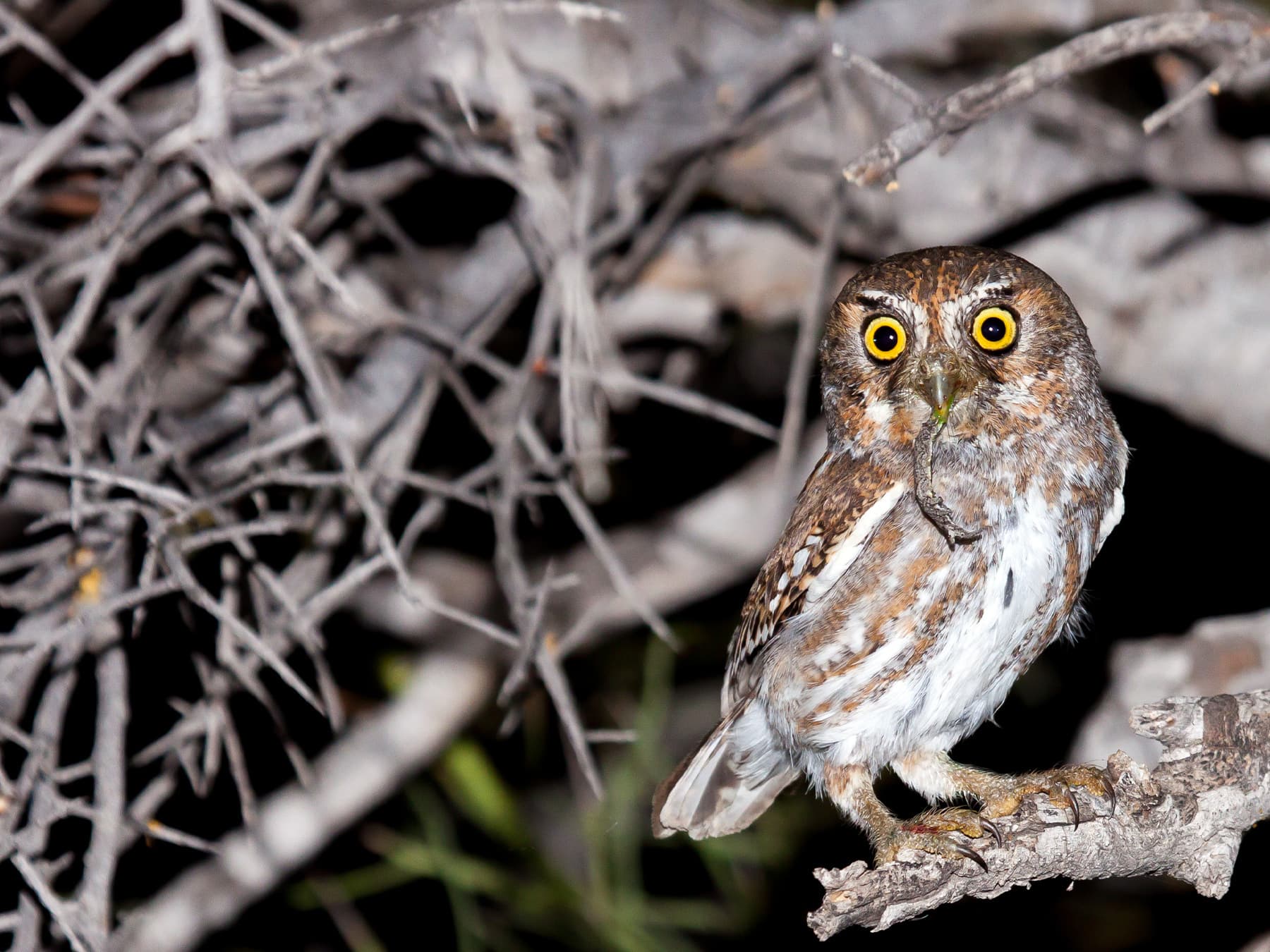
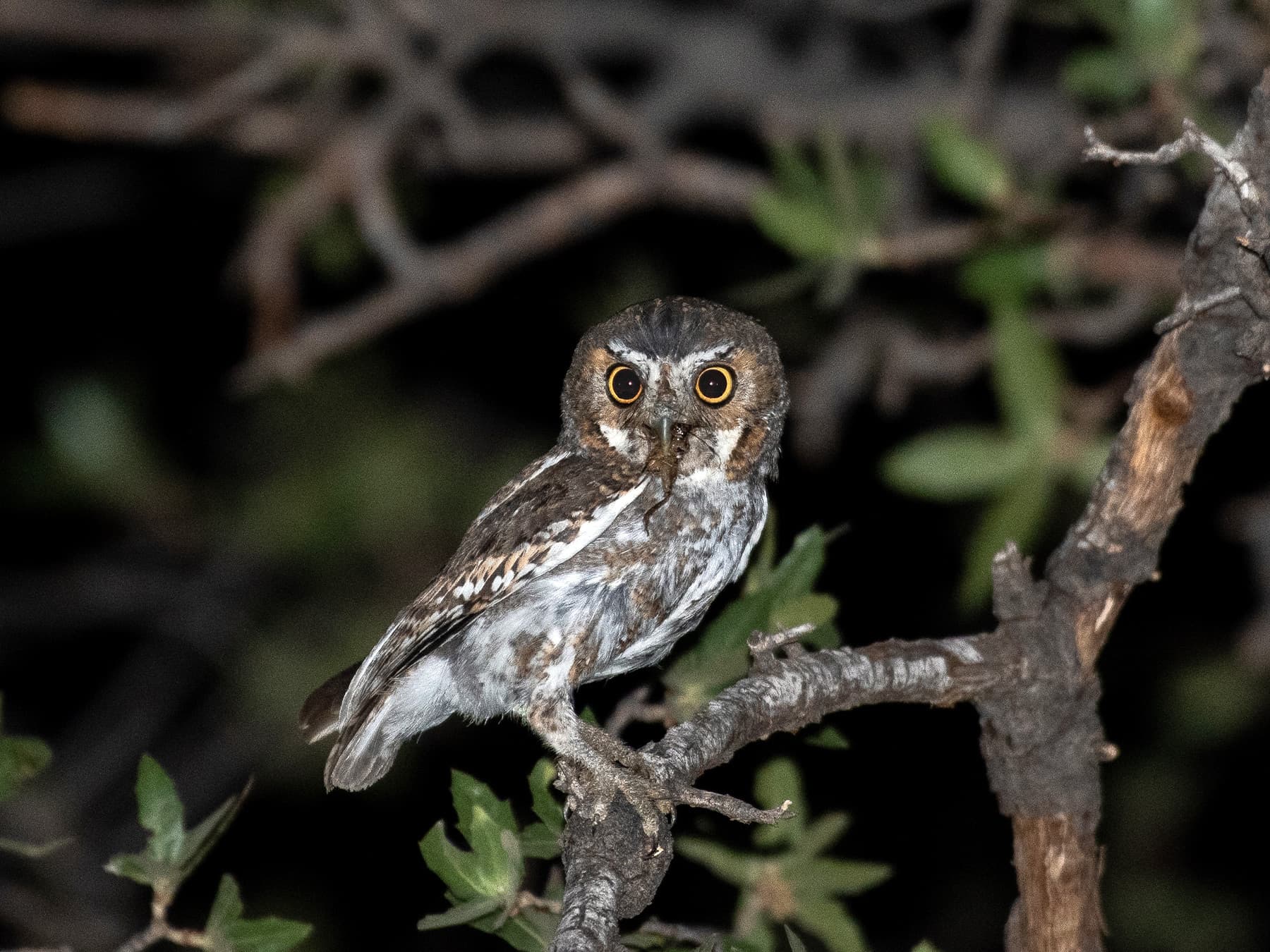
Due to their size and precise geographical range, it’s difficult to confuse an elf owl with any other species. Their plumage is a mixture of gray, brown, and cinnamon-buff mottling, their facial disk is outlined with black, with prominent white eyebrows and orange-buff coloring. Eyes are bright yellow and the bill is greenish-yellow with a horn-colored tip.
Elf owls do not have ear tufts and their heads are rounded. The especially short tail is mid-brown, marked with light brown banding. Their upperparts, including the back of the head, nape, wings, and rump are mid-brown and mottled with grayish-white and buff, with two bold white shoulder stripes and spotting along the wing edges.
Underparts are gray with fine dark streaks, interspersed with bolder reddish coloring. Legs are yellowish and unfeathered.
Females and male elf owls are alike in plumage, but females are marginally larger and heavier than males.
Juvenile elf owls are heavily mottled with gray and brown plumage. They molt into their full adult coloring after around 4 months.
How big are Elf Owls?
The world’s smallest owl species, elf owls are around 57 cm (22.4 in) shorter than the world’s tallest owl, the Blakiston’s fish owl, and roughly the same size as a house sparrow. Female elf owls are slightly larger and heavier than males.
- Length: 12.5 cm to 14.5 cm (4.9 in to 5.7 in)
- Wingspan: 27 cm (10.5 in)
- Weight: 40 g (1.4 oz)
Its size
Adults- Length
- 12.5–14.5 cm
- Wingspan
- 25–27 cm
- Weight
- 35–55 g
Its song and calls
What sound does an Elf Owl make?
The call of a male elf owl is frequently likened to the yelping of a puppy, with high-pitched repetitive notes, which is used in nest defense and also to attract a mate.
- Song0:00 / 0:20
Recorded in Baja California Sur, Mexico · January 2024
When and where to see it
OctoberMostly absent
Most recorded in October
- 1. Arizonaunder 0.1%
- 2. New Mexicounder 0.1%
- 3. Texasunder 0.1%
Each dot is a county, state or province: the bigger and darker, the larger the bird’s share of that place’s bird records that month. Grey dots: no regular records. The ringed point is the centre of the bird’s records this month; the arrow shows how it moved since last month, and the dashed loop its path through the year. “Arrivals” colours places where it becomes regular this month (orange) or is in its last regular month (grey). GBIF eBird Observation Dataset, 2019–2024. Map data: Natural Earth, US Census Bureau; place centres © OpenStreetMap contributors.
In your area
See when the Elf Owl is recorded in your county, state or province.
How often the Elf Owl turns up in the United States through the year, from birdwatchers' records.
United States
Summer visitor · regularly Mar–Aug · most records in April
Show as a table
| Month | United States |
|---|---|
| January | – |
| February | <0.001% |
| March | 0.003% (regular) |
| April | 0.006% (regular) |
| May | 0.004% (regular) |
| June | 0.003% (regular) |
| July | 0.003% (regular) |
| August | 0.002% (regular) |
| September | <0.001% |
| October | <0.001% |
| November | <0.001% |
| December | <0.001% |
Worldwide: recorded regularly in 2 countries
Countries where it was recorded in at least 3 of the 6 years 2019–2024. Linked countries have their own bird list.
North America (2)
Data: EOD – eBird Observation Dataset (Cornell Lab of Ornithology), accessed via GBIF.org, CC BY 4.0. Records from 2019–2024, aggregated and filtered by Birdfact. How these lists are made
What is the habitat of an Elf Owl?
Elf owls’ preferred habitats are typical of the southern US and Mexico, with arid desert landscapes dominating their choices of nesting locations. Further south, they are found in dry thorny forests, pine-oak forests, and riparian woodlands.
What is the range of an Elf Owl?
Elf owls are breeding visitors to the southwest United States, with their range spreading southwards in winter to the Pacific slope of central Mexico. Non-migratory populations are found across Baja California and in an isolated region in Oaxaca in southern Mexico.
Where do Elf Owls live?
Elf owls only live in the wild in the United States and Mexico. Of these, only Mexico supports year-round populations, while birds that breed in the southern states of California, Arizona, New Mexico, and Texas head south into central and southern Mexico in the fall.
How rare are Elf Owls?
These sparrow-sized owls were listed in third place on the list of birds birdwatchers most want to spot, and with a declining population, a nocturnal lifestyle, and a limited range in the United States, sightings can be almost impossible to come by. The global population is estimated at only around 72,000 individuals, all of which are found in the United States (in breeding season) and Mexico (all year round).
Their preference for desert landscapes and thorny forests makes them particularly challenging to track down.
Where can you see Elf Owls in the US?
Elf owls are only regular visitors to four US states and arrive for the breeding season from February onwards, before departing for wintering grounds in October. As you may imagine, these tiny nocturnal hunters aren’t the easiest birds to spot, and sightings are unusual.
Arizona’s Saguaro National Park offers the perfect environment to successfully observe elf owls. In Texas, locations with regular sightings of elf owls include Big Bend National Park and parts of the lower Rio Grande Valley.
Where can you see Elf Owls in Canada?
The breeding range of elf owls does not extend as far north as Canada and the species is not present there in the wild.
Migration
Do Elf Owls migrate?
Elf owls are a migratory species in most of their range, although small pockets exist where the species is sedentary and resident all year round. In the northern regions of their range, from the extreme southern US to northwestern Mexico, they are a breeding species but depart for winter territories further south.
Are Elf Owls native to the US?
Elf owls breed in the southwestern United States but are not resident in any part of the country all year round. Parts of the states of California, Arizona, New Mexico, and Texas are the destinations for breeding elf owls between February-March and October each year.
Tips for seeing it
- Look for Elf Owls in saguaro cacti or tree cavities during the day
- Listen for their high-pitched, repetitive 'chuk' calls at night
- Use a flashlight to spot their eyeshine in trees after dark
- In the US, focus on desert areas of Arizona and Texas
What it eats
What do Elf Owls eat?
Elf owls are mainly insectivorous, with moths, beetles, and crickets as the chief prey. Prey is usually caught in flight, after a period of observation from a perch. Occasionally, elf owls will chase insects on the ground on foot.
Scorpions, small lizards, blind snakes, and kangaroo rats are also eaten but form a less important element of their diet.
What do Elf Owl chicks eat?
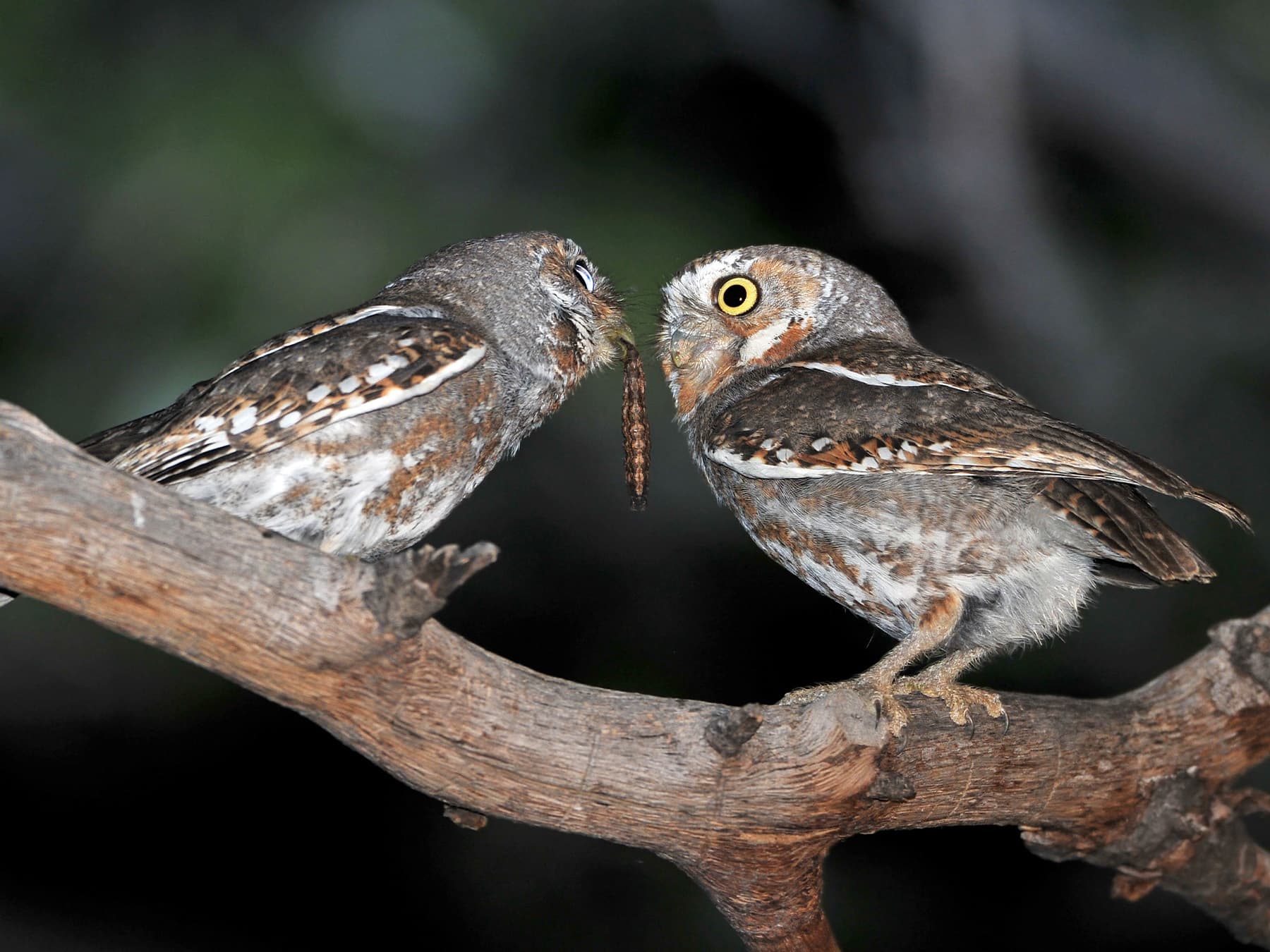
Male elf owls are responsible for providing all prey to the nest in the initial days after hatching, delivering insects to the female. She then tears the prey into smaller pieces before feeding to her young, with crickets, beetles, scorpions, cicadas, and moths being their most common foods.
Nesting and breeding
Where do Elf Owls nest?
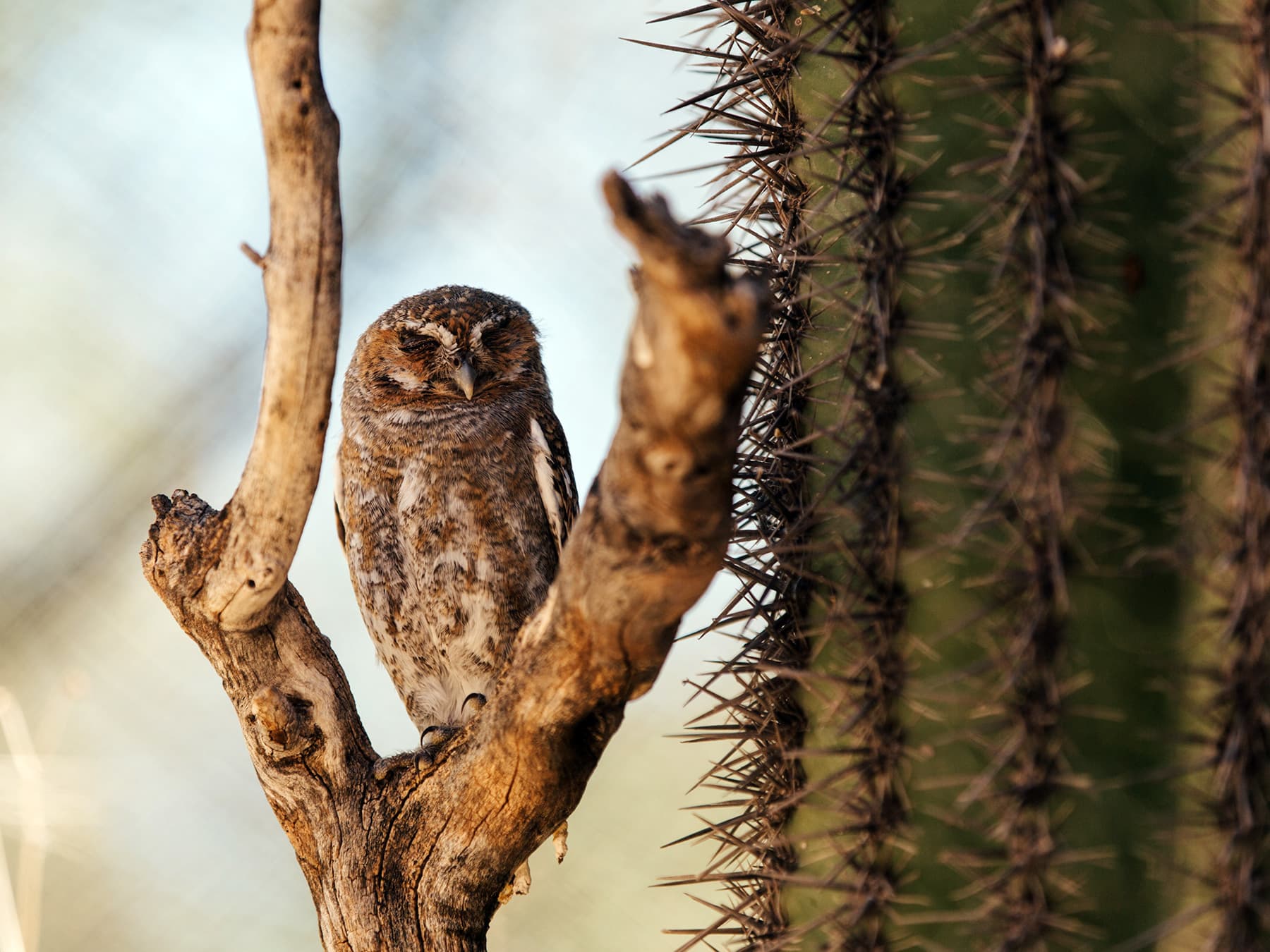
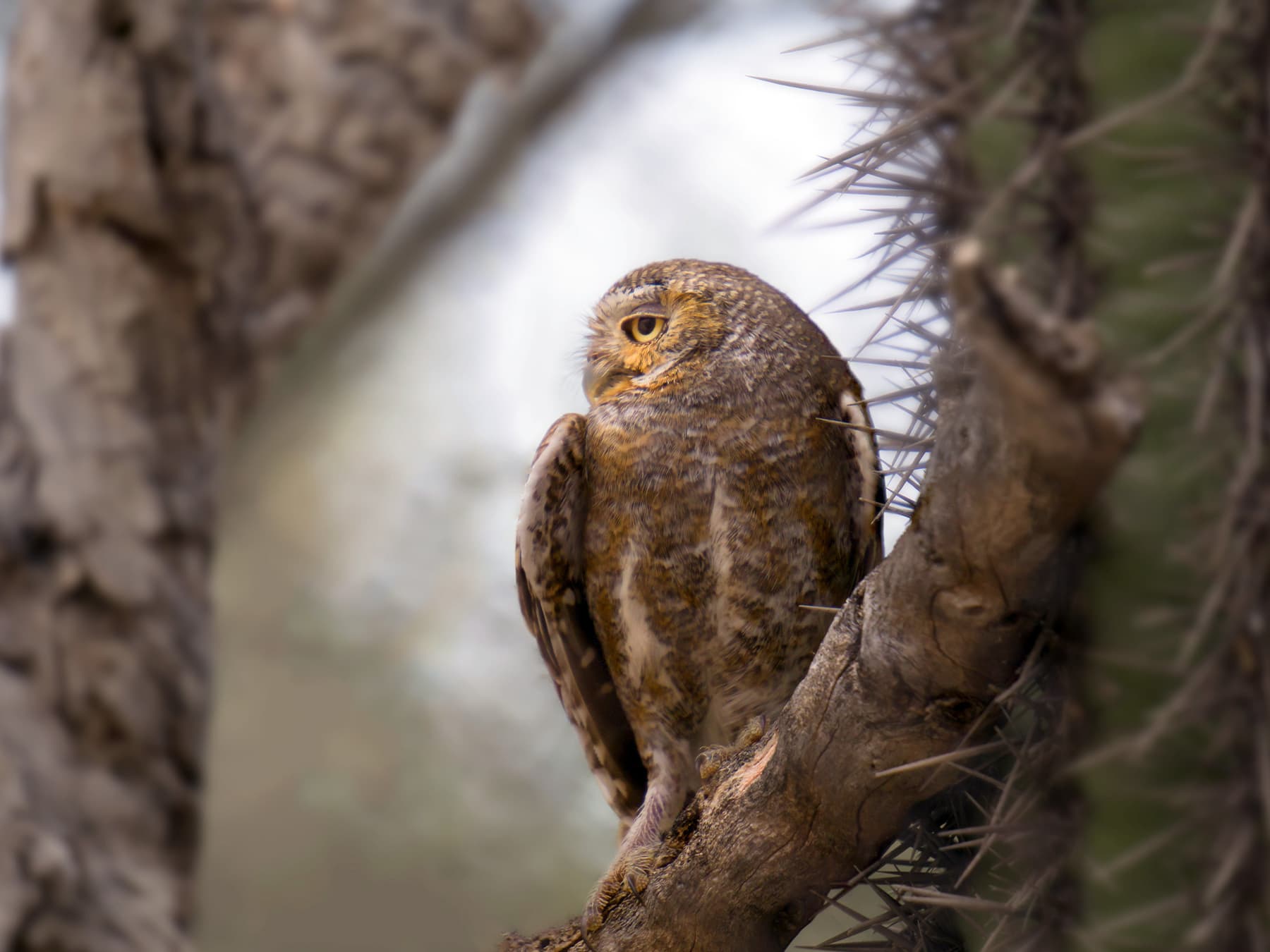
Elf owls are cavity nesters, using abandoned cavities that were originally excavated by woodpeckers, frequently in saguaro cacti. Tree hollows may also be used, in particular oaks and sycamores.
The nest opening is usually located around 4.6 m to 10.7 m (15 ft to 35 ft) above the ground. Elf owls have also been observed to successfully breed in nest boxes in parts of Arizona.
When do Elf Owls nest?
Elf owls arrive at their breeding grounds in early spring, from late February onwards. Pairs form after males show off their cavities and a female accepts food offerings. Before eggs are laid, a female spends up to two weeks inside the nest chamber.
The peak time of year for egg-laying falls between May and June, and incubation, by the female alone, lasts for around 24 days.
What do Elf Owl eggs look like?
Although, anything between 1 and 5 eggs is considered normal, a typical elf owl’s clutch contains 3 eggs. Eggs are white, semi-glossy, and measure up to 3 cm by 2.5 cm (1.2 in by 1.0 in)
Do Elf Owls mate for life?
During the breeding season, from April to July, elf owls are monogamous and strongly bonded, raising one brood together. The pair bond dissolves ahead of migration and it’s unclear whether former mates head to the same wintering grounds. Some pairs may reunite on their return to their breeding grounds the following spring, but not all.
Behaviour
Are Elf Owls aggressive?
They are not known to be an overly aggressive species and physical fighting has only ever been observed in captive elf owls.
In the wild, elf owls commonly use distraction tactics to evade predators rather than actively trying to drive them away. These include feigning death or displaying wing feathers to make themselves harder to spot. Their song is used to defend their nest site.
Where do Elf Owls sleep at night?
Elf owls are nocturnal, so they are generally active at night and rest during daylight hours.
Roosting sites inside empty cavities in cactuses or trees are used during the day for sleeping in, as they provide important shelter from the desert heat. On wintering grounds, shrubbery offers suitable roosting spots, with mistletoe and dense evergreen foliage being common choices.
Lifespan and predators
How long do Elf Owls live?
Female elf owls are known to breed for the first time in their first year, although there is no available data for the first-breeding age of males.
The average lifespan is believed to be around three years, with the oldest known individual surviving until 5 years and 10 months. In captivity, considerably longer lives can be expected, with one elf owl known to have reached 14 years of age.
What are the predators of Elf Owls?
Avian predators that are common threats to elf owls include great horned owls, Cooper’s hawks, and Mexican jays. Nests may be raided and eggs eaten by gopher snakes and green rat snakes. Elf owls’ choice of nest sites in prickly saguaro cacti is an effective deterrent to many potential predators.
Are Elf Owls protected?
In the United States, the Migratory Bird Treaty Act prohibits killing, injuring, taking into captivity, or selling elf owls, and it is also an offense to disturb their nest sites or take their eggs or feathers.
Are Elf Owls endangered?
Despite the decline in population, elf owls are rated as a species of least concern globally, although in California they have endangered species status. This is due to extensive deforestation that has led to habitat loss.
Elf owls are unable to excavate their own cavities and rely on nest sites made by woodpeckers. If cacti and trees with these chambers are removed, then it quickly becomes harder to find appropriate nesting spots.
Conservation
While currently listed as Least Concern, Elf Owls face threats from habitat loss due to urban development and agricultural expansion. Conservation efforts focus on preserving desert ecosystems and maintaining suitable nesting sites, particularly in saguaro cacti.
Quick facts
- Length
- 12.5–14.5 cm
- Wingspan
- 25–27 cm
- Weight
- 35–55 g
- Lifespan
- 3–6 years
- Family
- Owls
- Migration
- Partial migrant
- Global status (IUCN)
- Least Concern
- World population
- 72,000 mature individuals
- Population trend
- Decreasing
- Also called
- Whitney's Elf Owl
- Scientific name
- Micrathene whitneyi
Questions
7What is unique about the elf owl?
Apart from their tiny size, making them the smallest owl species, elf owls have a unique flight adaptation that helps them survive predation and can forage for food undetected. Their flight is silent, with wingbeats muffled by soft feathers on the outer edge of their wings.
How many elf owls are left in the world?
The global population of elf owls is in decline, and there are believed to be only around 72,000 individuals remaining.
Do elf owls drink water?
Elf owls get all of their nutrition and hydration needs from their food and do not need to drink water for additional moisture.
Can an elf owl fly?
Elf owls are proficient flyers and have an adaptation that allows them to fly without making a sound. Occasionally they will chase prey on foot through the undergrowth before pouncing and catching it.
Do elf owls hunt during the day?
Elf owls are a strictly nocturnal species and hunt for prey overnight, with insects that are most active at night, in particular moths, forming an important part of their diet.
Are Elf owls nocturnal?
Elf owls are nocturnal and are active from dusk onwards. They have heightened night vision as well as incredibly accurate hearing, which allows them to forage effectively in darkness.
Why do Elf owls live in cactus?
Elf owls use cavities in cacti for breeding and roosting. The chambers, which have been hollowed out by woodpeckers, offer shelter from the intense heat and a safe place to rest or raise young which is inaccessible to predators because of the difficult-to-navigate cactus spines.
Sources
3- 1BirdLife International. 2021. Micrathene whitneyi. The IUCN Red List of Threatened Species 2021: e.T22689325A168847632. Source (opens in a new tab)
- 2BirdLife International. 2021. Micrathene whitneyi. The IUCN Red List of Threatened Species 2021: e.T22689325A168847632. Source (opens in a new tab)
- 3Partners in Flight (2019)

Checked by
Nathan Cope, founder and editor
Nathan founded Birdfact and leads its writers and contributors in the UK, the US and Canada. He has watched and studied birds for more than ten years, and checks every article and species guide before it’s published.