


Common Rosefinch
Scarlet Rosefinch · Carpodacus erythrinus
By the Birdfact teamChecked by Nathan Cope
On this page13 sections
How to recognise it
What do rosefinches look like?
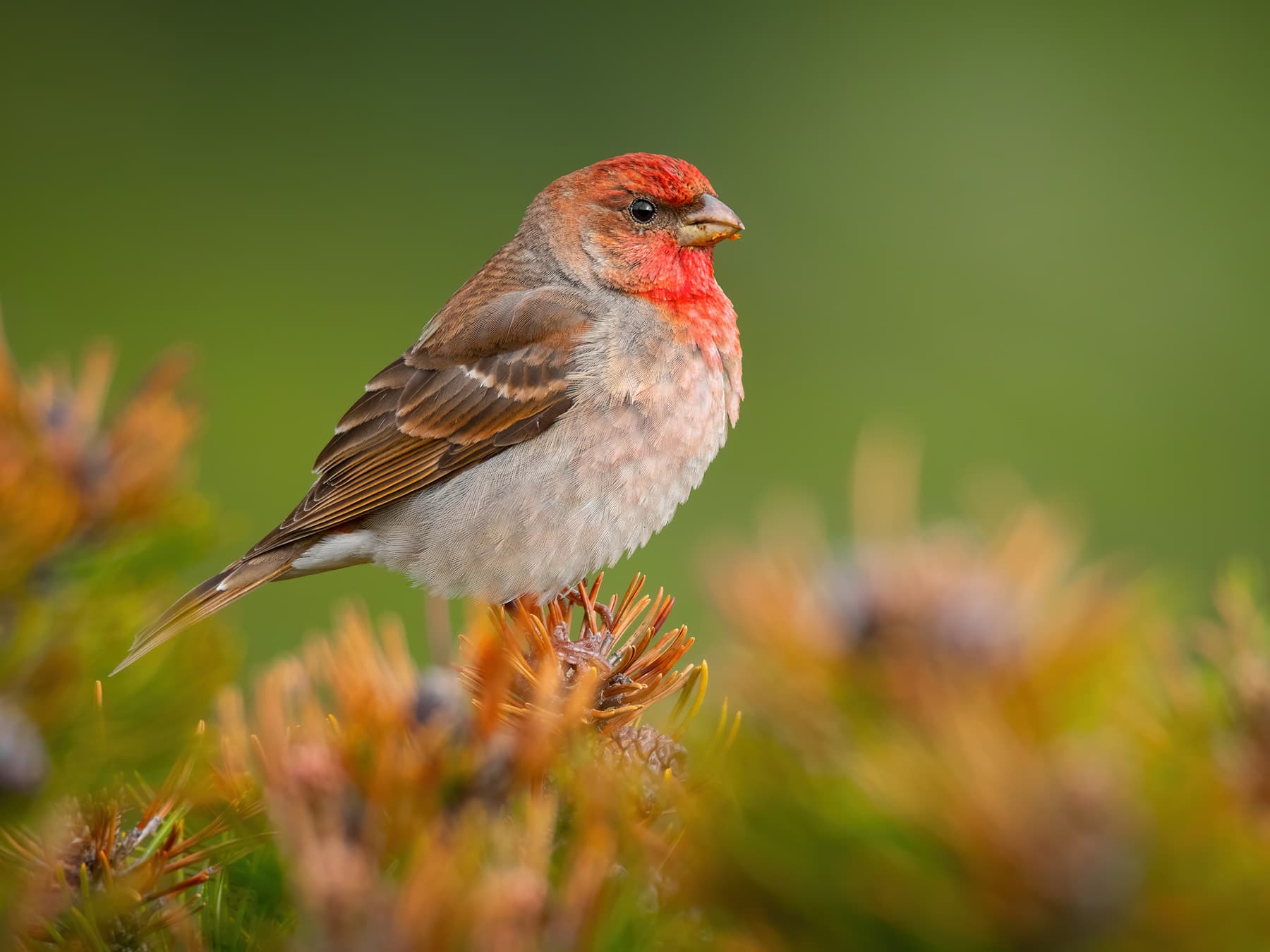
Common rosefinches, also known as scarlet rosefinches, are medium finches with a stocky build, forked tail and a dark grey stubby bill. Males and females are different in appearance, although roughly the same size.
Male Common rosefinches
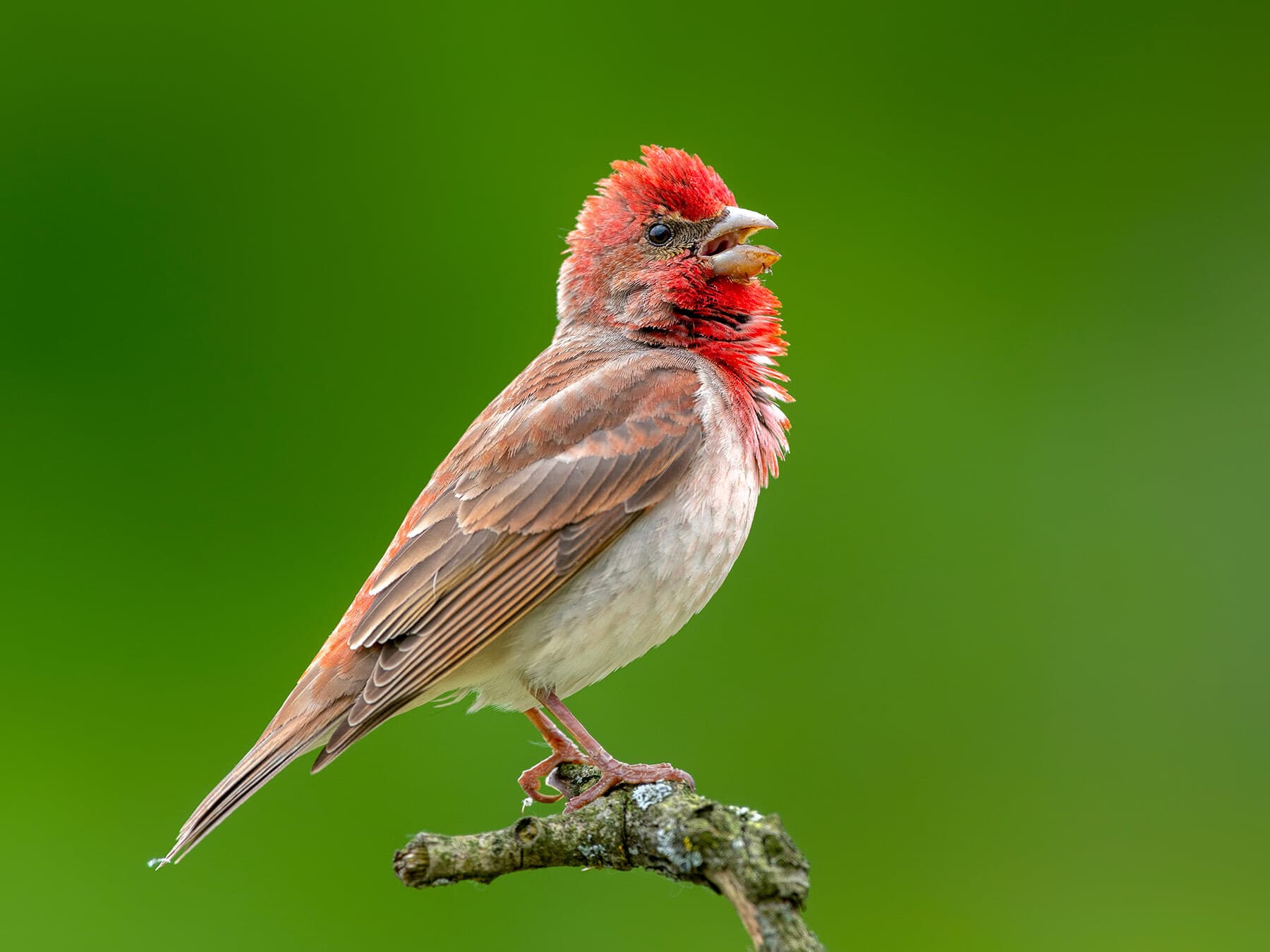
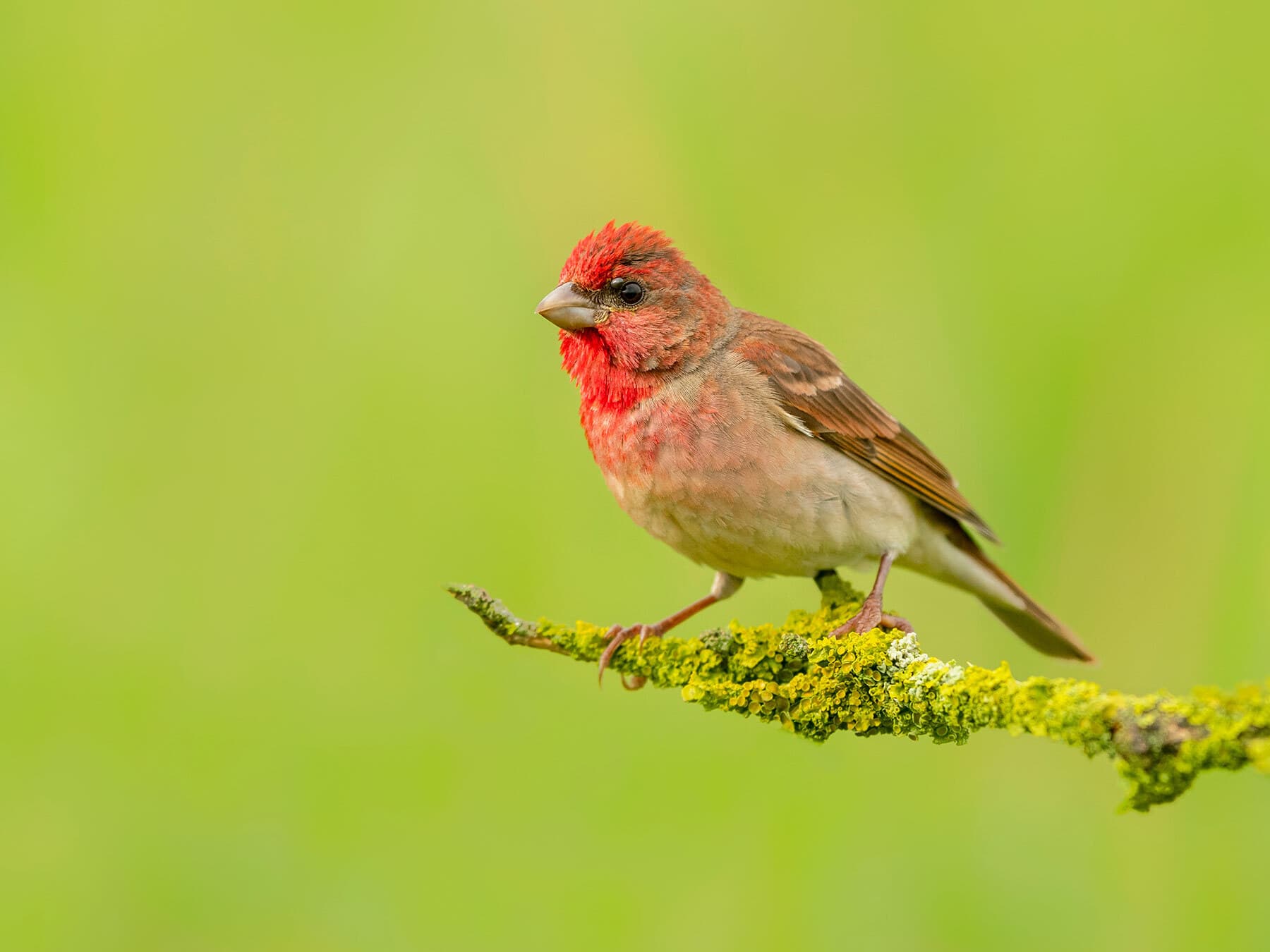
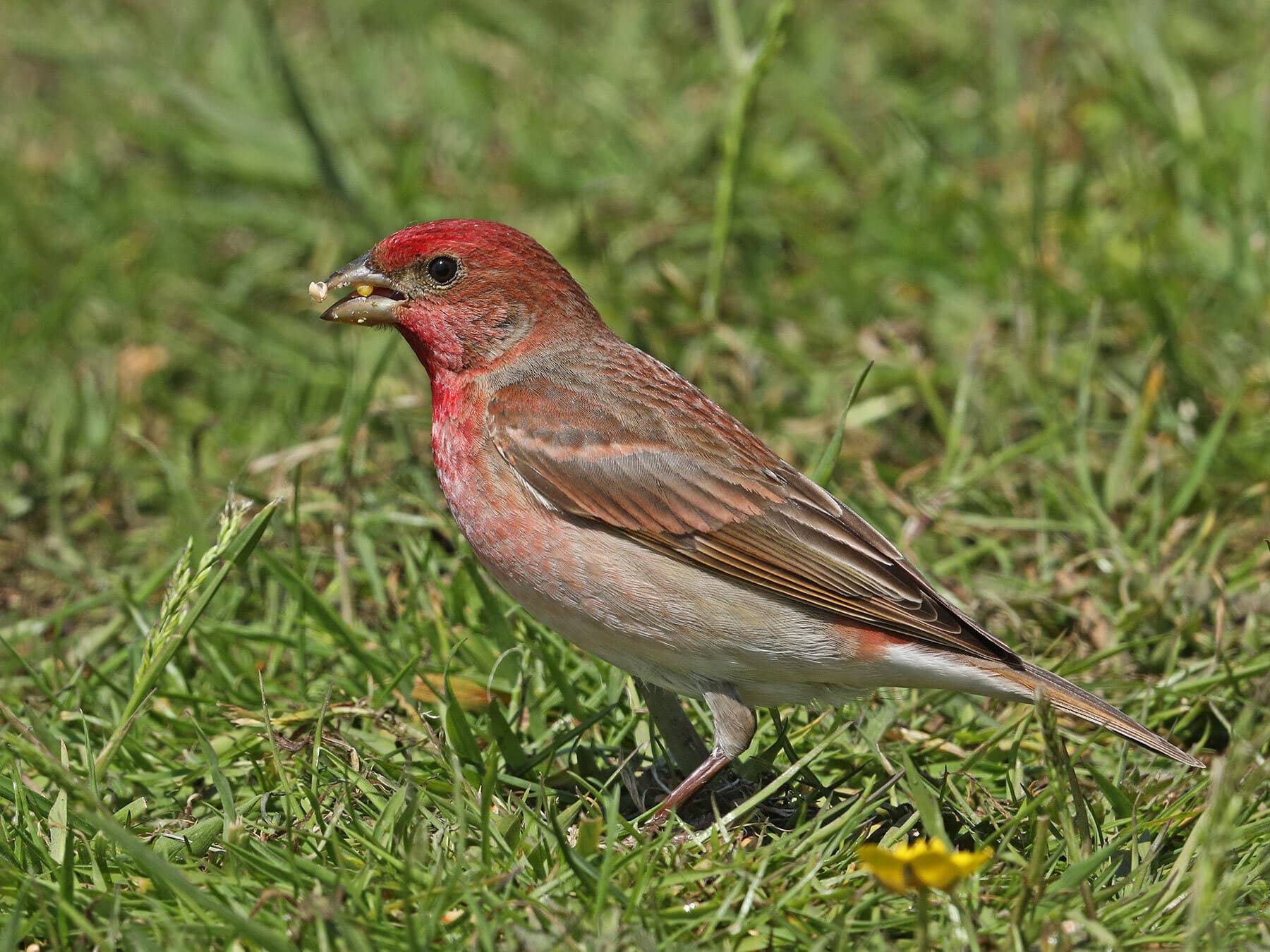
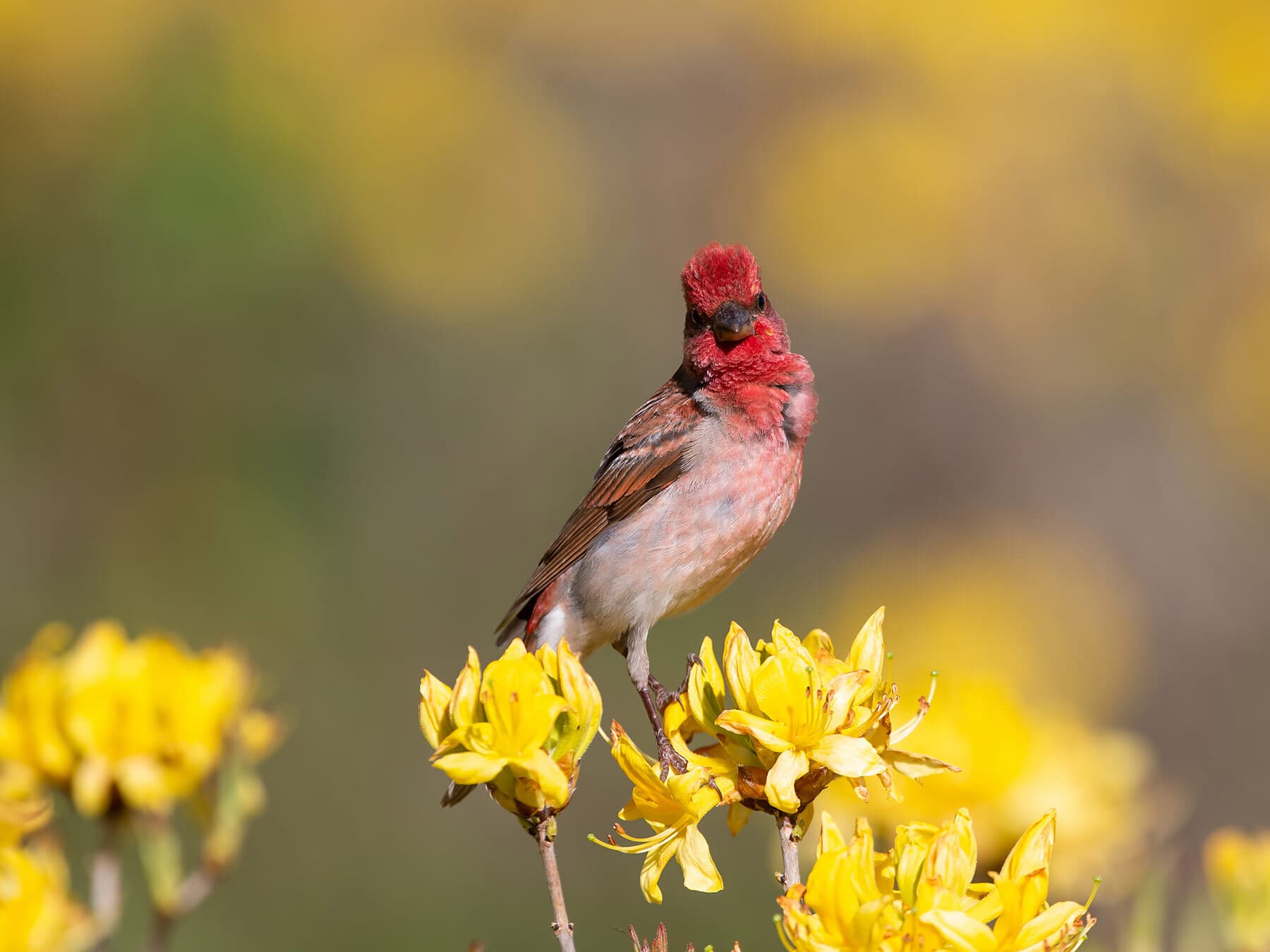
Adult male Common rosefinches have bright red upperparts and breast feathers, with paler reddish-white underparts that are streaked with brown and black. Their wings and tail are a much darker brown.
Female Common rosefinches
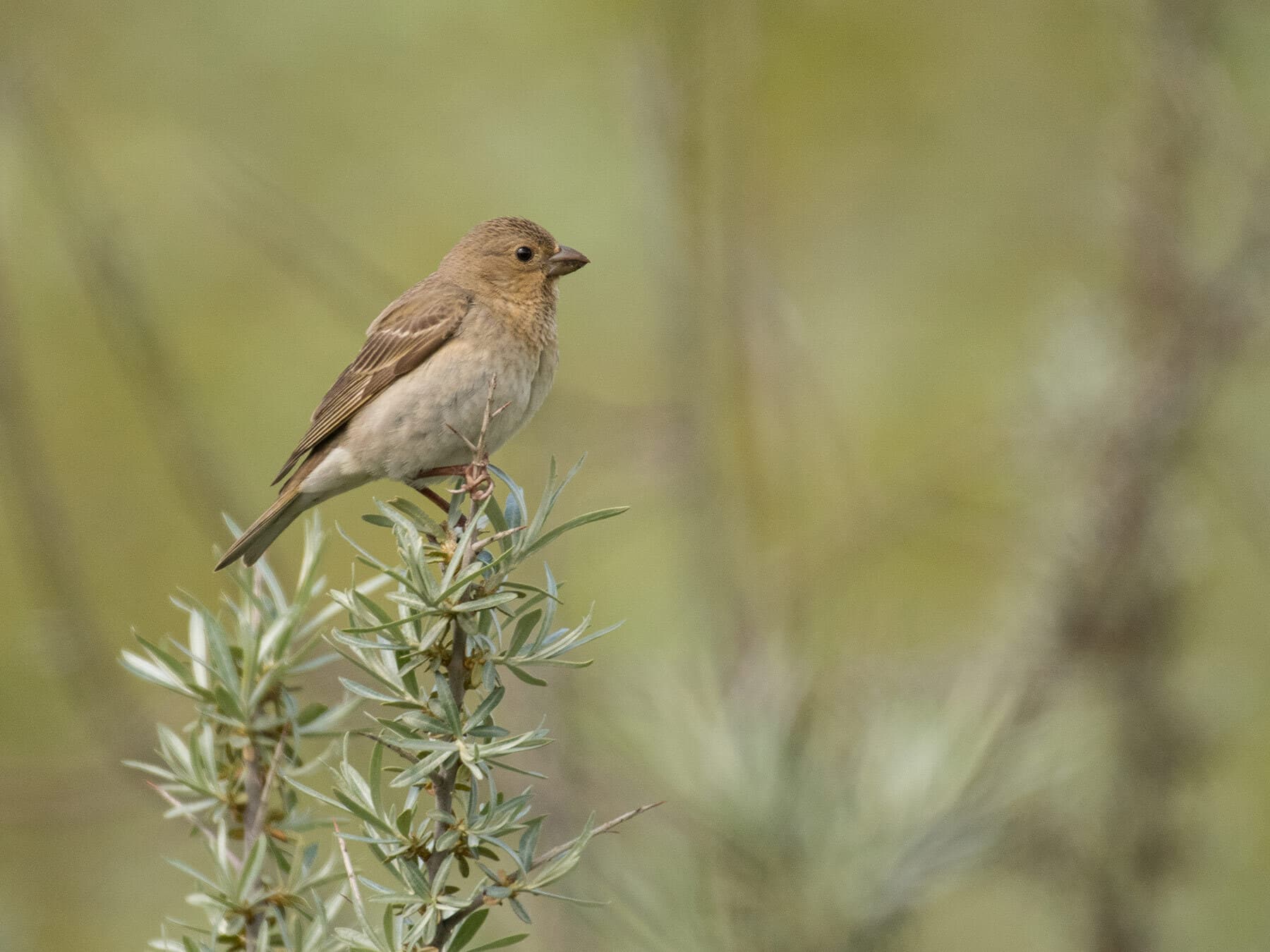
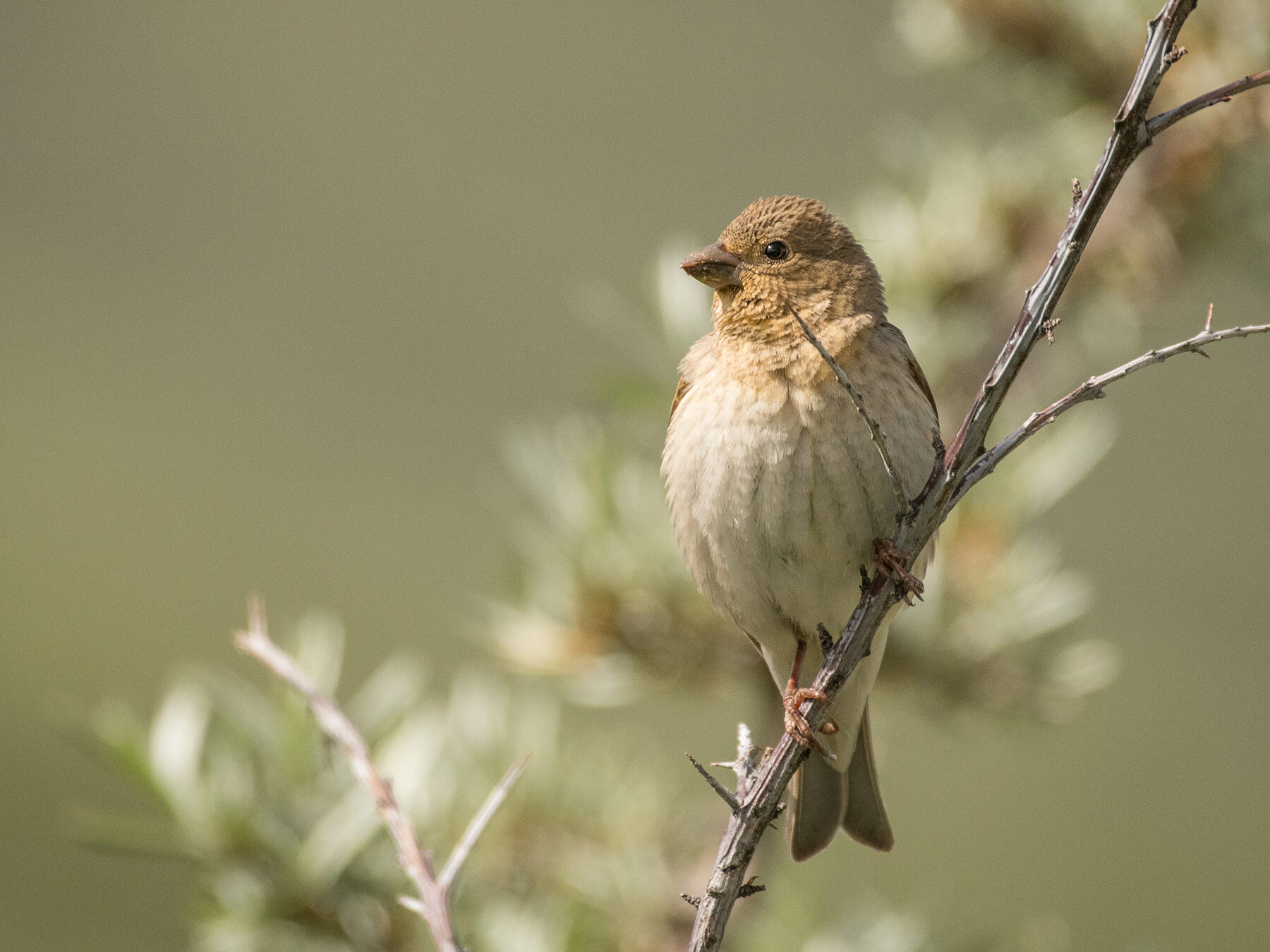
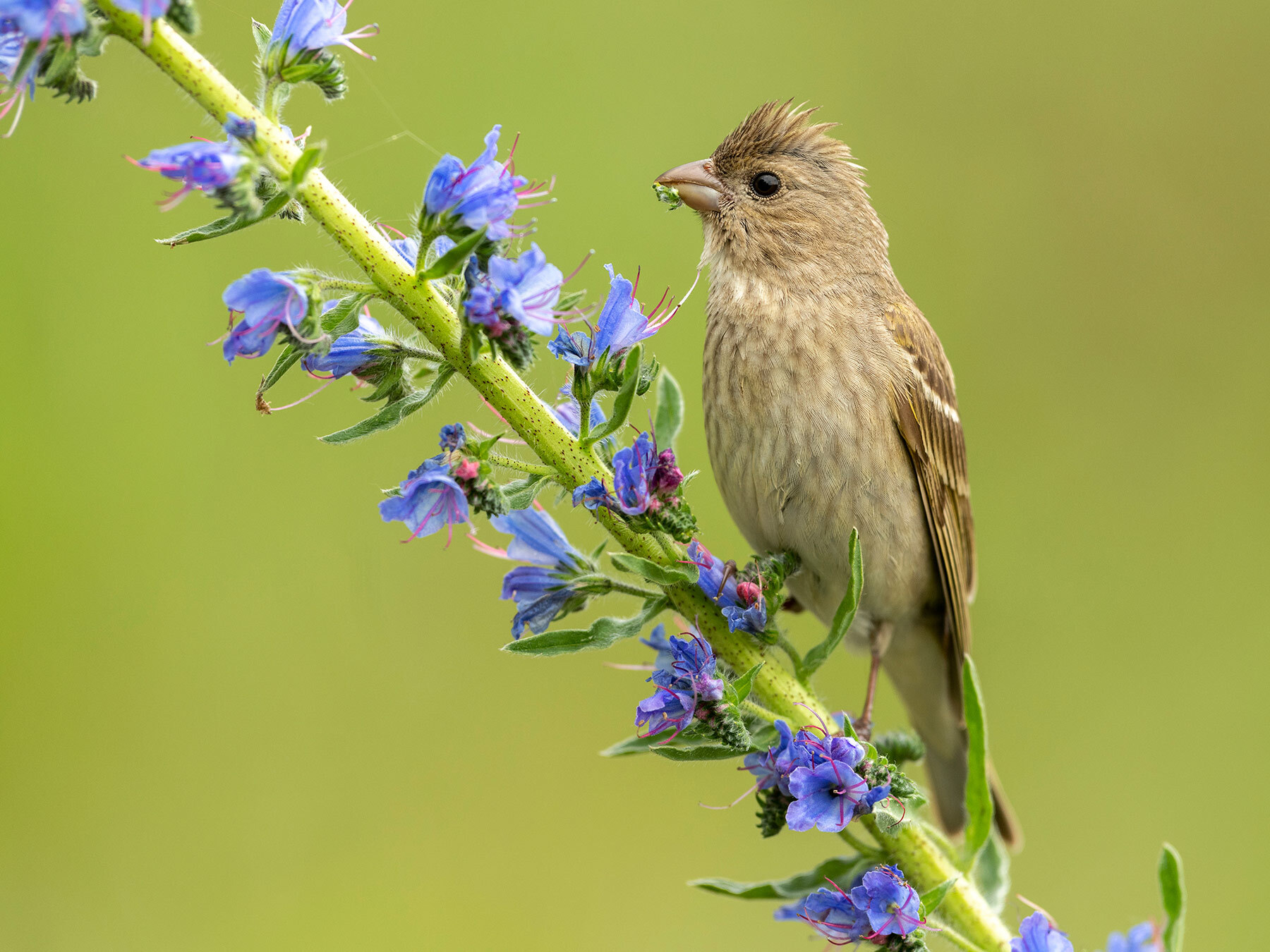
Female Common rosefinches may be confused with female House sparrows, and lack the scarlet plumage of their male counterparts. They are an olive-grey shade all over, with paler underparts, and darker brown wing and tail feathers. Under the eye, female rosefinches have a small white crescent of feathers, and their heads are streaked with black on the crown and forehead.
Juvenile Common rosefinches
Juvenile common rosefinches are similar in appearance to adult females, with brownish-grey bodies mottled with darker markings.
First year males are a greenish-grey colour and continue to look similar to females, although their head feathers have a tinge of buff-pink and their wing bars are becoming more pronounced barred wings.
How big are rosefinches?
Rosefinches are classed as medium to large members of the finch family, smaller than a hawfinch but larger than a goldfinch. Males and females are roughly the same size, measuring on average between 13 and 15 cm (5 and 6 in).
- Fully grown Common rosefinches weigh between 21 and 27 g (0.7 and 1 oz).
- The average wingspan of a Common rosefinch is between 22 and 26 cm (8.7 and 10.6 in).
Its size
Adults- Length
- 13–15 cm
- Wingspan
- 22–26 cm
- Weight
- 19–27 g
Its song and calls
What sound does a rosefinch make?
Outside of breeding season, Common rosefinches are not especially vocal birds. Males begin singing in early spring, and have a distinctive and repetitive short song, with three to five rising high-pitched notes.
- Song0:00 / 0:08
Recorded in Volyn Oblast, Ukraine · June 2025
- Call0:00 / 0:23
Recorded in Normandie, France · October 2023
When and where to see it
OctoberPeak season
Most recorded in October
- 1. Shetland Islands0.13%
- 2. Fife0.12%
- 3. Pembrokeshire0.11%
- 4. Cornwallunder 0.1%
- 5. Galwayunder 0.1%
Each dot is a county, state or province: the bigger and darker, the larger the bird’s share of that place’s bird records that month. Grey dots: no regular records. The ringed point is the centre of the bird’s records this month; the arrow shows how it moved since last month, and the dashed loop its path through the year. “Arrivals” colours places where it becomes regular this month (orange) or is in its last regular month (grey). GBIF eBird Observation Dataset, 2019–2024. Map data: Natural Earth, US Census Bureau; place centres © OpenStreetMap contributors.
In your area
See when the Common Rosefinch is recorded in your county, state or province.
How often the Common Rosefinch turns up in the UK and Ireland through the year, from birdwatchers' records.
United Kingdom
Passage migrant · regularly May–Oct · most records in September
Ireland
Passage migrant · regularly Oct · most records in October
Show as a table
| Month | United Kingdom | Ireland |
|---|---|---|
| January | <0.001% | – |
| February | <0.001% | – |
| March | <0.001% | – |
| April | <0.001% | – |
| May | 0.002% (regular) | – |
| June | 0.003% (regular) | <0.001% |
| July | <0.001% | – |
| August | 0.001% (regular) | – |
| September | 0.013% (regular) | 0.002% |
| October | 0.009% (regular) | 0.011% (regular) |
| November | <0.001% | – |
| December | <0.001% | – |
Recorded regularly in
Worldwide: recorded regularly in 61 countries
Countries where it was recorded in at least 3 of the 6 years 2019–2024. Linked countries have their own bird list.
Europe (32)
Asia (29)
- Armenia
- Azerbaijan
- Bangladesh
- Bhutan
- China
- Georgia
- Hong Kong SAR China
- India
- Iran
- Israel
- Japan
- Kazakhstan
- Kuwait
- Kyrgyzstan
- Laos
- Mongolia
- Myanmar (Burma)
- Nepal
- Oman
- Pakistan
- Palestinian Territories
- South Korea
- Taiwan
- Tajikistan
- Thailand
- Turkey
- United Arab Emirates
- Uzbekistan
- Vietnam
Data: EOD – eBird Observation Dataset (Cornell Lab of Ornithology), accessed via GBIF.org, CC BY 4.0. Records from 2019–2024, aggregated and filtered by Birdfact. How these lists are made
What is the habitat of a rosefinch?
The natural habitat of common rosefinches ranges from lowland forests and deciduous and mixed woodlands to scrubland next to rivers and lakes. In winter months, they may venture into gardens, orchards, and urban parks in search of food.
What is the range of a rosefinch?
Rosefinches are common across eastern Europe, through Russia, and as far east as Japan. In recent decades, resident populations of Common rosefinch have been observed further into western Europe, reaching as far as England, Portugal and Sweden.
In winter months, some of the northernmost populations will migrate south, reaching wintering grounds in India, Sri Lanka, southern Iran, Myanmar, and south-eastern China. On rare occasions, Common rosefinches have been spotted in the wild in North America, where it is recognized as a vagrant visitor. Breeding has been observed on a sporadic basis in the UK, where migratory birds have also been seen in passage.
Where do rosefinches live?
Common rosefinches are widespread across northern Asia and also have resident year-round populations in eastern and central Europe.
There are estimated to be up to 631,000 breeding pairs of Common rosefinches in Europe, mainly located in Finland and Belarus. By far the largest share of the Common rosefinch population is resident in Russia, where an estimated 10 million pairs are present, at least for part of the year.
How rare are rosefinches?
In the UK, rosefinches are incredibly rare, with between 0 and 4 breeding pairs. Migratory birds in passage swell the numbers with up to 146 sightings between May and October. Deeper into their natural habitat, rosefinches are a common sight, with an estimated 10 million pairs in Russia alone.
Where to see rosefinches in the UK?
Although rosefinches do sporadically breed in the UK, the best chance of seeing one of these scarlet songbirds is in May and October, when migratory birds may be passing through en-route to their final winter and summer destinations.
The best places to see Common rosefinches in the UK include the Northern Isles and along the coast of eastern Scotland. Coastal strips of eastern and south-eastern England are also good spots for a potential sighting, particularly in May and October.
Migration
Do rosefinches migrate?
Common rosefinches are migratory, although birds living towards the southern parts of their range do not usually migrate. Non-breeding populations of rosefinches are present in India, Myanmar, and south-eastern China in autumn, returning to breeding grounds further north by late spring.
Tips for seeing it
- Listen for their distinctive, sweet whistling song
- Look for males perched on exposed branches during the breeding season
- Check scrubby areas and forest edges in appropriate habitats
- Observe foraging behaviour in small flocks outside the breeding season
What it eats
What do rosefinches eat?
The diet of Common rosefinches consists mainly of plant and tree seeds (particularly larch, spruce and juniper), as well as shoots, fruit and berries.
Rosefinches forage on the ground and in low vegetation. Buds and flowerheads are quickly and expertly stripped from shrubbery, and outer husks removed from cereal crops. Insects and larvae are also an important part of a rosefinch’s diet, particularly in summer months, when dragonfly and damselfly are frequently eaten. Additional minerals are obtained from deposits at saltpans.
What do baby rosefinches eat?
Baby common rosefinches are fed by both parents with a regurgitated pulp of seeds and insects.
Nesting and breeding
Where do rosefinches nest?
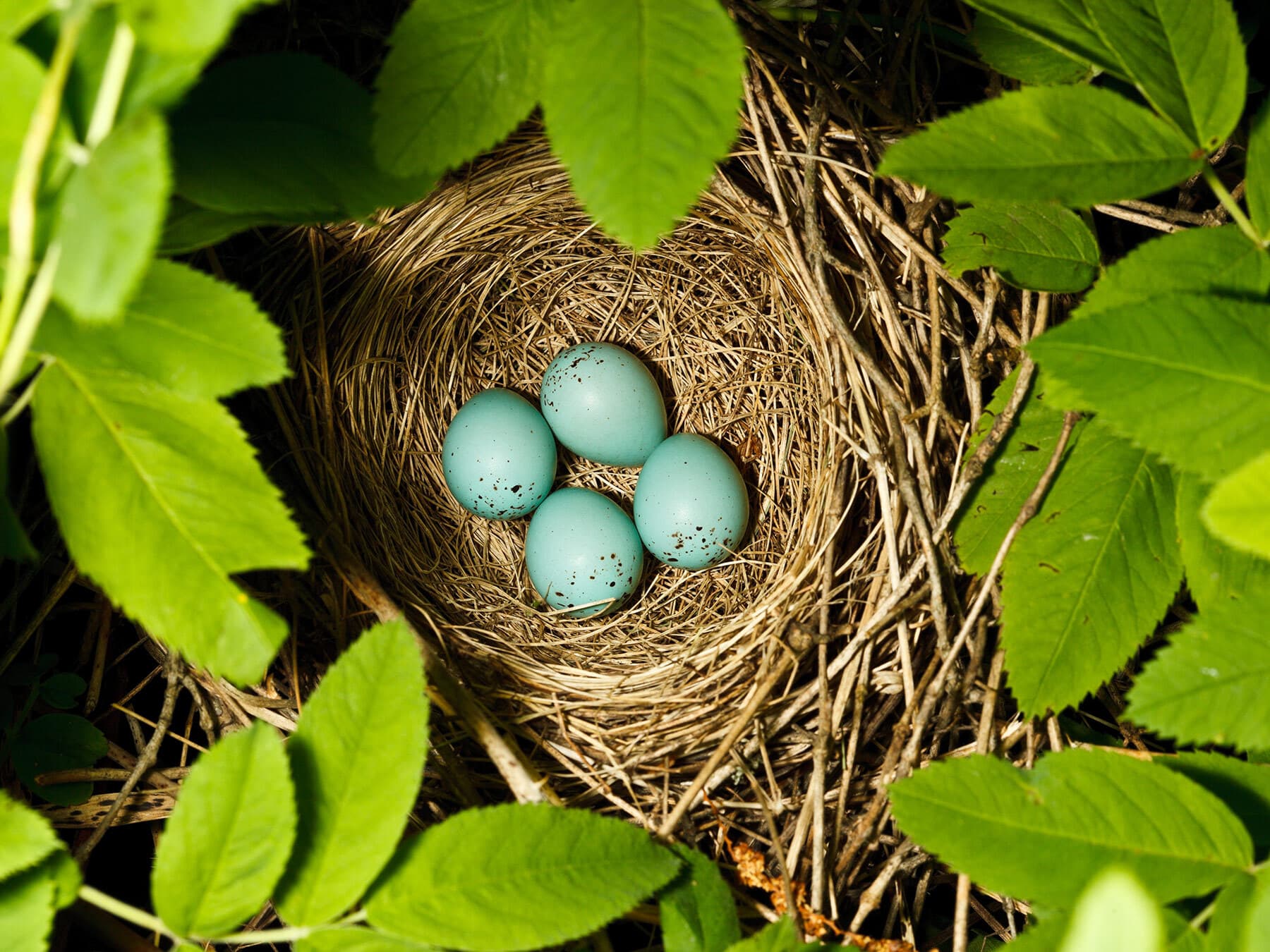
Rosefinches build nests low down in bushes, less than 90 cm (3 ft) off the ground. The nest, constructed by the female rosefinch, is cup-shaped and woven from grass and roots, and lined with fine rootlets and hair.
What do rosefinch eggs look like?
Rosefinch eggs are dark blue and speckled with rough, dark brown markings. One clutch is laid per year, typically containing three to six eggs.
Do rosefinches mate for life?
Rosefinches are monogamous for one season but on rare occasions may mate with the same partner in subsequent years.
Can female rosefinches raise their young alone?
Incubation of the eggs is undertaken exclusively by the female rosefinch. Once the young have hatched, both parents share feeding duties of the nestlings.
Behaviour
Are rosefinches aggressive?
Rosefinches are active birds, with a reputation for being sociable and inquisitive, rather than overly aggressive or territorial.
Lifespan and predators
How long do rosefinches live?
The average lifespan of a Common rosefinch is between two and three years.
What are the predators of rosefinches?
Rosefinches build their nests at a relatively low height, which means they are at risk of being raided by a number of predators, including weasels, squirrels, pine martens, rodents and other birds.
Are rosefinches protected?
Common rosefinches are protected under The Birds Directive, EU legislation that safeguards the survival of wild birds across Europe. In England, Scotland and Wales, Common rosefinches, their nests and eggs are protected under the Wildlife and Countryside Act 1981.
Are rosefinches endangered?
According to the IUCN Red List of Threatened Species, Common rosefinches are classed as a species of least concern, and are the most common rosefinches in Asia and Europe. However, increasing habitat loss has started to have a negative impact on population numbers in recent years.
Conservation
While listed as Least Concern globally, the Common Rosefinch faces localised threats from habitat loss and climate change. Conservation efforts focus on preserving diverse habitats across its range, particularly in breeding areas.
More photos
3 photos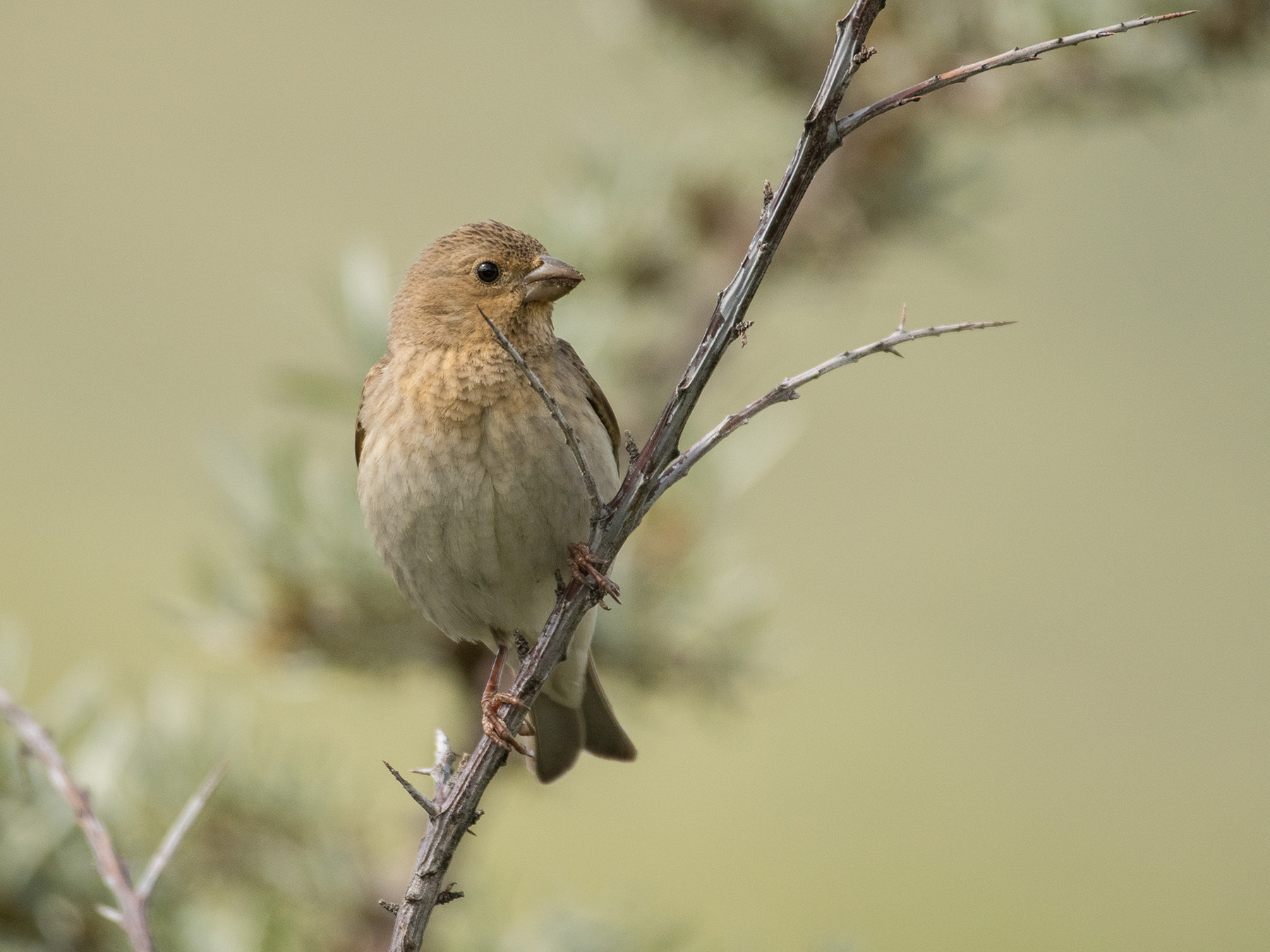
Common Rosefinch guides
1 guidesQuick facts
- Length
- 13–15 cm
- Wingspan
- 22–26 cm
- Weight
- 19–27 g
- Lifespan
- 2–3 years
- Family
- Finches
- Migration
- Long-distance Migrant
- Global status (IUCN)
- Least Concern
- World population
- 60,000,000 - 119,999,999 mature individuals
- Population trend
- Decreasing
- Also called
- Scarlet Rosefinch
- Scientific name
- Carpodacus erythrinus
Sources
3- 1BirdLife International. 2017. Carpodacus erythrinus (amended version of 2016 assessment). The IUCN Red List of Threatened Species 2017: e.T22720556A111130806. Source (opens in a new tab)
- 2EBCC (2015)
- 3BirdLife International. 2017. Carpodacus erythrinus (amended version of 2016 assessment). The IUCN Red List of Threatened Species 2017: e.T22720556A111130806. Source (opens in a new tab)

Checked by
Nathan Cope, founder and editor
Nathan founded Birdfact and leads its writers and contributors in the UK, the US and Canada. He has watched and studied birds for more than ten years, and checks every article and species guide before it’s published.