


Cockatiel
Quarrion, Weiro · Nymphicus hollandicus
By the Birdfact teamChecked by Nathan Cope
On this page12 sections
How to recognise it
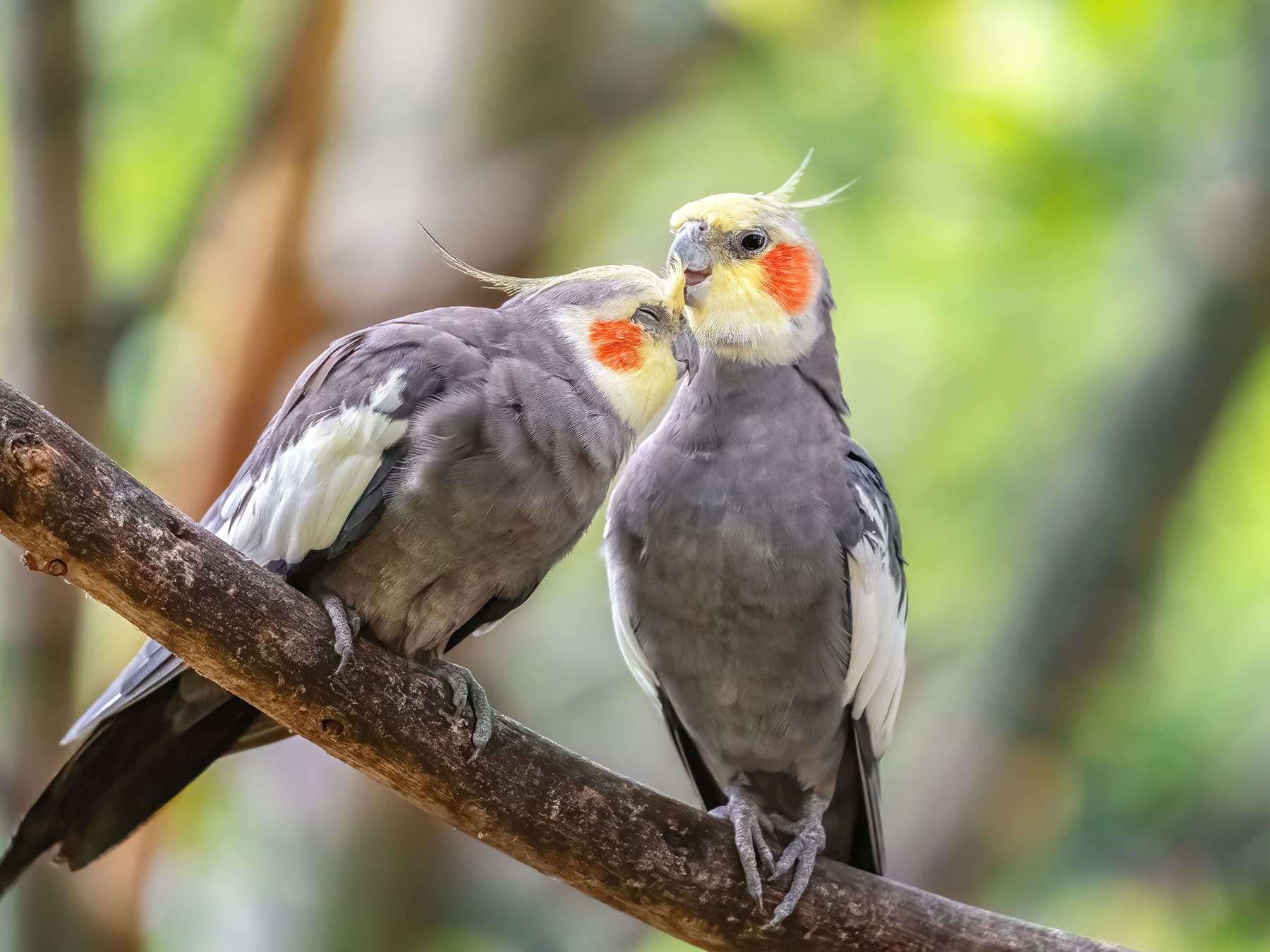
Cockatiels are small, slender parrots with long, pointed tails and distinctive crests. Their bodies are primarily grey, with white wing patches and yellow faces in males. Cheek patches are bright orange, contrasting with their grey beaks.
Females have duller faces with less yellow, and their tail feathers are barred underneath. Juveniles resemble females but have darker plumage and less defined markings.
Its size
Adults- Length
- 30–33 cm
- Wingspan
- 44–48 cm
- Weight
- 80–120 g
Its song and calls
Cockatiels are known for their melodious whistles and chirps. Their repertoire includes a variety of soft, pleasant calls, often described as 'tweet-tweet' or 'weiro-weiro'.
Males are more vocal and can learn to mimic simple tunes and human speech, though not as extensively as some other parrot species.
- Call0:00 / 0:07
When and where to see it
OctoberLeaving
Most recorded in October
- 1. Nevadaunder 0.1%
- 2. Floridaunder 0.1%
- 3. Arkansasunder 0.1%
- 4. Illinoisunder 0.1%
- 5. Texasunder 0.1%
Each dot is a county, state or province: the bigger and darker, the larger the bird’s share of that place’s bird records that month. Grey dots: no regular records. The ringed point is the centre of the bird’s records this month; the arrow shows how it moved since last month, and the dashed loop its path through the year. “Arrivals” colours places where it becomes regular this month (orange) or is in its last regular month (grey). GBIF eBird Observation Dataset, 2019–2024. Map data: Natural Earth, US Census Bureau; place centres © OpenStreetMap contributors.
In your area
See when the Cockatiel is recorded in your county, state or province.
The Cockatiel is not recorded regularly in the UK, Ireland, the United States or Canada.
United States: recorded in 6 of the 6 years; Canada: recorded in 6 of the 6 years; United Kingdom: recorded in 5 of the 6 years; Ireland: recorded in 1 of the 6 years. Too few years to count as a regular visitor.
Worldwide: recorded regularly in 19 countries
Countries where it was recorded in at least 3 of the 6 years 2019–2024. Linked countries have their own bird list.
Data: EOD – eBird Observation Dataset (Cornell Lab of Ornithology), accessed via GBIF.org, CC BY 4.0. Records from 2019–2024, aggregated and filtered by Birdfact. How these lists are made
Tips for seeing it
- Look for their distinctive crest and long tail in flight
- Listen for their soft, melodious whistles
- Observe near water sources in arid regions
- Check urban parks and gardens, especially in Australia
- Watch for their acrobatic feeding behaviour in trees
What it eats
Cockatiels are primarily seed eaters, favouring a variety of grass seeds and grains. They also consume fruits, berries, and vegetation.
In agricultural areas, they may feed on crops, using their strong beaks to crack open seeds and nuts. They often forage on the ground or in low vegetation.
Nesting and breeding
Cockatiels form monogamous pairs and breed opportunistically, often in response to rainfall. The breeding season typically occurs between August and December in southern Australia and year-round in the north when conditions are favourable.
Nests are usually built in tree hollows, often in eucalyptus trees. The female lays 4-7 white eggs, which both parents incubate for about 18-21 days. The eggs are laid every other day, resulting in asynchronous hatching.
Chicks fledge at around 4-5 weeks old but may remain with their parents for several more weeks. Both parents participate in feeding and caring for the young.
Behaviour
Cockatiels are highly social birds, often seen in small flocks or pairs. They are excellent flyers, capable of swift, direct flight with rapid wing beats.
On the ground, they walk with a waddling gait. They're known for their curious nature, often exploring their surroundings with their beaks.
Conservation
Cockatiels are listed as Least Concern by the IUCN due to their large range and stable population. However, habitat loss and the illegal pet trade pose potential threats.
Conservation efforts focus on protecting their natural habitats and regulating the captive breeding industry.
More photos
1 photos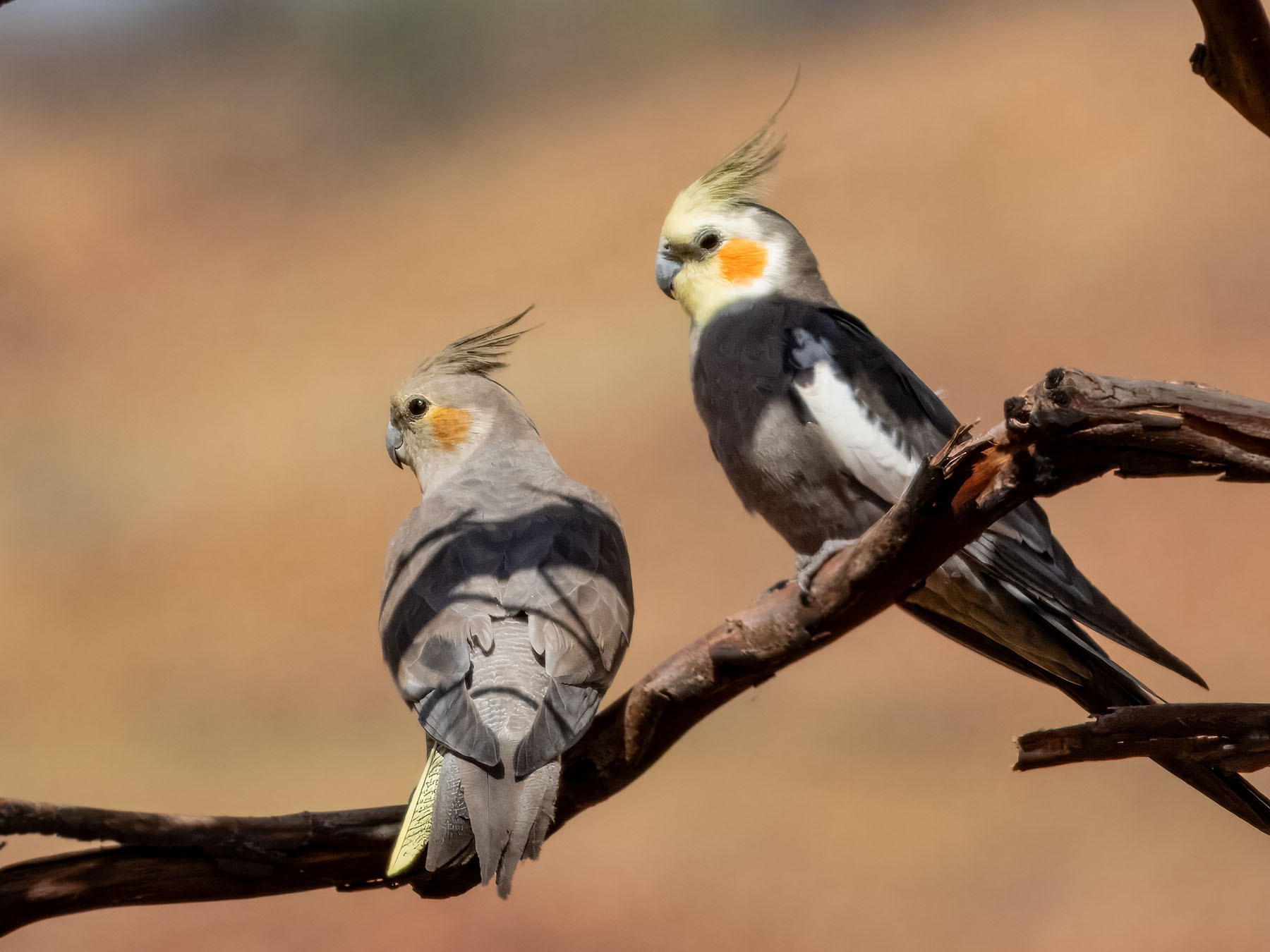
Cockatiel guides
1 guidesQuick facts
- Length
- 30–33 cm
- Wingspan
- 44–48 cm
- Weight
- 80–120 g
- Lifespan
- 10–14 years · oldest recorded 35 years
- Family
- Cockatoos
- Migration
- Nomadic
- Global status (IUCN)
- Least Concern
- World population
- Not quantified, but abundant in its range
- Population trend
- Stable
- Also called
- Quarrion, Weiro
- Scientific name
- Nymphicus hollandicus
Sources
3- 1BirdLife International. 2018. Nymphicus hollandicus. The IUCN Red List of Threatened Species 2018: e.T22684828A132056250. Source (opens in a new tab)
- 2BirdLife International. 2018. Nymphicus hollandicus. The IUCN Red List of Threatened Species 2018: e.T22684828A132056250. Source (opens in a new tab)
- 3Brouwer et al., Longevity records for Psittaciformes in captivity, Int Zoo Yb, 37:299-316 (2000)

Checked by
Nathan Cope, founder and editor
Nathan founded Birdfact and leads its writers and contributors in the UK, the US and Canada. He has watched and studied birds for more than ten years, and checks every article and species guide before it’s published.