


Chinstrap Penguin
Ringed Penguin, Bearded Penguin · Pygoscelis antarcticus
By the Birdfact teamChecked by Nathan Cope
On this page10 sections
How to recognise it
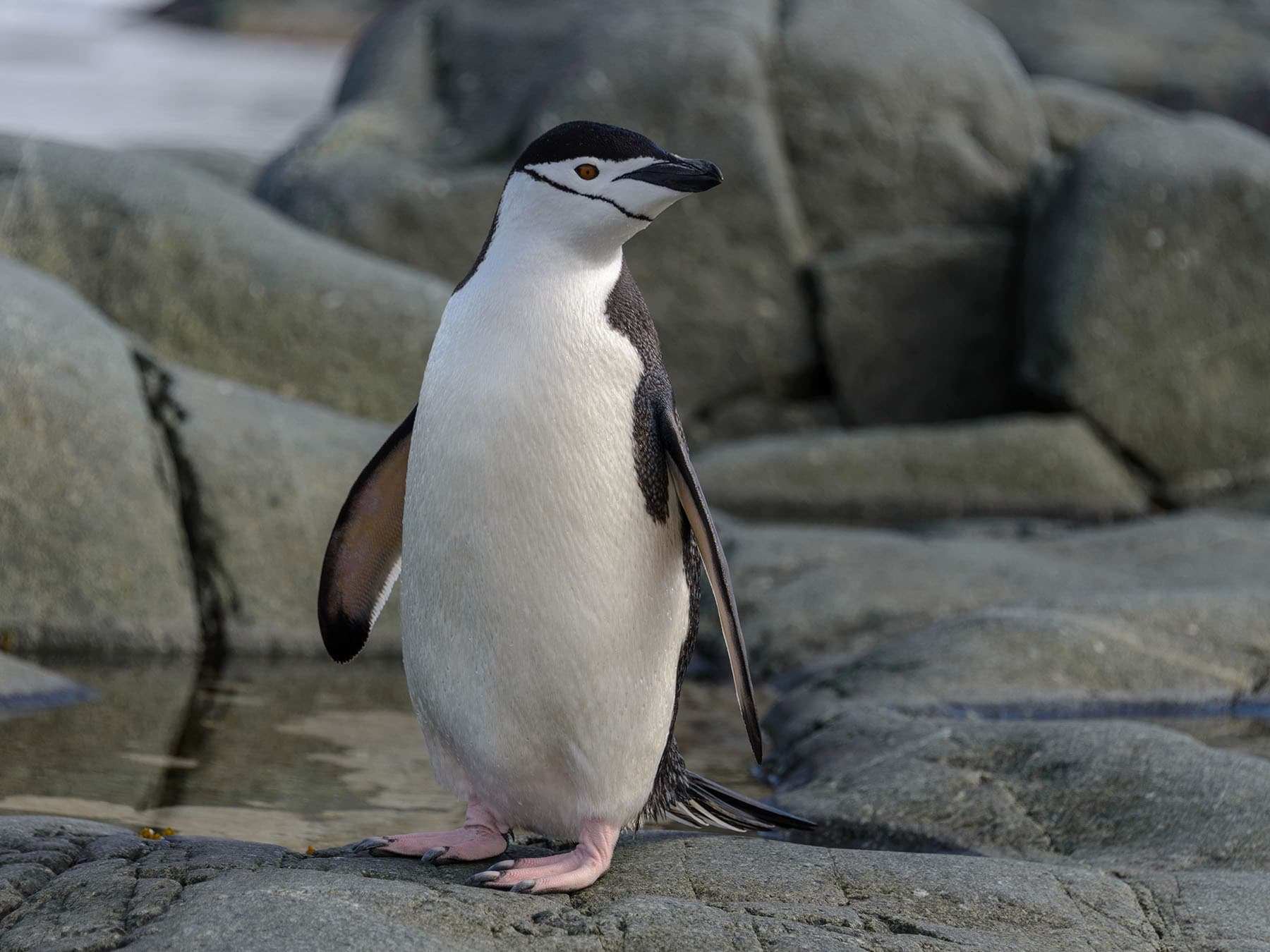
The Chinstrap Penguin is easily identifiable by its distinctive black band extending from ear to ear under its chin, resembling a helmet strap. Its back and flippers are black, contrasting sharply with its white underparts and face. The penguin has a black bill and pink feet.
Adults typically measure 68-76 cm in length. There is little difference between males and females in appearance, though males are slightly larger. Juveniles have a similar colouration but may have a less defined chinstrap marking.
Its size
Adults- Length
- 68–76 cm
- Wingspan
- 91–99 cm
- Weight
- 3000–5000 g
Its song and calls
Chinstrap Penguins are known for their loud, harsh calls. During the breeding season, they produce a variety of vocalisations, including a high-pitched, repetitive screech often described as an 'ecstatic display call'. This call, which sounds like 'keee-keee-keee', is used for mate recognition and territorial defence in crowded colonies.
- Call0:00 / 0:14
Recorded in Cámara Base, Antarctica · November 2024
When and where to see it
The Chinstrap Penguin is not recorded regularly in the UK, Ireland, the United States or Canada.
Worldwide: recorded regularly in 3 countries
Countries where it was recorded in at least 3 of the 6 years 2019–2024. Linked countries have their own bird list.
South America (1)
- Argentina
Antarctica (2)
- Antarctica
- South Georgia & South Sandwich Islands
Data: EOD – eBird Observation Dataset (Cornell Lab of Ornithology), accessed via GBIF.org, CC BY 4.0. Records from 2019–2024, aggregated and filtered by Birdfact. How these lists are made
Tips for seeing it
- Look for large colonies on rocky, ice-free areas of Antarctica and nearby islands
- Observe their distinctive black 'chinstrap' marking for easy identification
- Watch for their energetic swimming and diving behaviours near shorelines
- Visit during the austral summer (November to March) for the best viewing opportunities
What it eats
Chinstrap Penguins primarily feed on krill, which accounts for about 95% of their diet. They also consume small fish and squid.
These penguins are skilled divers, capable of reaching depths of 70 meters to forage for food. They typically hunt in groups, which can help them more effectively corral schools of krill.
Nesting and breeding
Chinstrap Penguins breed during the austral summer, typically from November to March. They form monogamous pairs and often return to the same nesting sites year after year.
Nests are simple circular structures made of stones placed on bare rock. Females usually lay two eggs, which are pale blue-green in colour. Both parents take turns incubating the eggs for about 37 days.
After hatching, chicks are guarded for about 20-30 days before joining a crèche with other chicks. They fledge at around 50-60 days old, becoming independent and ready to enter the water.
Behaviour
Chinstrap Penguins are highly social, often forming large colonies during breeding season. They are agile swimmers, using their flippers to 'fly' underwater at speeds up to 30 km/h (8.3 mph).
On land, they waddle upright or toboggan on their bellies across ice and snow, using their flippers and feet for propulsion.
Conservation
While currently listed as Least Concern, Chinstrap Penguins face threats from climate change, which affects their food supply and breeding habitats.
Krill fishing in the Southern Ocean also poses a potential risk to their primary food source. Ongoing monitoring and conservation efforts are crucial to protect their populations.
Quick facts
- Length
- 68–76 cm
- Wingspan
- 91–99 cm
- Weight
- 3000–5000 g
- Lifespan
- 15–20 years
- Family
- Penguins
- Migration
- Partial migrant
- Global status (IUCN)
- Least Concern
- World population
- 8,000,000 mature individuals
- Population trend
- Decreasing
- Also called
- Ringed Penguin, Bearded Penguin
- Scientific name
- Pygoscelis antarcticus
Sources
3- 1BirdLife International. 2020. Pygoscelis antarcticus. The IUCN Red List of Threatened Species 2020: e.T22697761A184807209. Source (opens in a new tab)
- 2Lynch et al. (2016)
- 3Convey et al. (1999)

Checked by
Nathan Cope, founder and editor
Nathan founded Birdfact and leads its writers and contributors in the UK, the US and Canada. He has watched and studied birds for more than ten years, and checks every article and species guide before it’s published.